
Radiofrequency RF accelerators v Key idea using rapidly
- Slides: 15
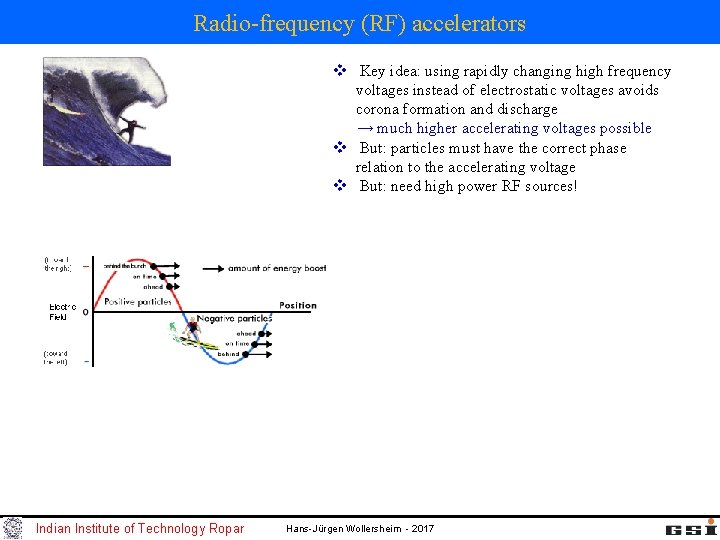
Radio-frequency (RF) accelerators v Key idea: using rapidly changing high frequency voltages instead of electrostatic voltages avoids corona formation and discharge → much higher accelerating voltages possible v But: particles must have the correct phase relation to the accelerating voltage v But: need high power RF sources! Indian Institute of Technology Ropar Hans-Jürgen Wollersheim - 2017
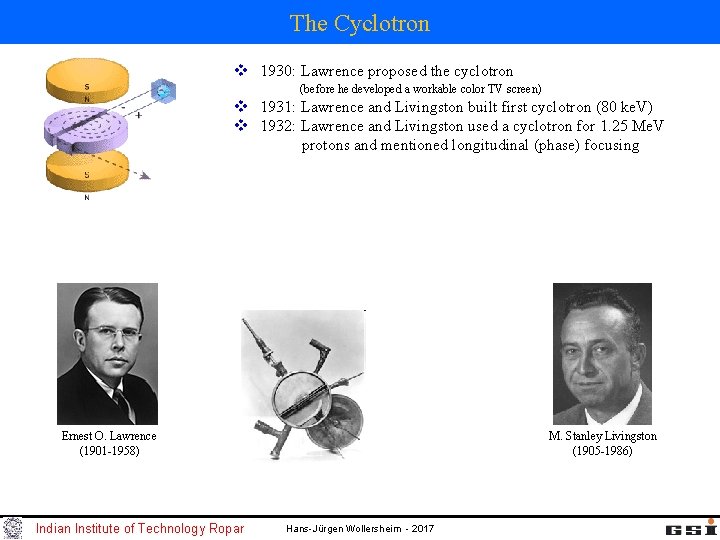
The Cyclotron v 1930: Lawrence proposed the cyclotron (before he developed a workable color TV screen) v 1931: Lawrence and Livingston built first cyclotron (80 ke. V) v 1932: Lawrence and Livingston used a cyclotron for 1. 25 Me. V protons and mentioned longitudinal (phase) focusing Ernest O. Lawrence (1901 -1958) Indian Institute of Technology Ropar M. Stanley Livingston (1905 -1986) Hans-Jürgen Wollersheim - 2017
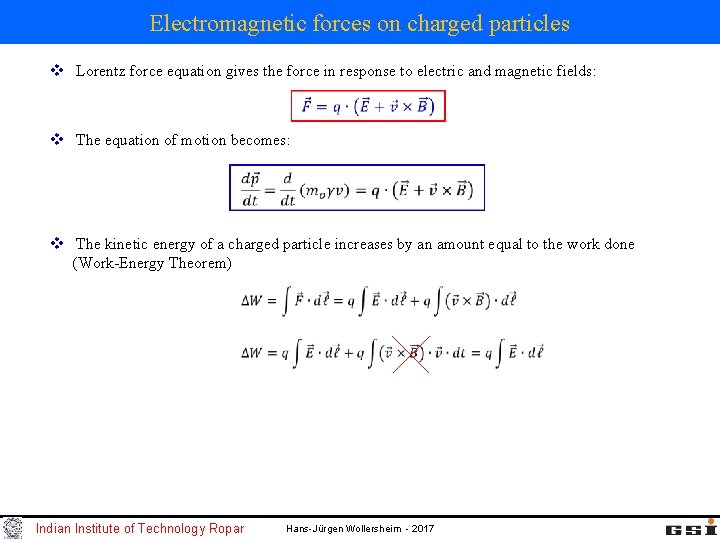
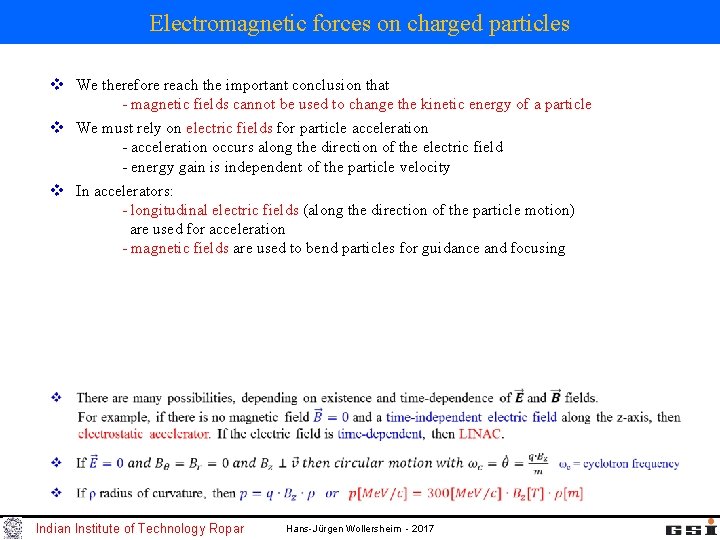
Electromagnetic forces on charged particles v Lorentz force equation gives the force in response to electric and magnetic fields: v The equation of motion becomes: v The kinetic energy of a charged particle increases by an amount equal to the work done (Work-Energy Theorem) Indian Institute of Technology Ropar Hans-Jürgen Wollersheim - 2017
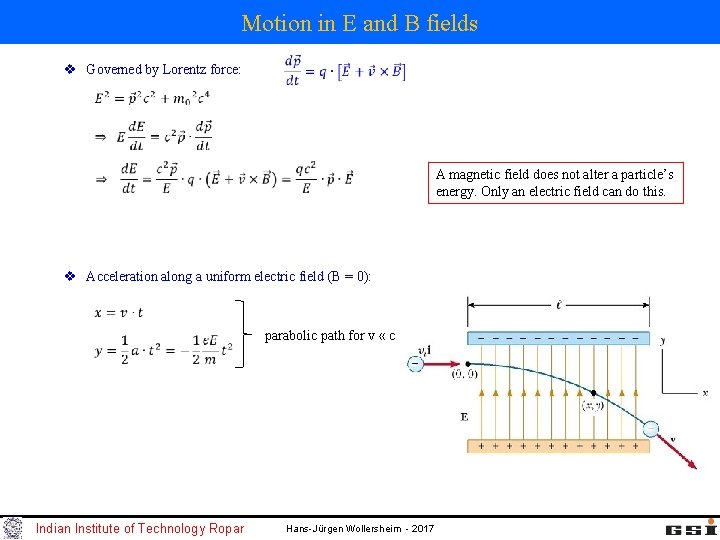
Motion in E and B fields v Governed by Lorentz force: A magnetic field does not alter a particle’s energy. Only an electric field can do this. v Acceleration along a uniform electric field (B = 0): Indian Institute of Technology Ropar parabolic path for v « c Hans-Jürgen Wollersheim - 2017
Electromagnetic forces on charged particles v We therefore reach the important conclusion that - magnetic fields cannot be used to change the kinetic energy of a particle v We must rely on electric fields for particle acceleration - acceleration occurs along the direction of the electric field - energy gain is independent of the particle velocity v In accelerators: - longitudinal electric fields (along the direction of the particle motion) are used for acceleration - magnetic fields are used to bend particles for guidance and focusing Indian Institute of Technology Ropar Hans-Jürgen Wollersheim - 2017
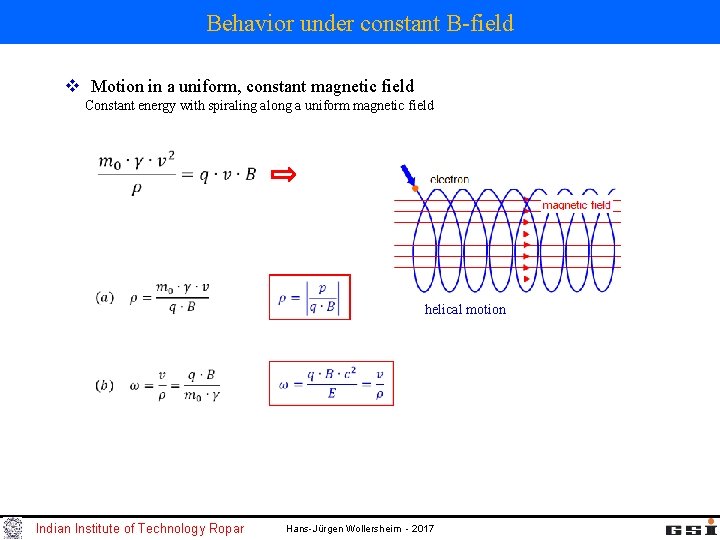
Behavior under constant B-field v Motion in a uniform, constant magnetic field Constant energy with spiraling along a uniform magnetic field Indian Institute of Technology Ropar helical motion Hans-Jürgen Wollersheim - 2017
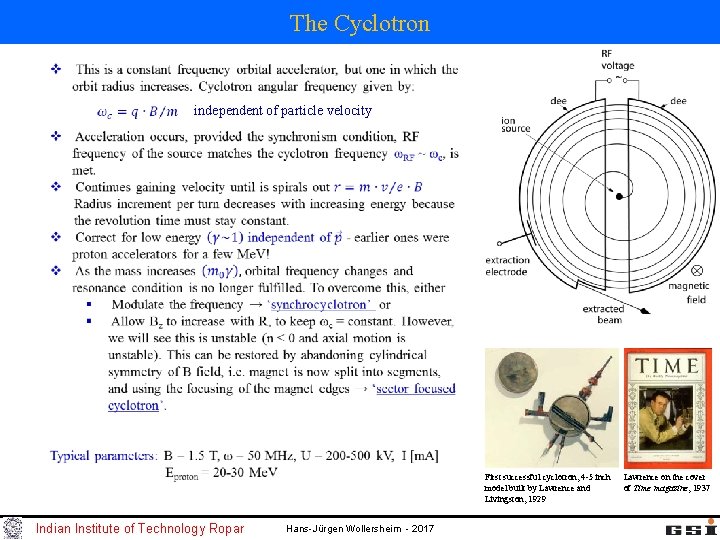
The Cyclotron independent of particle velocity First successful cyclotron, 4 -5 inch model built by Lawrence and Livingston, 1929 Indian Institute of Technology Ropar Hans-Jürgen Wollersheim - 2017 Lawrence on the cover of Time magazine, 1937
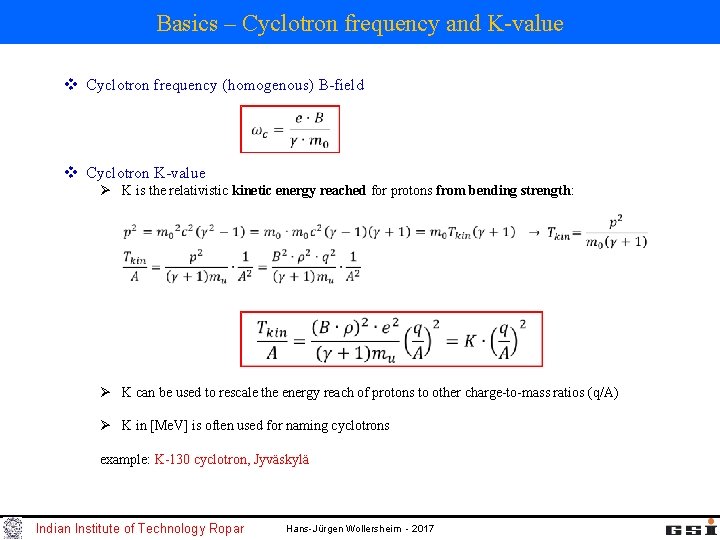
Basics – Cyclotron frequency and K-value v Cyclotron frequency (homogenous) B-field v Cyclotron K-value Ø K is the relativistic kinetic energy reached for protons from bending strength: Ø K can be used to rescale the energy reach of protons to other charge-to-mass ratios (q/A) Ø K in [Me. V] is often used for naming cyclotrons example: K-130 cyclotron, Jyväskylä Indian Institute of Technology Ropar Hans-Jürgen Wollersheim - 2017
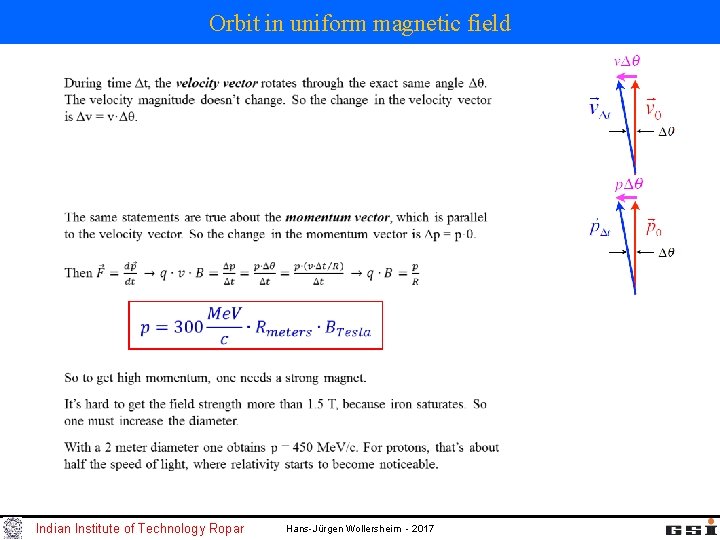
Orbit in uniform magnetic field Indian Institute of Technology Ropar Hans-Jürgen Wollersheim - 2017
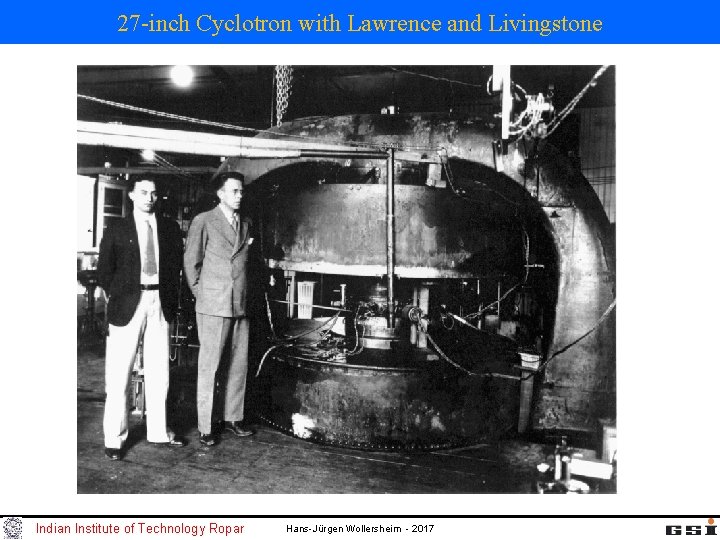
27 -inch Cyclotron with Lawrence and Livingstone Indian Institute of Technology Ropar Hans-Jürgen Wollersheim - 2017
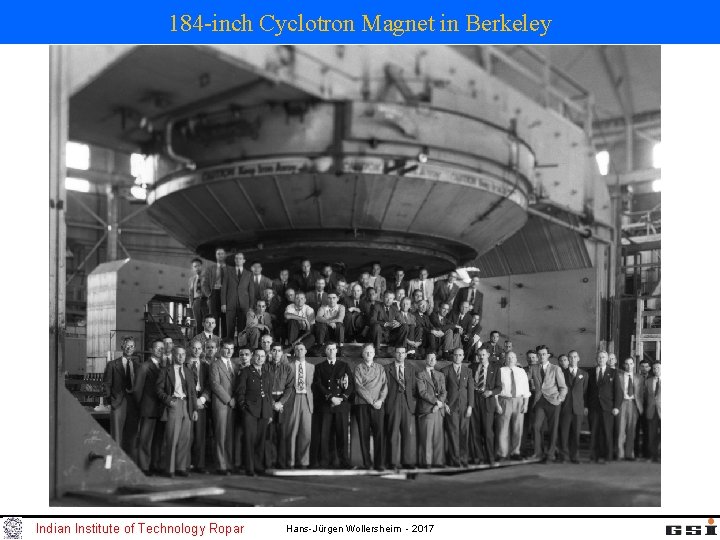
184 -inch Cyclotron Magnet in Berkeley Indian Institute of Technology Ropar Hans-Jürgen Wollersheim - 2017
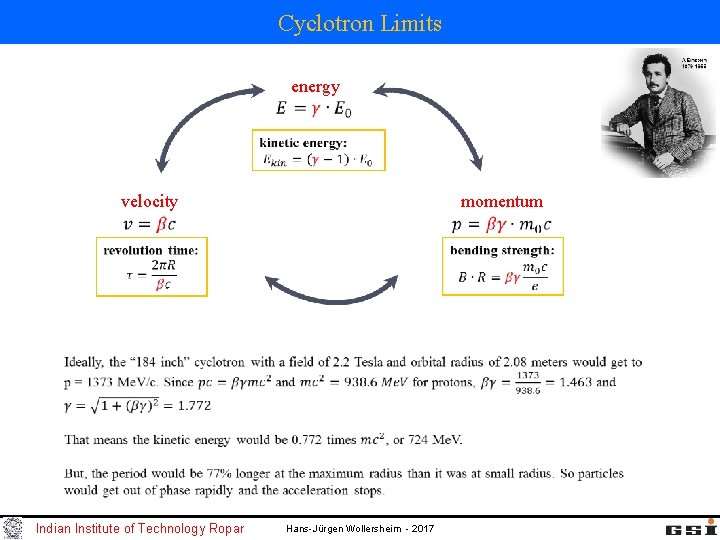
Cyclotron Limits energy velocity momentum Indian Institute of Technology Ropar Hans-Jürgen Wollersheim - 2017
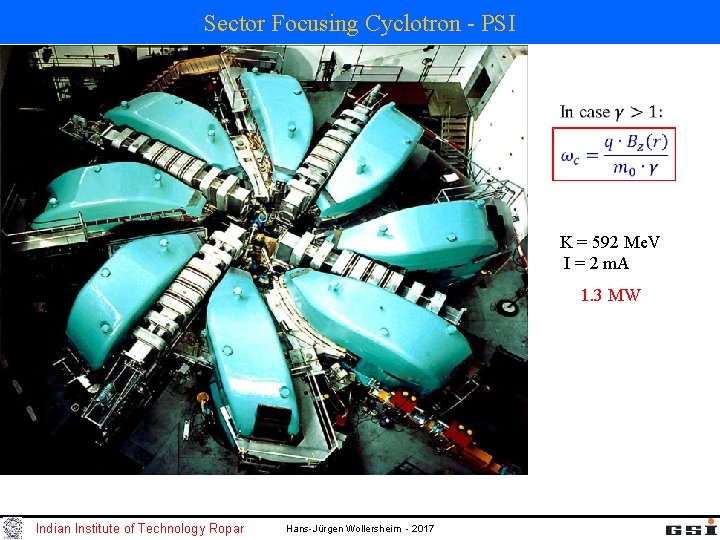
Sector Focusing Cyclotron - PSI K = 592 Me. V I = 2 m. A 1. 3 MW Indian Institute of Technology Ropar Hans-Jürgen Wollersheim - 2017
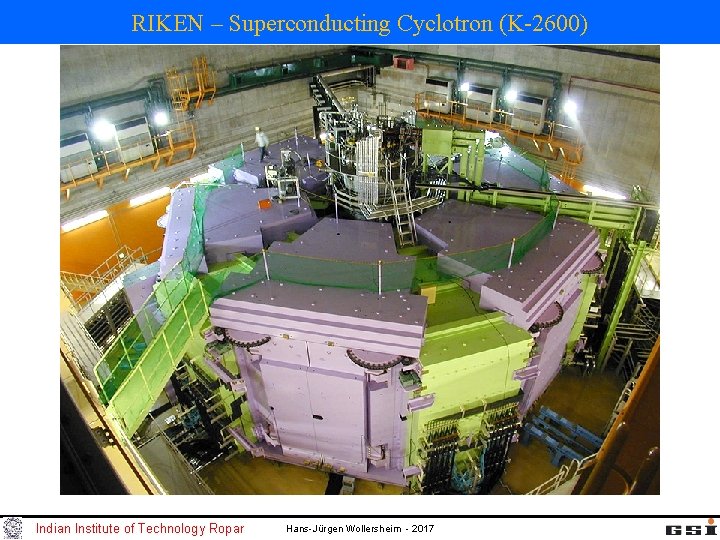
RIKEN – Superconducting Cyclotron (K-2600) Indian Institute of Technology Ropar Hans-Jürgen Wollersheim - 2017
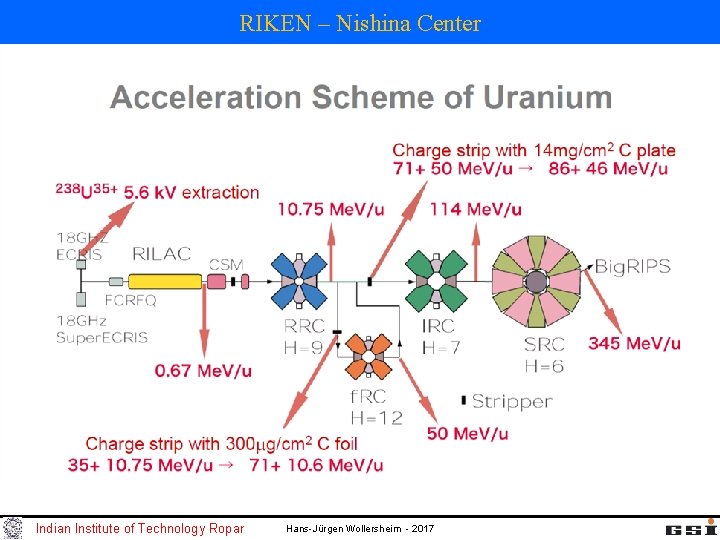
RIKEN – Nishina Center Indian Institute of Technology Ropar Hans-Jürgen Wollersheim - 2017