
Radioactivity Crash Course Radioactive Marie Curie called elements
- Slides: 15
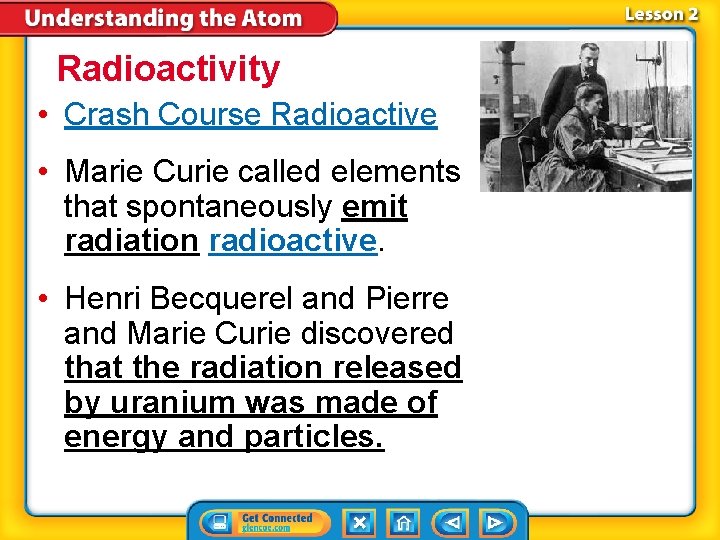
Radioactivity • Crash Course Radioactive • Marie Curie called elements that spontaneously emit radiation radioactive. • Henri Becquerel and Pierre and Marie Curie discovered that the radiation released by uranium was made of energy and particles.
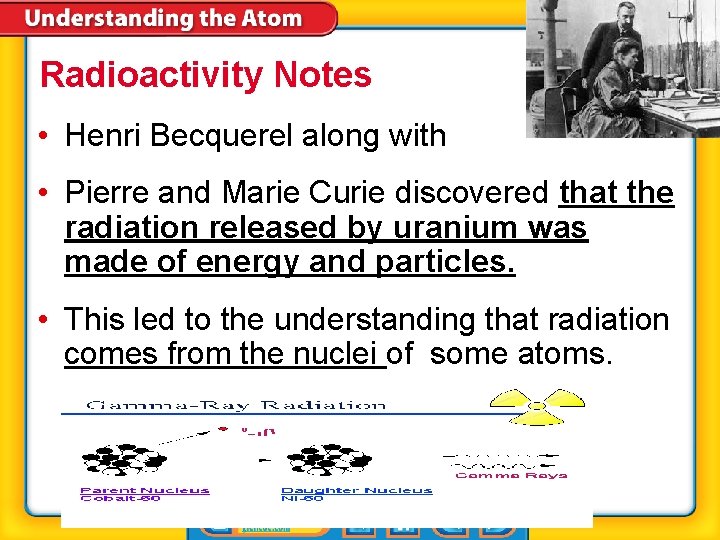
Radioactivity Notes • Henri Becquerel along with • Pierre and Marie Curie discovered that the radiation released by uranium was made of energy and particles. • This led to the understanding that radiation comes from the nuclei of some atoms.
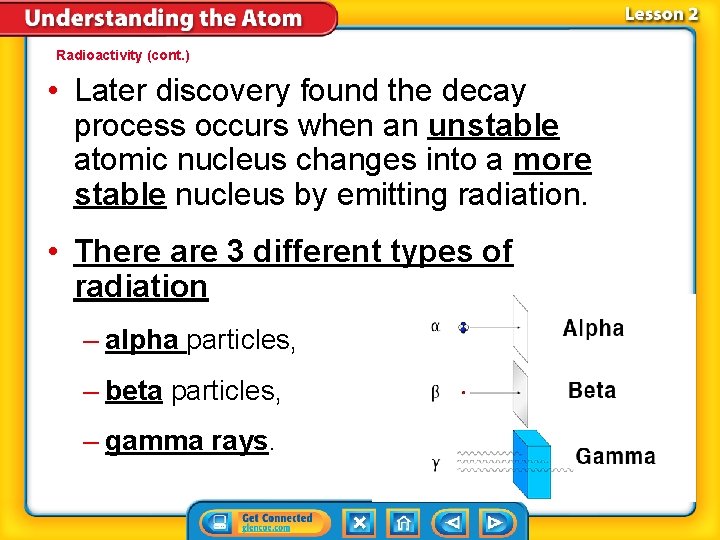
Radioactivity (cont. ) • Later discovery found the decay process occurs when an unstable atomic nucleus changes into a more stable nucleus by emitting radiation. • There are 3 different types of radiation – alpha particles, – beta particles, – gamma rays.
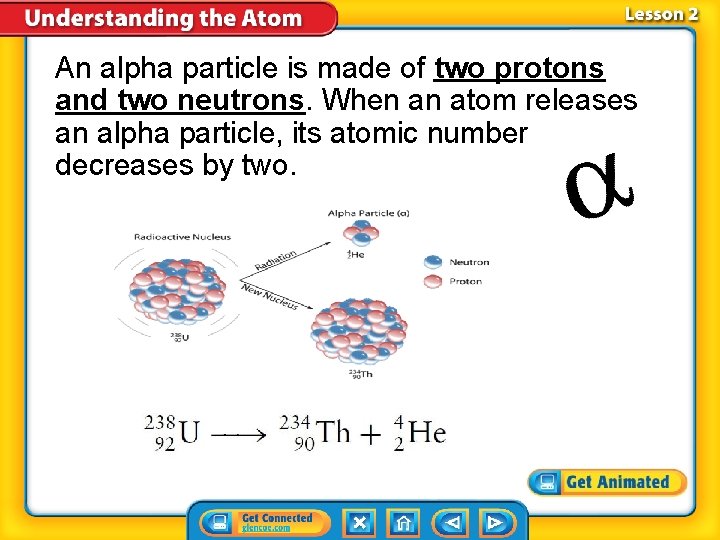
An alpha particle is made of two protons and two neutrons. When an atom releases an alpha particle, its atomic number decreases by two.
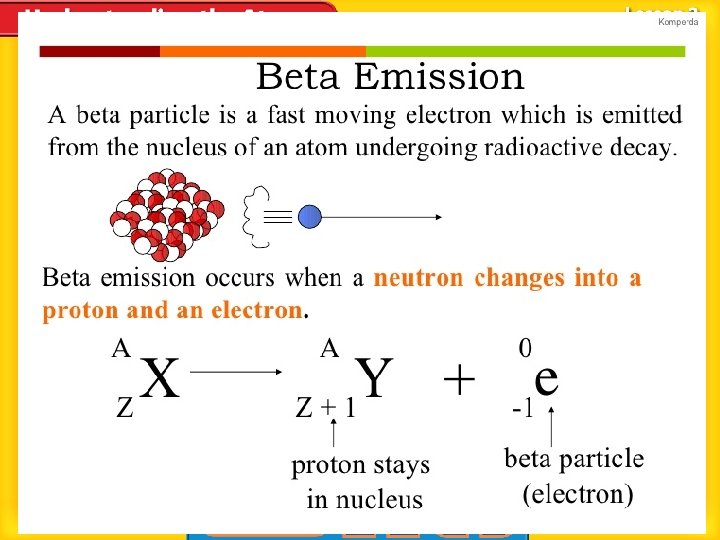
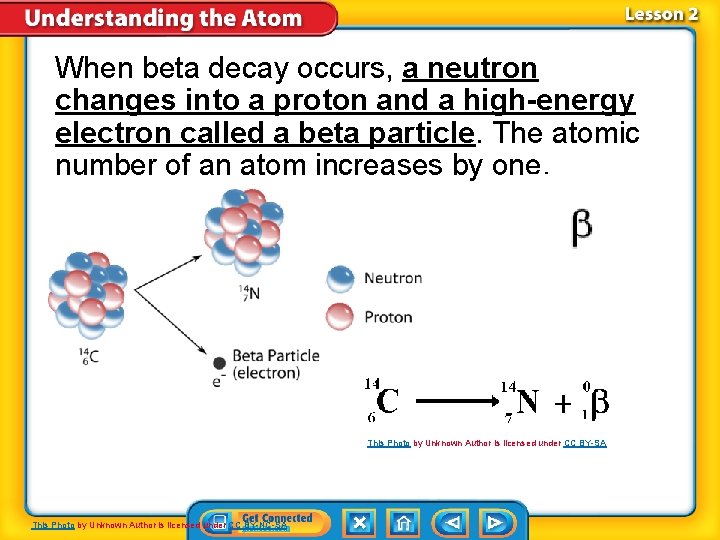
When beta decay occurs, a neutron changes into a proton and a high-energy electron called a beta particle. The atomic number of an atom increases by one. This Photo by Unknown Author is licensed under CC BY-SA This Photo by Unknown Author is licensed under CC BY-NC-SA
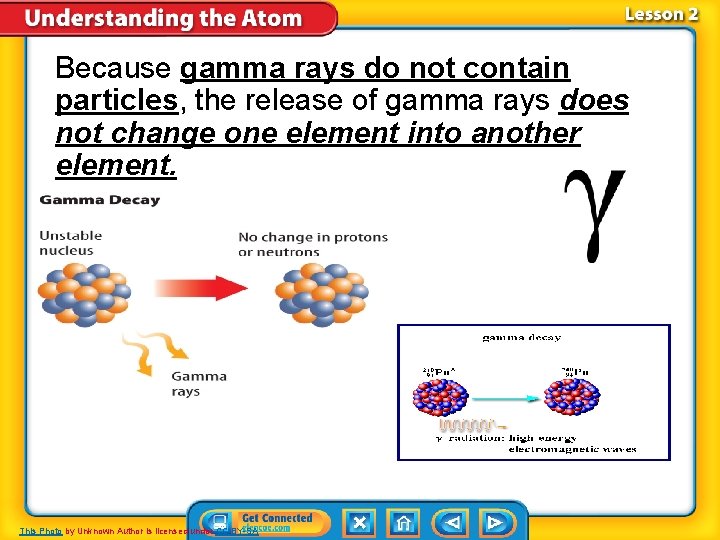
Because gamma rays do not contain particles, the release of gamma rays does not change one element into another element. This Photo by Unknown Author is licensed under CC BY-SA
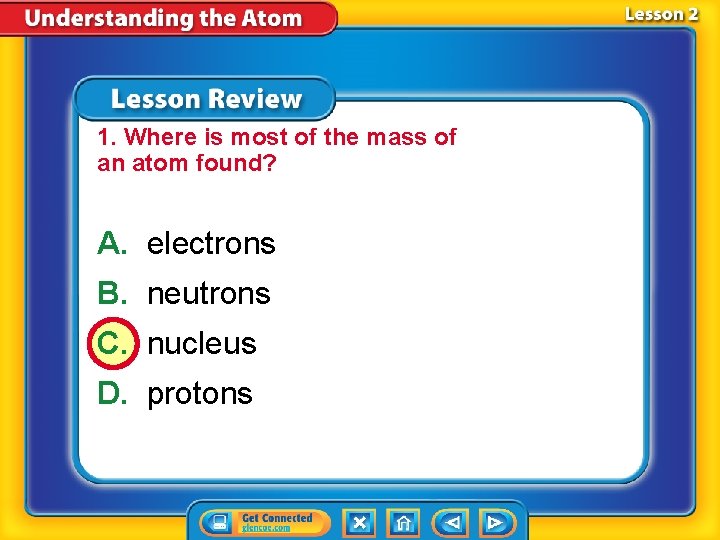
1. Where is most of the mass of an atom found? A. electrons B. neutrons C. nucleus D. protons
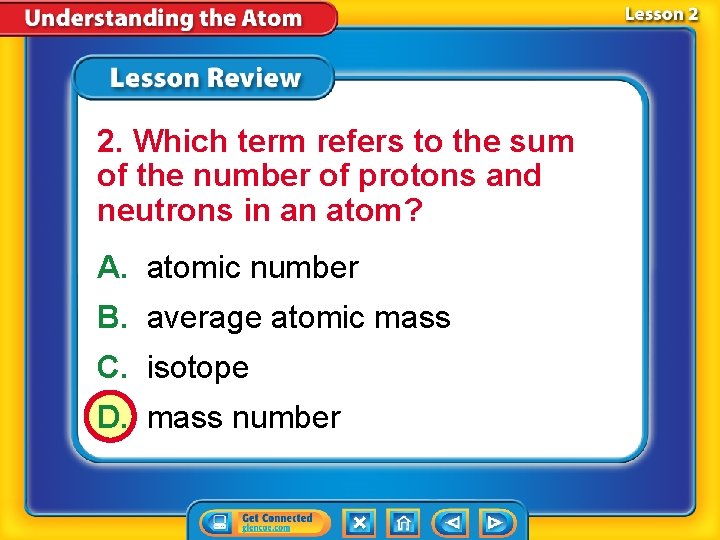
2. Which term refers to the sum of the number of protons and neutrons in an atom? A. atomic number B. average atomic mass C. isotope D. mass number
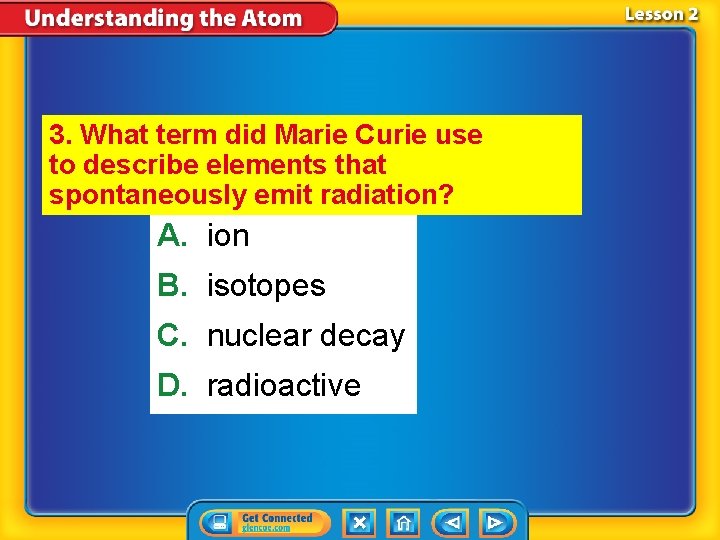
3. What term did Marie Curie use to describe elements that spontaneously emit radiation? A. ion B. isotopes C. nuclear decay D. radioactive
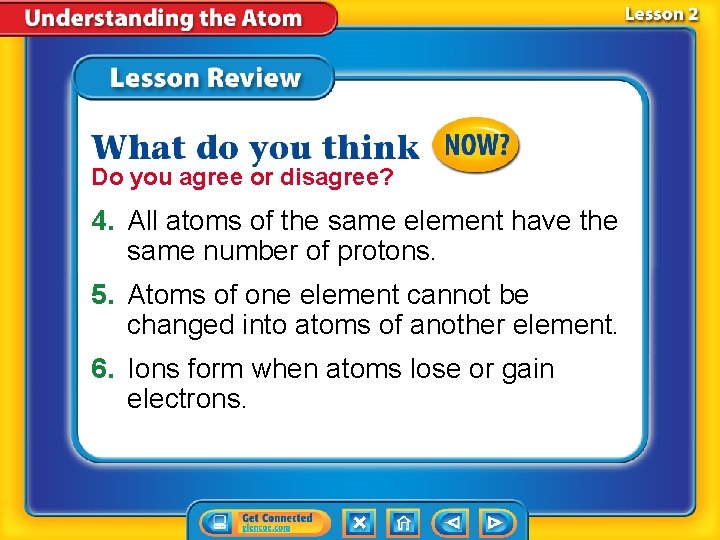
Do you agree or disagree? 4. All atoms of the same element have the same number of protons. 5. Atoms of one element cannot be changed into atoms of another element. 6. Ions form when atoms lose or gain electrons.
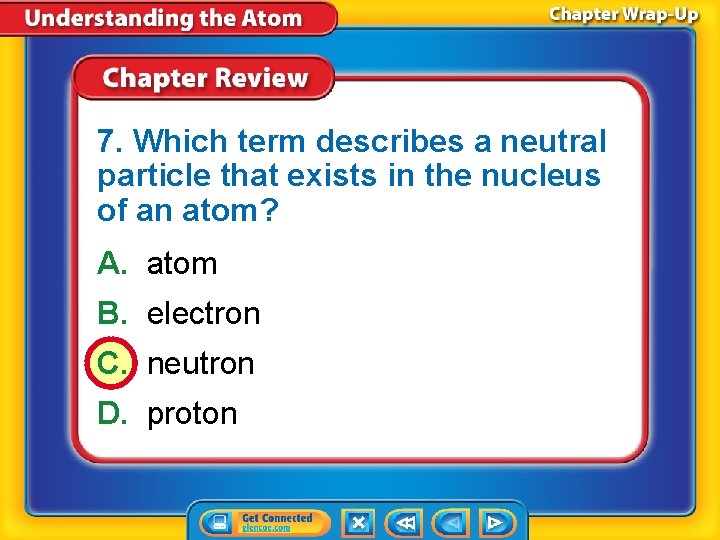
7. Which term describes a neutral particle that exists in the nucleus of an atom? A. atom B. electron C. neutron D. proton
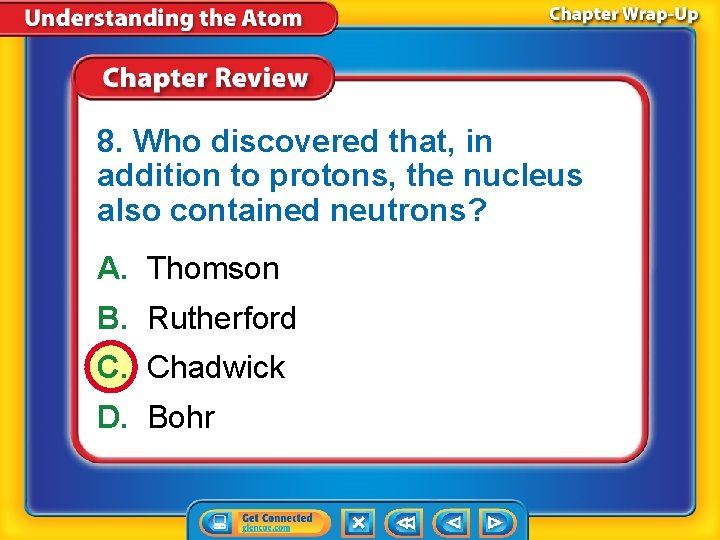
8. Who discovered that, in addition to protons, the nucleus also contained neutrons? A. Thomson B. Rutherford C. Chadwick D. Bohr
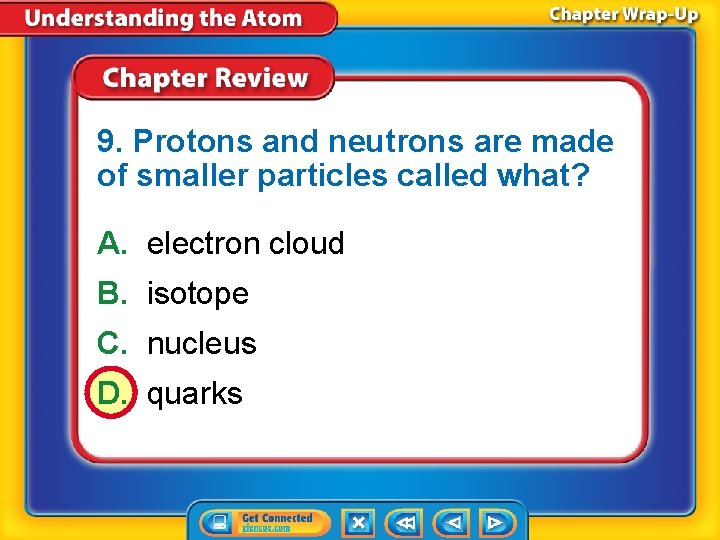
9. Protons and neutrons are made of smaller particles called what? A. electron cloud B. isotope C. nucleus D. quarks
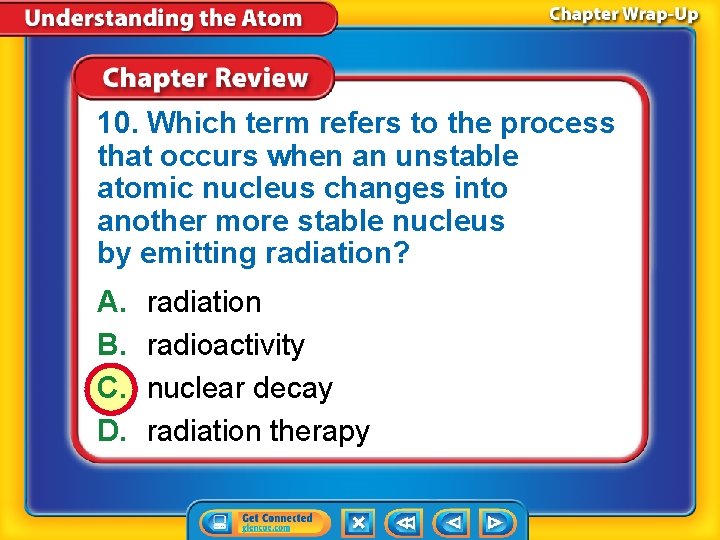
10. Which term refers to the process that occurs when an unstable atomic nucleus changes into another more stable nucleus by emitting radiation? A. B. C. D. radiation radioactivity nuclear decay radiation therapy