
Radioactivity Chapter 25 Nuclear Radiation Nuclear chemistry study

- Slides: 25
Radioactivity Chapter 25
Nuclear Radiation • Nuclear chemistry • study of the structure of atomic nuclei • changes they undergo.
The Discovery of Radioactivity • Wilhelm Roentgen (1845– 1923) • 1895 -invisible rays were emitted when electrons bombarded the surface of certain materials. • caused photographic plates to darken. • named the invisible high-energy emissions X rays.
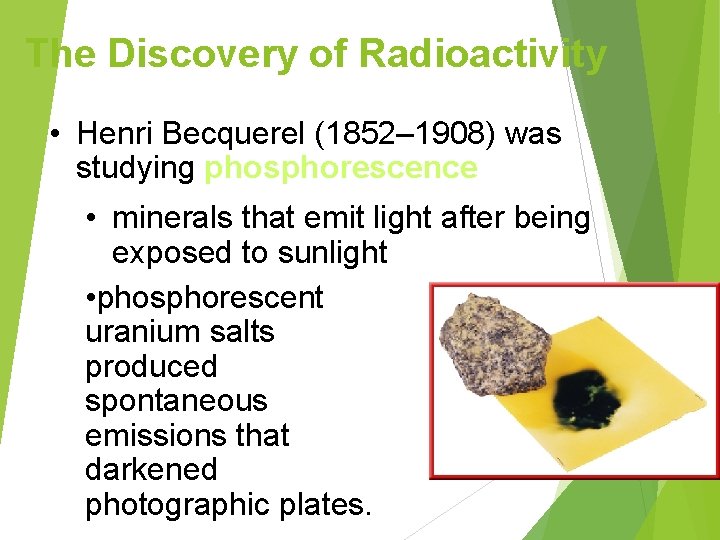
The Discovery of Radioactivity • Henri Becquerel (1852– 1908) was studying phosphorescence • minerals that emit light after being exposed to sunlight • phosphorescent uranium salts produced spontaneous emissions that darkened photographic plates.
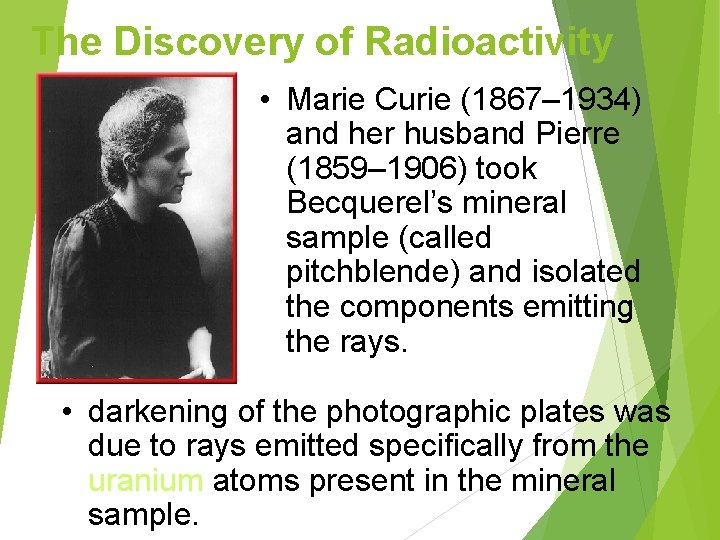
The Discovery of Radioactivity • Marie Curie (1867– 1934) and her husband Pierre (1859– 1906) took Becquerel’s mineral sample (called pitchblende) and isolated the components emitting the rays. • darkening of the photographic plates was due to rays emitted specifically from the uranium atoms present in the mineral sample.
The Discovery of Radioactivity • Marie Curie named the process by which materials give off such rays radioactivity • the rays and particles emitted by a radioactive source are called radiation.
Types of Radiation • isotopes are atoms of the same element that have different numbers of neutrons. • Isotopes of atoms with unstable nuclei are called radioisotopes • emit radiation to attain more stable atomic configurations in a process called radioactive decay • lose energy by emitting one of several types of radiation.
Why do some atoms decay? The nucleus contains tightly packed protons and neutrons (nucleons) The strong nuclear force keeps the nucleons packed together even though protons want to push each other away Stable atoms have a neutron to proton ratio of about 1: 1
As atomic number increases, more neutrons are required to have enough of a strong force to keep the protons pushed together The neutron to proton ratio for stable atoms increases to 1. 5: 1
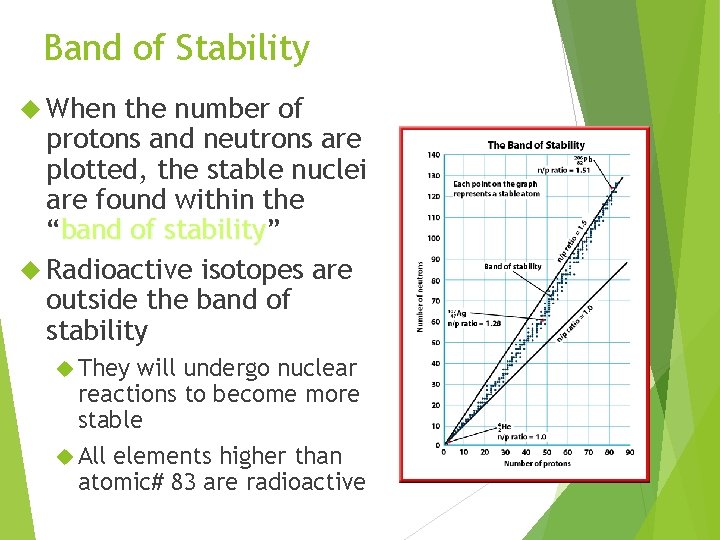
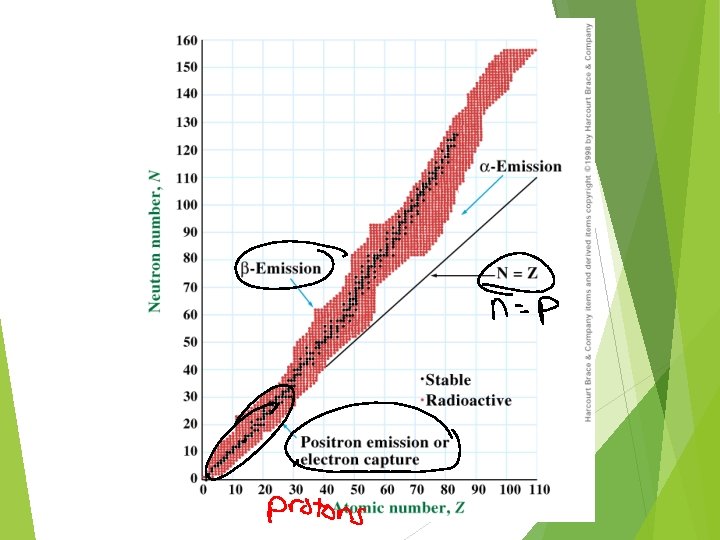
Band of Stability When the number of protons and neutrons are plotted, the stable nuclei are found within the “band of stability” stability Radioactive isotopes are outside the band of stability They will undergo nuclear reactions to become more stable All elements higher than atomic# 83 are radioactive
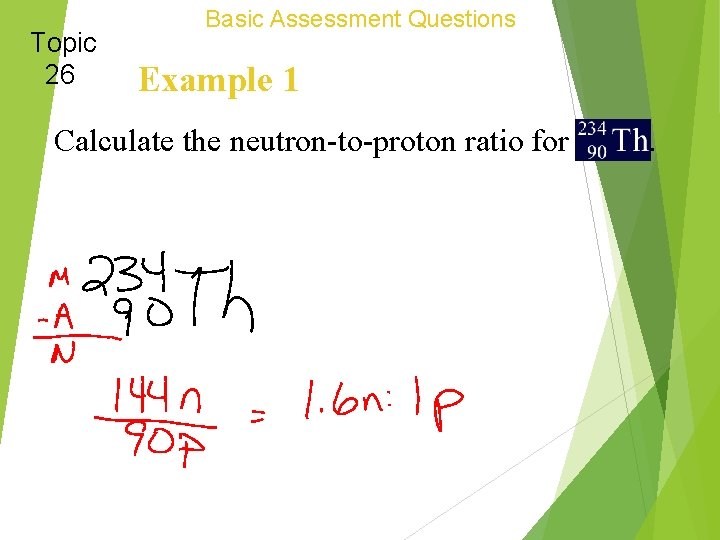
Topic 26 Basic Assessment Questions Example 1 Calculate the neutron-to-proton ratio for .
Topic 26 1. 6 : 1 Basic Assessment Questions Answer
Types of Nuclear Radiation Alpha Beta Gamma
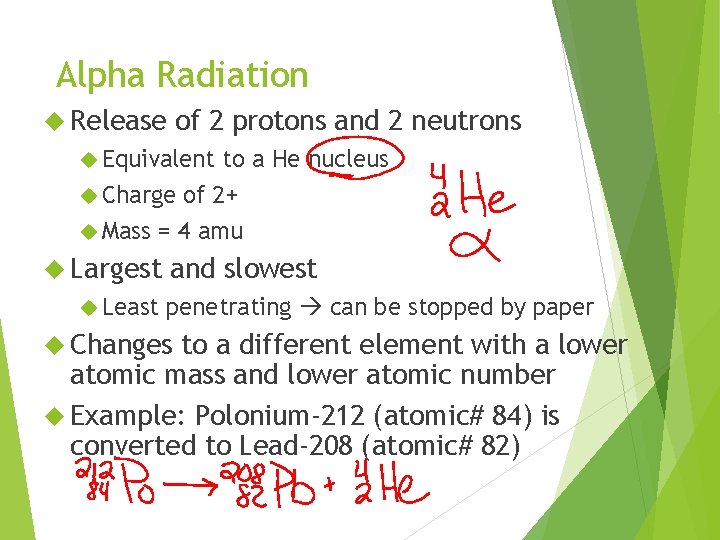
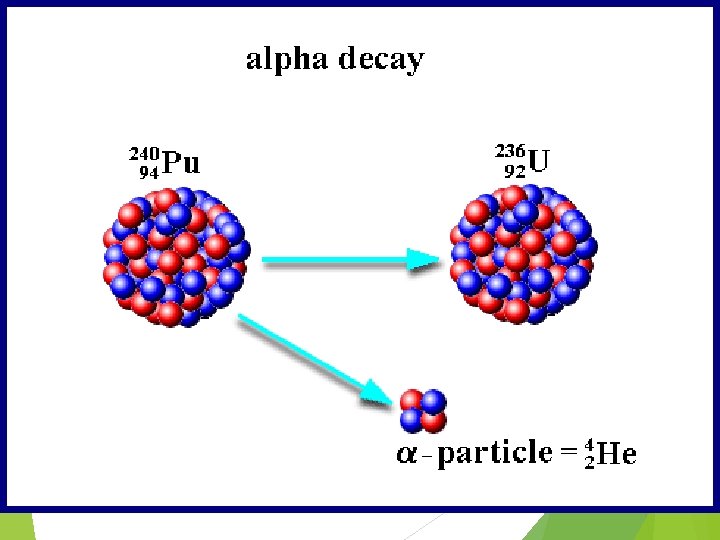
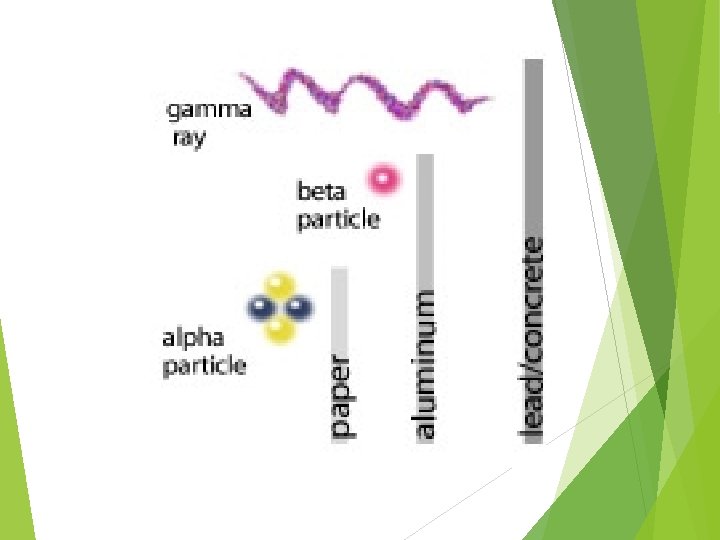
Alpha Radiation Release of 2 protons and 2 neutrons Equivalent to a He nucleus Charge of 2+ Mass = 4 amu Largest Least and slowest penetrating can be stopped by paper Changes to a different element with a lower atomic mass and lower atomic number Example: Polonium-212 (atomic# 84) is converted to Lead-208 (atomic# 82)
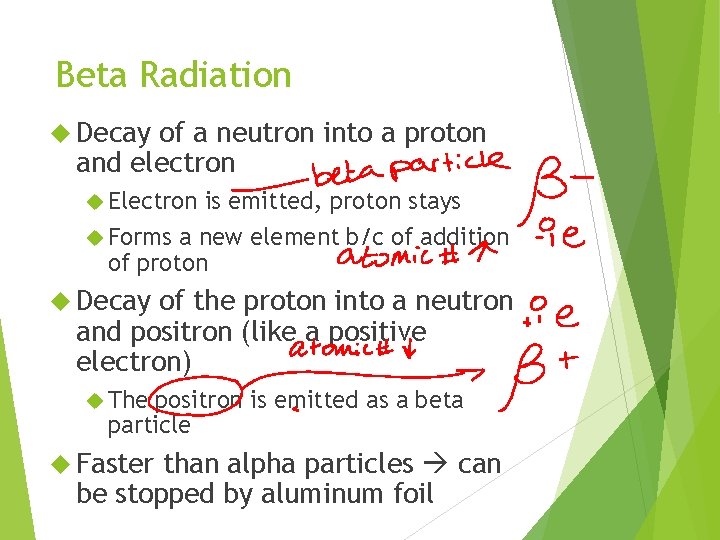
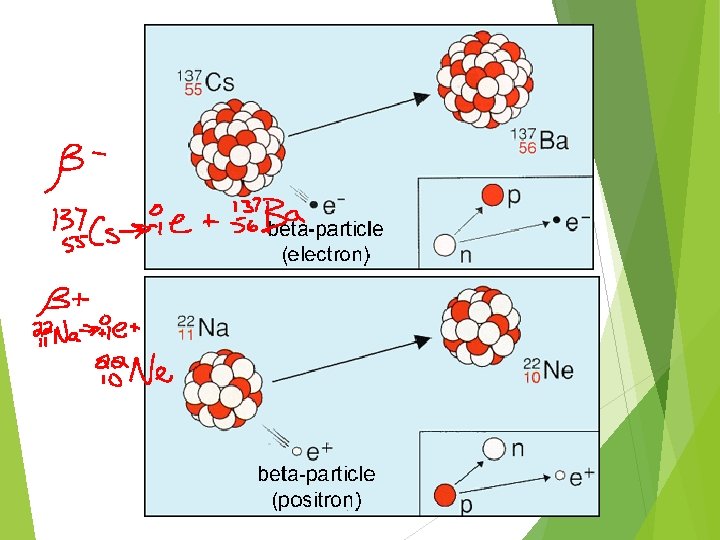
Beta Radiation Decay of a neutron into a proton and electron Electron is emitted, proton stays Forms a new element b/c of addition of proton Decay of the proton into a neutron and positron (like a positive electron) The positron is emitted as a beta particle Faster than alpha particles can be stopped by aluminum foil
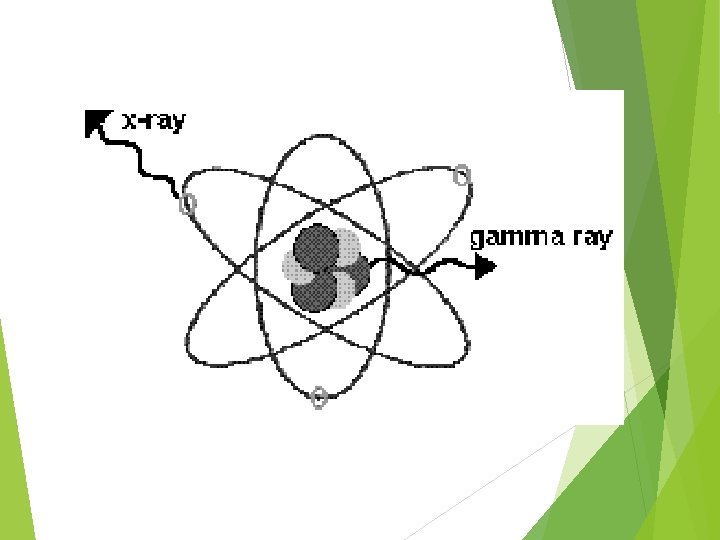
Gamma Radiation Not a particle Electromagnetic wave with short wavelength and high frequency & energy No mass, no charge Very fast speed of light Stronger than X-ray Stopped by several centimeters of lead
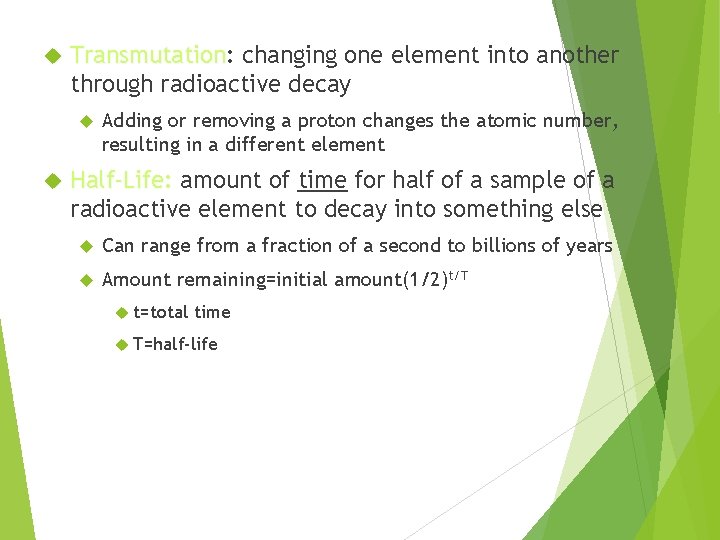
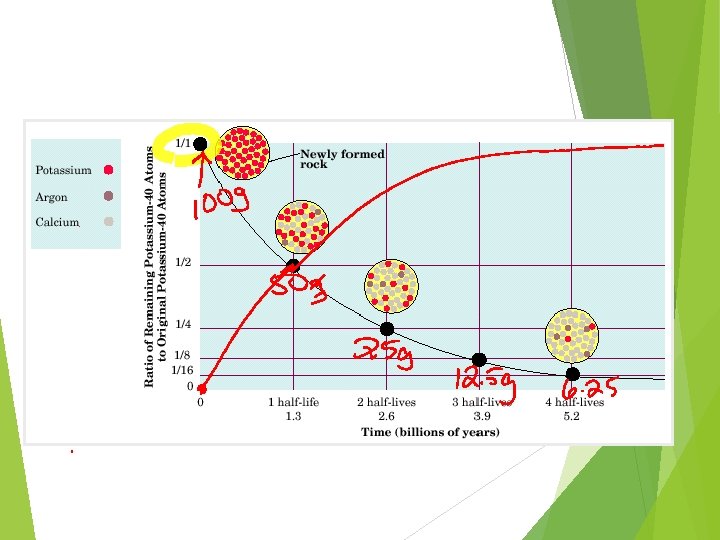
Transmutation: Transmutation changing one element into another through radioactive decay Adding or removing a proton changes the atomic number, resulting in a different element Half-Life: amount of time for half of a sample of a radioactive element to decay into something else Can range from a fraction of a second to billions of years Amount remaining=initial amount(1/2)t/T t=total time T=half-life
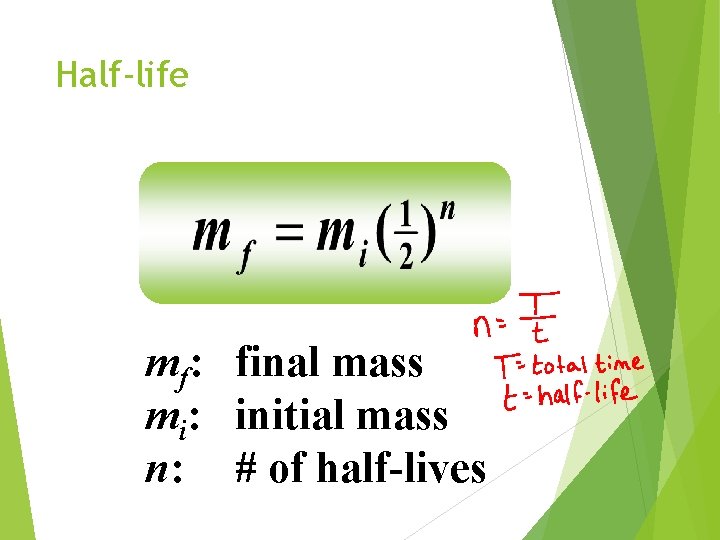
Half-life mf: final mass mi: initial mass n: # of half-lives
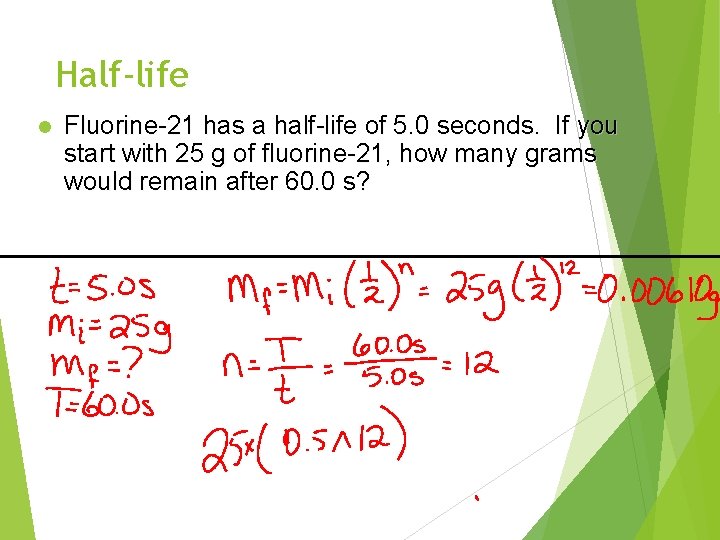
Half-life l Fluorine-21 has a half-life of 5. 0 seconds. If you start with 25 g of fluorine-21, how many grams would remain after 60. 0 s?