
RADIOACTIVE WASTE AND ITS DISPOSAL source Adapted from


- Slides: 52
RADIOACTIVE WASTE AND ITS DISPOSAL (source : Adapted from world nuclear association)
• WHERE AND WHEN • THIS WASTE IS PRODUCED ( STUDENTS ARE ADVISED TO VISIT THE WEBSITE OF BARC FOR INDIA SPECIFIC INFORMATION)
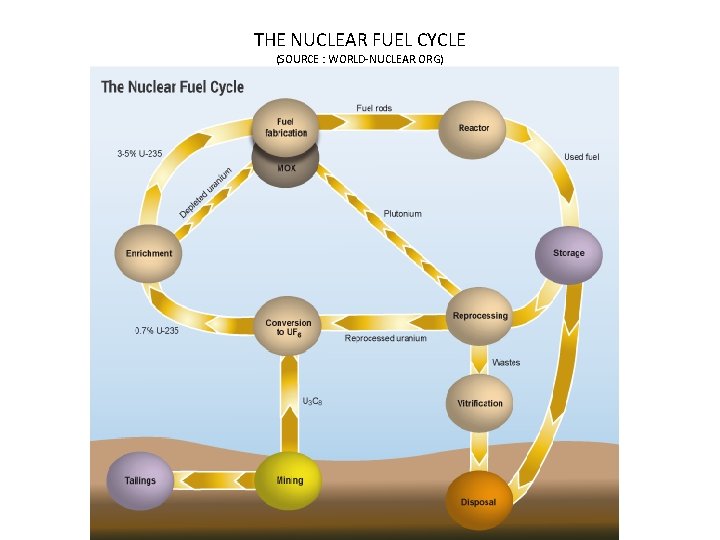
THE NUCLEAR FUEL CYCLE (SOURCE : WORLD-NUCLEAR. ORG)
URANIUM • Uranium is a slightly radioactive metal that occurs throughout the Earth's crust . It is about 500 times more abundant than gold and about as common as tin. It is present in most rocks and soils as well as in many rivers and in sea water. • It is, for example, found in concentrations of about four parts per million (ppm) in granite, which makes up 60% of the Earth's crust. In fertilisers, uranium concentration can be as high as 400 ppm (0. 04%), and some coal deposits contain uranium at concentrations greater than 100 ppm (0. 01%). • There a number of areas around the world where the concentration of uranium in the ground is sufficiently high that extraction of it for use as nuclear fuel is economically feasible. Such concentrations are called ore.
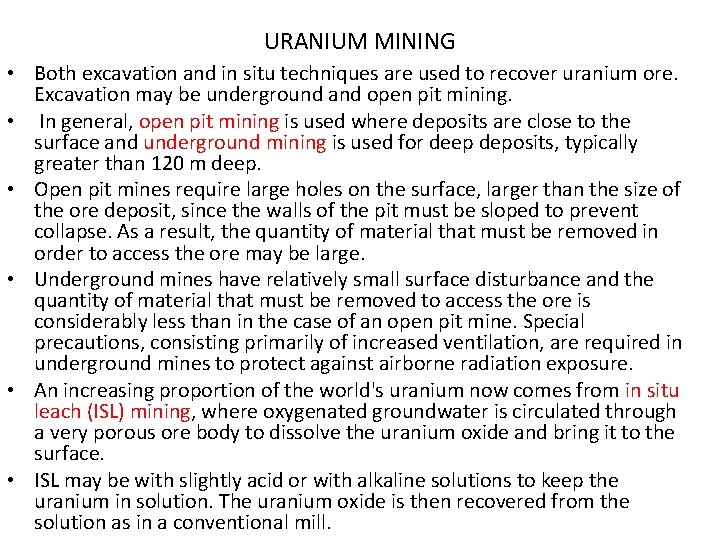
URANIUM MINING • Both excavation and in situ techniques are used to recover uranium ore. Excavation may be underground and open pit mining. • In general, open pit mining is used where deposits are close to the surface and underground mining is used for deep deposits, typically greater than 120 m deep. • Open pit mines require large holes on the surface, larger than the size of the ore deposit, since the walls of the pit must be sloped to prevent collapse. As a result, the quantity of material that must be removed in order to access the ore may be large. • Underground mines have relatively small surface disturbance and the quantity of material that must be removed to access the ore is considerably less than in the case of an open pit mine. Special precautions, consisting primarily of increased ventilation, are required in underground mines to protect against airborne radiation exposure. • An increasing proportion of the world's uranium now comes from in situ leach (ISL) mining, where oxygenated groundwater is circulated through a very porous ore body to dissolve the uranium oxide and bring it to the surface. • ISL may be with slightly acid or with alkaline solutions to keep the uranium in solution. The uranium oxide is then recovered from the solution as in a conventional mill.
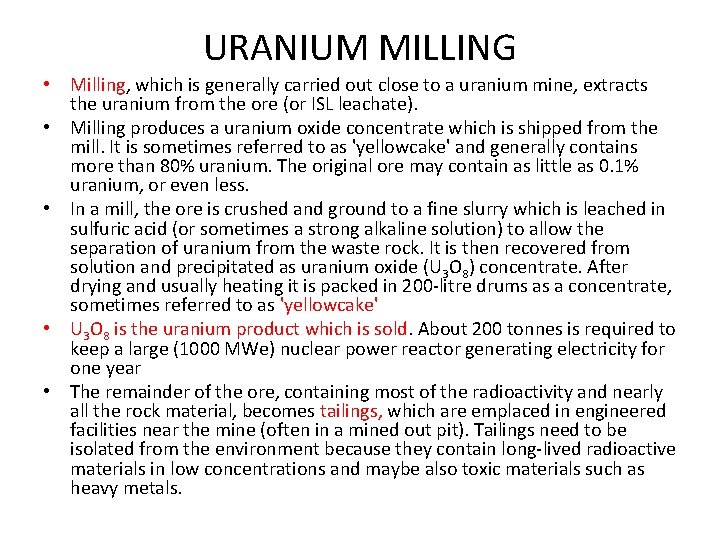
URANIUM MILLING • Milling, which is generally carried out close to a uranium mine, extracts the uranium from the ore (or ISL leachate). • Milling produces a uranium oxide concentrate which is shipped from the mill. It is sometimes referred to as 'yellowcake' and generally contains more than 80% uranium. The original ore may contain as little as 0. 1% uranium, or even less. • In a mill, the ore is crushed and ground to a fine slurry which is leached in sulfuric acid (or sometimes a strong alkaline solution) to allow the separation of uranium from the waste rock. It is then recovered from solution and precipitated as uranium oxide (U 3 O 8) concentrate. After drying and usually heating it is packed in 200 -litre drums as a concentrate, sometimes referred to as 'yellowcake' • U 3 O 8 is the uranium product which is sold. About 200 tonnes is required to keep a large (1000 MWe) nuclear power reactor generating electricity for one year • The remainder of the ore, containing most of the radioactivity and nearly all the rock material, becomes tailings, which are emplaced in engineered facilities near the mine (often in a mined out pit). Tailings need to be isolated from the environment because they contain long-lived radioactive materials in low concentrations and maybe also toxic materials such as heavy metals.
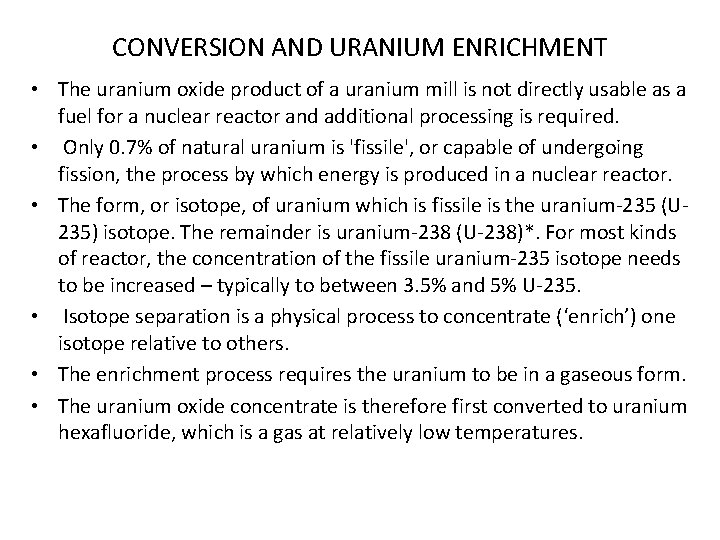
CONVERSION AND URANIUM ENRICHMENT • The uranium oxide product of a uranium mill is not directly usable as a fuel for a nuclear reactor and additional processing is required. • Only 0. 7% of natural uranium is 'fissile', or capable of undergoing fission, the process by which energy is produced in a nuclear reactor. • The form, or isotope, of uranium which is fissile is the uranium-235 (U 235) isotope. The remainder is uranium-238 (U-238)*. For most kinds of reactor, the concentration of the fissile uranium-235 isotope needs to be increased – typically to between 3. 5% and 5% U-235. • Isotope separation is a physical process to concentrate (‘enrich’) one isotope relative to others. • The enrichment process requires the uranium to be in a gaseous form. • The uranium oxide concentrate is therefore first converted to uranium hexafluoride, which is a gas at relatively low temperatures.
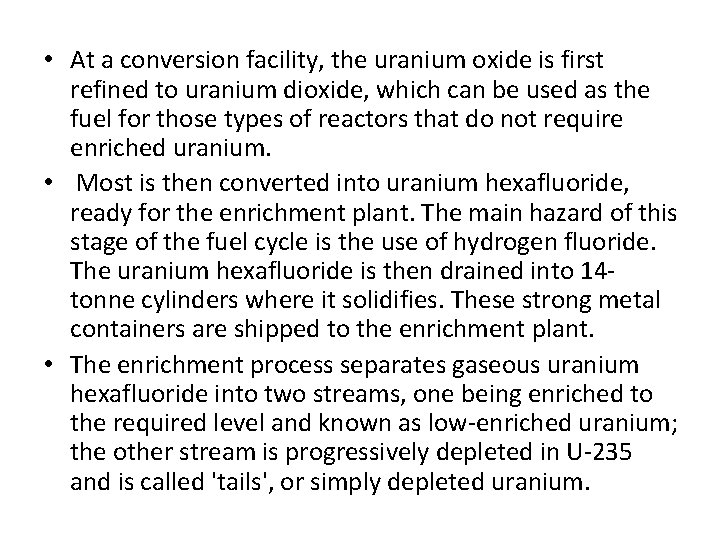
• At a conversion facility, the uranium oxide is first refined to uranium dioxide, which can be used as the fuel for those types of reactors that do not require enriched uranium. • Most is then converted into uranium hexafluoride, ready for the enrichment plant. The main hazard of this stage of the fuel cycle is the use of hydrogen fluoride. The uranium hexafluoride is then drained into 14 tonne cylinders where it solidifies. These strong metal containers are shipped to the enrichment plant. • The enrichment process separates gaseous uranium hexafluoride into two streams, one being enriched to the required level and known as low-enriched uranium; the other stream is progressively depleted in U-235 and is called 'tails', or simply depleted uranium.
• The main enrichment process in commercial plants uses centrifuges, with thousands of rapidly-spinning vertical tubes. • As they spin, the physical properties of molecules, specifically the 1% mass difference between the two uranium isotopes, separates them. A laser enrichment process is in the final stage of development. • The product of this stage of the nuclear fuel cycle is enriched uranium hexafluoride, which is reconverted to produce enriched uranium oxide. • Up to this point the fuel material can be considered fungible (though enrichment levels vary), but fuel fabrication involves very specific design. • A small number of reactors, notably the Canadian and Indian heavy water type, do not require uranium to be enriched.
FUEL FABRICATION • Reactor fuel is generally in the form of ceramic pellets. These are formed from pressed uranium oxide (UO 2) which is sintered (baked) at a high temperature (over 1400°C)a. • The pellets are then encased in metal tubes to form fuel rods, which are arranged into a fuel assembly ready for introduction into a reactor. The dimensions of the fuel pellets and other components of the fuel assembly are precisely controlled to ensure consistency in the characteristics of the fuel. • In a fuel fabrication plant great care is taken with the size and shape of processing vessels to avoid criticality (a limited chain reaction releasing radiation). • Some 27 tonnes of fresh enriched fuel is required each year by a 1000 MWe reactor.
POWER GENERATION AND BURNUP • • • Several hundred fuel assemblies make up the core of a reactor. For a reactor with an output of 1000 megawatts (MWe), the core would contain about 75 tonnes of low-enriched uranium. In the reactor core the U-235 isotope fissions or splits, producing a lot of heat in a continuous process called a chain reaction. The process depends on the presence of a moderator such as water or graphite, and is fully controlled. Some of the U-238 in the reactor core is turned into plutonium and about half of this is also fissioned, providing about one-third of the reactor's energy output To maintain efficient reactor performance, about one-third of the spent fuel is removed every year or 18 months, to be replaced with fresh fuel. Typically, some 44 million kilowatt-hours of electricity are produced from one tonne of natural uranium. The production of this amount of electrical power from fossil fuels would require the burning of over 20, 000 tonnes of black coal or 8. 5 million cubic metres of gas. As with as a coal-fired power station about two thirds of the heat is dumped, either to a large volume of water (from the sea or large river, heating it a few degrees) or to a relatively smaller volume of water in cooling towers, using evaporative cooling (latent heat of vapourisation).
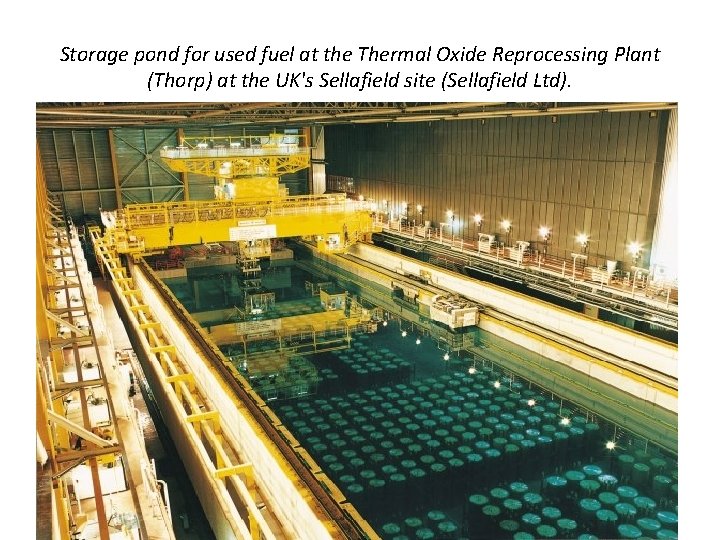
USED FUEL • With time, the concentration of fission fragments and heavy elements formed in the same way as plutonium in the fuel will increase to the point where it is no longer practical to continue to use the fuel, though much potential remains in it. • So after 18 -36 months the used fuel is removed from the reactor. The amount of energy that is produced from a fuel assembly varies with the type of reactor and the policy of the reactor operator. • Used fuel will typically have about 1. 0% U-235 and 0. 6% fissile plutonium (almost 1% Pu total), with around 95% U-238. * • About 3% is fission products and minor actinides. • When removed from a reactor, the fuel will be emitting both radiation, principally from the fission fragments, and heat. • It is unloaded into a storage pond immediately adjacent to the reactor to allow the radiation levels to decrease. In the ponds the water shields the radiation and absorbs the heat, which is removed by circulating the water to external heat exchangers. • Used fuel is held in such pools for several months and sometimes many years. It may be transferred to naturally-ventilated dry storage on site after about five years.
There are two alternatives for used fuel: 1 Reprocessing to recover and recycle the usable portion of it. 2. Long-term storage and final disposal without reprocessing. Used fuel still contains about 96% of its original uranium, of which the fissionable U-235 content has been reduced to less than 1%. About 3% of the used fuel comprises waste products and the remaining 1% is plutonium (Pu) produced while the fuel was in the reactor and not 'burned' then. • Reprocessing separates uranium and plutonium from waste products (and from the fuel assembly cladding) by chopping up the fuel rods and dissolving them in acid to separate the various materials. • It enables recycling of the uranium and plutonium into fresh fuel, and produces a significantly reduced amount of waste (compared with treating all used fuel as waste • The remaining 3% of high-level radioactive wastes (some 750 kg per year from a 1000 MWe reactor) can be stored in liquid form and subsequently solidified. • •
URANIUM AND PLUTONIUM RECYCLING • The uranium recovered from reprocessing, which typically contains a slightly higher concentration of U-235 than occurs in nature, can be reused as fuel after conversion and enrichment. • The plutonium can be directly made into mixed oxide (MOX) fuel, in which uranium and plutonium oxides are combined. In reactors that use MOX fuel, plutonium substitutes for the U-235 in normal uranium oxide fuel
• Apart from the incidental transformation of U 238 into plutonium in a normal reactor, U-238 is not usable in today’s fuel cycle. • However, in a fast neutron reactor it is fissionable as well as (more importantly) giving rise to plutonium, and is therefore potentially valuable. • Increasingly, today’s used fuel is being seen as a future resource rather than a waste.
WASTES • Wastes from the nuclear fuel cycle are categorised as high-, medium- or low-level wastes by the amount of radiation that they emit. These wastes come from a number of sources and include: • low-level waste produced at all stages of the fuel cycle; • intermediate-level waste produced during reactor operation and by reprocessing; • high-level waste, which is waste containing the highlyradioactive fission products separated in reprocessing, and in many countries, the used fuel itself. Separated high-level wastes also contain long-lived transuranic elements.
• After reprocessing, the liquid high-level waste can be calcined (heated strongly) to produce a dry powder which is incorporated into borosilicate (Pyrex) glass to immobilise it. • The glass is then poured into stainless steel canisters, each holding 400 kg of glass. • A year's waste from a 1000 MWe reactor is contained in five tonnes of such glass, or about 12 canisters 1. 3 metres high and 0. 4 metres in diameter. • These can readily be transported and stored, with appropriate shielding.
• The uranium enrichment process leads to the production of much 'depleted' uranium, in which the concentration of U-235 is significantly less than the 0. 7% found in nature. • Small quantities of this material, which is primarily U-238, are used in applications where high density material is required, including radiation shielding and some is used in the production of MOX fuel. • While U-238 is not fissile it is a low specific activity radioactive material and some precautions must, therefore, be taken in its storage or disposal.
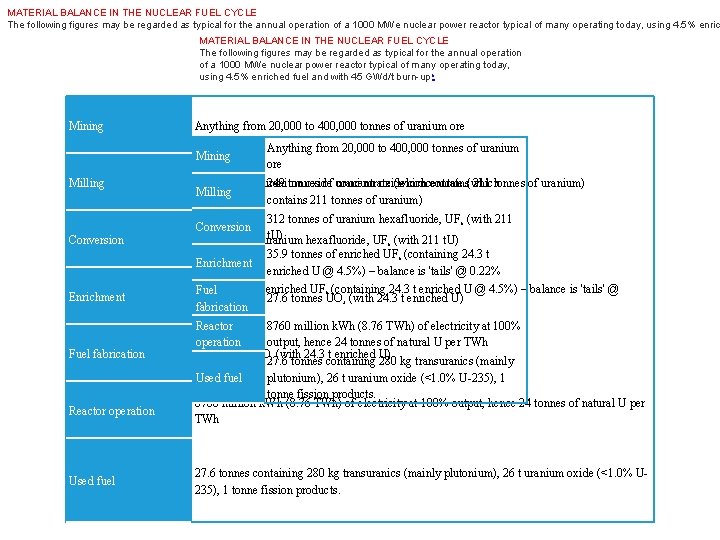
MATERIAL BALANCE IN THE NUCLEAR FUEL CYCLE The following figures may be regarded as typical for the annual operation of a 1000 MWe nuclear power reactor typical of many operating today, using 4. 5% enriched fuel and with 45 GWd/t burn-up: b Mining Anything from 20, 000 to 400, 000 tonnes of uranium ore Mining Milling Conversion Enrichment Fuel fabrication Reactor operation Used fuel Anything from 20, 000 to 400, 000 tonnes of uranium ore 249 tonnes of uranium oxide concentrate (which contains 211 tonnes of uranium) 249 tonnes of uranium oxide concentrate (which Milling contains 211 tonnes of uranium) 312 tonnes of uranium hexafluoride, UF 6 (with 211 Conversion t. U) 312 tonnes of uranium hexafluoride, UF 6 (with 211 t. U) 35. 9 tonnes of enriched UF 6 (containing 24. 3 t Enrichment enriched U @ 4. 5%) – balance is 'tails' @ 0. 22% 35. 9 tonnes of enriched UF Fuel 6 (containing 24. 3 t enriched U @ 4. 5%) – balance is 'tails' @ 27. 6 tonnes UO 2 (with 24. 3 t enriched U) 0. 22% fabrication Reactor 8760 million k. Wh (8. 76 TWh) of electricity at 100% operation output, hence 24 tonnes of natural U per TWh 27. 6 tonnes UO 2 (with 24. 3 t enriched U) 27. 6 tonnes containing 280 kg transuranics (mainly plutonium), 26 t uranium oxide (<1. 0% U-235), 1 Used fuel tonne fission products. 8760 million k. Wh (8. 76 TWh) of electricity at 100% output, hence 24 tonnes of natural U per TWh 27. 6 tonnes containing 280 kg transuranics (mainly plutonium), 26 t uranium oxide (<1. 0% U 235), 1 tonne fission products.
Types of Radioactive wastes • Radioactive waste includes any material that is either intrinsically radioactive, or has been contaminated by radioactivity, and that is deemed to have no further use. • Every radionuclide has a half-life – the time taken for half of its atoms to decay, and thus for it to lose half of its radioactivity. • Radionuclides with long half-lives tend to be alpha and beta emitters – making their handling easier – while those with short half-lives tend to emit the more penetrating gamma rays. Eventually all radioactive waste decays into nonradioactive elements. The more radioactive an isotope is, the faster it decays. • Radioactive waste is typically classified as either low-level (LLW), intermediate-level (ILW), or high-level (HLW), dependent, primarily, on its level of radioactivity.
LOW-LEVEL WASTE • Low-level waste (LLW) has a radioactive content not exceeding four giga-becquerels per tonne (GBq/t) of alpha activity or 12 GBq/t beta-gamma activity. • LLW does not require shielding during handling and transport, and is suitable for disposal in near surface facilities. • LLW is generated from hospitals and industry, as well as the nuclear fuel cycle. • It comprises paper, rags, tools, clothing, filters, etc. , which contain small amounts of mostly short-lived radioactivity. • To reduce its volume, LLW is often compacted or incinerated before disposal. • LLW comprises some 90% of the volume but only 1% of the radioactivity of all radioactive waste.
INTERMEDIATE-LEVEL WASTE • Intermediate-level waste (ILW) is more radioactive than LLW, but the heat it generates (<2 k. W/m 3) is not sufficient to be taken into account in the design or selection of storage and disposal facilities. • Due to its higher levels of radioactivity, ILW requires some shielding. • ILW typically comprises resins, chemical sludges, and metal fuel cladding, as well as contaminated materials from reactor decommissioning. • Smaller items and any non-solids may be solidified in concrete or bitumen for disposal. • It makes up some 7% of the volume and has 4% of the radioactivity of all radioactive waste.
HIGH-LEVEL WASTE • High-level waste (HLW) is sufficiently radioactive for its decay heat (>2 k. W/m 3) to increase its temperature, and the temperature of its surroundings, significantly. As a result, HLW requires cooling and shielding. • HLW arises from the 'burning' of uranium fuel in a nuclear reactor. • HLW contains the fission products and transuranic elements generated in the reactor core. • HLW accounts for just 3% of the volume, but 95% of the total radioactivity of produced waste.
There are two distinct kinds of HLW: 1. Used fuel that has been designated as waste. 2. Separated waste from reprocessing of used fuel. HLW has both long-lived and short-lived components, depending on the length of time it will take for the radioactivity of particular radionuclides to decrease to levels that are considered non-hazardous for people and the surrounding environment. • If generally short-lived fission products can be separated from long-lived actinides, this distinction becomes important in management and disposal of HLW. • HLW is the focus of significant attention regarding nuclear power, and is managed accordingly. • •
VERY LOW-LEVEL WASTE • Exempt waste and very low-level waste (VLLW) contains radioactive materials at a level which is not considered harmful to people or the surrounding environment. • It consists mainly of demolished material (such as concrete, plaster, bricks, metal, valves, piping, etc. ) produced during rehabilitation or dismantling operations on nuclear industrial sites. • Other industries, such as food processing, chemical, steel, etc. , also produce VLLW as a result of the concentration of natural radioactivity present in certain minerals used in their manufacturing processes • The waste is therefore disposed of with domestic refuse, although countries such as France are currently developing specifically designed VLLW disposal facilities.
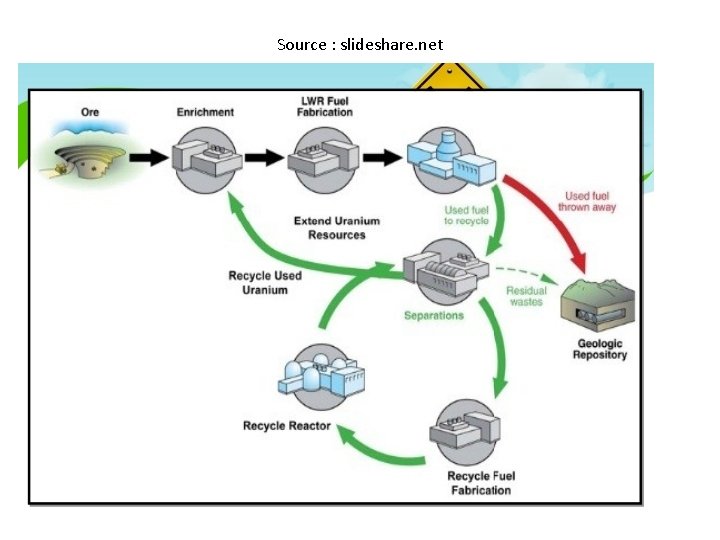
WHEN AND WHERE WASTE IS PRODUCED • Radioactive waste is produced at all stages of the nuclear fuel cycle – the process of producing electricity from nuclear materials. • The fuel cycle involves • the mining and milling of uranium ore, • its processing and fabrication into nuclear fuel, • its use in the reactor, • its reprocessing (if conducted), the treatment of the used fuel taken from the reactor, and finally, disposal of the waste. • Whilst waste is produced during mining and milling and fuel fabrication, the majority (in terms of radioactivity) comes from the actual 'burning' of uranium to produce electricity. • Where the used fuel is reprocessed, the amount of waste is reduced materially.
Source : slideshare. net
Mining through to fuel fabrication • Traditional uranium mining generates fine sandy tailings, which contain virtually all the naturally occurring radioactive elements found in uranium ore. • The tailings are collected in engineered dams and finally covered with a layer of clay and rock to inhibit the leakage of radon gas, and to ensure long-term stability. • In the short term, the tailings material is often covered with water. • After a few months, the tailings material contains about 75% of the radioactivity of the original ore. • Strictly speaking these are not classified as radioactive waste.
• Uranium oxide concentrate from mining, essentially 'yellowcake' (U 3 O 8), is not significantly radioactive – barely more so than the granite used in buildings. • It is refined then converted to uranium hexafluoride (UF 6) gas. As a gas, it undergoes enrichment to increase the U-235 content from 0. 7% to about 3. 5%. • It is then turned into a hard ceramic oxide (UO 2) for assembly as reactor fuel elements • The main by-product of enrichment is depleted uranium (DU), principally the U-238 isotope, which is stored either as UF 6 or U 3 O 8. • Some DU is used in applications where its extremely high density makes it valuable, such as for the keels of yachts and military projectiles. • It is also used (with reprocessed plutonium) for making mixed oxide (MOX) fuel and to dilute highly-enriched uranium from dismantled weapons, which can then be used for reactor fuel
ELECTRICITY GENERATION • In terms of radioactivity, the major source arising from the use of nuclear reactors to generate electricity comes from the material classified as HLW. • Highly radioactive fission products and transuranic elements are produced from uranium and plutonium during reactor operations, and are contained within the used fuel. • Where countries have adopted a closed cycle and reprocess used fuel, the fission products and minor actinides are separated from uranium and plutonium and treated as HLW (see below). • In countries where used fuel is not reprocessed, the used fuel itself is considered a waste and therefore classified as HLW. • LLW and ILW is produced as a result of general operations, such as the cleaning of reactor cooling systems and fuel storage ponds, and the decontamination of equipment, filters, and metal components that have become radioactive as a result of their use in or near the reactor.
Reprocessing of used fuel • Any used fuel will still contain some of the original U-235 as well as various plutonium isotopes which have been formed inside the reactor core, and U 238. • In total these account for some 96% of the original uranium and over half of the original energy content (ignoring U-238). • Used nuclear fuel has long been reprocessed to extract fissile materials for recycling and to reduce the volume of HLW. • Several European countries, as well as Russia, China, and Japan have policies to reprocess used nuclear fuel.
• Reprocessing allows for a significant amount of plutonium to be recovered from used fuel, which is then mixed with depleted uranium oxide in a MOX fabrication plant to make fresh fuel. • This process allows some 25 -30% more energy to be extracted from the original uranium ore, and significantly reduces the volume of HLW (by about 85%). • The IAEA estimates that of the 370, 000 metric tonnes of heavy metal (MTHM) produced since the advent of civil nuclear power production, 120, 000 MTHM has been reprocessed. 1 • In addition, the remaining HLW is significantly less radioactive – decaying to the same level as the original ore within 9000 years (vs. 300, 000 years).
• Commercial reprocessing plants currently operate in France, the UK, and Russia. • Another is being commissioned in Japan, and China plans to construct one too. • France undertakes reprocessing for utilities in other countries, and a lot of Japan’s fuel has been reprocessed there, with both waste and recycled plutonium in MOX fuel being returned to Japan • The main historical and current process is Purex, a hydrometallurgical process. The main prospective ones are electrometallurgical – often called pyroprocessing since it happens to be hot. With it, all actinide anions (notably uranium and plutonium) are recovered together. Whilst not yet operational, these technologies will result in waste that only needs 300 years to reach the same level of radioactivity as the originally mined ore.
Storage pond for used fuel at the Thermal Oxide Reprocessing Plant (Thorp) at the UK's Sellafield site (Sellafield Ltd).
Decommissioning nuclear plants • In the case of nuclear reactors, about 99% of the radioactivity is associated with the fuel. • Apart from any surface contamination of plant, the remaining radioactivity comes from 'activation products' such as steel components which have long been exposed to neutron irradiation. • Their atoms are changed into different isotopes such as iron-55, cobalt-60, nickel-63, and carbon-14. • The first two are highly radioactive, emitting gamma rays, but with correspondingly short half-lives so that after 50 years from final shutdown their hazard is much diminished. Some caesium-137 may also be found in decommissioning wastes.
Non-nuclear power waste • In recent years, there has been increased attention on how to effectively manage non‑power related nuclear waste. • All countries, have to manage radioactive waste generated by activities unrelated to the production of nuclear energy, including: • national laboratory and university research activities; • used and lost industrial gauges and radiography sources; • and nuclear medicine activities at hospitals. • Although much of this waste is not long-lived, the variety of the sources makes any general assessment of physical or radiological characteristics difficult.
Treatment and conditioning • Treatment involves operations intended to change waste streams’ characteristics to improve safety or economy. Treatment techniques may involve compaction to reduce volume, filtration or ion exchange to remove radionuclide content, or precipitation to induce changes in composition. • Conditioning is undertaken to change waste into a form that is suitable for safe handling, transportation, storage, and disposal. This step typically involves the immobilisation of waste in containers. Liquid LLW and ILW are typically solidified in cement, whilst HLW is calcined/dried then vitrified in a glass matrix. Immobilised waste will be placed in a container suitable for its characteristics.
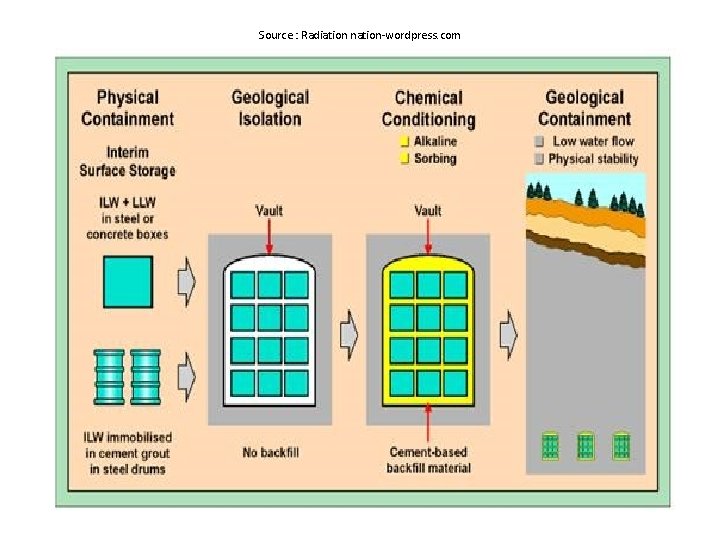
STORAGE AND DISPOSAL • Storage of waste may take place at any stage during the management process. Storage involves maintaining the waste in a manner such that it is retrievable, whilst ensuring it is isolated from the external environment. Waste may be stored to make the next stage of management easier (for example, by allowing its natural radioactivity to decay). Storage facilities are commonly onsite at the power plant, but may be also be separate from the facility where it was produced. • Disposal of waste takes place when there is no further foreseeable use for it, and in the case of HLW, when radioactivity has decayed to relatively low levels after about 40 -50 years.
Source : Radiation nation-wordpress. com
STORAGE AND DISPOSAL OF LLW AND SHORT-LIVED ILW • Most LLW and short-lived ILW are typically sent to land-based disposal immediately following packaging. • Near-surface disposal facilities are currently in operation in many countries, including: • UK – LLW Repository at Drigg in Cumbria operated by UK Nuclear Waste Management (a consortium led by Washington Group International with Studsvik UK, Serco, and Areva) on behalf of the Nuclear Decommissioning Authority. • Spain – El Cabril LLW and ILW disposal facility operated by ENRESA. • France – Centre de l'Aube and Morvilliers operated by ANDRA. • Sweden – SFR at Forsmark operated by SKB. • Finland – Olkiluoto and Loviisa, operated by TVO and Fortum. • Russia – Ozersk, Tomsk, Novouralsk, Sosnovy Bor, operated by NO RAO. • South Korea – Wolseong, operated by KORAD. • Japan – LLW Disposal Center at Rokkasho-Mura operated by Japan Nuclear Fuel Limited. • USA – five LLW disposal facilities: Texas Compact facility near the New Mexico border, operated by Waste Control Specialists; Barnwell, South Carolina; Clive, Utah; Oak Ridge, Tennessee – all operated by Energy Solutions; and Richland, Washington – operated by American Ecology Corporation.
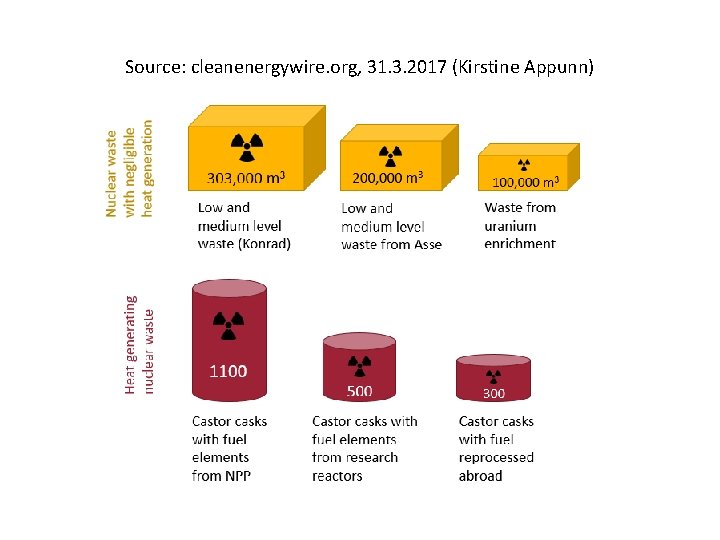
Source: cleanenergywire. org, 31. 3. 2017 (Kirstine Appunn)
• Some low-level liquid waste from reprocessing plants is discharged to the sea. This includes radionuclides which are distinctive, notably technetium-99 (sometimes used as a tracer in environmental studies), and this can be discerned many hundred kilometres away. However, such discharges are regulated and controlled, and the maximum radiation dose anyone receives from them is a small fraction of natural background radiation. • Nuclear power stations and reprocessing plants release small quantities of radioactive gases (e. g. krypton-85 and xenon-133) and trace amounts of iodine-131 to the atmosphere. However, krypton-85 and xenon-133 are chemically inert, all three gases have short half-lives, and the radioactivity in the emissions is diminished by delaying their release. The net effect is too small to warrant consideration in any life-cycle analysis. A little tritium is also produced but regulators do not consider its release to be significant.
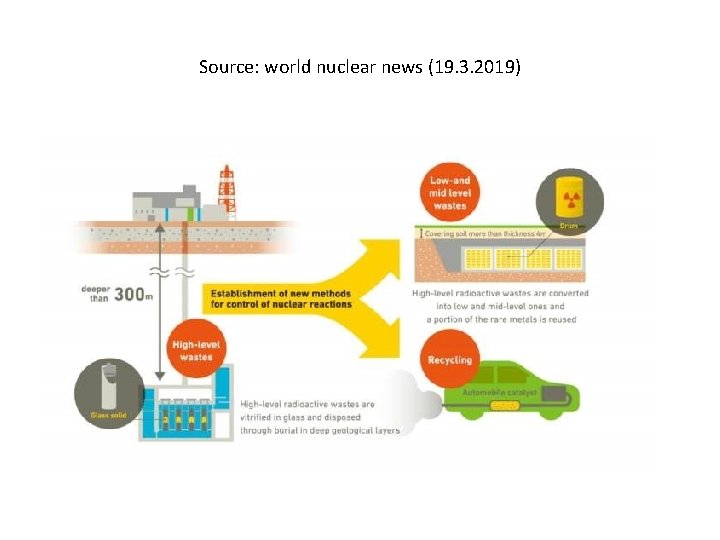
Source: world nuclear news (19. 3. 2019)
Long-lived ILW and HLW • The long timescales over which some ILW and HLW – including used fuel when considered a waste – remains radioactive has led to universal acceptance of the concept of deep geological disposal. Many other long-term waste management options have been investigated, but deep disposal in a mined repository is now the preferred option in most countries. The Waste Isolation Pilot Plant (WIPP) deep geological waste repository is in operation in the US for the disposal of transuranic waste – long-lived ILW from military sources, contaminated with plutonium. • used fuel may either by reprocessed or disposed of directly. Either way, there is a strong technical incentive to delay final disposal of HLW for about 40 -50 years after removal, at which point the heat and radioactivity will have reduced by over 99%. Interim storage of used fuel is mostly in ponds associated with individual reactors, or in a common pool at multi-reactor sites, or occasionally at a central site. At present there is about 250, 000 tonnes of used fuel in storage. Over two-thirds of this is in storage ponds, with an increasing proportion in dry storage. 1
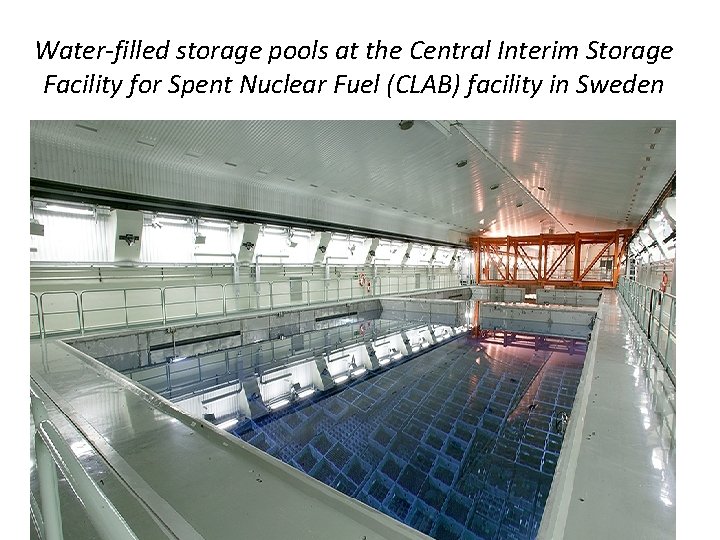
• Storage ponds at reactors, and those at centralised facilities such as CLAB in Sweden, are 7 -12 metres deep to allow for several metres of water over the used fuel (assembled in racks typically about 4 metres long and standing on end). • The multiple racks are made of metal with neutron absorbers incorporated. • The circulating water both shields and cools the fuel. • These pools are robust constructions made of thick reinforced concrete with steel liners. • Ponds at reactors are often designed to hold all the used fuel produced over the planned operating lifetime of the reactor.
Water-filled storage pools at the Central Interim Storage Facility for Spent Nuclear Fuel (CLAB) facility in Sweden
• Some fuel that has cooled in ponds for at least five years is stored in dry casks or vaults with air circulation inside concrete shielding. • One common system is for sealed steel casks or multi-purpose canisters (MPCs) each holding up to about 40 fuel assemblies with inert gas. Casks/MPCs may also be used for the transport and eventual disposal of the used fuel. • For storage, each is enclosed in a ventilated storage module made of concrete and steel. • These are commonly standing on the surface, about 6 m high, and cooled by air convection, or they may be below grade, with just the tops showing. • The modules are robust and provide full shielding. Each cask has up to 45 k. W heat load.
• If used reactor fuel is reprocessed, the resulting liquid HLW must be solidified. • The HLW also generates a considerable amount of heat and requires cooling. • It is vitrified into borosilicate (Pyrex) glass, sealed into heavy stainless steel cylinders about 1. 3 metres high, and stored for eventual disposal deep underground. This material has no conceivable future use and is universally classified as waste. • France has two commercial plants to vitrify HLW left over from reprocessing fuel, and there also plants active in the UK and Belgium. • The capacity of these western European plants is 2, 500 canisters (1000 t) a year, and some have been operating for three decades. • By mid-2009, the vitrification plant at Sellafield, UK, had produced its 5000 th canister of vitrified HLW, representing 3000 m 3 of liquor reduced to 750 m 3 of glass. The plant currently fills about 400 canisters per year. 2
• The Australian Synroc (synthetic rock) system is a more sophisticated way to immobilise such waste, and this process may eventually come into commercial use for civil wastes • If used reactor fuel is not reprocessed, it will still contain all the highly radioactive isotopes. • Spent fuel that is not reprocessed is treated as HLW for direct disposal. • It too generates a lot of heat and requires cooling. • However, since it largely consists of uranium (with a little plutonium), it represents a potentially valuable resource, and there is an increasing reluctance to dispose of it irretrievably.
• For final disposal, to ensure that no significant environmental releases occur over tens of thousands of years, 'multiple barrier' geological disposal is planned. This technique will immobilise the radioactive elements in HLW and long-lived ILW, and isolate them from the biosphere. The multiple barriers are: – Immobilisation of waste in an insoluble matrix such as borosilicate glass or synthetic rock (fuel pellets are already a very stable ceramic, UO 2). – Contain waste sealed inside a corrosion-resistant container, such as stainless steel. – Isolate waste from people and the environment, so eventually locate it deep underground in a stable rock structure. – Delay any significant migration of radionuclides from the repository, so surround containers with an impermeable backfill such as bentonite clay if the repository is wet.
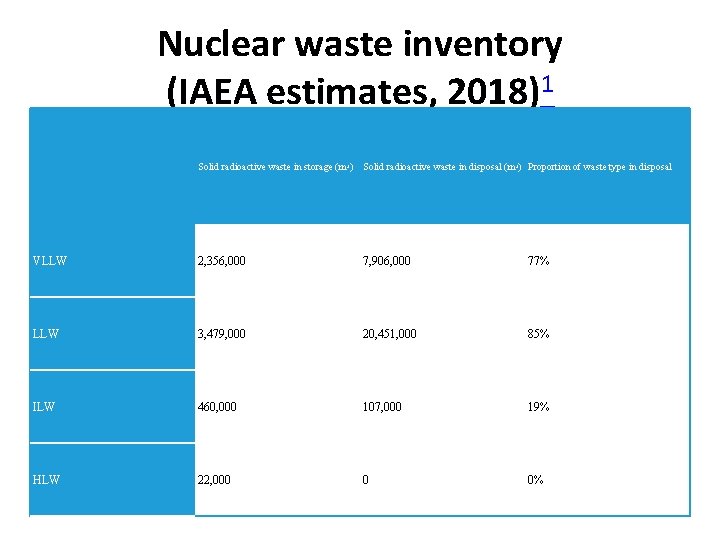
Nuclear waste inventory (IAEA estimates, 2018)1 Solid radioactive waste in storage (m 3) Solid radioactive waste in disposal (m 3) Proportion of waste type in disposal VLLW 2, 356, 000 7, 906, 000 77% LLW 3, 479, 000 20, 451, 000 85% ILW 460, 000 107, 000 19% HLW 22, 000 0 0%
THANK YOU