
Radio Wavelength Evidence for High Energy Particles in
- Slides: 43
Radio Wavelength Evidence for High Energy Particles in the Nearby Universe Ron Ekers CSIRO Ginzburg Conference on Physics Lebedev Institute, Moscow, 28 May - 2 June 2012
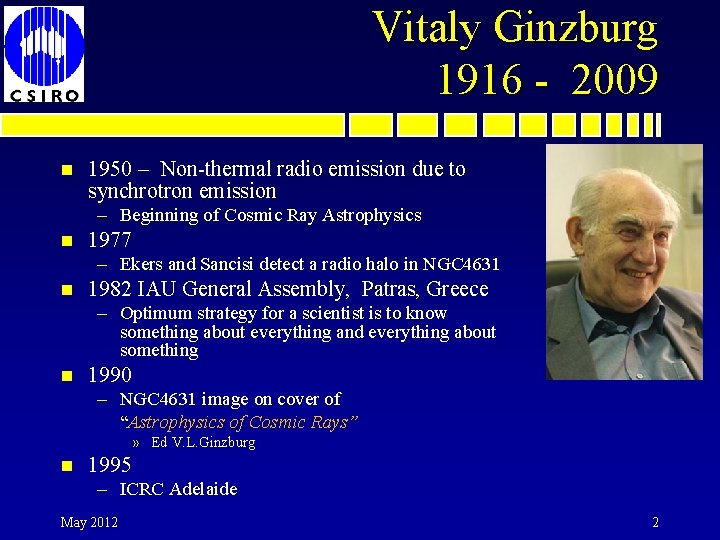
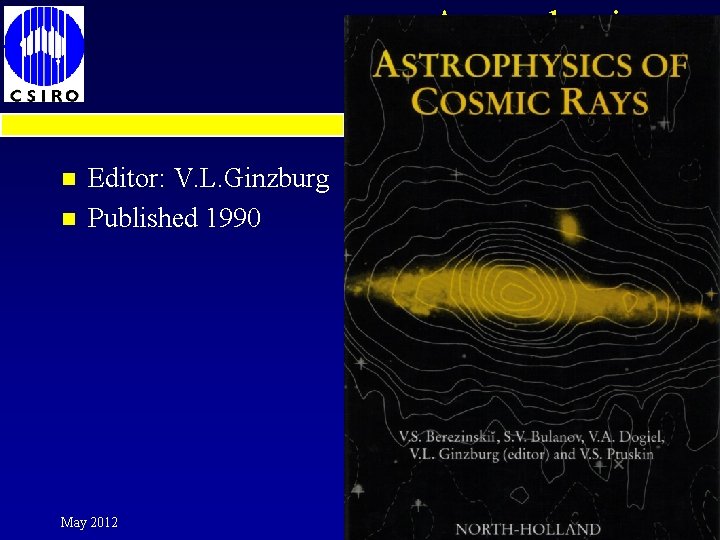
Vitaly Ginzburg 1916 - 2009 n 1950 – Non-thermal radio emission due to synchrotron emission – Beginning of Cosmic Ray Astrophysics n 1977 – Ekers and Sancisi detect a radio halo in NGC 4631 n 1982 IAU General Assembly, Patras, Greece – Optimum strategy for a scientist is to know something about everything and everything about something n 1990 – NGC 4631 image on cover of “Astrophysics of Cosmic Rays” » Ed V. L. Ginzburg n 1995 – ICRC Adelaide May 2012 2
Summary n n Vitaly Ginzburg (1916 - 2009) Cosmic Ray Astrophysics – Synchrotron radio emission n n The Cosmic Ray halo model The detection of a radio halo in NGC 4631 Other normal galaxies Radio Galaxies – Centaurus A n n UHE cosmic rays and neutrinos SKA and the future May 2012 Ekers 3
Cosmic Ray Astrophysics comments by Ginzburg n n Cosmic ray astrophysics was born in the early 1950 s when it became possible to observe cosmic rays far from the Earth. – Non-thermal continuum radio emission is from the synchrotron process – Crab nebula, and the first radio galaxies identified – Because radio waves propagate rectilinearly, the reception of cosmic radio emission provides a tool to obtain information about the electron component of cosmic rays at a distance from the Earth, in our Galaxy, other galaxies, and quasars. – From Ginzburg 1996, Cosmic ray astrophysics – Physics Uspekhi, Volume 39, pp. 155 -168 (1996) CR now traced at all wavelengths, and directly in gamma rays and UHE cosmic rays. May 2012 4
Cosmic Ray Halo Ginzburg & Ptuskin n Need a halo to get consistency between the observed CR abundances, the lifetimes and the radio luminosity – Be isotopes and the mean path length for observed cosmic rays n CR ages are 108 years rather than 106 years in the disk models – Rev Mod Phys 48, 161 (1976) n Ginzburg & Ptuskin – “the assertion of the validity of the galactic disk model, often heard of late, and the use, in accordance with this, of the age 3. 106 years may be characterized as adopted by repetition” – Usp. Fiz. Nauk , 117, 585 (1975) May 2012 5
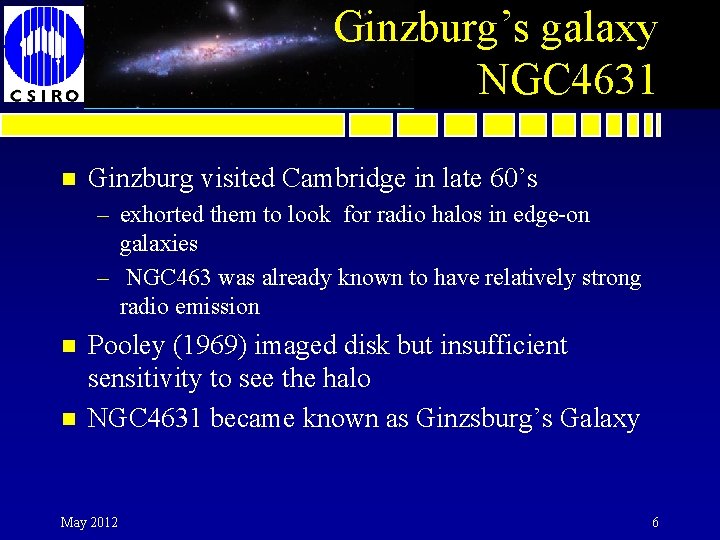
Ginzburg’s galaxy NGC 4631 n Ginzburg visited Cambridge in late 60’s – exhorted them to look for radio halos in edge-on galaxies – NGC 463 was already known to have relatively strong radio emission n n Pooley (1969) imaged disk but insufficient sensitivity to see the halo NGC 4631 became known as Ginzsburg’s Galaxy May 2012 6
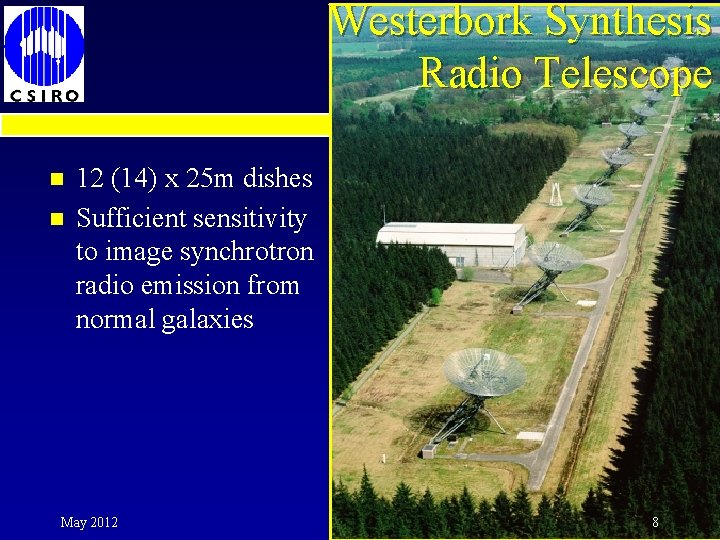
Westerbork Synthesis Radio Telescope n n 12 (14) x 25 m dishes Sufficient sensitivity to image synchrotron radio emission from normal galaxies May 2012 8
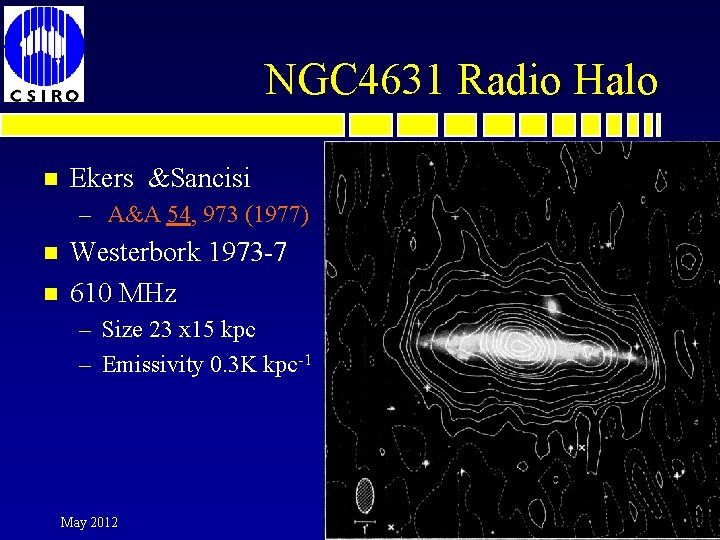
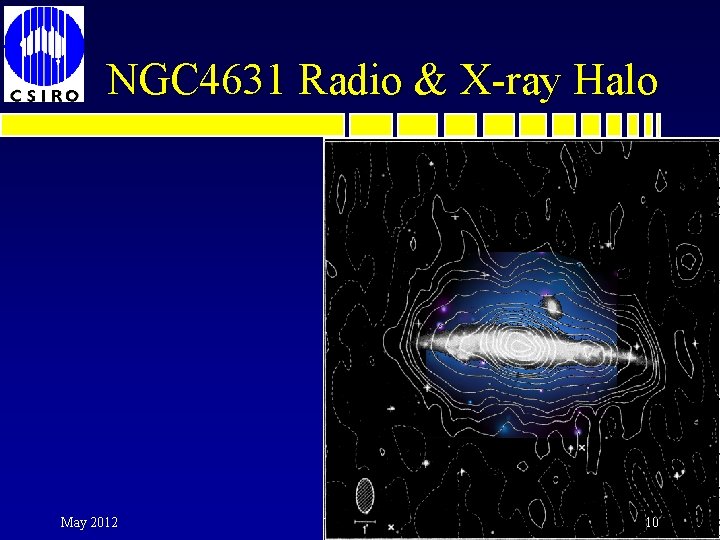
NGC 4631 Radio Halo n Ekers &Sancisi – A&A 54, 973 (1977) n n Westerbork 1973 -7 610 MHz – Size 23 x 15 kpc – Emissivity 0. 3 K kpc-1 May 2012 9
NGC 4631 Radio & X-ray Halo May 2012 10
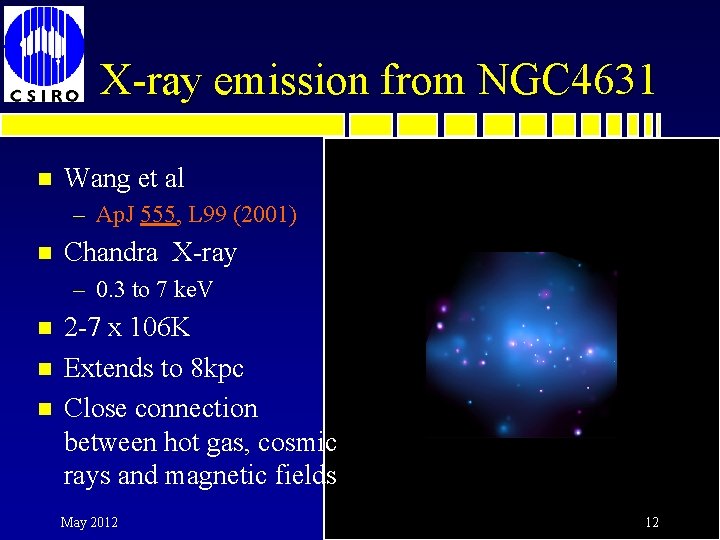
X-ray emission from NGC 4631 n Wang et al – Ap. J 555, L 99 (2001) n Chandra X-ray – 0. 3 to 7 ke. V n n n 2 -7 x 10⁶ K Extends to 8 kpc Close connection between hot gas, cosmic rays and magnetic fields May 2012 12
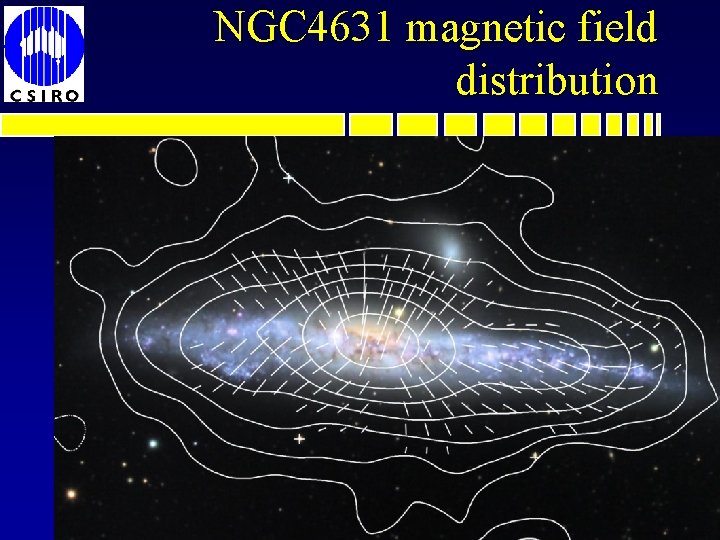
NGC 4631 magnetic field distribution May 2012 13
Astrophysics of Cosmic Rays n n Editor: V. L. Ginzburg Published 1990 May 2012 14
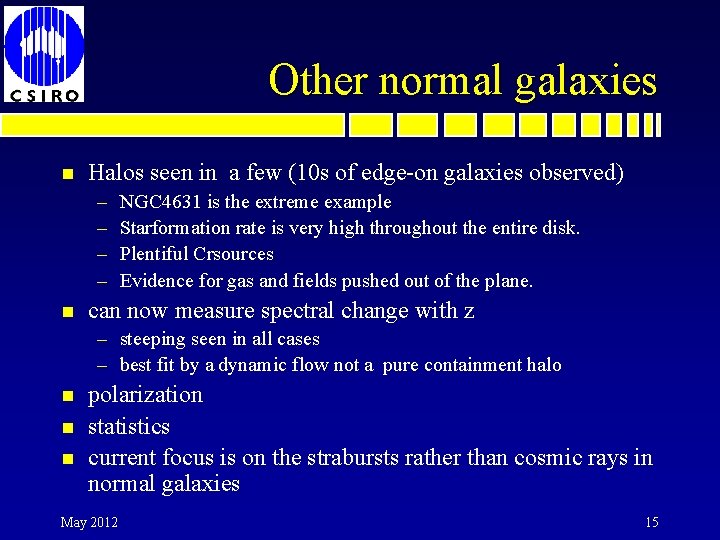
Other normal galaxies n Halos seen in a few (10 s of edge-on galaxies observed) – – n NGC 4631 is the extreme example Starformation rate is very high throughout the entire disk. Plentiful Crsources Evidence for gas and fields pushed out of the plane. can now measure spectral change with z – steeping seen in all cases – best fit by a dynamic flow not a pure containment halo n n n polarization statistics current focus is on the strabursts rather than cosmic rays in normal galaxies May 2012 15
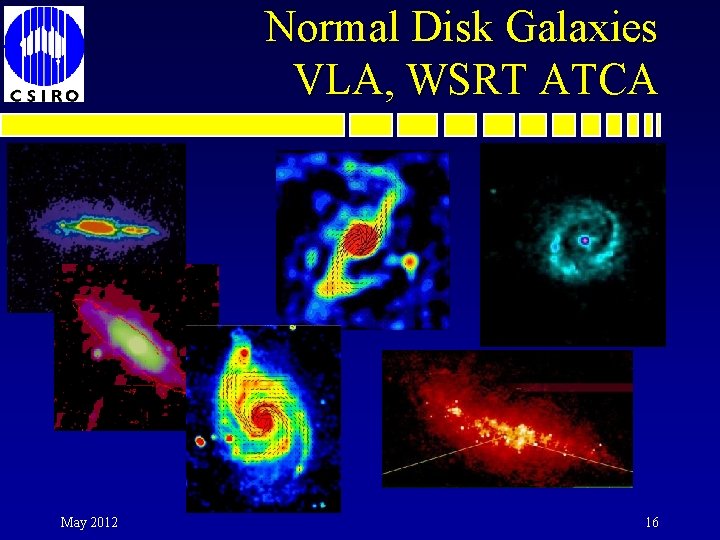
Normal Disk Galaxies VLA, WSRT ATCA May 2012 16
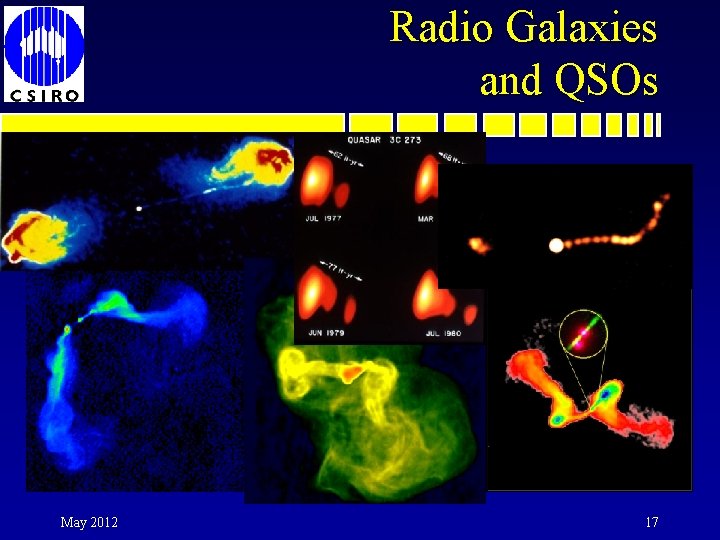
Radio Galaxies and QSOs May 2012 17
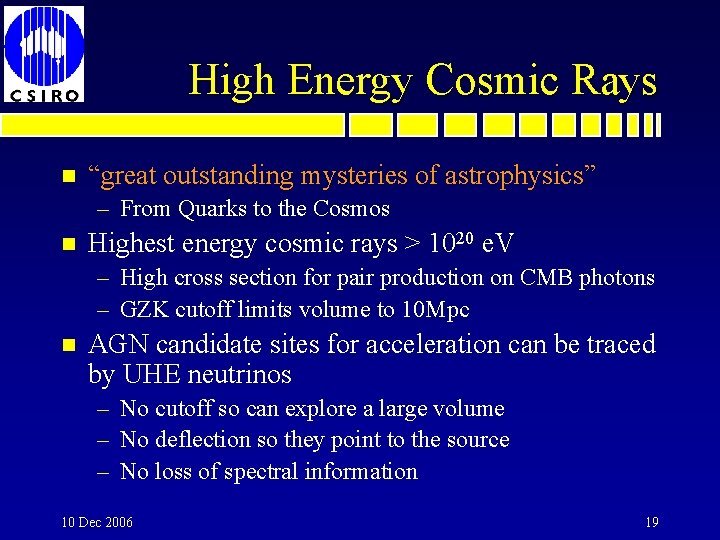
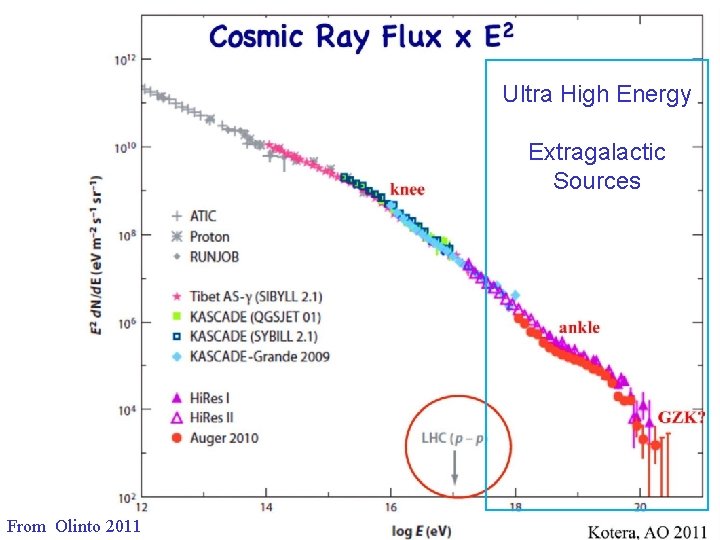
High Energy Cosmic Rays n “great outstanding mysteries of astrophysics” – From Quarks to the Cosmos n Highest energy cosmic rays > 1020 e. V – High cross section for pair production on CMB photons – GZK cutoff limits volume to 10 Mpc n AGN candidate sites for acceleration can be traced by UHE neutrinos – No cutoff so can explore a large volume – No deflection so they point to the source – No loss of spectral information 10 Dec 2006 19
Cosmic Ray Spectrum Ultra High Energy Extragalactic Sources Jan 20122011 From Olinto 20
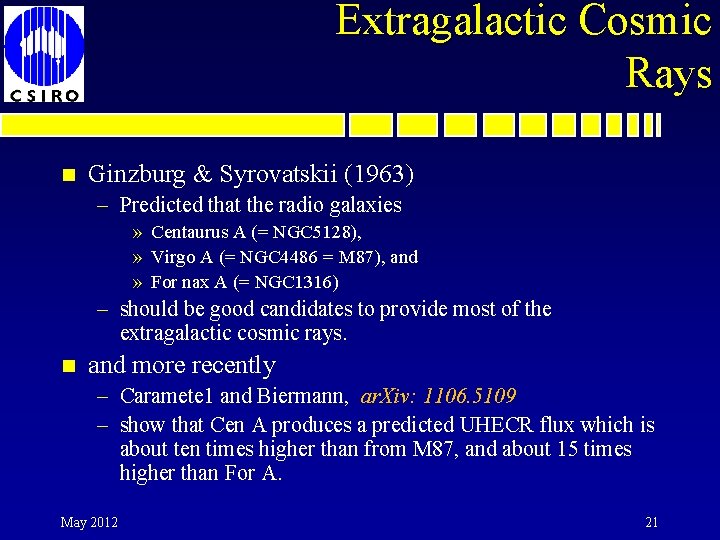
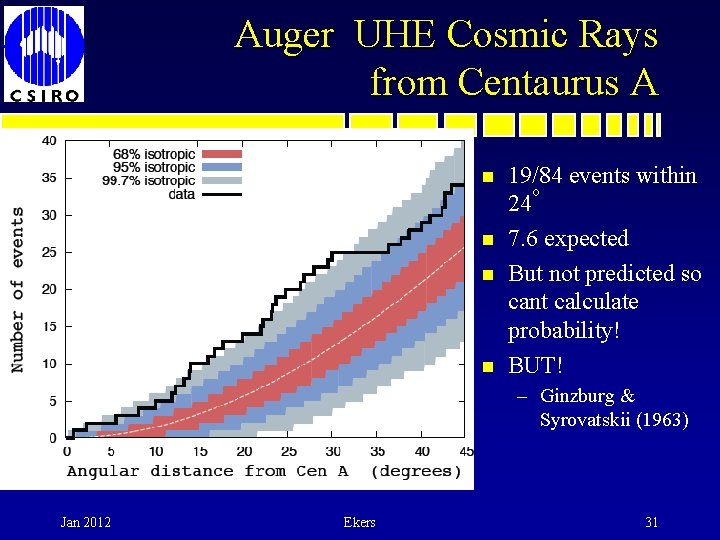
Extragalactic Cosmic Rays n Ginzburg & Syrovatskii (1963) – Predicted that the radio galaxies » Centaurus A (= NGC 5128), » Virgo A (= NGC 4486 = M 87), and » For nax A (= NGC 1316) – should be good candidates to provide most of the extragalactic cosmic rays. n and more recently – Caramete 1 and Biermann, ar. Xiv: 1106. 5109 – show that Cen A produces a predicted UHECR flux which is about ten times higher than from M 87, and about 15 times higher than For A. May 2012 21
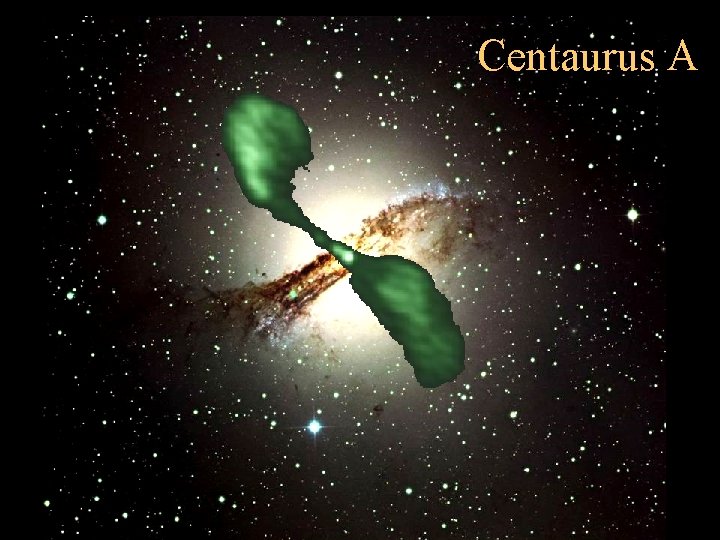
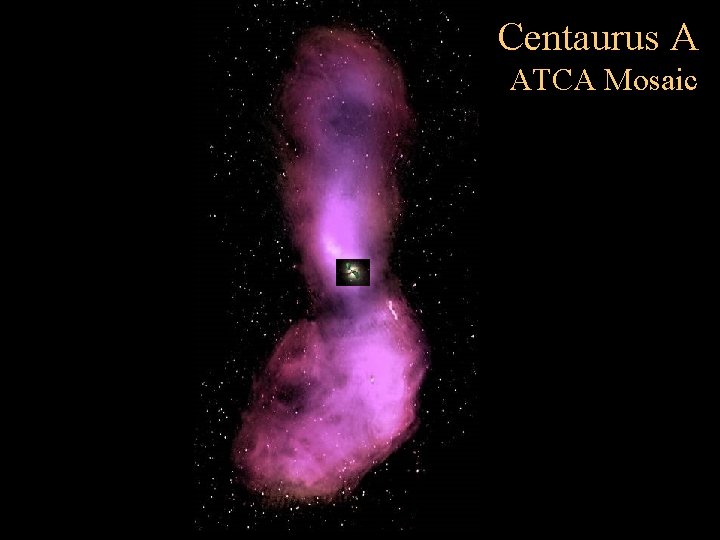
Centaurus A
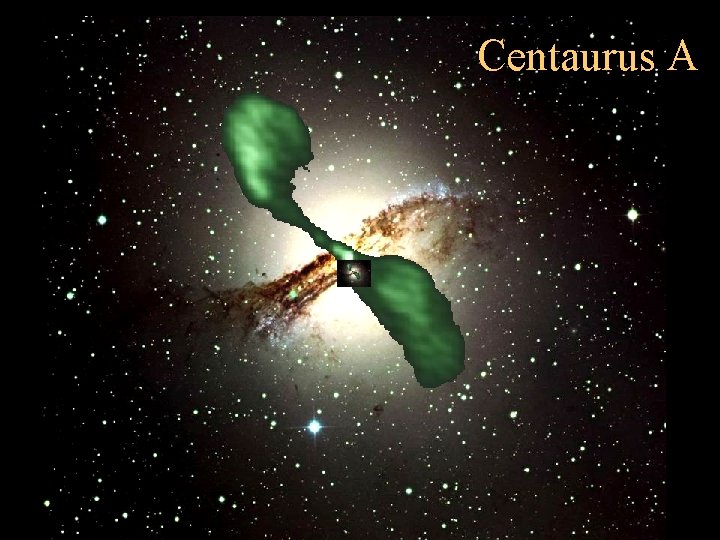
Centaurus A
Centaurus A ATCA Mosaic
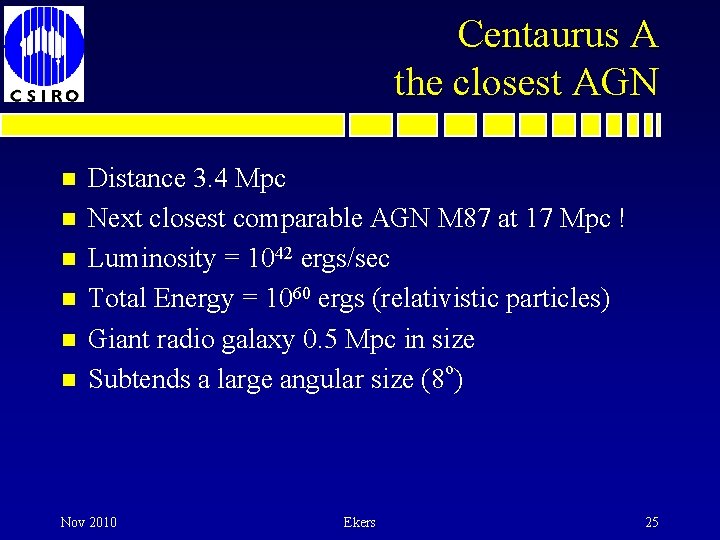
Centaurus A the closest AGN n n n Distance 3. 4 Mpc Next closest comparable AGN M 87 at 17 Mpc ! Luminosity = 1042 ergs/sec Total Energy = 1060 ergs (relativistic particles) Giant radio galaxy 0. 5 Mpc in size o Subtends a large angular size (8 ) Nov 2010 Ekers 25
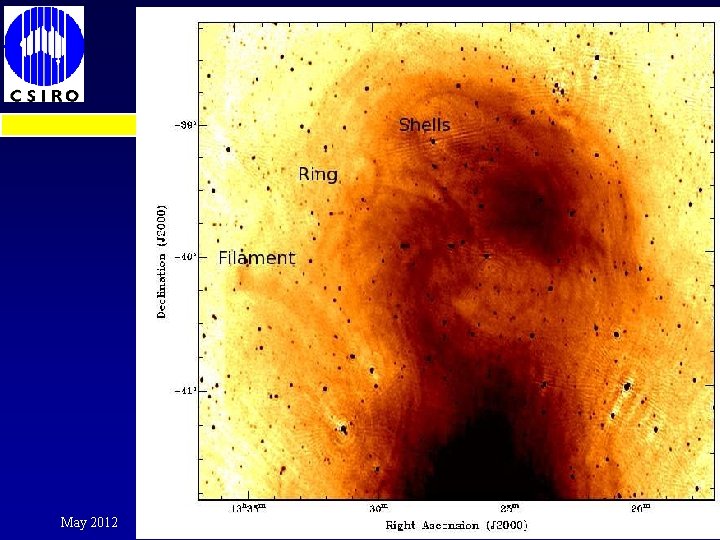
May 2012 26
May 2012 27
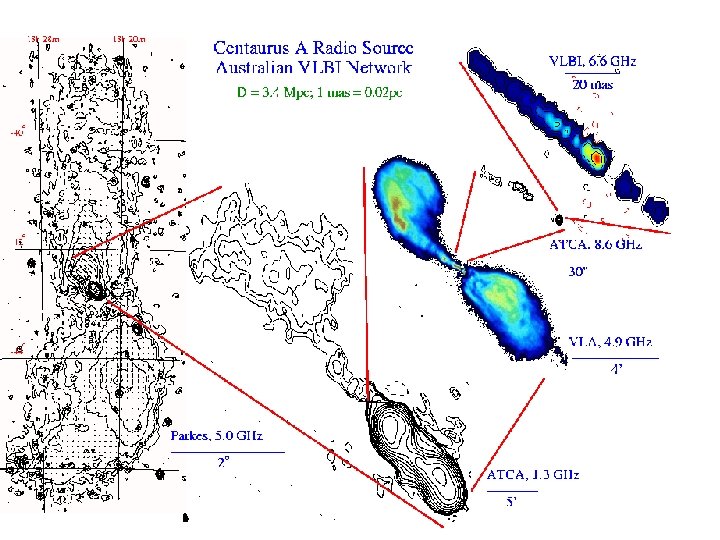
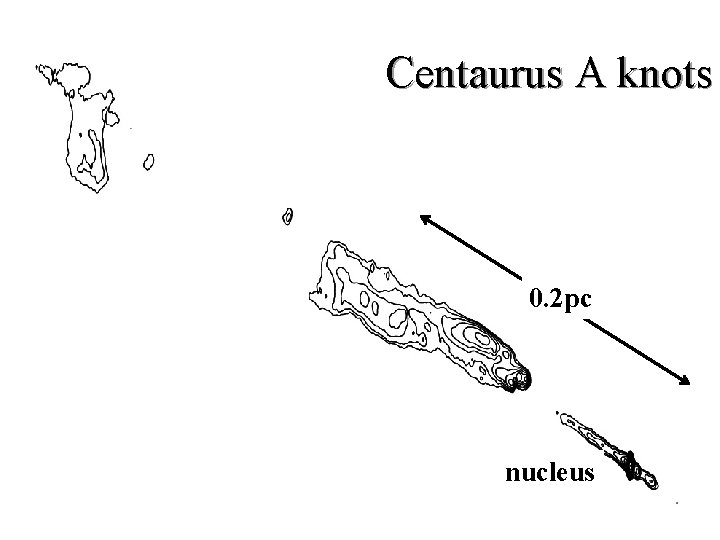
Centaurus A knots 0. 2 pc nucleus May 2012 28
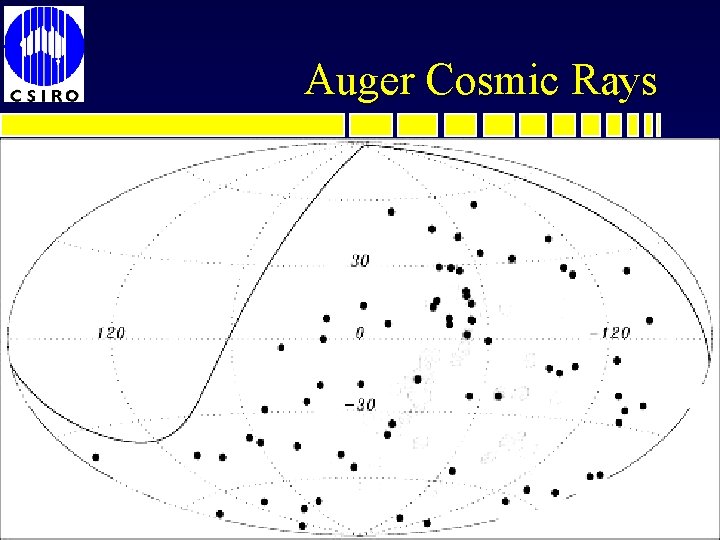
Auger Cosmic Rays 10 Dec 2006 29
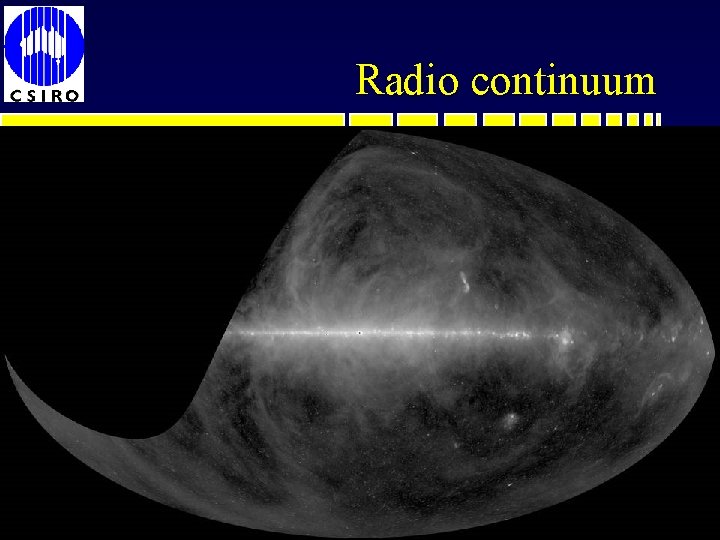
Radio continuum 10 Dec 2006 30
Auger UHE Cosmic Rays from Centaurus A n n 19/84 events within o 24 7. 6 expected But not predicted so cant calculate probability! BUT! – Ginzburg & Syrovatskii (1963) Jan 2012 Ekers 31
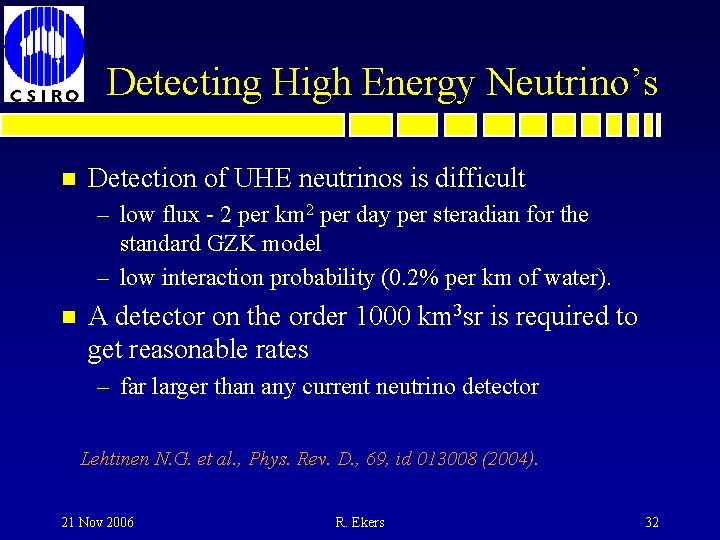
Detecting High Energy Neutrino’s n Detection of UHE neutrinos is difficult – low flux - 2 per km 2 per day per steradian for the standard GZK model – low interaction probability (0. 2% per km of water). n A detector on the order 1000 km 3 sr is required to get reasonable rates – far larger than any current neutrino detector Lehtinen N. G. et al. , Phys. Rev. D. , 69, id 013008 (2004). 21 Nov 2006 R. Ekers 32
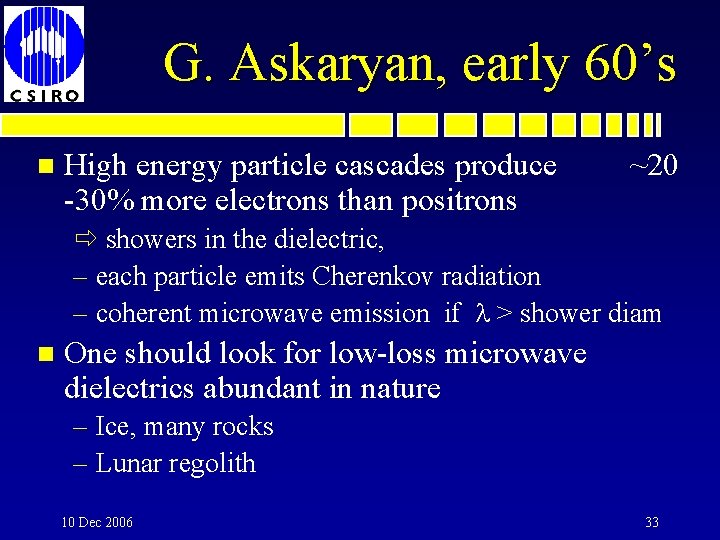
G. Askaryan, early 60’s n High energy particle cascades produce -30% more electrons than positrons ~20 ð showers in the dielectric, – each particle emits Cherenkov radiation – coherent microwave emission if > shower diam n One should look for low-loss microwave dielectrics abundant in nature – Ice, many rocks – Lunar regolith 10 Dec 2006 33
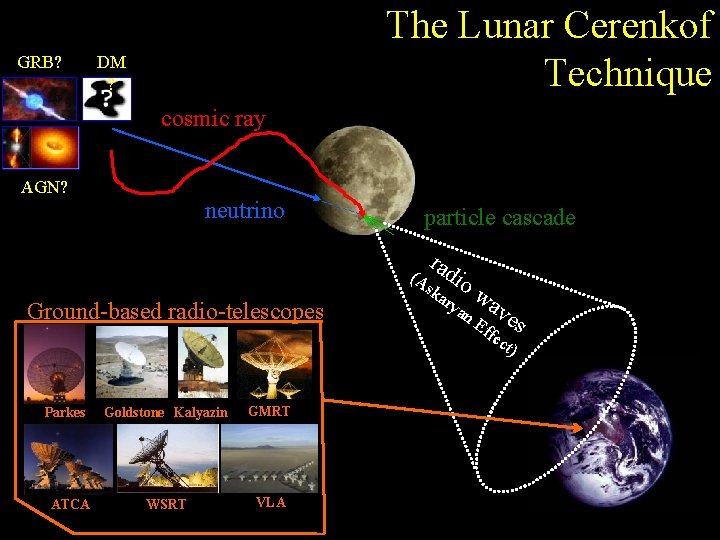
GRB? The Lunar Cerenkof Technique DM ? cosmic ray AGN? neutrino particle cascade (A Ground-based radio-telescopes Parkes ATCA Goldstone Kalyazin GMRT WSRT VLA rad sk io w ary an Ef av fec es t)
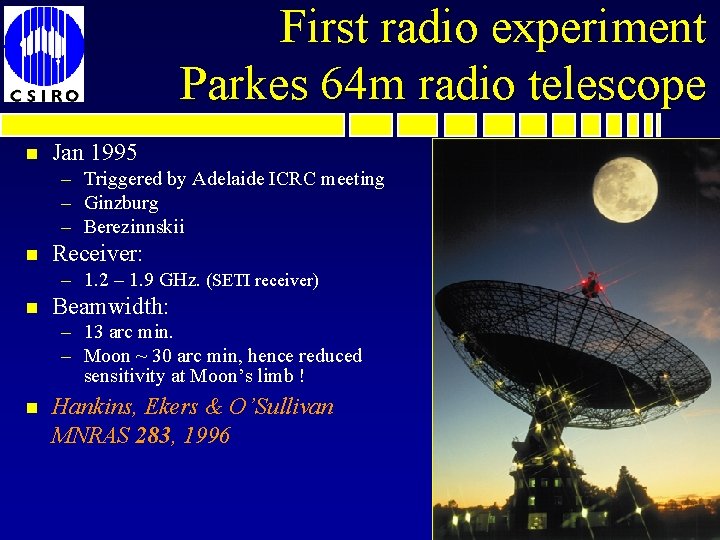
First radio experiment Parkes 64 m radio telescope n Jan 1995 – Triggered by Adelaide ICRC meeting – Ginzburg – Berezinnskii n Receiver: – 1. 2 – 1. 9 GHz. (SETI receiver) n Beamwidth: – 13 arc min. – Moon ~ 30 arc min, hence reduced sensitivity at Moon’s limb ! n Hankins, Ekers & O’Sullivan MNRAS 283, 1996 35
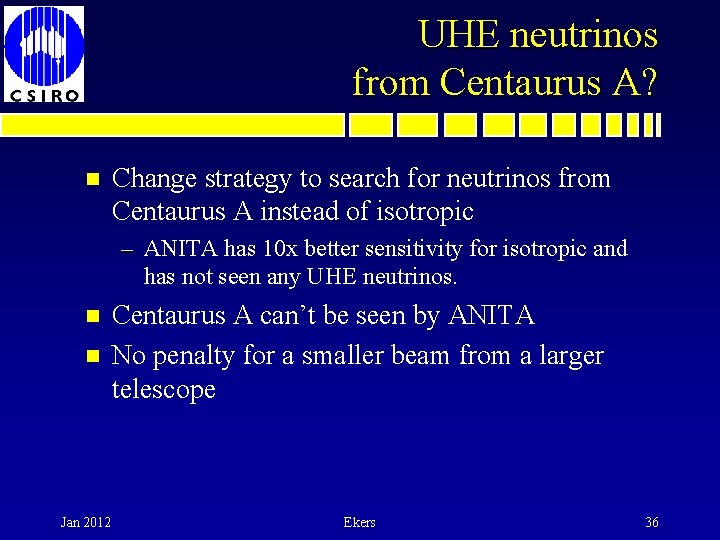
UHE neutrinos from Centaurus A? n Change strategy to search for neutrinos from Centaurus A instead of isotropic – ANITA has 10 x better sensitivity for isotropic and has not seen any UHE neutrinos. n n Jan 2012 Centaurus A can’t be seen by ANITA No penalty for a smaller beam from a larger telescope Ekers 36
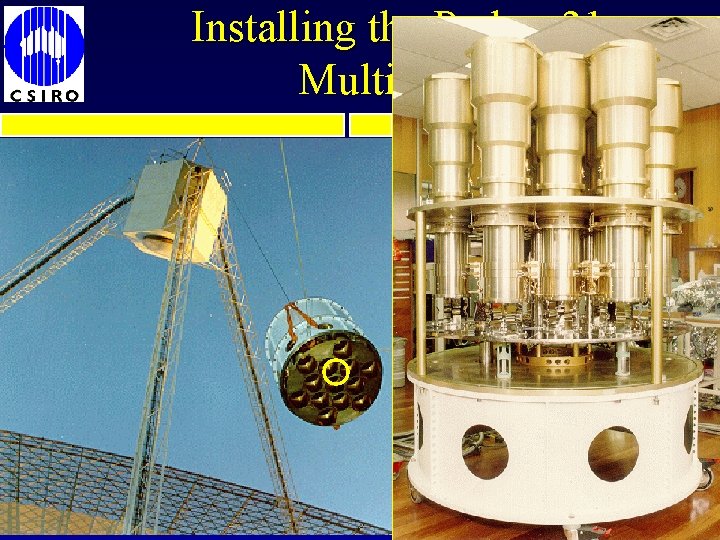
Installing the Parkes 21 cm Multibeam Receiver 10 Dec 2006 37
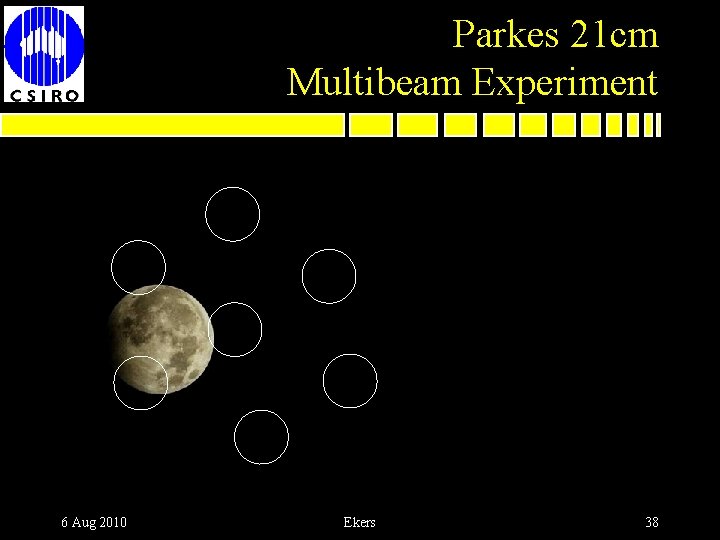
Parkes 21 cm Multibeam Experiment 6 Aug 2010 Ekers 38
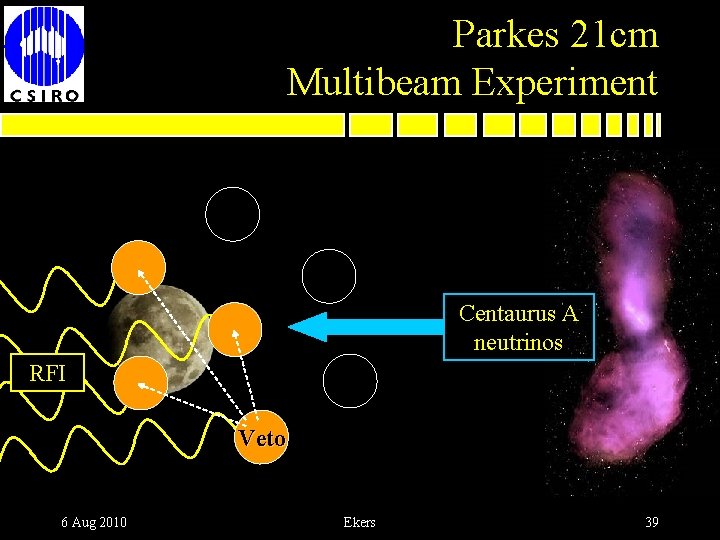
Parkes 21 cm Multibeam Experiment Centaurus A neutrinos RFI Veto 6 Aug 2010 Ekers 39
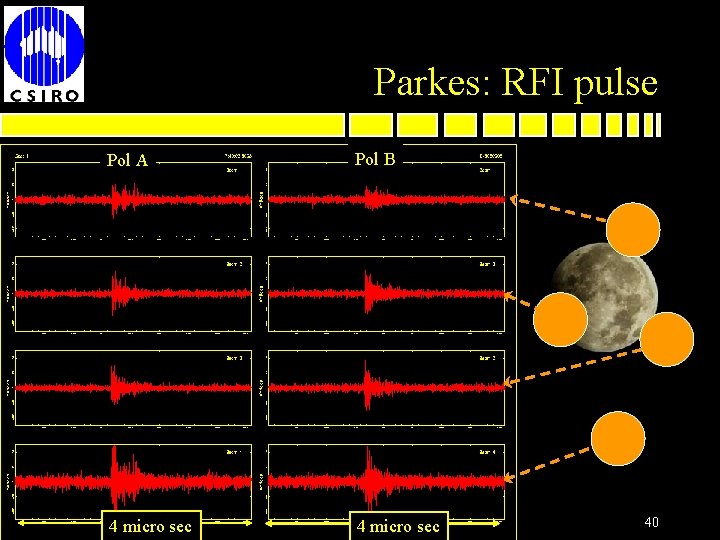
Parkes: RFI pulse Pol B Pol A 6 Aug 2010 4 micro sec Ekers 4 micro sec 40
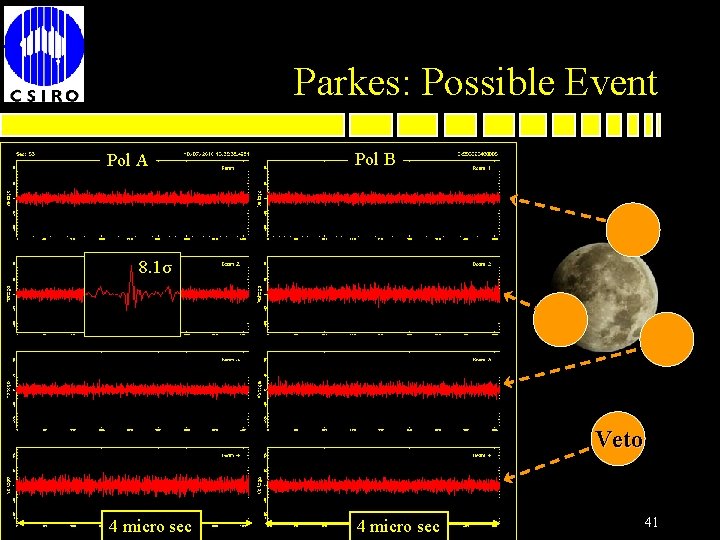
Parkes: Possible Event Pol B Pol A 8. 1σ Veto 6 Aug 2010 4 micro sec Ekers 4 micro sec 41
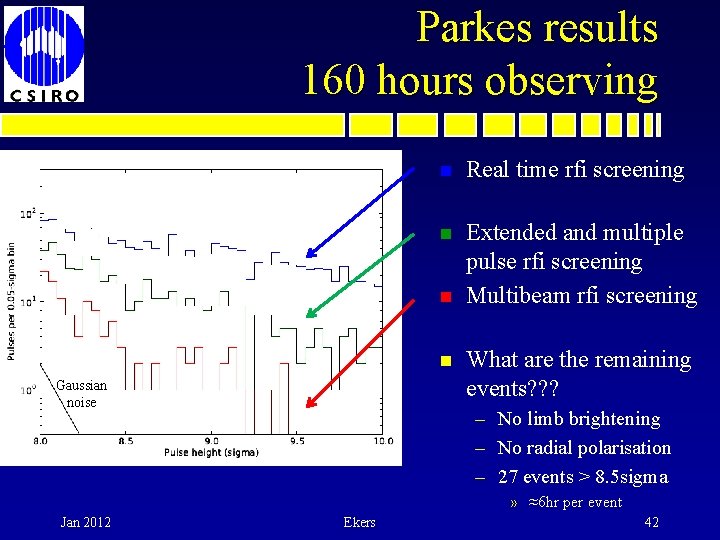
Parkes results 160 hours observing n Real time rfi screening n Extended and multiple pulse rfi screening Multibeam rfi screening n n Gaussian noise What are the remaining events? ? ? – No limb brightening – No radial polarisation – 27 events > 8. 5 sigma » ≈6 hr per event Jan 2012 Ekers 42
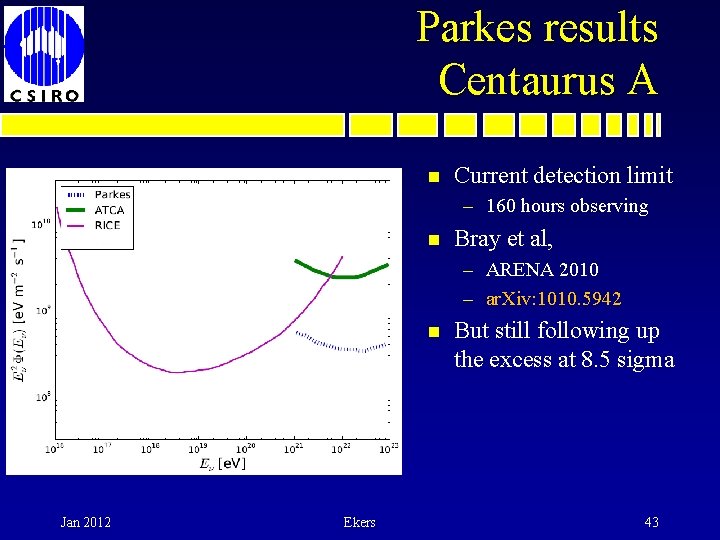
Parkes results Centaurus A n Current detection limit – 160 hours observing n Bray et al, – ARENA 2010 – ar. Xiv: 1010. 5942 n Jan 2012 Ekers But still following up the excess at 8. 5 sigma 43
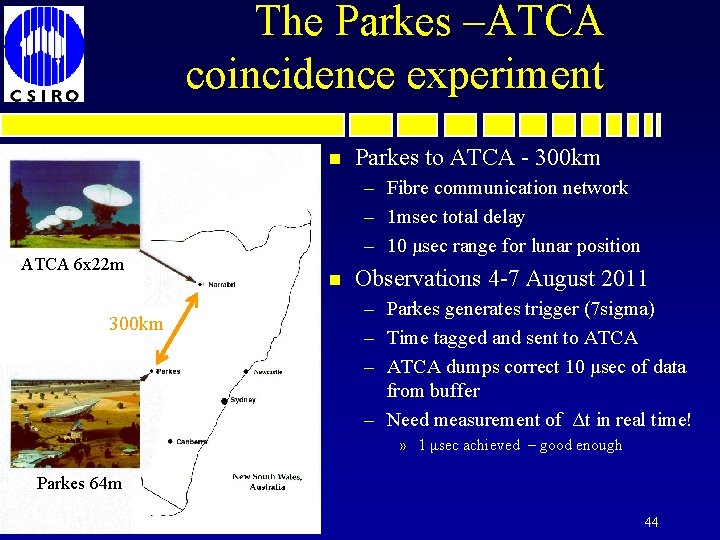
The Parkes –ATCA coincidence experiment n ATCA 6 x 22 m 300 km Parkes to ATCA - 300 km – Fibre communication network – 1 msec total delay – 10 μsec range for lunar position n Observations 4 -7 August 2011 – Parkes generates trigger (7 sigma) – Time tagged and sent to ATCA – ATCA dumps correct 10 μsec of data from buffer – Need measurement of Δt in real time! » 1 μsec achieved – good enough Parkes 64 m 44
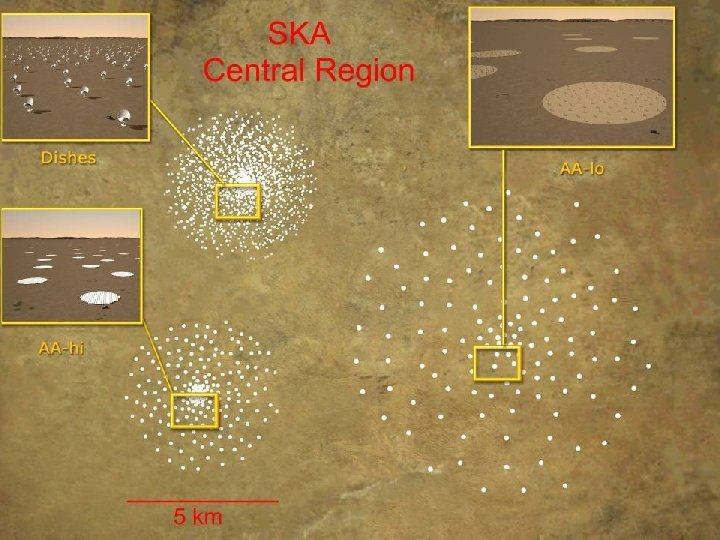
SKA 10 Dec 2006 45
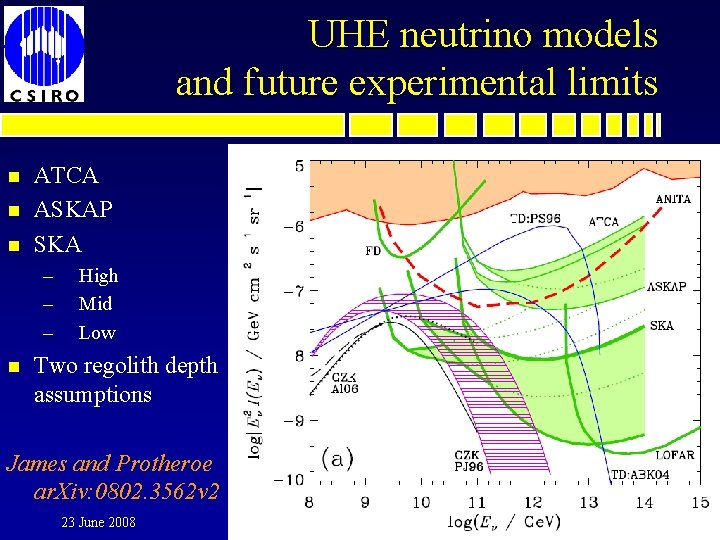
UHE neutrino models and future experimental limits n n n ATCA ASKAP SKA – – – n High Mid Low Two regolith depth assumptions James and Protheroe ar. Xiv: 0802. 3562 v 2 23 June 2008 46