
Radio Telescopes Angular resolution Distant objects are separated
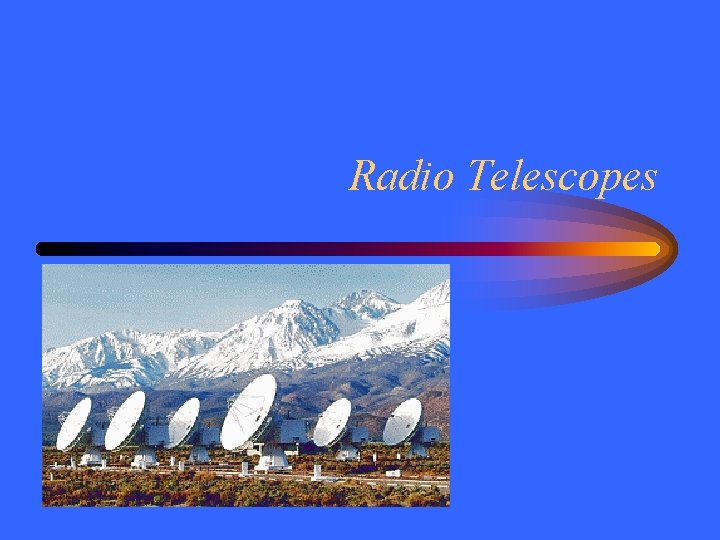
Radio Telescopes

Angular resolution • Distant objects are separated by an angle. – Degrees, arc-minutes, arc-seconds • Angular resolution refers to the ability to see objects that are close together. primary focal point eyepiece
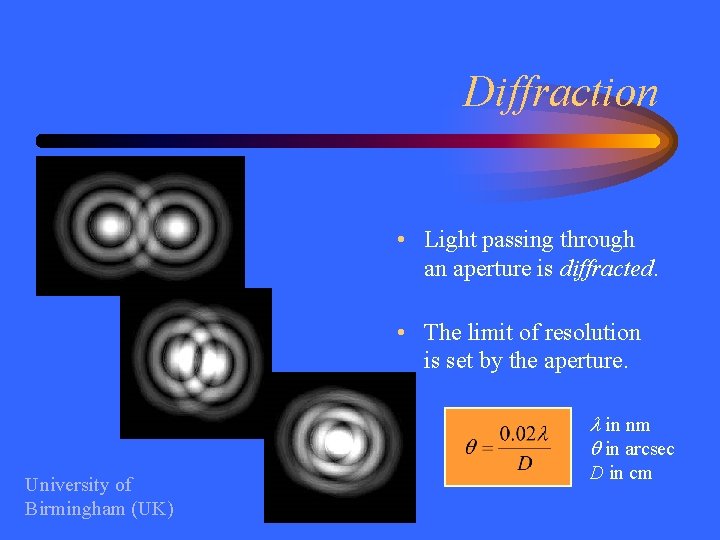
Diffraction • Light passing through an aperture is diffracted. • The limit of resolution is set by the aperture. l in nm q in arcsec University of Birmingham (UK) D in cm
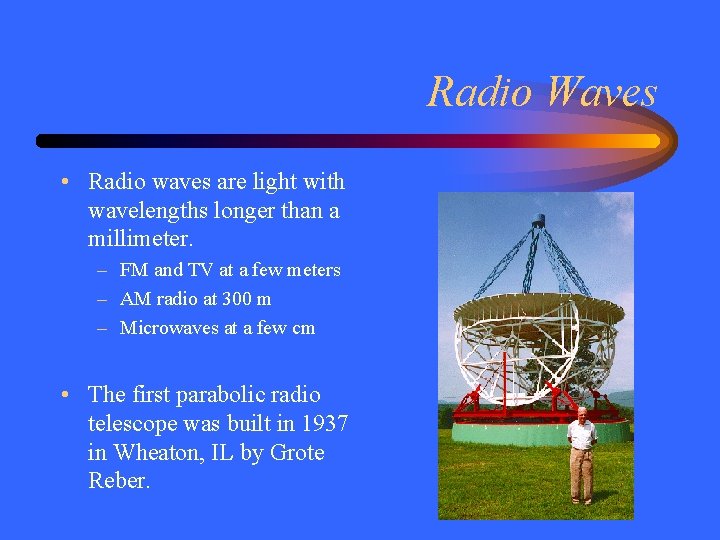
Radio Waves • Radio waves are light with wavelengths longer than a millimeter. – FM and TV at a few meters – AM radio at 300 m – Microwaves at a few cm • The first parabolic radio telescope was built in 1937 in Wheaton, IL by Grote Reber.
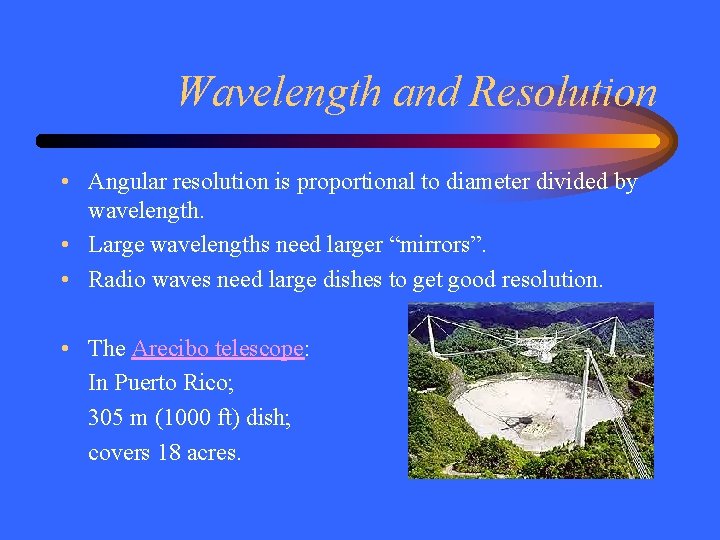
Wavelength and Resolution • Angular resolution is proportional to diameter divided by wavelength. • Large wavelengths need larger “mirrors”. • Radio waves need large dishes to get good resolution. • The Arecibo telescope: In Puerto Rico; 305 m (1000 ft) dish; covers 18 acres.
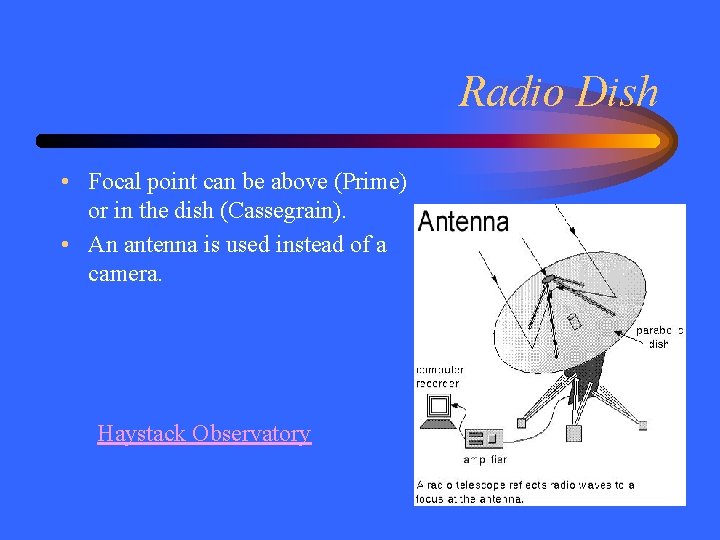
Radio Dish • Focal point can be above (Prime) or in the dish (Cassegrain). • An antenna is used instead of a camera. Haystack Observatory
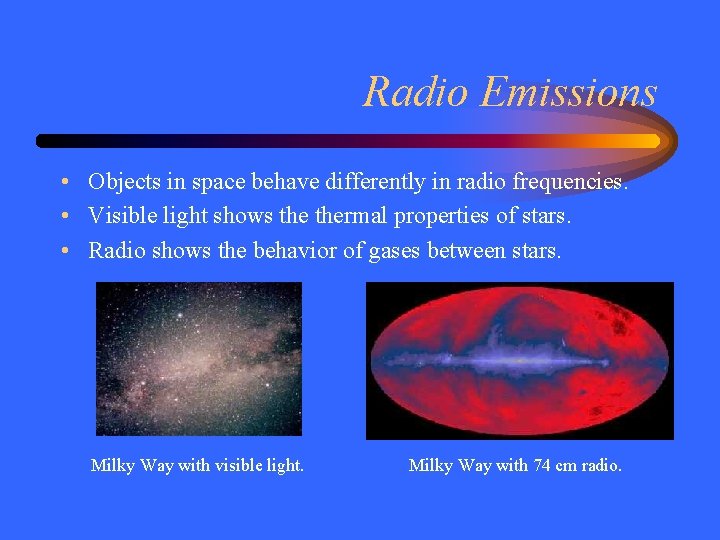
Radio Emissions • Objects in space behave differently in radio frequencies. • Visible light shows thermal properties of stars. • Radio shows the behavior of gases between stars. Milky Way with visible light. Milky Way with 74 cm radio.
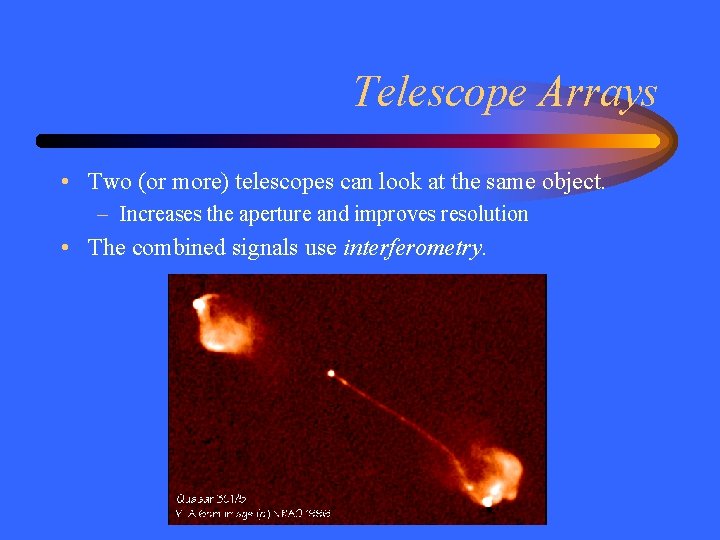
Telescope Arrays • Two (or more) telescopes can look at the same object. – Increases the aperture and improves resolution • The combined signals use interferometry.
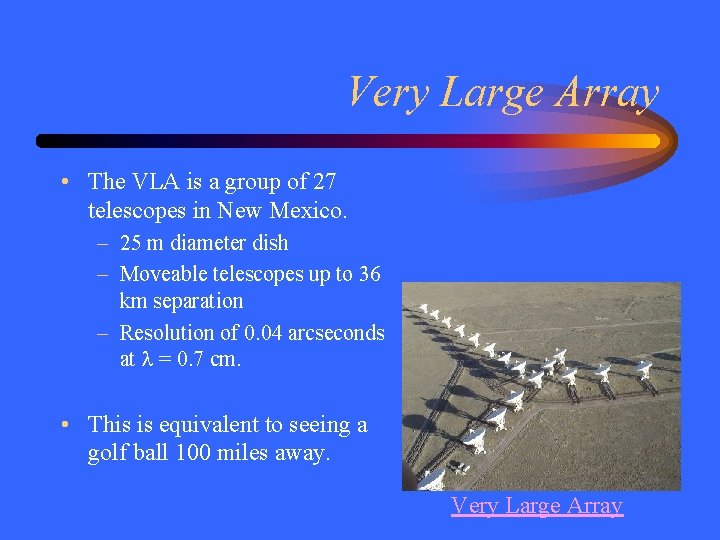
Very Large Array • The VLA is a group of 27 telescopes in New Mexico. – 25 m diameter dish – Moveable telescopes up to 36 km separation – Resolution of 0. 04 arcseconds at l = 0. 7 cm. • This is equivalent to seeing a golf ball 100 miles away. Very Large Array
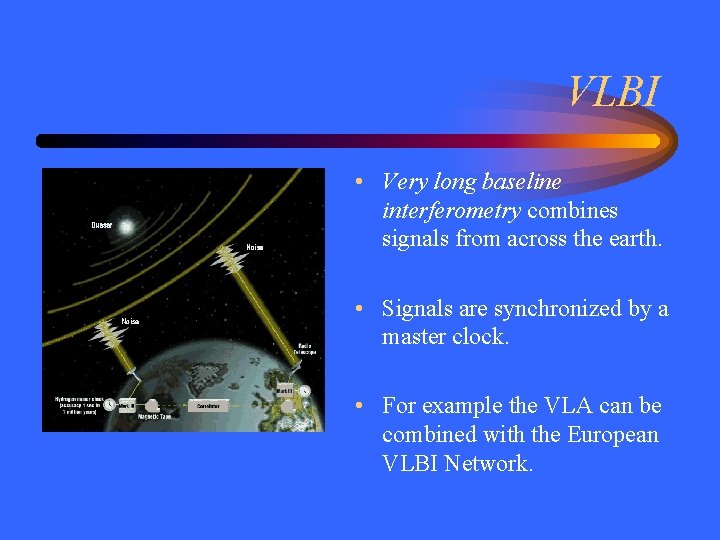
VLBI • Very long baseline interferometry combines signals from across the earth. • Signals are synchronized by a master clock. • For example the VLA can be combined with the European VLBI Network.
- Slides: 10