
RADIO SPECTRUM MANAGEMENT Prepared by Torsten JACOB ANBCNS
RADIO SPECTRUM MANAGEMENT Prepared by Torsten JACOB ANB/CNS ICAO Radio Spectrum Seminar MID Office, Cairo, 4 – 6 June 2006 1
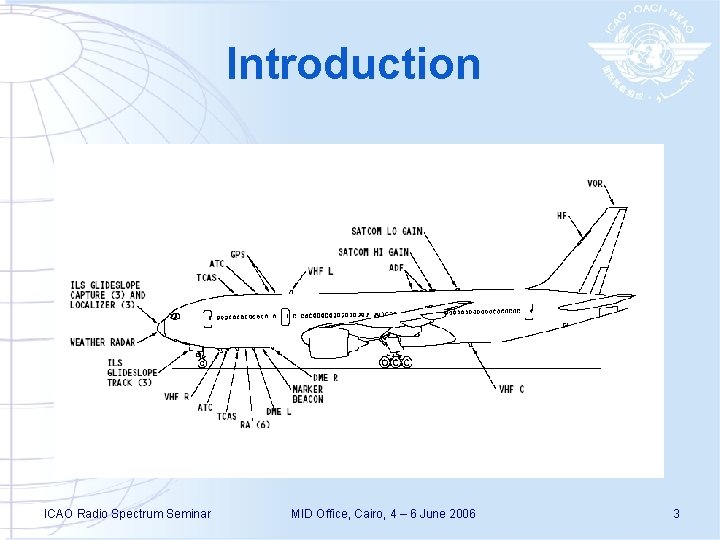
Introduction Q Aircraft operation would neither be safe nor be capable of meeting the global demand for rapid and cost-effective transport without aeronautical radio services. Q Radio spectrum is a scarce natural resource with finite capacity limits and constantly increasing demands. Q Radio frequency spectrum congestion imposes the need for an efficient and effective spectrum and frequency management system. ICAO Radio Spectrum Seminar MID Office, Cairo, 4 – 6 June 2006 2
Introduction ICAO Radio Spectrum Seminar MID Office, Cairo, 4 – 6 June 2006 3
Spectrum and Frequency Management Q Spectrum management is the combination of administrative and technical procedures necessary to ensure the interference-free and efficient operation of radio services (e. g. Radionavigation). Q Frequency management deals with the assignment of frequencies to transmitting and/or receiving stations (e. g. airborne radio station). ICAO Radio Spectrum Seminar MID Office, Cairo, 4 – 6 June 2006 4
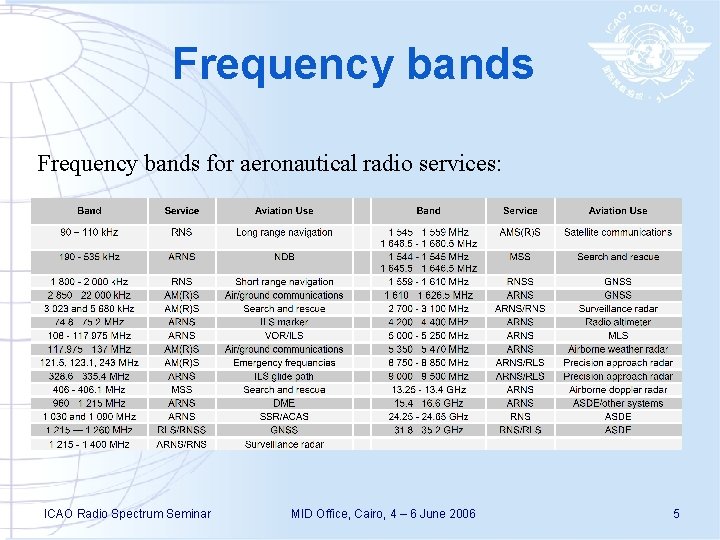
Frequency bands for aeronautical radio services: ICAO Radio Spectrum Seminar MID Office, Cairo, 4 – 6 June 2006 5
ITU Q The International Telecommunication Union (ITU) is the specialized agency of the United Nations for telecommunications matters where international agreements are made on the use of the radio frequency spectrum Q ITU Radio Regulations provide a basis for the regulation of radio frequency spectrum between 9 k. Hz and 275 GHz ICAO Radio Spectrum Seminar MID Office, Cairo, 4 – 6 June 2006 6

ICAO Q Was created in 1944 to promote the safe and orderly development of civil aviation in the world Q Specialized agency of the United Nations, sets international Standards and Regulations necessary for the safety, security, efficiency and regularity of air transport… ICAO Radio Spectrum Seminar MID Office, Cairo, 4 – 6 June 2006 7
ICAO’s role Q Analyze the agenda of ITU WRC’s (World Radiocommunication Conferences) Q Develop an ICAO position Q Work with ITU and Regional Telecommunications Organizations (APT, CEPT, CITEL…) Q Submit the approved position to States and ITU Q Participate in WRC’s ICAO Radio Spectrum Seminar MID Office, Cairo, 4 – 6 June 2006 8
Main goals for WRC-07 Q Protect airborne weather radar and primary radar systems for short‑range applications including precision approach radar and airport surface detection equipment (ASDE) Q Protect high frequency (HF) bands used for aeronautical communications and to review regulatory and operational provisions for maritime mobile service identities (MMSIs) on search and rescue aircraft Q Introduce additional global spectrum allocations to accommodate new applications to satisfy future air traffic management (ATM) and potential aviation security requirements ICAO Radio Spectrum Seminar MID Office, Cairo, 4 – 6 June 2006 9
What is expected from States Q Assist in the development of the ICAO position Q Participate with aviation experts in the work of ITU and Regional Telecommunications Organizations Q Send aviation experts to WRC’s (A 32 -13) Q Support ICAO position (Assembly Resolution A 32 -13) Q WRC-2007 – Geneva Switzerland, October 2007 Q Next WRC – 2010 ICAO Radio Spectrum Seminar MID Office, Cairo, 4 – 6 June 2006 10
Thank You Any questions? ICAO Radio Spectrum Seminar MID Office, Cairo, 4 – 6 June 2006 11
- Slides: 11