
Radio Resource Management Roy Yates WINLAB Rutgers University
Radio Resource Management Roy Yates WINLAB, Rutgers University Airlie House Workshop 1
What is Radio Resource Mgmt? • Assign channel, xmit power for each user – Cellular networks, packet radio networks Receiver Technology User Services How does it work? How well does it work? 2
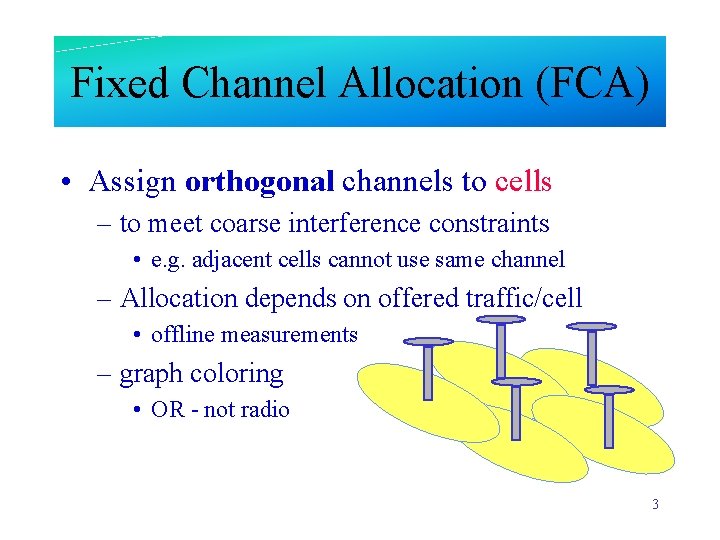
Fixed Channel Allocation (FCA) • Assign orthogonal channels to cells – to meet coarse interference constraints • e. g. adjacent cells cannot use same channel – Allocation depends on offered traffic/cell • offline measurements – graph coloring • OR - not radio 3
FCA Problems • Traffic in each cell? • Coarse interference constraints – Interference depends on detailed propagation • Microcells require too many measurements • Better heuristics offer small performance benefits 4

Dynamic Channel Allocation • Queueing network models – No measurements, partial state information • max packing, borrowing – [Everitt 89] [Cimini, Foschini, I, Miljanic, 94] – Measurements: • Least Interference, Maxmin SIR? • Common Wisdom: – DCA for light loads, FCA for high loads 5
Impact of Qualcomm IS-95 • 1 channel: no frequency planning • CDMA research became practical – Existence proof that power control could work – Any interference suppression helps • Multiuser Detection • Emphasis on signal measurements 6
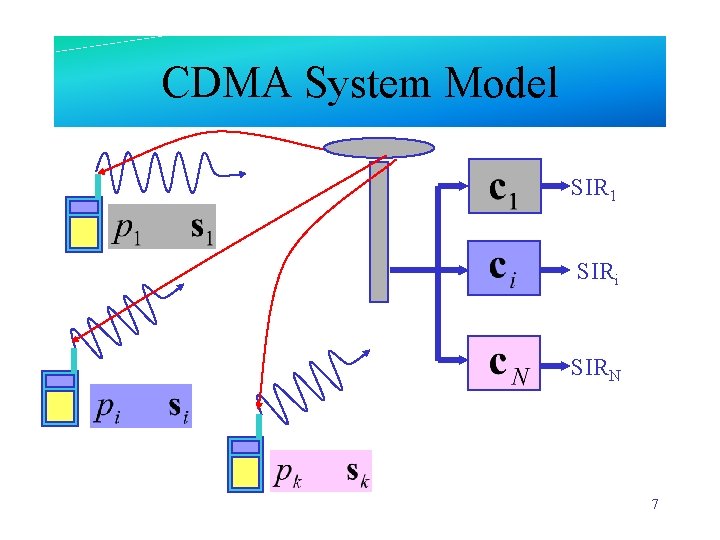
CDMA System Model SIR 1 SIRi SIRN 7
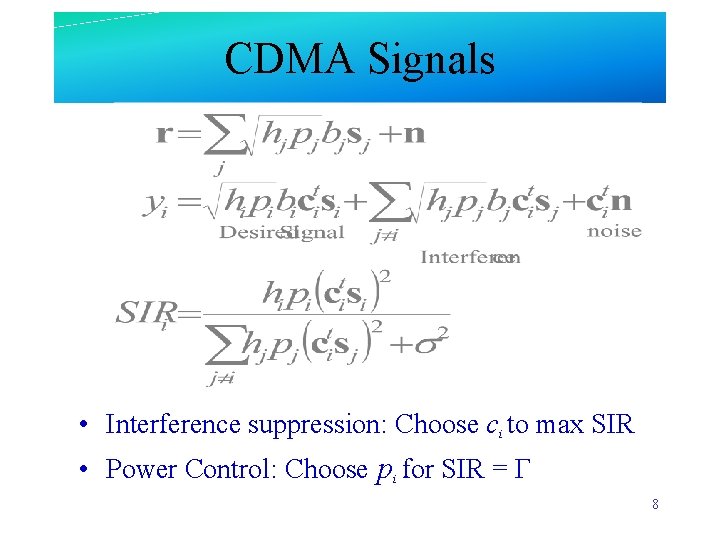
CDMA Signals • Interference suppression: Choose ci to max SIR • Power Control: Choose pi for SIR = Γ 8
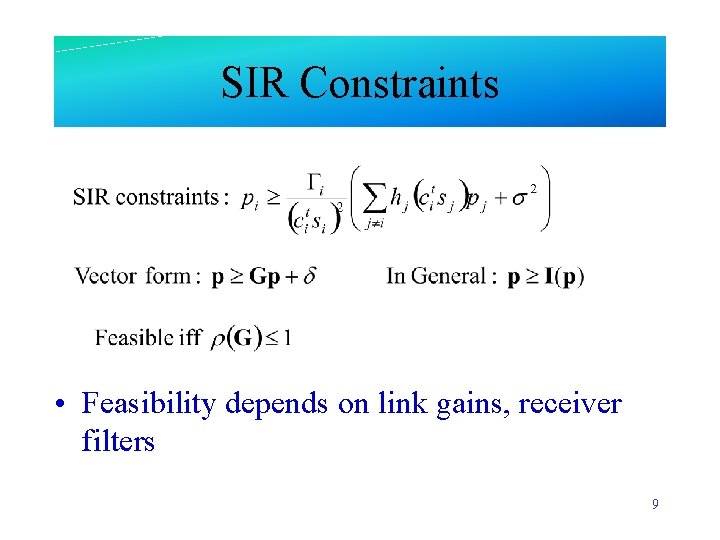
SIR Constraints • Feasibility depends on link gains, receiver filters 9
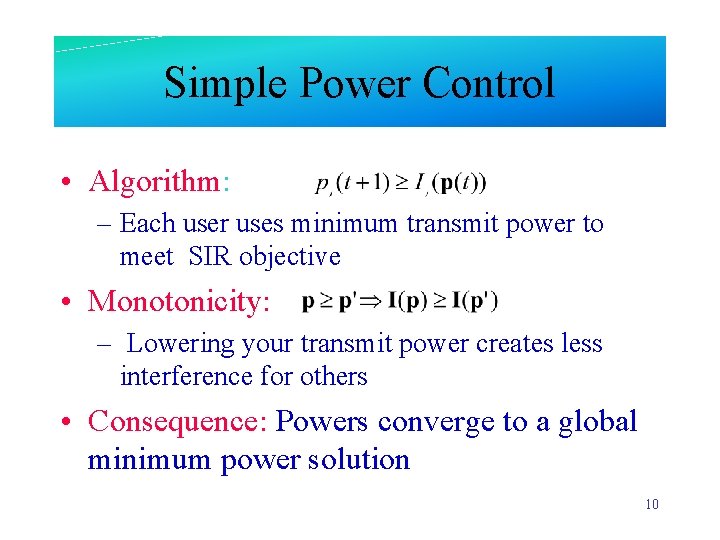
Simple Power Control • Algorithm: – Each user uses minimum transmit power to meet SIR objective • Monotonicity: – Lowering your transmit power creates less interference for others • Consequence: Powers converge to a global minimum power solution 10
Adaptive Power Control • SIR Balancing – [Aein 73, Nettleton 83, Zander 92, Foschini&Miljanic 93] • Integrated BS Assignment – [Hanly 95, Yates 95] • Macrodiversity – [Hanly 94] • Link Protection/Admission Control – [Bambos, Pottie 94], [Andersin, Rosberg, Zander 95] • Note: Adaptive PC analysis is deterministic 11
CDMA and Antenna Arrays • si =CDMA signature Antenna signature • ci = Receiver filter Antenna weights • CDMA Interference Suppression – in signal space – e. g. [Lupas, Verdu, 89] • Antenna beamforming – in real space – [Winters, Salz, Gitlin 94] 12
![Linear Filtering with Power Control • 2 step Algorithm: – [Rashid-Farrokhi, Tassiulas, Liu], [Ulukus,](http://slidetodoc.com/presentation_image_h2/18f73c4b49d5e7ad2c347abcd7dbf7bb/image-13.jpg "Linear Filtering with Power Control • 2 step Algorithm: – [Rashid-Farrokhi, Tassiulas, Liu], [Ulukus,")
Linear Filtering with Power Control • 2 step Algorithm: – [Rashid-Farrokhi, Tassiulas, Liu], [Ulukus, Yates] – Adapt receiver filter to maximize SIR • Given powers, use MMSE filter [Madhow, Honig 94] – Given receiver, use min transmit power to meet SIR target • Converges to global minimum power solution 13
Wireless Voice vs Wireless Data • Voice – Delay sensitive • msec OK – Maximum rate – Minimize the probability of outage • Data – Delay insensitive • sec OK? hours OK? – No Maximum Rate – Maximize the time average data rate 14
Wireless Data • Current Data Standards – Cellular modem, CDPD (AMPS) – IS-99/IS-707 (for IS-95) – GPRS (for GSM) Low rate service, cellular price • Proposed Solutions: – EDGE, space time codes – 3 G WCDMA Complex solutions 15
Optimizing Data Services • Channel Quality (link gain) is stochastic – Rayleigh and shadow Fading, – Distance propagation • Use more power when the channel is good • Reduce power when the channel is bad – Water filling in time • [Goldsmith 94+] 16
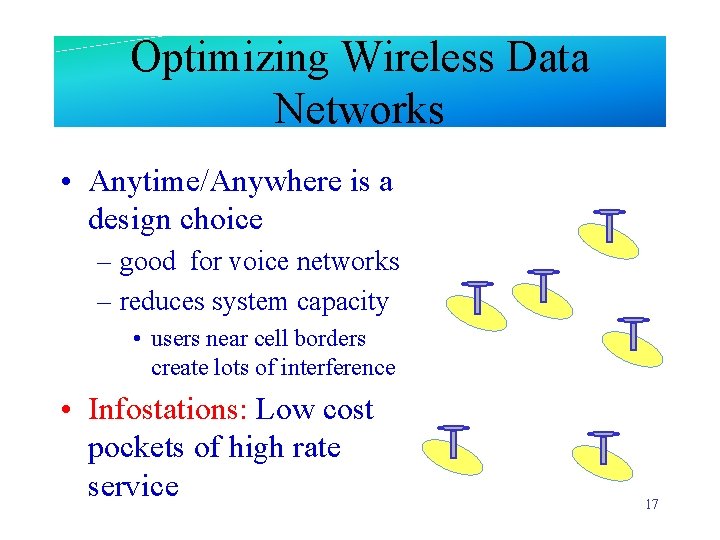
Optimizing Wireless Data Networks • Anytime/Anywhere is a design choice – good for voice networks – reduces system capacity • users near cell borders create lots of interference • Infostations: Low cost pockets of high rate service 17
Unlicensed Bands • FCC allocated 3 bands (each 100 MHz) around 5 GHz • Minimal power/bandwidth requirements • No required etiquette • How can or should it be used? – Dominant uses? • Non-cooperative system interference 18
Interference Avoidance • Old Assumption: Signatures of users never change • New Approach: Adapt signatures to improve SIR – Receiver feedback tells transmitter how to adapt. • Application: – Fixed Wireless – Unlicensed Bands 19
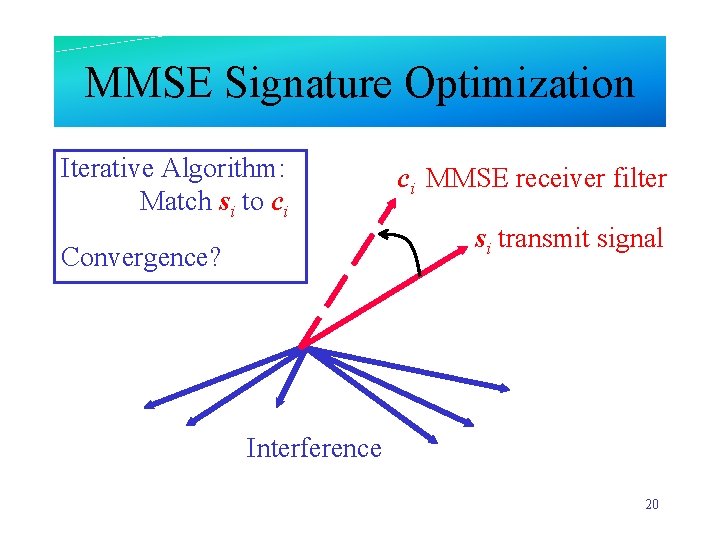
MMSE Signature Optimization Iterative Algorithm: Match si to ci ci MMSE receiver filter si transmit signal Convergence? Interference 20
Optimal Signatures • N users, proc gain G, N>G • Signature set: S =[s 1 | s 2 | … |s. N] • Optimal Signatures? – IT Sum capacity: [Rupf, Massey] – User Capacity [Viswanath, Anantharam, Tse] • WBE sequences: SSt =(N/L)I are optimal – Property: MMSE filter =matched filter 21
MMSE Signature Optimization • RX i converges to MMSE filter ci • TX i matches RX: si = ci – Some users see more interference, others less – Other users iterate in response • Preliminary Result: – Users at 1 BS converge to optimal WBE signatures • Interference Avoidance – Generalizations to arbitrary systems 22
Unresolved Questions • Multicell systems: – Capacity? • Old Problem: Interference Channel – MMSE Effectiveness? • Dimensionality of antenna arrays? • Systems in unlicensed bands? • Architectures for Data Networks? 23
- Slides: 23