
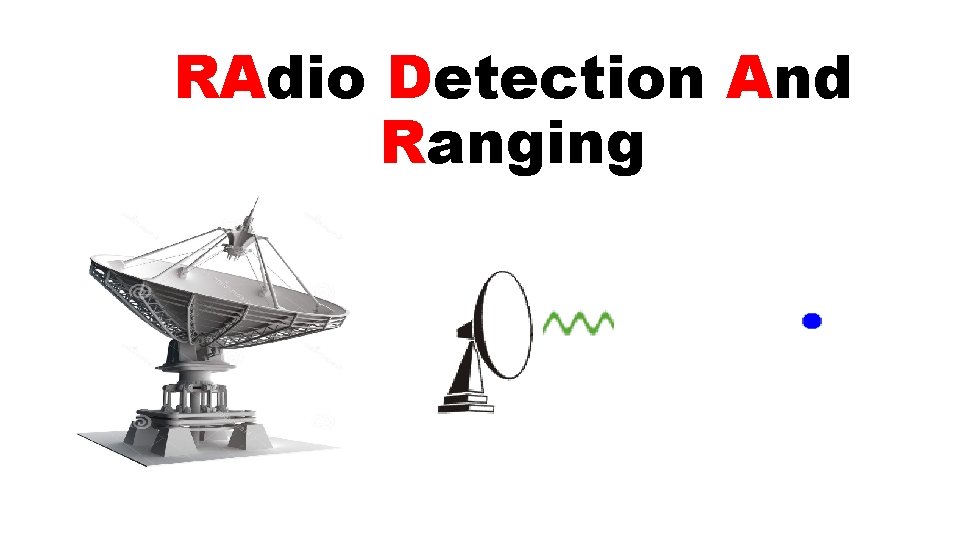
RAdio Detection And Ranging ECE Dept 2 1
- Slides: 12
RAdio Detection And Ranging
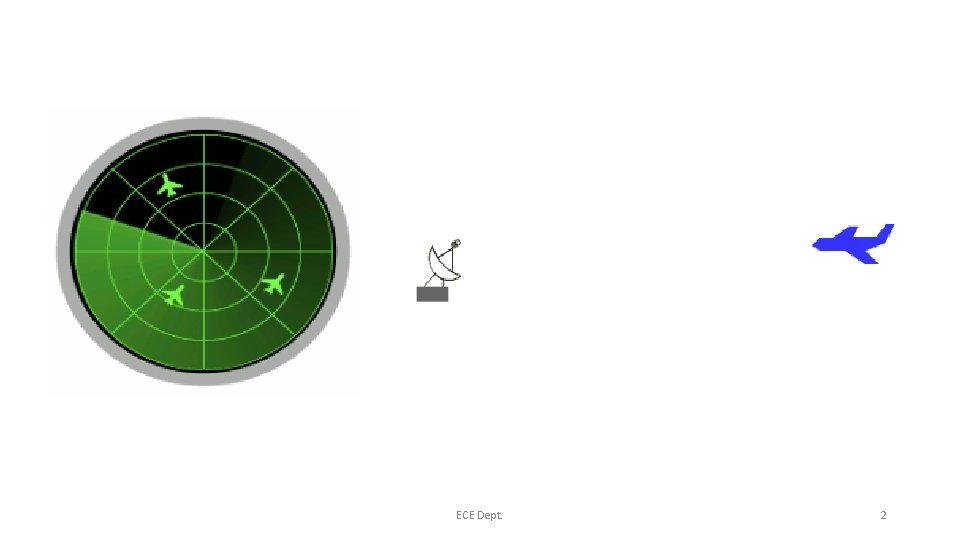
ECE Dept. 2
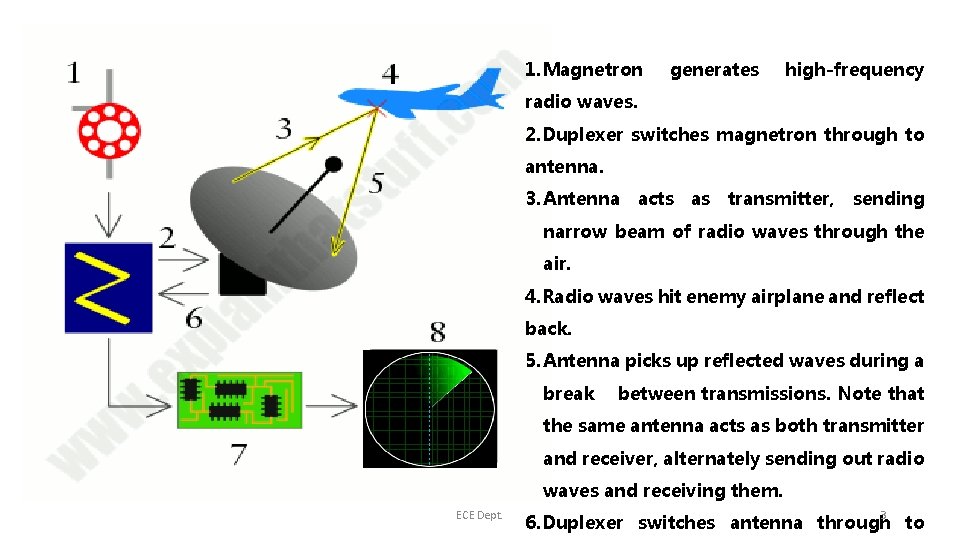
1. Magnetron generates high-frequency radio waves. 2. Duplexer switches magnetron through to antenna. 3. Antenna acts as transmitter, sending narrow beam of radio waves through the air. 4. Radio waves hit enemy airplane and reflect back. 5. Antenna picks up reflected waves during a break between transmissions. Note that the same antenna acts as both transmitter and receiver, alternately sending out radio waves and receiving them. ECE Dept. 3 6. Duplexer switches antenna through to
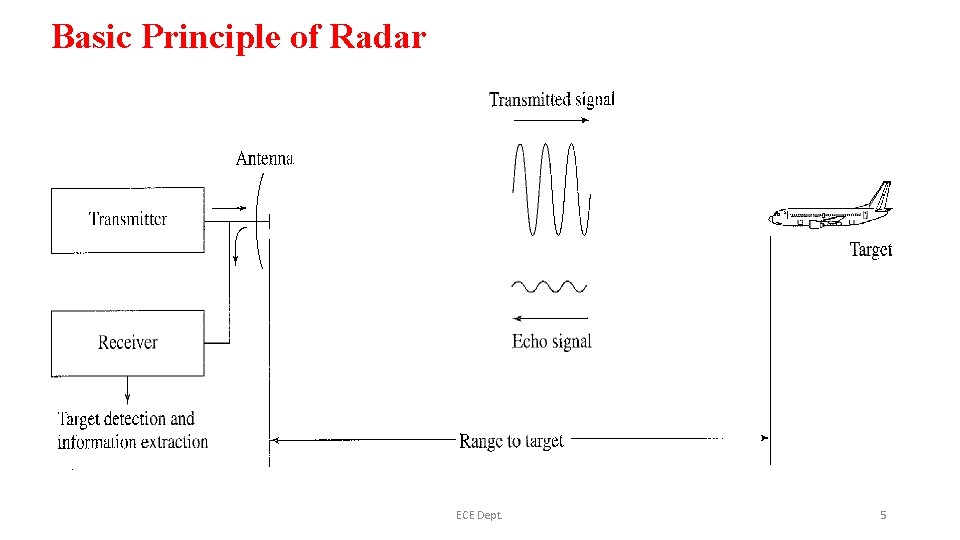
What is radar? • Radar is an electromagnetic system for detection and location of reflecting objects such as aircraft, ships, people etc. . • It has ability to measure the distance with high accuracy in all weather condition like fog, rain, snow, night etc. . ECE Dept. 4
Basic Principle of Radar ECE Dept. 5
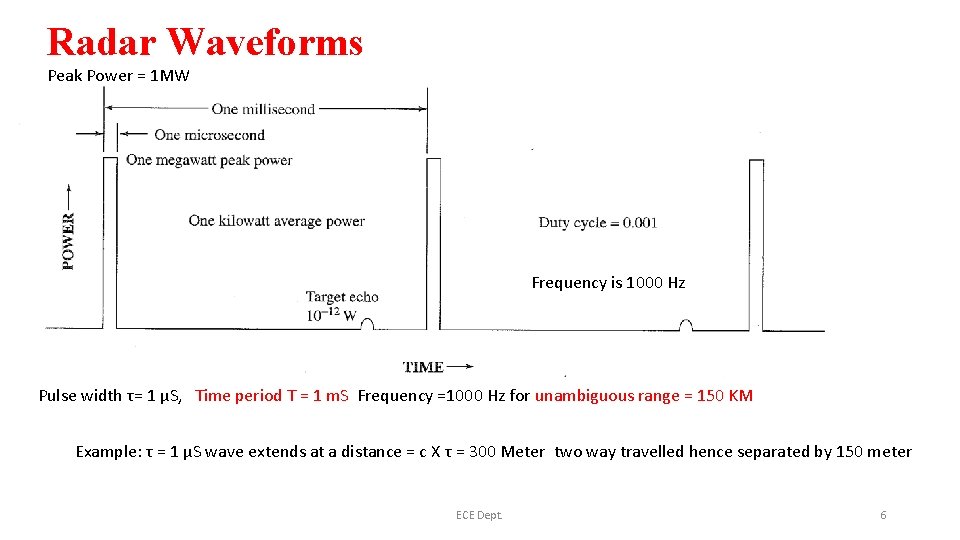
Radar Waveforms Peak Power = 1 MW Frequency is 1000 Hz Pulse width τ= 1 μS, Time period T = 1 m. S Frequency =1000 Hz for unambiguous range = 150 KM Example: τ = 1 μS wave extends at a distance = c X τ = 300 Meter two way travelled hence separated by 150 meter ECE Dept. 6
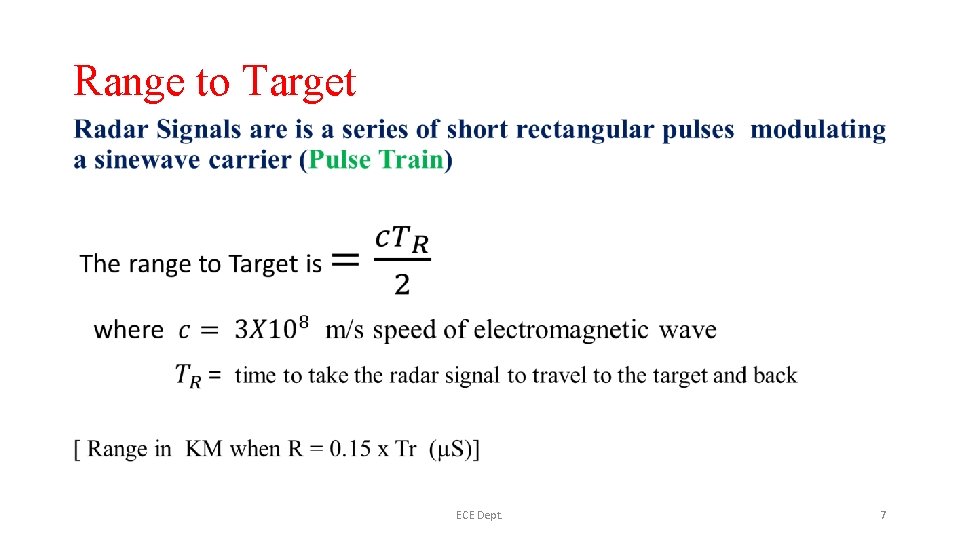
Range to Target • ECE Dept. 7
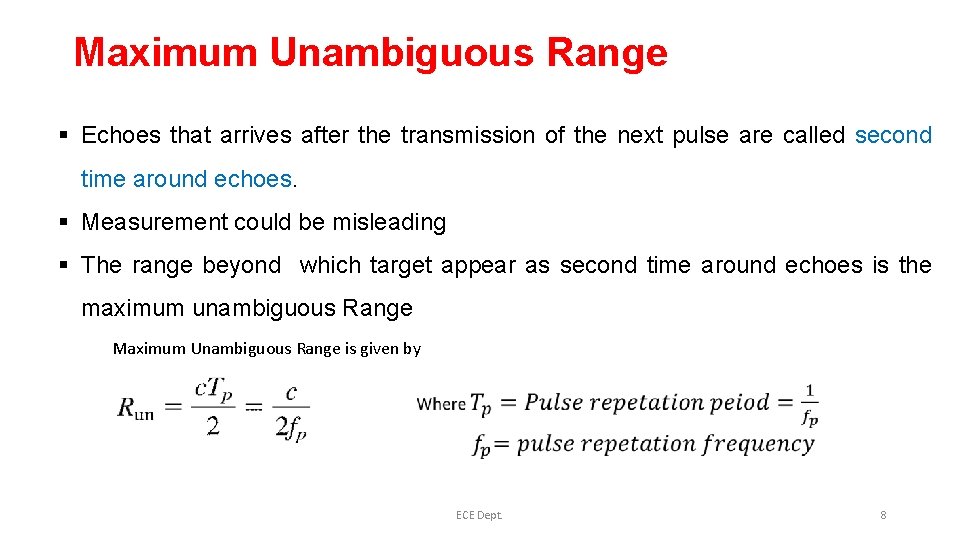
Maximum Unambiguous Range § Echoes that arrives after the transmission of the next pulse are called second time around echoes. § Measurement could be misleading § The range beyond which target appear as second time around echoes is the maximum unambiguous Range Maximum Unambiguous Range is given by ECE Dept. 8
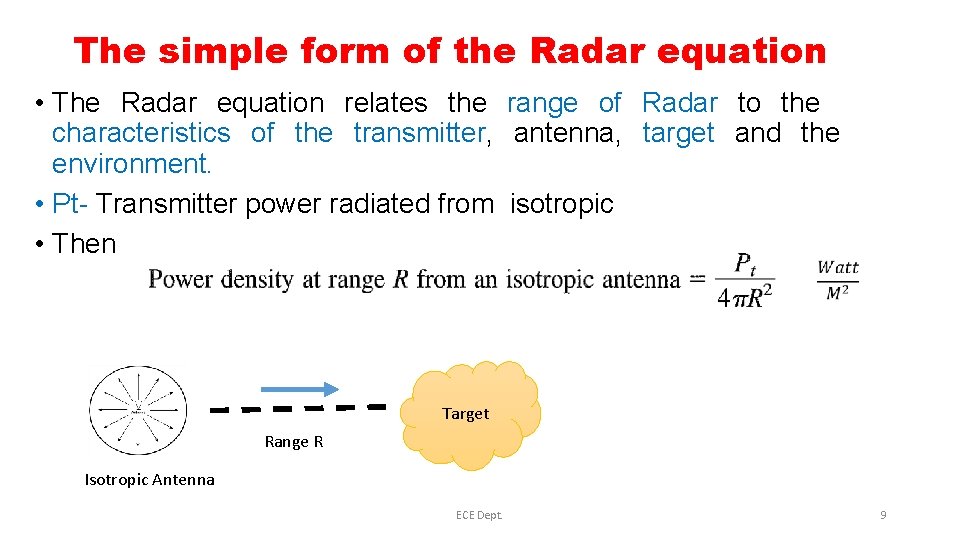
The simple form of the Radar equation • The Radar equation relates the range of Radar to the characteristics of the transmitter, antenna, target and the environment. • Pt- Transmitter power radiated from isotropic • Then Target Range R Isotropic Antenna ECE Dept. 9
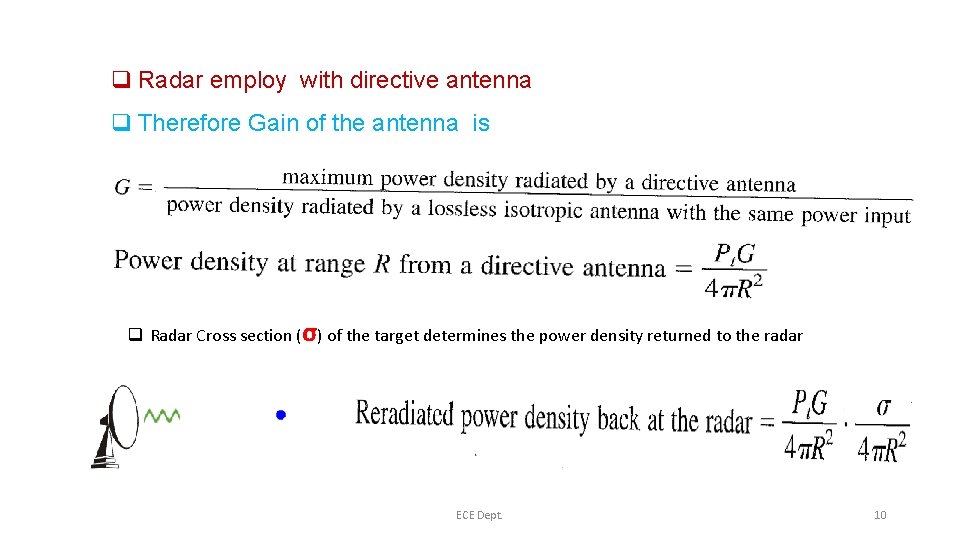
q Radar employ with directive antenna q Therefore Gain of the antenna is q Radar Cross section (σ) of the target determines the power density returned to the radar ECE Dept. 10
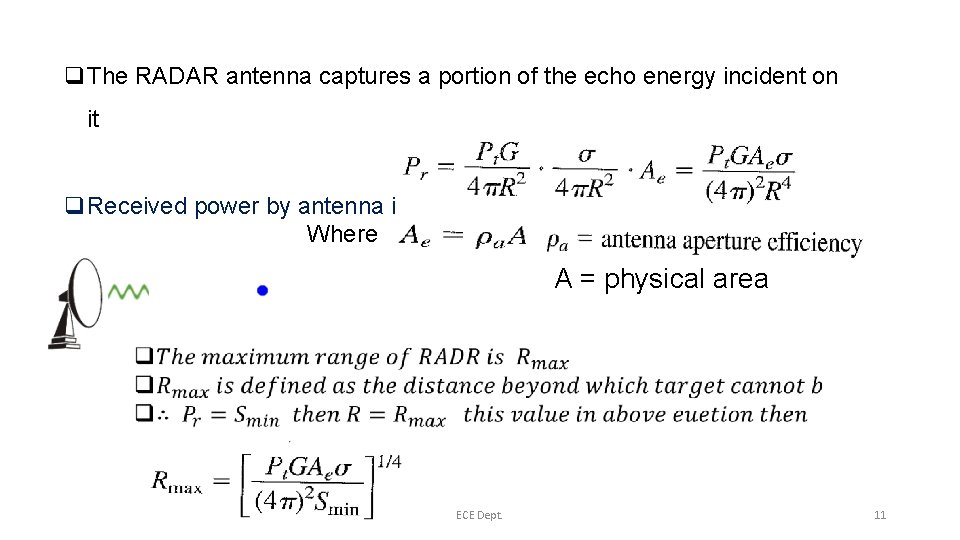
q. The RADAR antenna captures a portion of the echo energy incident on it q. Received power by antenna is Where A = physical area ECE Dept. 11
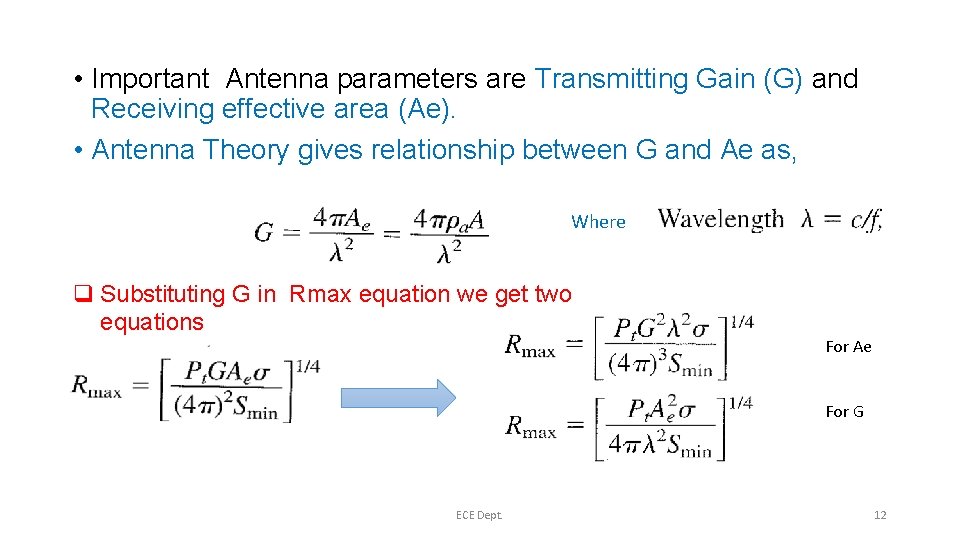
• Important Antenna parameters are Transmitting Gain (G) and Receiving effective area (Ae). • Antenna Theory gives relationship between G and Ae as, Where q Substituting G in Rmax equation we get two equations For Ae For G ECE Dept. 12