
Radiative forcing climate sensitivity and feedbacks Our understanding
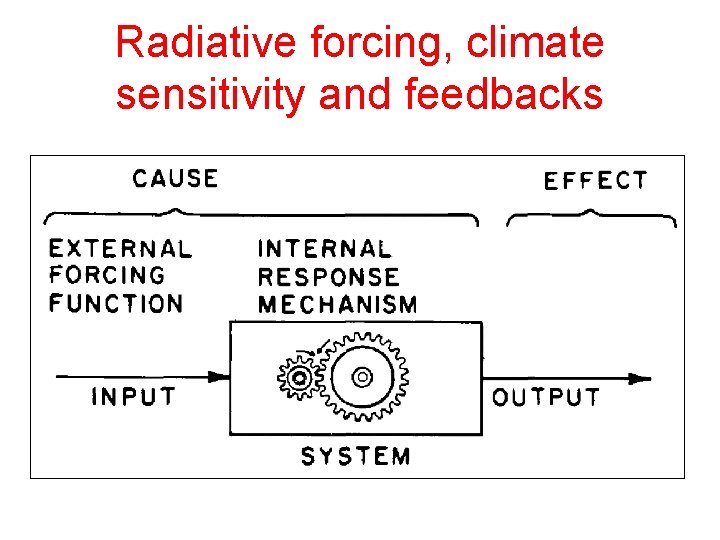
Radiative forcing, climate sensitivity and feedbacks
“Our understanding of the climate system is complicated by feedbacks that either amplify or damp perturbations…” Feedbacks
“Our understanding of the climate system is complicated by feedbacks that either amplify or damp perturbations…” Feedbacks Describe the inter-related growth or decay of the components of a system. A positive feedback exists…
“Our understanding of the climate system is complicated by feedbacks that either amplify or damp perturbations…” Feedbacks Describe the inter-related growth or decay of the components of a system. A positive feedback exists… if an initial perturbation is amplified by other changes through the system.
“Our understanding of the climate system is complicated by feedbacks that either amplify or damp perturbations…” Feedbacks Describe the inter-related growth or decay of the components of a system. A positive feedback exists… if an initial perturbation is amplified by other changes through the system. A negative feedback exists… if the perturbation is reduced after the system adjusts. Negative feedbacks stabilize systems.
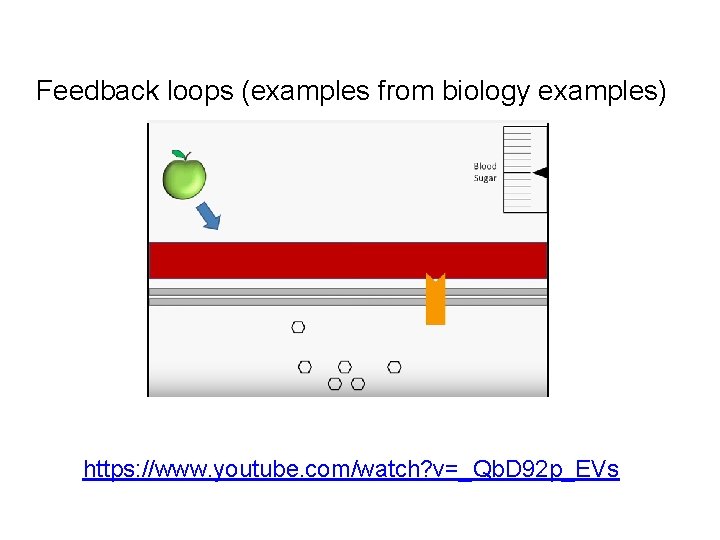
Feedback loops (examples from biology examples) https: //www. youtube. com/watch? v=_Qb. D 92 p_EVs
What activates feedback loops? In the climate system we find many feedback loops, and most of these feedbacks are always active and contribute to the natural climate variability. (e. g. year to year sea ice variability in the Arctic). Other feedback loops are currently in a stand-by mode. A strong enough external radiative forcing (RF) can activate additional feedbacks in the climate system. (e. g. thawing of permafrost and release of methane) It is very important to study feedbacks in the climate system if we want to understand project climate change for the 21 st century because they can amplify or dampen the direct anthropogenic forcing effect.

Radiative Forcing Before we take a closer look at feedback loops, we need to quantify first of all how strong the anthropogenic forcing is. How do we know that CO 2 is the main driver of the 20 th century warming trend? And will it continue to be the single most important forcing factor in the next 2100 years? What about other greenhouse gases? How do they compare to the CO 2 forcing? Is there or compensation of the greenhouse gas forcing by aerosols (global dimming)?
Radiative Forcing § The purpose of defining ‘radiative forcing’ for climate change studies is: § To give us a quantitative measure how strong a specific forcing perturbs the climate system § This makes effects from aerosols comparable with CO 2 forcing, for example. § Studies have shown that individual forcing factors applied at the same time behave additive for radiative forcing. (That means: if we know the radiative forcing CO 2 and methane then we know the combined radiative forcing, too)
Radiative Forcing § For the definition of RF: § The climate system is in an equilibrium (incoming equals outgoing radiation) § In such a state the forcing is applied (most definitions use a constant forcing) and the imbalance in the radiative fluxes is calculated. § Units are watts per square meter (W/m^2) § As we will see from there on it depends on the exact definition how the induced change in the energy imbalance is measured.
Radiative Forcing � Change in the net balance of incoming and outgoing radiation at the tropopause
Radiative Forcing � � � Change in the net balance of incoming and outgoing radiation at the tropopause after the stratosphere was allowed to adjust to the initial radiative perturbation
Radiative Forcing � � � Change in the net balance of incoming and outgoing radiation at the tropopause after the stratosphere was allowed to adjust to the initial radiative perturbation Surface and troposphere, however, have not responded yet (same as before the perturbation was introduced)

Goosse, Chapter 4.
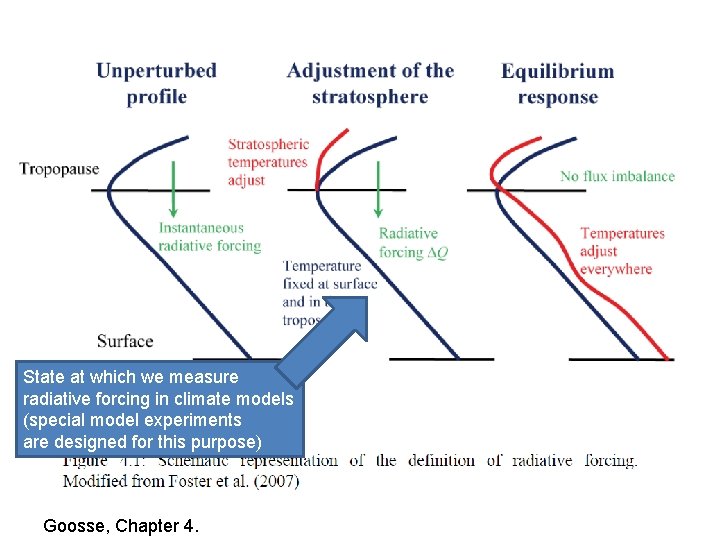
State at which we measure radiative forcing in climate models (special model experiments are designed for this purpose) Goosse, Chapter 4.

How do we quantify radiative forcing? § Sophisticated radiative transfer models § § § 1 -dimensional column models with detailed line-by-line (or band) absorption for each gas / substance in the air column General circulation models (GCMs) § State-of-the-art climate models are run in 'specific modes': suppress changes in atmospheric and surface temperature changes, keep water vapor constant, etc.
How do we quantify radiative forcing? § For the most important greenhouse gases: § Approximated equations have been derived § They describe the global mean radiative forcing for a single forcing agent (Remember: To good approximation, the radiative forcing is additive: the combined forcing from CO 2 and CH 4, N 2 O, for example, is additive)
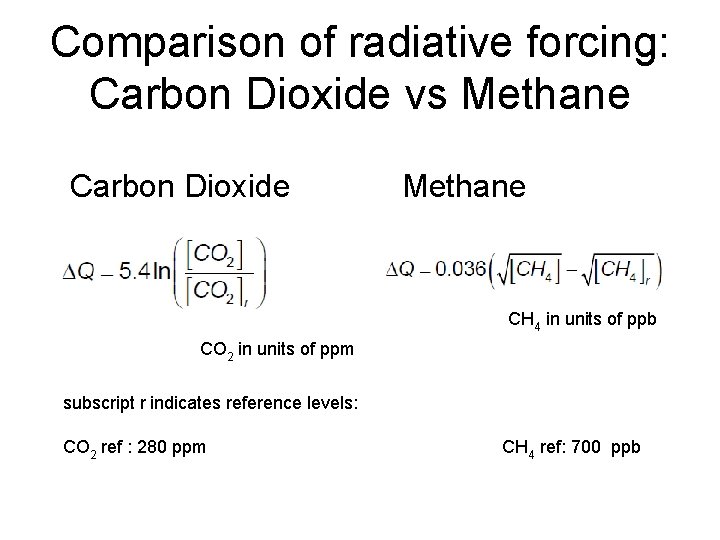
Comparison of radiative forcing: Carbon Dioxide vs Methane � Carbon Dioxide � Methane CH 4 in units of ppb CO 2 in units of ppm subscript r indicates reference levels: CO 2 ref : 280 ppm CH 4 ref: 700 ppb
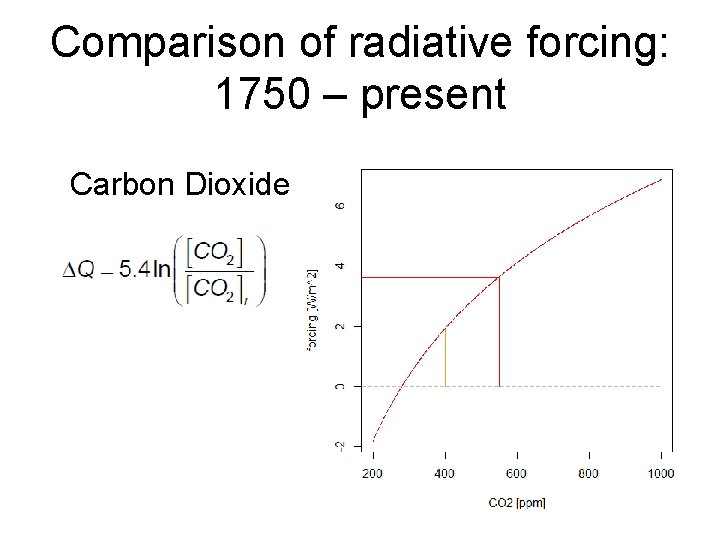
Comparison of radiative forcing: 1750 – present � Carbon Dioxide
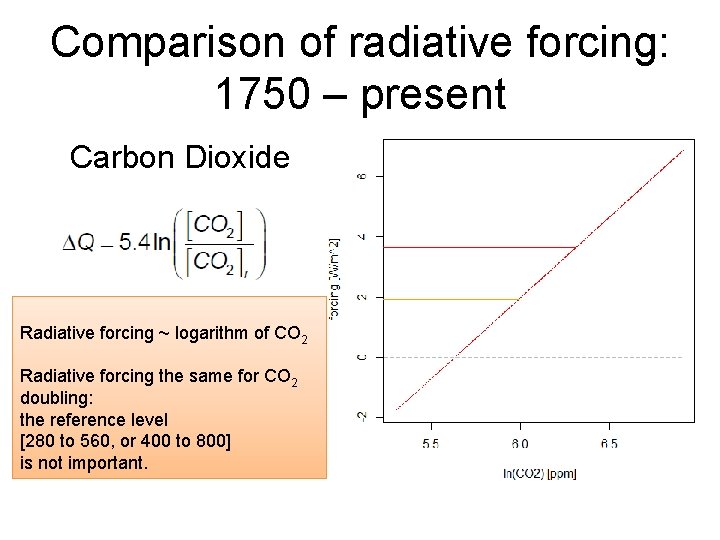
Comparison of radiative forcing: 1750 – present � Carbon Dioxide Radiative forcing ~ logarithm of CO 2 Radiative forcing the same for CO 2 doubling: the reference level [280 to 560, or 400 to 800] is not important.
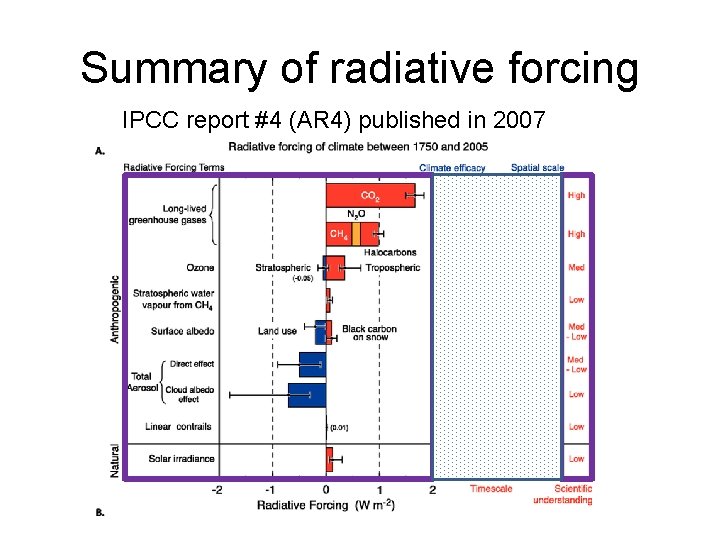
Summary of radiative forcing IPCC report #4 (AR 4) published in 2007
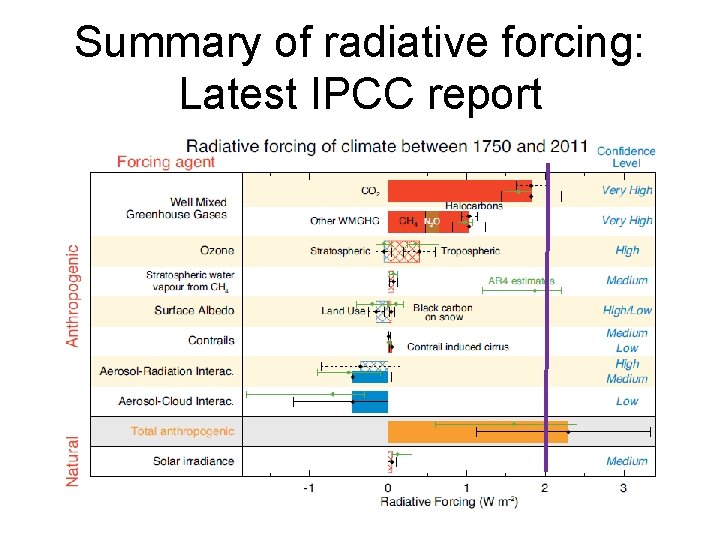
Summary of radiative forcing: Latest IPCC report � IPCC report #5 (AR 5) published in 2013
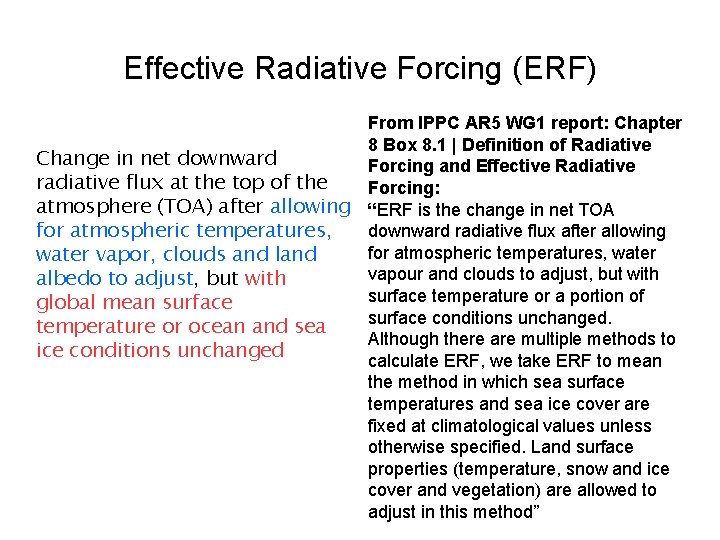
Effective Radiative Forcing (ERF) From IPPC AR 5 WG 1 report: Chapter 8 Box 8. 1 | Definition of Radiative Change in net downward Forcing and Effective Radiative radiative flux at the top of the Forcing: atmosphere (TOA) after allowing “ERF is the change in net TOA for atmospheric temperatures, downward radiative flux after allowing for atmospheric temperatures, water vapor, clouds and land vapour and clouds to adjust, but with albedo to adjust, but with surface temperature or a portion of global mean surface conditions unchanged. temperature or ocean and sea Although there are multiple methods to ice conditions unchanged calculate ERF, we take ERF to mean the method in which sea surface temperatures and sea ice cover are fixed at climatological values unless otherwise specified. Land surface properties (temperature, snow and ice cover and vegetation) are allowed to adjust in this method”
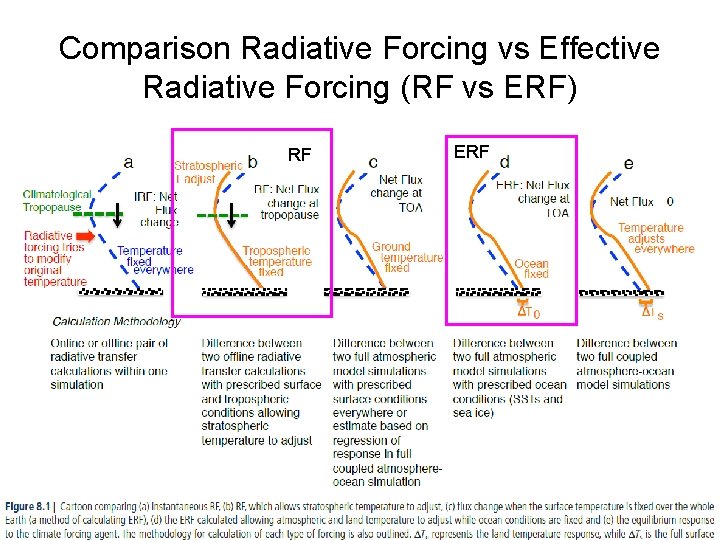
Comparison Radiative Forcing vs Effective Radiative Forcing (RF vs ERF) RF ERF
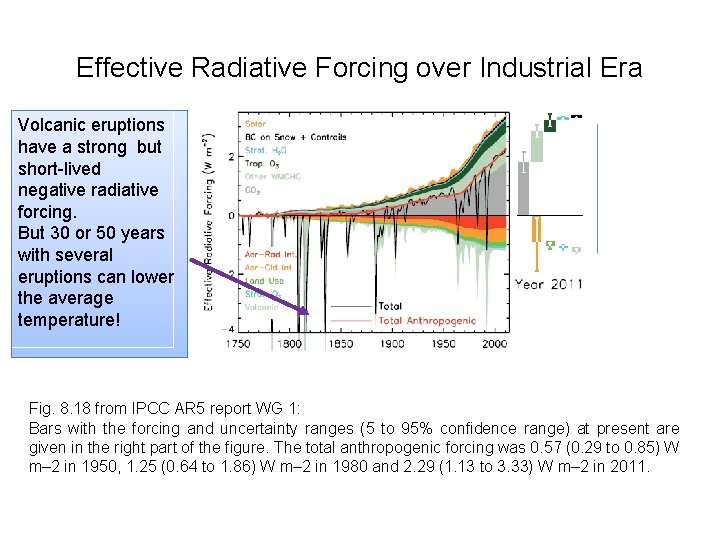
Effective Radiative Forcing over Industrial Era Volcanic eruptions have a strong but short-lived negative radiative forcing. But 30 or 50 years with several eruptions can lower the average temperature! Fig. 8. 18 from IPCC AR 5 report WG 1: Bars with the forcing and uncertainty ranges (5 to 95% confidence range) at present are given in the right part of the figure. The total anthropogenic forcing was 0. 57 (0. 29 to 0. 85) W m– 2 in 1950, 1. 25 (0. 64 to 1. 86) W m– 2 in 1980 and 2. 29 (1. 13 to 3. 33) W m– 2 in 2011.
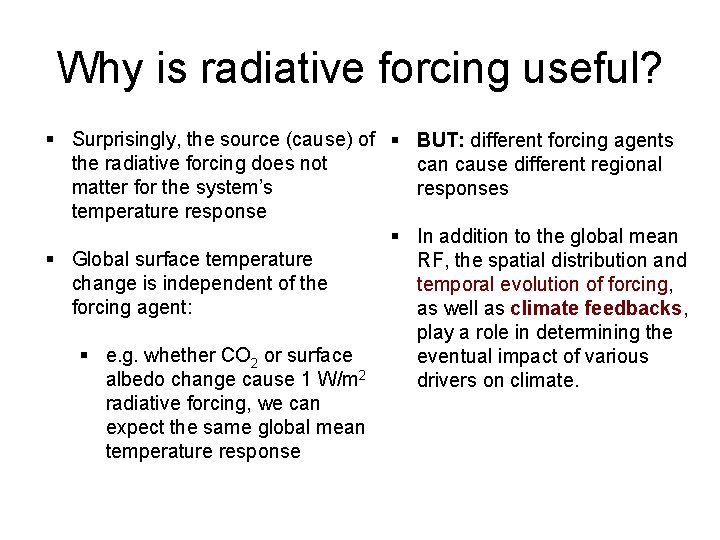
Why is radiative forcing useful? § Surprisingly, the source (cause) of § BUT: different forcing agents the radiative forcing does not can cause different regional matter for the system’s responses temperature response § In addition to the global mean § Global surface temperature RF, the spatial distribution and change is independent of the temporal evolution of forcing, forcing agent: as well as climate feedbacks, play a role in determining the § e. g. whether CO 2 or surface eventual impact of various albedo change cause 1 W/m 2 drivers on climate. radiative forcing, we can expect the same global mean temperature response
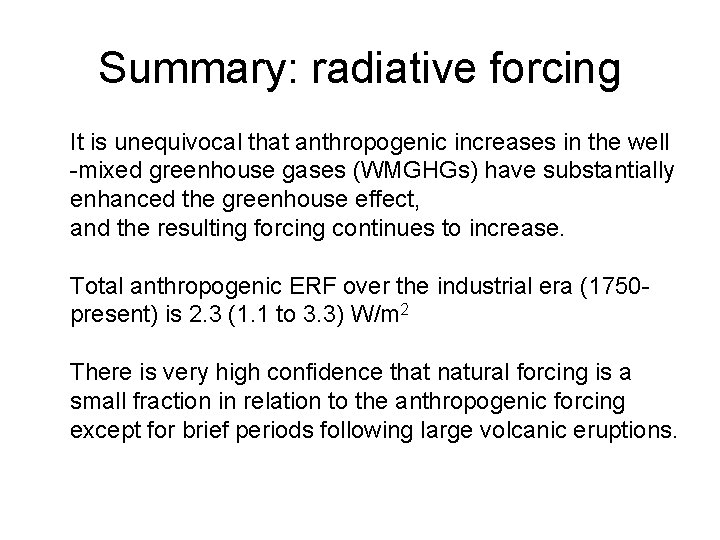
Summary: radiative forcing � � � It is unequivocal that anthropogenic increases in the well -mixed greenhouse gases (WMGHGs) have substantially enhanced the greenhouse effect, and the resulting forcing continues to increase. Total anthropogenic ERF over the industrial era (1750 present) is 2. 3 (1. 1 to 3. 3) W/m 2 There is very high confidence that natural forcing is a small fraction in relation to the anthropogenic forcing except for brief periods following large volcanic eruptions.
Summary: radiative forcing • The results regarding the relative importance of the anthropogenic versus natural forcing are robust and do not depend on the definition of radiative forcing and the details of how radiative forcing is calculated. • For the changes expected in the near future (next 100 years), individual radiative forcing factors are linear: • The total radiative forcing is the sum of all individual radiative forcings acting on the system.
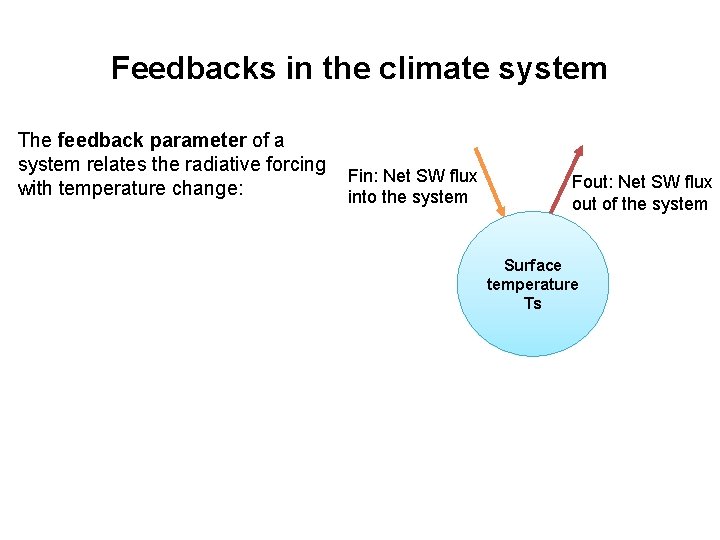
Feedbacks in the climate system The feedback parameter of a system relates the radiative forcing with temperature change: Fin: Net SW flux into the system Fout: Net SW flux out of the system Surface temperature Ts
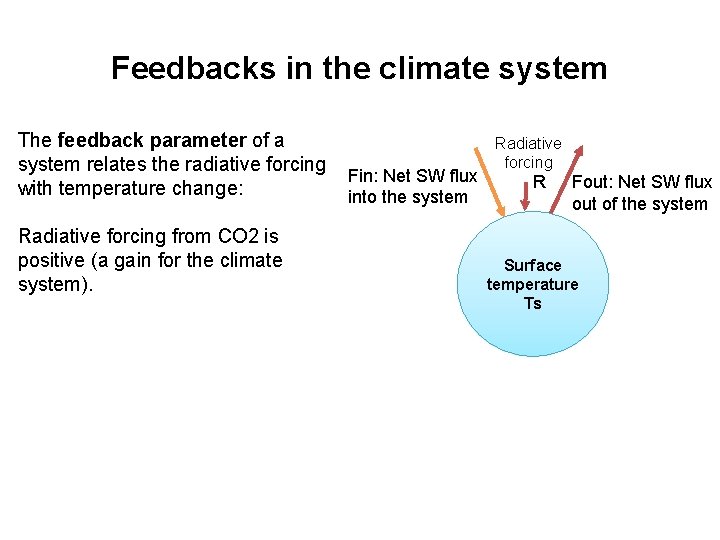
Feedbacks in the climate system The feedback parameter of a system relates the radiative forcing with temperature change: Radiative forcing from CO 2 is positive (a gain for the climate system). Fin: Net SW flux into the system Radiative forcing R Fout: Net SW flux out of the system Surface temperature Ts
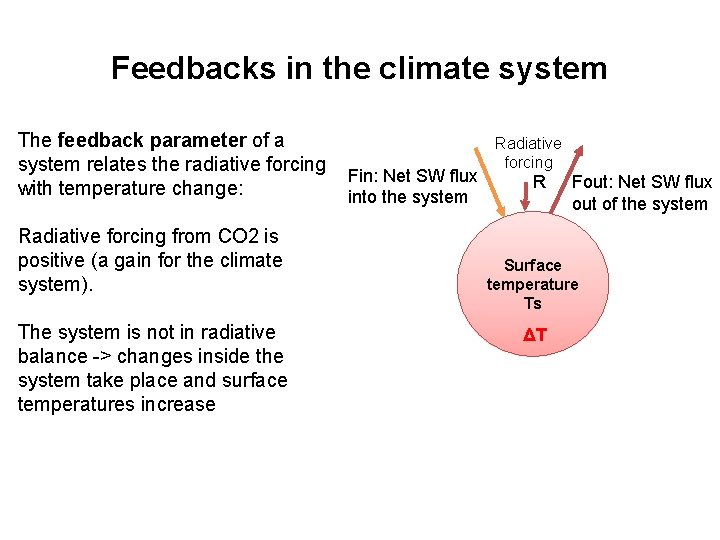
Feedbacks in the climate system The feedback parameter of a system relates the radiative forcing with temperature change: Radiative forcing from CO 2 is positive (a gain for the climate system). The system is not in radiative balance -> changes inside the system take place and surface temperatures increase Fin: Net SW flux into the system Radiative forcing R Fout: Net SW flux out of the system Surface temperature Ts ΔT
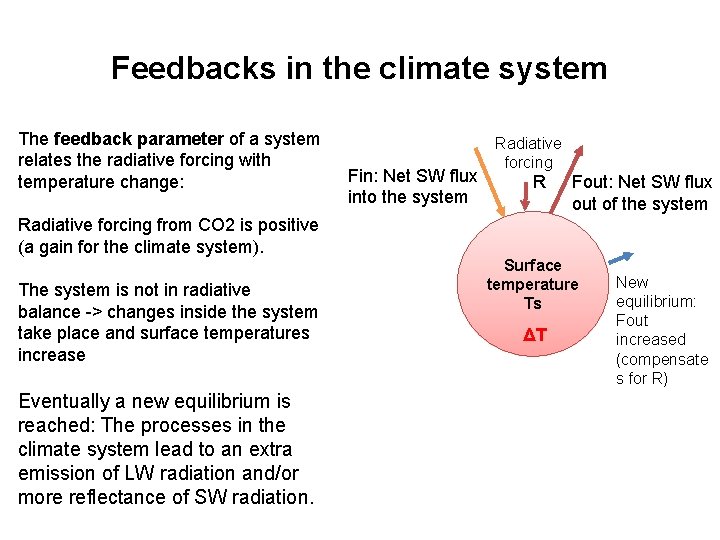
Feedbacks in the climate system The feedback parameter of a system relates the radiative forcing with temperature change: Radiative forcing from CO 2 is positive (a gain for the climate system). The system is not in radiative balance -> changes inside the system take place and surface temperatures increase Eventually a new equilibrium is reached: The processes in the climate system lead to an extra emission of LW radiation and/or more reflectance of SW radiation. Fin: Net SW flux into the system Radiative forcing R Fout: Net SW flux out of the system Surface temperature Ts ΔT New equilibrium: Fout increased (compensate s for R)
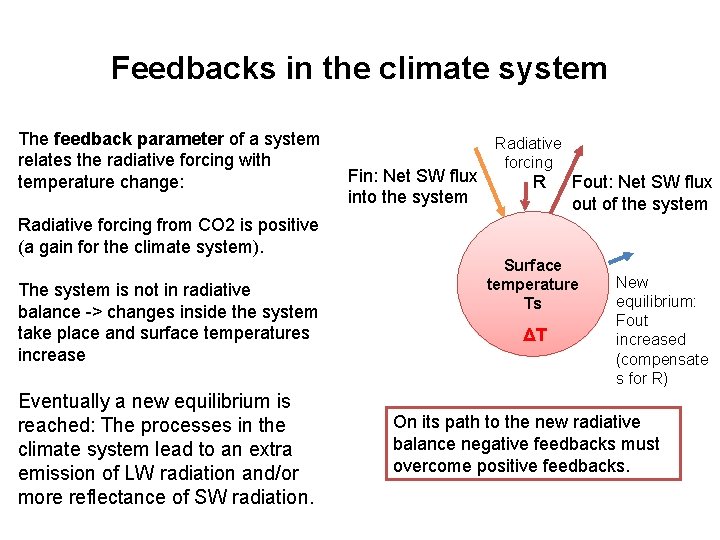
Feedbacks in the climate system The feedback parameter of a system relates the radiative forcing with temperature change: Radiative forcing from CO 2 is positive (a gain for the climate system). The system is not in radiative balance -> changes inside the system take place and surface temperatures increase Eventually a new equilibrium is reached: The processes in the climate system lead to an extra emission of LW radiation and/or more reflectance of SW radiation. Fin: Net SW flux into the system Radiative forcing R Fout: Net SW flux out of the system Surface temperature Ts ΔT New equilibrium: Fout increased (compensate s for R) On its path to the new radiative balance negative feedbacks must overcome positive feedbacks.
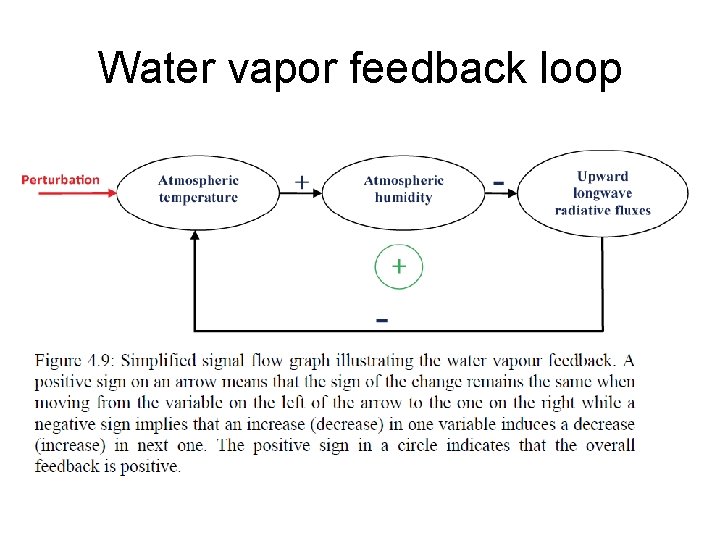
Water vapor feedback loop
Class activity: Feedback loops Slides with class activity
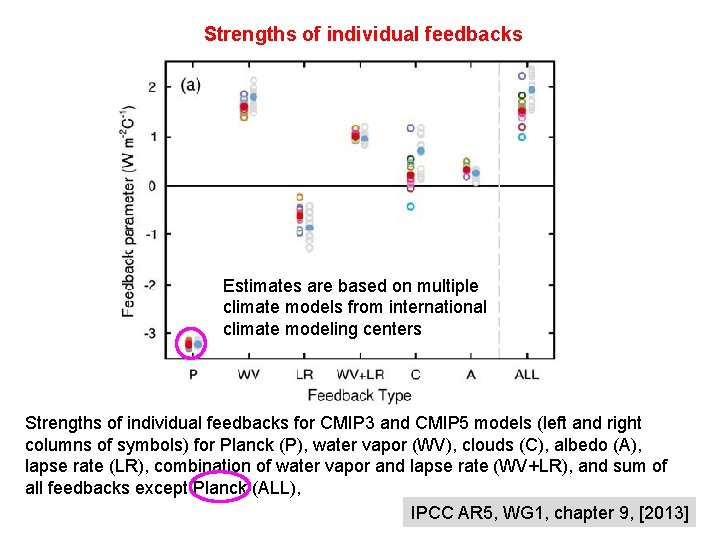
Strengths of individual feedbacks Estimates are based on multiple climate models from international climate modeling centers Strengths of individual feedbacks for CMIP 3 and CMIP 5 models (left and right columns of symbols) for Planck (P), water vapor (WV), clouds (C), albedo (A), lapse rate (LR), combination of water vapor and lapse rate (WV+LR), and sum of all feedbacks except Planck (ALL), IPCC AR 5, WG 1, chapter 9, [2013]
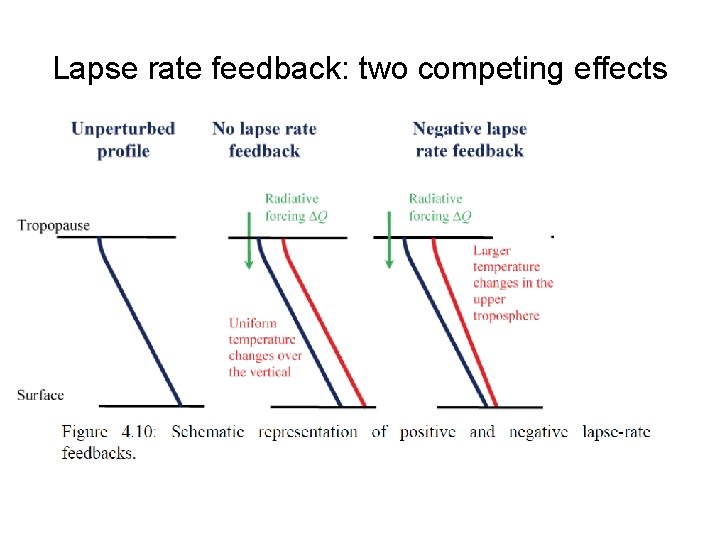
Lapse rate feedback: two competing effects
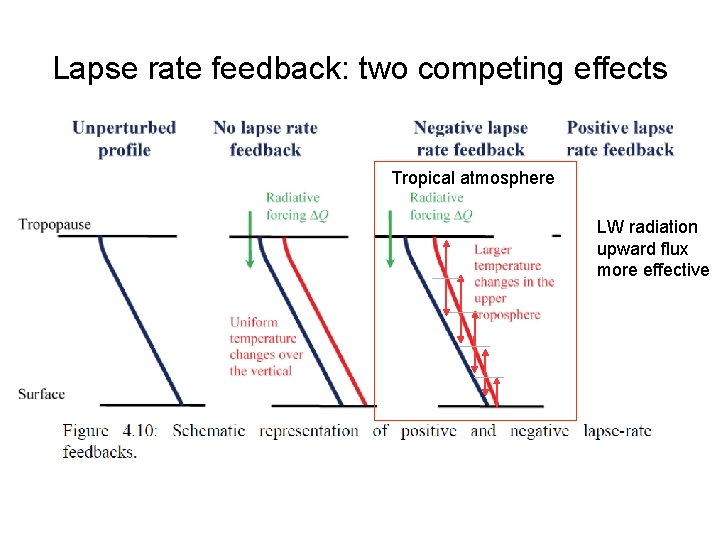
Lapse rate feedback: two competing effects Tropical atmosphere LW radiation upward flux more effective
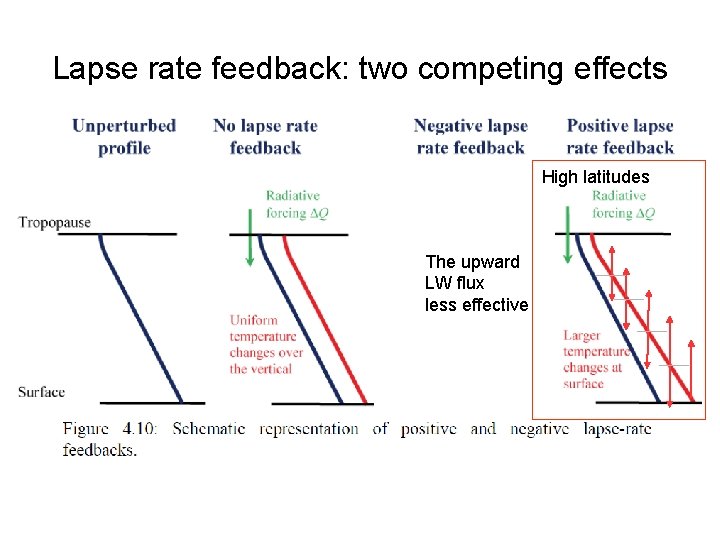
Lapse rate feedback: two competing effects High latitudes The upward LW flux less effective
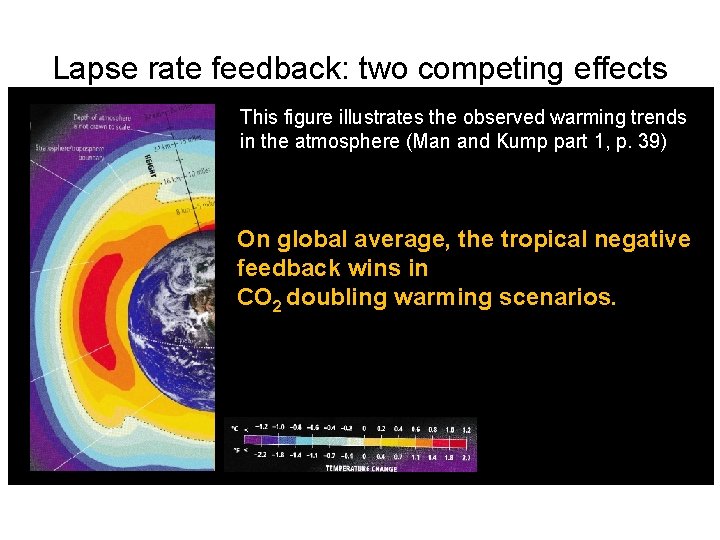
Lapse rate feedback: two competing effects This figure illustrates the observed warming trends in the atmosphere (Man and Kump part 1, p. 39) High latitudes On global average, the tropical negative feedback wins in. The upward LW flux CO 2 doubling warming scenarios. less effective
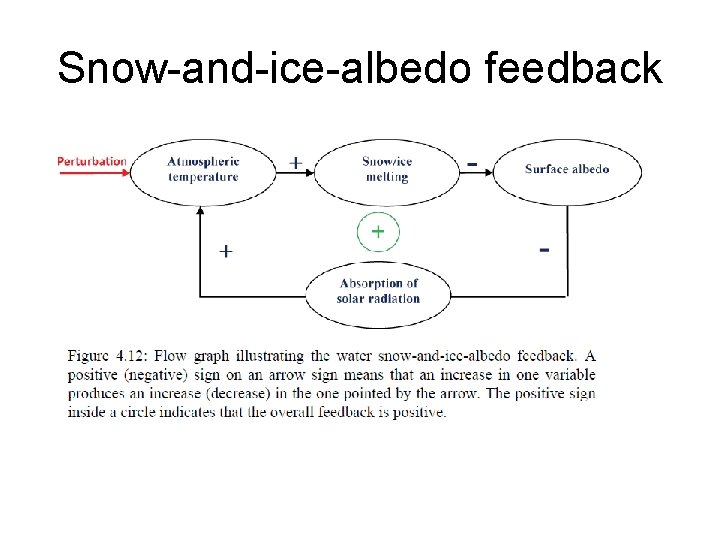
Snow-and-ice-albedo feedback
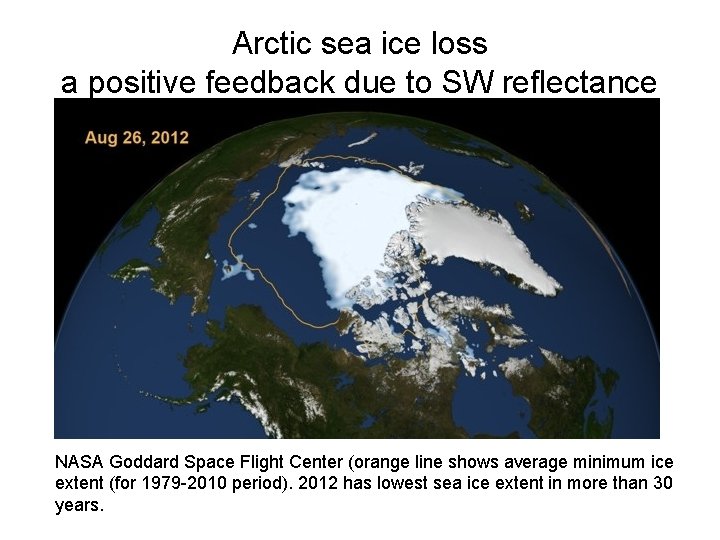
Arctic sea ice loss Observed Northern Hemisphere Extent a positive feedback due. Sea-Ice to SW reflectance NASA Goddard Space Flight Center (orange line shows average minimum ice extent (for 1979 -2010 period). 2012 has lowest sea ice extent in more than 30 years.
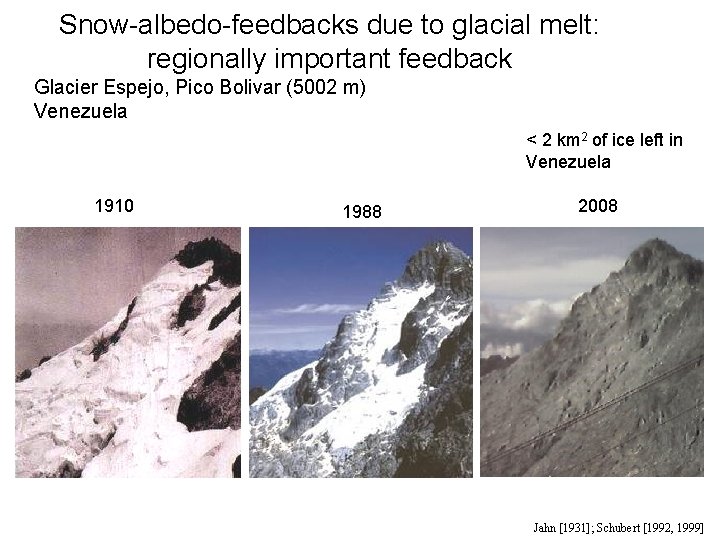
Snow-albedo-feedbacks due to glacial melt: regionally important feedback Northern Glacier. Observed Espejo, Pico Bolivar. Hemisphere (5002 m) Sea-Ice Extent Venezuela < 2 km 2 of ice left in Venezuela 1910 1988 2008 Jahn [1931]; Schubert [1992, 1999]
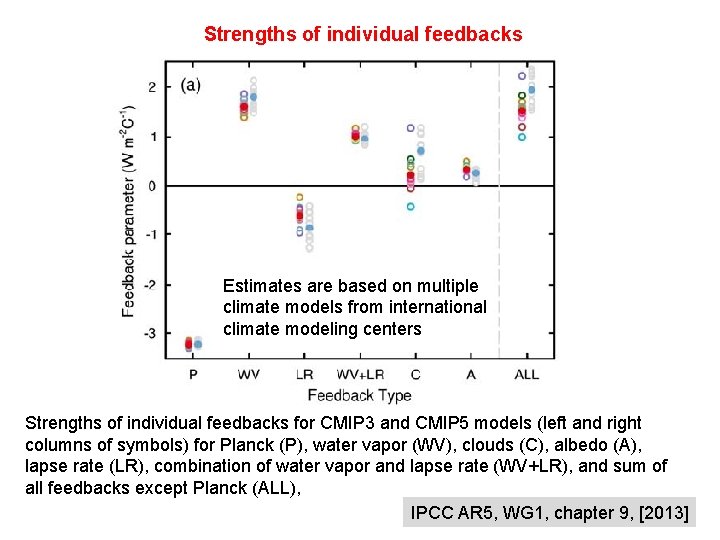
Strengths of individual feedbacks Estimates are based on multiple climate models from international climate modeling centers Strengths of individual feedbacks for CMIP 3 and CMIP 5 models (left and right columns of symbols) for Planck (P), water vapor (WV), clouds (C), albedo (A), lapse rate (LR), combination of water vapor and lapse rate (WV+LR), and sum of all feedbacks except Planck (ALL), IPCC AR 5, WG 1, chapter 9, [2013]
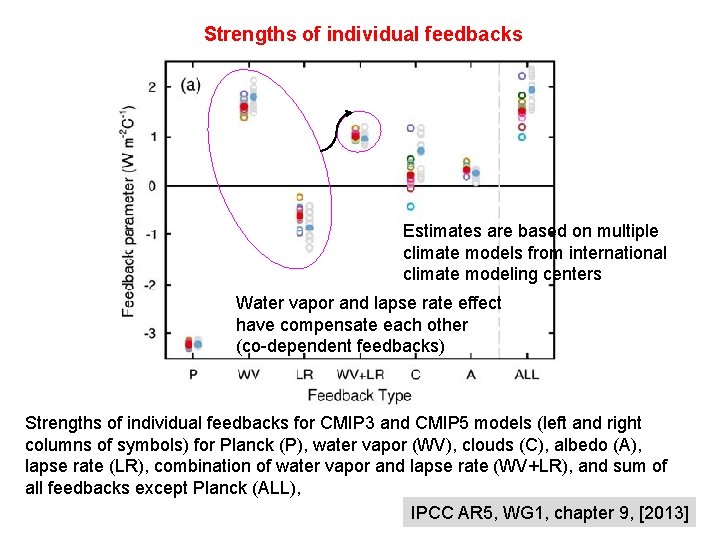
Strengths of individual feedbacks Estimates are based on multiple climate models from international climate modeling centers Water vapor and lapse rate effect have compensate each other (co-dependent feedbacks) Strengths of individual feedbacks for CMIP 3 and CMIP 5 models (left and right columns of symbols) for Planck (P), water vapor (WV), clouds (C), albedo (A), lapse rate (LR), combination of water vapor and lapse rate (WV+LR), and sum of all feedbacks except Planck (ALL), IPCC AR 5, WG 1, chapter 9, [2013]
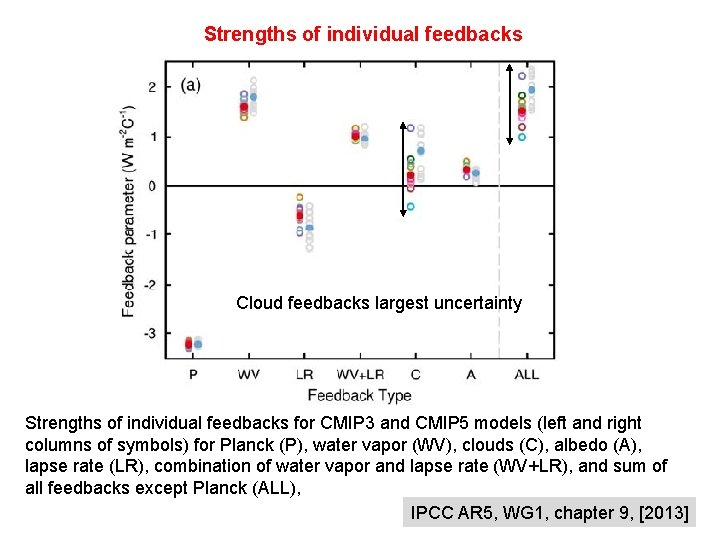
Strengths of individual feedbacks Cloud feedbacks largest uncertainty Strengths of individual feedbacks for CMIP 3 and CMIP 5 models (left and right columns of symbols) for Planck (P), water vapor (WV), clouds (C), albedo (A), lapse rate (LR), combination of water vapor and lapse rate (WV+LR), and sum of all feedbacks except Planck (ALL), IPCC AR 5, WG 1, chapter 9, [2013]
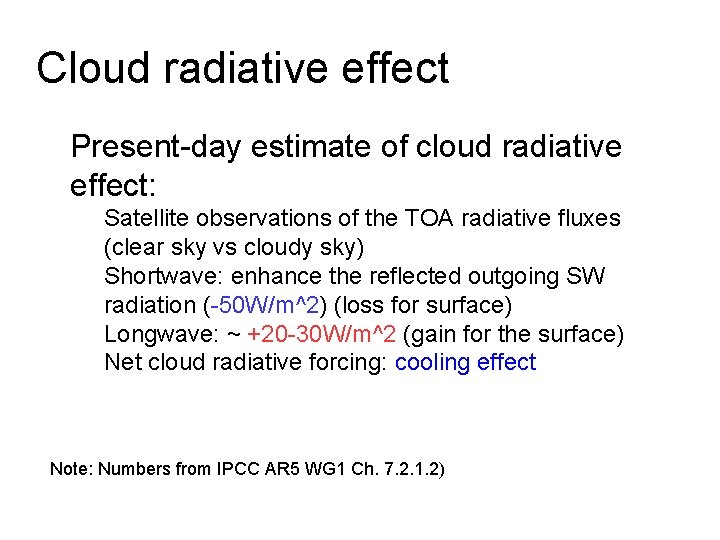
Cloud radiative effect � Present-day estimate of cloud radiative effect: Satellite observations of the TOA radiative fluxes � (clear sky vs cloudy sky) � Shortwave: enhance the reflected outgoing SW radiation (-50 W/m^2) (loss for surface) � Longwave: ~ +20 -30 W/m^2 (gain for the surface) � Net cloud radiative forcing: cooling effect � Note: Numbers from IPCC AR 5 WG 1 Ch. 7. 2. 1. 2)
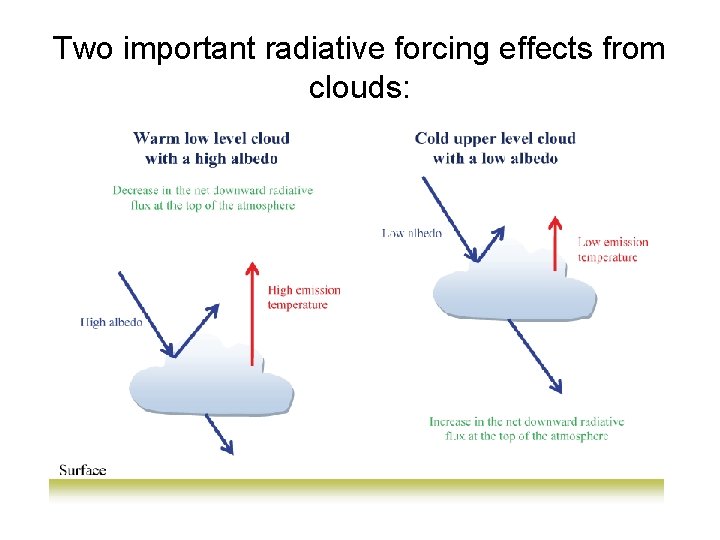
Two important radiative forcing effects from clouds:
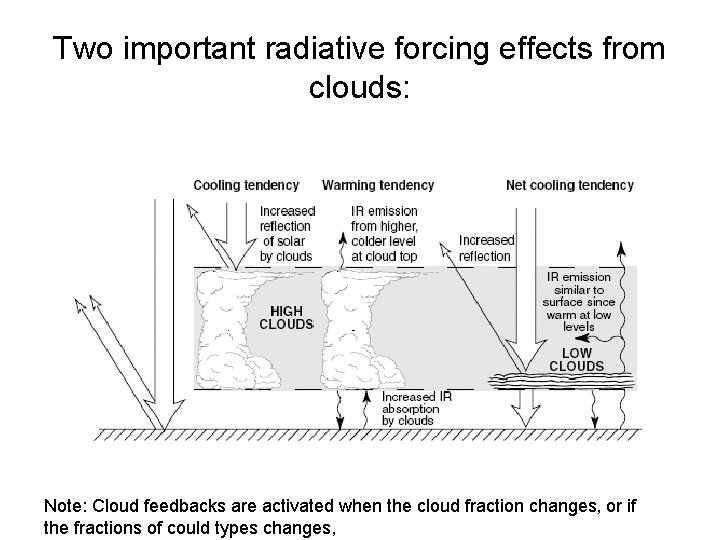
Two important radiative forcing effects from clouds: Note: Cloud feedbacks are activated when the cloud fraction changes, or if the fractions of could types changes,
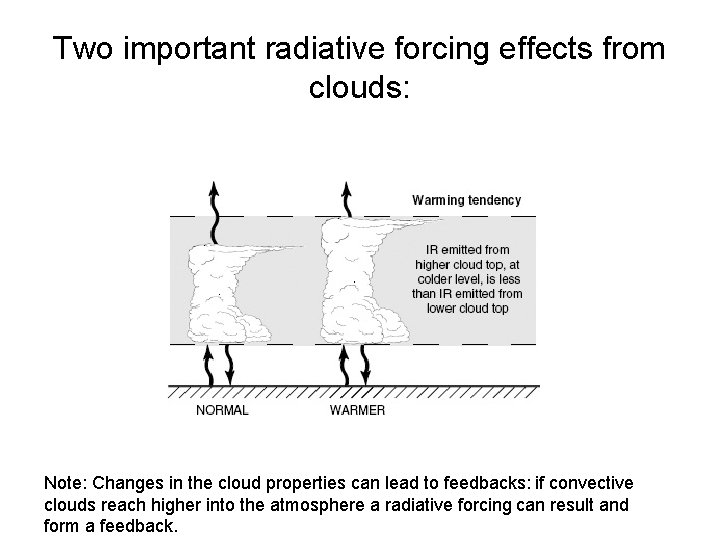
Two important radiative forcing effects from clouds: Note: Changes in the cloud properties can lead to feedbacks: if convective clouds reach higher into the atmosphere a radiative forcing can result and form a feedback.
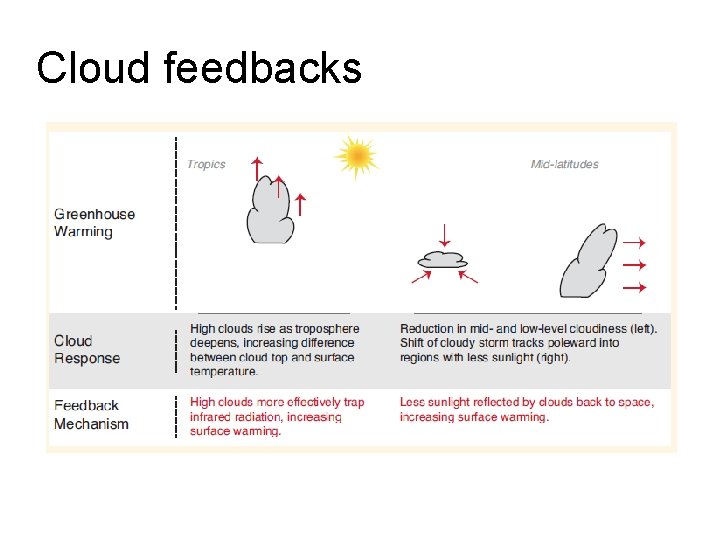
Cloud feedbacks
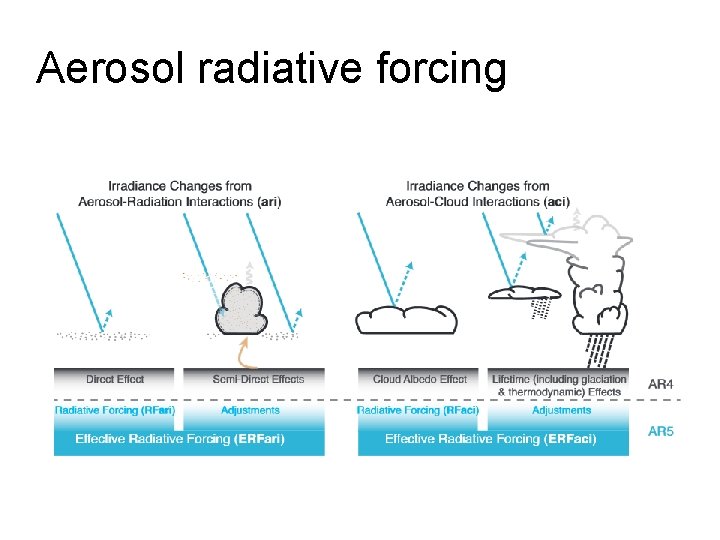
Aerosol radiative forcing
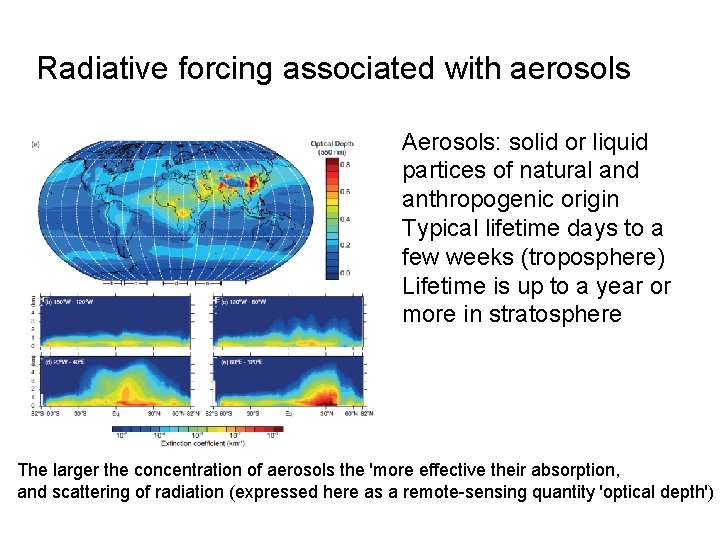
Radiative forcing associated with aerosols � � � Aerosols: solid or liquid partices of natural and anthropogenic origin Typical lifetime days to a few weeks (troposphere) Lifetime is up to a year or more in stratosphere The larger the concentration of aerosols the 'more effective their absorption, and scattering of radiation (expressed here as a remote-sensing quantity 'optical depth')
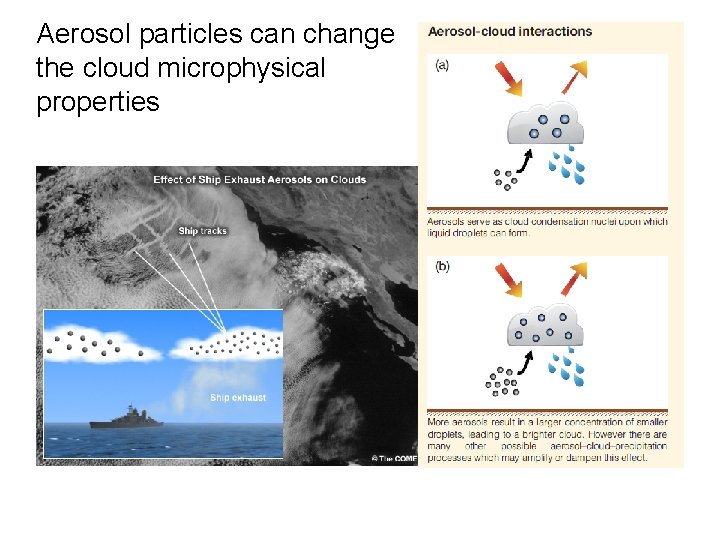
Aerosol particles can change the cloud microphysical properties
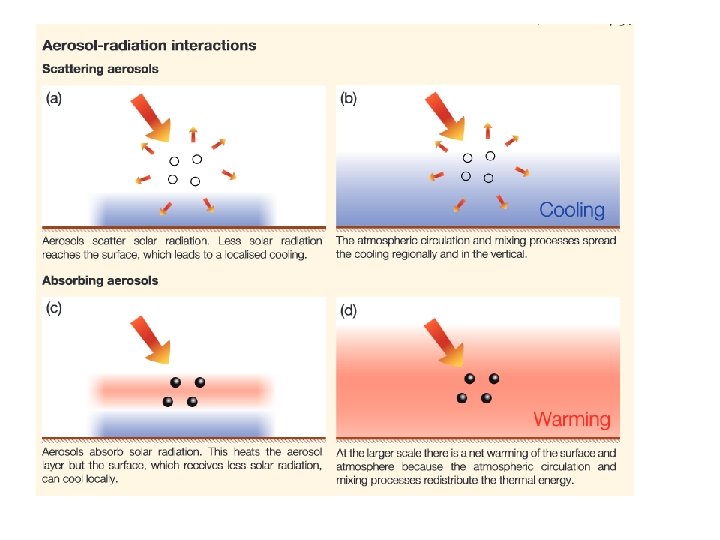
Radiative effect of aerosols is one of the most complex problems in radiative forcing � � Black carbon aerosols are estimated to have a net warming effect. The overall effect of all aerosols is a negative radiative forcing, and it is estimated to cool the surface of the planet.
Summary: Radiative Forcing, Climate Sensitivity and Feedbacks § Radiative forcing (RF) measures how strong a forcing perturbs the radiative energy balance of our climate system. § A number of anthropogenic forcing have been identified and quantified. Their combined RF is a positive value and CO 2 is the largest contributor to the RF. The climate system gains energy surface warming § Several feedbacks are activated in the climate system in response to the radiative forcing. They determine the sensitivity of the climate system: § Positive feedbacks amplify the warming § Negative feedbacks reduce the warming § The larger the change in global mean surface temperature for a given RF, the more ‘sensitive’ the system is responding. § The combined feedback is negative and prevents a ‘runaway climate’ in the coming decades to centuries.
- Slides: 57