
Radiations from a Reactor Shielding Monitoring 1 Neutrons
- Slides: 10
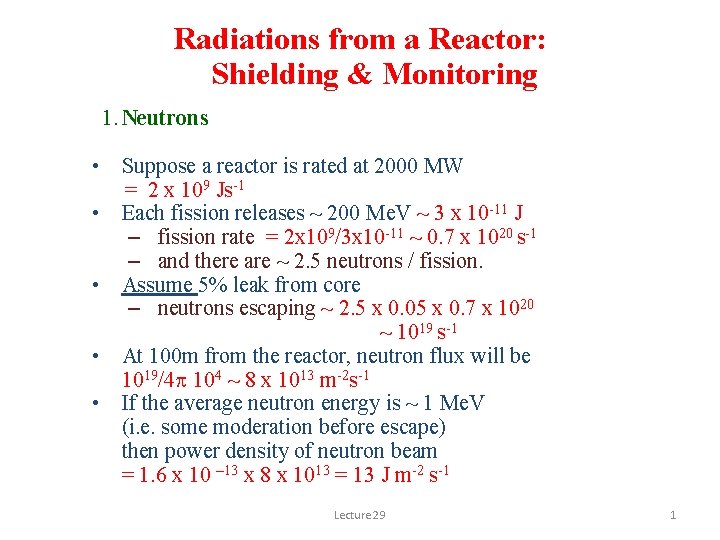
Radiations from a Reactor: Shielding & Monitoring 1. Neutrons • Suppose a reactor is rated at 2000 MW = 2 x 10⁹ Js-1 • Each fission releases ~ 200 Me. V ~ 3 x 10 -11 J – fission rate = 2 x 10⁹/3 x 10 -11 ~ 0. 7 x 10²⁰ s-1 – and there are ~ 2. 5 neutrons / fission. • Assume 5% leak from core – neutrons escaping ~ 2. 5 x 0. 05 x 0. 7 x 10²⁰ ~ 1019 s-1 • At 100 m from the reactor, neutron flux will be 1019/4 104 ~ 8 x 10¹³ m-2 s-1 • If the average neutron energy is ~ 1 Me. V (i. e. some moderation before escape) then power density of neutron beam = 1. 6 x 10 – 13 x 8 x 1013 = 13 J m-2 s-1 Lecture 29 1
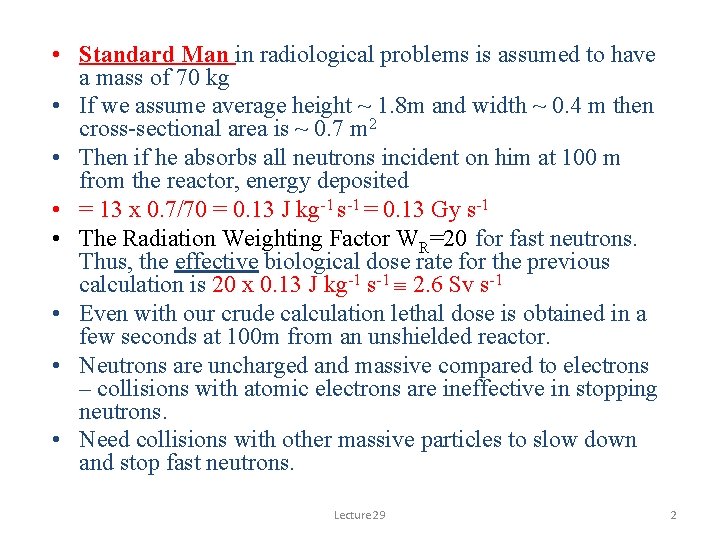
• Standard Man in radiological problems is assumed to have a mass of 70 kg • If we assume average height ~ 1. 8 m and width ~ 0. 4 m then cross-sectional area is ~ 0. 7 m 2 • Then if he absorbs all neutrons incident on him at 100 m from the reactor, energy deposited • = 13 x 0. 7/70 = 0. 13 J kg-1 s-1 = 0. 13 Gy s-1 • The Radiation Weighting Factor WR=20 for fast neutrons. Thus, the effective biological dose rate for the previous calculation is 20 x 0. 13 J kg-1 s-1 2. 6 Sv s-1 • Even with our crude calculation lethal dose is obtained in a few seconds at 100 m from an unshielded reactor. • Neutrons are uncharged and massive compared to electrons – collisions with atomic electrons are ineffective in stopping neutrons. • Need collisions with other massive particles to slow down and stop fast neutrons. Lecture 29 2
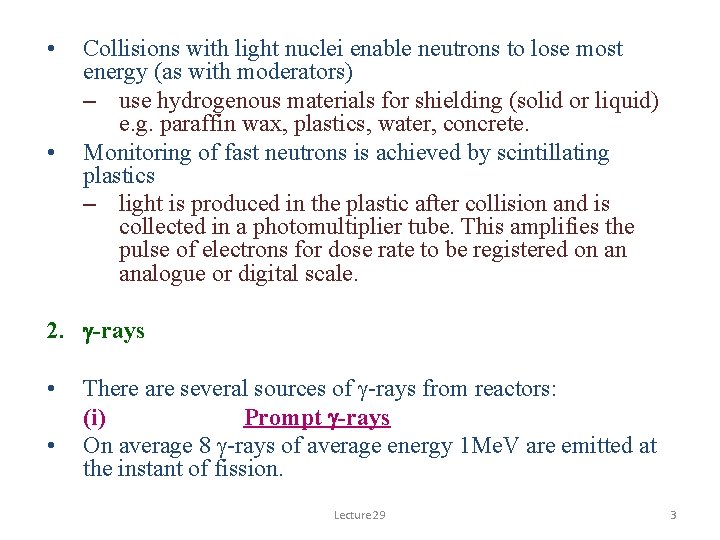
• • Collisions with light nuclei enable neutrons to lose most energy (as with moderators) – use hydrogenous materials for shielding (solid or liquid) e. g. paraffin wax, plastics, water, concrete. Monitoring of fast neutrons is achieved by scintillating plastics – light is produced in the plastic after collision and is collected in a photomultiplier tube. This amplifies the pulse of electrons for dose rate to be registered on an analogue or digital scale. 2. -rays • • There are several sources of -rays from reactors: (i) Prompt -rays On average 8 -rays of average energy 1 Me. V are emitted at the instant of fission. Lecture 29 3
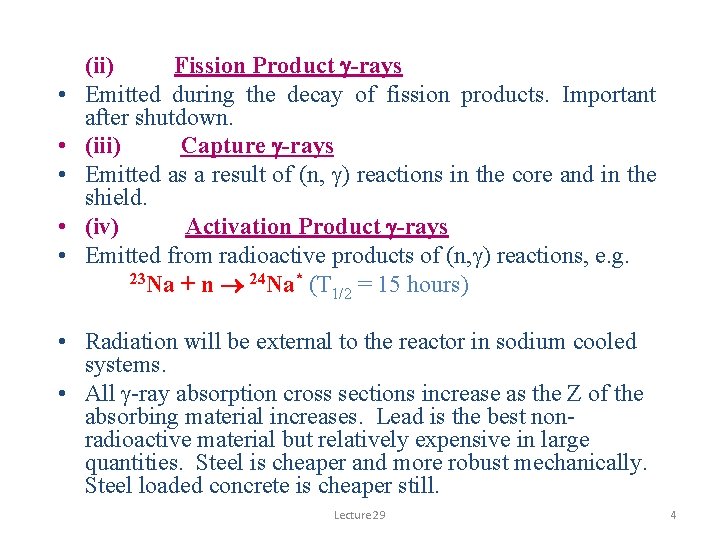
• • • (ii) Fission Product -rays Emitted during the decay of fission products. Important after shutdown. (iii) Capture -rays Emitted as a result of (n, ) reactions in the core and in the shield. (iv) Activation Product -rays Emitted from radioactive products of (n, ) reactions, e. g. 23 Na + n 24 Na* (T = 15 hours) 1/2 • Radiation will be external to the reactor in sodium cooled systems. • All -ray absorption cross sections increase as the Z of the absorbing material increases. Lead is the best nonradioactive material but relatively expensive in large quantities. Steel is cheaper and more robust mechanically. Steel loaded concrete is cheaper still. Lecture 29 4
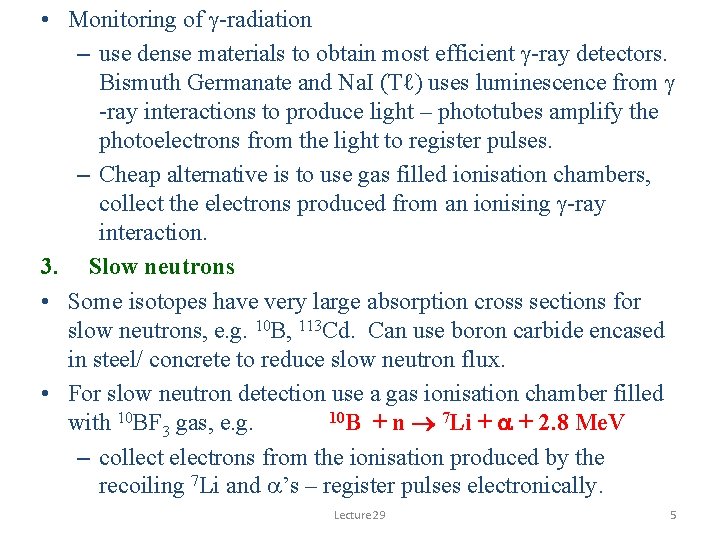
• Monitoring of -radiation – use dense materials to obtain most efficient -ray detectors. Bismuth Germanate and Na. I (Tℓ) uses luminescence from -ray interactions to produce light – phototubes amplify the photoelectrons from the light to register pulses. – Cheap alternative is to use gas filled ionisation chambers, collect the electrons produced from an ionising -ray interaction. 3. Slow neutrons • Some isotopes have very large absorption cross sections for slow neutrons, e. g. 10 B, 113 Cd. Can use boron carbide encased in steel/ concrete to reduce slow neutron flux. • For slow neutron detection use a gas ionisation chamber filled 10 B + n 7 Li + + 2. 8 Me. V with 10 BF 3 gas, e. g. – collect electrons from the ionisation produced by the recoiling 7 Li and ’s – register pulses electronically. Lecture 29 5
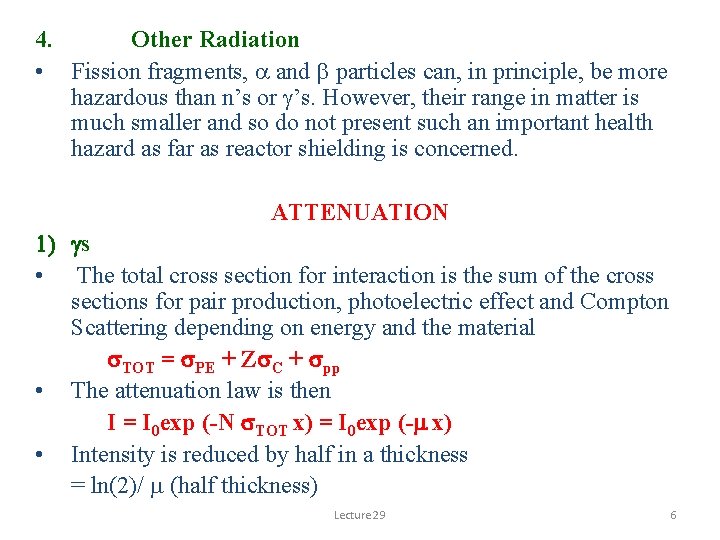
4. Other Radiation • Fission fragments, and particles can, in principle, be more hazardous than n’s or ’s. However, their range in matter is much smaller and so do not present such an important health hazard as far as reactor shielding is concerned. ATTENUATION 1) s • The total cross section for interaction is the sum of the cross sections for pair production, photoelectric effect and Compton Scattering depending on energy and the material s. TOT = s. PE + Zs. C + spp • The attenuation law is then I = I 0 exp (-N s. TOT x) = I 0 exp (-m x) • Intensity is reduced by half in a thickness = ln(2)/ m (half thickness) Lecture 29 6
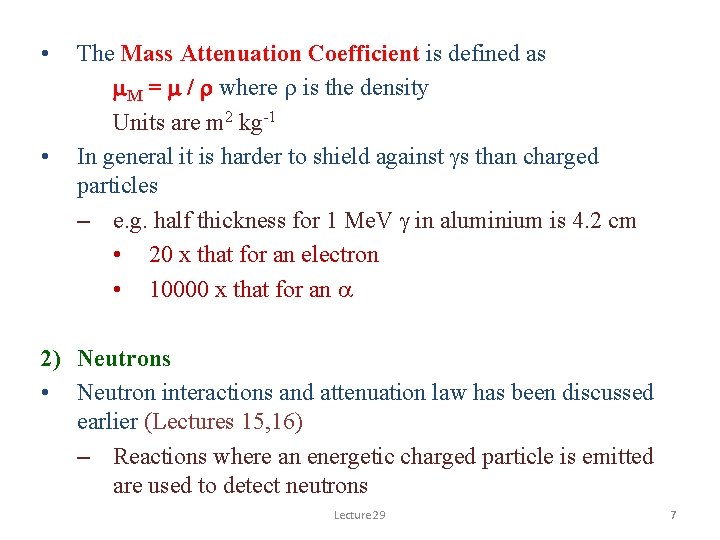
• • The Mass Attenuation Coefficient is defined as m. M = m / r where r is the density Units are m 2 kg-1 In general it is harder to shield against s than charged particles – e. g. half thickness for 1 Me. V in aluminium is 4. 2 cm • 20 x that for an electron • 10000 x that for an 2) Neutrons • Neutron interactions and attenuation law has been discussed earlier (Lectures 15, 16) – Reactions where an energetic charged particle is emitted are used to detect neutrons Lecture 29 7
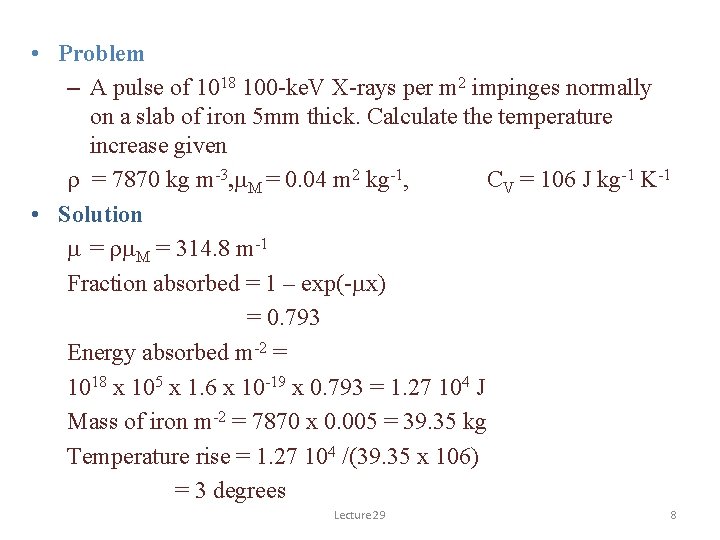
• Problem – A pulse of 1018 100 -ke. V X-rays per m 2 impinges normally on a slab of iron 5 mm thick. Calculate the temperature increase given r = 7870 kg m-3, m. M = 0. 04 m 2 kg-1, CV = 106 J kg-1 K-1 • Solution m = rm. M = 314. 8 m-1 Fraction absorbed = 1 – exp(-mx) = 0. 793 Energy absorbed m-2 = 1018 x 105 x 1. 6 x 10 -19 x 0. 793 = 1. 27 104 J Mass of iron m-2 = 7870 x 0. 005 = 39. 35 kg Temperature rise = 1. 27 104 /(39. 35 x 106) = 3 degrees Lecture 29 8
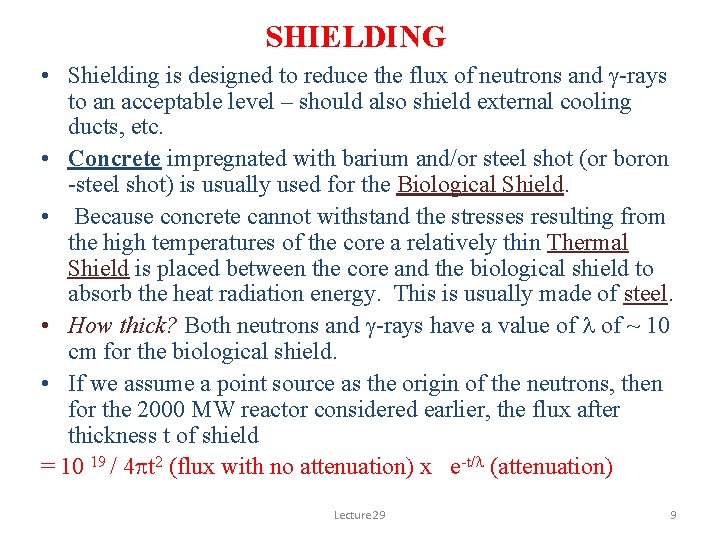
SHIELDING • Shielding is designed to reduce the flux of neutrons and -rays to an acceptable level – should also shield external cooling ducts, etc. • Concrete impregnated with barium and/or steel shot (or boron -steel shot) is usually used for the Biological Shield. • Because concrete cannot withstand the stresses resulting from the high temperatures of the core a relatively thin Thermal Shield is placed between the core and the biological shield to absorb the heat radiation energy. This is usually made of steel. • How thick? Both neutrons and -rays have a value of ~ 10 cm for the biological shield. • If we assume a point source as the origin of the neutrons, then for the 2000 MW reactor considered earlier, the flux after thickness t of shield = 10 19 / 4 t 2 (flux with no attenuation) x e-t/ (attenuation) Lecture 29 9
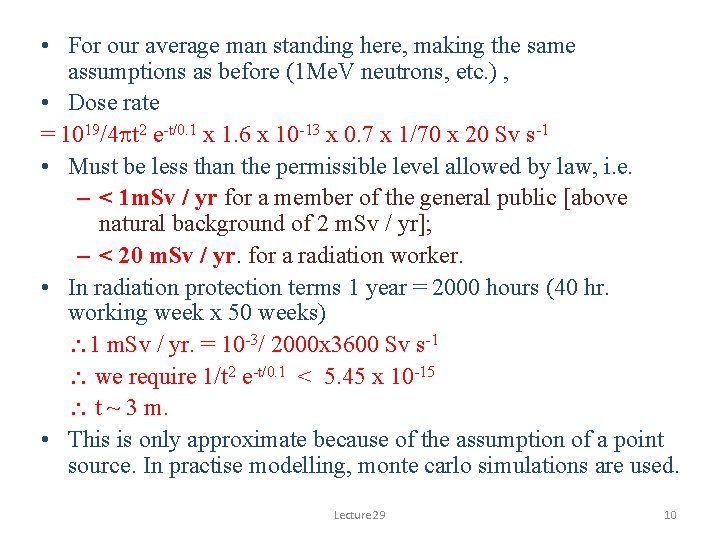
• For our average man standing here, making the same assumptions as before (1 Me. V neutrons, etc. ) , • Dose rate = 1019/4 t 2 e-t/0. 1 x 1. 6 x 10 -13 x 0. 7 x 1/70 x 20 Sv s-1 • Must be less than the permissible level allowed by law, i. e. – < 1 m. Sv / yr for a member of the general public [above natural background of 2 m. Sv / yr]; – < 20 m. Sv / yr. for a radiation worker. • In radiation protection terms 1 year = 2000 hours (40 hr. working week x 50 weeks) 1 m. Sv / yr. = 10 -3/ 2000 x 3600 Sv s-1 we require 1/t 2 e-t/0. 1 < 5. 45 x 10 -15 t ~ 3 m. • This is only approximate because of the assumption of a point source. In practise modelling, monte carlo simulations are used. Lecture 29 10