
Radiation shielding issues at the ESS linac Lali
- Slides: 18
Radiation shielding issues at the ESS linac Lali Tchelidze SLHi. PP April 17 -18 Louvain-la-Neuve, Belgium
Agenda • Linac tunnel earth berm shielding – Front end vs. high energy end of the linac. • Shielding issues for klystron building (around stubs) – Preliminary results and proposed solution. • Location of fences around the linac. • Tunnel air activation and release to environment. • Potential high energy neutron background to experiments. • Future plans.
Moral • Geometrical model - Beam loss assumptions - Radiation fields assessment “Even if all the parameters affecting beam losses in the accelerator were known, the variability inherent in accelerator layout and operation together with the complicated physics of high energy particle interactions and the subsequent production of secondary radiation and radioactivity make it extremely difficult to quantify radiation and radioactivity levels in an absolute way. ” - A. H. Sullivan
“The methods used to assess radiation levels under idealized conditions only lead to adequate guideline values rather than a detailed scientific description of the situation being studied. Precision is of secondary importance. ” - A. H. Sullivan
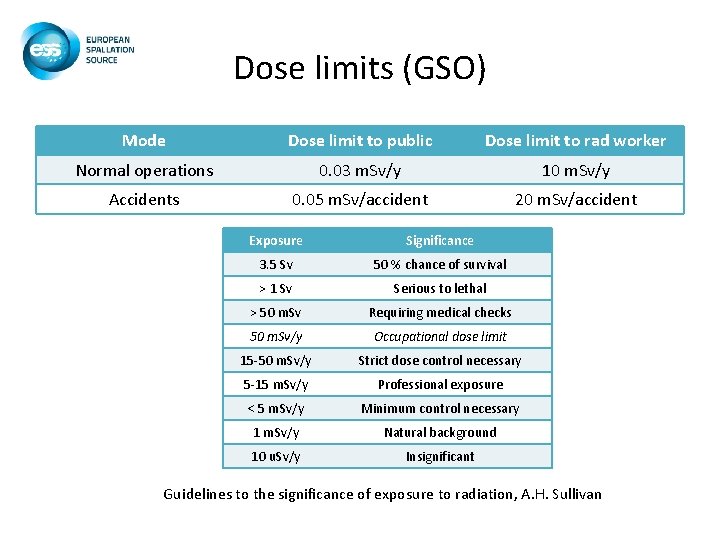
Dose limits (GSO) Mode Dose limit to public Dose limit to rad worker Normal operations 0. 03 m. Sv/y 10 m. Sv/y Accidents 0. 05 m. Sv/accident 20 m. Sv/accident Exposure Significance 3. 5 Sv 50 % chance of survival > 1 Sv Serious to lethal > 50 m. Sv Requiring medical checks 50 m. Sv/y Occupational dose limit 15 -50 m. Sv/y Strict dose control necessary 5 -15 m. Sv/y Professional exposure < 5 m. Sv/y Minimum control necessary 1 m. Sv/y Natural background 10 u. Sv/y Insignificant Guidelines to the significance of exposure to radiation, A. H. Sullivan
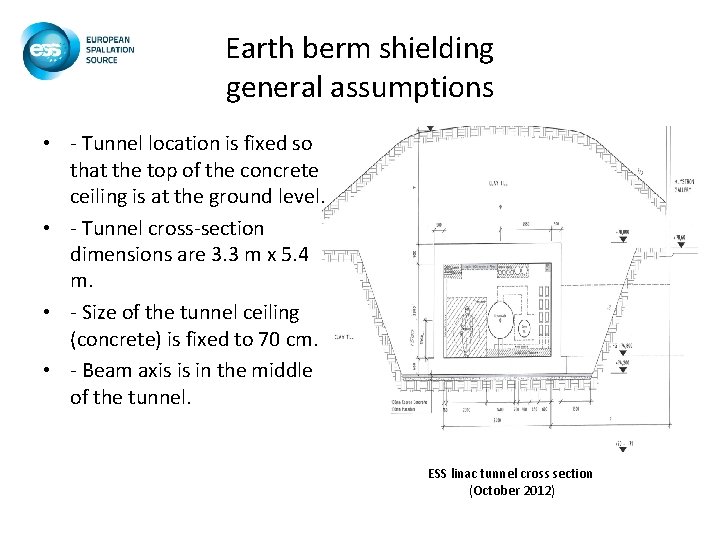
Earth berm shielding general assumptions • - Tunnel location is fixed so that the top of the concrete ceiling is at the ground level. • - Tunnel cross-section dimensions are 3. 3 m x 5. 4 m. • - Size of the tunnel ceiling (concrete) is fixed to 70 cm. • - Beam axis is in the middle of the tunnel. ESS linac tunnel cross section (October 2012)
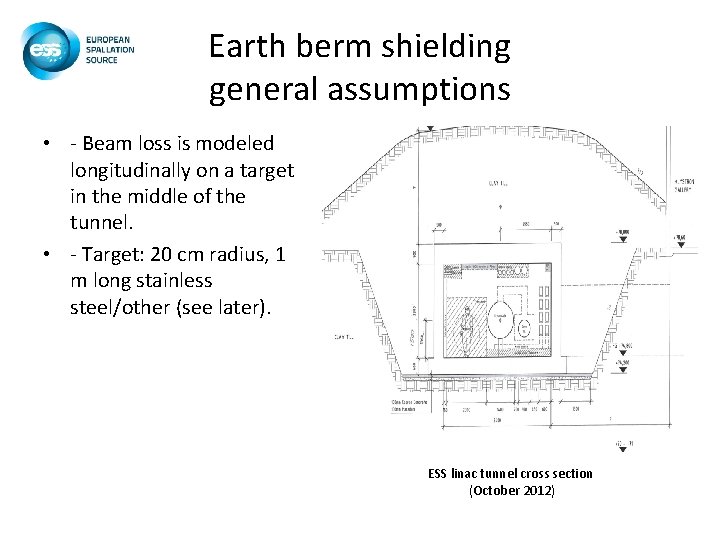
Earth berm shielding general assumptions • - Beam loss is modeled longitudinally on a target in the middle of the tunnel. • - Target: 20 cm radius, 1 m long stainless steel/other (see later). ESS linac tunnel cross section (October 2012)
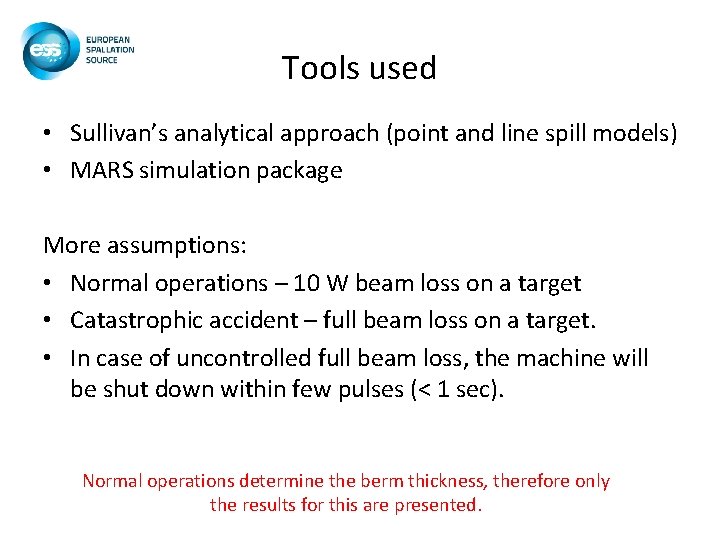
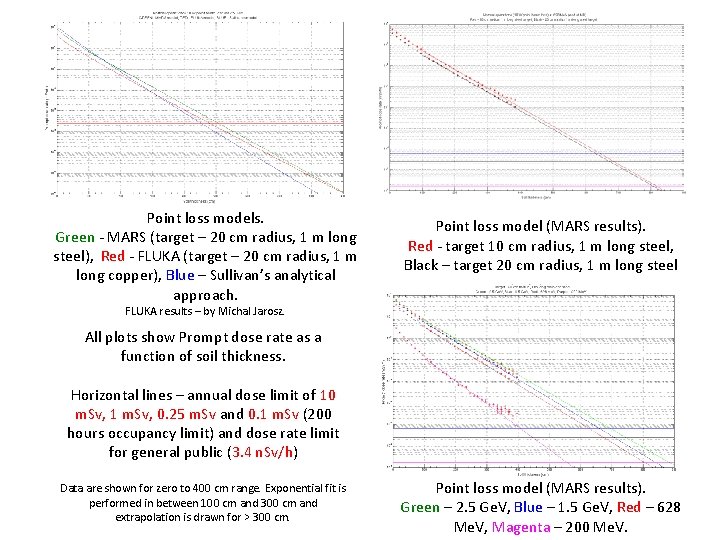
Tools used • Sullivan’s analytical approach (point and line spill models) • MARS simulation package More assumptions: • Normal operations – 10 W beam loss on a target • Catastrophic accident – full beam loss on a target. • In case of uncontrolled full beam loss, the machine will be shut down within few pulses (< 1 sec). Normal operations determine the berm thickness, therefore only the results for this are presented.
Point loss models. Green - MARS (target – 20 cm radius, 1 m long steel), Red - FLUKA (target – 20 cm radius, 1 m long copper), Blue – Sullivan’s analytical approach. Point loss model (MARS results). Red - target 10 cm radius, 1 m long steel, Black – target 20 cm radius, 1 m long steel FLUKA results – by Michal Jarosz. All plots show Prompt dose rate as a function of soil thickness. Horizontal lines – annual dose limit of 10 m. Sv, 1 m. Sv, 0. 25 m. Sv and 0. 1 m. Sv (200 hours occupancy limit) and dose rate limit for general public (3. 4 n. Sv/h) Data are shown for zero to 400 cm range. Exponential fit is performed in between 100 cm and 300 cm and extrapolation is drawn for > 300 cm. Point loss model (MARS results). Green – 2. 5 Ge. V, Blue – 1. 5 Ge. V, Red – 628 Me. V, Magenta – 200 Me. V.
Results
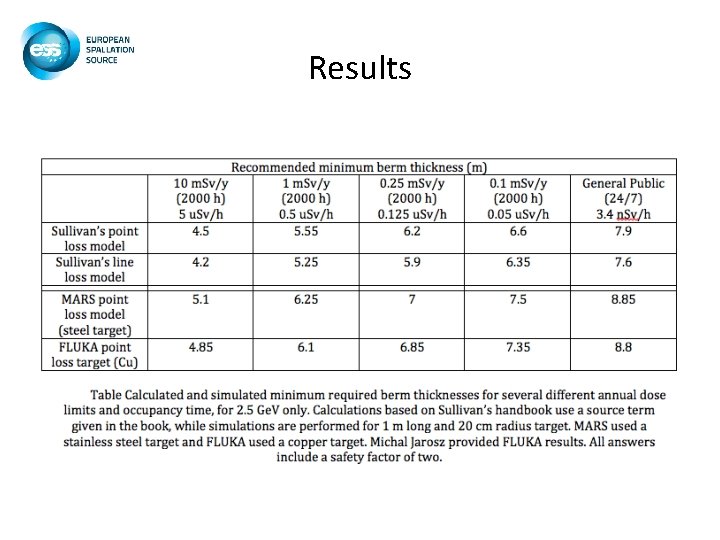
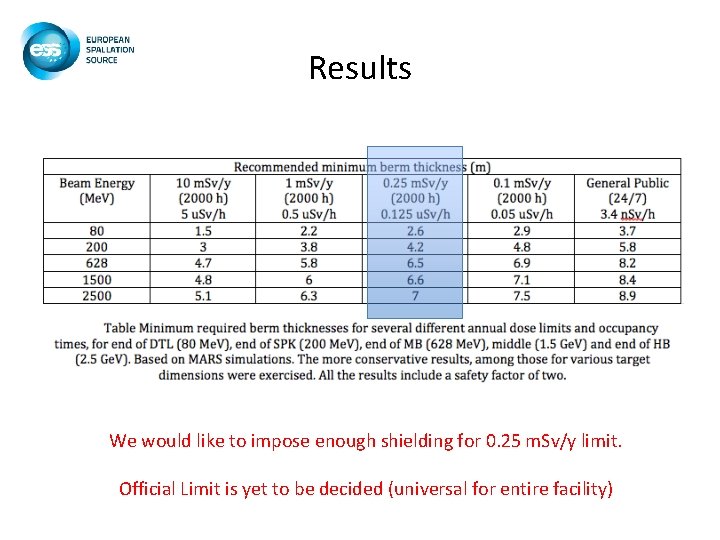
Results We would like to impose enough shielding for 0. 25 m. Sv/y limit. Official Limit is yet to be decided (universal for entire facility)
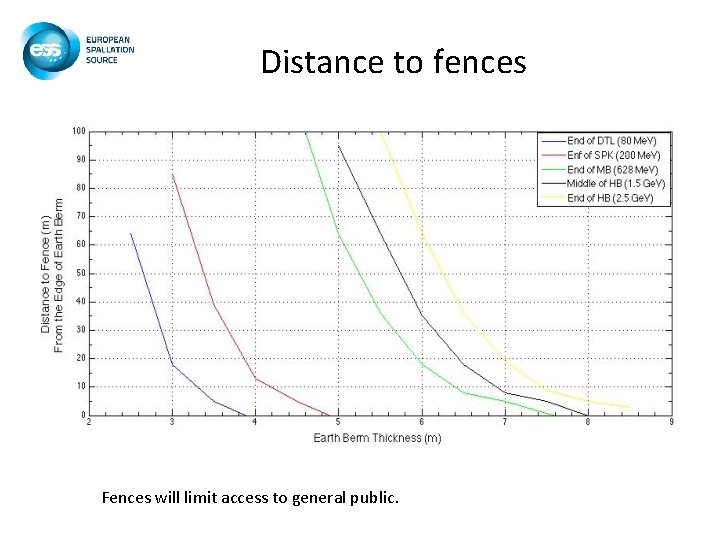
Distance to fences Fences will limit access to general public.
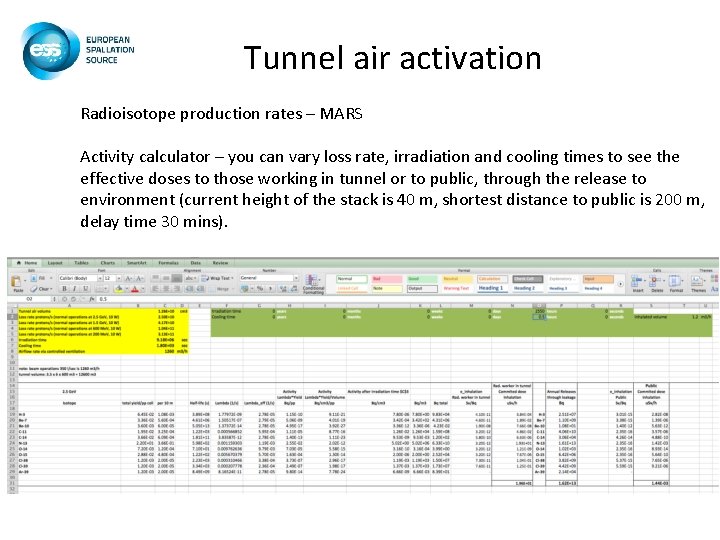
Tunnel air activation Radioisotope production rates – MARS Activity calculator – you can vary loss rate, irradiation and cooling times to see the effective doses to those working in tunnel or to public, through the release to environment (current height of the stack is 40 m, shortest distance to public is 200 m, delay time 30 mins).
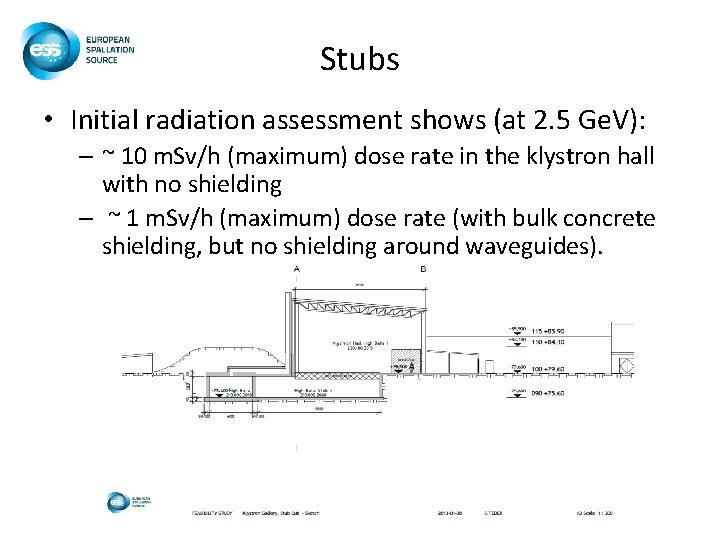
Stubs • Initial radiation assessment shows (at 2. 5 Ge. V): – ~ 10 m. Sv/h (maximum) dose rate in the klystron hall with no shielding – ~ 1 m. Sv/h (maximum) dose rate (with bulk concrete shielding, but no shielding around waveguides).
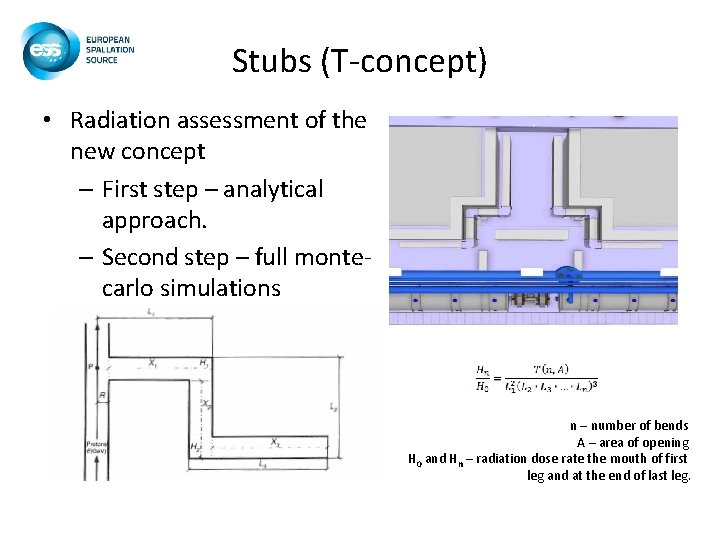
Stubs (T-concept) • Radiation assessment of the new concept – First step – analytical approach. – Second step – full montecarlo simulations n – number of bends A – area of opening H 0 and Hn – radiation dose rate the mouth of first leg and at the end of last leg.
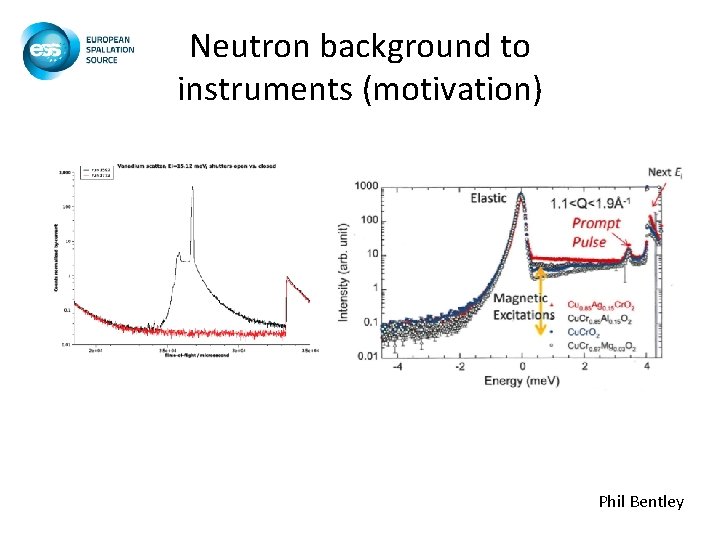
Neutron background to instruments (motivation) Phil Bentley
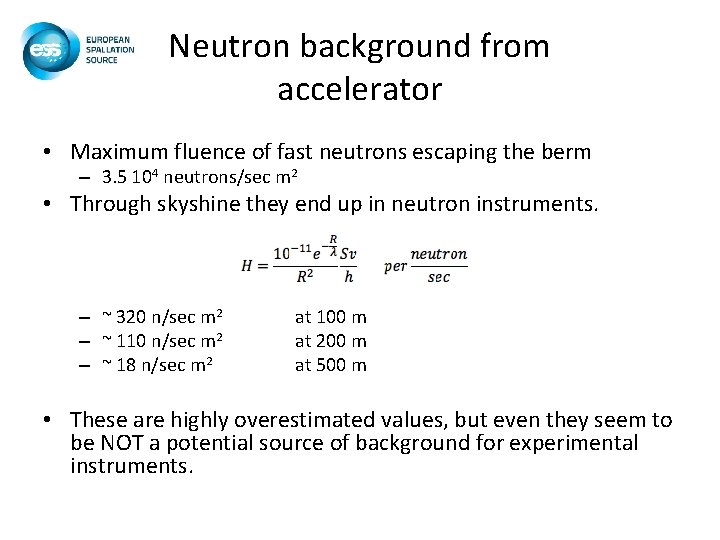
Neutron background from accelerator • Maximum fluence of fast neutrons escaping the berm – 3. 5 104 neutrons/sec m 2 • Through skyshine they end up in neutron instruments. – ~ 320 n/sec m 2 – ~ 110 n/sec m 2 – ~ 18 n/sec m 2 at 100 m at 200 m at 500 m • These are highly overestimated values, but even they seem to be NOT a potential source of background for experimental instruments.
Summary/Future work • Optimize the dimensions of the chicane of stubs. • Run full 3 D simulations to verify the analytical results. • Run full 3 D simulations to verify the results for fast neutron background to neutron instruments. • Shielding of – – HEBT loading bay area Cryogenic transfer line Emergency exits Front end building Thank you