
Radiation Safety under Emergency ASET Advances in Science
- Slides: 72
Radiation Safety under Emergency ASET ( Advances in Science, Engineering and Technology) Forum Tata Institute of Fundamental Research 20 th July. 2018 S A Bhardwaj Atomic Energy Regulatory Board, India 1
Mission of AERB: To ensure that the use of ionizing radiation and nuclear energy in India does not cause undue risk to health and the environment. 2
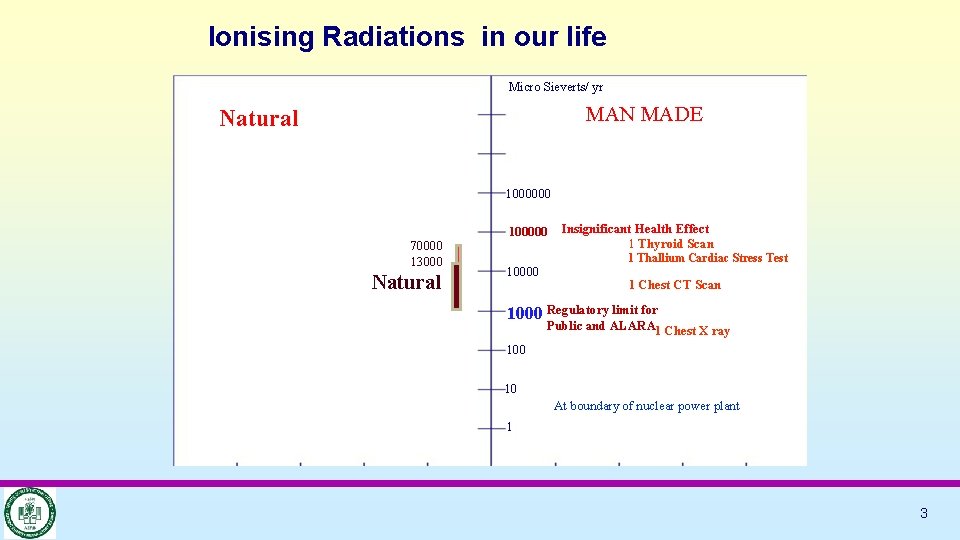
Ionising Radiations in our life Micro Sieverts/ yr MAN MADE Natural 1000000 70000 13000 Natural 100000 10000 Insignificant Health Effect 1 Thyroid Scan 1 Thallium Cardiac Stress Test 1 Chest CT Scan 1000 Regulatory limit for Public and ALARA 1 Chest X ray 100 10 At boundary of nuclear power plant 1 3
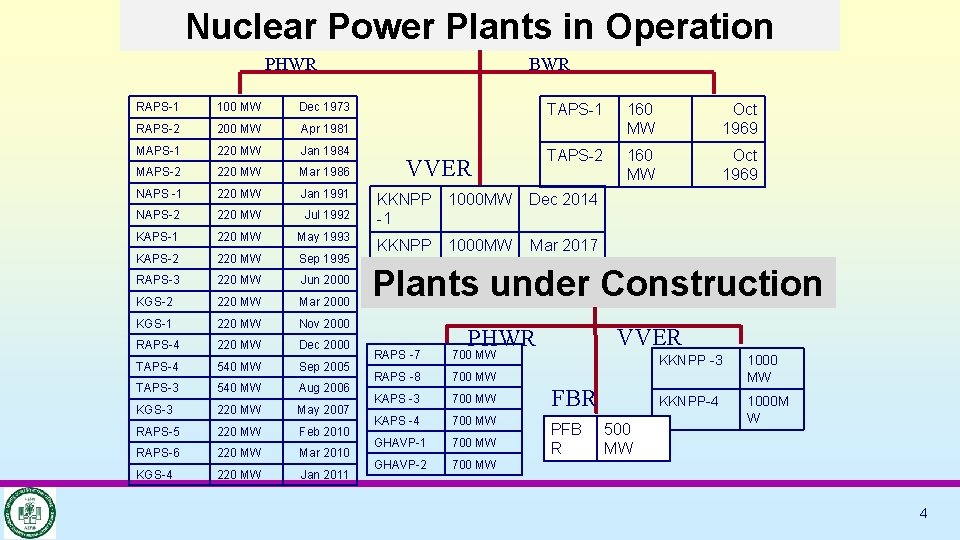
Nuclear Power Plants in Operation PHWR RAPS-1 100 MW Dec 1973 RAPS-2 200 MW Apr 1981 MAPS-1 220 MW Jan 1984 MAPS-2 220 MW Mar 1986 NAPS -1 220 MW Jan 1991 NAPS-2 220 MW Jul 1992 KAPS-1 220 MW May 1993 KAPS-2 220 MW Sep 1995 RAPS-3 220 MW Jun 2000 KGS-2 220 MW Mar 2000 KGS-1 220 MW Nov 2000 RAPS-4 220 MW Dec 2000 TAPS-4 540 MW Sep 2005 TAPS-3 540 MW Aug 2006 KGS-3 220 MW May 2007 RAPS-5 220 MW Feb 2010 RAPS-6 220 MW Mar 2010 KGS-4 220 MW Jan 2011 BWR VVER TAPS-1 160 MW Oct 1969 TAPS-2 160 MW Oct 1969 KKNPP -1 1000 MW Dec 2014 KKNPP -2 1000 MW Mar 2017 Plants under Construction VVER PHWR RAPS -7 700 MW RAPS -8 700 MW KAPS -3 700 MW KAPS -4 700 MW GHAVP-1 700 MW GHAVP-2 700 MW FBR PFB R 500 MW KKNPP -3 1000 MW KKNPP-4 1000 M W 4
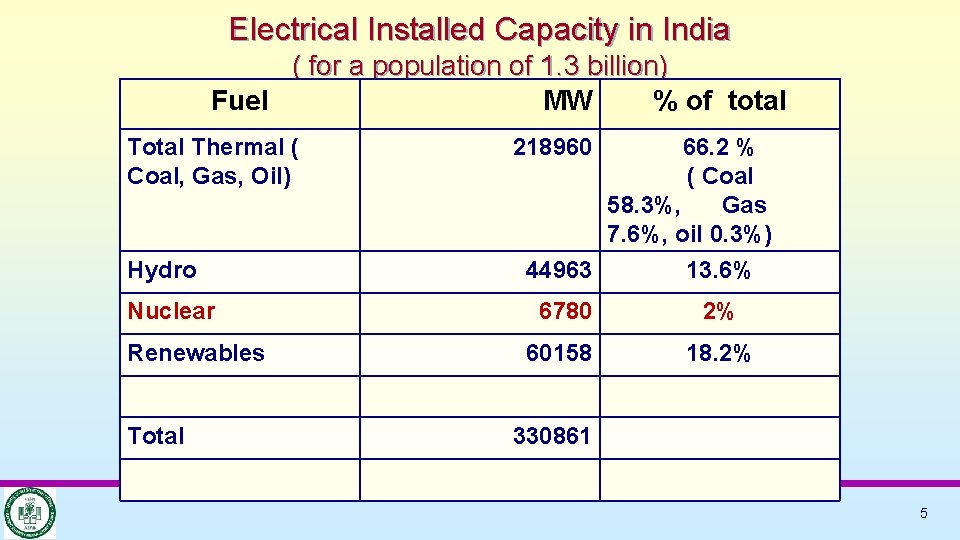
Electrical Installed Capacity in India ( for a population of 1. 3 billion) Fuel MW % of total Thermal ( Coal, Gas, Oil) Hydro Nuclear Renewables Total 218960 66. 2 % ( Coal 58. 3%, Gas 7. 6%, oil 0. 3%) 44963 13. 6% 6780 2% 60158 18. 2% 330861 5
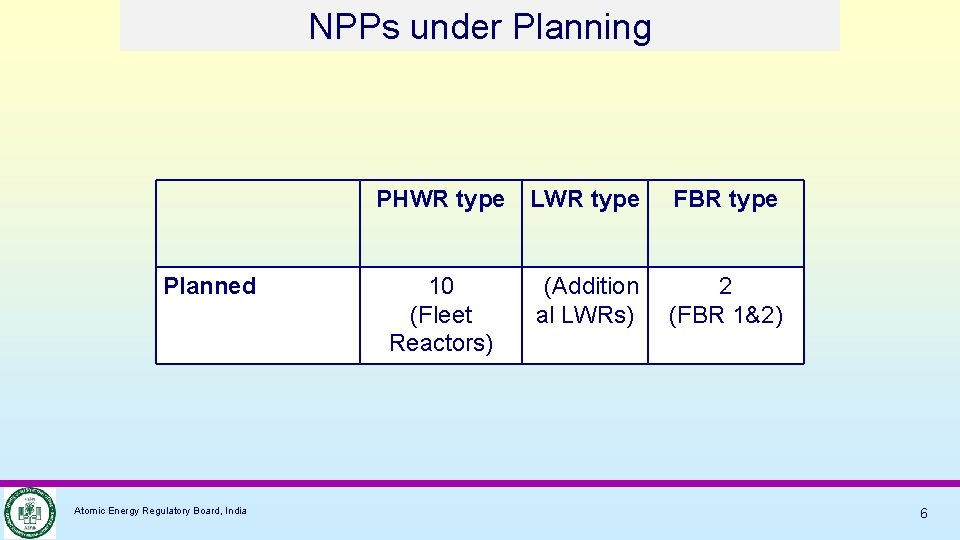
NPPs under Planning Planned Atomic Energy Regulatory Board, India PHWR type LWR type FBR type 10 (Fleet Reactors) (Addition al LWRs) 2 (FBR 1&2) 6
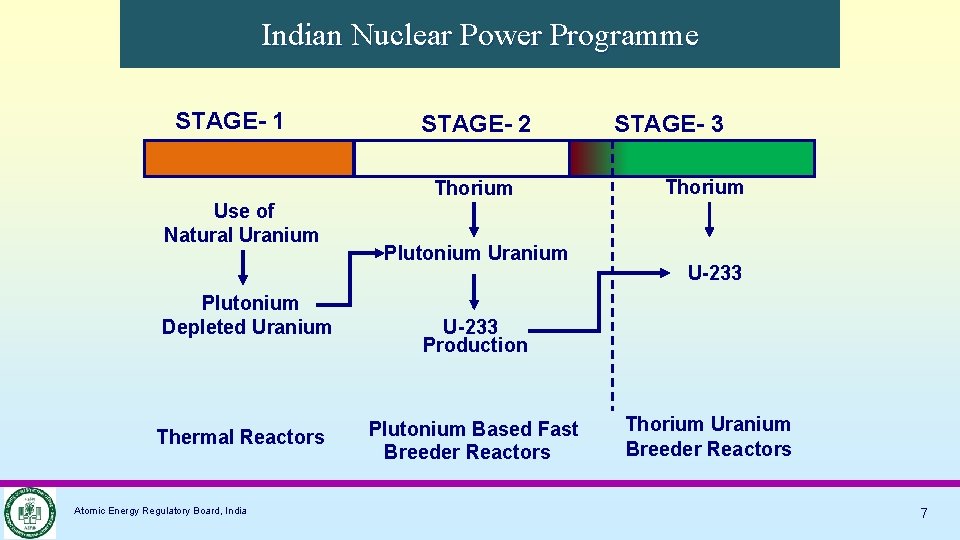
Indian Nuclear Power Programme STAGE- 1 STAGE- 2 Thorium Use of Natural Uranium Plutonium Depleted Uranium Thermal Reactors Atomic Energy Regulatory Board, India Plutonium Uranium STAGE- 3 Thorium U-233 Production Plutonium Based Fast Breeder Reactors Thorium Uranium Breeder Reactors 7
Large Number of Radiation facilities Atomic Energy Regulatory Board, India 8
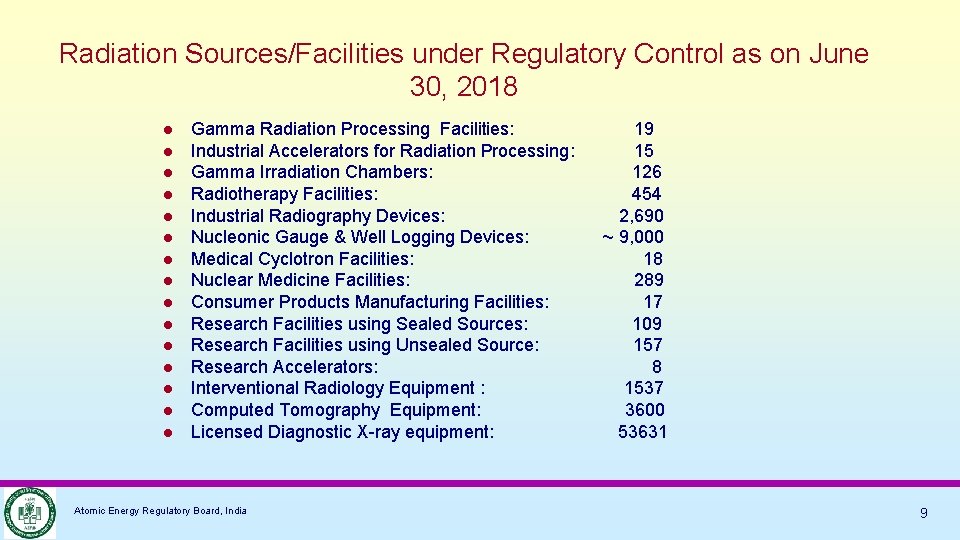
Radiation Sources/Facilities under Regulatory Control as on June 30, 2018 Gamma Radiation Processing Facilities: 19 Industrial Accelerators for Radiation Processing: 15 Gamma Irradiation Chambers: 126 Radiotherapy Facilities: 454 Industrial Radiography Devices: 2, 690 Nucleonic Gauge & Well Logging Devices: ~ 9, 000 Medical Cyclotron Facilities: 18 Nuclear Medicine Facilities: 289 Consumer Products Manufacturing Facilities: 17 Research Facilities using Sealed Sources: 109 Research Facilities using Unsealed Source: 157 Research Accelerators: 8 Interventional Radiology Equipment : 1537 Computed Tomography Equipment: 3600 Licensed Diagnostic X-ray equipment: 53631 Atomic Energy Regulatory Board, India 9
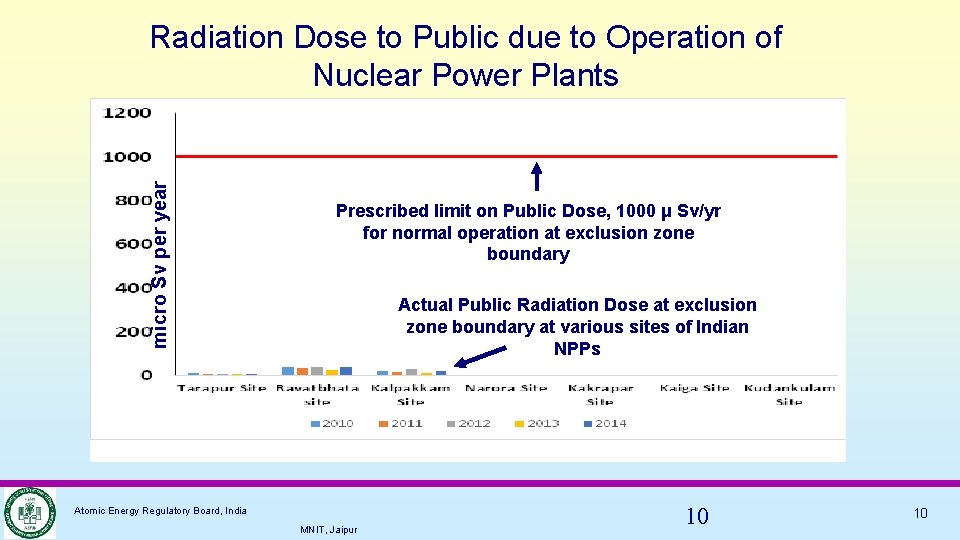
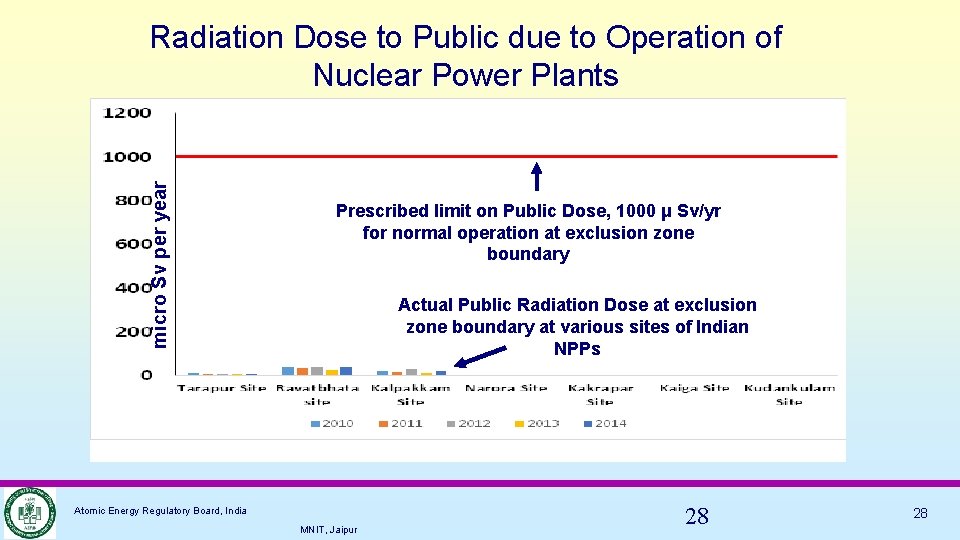
micro Sv per year Radiation Dose to Public due to Operation of Nuclear Power Plants Prescribed limit on Public Dose, 1000 μ Sv/yr for normal operation at exclusion zone boundary Actual Public Radiation Dose at exclusion zone boundary at various sites of Indian NPPs Atomic Energy Regulatory Board, India MNIT, Jaipur 10 10
Technological aspects of Nuclear Safety Atomic Energy Regulatory Board, India 11
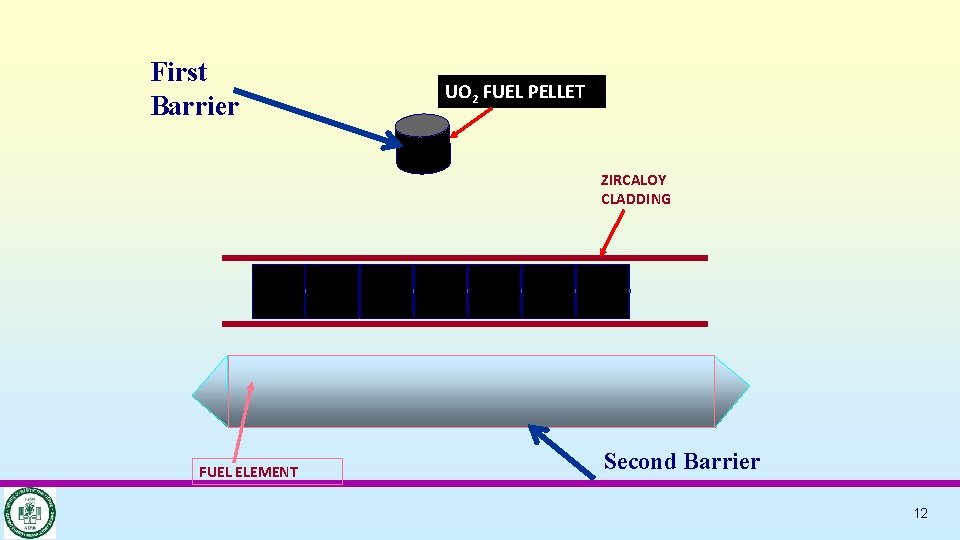
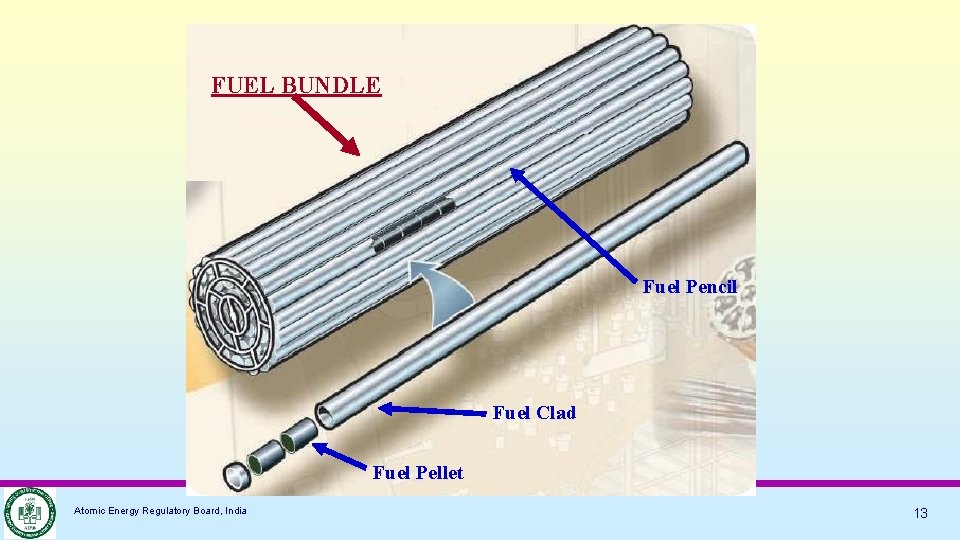
First Barrier UO 2 FUEL PELLET ZIRCALOY CLADDING FUEL ELEMENT Second Barrier 12
FUEL BUNDLE Fuel Pencil Fuel Clad Fuel Pellet Atomic Energy Regulatory Board, India 13
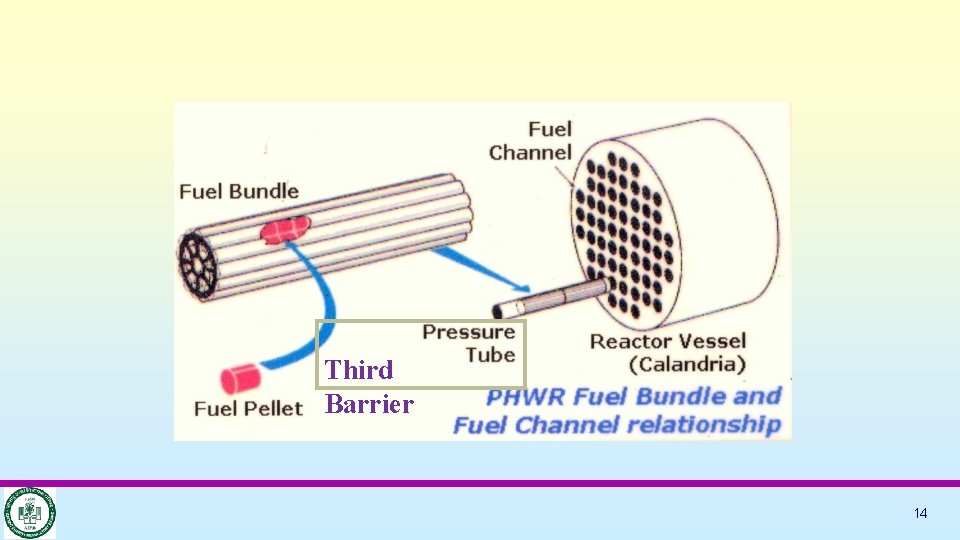
Third Barrier 14
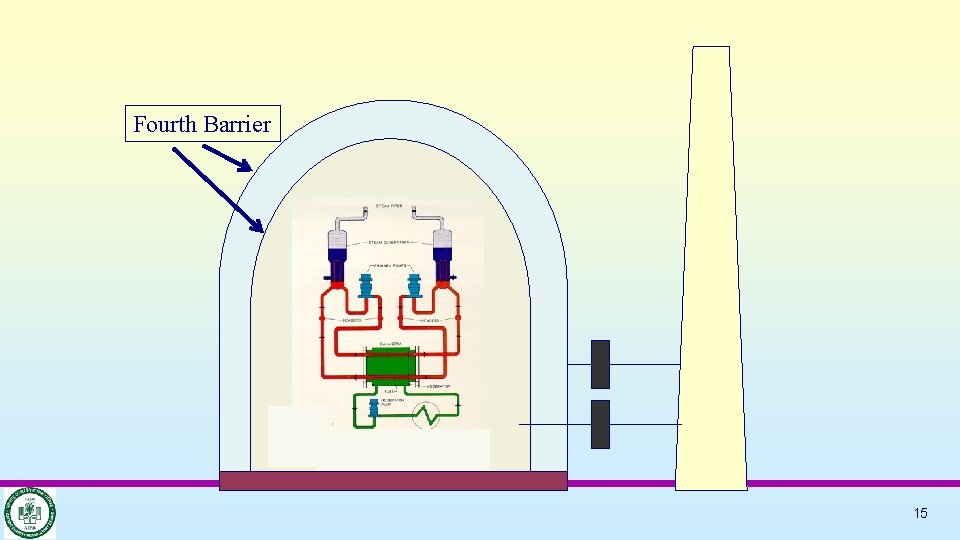
Fourth Barrier 15
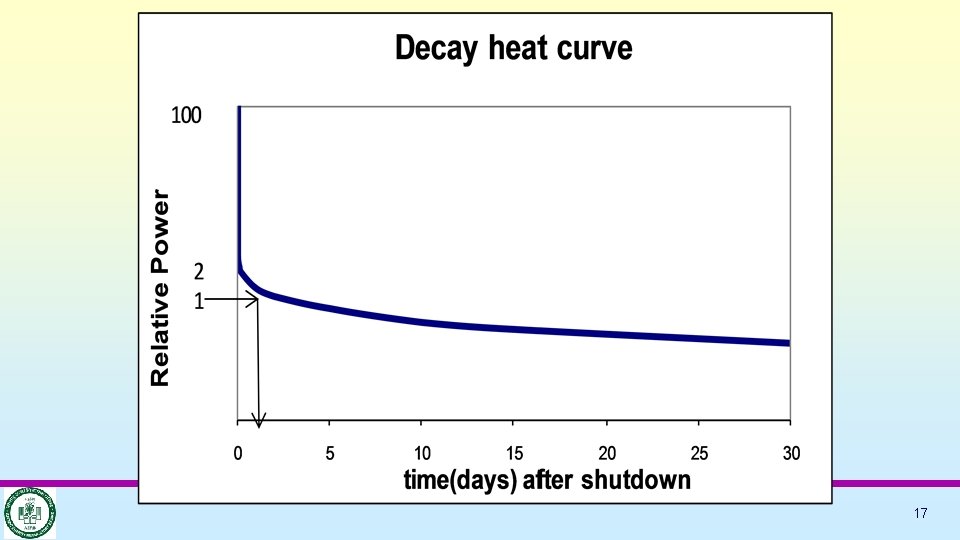
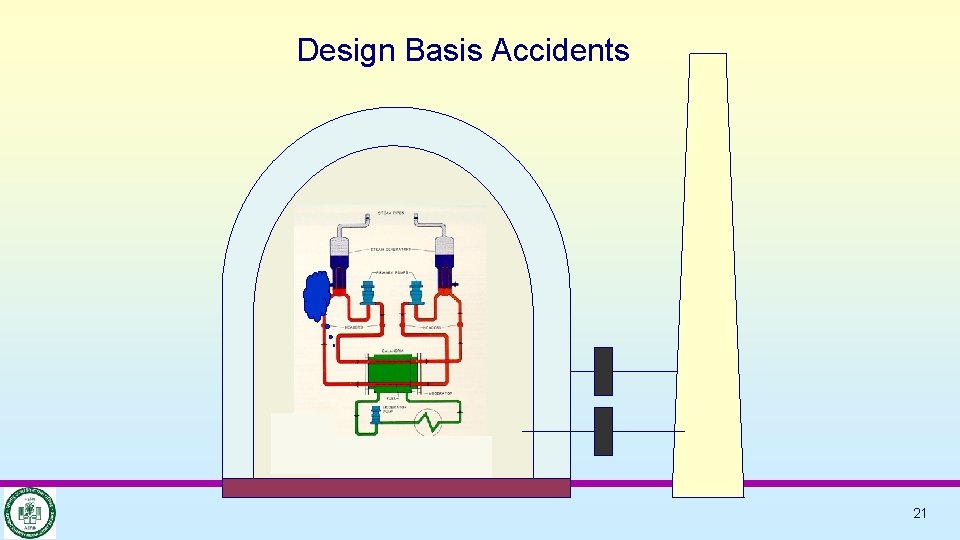
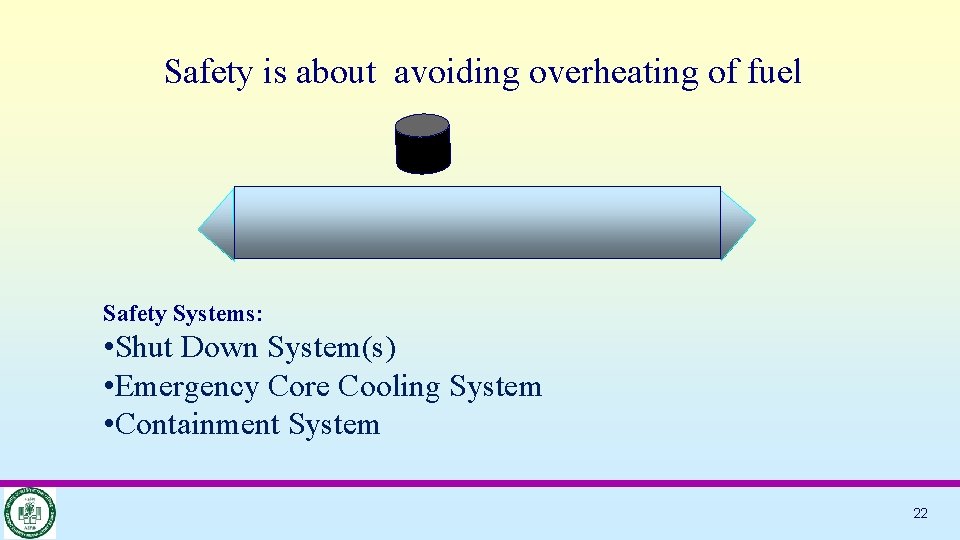
• Safety is ensured if fuel is cooled at all times to remove the heat being produced including even when the plant is not operating. 16
17
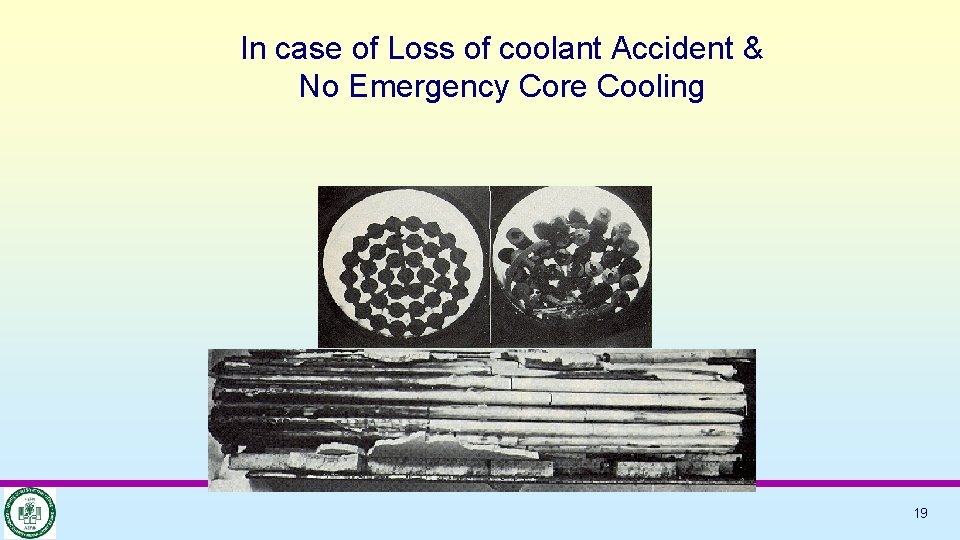
What happens if not able to cool? 18
In case of Loss of coolant Accident & No Emergency Core Cooling 19
20
Design Basis Accidents 21
Safety is about avoiding overheating of fuel Safety Systems: • Shut Down System(s) • Emergency Core Cooling System • Containment System 22
What does Atomic Energy Regulatory Board (AERB) do for you? Atomic Energy Regulatory Board, India 23
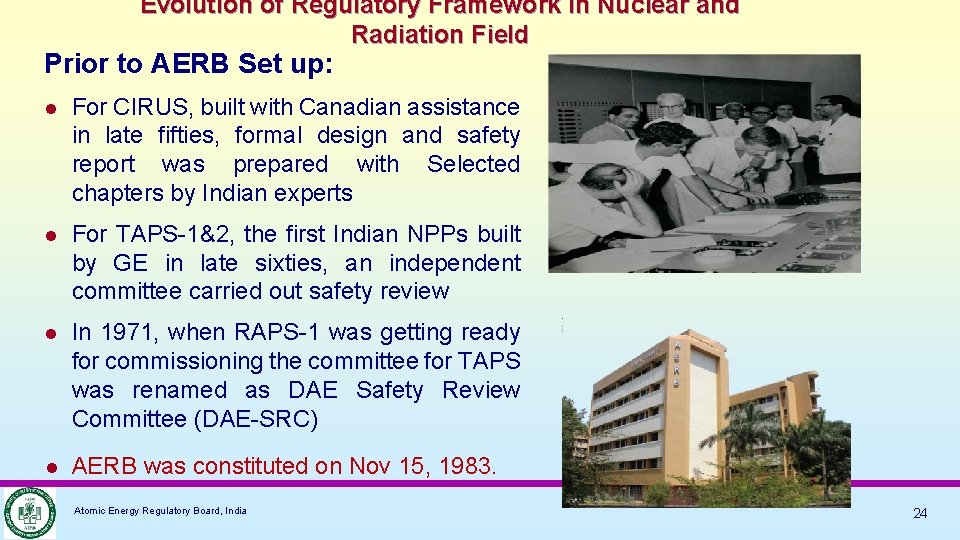
Evolution of Regulatory Framework in Nuclear and Radiation Field Prior to AERB Set up: For CIRUS, built with Canadian assistance in late fifties, formal design and safety report was prepared with Selected chapters by Indian experts For TAPS-1&2, the first Indian NPPs built by GE in late sixties, an independent committee carried out safety review In 1971, when RAPS-1 was getting ready for commissioning the committee for TAPS was renamed as DAE Safety Review Committee (DAE-SRC) AERB was constituted on Nov 15, 1983. Atomic Energy Regulatory Board, India 24
NUCLEAR POWER REGULATION IN INDIA Constitution of AERB empowered to enforce rules and regulations framed under the Atomic Energy Act, 1962 for radiation safety in the country – Atomic Energy (Radiation Protection) Rules, 2004 – Atomic Energy (Safe Disposal of Radioactive Wastes) Rules, 1987 – Atomic Energy (Factories) Rules, 1996 – Atomic Energy (Working of the Mines, Minerals and Handling of Prescribed Substances) Rules, 1984 25
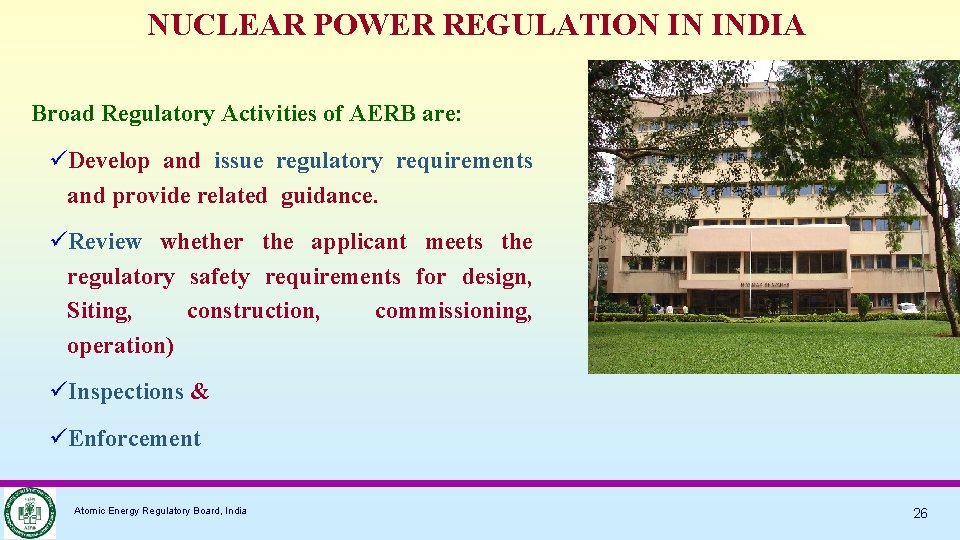
NUCLEAR POWER REGULATION IN INDIA Broad Regulatory Activities of AERB are: üDevelop and issue regulatory requirements and provide related guidance. üReview whether the applicant meets the regulatory safety requirements for design, Siting, construction, commissioning, operation) üInspections & üEnforcement Atomic Energy Regulatory Board, India 26
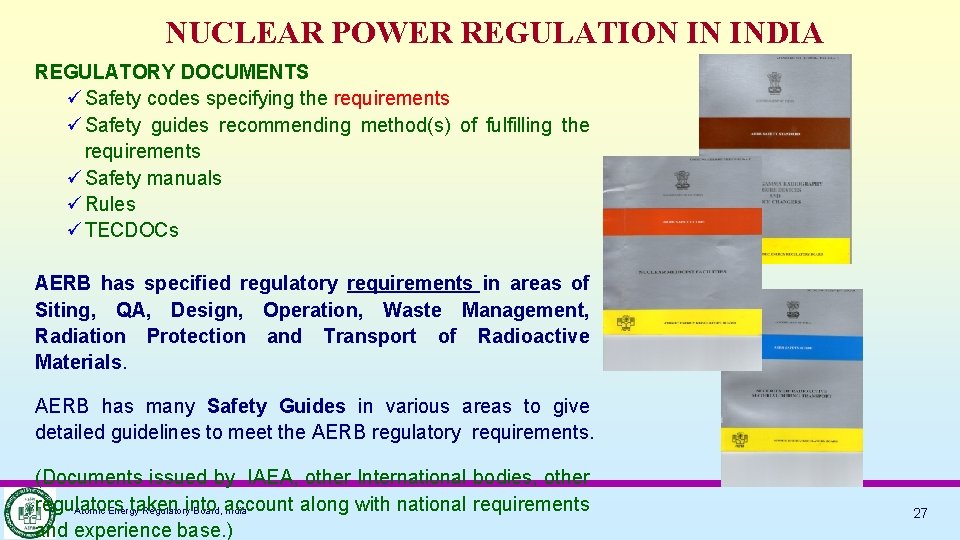
NUCLEAR POWER REGULATION IN INDIA REGULATORY DOCUMENTS ü Safety codes specifying the requirements ü Safety guides recommending method(s) of fulfilling the requirements ü Safety manuals ü Rules ü TECDOCs AERB has specified regulatory requirements in areas of Siting, QA, Design, Operation, Waste Management, Radiation Protection and Transport of Radioactive Materials. AERB has many Safety Guides in various areas to give detailed guidelines to meet the AERB regulatory requirements. (Documents issued by IAEA, other International bodies, other regulators taken into account along with national requirements Atomic Energy Regulatory Board, India and experience base. ) 27
micro Sv per year Radiation Dose to Public due to Operation of Nuclear Power Plants Prescribed limit on Public Dose, 1000 μ Sv/yr for normal operation at exclusion zone boundary Actual Public Radiation Dose at exclusion zone boundary at various sites of Indian NPPs Atomic Energy Regulatory Board, India MNIT, Jaipur 28 28
Indian NPP Incidents NAPS : Fire Incident MAPS : Tsunami KAPS : Flood Loss of coolant Accident Atomic Energy Regulatory Board, India 29
Experiences of Radiological Events Three Mile Island, Chernobyl and Fukushima Atomic Energy Regulatory Board, India 30
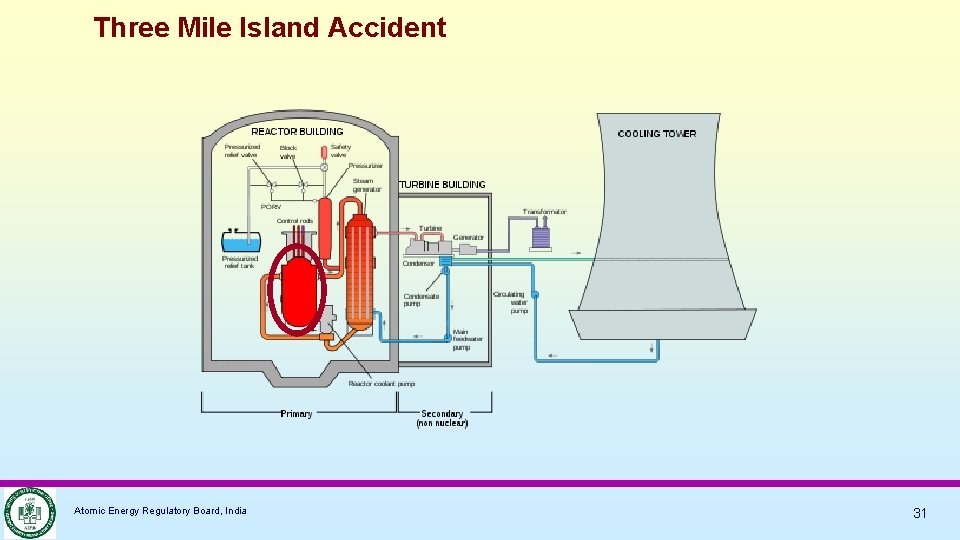
Three Mile Island Accident Atomic Energy Regulatory Board, India 31
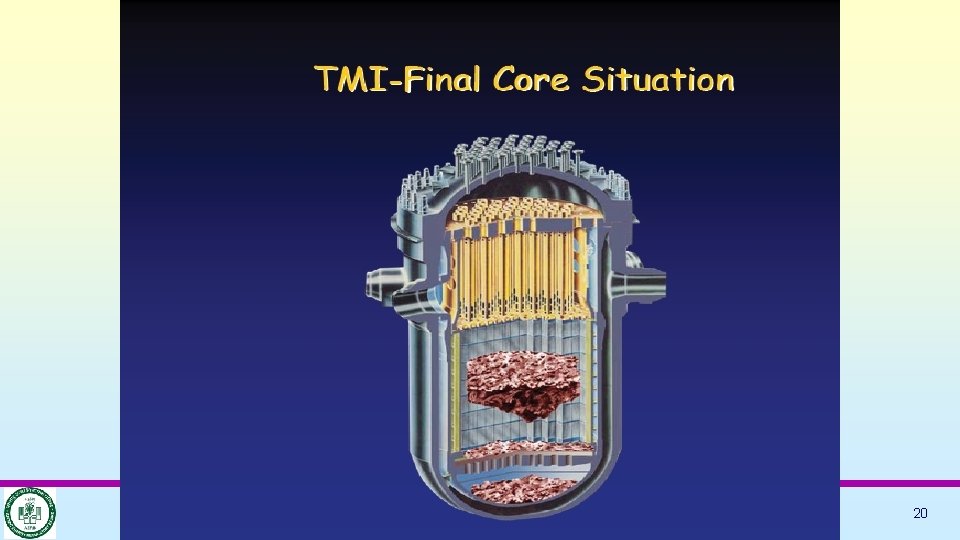
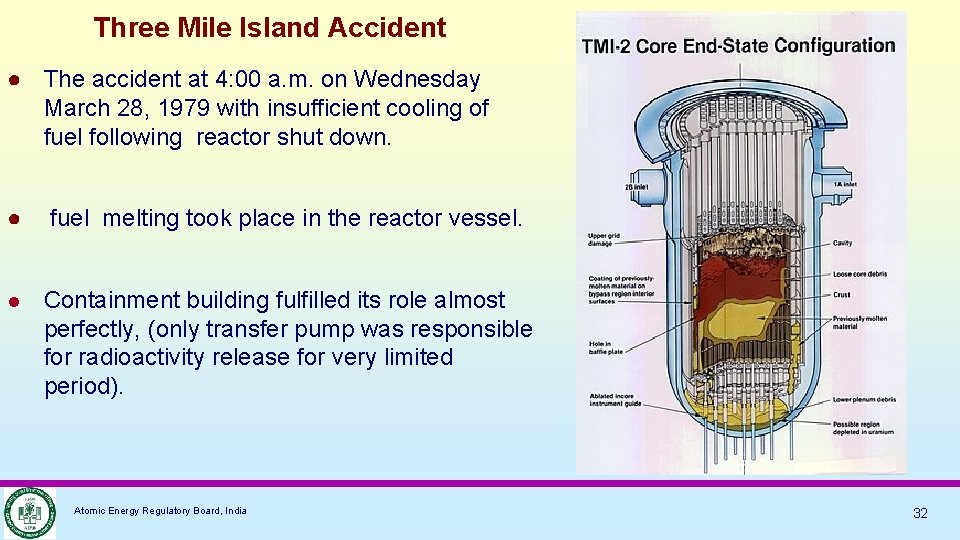
Three Mile Island Accident ● The accident at 4: 00 a. m. on Wednesday March 28, 1979 with insufficient cooling of fuel following reactor shut down. ● fuel melting took place in the reactor vessel. Containment building fulfilled its role almost perfectly, (only transfer pump was responsible for radioactivity release for very limited period). Atomic Energy Regulatory Board, India 32
Three Mile Island Accident It is estimated that an individual downwind at the edge of the site boundary would have received a dose of less than 1 m. Sv , equivalent to the annual dose limit of public during the normal operation. ● After two days of core melt down, pregnant women and children of preschool age were evacuated within five miles radius. In addition, the advisory calling for a few thousand pregnant women and preschool children to evacuate, resulted in entire families evacuating, and it is estimated that over 100, 000 people evacuated from areas within 40 kilometres of the plant. Source : IAEA, Safety Assessment Atomic Energy Regulatory Board, India 33
Experiences of Radiological Events Chernobyl Atomic Energy Regulatory Board, India 34
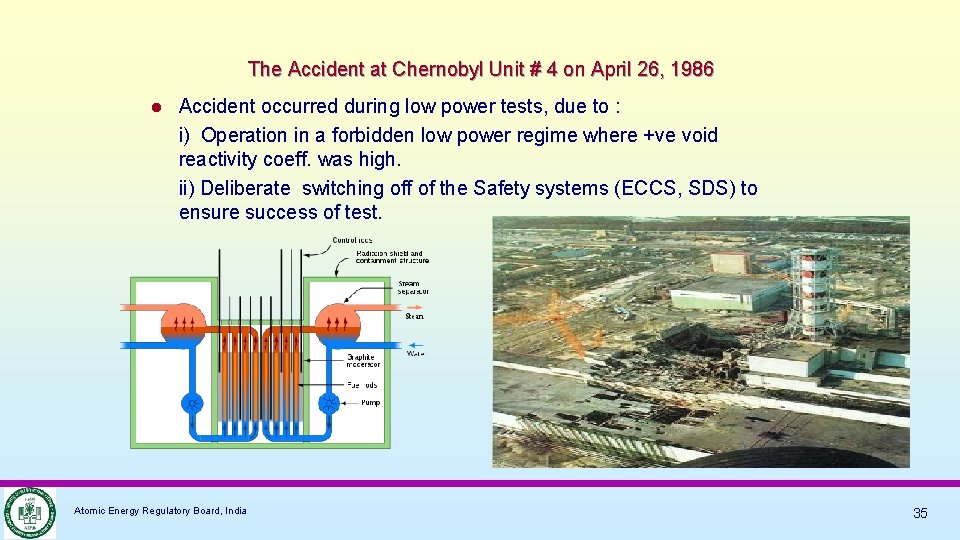
The Accident at Chernobyl Unit # 4 on April 26, 1986 Accident occurred during low power tests, due to : i) Operation in a forbidden low power regime where +ve void reactivity coeff. was high. ii) Deliberate switching off of the Safety systems (ECCS, SDS) to ensure success of test. Atomic Energy Regulatory Board, India 35
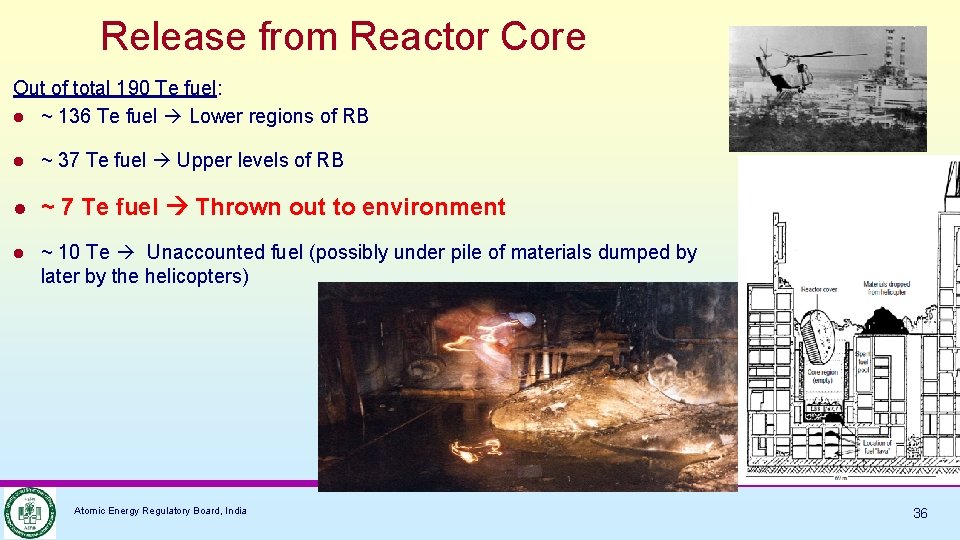
Release from Reactor Core Out of total 190 Te fuel: ~ 136 Te fuel Lower regions of RB ~ 37 Te fuel Upper levels of RB ~ 7 Te fuel Thrown out to environment ~ 10 Te Unaccounted fuel (possibly under pile of materials dumped by later by the helicopters) Atomic Energy Regulatory Board, India 36
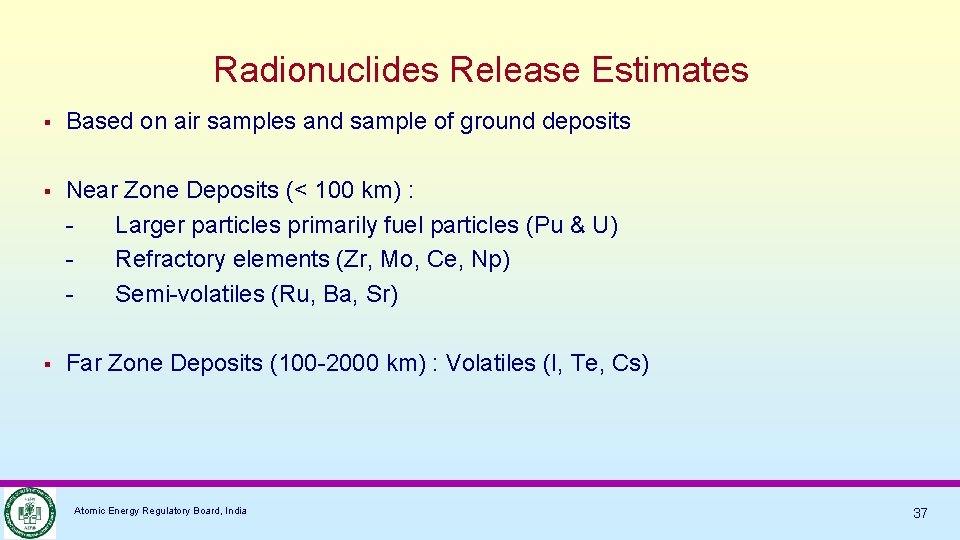
Radionuclides Release Estimates § Based on air samples and sample of ground deposits § Near Zone Deposits (< 100 km) : Larger particles primarily fuel particles (Pu & U) Refractory elements (Zr, Mo, Ce, Np) Semi-volatiles (Ru, Ba, Sr) § Far Zone Deposits (100 -2000 km) : Volatiles (I, Te, Cs) Atomic Energy Regulatory Board, India 37
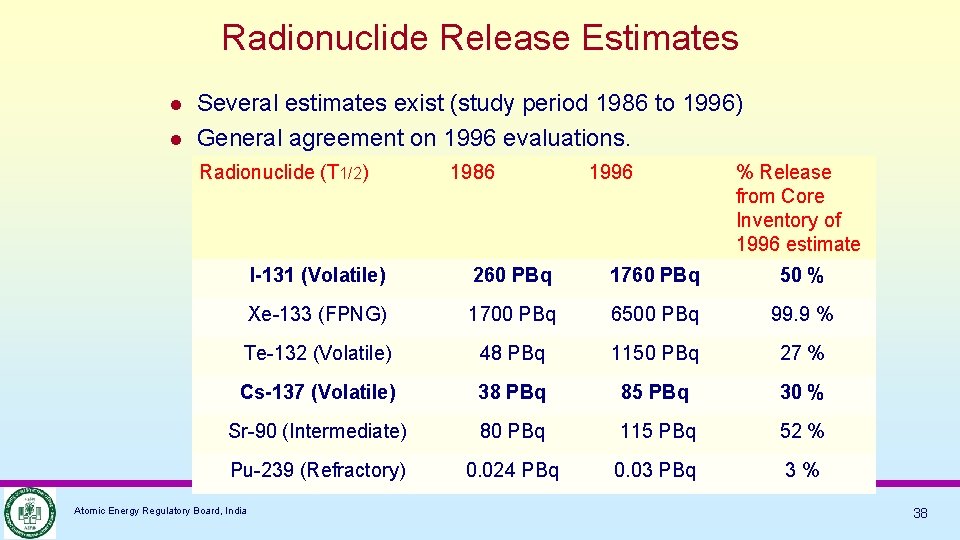
Radionuclide Release Estimates Several estimates exist (study period 1986 to 1996) General agreement on 1996 evaluations. Radionuclide (T 1/2) 1986 1996 % Release from Core Inventory of 1996 estimate I-131 (Volatile) 260 PBq 1760 PBq 50 % Xe-133 (FPNG) 1700 PBq 6500 PBq 99. 9 % Te-132 (Volatile) 48 PBq 1150 PBq 27 % Cs-137 (Volatile) 38 PBq 85 PBq 30 % Sr-90 (Intermediate) 80 PBq 115 PBq 52 % Pu-239 (Refractory) 0. 024 PBq 0. 03 PBq 3 % Atomic Energy Regulatory Board, India 38
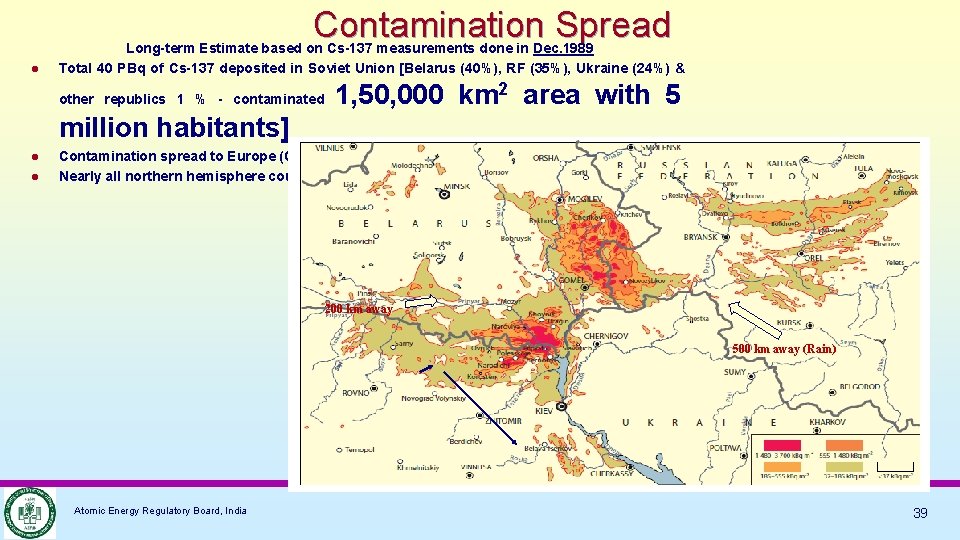
Contamination Spread Long-term Estimate based on Cs-137 measurements done in Dec. 1989 Total 40 PBq of Cs-137 deposited in Soviet Union [Belarus (40%), RF (35%), Ukraine (24%) & other republics 1 % - contaminated 1, 50, 000 km 2 area with 5 million habitants] Contamination spread to Europe (Cs-137 : 37 -200 k. Bq/m 2 over 45000 km 2) Nearly all northern hemisphere countries showed traces of radionuclides 200 km away 500 km away (Rain) Atomic Energy Regulatory Board, India 39
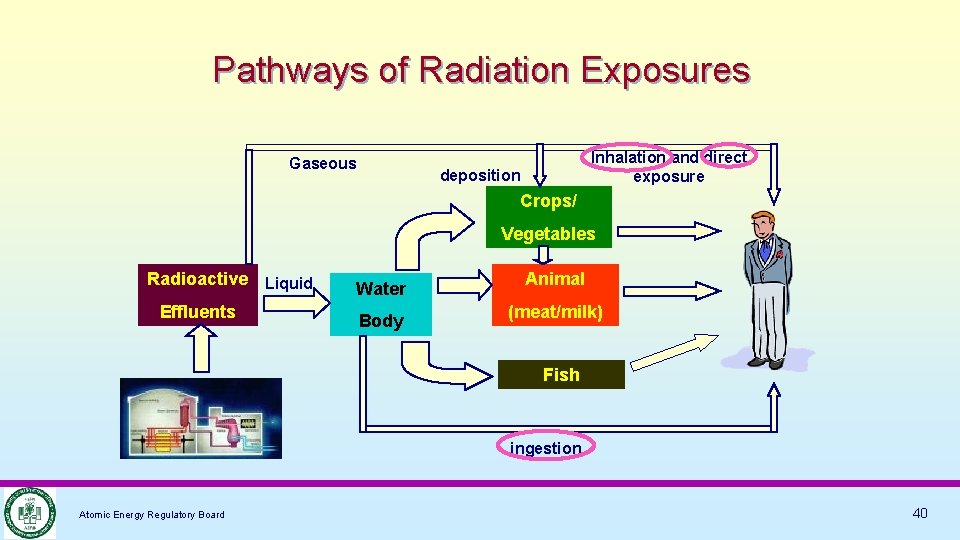
Pathways of Radiation Exposures Gaseous Inhalation and direct exposure deposition Crops/ Vegetables Radioactive Liquid Effluents Water Body Animal (meat/milk) Fish ingestion Atomic Energy Regulatory Board 40
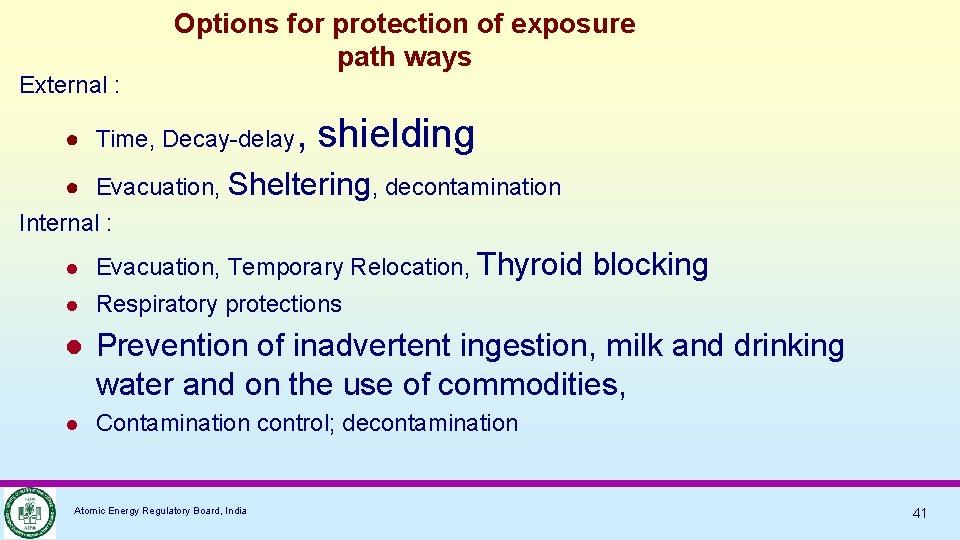
External : Options for protection of exposure path ways ● Time, Decay-delay , shielding ● Evacuation, Sheltering, decontamination Internal : Evacuation, Temporary Relocation, Thyroid blocking Respiratory protections Prevention of inadvertent ingestion, milk and drinking water and on the use of commodities, Contamination control; decontamination Atomic Energy Regulatory Board, India 41
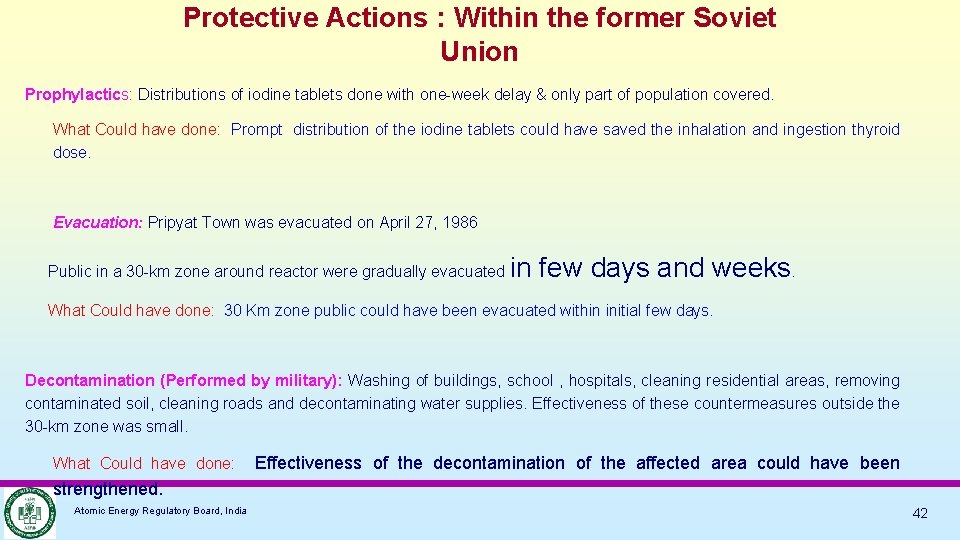
Protective Actions : Within the former Soviet Union Prophylactics: Distributions of iodine tablets done with one-week delay & only part of population covered. What Could have done: Prompt distribution of the iodine tablets could have saved the inhalation and ingestion thyroid dose. Evacuation: Pripyat Town was evacuated on April 27, 1986 Public in a 30 -km zone around reactor were gradually evacuated in few days and weeks. What Could have done: 30 Km zone public could have been evacuated within initial few days. Decontamination (Performed by military): Washing of buildings, school , hospitals, cleaning residential areas, removing contaminated soil, cleaning roads and decontaminating water supplies. Effectiveness of these countermeasures outside the 30 -km zone was small. What Could have done: Effectiveness of the decontamination of the affected area could have been strengthened. Atomic Energy Regulatory Board, India 42
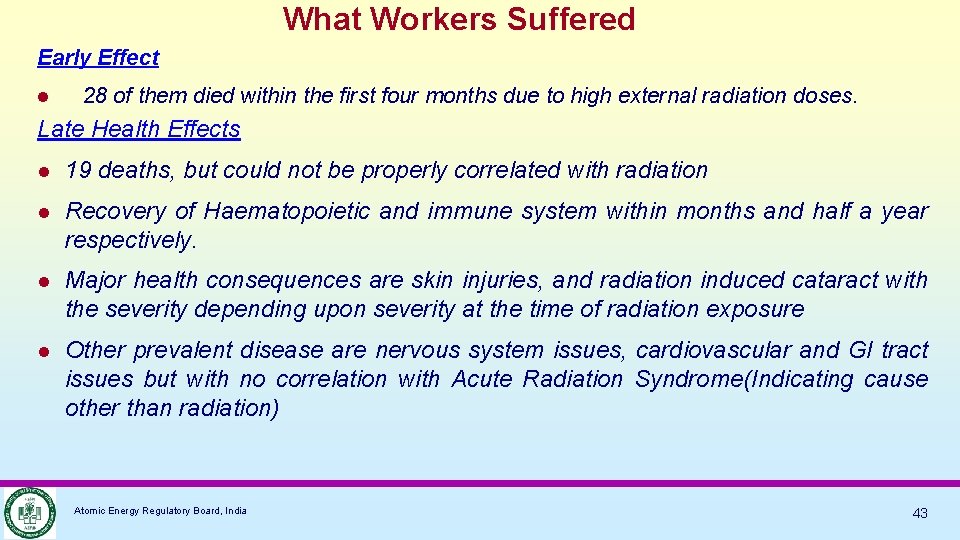
What Workers Suffered Early Effect 28 of them died within the first four months due to high external radiation doses. Late Health Effects 19 deaths, but could not be properly correlated with radiation Recovery of Haematopoietic and immune system within months and half a year respectively. Major health consequences are skin injuries, and radiation induced cataract with the severity depending upon severity at the time of radiation exposure Other prevalent disease are nervous system issues, cardiovascular and GI tract issues but with no correlation with Acute Radiation Syndrome(Indicating cause other than radiation) Atomic Energy Regulatory Board, India 43
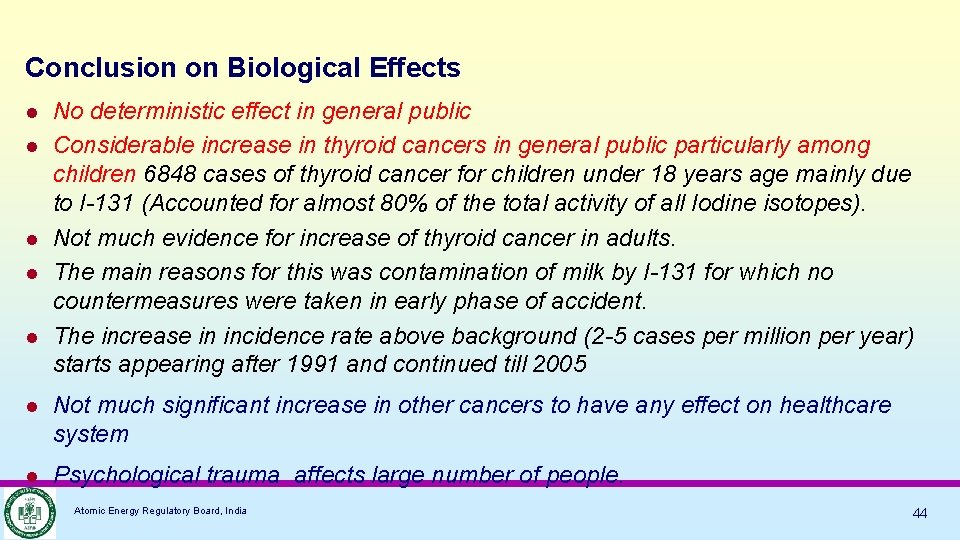
Conclusion on Biological Effects No deterministic effect in general public Considerable increase in thyroid cancers in general public particularly among children 6848 cases of thyroid cancer for children under 18 years age mainly due to I-131 (Accounted for almost 80% of the total activity of all Iodine isotopes). Not much evidence for increase of thyroid cancer in adults. The main reasons for this was contamination of milk by I-131 for which no countermeasures were taken in early phase of accident. The increase in incidence rate above background (2 -5 cases per million per year) starts appearing after 1991 and continued till 2005 Not much significant increase in other cancers to have any effect on healthcare system Psychological trauma affects large number of people. Atomic Energy Regulatory Board, India 44
Experiences of Radiological Events Fukushima Atomic Energy Regulatory Board, India 45
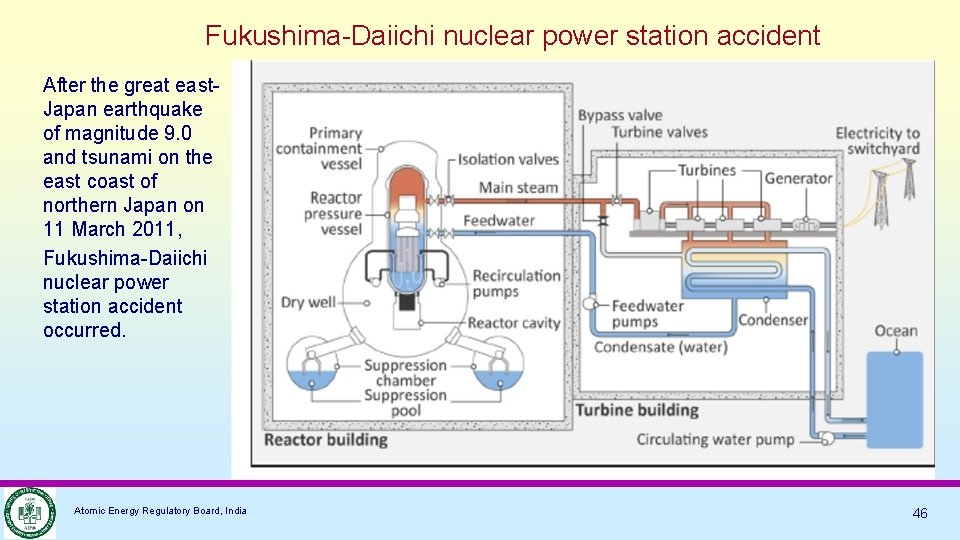
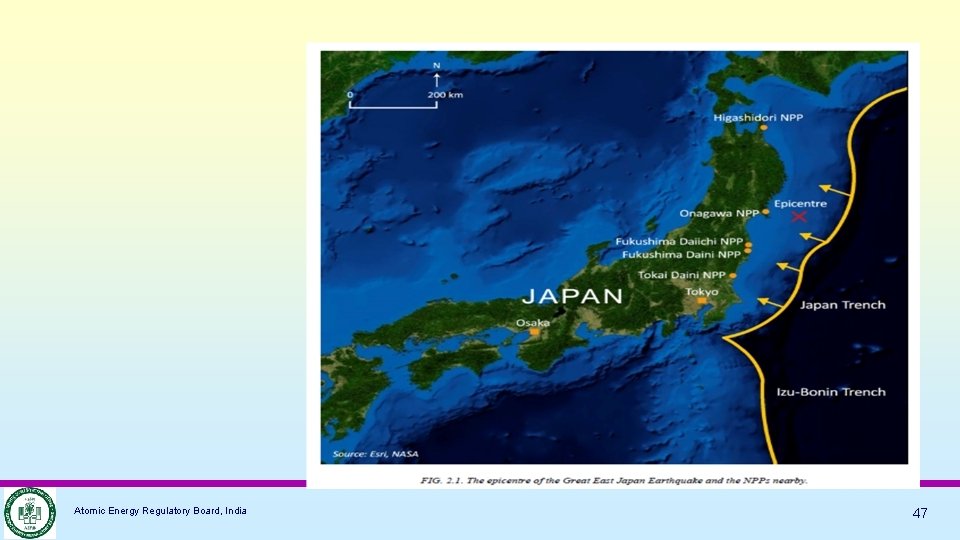
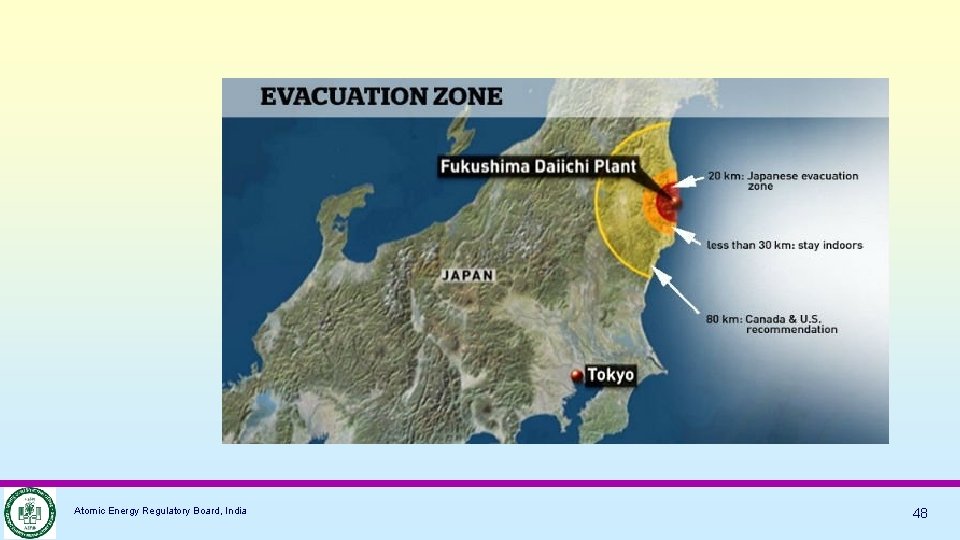
Fukushima-Daiichi nuclear power station accident After the great east. Japan earthquake of magnitude 9. 0 and tsunami on the east coast of northern Japan on 11 March 2011, Fukushima-Daiichi nuclear power station accident occurred. Atomic Energy Regulatory Board, India 46
Atomic Energy Regulatory Board, India 47
Atomic Energy Regulatory Board, India 48
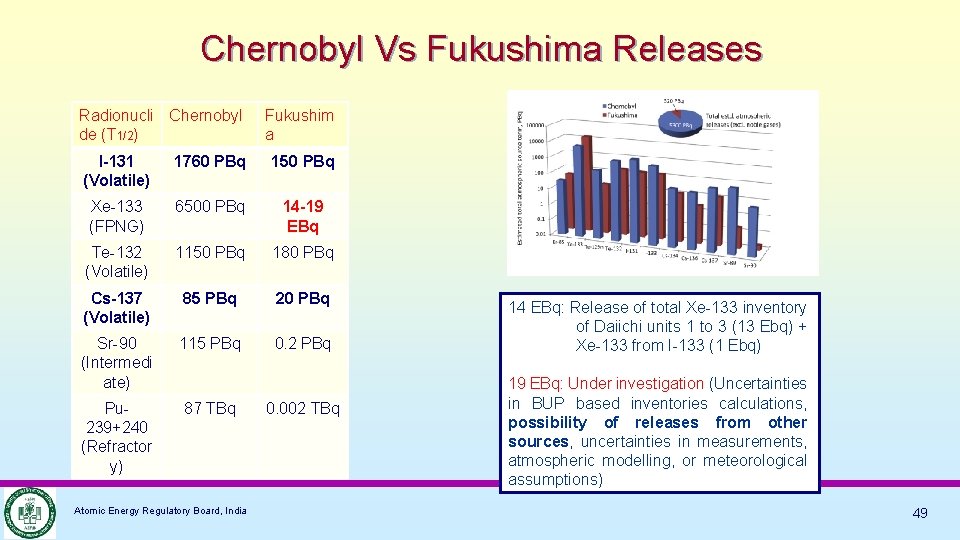
Chernobyl Vs Fukushima Releases Radionucli Chernobyl de (T 1/2) Fukushim a I-131 (Volatile) 1760 PBq 150 PBq Xe-133 (FPNG) 6500 PBq 14 -19 EBq Te-132 (Volatile) 1150 PBq 180 PBq Cs-137 (Volatile) 85 PBq 20 PBq Sr-90 (Intermedi ate) 115 PBq 0. 2 PBq Pu 239+240 (Refractor y) 87 TBq Atomic Energy Regulatory Board, India 0. 002 TBq 14 EBq: Release of total Xe-133 inventory of Daiichi units 1 to 3 (13 Ebq) + Xe-133 from I-133 (1 Ebq) 19 EBq: Under investigation (Uncertainties in BUP based inventories calculations, possibility of releases from other sources, uncertainties in measurements, atmospheric modelling, or meteorological assumptions) 49
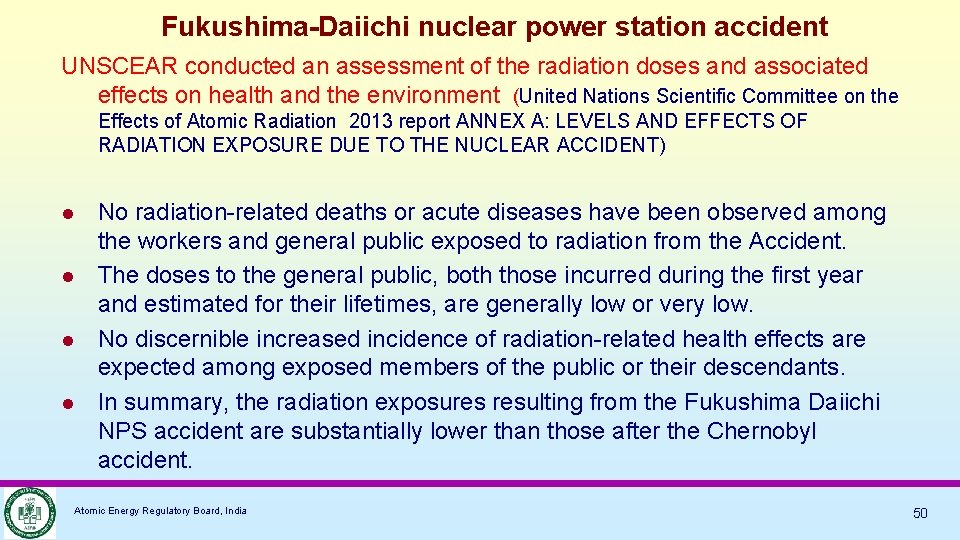
Fukushima-Daiichi nuclear power station accident UNSCEAR conducted an assessment of the radiation doses and associated effects on health and the environment (United Nations Scientific Committee on the Effects of Atomic Radiation 2013 report ANNEX A: LEVELS AND EFFECTS OF RADIATION EXPOSURE DUE TO THE NUCLEAR ACCIDENT) No radiation-related deaths or acute diseases have been observed among the workers and general public exposed to radiation from the Accident. The doses to the general public, both those incurred during the first year and estimated for their lifetimes, are generally low or very low. No discernible increased incidence of radiation-related health effects are expected among exposed members of the public or their descendants. In summary, the radiation exposures resulting from the Fukushima Daiichi NPS accident are substantially lower than those after the Chernobyl accident. Atomic Energy Regulatory Board, India 50
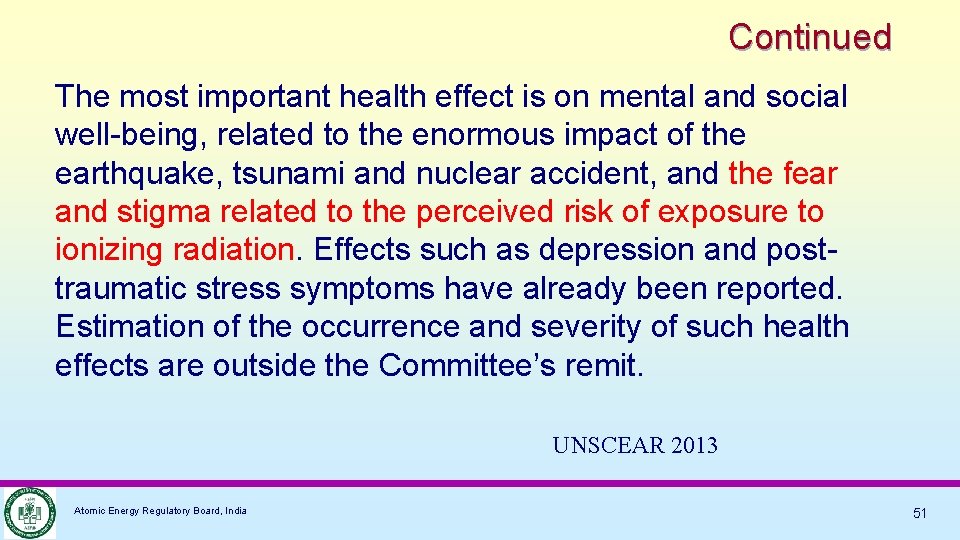
Continued The most important health effect is on mental and social well-being, related to the enormous impact of the earthquake, tsunami and nuclear accident, and the fear and stigma related to the perceived risk of exposure to ionizing radiation. Effects such as depression and posttraumatic stress symptoms have already been reported. Estimation of the occurrence and severity of such health effects are outside the Committee’s remit. UNSCEAR 2013 Atomic Energy Regulatory Board, India 51
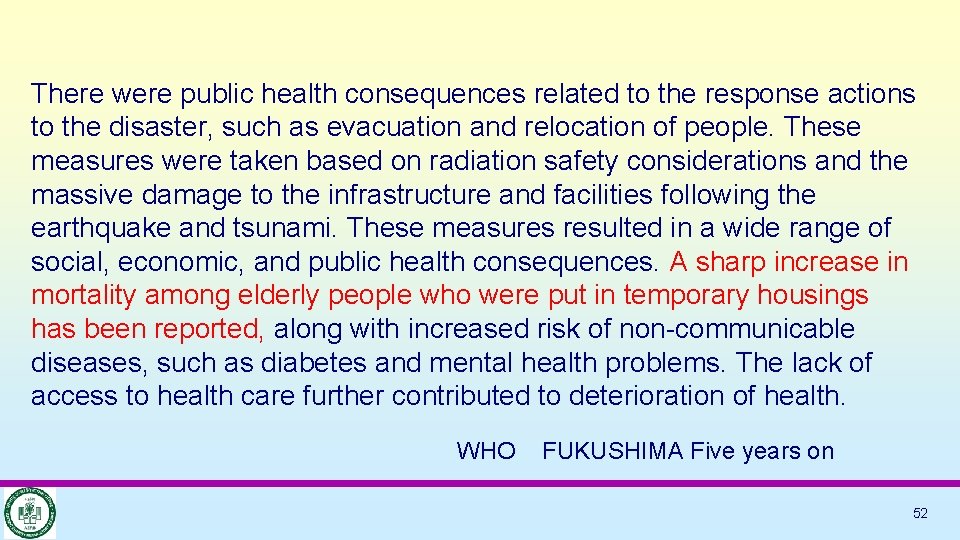
to health care further contributed to deterioration of health. There were public health consequences related to the response actions to the disaster, such as evacuation and relocation of people. These measures were taken based on radiation safety considerations and the massive damage to the infrastructure and facilities following the earthquake and tsunami. These measures resulted in a wide range of social, economic, and public health consequences. A sharp increase in mortality among elderly people who were put in temporary housings has been reported, along with increased risk of non-communicable diseases, such as diabetes and mental health problems. The lack of access to health care further contributed to deterioration of health. WHO FUKUSHIMA Five years on 52
Biological Effects of Radiation Atomic Energy Regulatory Board, India 53
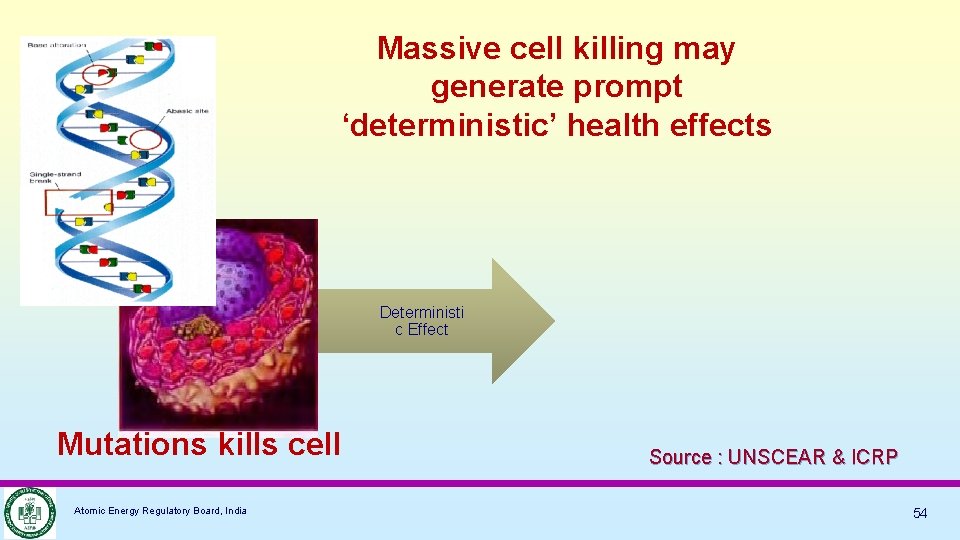
Massive cell killing may generate prompt ‘deterministic’ health effects Deterministi c Effect Mutations kills cell Atomic Energy Regulatory Board, India Source : UNSCEAR & ICRP 54
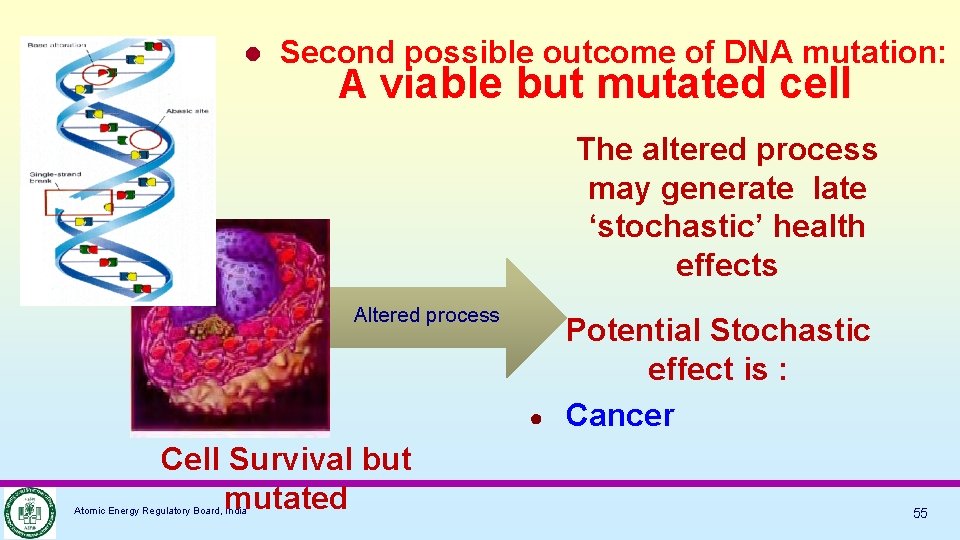
Second possible outcome of DNA mutation: A viable but mutated cell The altered process may generate late ‘stochastic’ health effects Altered process ● Cell Survival but mutated Atomic Energy Regulatory Board, India Potential Stochastic effect is : Cancer 55
56
UNSCEAR Estimates of Cancer Risk ● ~ 4. 3 -7. 2% per Sv ● For all solid cancers combined ~ 5% per Sv (approximately) Atomic Energy Regulatory Board, India 57
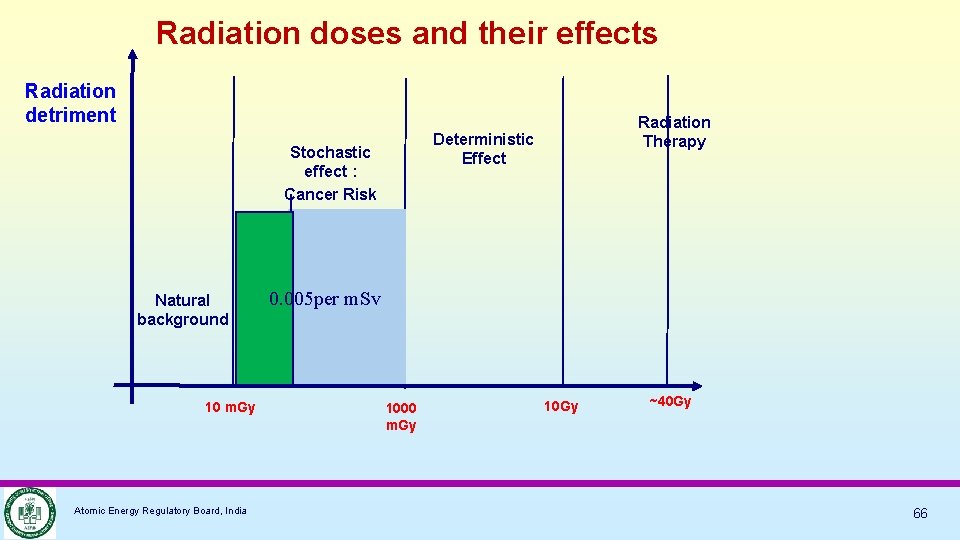
…. above the prevalent natural background dose, an increment in dose is ASSUMED to result in a proportional increment in the probability of stochastic effects of ~0. 005% per m. Sv. 58
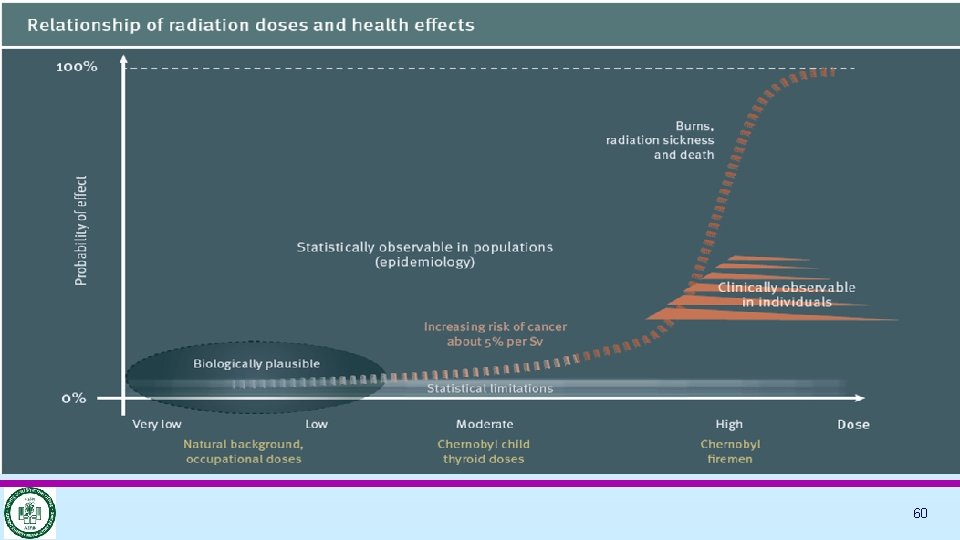
Relationship of radiation doses and effects UNSCEAR has stressed the importance of distinguishing between observations of existing health effects in exposed populations, and theoretical projections of possible future effects. Given the present state of knowledge, observed health effects can be confidently attributed to radiation exposure if early effects (e. g. skin burns) occur in individuals after high doses above 1 Gy. Using epidemiological methods, to attribute an increased occurrence of delayed health effects (e. g. cancer) in a population exposed to moderate radiation doses if the observed increase is high enough to overcome any uncertainties. However, there are no biomarkers presently available to distinguish whether a Atomic Energy Regulatory Board, India cancer has been caused by radiation exposure or not. 59
60
Principles of Radiation protection ● The principles of justification of actions ● The principles of optimization ● The principle of individual dose limitation Atomic Energy Regulatory Board, India 61
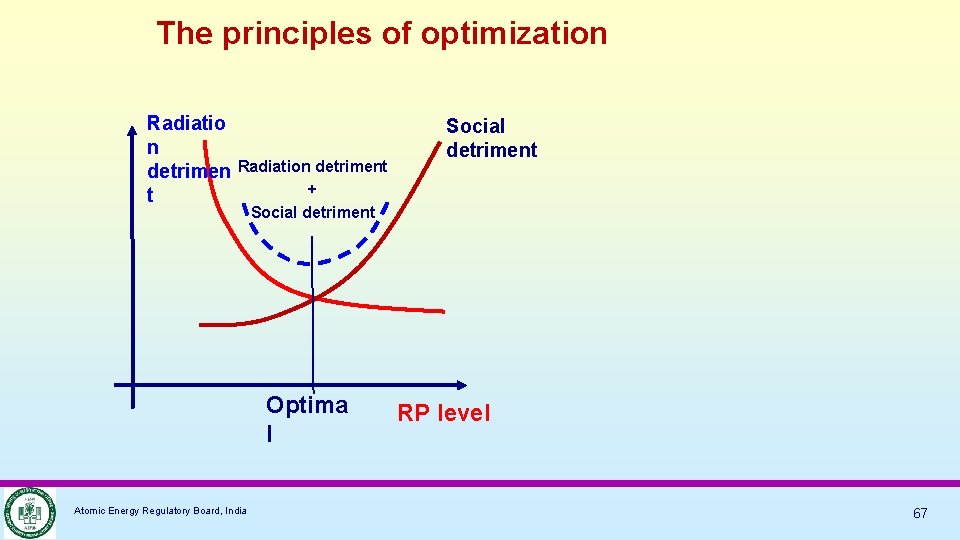
The Principle of Optimization Best possible protection strategy to be adopted under prevailing circumstances. (The best projection of likely level of exposure, number and type of people likely to be exposed, available means to avert dose so that individual dose is kept as low as reasonably achievable, taking into account economic and societal factors) 62
Justification and Optimization : IAEA GSR part-7, Requirements Requirement 5: Protection strategy for a nuclear or radiological emergency The government shall ensure that protection strategies are developed, justified and optimized at the preparedness stage for taking protective actions and other response actions effectively in a nuclear or radiological emergency. Atomic Energy Regulatory Board, India 63
Do more good than harm Each protective action, in the context of the protection strategy, and the protection strategy itself shall be demonstrated to be justified (i. e. to do more good than harm), with account taken not only of those detriments that are associated with radiation exposure but also of those detriments associated with impacts of the actions taken on public health , the economy, society and the environment. 14 Atomic Energy Regulatory Board, India 64
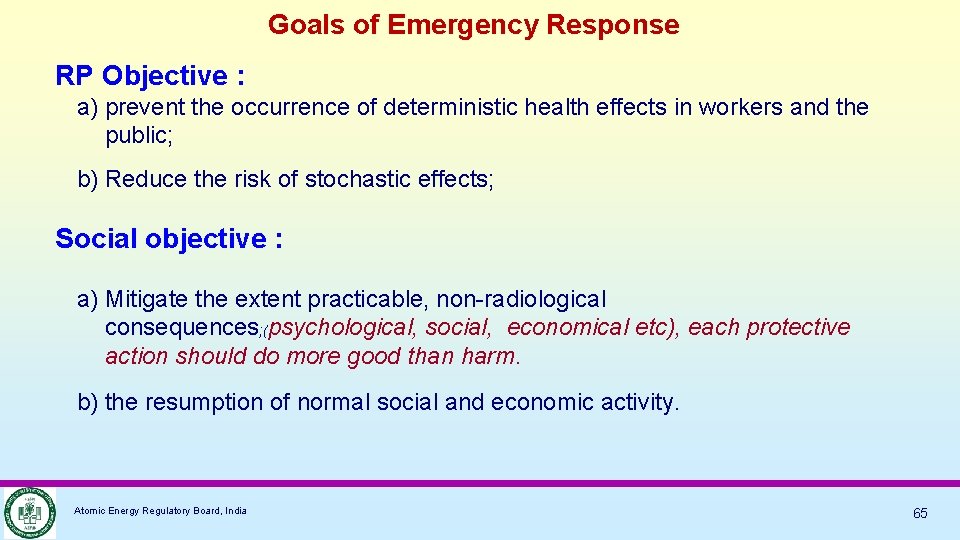
Goals of Emergency Response RP Objective : a) prevent the occurrence of deterministic health effects in workers and the public; b) Reduce the risk of stochastic effects; Social objective : a) Mitigate the extent practicable, non-radiological consequences; (psychological, social, economical etc), each protective action should do more good than harm. b) the resumption of normal social and economic activity. Atomic Energy Regulatory Board, India 65
Radiation doses and their effects Radiation detriment Deterministic Effect Stochastic effect : Cancer Risk Natural background 10 m. Gy Atomic Energy Regulatory Board, India Radiation Therapy 0. 005 per m. Sv 1000 m. Gy 10 Gy ~40 Gy 66
The principles of optimization Radiatio n detrimen t Radiation detriment + Social detriment Optima l Atomic Energy Regulatory Board, India Social detriment RP level 67
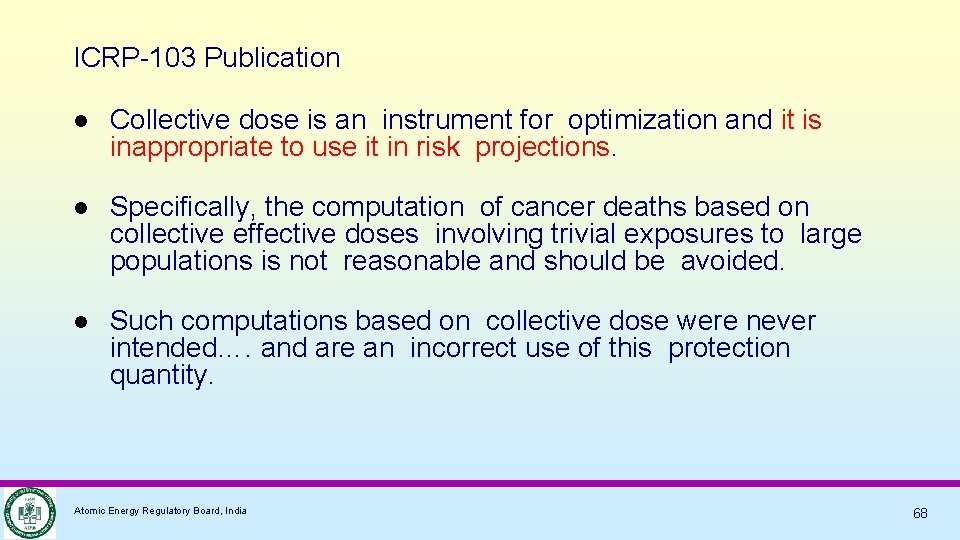
ICRP-103 Publication Collective dose is an instrument for optimization and it is inappropriate to use it in risk projections. Specifically, the computation of cancer deaths based on collective effective doses involving trivial exposures to large populations is not reasonable and should be avoided. Such computations based on collective dose were never intended…. and are an incorrect use of this protection quantity. Atomic Energy Regulatory Board, India 68
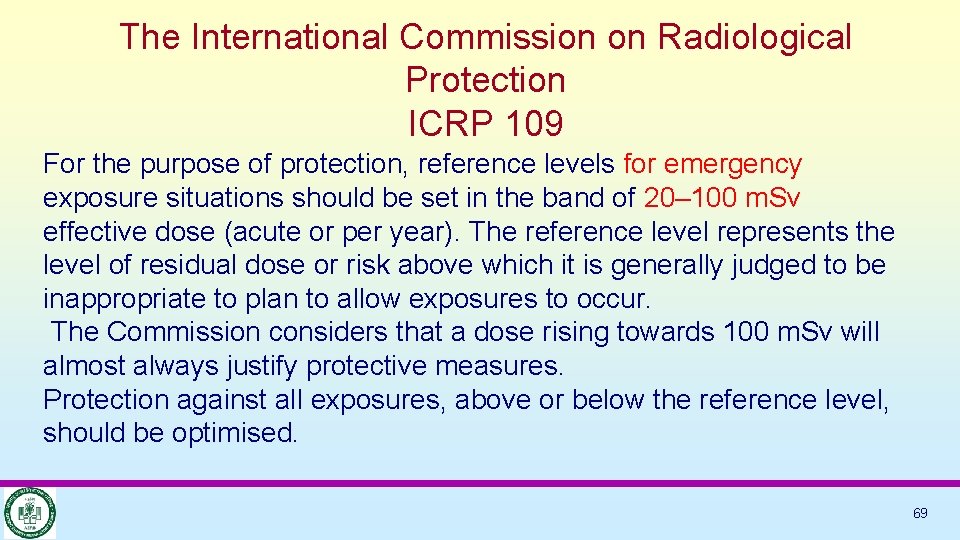
The International Commission on Radiological Protection ICRP 109 For the purpose of protection, reference levels for emergency exposure situations should be set in the band of 20– 100 m. Sv effective dose (acute or per year). The reference level represents the level of residual dose or risk above which it is generally judged to be inappropriate to plan to allow exposures to occur. The Commission considers that a dose rising towards 100 m. Sv will almost always justify protective measures. Protection against all exposures, above or below the reference level, should be optimised. 69
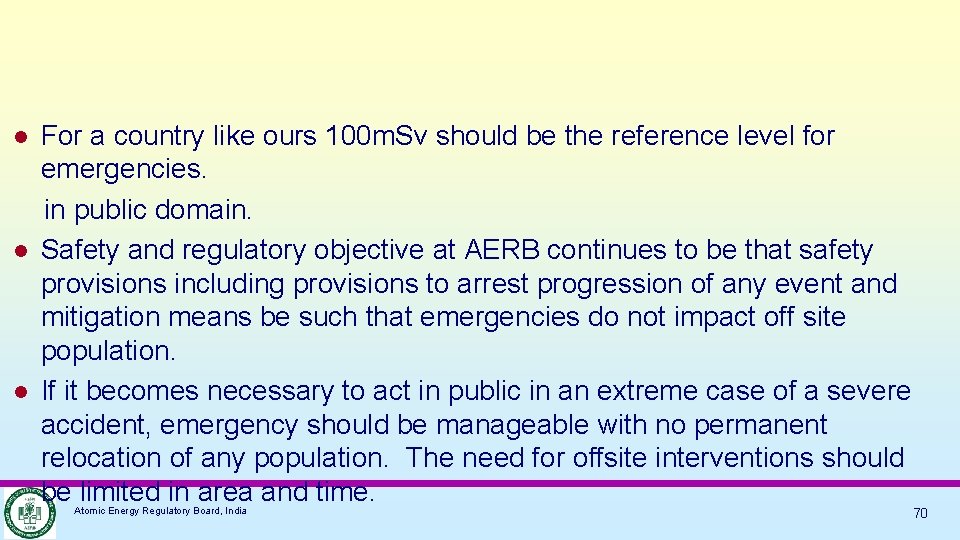
For a country like ours 100 m. Sv should be the reference level for emergencies. in public domain. Safety and regulatory objective at AERB continues to be that safety provisions including provisions to arrest progression of any event and mitigation means be such that emergencies do not impact off site population. If it becomes necessary to act in public in an extreme case of a severe accident, emergency should be manageable with no permanent relocation of any population. The need for offsite interventions should be limited in area and time. Atomic Energy Regulatory Board, India 70
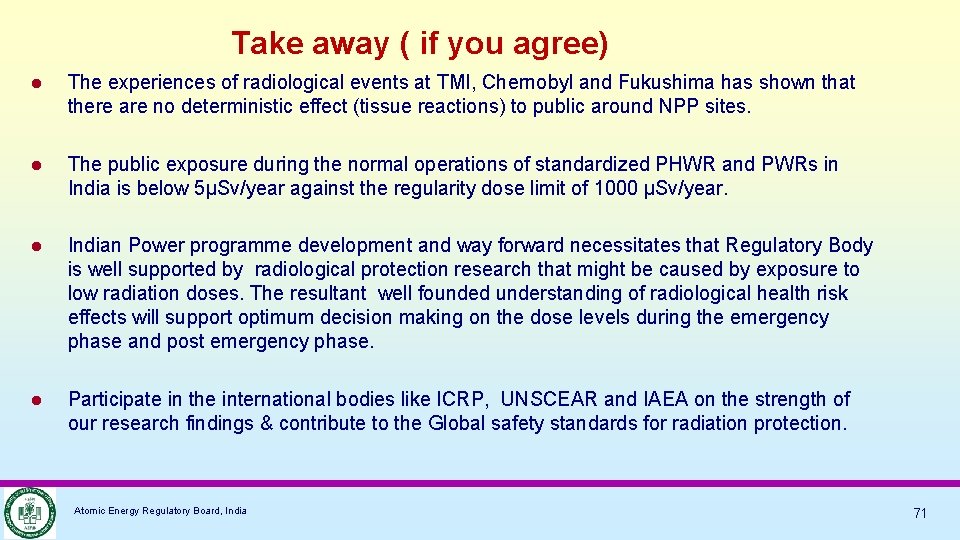
Take away ( if you agree) The experiences of radiological events at TMI, Chernobyl and Fukushima has shown that there are no deterministic effect (tissue reactions) to public around NPP sites. The public exposure during the normal operations of standardized PHWR and PWRs in India is below 5µSv/year against the regularity dose limit of 1000 µSv/year. Indian Power programme development and way forward necessitates that Regulatory Body is well supported by radiological protection research that might be caused by exposure to low radiation doses. The resultant well founded understanding of radiological health risk effects will support optimum decision making on the dose levels during the emergency phase and post emergency phase. Participate in the international bodies like ICRP, UNSCEAR and IAEA on the strength of our research findings & contribute to the Global safety standards for radiation protection. Atomic Energy Regulatory Board, India 71
I thank my colleague Sh S. K. Pawar to compile this information quoted from UNSCEAR, ICRP, IAEA reports and from a lecture delivered by Dr. Abel J. González, (Former Vice. President of the International Commission on radiation Protection) at IARPIC-2018 And Thank you all Atomic Energy Regulatory Board, India 72