
Radiation Quality Chapter 4 Xray Intensity Intensity the
- Slides: 14
Radiation Quality Chapter 4
X-ray Intensity • Intensity: the amount of energy present per unit time per unit area perpendicular to the beam direction at the location of interest. Ø The number of photons reaching the detector per second is a measure of beam intensity (photons/cm 2). Ø Exposure Rate: (m. R/hr); dose rate: (c. Gy/min) • Intensity of photon beam at the tumor Ø Depends primarily on the original strength of the beam. Ø Reduced by beam divergence and attenuation.
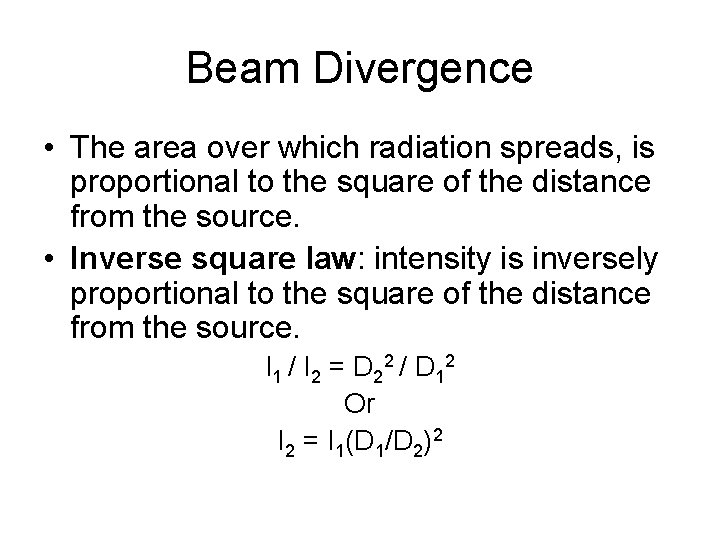
Beam Divergence • The area over which radiation spreads, is proportional to the square of the distance from the source. • Inverse square law: intensity is inversely proportional to the square of the distance from the source. I 1 / I 2 = D 22 / D 12 Or I 2 = I 1(D 1/D 2)2
Beam attenuation • Attenuation: the removal of energy from the beam. • X-rays interact with charged particles through the electromagnetic fields associated with the electric and magnetic fields of electrons and nuclei. Ø When a beam passes through matter, energy is removed from the beam. • Photons will either… Ø Interact with the filter/attenuator Ø Be absorbed by the material Ø They deposit all their energy in the filter Ø Direction changed or scattered Ø Unaffected by the filter
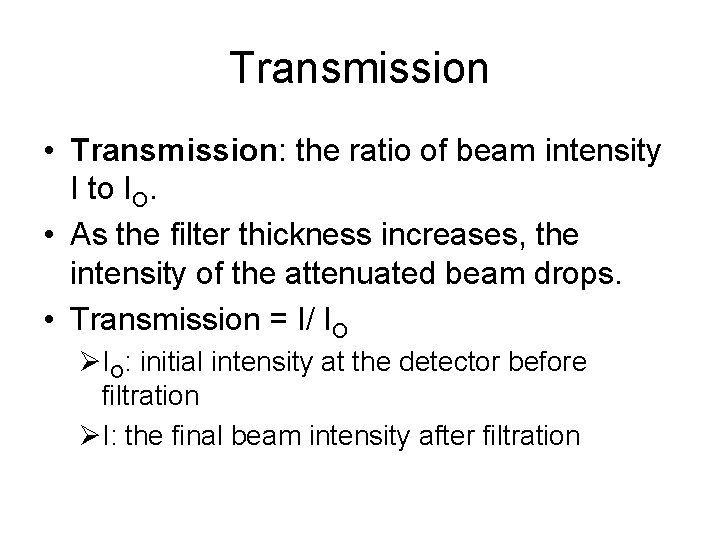
Transmission • Transmission: the ratio of beam intensity I to IO. • As the filter thickness increases, the intensity of the attenuated beam drops. • Transmission = I/ IO ØIO: initial intensity at the detector before filtration ØI: the final beam intensity after filtration
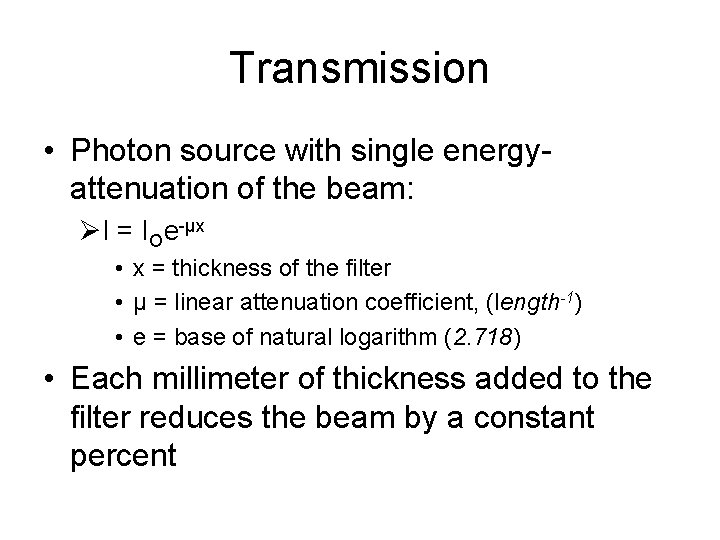
Transmission • Photon source with single energyattenuation of the beam: ØI = IOe-μx • x = thickness of the filter • μ = linear attenuation coefficient, (length-1) • e = base of natural logarithm (2. 718) • Each millimeter of thickness added to the filter reduces the beam by a constant percent
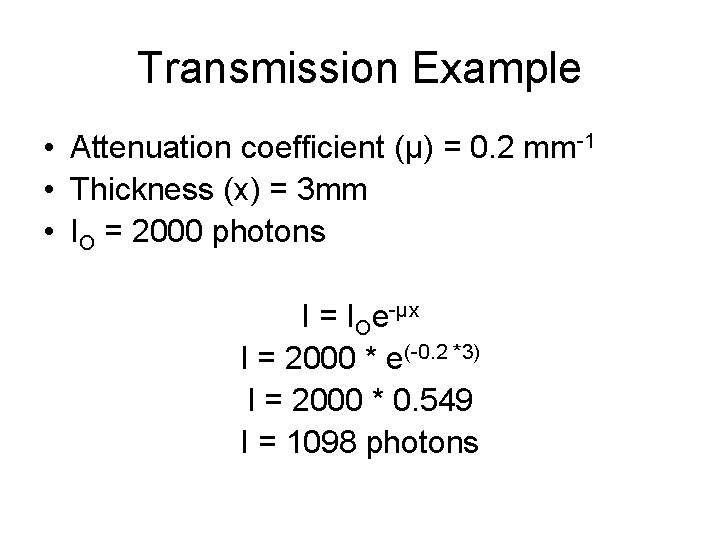
Transmission Example • Attenuation coefficient (μ) = 0. 2 mm-1 • Thickness (x) = 3 mm • IO = 2000 photons I = IOe-μx I = 2000 * e(-0. 2 *3) I = 2000 * 0. 549 I = 1098 photons
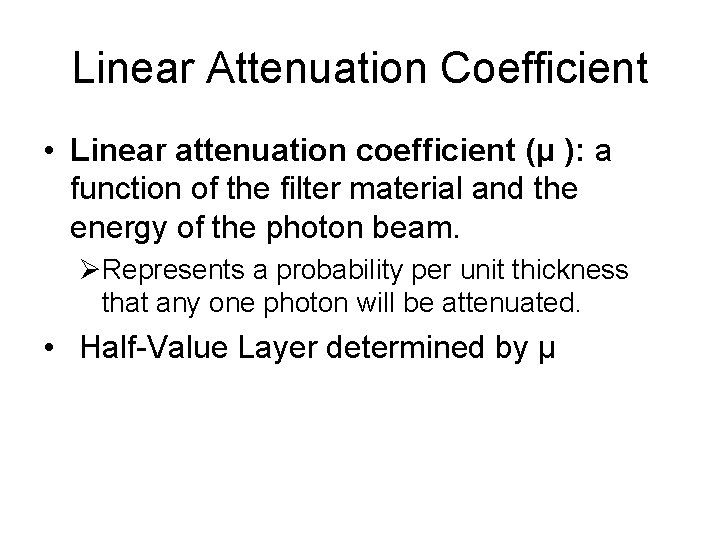
Linear Attenuation Coefficient • Linear attenuation coefficient (μ ): a function of the filter material and the energy of the photon beam. ØRepresents a probability per unit thickness that any one photon will be attenuated. • Half-Value Layer determined by μ
Monoenergetic / Homogenous • Monoenergetic/homogenous: all photons in the beam have the same energy Ø μ: remains unchanged for all filter thicknesses or number of photons removed (number of photons change) Ø Higher μ higher probability of interaction smaller HVL • More easily reduced in intensity • An exponential function produces a straight line on semi-log graph paper.
Polyenergetic / Heterogenous • Polyenergetic/heterogenous: broad range of photon energies (bremsstrahlung). Ø μ: each energy has a different value. • On semi-log graph paper, the slope changes as filter is added due to beam hardening. • Beam Hardening: the effective energy of the beam increases as it passes through the filter. Ø Only occurs in a polyenergetic/heterogeneous beam.
Half-Value Layer • Half-value layer (HVL): the thickness required for a particular material to cut the beam’s intensity in half. Ø HVL = 0. 693/ μ Ø Used to describe the beam’s penetrability Ø Convenient to characterize different bremsstrahlung beams using their attenuation characteristics. • Materials used to specify beams HVL changes with energy range Ø Diagnostic/superficial: mm Al Ø Orthovoltage: mm Cu Ø Me. V: mm. Pb
Homogeneity Coefficient • Homogeneity Coefficient: ØHC = 1 st HVL/2 nd HVL • As HC 1: the more alike individual beam energy are. • 1 st HVL = 2 nd HVL = 3 rd HVL… monoenergetic beam
Equivalent Energy • Equivalent Energy: represents the average energy of the beam ØThe energy of the monoenergetic beam that would have an HVL equal to the first HVL of the bremmsstrahlung beam in question.
Attenuation Coefficients • Linear attenuation coefficient (μ): gives the probability that a given photon will be attenuated in a unit thickness of a particular attenuator. – Photon energy & material dependant • Mass attenuation coefficient (μ/ρ): probability of interaction per unit mass length when μ/ρ << 1, (cm 2/g) – Decreasing the density of the material will cause much less attenuation.