
Radiation Protection RAD 101 Unit 1 Chapters 1




- Slides: 71
Radiation Protection RAD 101 Unit 1 Chapters 1 & 2
Chapter 1 - Introduction to Radiation Protection This chapter will cover: • Overview of Radiation Protection • Identify consequences of radiation during imaging procedures • Discuss effective radiation protection and safeguards • ALARA principles • Radiation Safety Programs within facilities • RT responsibilities • Patient education • Define Sievert (Sv) and millisievert (m. Sv)
What happened in 1895? • Discovery of X-rays Nov 8, 1895 by Willhelm Conrad Roentgen • Experimentation • Diagnostic Tool • Healing Tool • Became aware of the beneficial and destructive properties of radiation • X-rays have the ability to ionize matter- aka: change matter
Ionizing Radiation ( X-rays) • When radiation passes through matter it produces ions – either positive or negative charged particles • Ion production is what can cause biological effect ( damage ) to cells
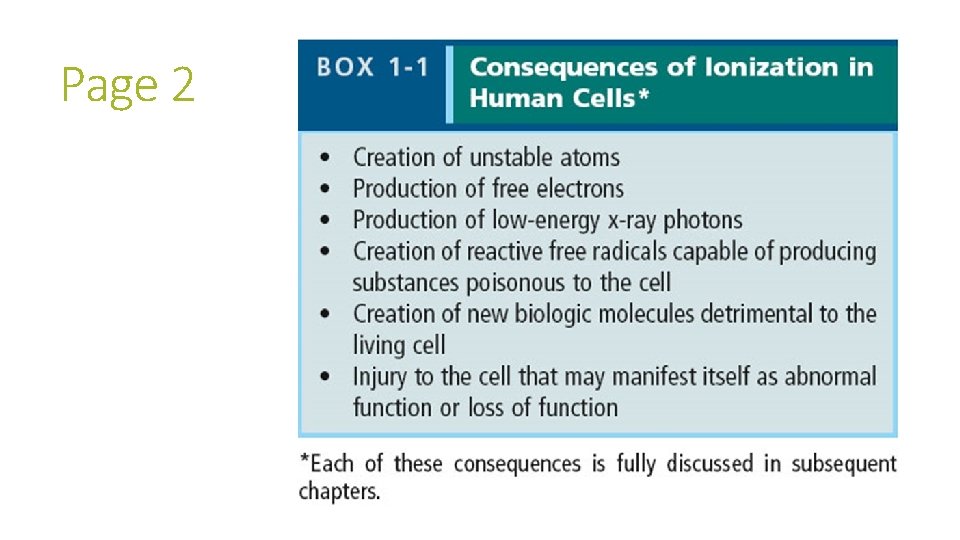
Page 2
What is our role? We must : 1. learn to safely operate imaging equipment 2. use protective devices ( lead, shields, etc. ) 3. follow procedures 4. Select technical factors that reduce radiation while maintain quality All of this is known as RADIATION PROTECTION !!
Effective Radiation Protection Definition: effective measures employed by radiation workers to safeguard patients, personnel and general public from unnecessary exposure to ionizing radiation. Why do we need to safeguard from unnecessary Radiation ? • Biologic Effects- Damage to living tissue or animals and humans exposed to radiation
Benefits versus Risks Do the benefits of having an exam done outweigh the risks of not having it done? EXAMPLES: • Mammography • Exams on trauma patients who are pregnant • Screening CXR on mine worker • CXR on pregnant woman for pneumonia Determined by Diagnostic Efficacy - the degree to which the study accurately reveal the presence or absence of disease in the patient- justification for the exam Who is responsible for determining this: patient, physician , RT ?
RTs Responsibility 1. Keep exposure low for occupational and nonoccupational doses 2. Keep doses to patients low but high enough for a good exam ( optimal exposure) 3. First exposure- reduce repeats
ALARA & ORP ALARA= As Low As Reasonably Achievable ORP= Optimization for Radiation Protection Both are utilized to help keep radiation exposure to a minimum- or the lowest levels possible
Cardinal Principles of Protection 1. Time 2. Distance 3. Shielding All three principles apply to both the patient and RT
Responsibilities of the facility 1. Written radiation safety policies 2. RSO – Radiation Safety Officer- oversees policies- executes, enforces and maintains P&P 3. Exposure audits
Patient Education COMMUNICATION: RTs must inform patients about imaging procedures WHAT & WHY? What to expect, what the exam requires, follow-up RISK vs BENEFIT: Risk= probability of injury, ailment or deathin x-ray it’s the possibility of inducing radiogenic cancer or genetic defect from radiation So, the benefits of the exam must outweigh this risk in order for a patient to want to have a procedure done. BE informed!!!
BERT ( Background Equivalent Radiation Time) Basic Definition: the amount of x-rays that equal what a patient would be exposed by nature Purpose: Easy to comprehend, relative to everyday life, lessens the anxiety over “radiation” Recommended by the U. S National Council on Radiation Protection and Measurement ( NRCP)
TABLE 1 -1 in textbook page 10
Programs for public awareness TRACE Program: Tools for Radiation Awareness and Community Education: • software to record and report dose • notifications of high dose >3 Gy. • lowering CT dose Image Gently and Image Wisely Campaigns: July 2015 ( JRC) • To raise awareness of the opportunities to lower radiation dose in the imaging of children. • Documentation of the radiation dose • Annual equipment performance evaluations by a medical physicist or magnetic resonance scientist • Minimum qualifications for radiologic technologists who perform computerized tomography (CT) exams.
DOSE Reporting • Leads to reduction in dose received • Dictation into Radiologist report recommended for: fluoro procedures, CT, interventional • Benefits both Patient and Referring physician • WHY?
Chapter 2 Radiation: Types, Sources and Doses Received
Objectives Define Radiation ID forms of ionizing, electromagnetic and particulate radiation Explain equivalent dose and effective dose Discuss the Sievert as a unit of measure Discuss potential for biologic damage Discuss sources of natural background, manmade, and artificial radiation Discuss accidents in nuclear power plants Discuss need for radiation protection Look at trends in radiation dose
Radiation • A transfer of energy that results either because of a change occurring naturally or within an atom -Type of kinetic energy • Natural or Manmade • Some produce biological damage to tissue/ some do not • Types of Radiation : • Ionizing • Non-ionizing
The Electromagnetic Spectrum • The full range of frequencies and wavelengths of electromagnetic waves • Categorized in terms of : Frequency – Hz- cycles per second (number of waves that pass a given point per second Wavelength- meters (measurement from peak to peak ) Energy- e. V • All of the members of the electromagnetic spectrum have the same velocity (the speed of light or 3 x 10*8 m/s) and vary only in their energy, wavelength, and frequency
Ionizing and Nonionizing Radiation The two divisions of the electromagnetic spectrum 1. Ionizing: Electromagnetic : x-rays, gamma rays, & high energy UV ( >10 e. V) 2. Non-ionizing: low energy UV, visible light, infrared, microwaves & radio waves Ionization : the transfer of energy that can remove orbital electron from the atoms from which they are attached – Contributes to radiation dose- Ionizing Radiation: when radiation passes through matter and produces + or – charged particles ( ions) Low dose- diagnostic x-rays High does- therapy
Particulate Radiation Ionizing Radiation: Alpha and Beta Radioactive decay: when unstable nuclei relieve the instability by types of nuclear spontaneous emissions Alpha: emitted from the nuclei of very heavy elements • 2 proton and 2 neurtons, +charge • Less penetrating than beta particles • Lose energy quickly as they travel- difficult to penetrate matter ( pick up electron that are attracted to their + charge – become helium atoms) • Harmless as an external source of radiation but can be very damaging as an internal source - radioisotopes Beta: emitted from an unstable nucleus ( not electron shell) • Lighter and smaller than alpha • Do not interact as much with their surroundings as alpha so they can penetrate more with less ionization because of their lightness – may be + (positrons) or – in charge but are not like electrons because they don’t come from the orbital shell • Can be produced in a linear accelerator for oncology treatment
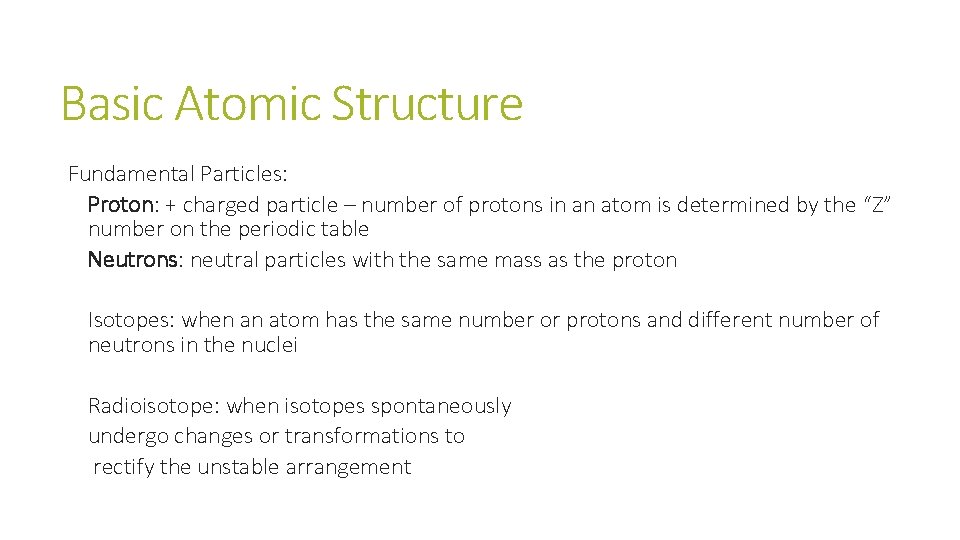
Basic Atomic Structure Fundamental Particles: Proton: + charged particle – number of protons in an atom is determined by the “Z” number on the periodic table Neutrons: neutral particles with the same mass as the proton Isotopes: when an atom has the same number or protons and different number of neutrons in the nuclei Radioisotope: when isotopes spontaneously undergo changes or transformations to rectify the unstable arrangement
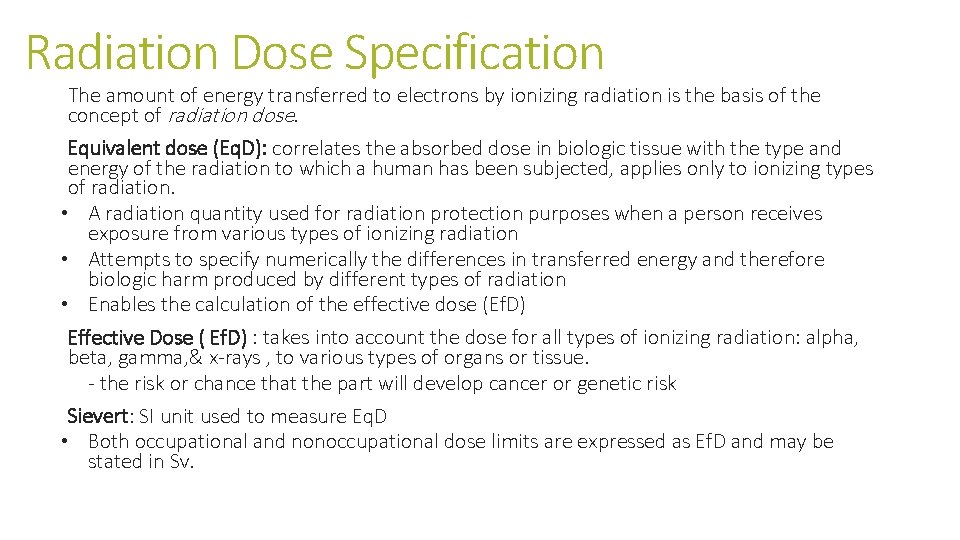
Radiation Dose Specification The amount of energy transferred to electrons by ionizing radiation is the basis of the concept of radiation dose. Equivalent dose (Eq. D): correlates the absorbed dose in biologic tissue with the type and energy of the radiation to which a human has been subjected, applies only to ionizing types of radiation. • A radiation quantity used for radiation protection purposes when a person receives exposure from various types of ionizing radiation • Attempts to specify numerically the differences in transferred energy and therefore biologic harm produced by different types of radiation • Enables the calculation of the effective dose (Ef. D) Effective Dose ( Ef. D) : takes into account the dose for all types of ionizing radiation: alpha, beta, gamma, & x-rays , to various types of organs or tissue. - the risk or chance that the part will develop cancer or genetic risk Sievert: SI unit used to measure Eq. D • Both occupational and nonoccupational dose limits are expressed as Ef. D and may be stated in Sv.
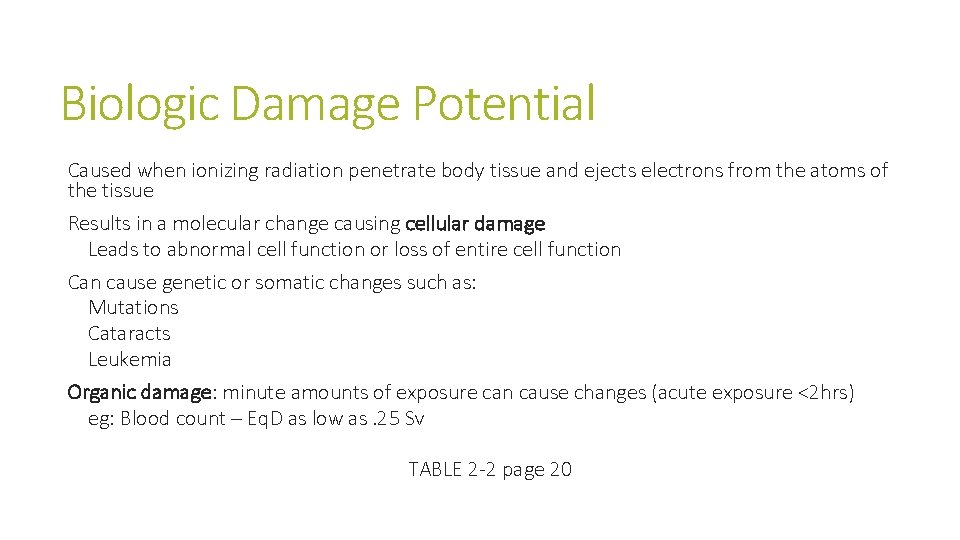
Biologic Damage Potential Caused when ionizing radiation penetrate body tissue and ejects electrons from the atoms of the tissue Results in a molecular change causing cellular damage Leads to abnormal cell function or loss of entire cell function Can cause genetic or somatic changes such as: Mutations Cataracts Leukemia Organic damage: minute amounts of exposure can cause changes (acute exposure <2 hrs) eg: Blood count – Eq. D as low as. 25 Sv TABLE 2 -2 page 20
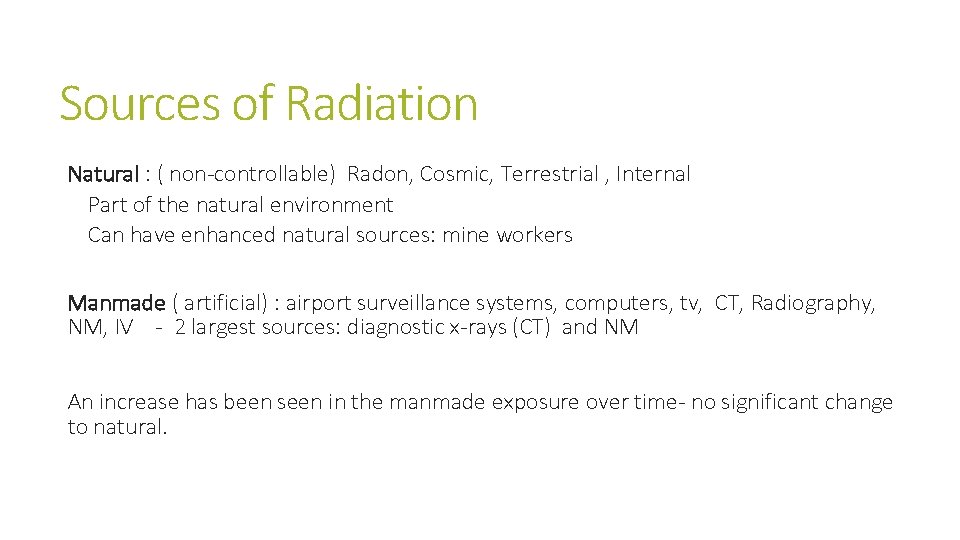
Sources of Radiation Natural : ( non-controllable) Radon, Cosmic, Terrestrial , Internal Part of the natural environment Can have enhanced natural sources: mine workers Manmade ( artificial) : airport surveillance systems, computers, tv, CT, Radiography, NM, IV - 2 largest sources: diagnostic x-rays (CT) and NM An increase has been seen in the manmade exposure over time- no significant change to natural.
Natural Radiation Terrestrial Cosmic Internal radiation
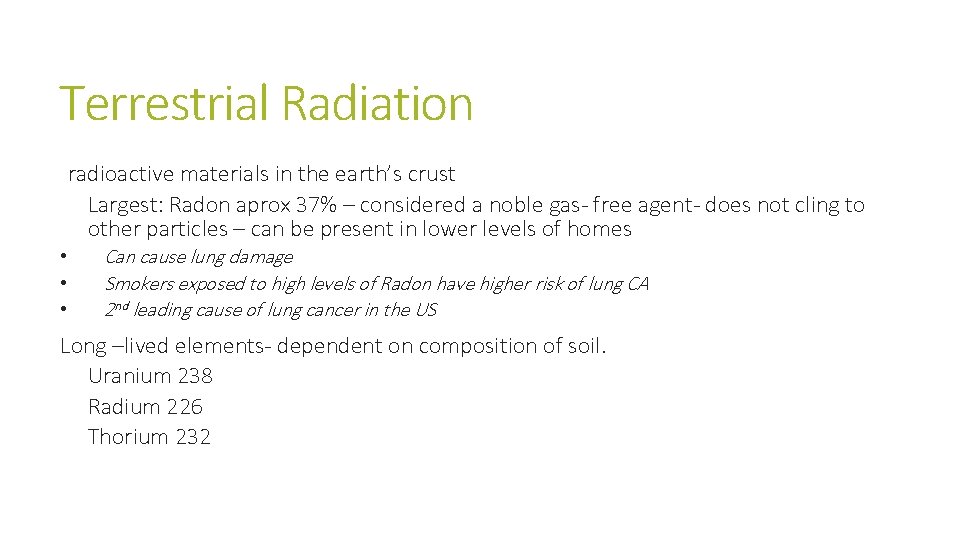
Terrestrial Radiation radioactive materials in the earth’s crust Largest: Radon aprox 37% – considered a noble gas- free agent- does not cling to other particles – can be present in lower levels of homes • • • Can cause lung damage Smokers exposed to high levels of Radon have higher risk of lung CA 2 nd leading cause of lung cancer in the US Long –lived elements- dependent on composition of soil. Uranium 238 Radium 226 Thorium 232
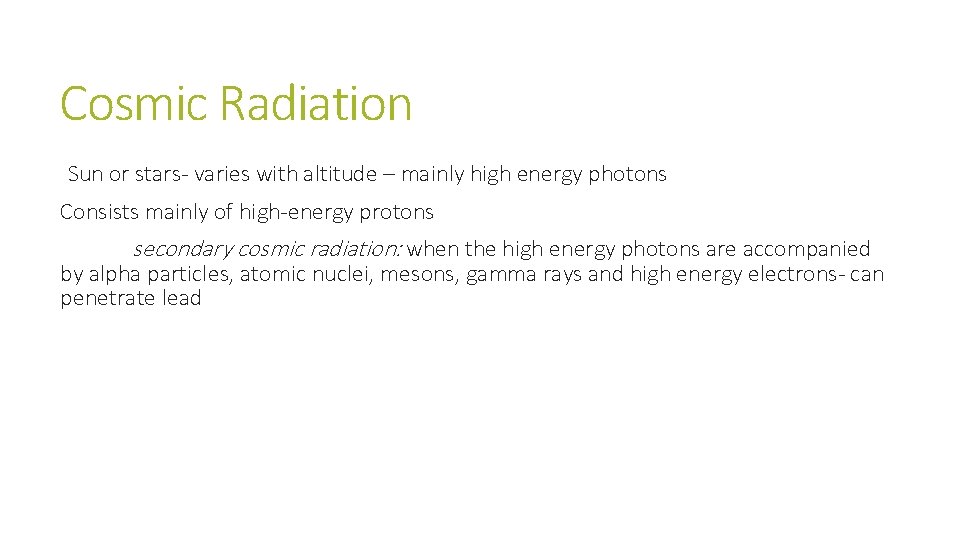
Cosmic Radiation Sun or stars- varies with altitude – mainly high energy photons Consists mainly of high-energy protons secondary cosmic radiation: when the high energy photons are accompanied by alpha particles, atomic nuclei, mesons, gamma rays and high energy electrons- can penetrate lead
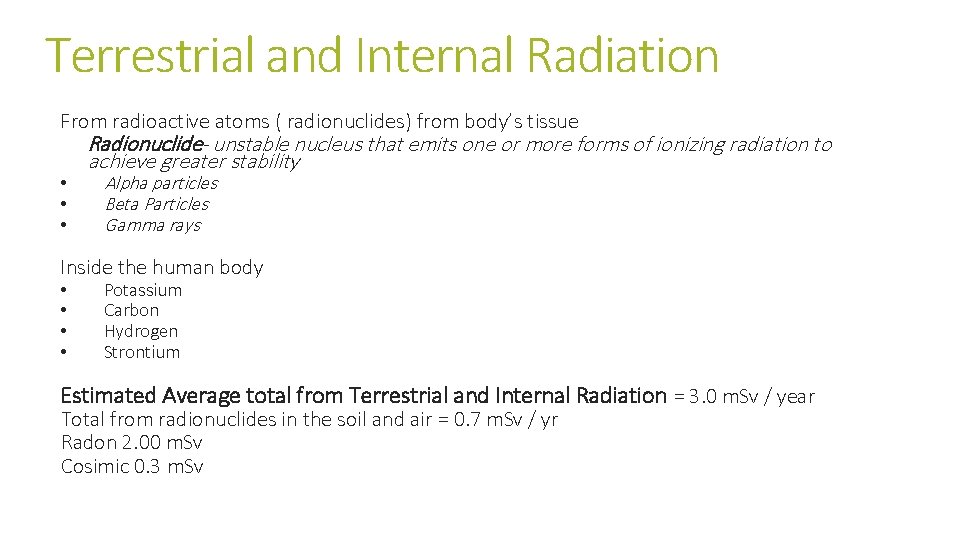
Terrestrial and Internal Radiation From radioactive atoms ( radionuclides) from body’s tissue • • • Radionuclide- unstable nucleus that emits one or more forms of ionizing radiation to achieve greater stability Alpha particles Beta Particles Gamma rays Inside the human body • • Potassium Carbon Hydrogen Strontium Estimated Average total from Terrestrial and Internal Radiation = 3. 0 m. Sv / year Total from radionuclides in the soil and air = 0. 7 m. Sv / yr Radon 2. 00 m. Sv Cosimic 0. 3 m. Sv
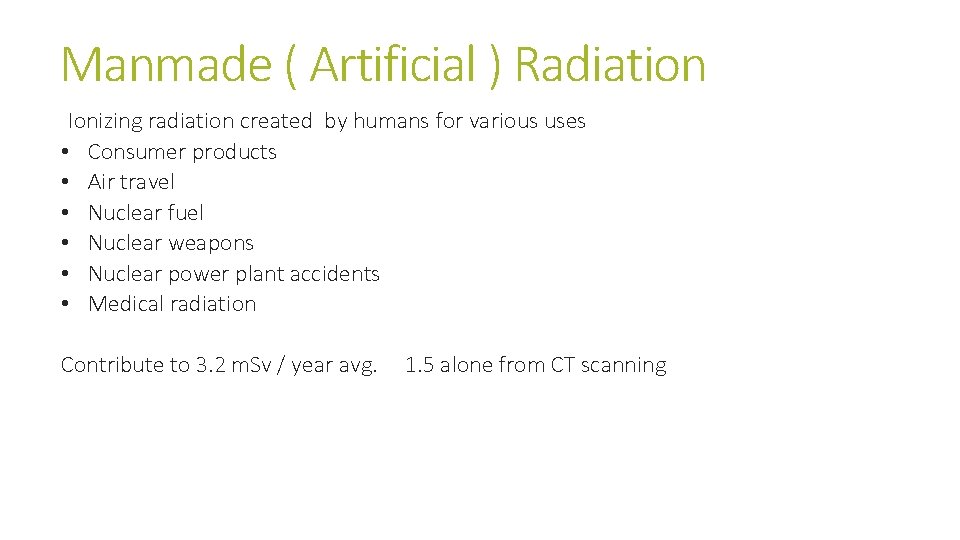
Manmade ( Artificial ) Radiation Ionizing radiation created by humans for various uses • Consumer products • Air travel • Nuclear fuel • Nuclear weapons • Nuclear power plant accidents • Medical radiation Contribute to 3. 2 m. Sv / year avg. 1. 5 alone from CT scanning
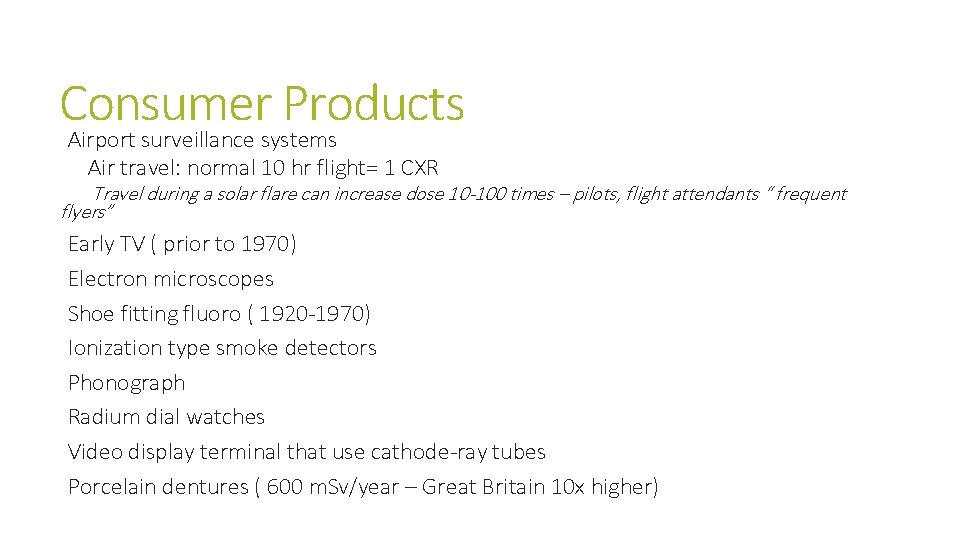
Consumer Products Airport surveillance systems Air travel: normal 10 hr flight= 1 CXR Travel during a solar flare can increase dose 10 -100 times – pilots, flight attendants “ frequent flyers” Early TV ( prior to 1970) Electron microscopes Shoe fitting fluoro ( 1920 -1970) Ionization type smoke detectors Phonograph Radium dial watches Video display terminal that use cathode-ray tubes Porcelain dentures ( 600 m. Sv/year – Great Britain 10 x higher)
Nuclear Fuel Nuclear power plants that produce nuclear fuel for power No significant contribution to the annual Eq. D 0. 1 m. Sv
Atmospheric Fallout from Nuclear Testing No accurate estimate can be made– radiation measurements do not exist Estimates only- delivered over years at changing dose rates. No atmospheric nuclear testing has occurred since 1980 s 2006 estimated 0. 1 m. Sv to the Eq. D of each person
Nuclear Power Plant Accidents Unplanned radiation exposure Three Mile Island Unit 2 - March 28, 1979 - Harrisburg PA • • • Loss of coolant and severe overheating- ( 5000 deg F) at the radioactive core Melting of the core occurred however no “melt through” of the reactor vessel resulted Avg dose was only. 08 m. Sv 30 years later- No significant increase in cancer deaths have ben reported- only psychological stress Monitoring until 2034
Nuclear Power Plant Accidents Chernobyl- April 26, 1986 - Kiev, Ukraine – former Soviet Union • Explosion releasing radioactive nuclides • Released 1 million times the amount of radioactive material at Three Mile Island • 30 -40 times as much as Hiroshima and Nagasaki combined. • 200 workers exceeded 1 Sv • 2 dozen received >4 Sv- died as a result • ¼ million people within 200 miles dose /2 Sv • Thyroid doses exceeded several Sieverts
ETHOS Project Started because of Chernobyl controversy 1996 - 3 year pilot research project Purpose /Aim- rebuild acceptable living conditions Adverse effects of Chernobyl: Highest=Thyroid CA – 1700 cases between 1990 -98 Increased incidence of breast CA- increase in pre-menopausal women Significant rise in leukemia cases
Adverse effects of Chernobyl Highest=Thyroid CA – 1700 cases between 1990 -98 Increased incidence of breast CA- increase in pre-menopausal women Significant rise in leukemia cases
After the incident Sarcophagus built- large concrete shelter was built around the reactor 10 years later- radiation began leaking through the weakened wall- danger of collapsing 1998 -99 major repair work was done- limited because of high radiation levels inside the shelter New Safe Confinement structure: April 2012 - 2016 - covering the sarcophagus with a weatherproof , steel vault- lasts 100 years
Natural Disasters- Nuclear Power Plants Fukushima Daiichi Nuclear Plant Crisis- Japan- March 11, 2012 • • 9. 0 earthquake off coast causing tsunami Plant automatically shut down because of earthquake Japans coastline dropped 3 feet- 18 foot walls surrounding the plant were not high enough for the 30 ft waves. Flooded cooling generators – Radiation exposure • • Difficult to measure Long term effects can not yet be determined
Medical Radiation Diagnostic X-rays and radiopharmaceuticals – 48% of total Ef. D in US CT, IR, conventional x-rays, fluoro, Nuclear medicine Use has Increased dramatically since the 1980 s CT scan increase – multislice spiral CT scanning Risk vs benefit Natural background radiation remains fairly constant- medical increase rapidly Increased radiation protection Limit unnecessary exams
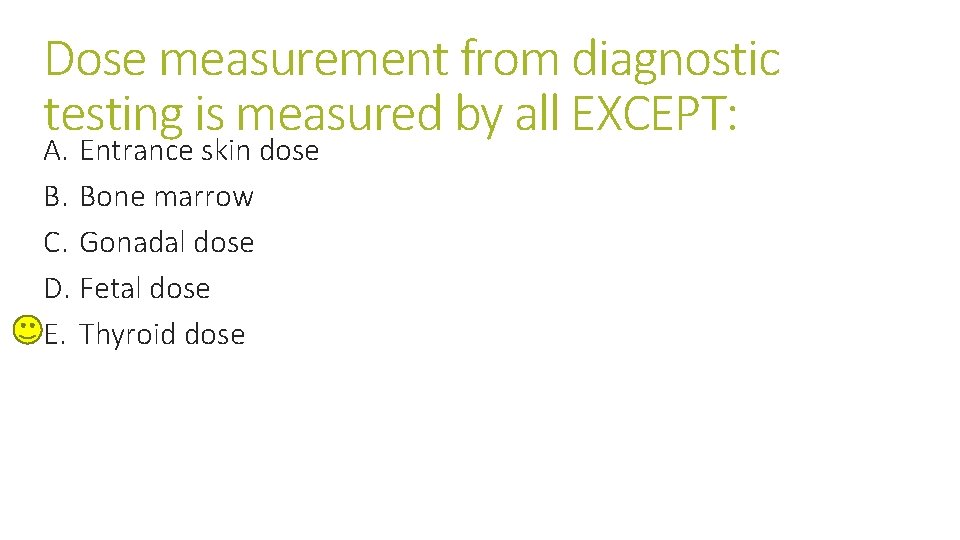
Measurement of dose from diagnostic testing 1. Entrance skin exposure ( ESE) – skin and glandular dose 2. Bone marrow dose 3. Gonadal dose 4. Fetal dose in pregnant women See table 2 -5 and 2 -6 in textbook
When were x-rays discovered? A. 1895 B. 1902 C. 1894 D. 1887
To change matter is to: A. Radiate B. Ionize C. Protinize D. Ionite
When radiation passes through matter it can produce ions that are positive or negative. A. True B. False
Damage to living tissues of animal and humans when exposed to radiation: A. Biologic effects B. Genetic damage C. Organic damage
Mutations, cataracts and leukemia are cause by : A. Cellular damage B. Somatic damage C. Organic damage
Changes in blood count is an example of: A. Cellular damage B. Somatic damage C. Organic damage
The effective measure to safeguard patients, personnel and public from ionizing radiation is? A. Diagnostic efficacy B. ALARA C. Radiation Protection D. ORP
Which of the following is NOT TRUE about ionization in human cells? A. Creates an unstable atom B. Produces free electrons C. Produces high energy x-ray photons D. Can cause cell to function abnormal or loose function
What does ALARA stand for A. As Low as Radiography Allows B. As Long as Reasonably Achievable C. As Long as Radiography Allows D. As Low As Reasonably Achievable
Which is NOT a cardinal principle? A. Time B. Shielding C. Dose D. Distance
Who is responsible for overseeing policies within a facility? A. OHSA B. JRCERT C. RSO D. RT
Who recommends BERT ( Background Equivalent Radiation Time) ? A. FDA B. NCRP C. ACR D. NRA
What type of energy is radiation? A. Magnetic B. Kinetic C. Potential D. Electrical
Sources of radiation include: A. Ionizing and non-ionizing B. Natural and manmade C. Electromagnetic
Types of radiation include: A. Natural and manmade B. Ionizing and non-ionizing
The electromagnetic spectrum is categorized by : A. Frequency B. Wavelength C. Amplitude D. A, B & C E. A & B F. A & C G. B & C
All members of the electromagnetic spectrum have the ability to ionize matter A. True B. False
Particulate radiation consists of : A. x- and gamma radiation B. Alpha and beta radiation C. Electromagnetic waves
Alpha and Beta particles are both emitted from the nucleus of an atom A. True B. False
Which is NOT true of a Alpha particle? A. 2 protons , 2 neutrons B. Have a – charge C. Can become helium atoms D. Harmless as external source
Which is true of a Beta Particle A. Emitted from the electron shell B. - in charge C. More ionizing than alpha particles D. Can be reproduced artificially
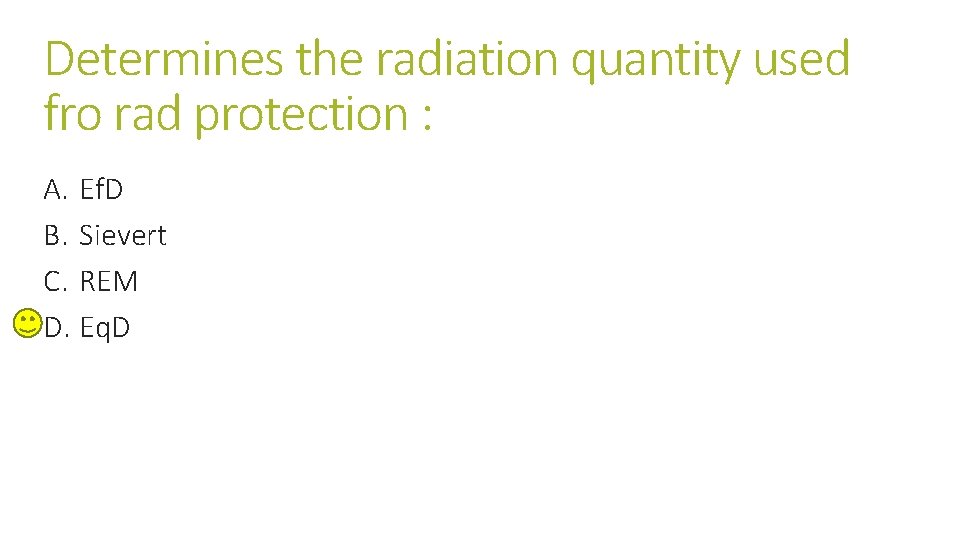
Determines the radiation quantity used fro rad protection : A. Ef. D B. Sievert C. REM D. Eq. D
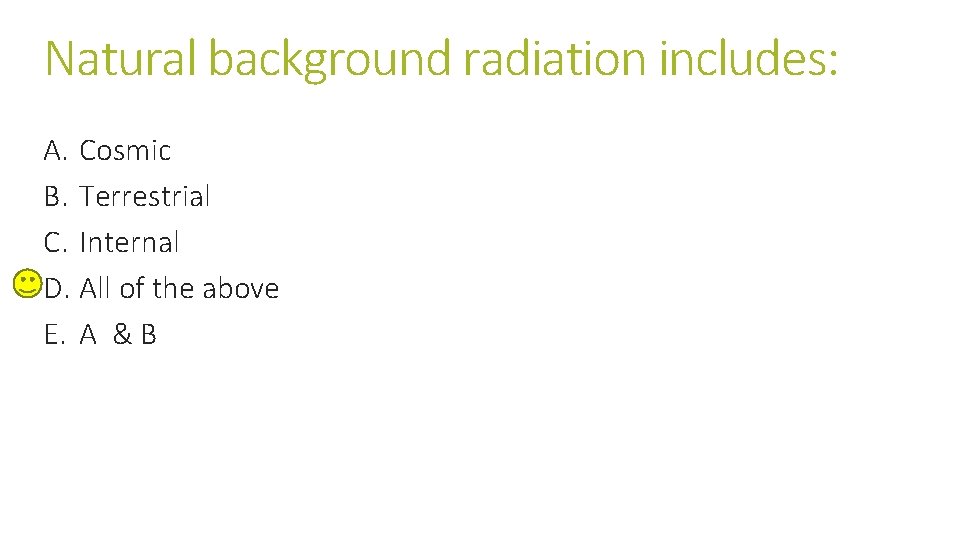
Natural background radiation includes: A. Cosmic B. Terrestrial C. Internal D. All of the above E. A & B
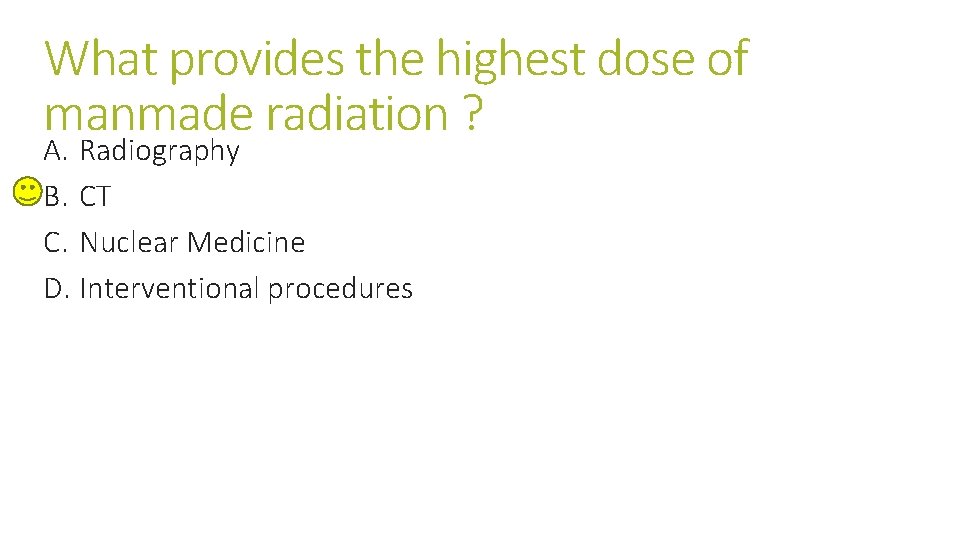
What provides the highest dose of manmade radiation ? A. Radiography B. CT C. Nuclear Medicine D. Interventional procedures
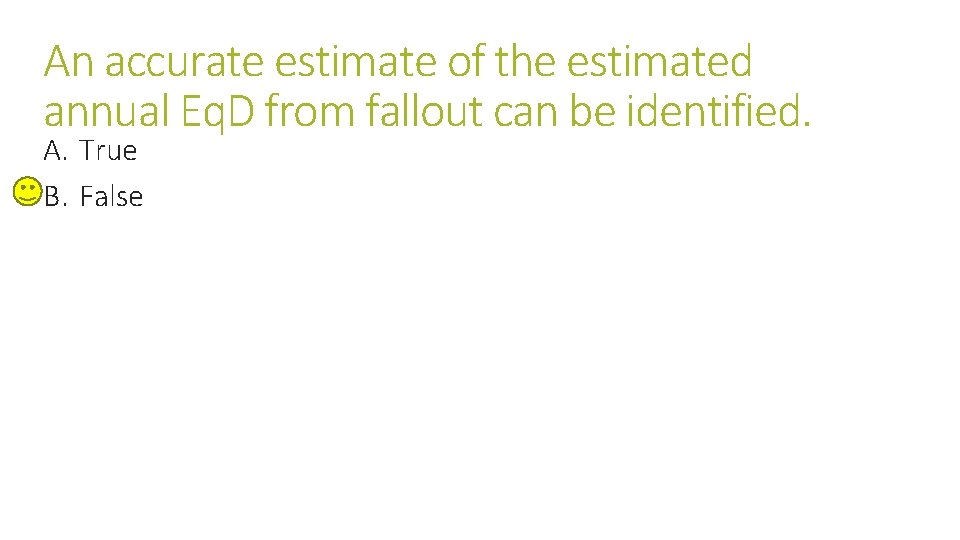
An accurate estimate of the estimated annual Eq. D from fallout can be identified. A. True B. False
Dose measurement from diagnostic testing is measured by all EXCEPT: A. Entrance skin dose B. Bone marrow C. Gonadal dose D. Fetal dose E. Thyroid dose
Resources Radiation Protection in Medical Radiography by Mary Alice Statkeiwicz Sherrer, Paula Visconti, E. Russell Ritenour and Kelli Welch Haynes. 6 th and 7 th Edition. Elsevier online. Essentials of Radiographic Physics and Imaging. James N. Johnston and Terri L Fauber. 1 st Edition. Elsevier Online. Resources: Radiation Protection in Medical Radiography by Mary Alice Statkeiwicz Sherrer, Paula Visconti, E. Russell Ritenour and Kelli Welch Haynes. 6 th and 7 th Edition. Elsevier online. Essentials of Radiographic Physics and Imaging. James N. Johnston and Terri L Fauber. 1 st Edition. Elsevier Online.
This workforce solution was funded by a grant awarded by the U. S. Department of Labor's Employment and Training Administration. The solution was created by the grantee and does not necessarily reflect the official position of the U. S. Department of Labor. The Department of Labor makes no guarantees, warranties, or assurances of any kind, express or implied, with respect to such information, including any information on linked sites and including, but not limited to, accuracy of the information or its completeness, timeliness, usefulness, adequacy, continued availability, or ownership.