
Radiation Protection and Safety This introduction may take
- Slides: 56
Radiation Protection and Safety This introduction may take about 15 minutes Continue
Welcome to the Introduction on Radiation Protection and Safety at PSI During this course you will be asked to answer a couple of questions. At the end you will be guided to a form, which you should fill in and print. This form must then be shown to the PSI staff when you pick up your personal dosimeter. A copy with signature of this form is to be send to the section „Sicherheit“, OFLC/U 105. Back Continue
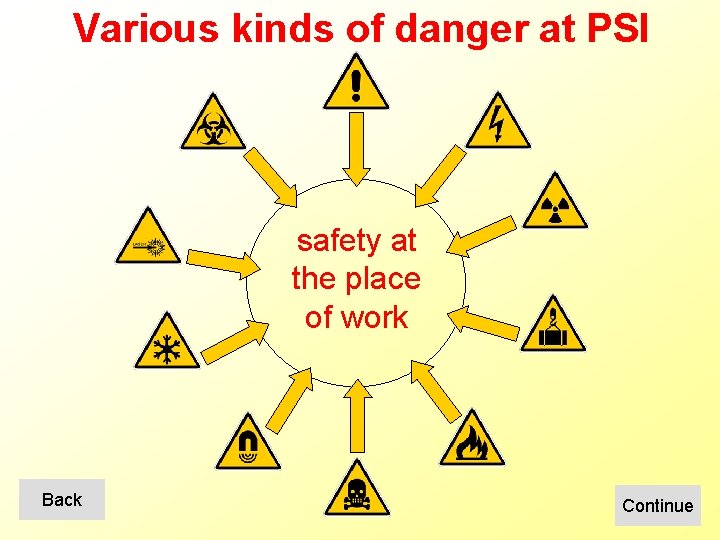
Various kinds of danger at PSI safety at the place of work Back Continue
General guidelines in case of emergency Emergency phone number serious accidents (e. g. fire or injured people) phone: 3333 Please provide the following information: Back • Who reports? please provide name and phone number • What happened? kind of accident, have people been injured? • Where did it happen? facility / building • When did it happen? time of accident Continue
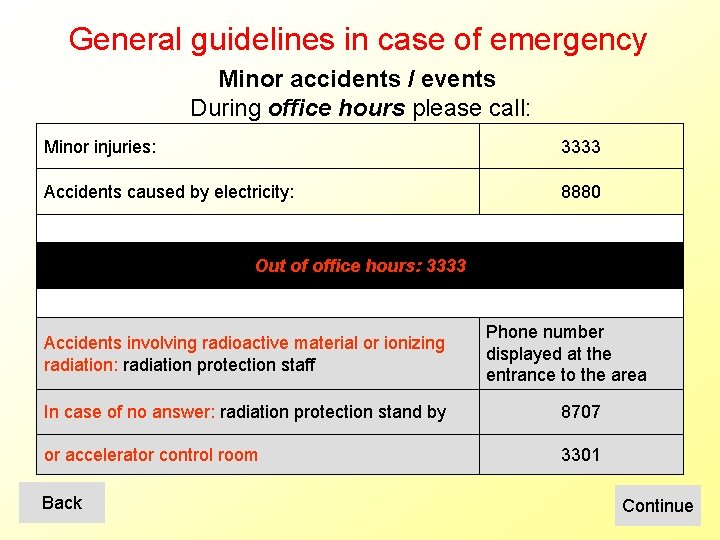
General guidelines in case of emergency Minor accidents / events During office hours please call: Minor injuries: 3333 Accidents caused by electricity: 8880 Out of office hours: 3333 Accidents involving radioactive material or ionizing radiation: radiation protection staff Phone number displayed at the entrance to the area In case of no answer: radiation protection stand by 8707 or accelerator control room 3301 Back Continue
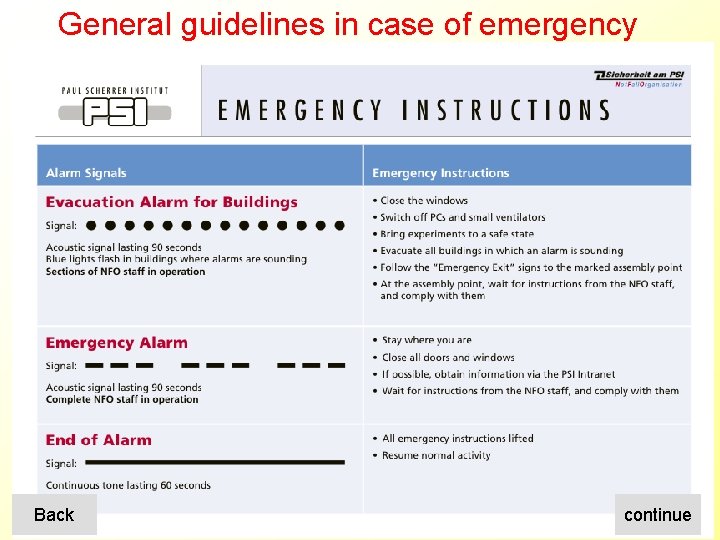
General guidelines in case of emergency Back continue
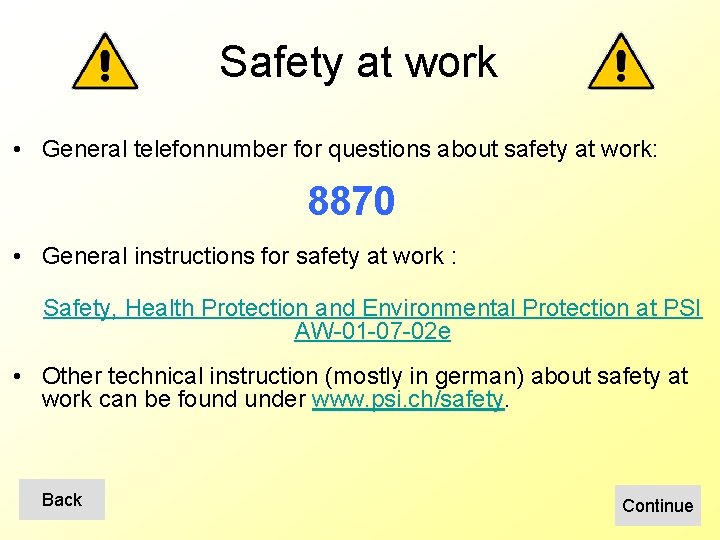
Safety at work • General telefonnumber for questions about safety at work: 8870 • General instructions for safety at work : Safety, Health Protection and Environmental Protection at PSI AW-01 -07 -02 e • Other technical instruction (mostly in german) about safety at work can be found under www. psi. ch/safety. Back Continue
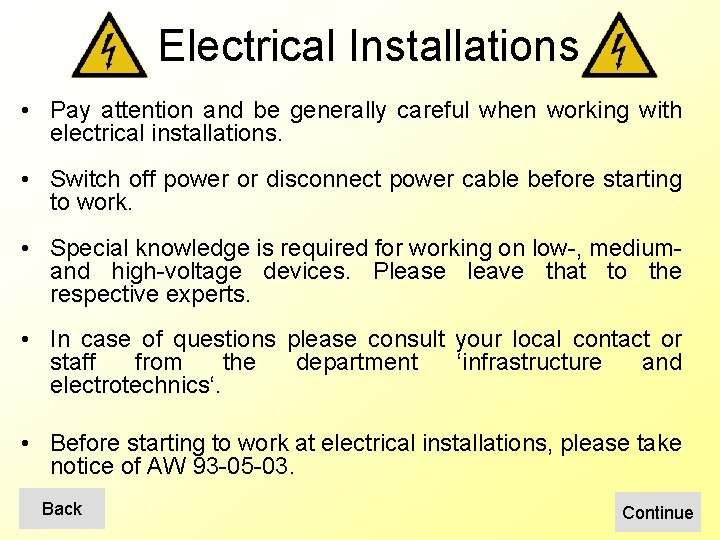
Electrical Installations • Pay attention and be generally careful when working with electrical installations. • Switch off power or disconnect power cable before starting to work. • Special knowledge is required for working on low-, mediumand high-voltage devices. Please leave that to the respective experts. • In case of questions please consult your local contact or staff from the department ‘infrastructure and electrotechnics‘. • Before starting to work at electrical installations, please take notice of AW 93 -05 -03. Back Continue
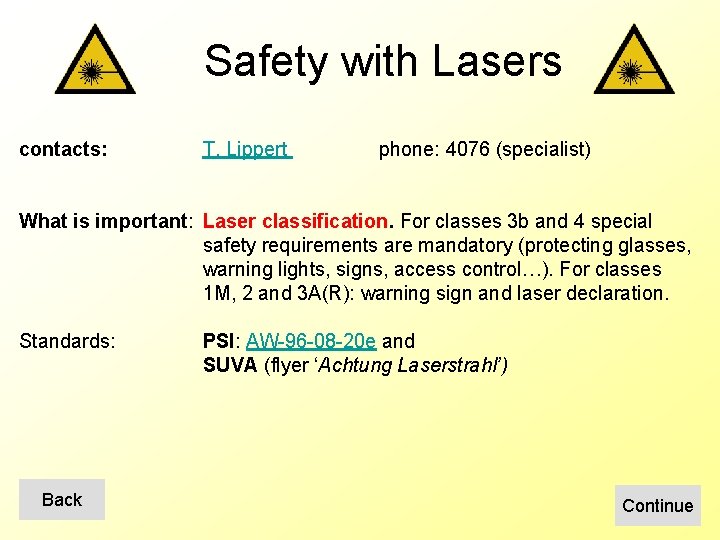
Safety with Lasers contacts: T. Lippert phone: 4076 (specialist) What is important: Laser classification. For classes 3 b and 4 special safety requirements are mandatory (protecting glasses, warning lights, signs, access control…). For classes 1 M, 2 and 3 A(R): warning sign and laser declaration. Standards: Back PSI: AW-96 -08 -20 e and SUVA (flyer ‘Achtung Laserstrahl’) Continue
Biolocial Risks A special guideline ’Einschliessungsverordnung des Bundes’ rules the handling of biolocical material. For certain kind of work a special registration or a dedicated bio laboratory is needed. If you are going to carry out such work, please contact K. Ballmer, phone 4165 to properly register the project. Further Information Back Continue
Lab Rules for handling biological material at PSI (for questions contact K. Ballmer-Hofer, phone 4165 or kurt. ballmer@psi. ch) The plasmids, microbial and cell systems registered at present at PSI are regulated legally as biosafety level 1 (BL 1), i. e. a weak classification just requiring 'good laboratory practice' standards. Since some of the plasmids used at PSI carry sequences encoding signalling molecules, the stricter BL 2 rules are applied. I would like to remind you of an old experiment where it was shown that oncogene DNA (ras) applied to the skin of mice induced tumors! The rules below conform to the BL 2 laboratory safety requirements, an in depth coverage of the biosafety legislation is given at: http: //www. bag. admin. ch/biosafety/d/index. htm. Before starting work with biological material you must read the instructions given under the above mentioned internet address. In particular you must check the biosafety level to be applied to work with the organisms used. Some simple rules in brief: • All live biological material must be killed before release into the environment. • Material that was in contact with cells, bacteria, yeast etc. must be decontaminated with a disinfectant such as 1% Bomix or alcohol. • All solid materials such as disposable pipet tips, plates, tubes etc. that were in contact with biological material such as DNA or live organisms must be collected in special containers and autoclaved before being discarded. • No food, drinks, dishes etc. are allowed in the labs. • Do not use containers such as glass jars that contained food for laboratory items. • When working with viruses, a vertical laminar flow hood must be used. • Before working in a tissue culture room, decontaminate your hands with Sterilin. • Clean bench of sterile hood with alcohol before and after use. • Rinse hose of waste pump with alcohol when finished. • Remove trash when bins are full from laboratories. Biological waste must be autoclaved before discarding. • When emptying liquid waste, rinse waste container and add fresh disinfectant such as Bomix. • Autoclaves used for decontamination of biological material must be tested every 3 months using bacterial indicator strips. Back Continue
High Pressure Devices If you need to work with unknown pressure devices please request prior assistance from your local contact. In case of further problems please contact: S. Bondt, phone: 2952 Back Continue
Using Cranes - PSI Guidelines For the use of cranes limited to 1000 kg an introduction by an expert is required. For cranes working in the range 1000 - 5000 kg an expert must be consulted unless a special 1 -day course had been taken. For loads > 5000 kg PSI expert staff has to be involved. Contact: Back David Reinhard phone: 5448 Continue
Fire Protection • Don‘t store any inflammable material • Please keep the escape routes clear • Please inform your local contact if you detect missing fire warning devices • Generally: comply with existing regulations Back Continue
Chemicals Please label all chemicals clearly. Retaining tubs should be used to store liquid chemicals. Consult the relevant data sheet before starting to work. Please dispose any chemicals at the dedicated central collection point (contact: A. Frei, phone 4302). In case of problems please contact the PSI expert for chemicals and toxicology: P. Hasler, phone 2842. Back Continue
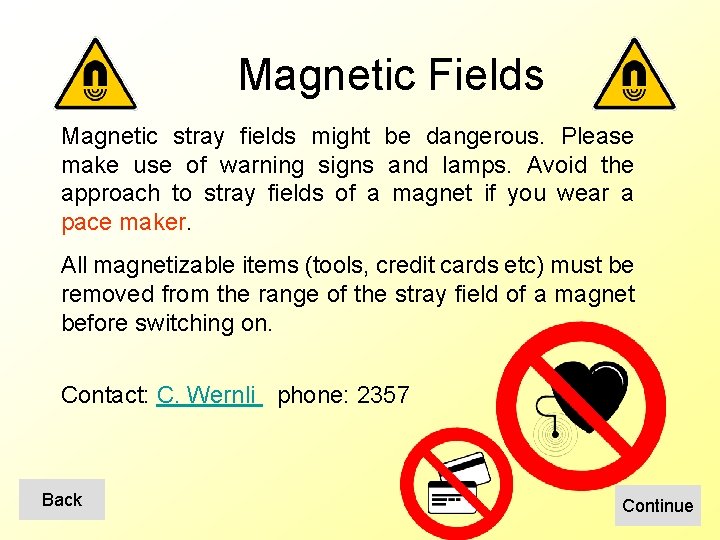
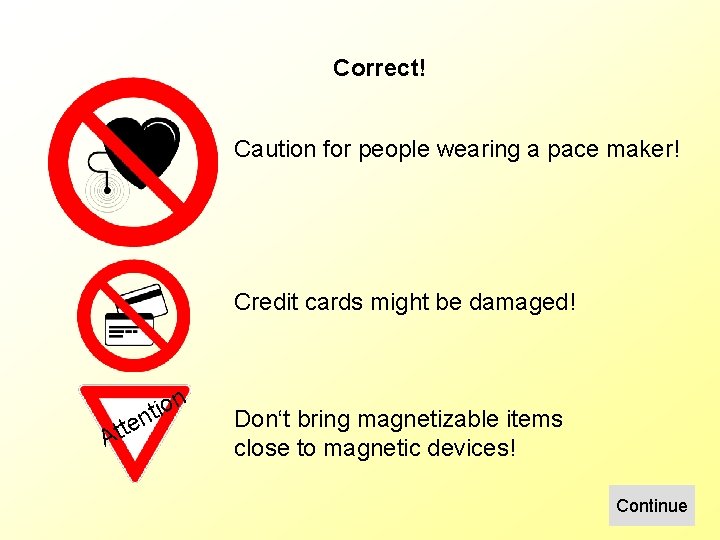
Magnetic Fields Magnetic stray fields might be dangerous. Please make use of warning signs and lamps. Avoid the approach to stray fields of a magnet if you wear a pace maker. All magnetizable items (tools, credit cards etc) must be removed from the range of the stray field of a magnet before switching on. Contact: C. Wernli phone: 2357 Back Continue
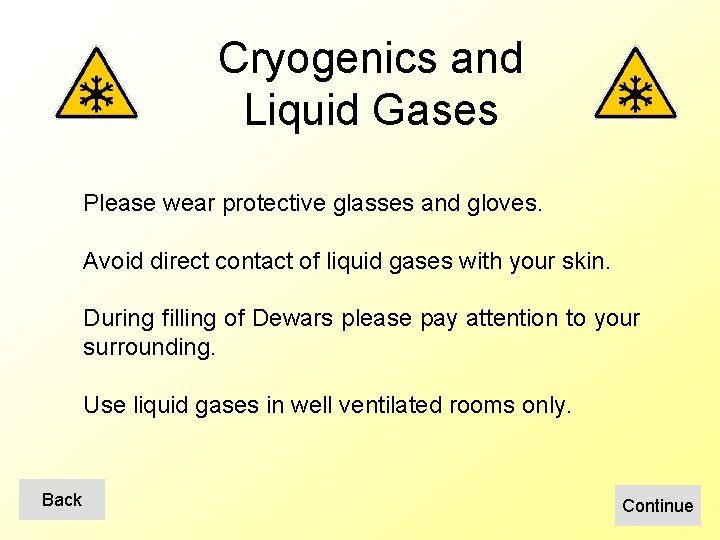
Cryogenics and Liquid Gases Please wear protective glasses and gloves. Avoid direct contact of liquid gases with your skin. During filling of Dewars please pay attention to your surrounding. Use liquid gases in well ventilated rooms only. Back Continue
Question What is the emergency phone number in case of serious accidents like fire or injured people? 6666 9999 3333 007
This was not the right number! Continue
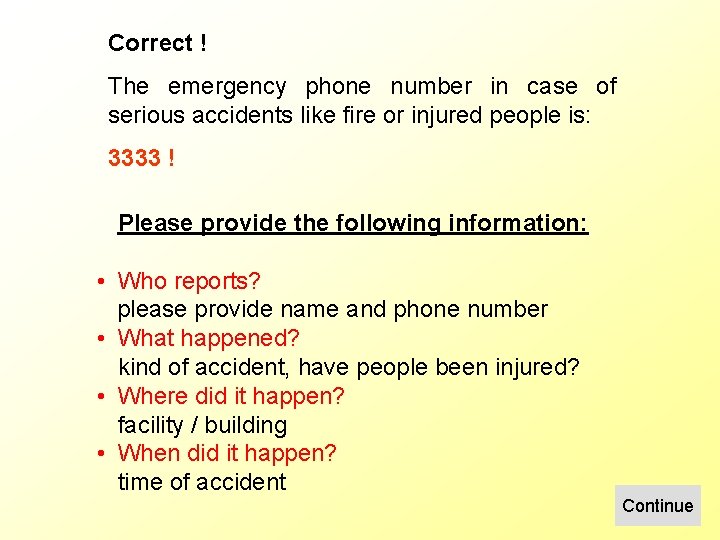
Correct ! The emergency phone number in case of serious accidents like fire or injured people is: 3333 ! Please provide the following information: • Who reports? please provide name and phone number • What happened? kind of accident, have people been injured? • Where did it happen? facility / building • When did it happen? time of accident Continue
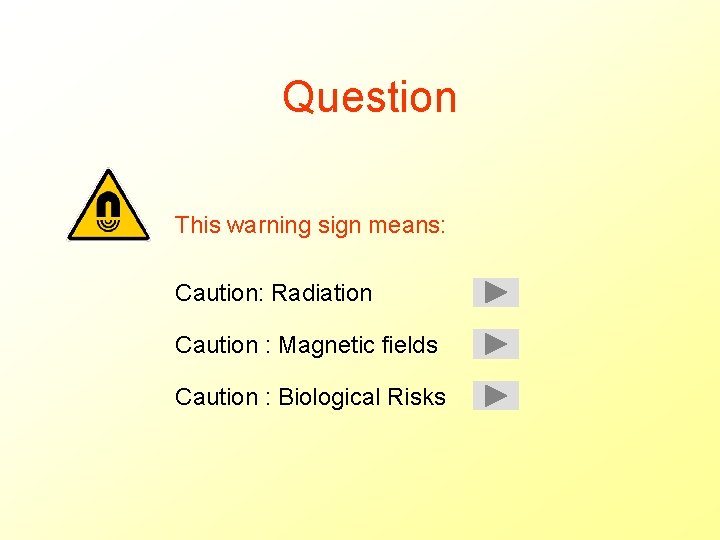
Question This warning sign means: Caution: Radiation Caution : Magnetic fields Caution : Biological Risks
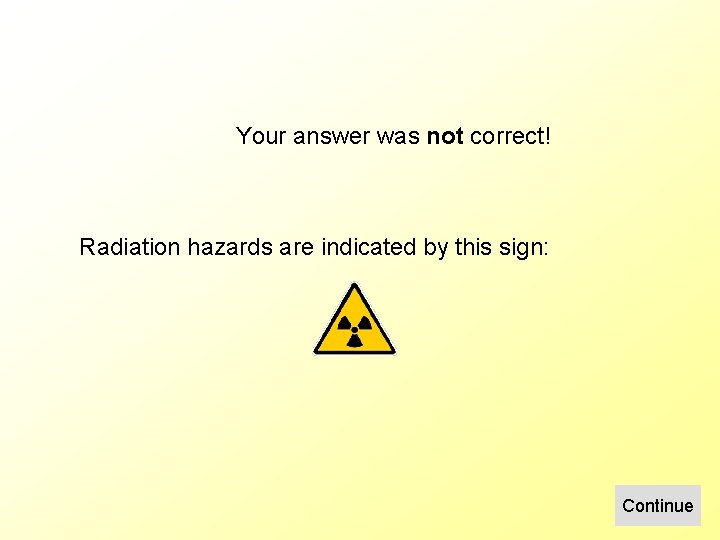
Your answer was not correct! Radiation hazards are indicated by this sign: Continue
Correct! Caution for people wearing a pace maker! Credit cards might be damaged! n e Att o nti Don‘t bring magnetizable items close to magnetic devices! Continue
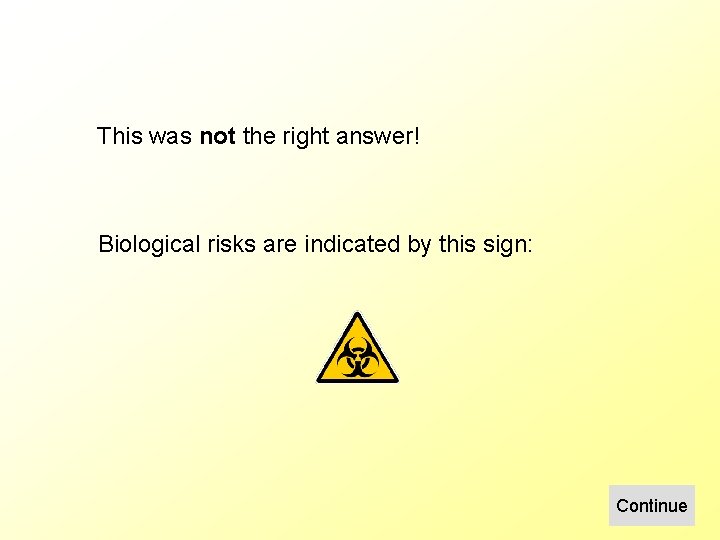
This was not the right answer! Biological risks are indicated by this sign: Continue
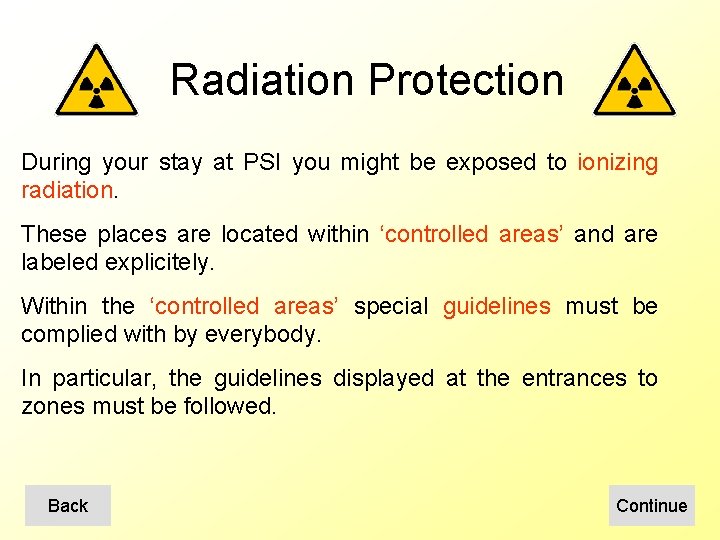
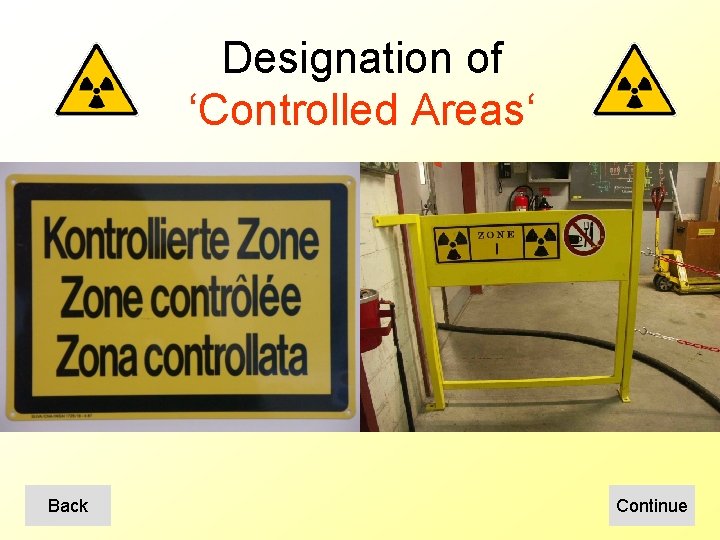
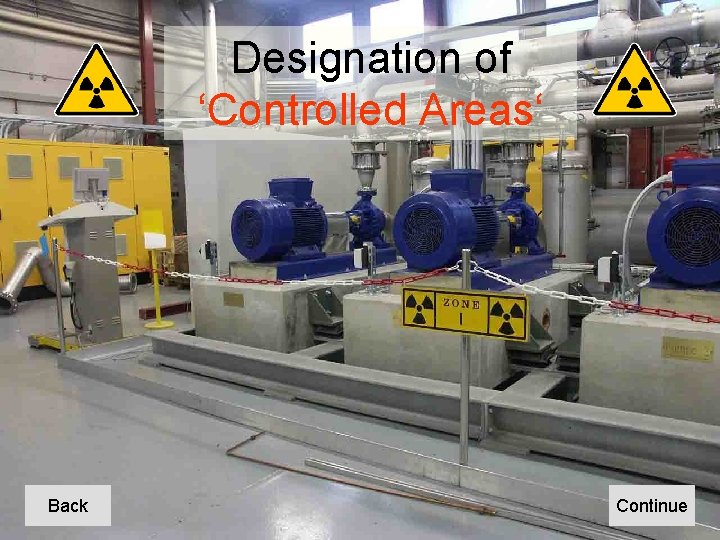
Radiation Protection During your stay at PSI you might be exposed to ionizing radiation. These places are located within ‘controlled areas’ and are labeled explicitely. Within the ‘controlled areas’ special guidelines must be complied with by everybody. In particular, the guidelines displayed at the entrances to zones must be followed. Back Continue
Designation of ‘Controlled Areas‘ Back Continue
Designation of ‘Controlled Areas‘ Back Continue
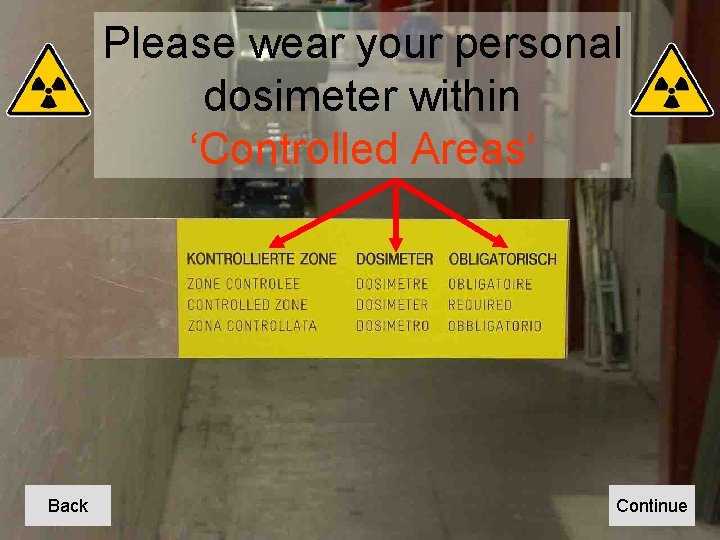
Please wear your personal dosimeter within ‘Controlled Areas‘ Back Continue
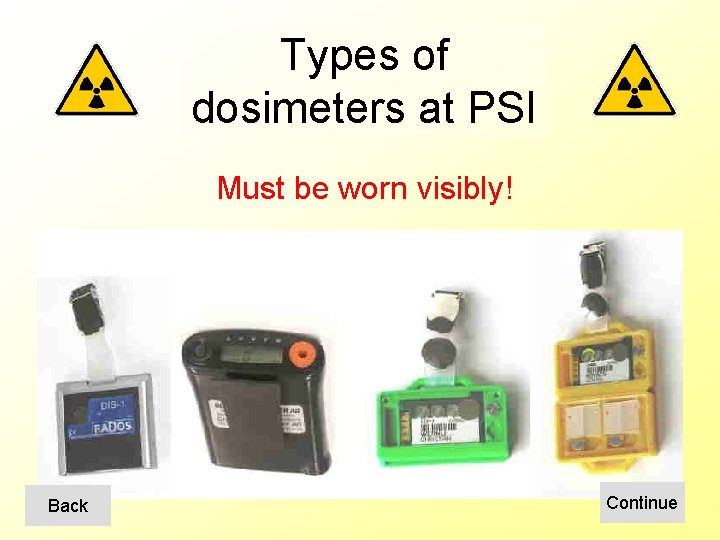
Types of dosimeters at PSI Must be worn visibly! Back Continue
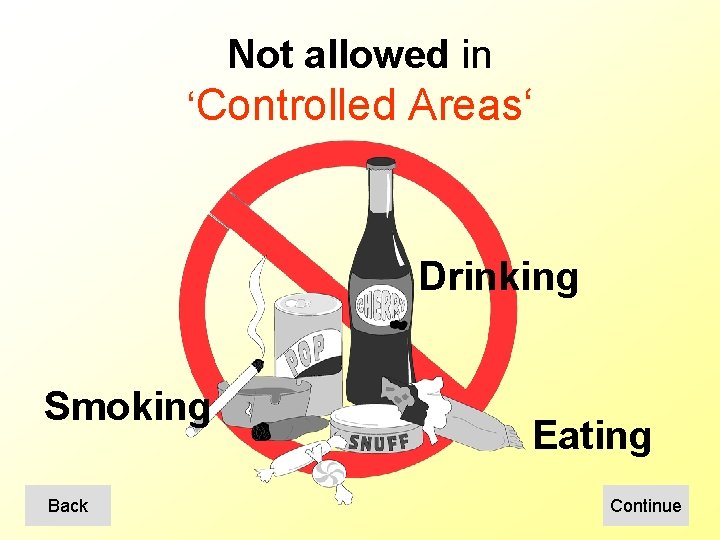
Not allowed in ‘Controlled Areas‘ Drinking Smoking Back Eating Continue
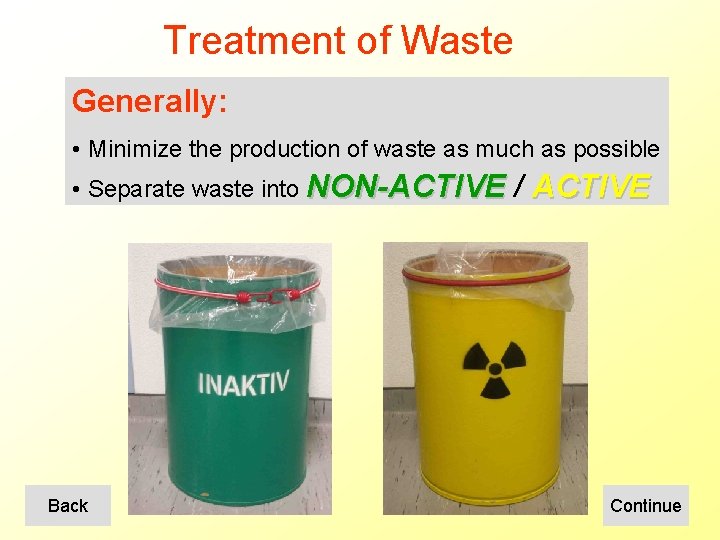
Treatment of Waste Generally: • Minimize the production of waste as much as possible • Separate waste into NON-ACTIVE Back / ACTIVE Continue
Question Guidelines for controlled areas do hold for: Persons not occupationally exposed to radiation Visitors Everybody Cleaning staff Persons occupationally exposed to radiation
This was not the right answer! Please go back to that chapter! Continue
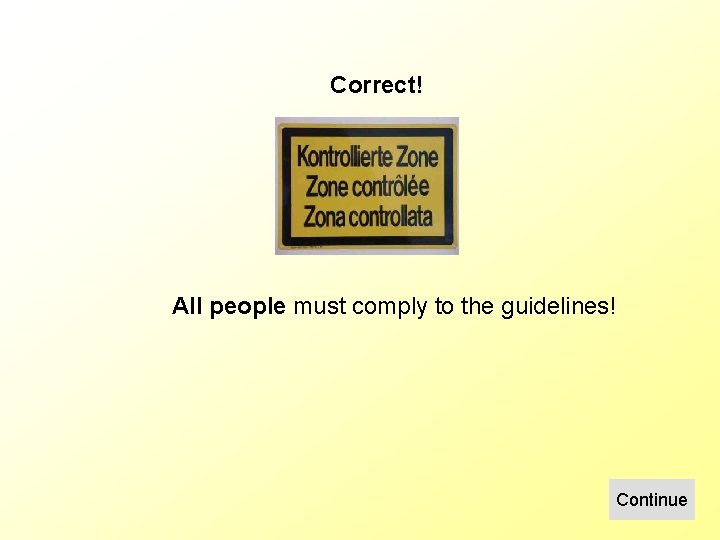
Correct! All people must comply to the guidelines! Continue
In case of questions please contact the PSI staff from the division for radiation safety and security (ASI). Contact numbers are displayed at the controlled areas. Back Continue
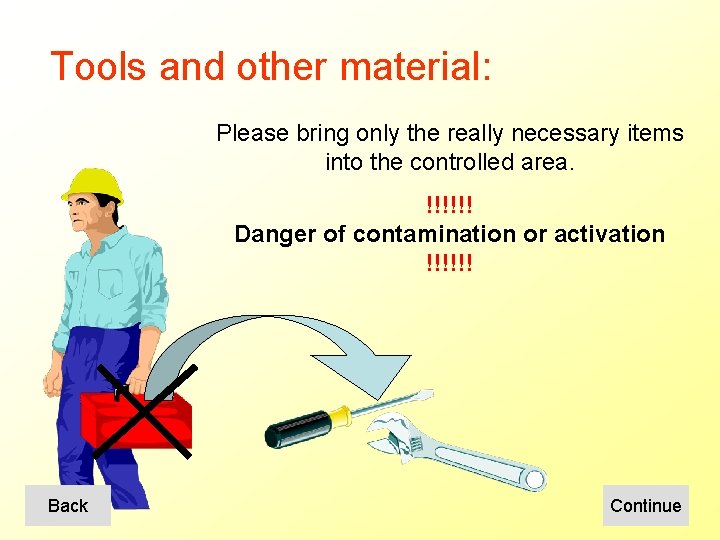
Tools and other material: Please bring only the really necessary items into the controlled area. !!!!!! Danger of contamination or activation !!!!!! Back Continue
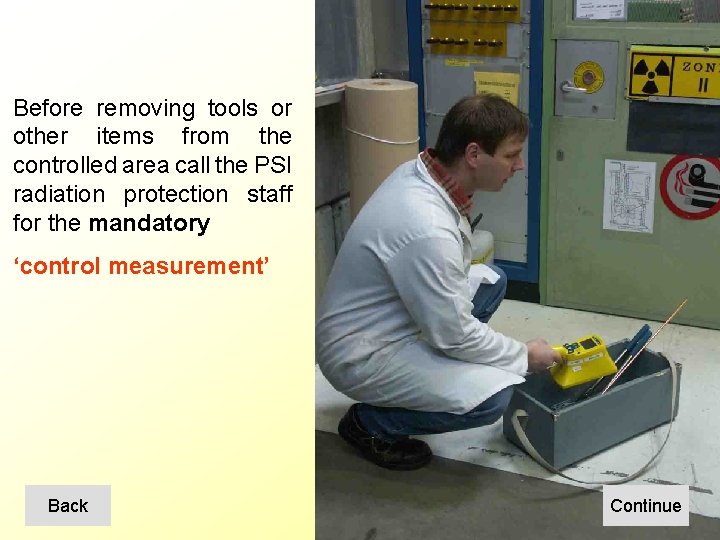
Before removing tools or other items from the controlled area call the PSI radiation protection staff for the mandatory ‘control measurement’ Back Continue
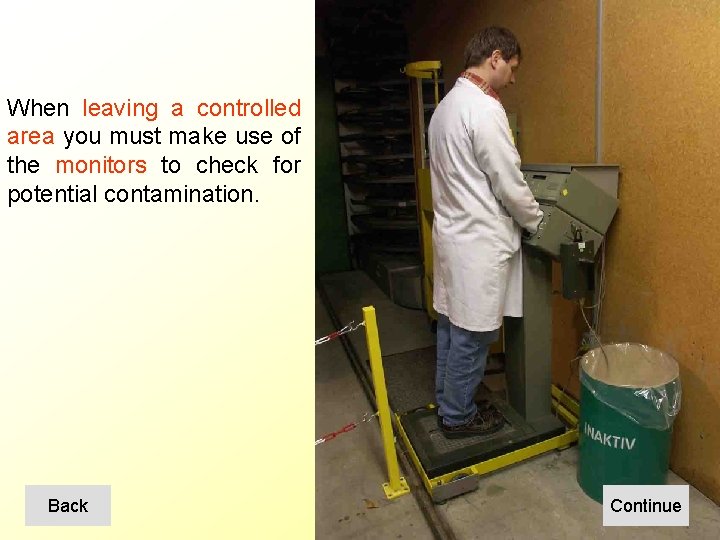
When leaving a controlled area you must make use of the monitors to check for potential contamination. Back Continue
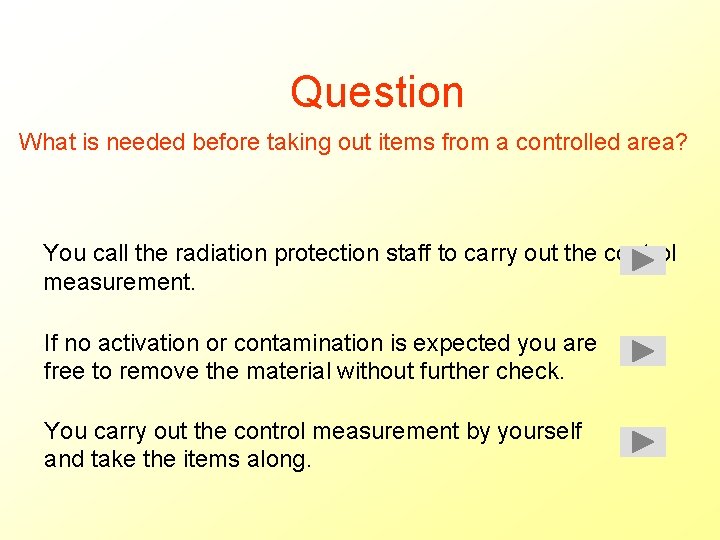
Question What is needed before taking out items from a controlled area? You call the radiation protection staff to carry out the control measurement. If no activation or contamination is expected you are free to remove the material without further check. You carry out the control measurement by yourself and take the items along.
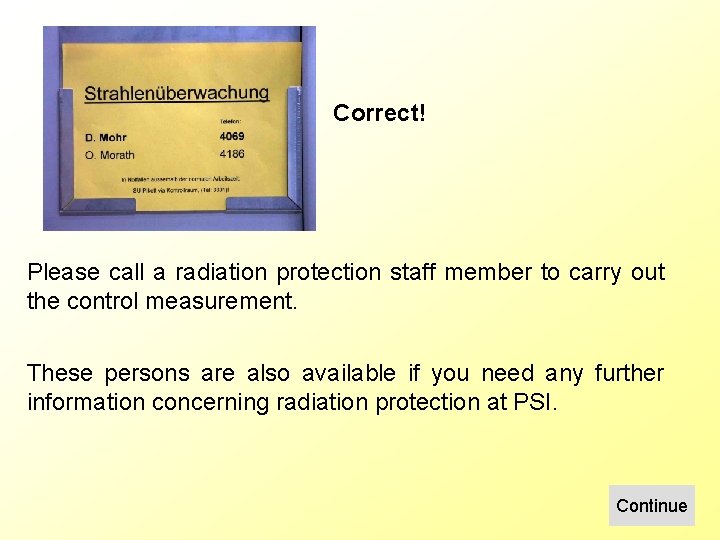
Correct! Please call a radiation protection staff member to carry out the control measurement. These persons are also available if you need any further information concerning radiation protection at PSI. Continue
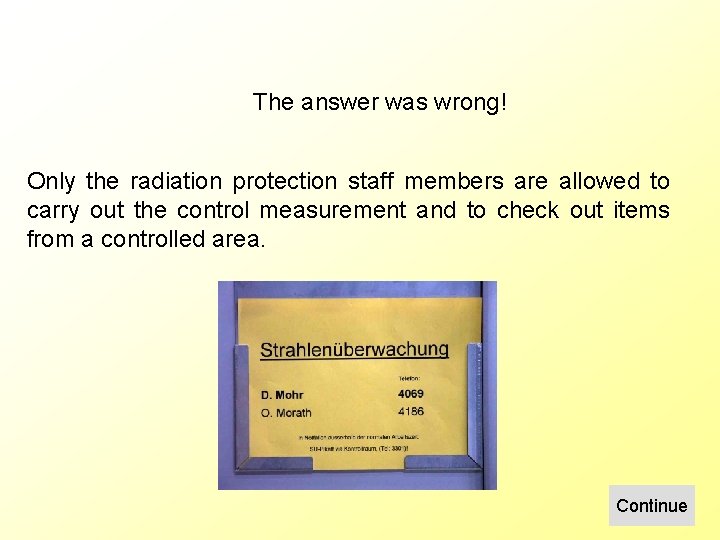
The answer was wrong! Only the radiation protection staff members are allowed to carry out the control measurement and to check out items from a controlled area. Continue
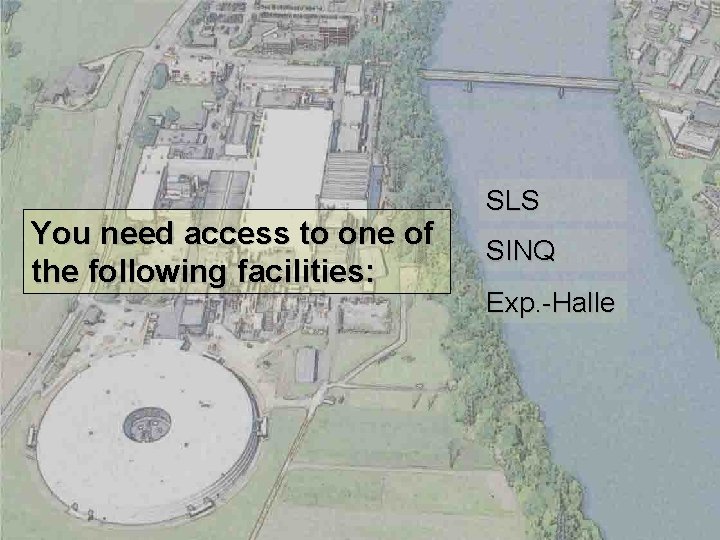
You need access to one of the following facilities: SLS SINQ Exp. -Halle
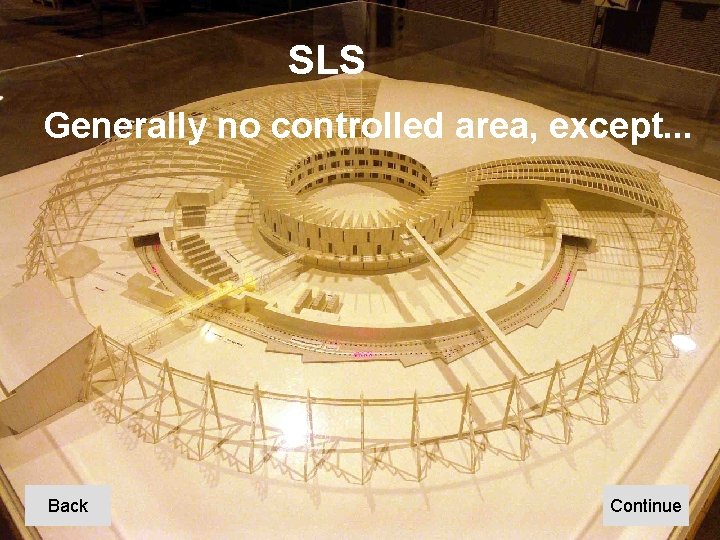
SLS Generally no controlled area, except. . . Back Continue
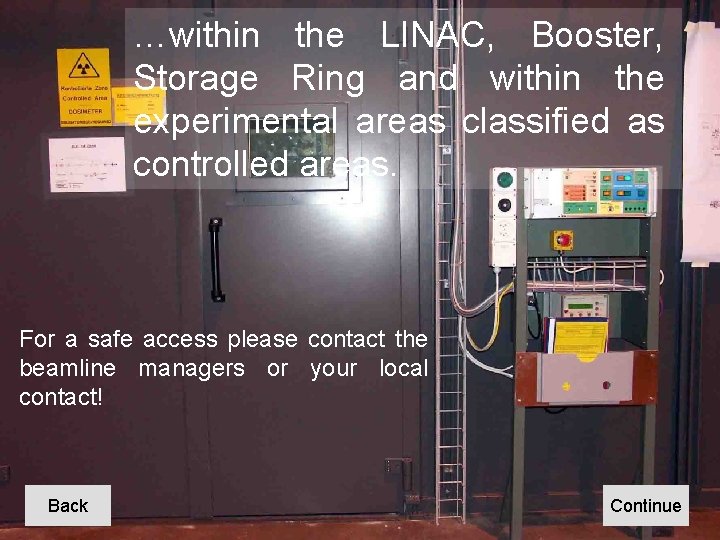
…within the LINAC, Booster, Storage Ring and within the experimental areas classified as controlled areas. For a safe access please contact the beamline managers or your local contact! Back Continue
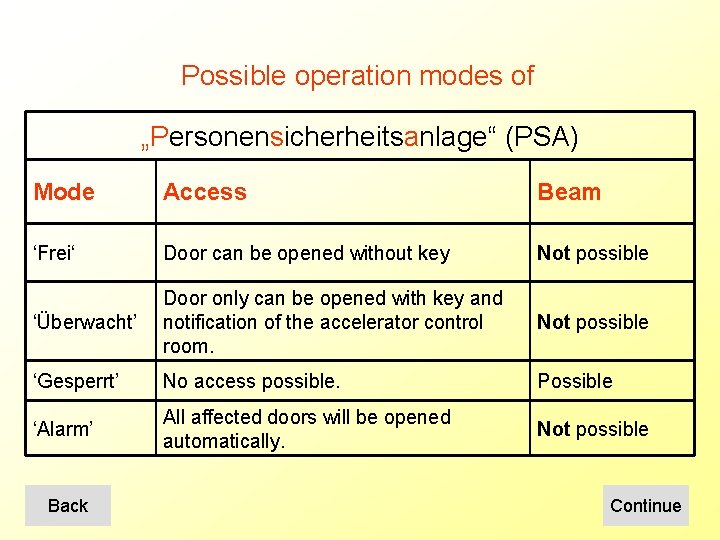
Possible operation modes of „Personensicherheitsanlage“ (PSA) Mode Access Beam ‘Frei‘ Door can be opened without key Not possible ‘Überwacht’ Door only can be opened with key and notification of the accelerator control room. Not possible ‘Gesperrt’ No access possible. Possible ‘Alarm’ All affected doors will be opened automatically. Not possible Back Continue
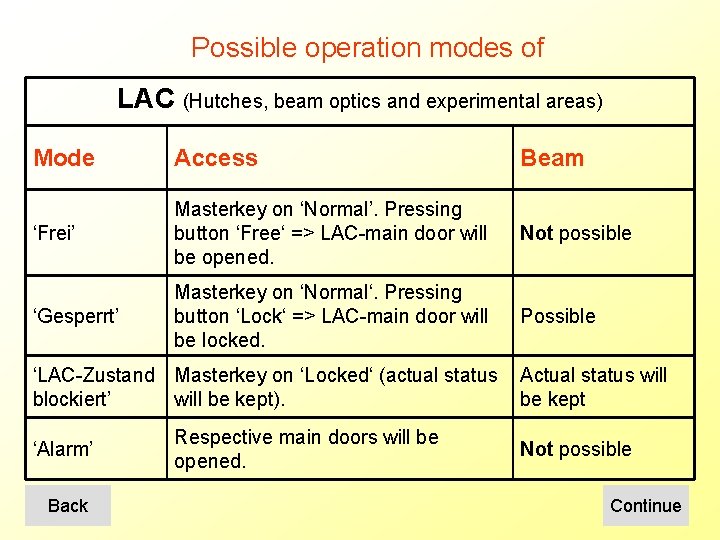
Possible operation modes of LAC (Hutches, beam optics and experimental areas) Mode Access Beam ‘Frei’ Masterkey on ‘Normal’. Pressing button ‘Free‘ => LAC-main door will be opened. Not possible ‘Gesperrt’ Masterkey on ‘Normal‘. Pressing button ‘Lock‘ => LAC-main door will be locked. Possible ‘LAC-Zustand Masterkey on ‘Locked‘ (actual status blockiert’ will be kept). ‘Alarm’ Back Respective main doors will be opened. Actual status will be kept Not possible Continue
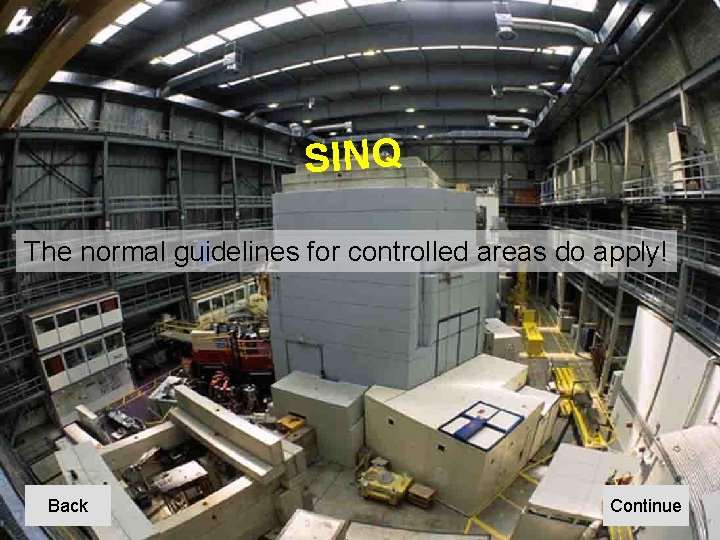
SINQ The normal guidelines for controlled areas do apply! Back Continue
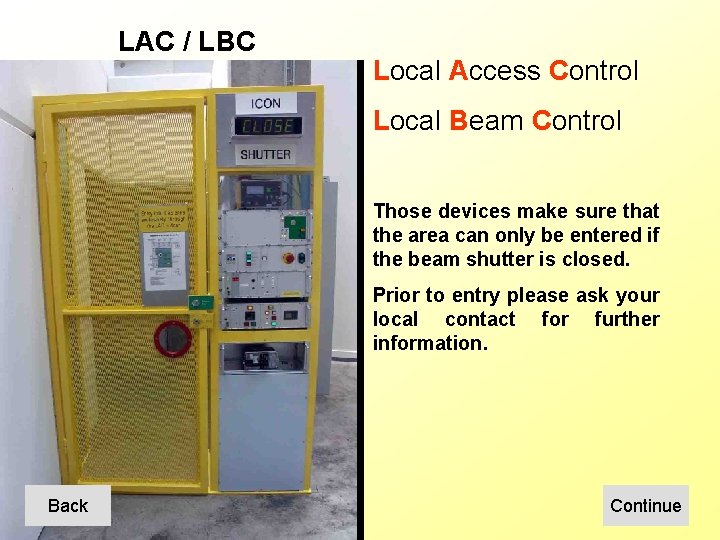
LAC / LBC Local Access Control Local Beam Control Those devices make sure that the area can only be entered if the beam shutter is closed. Prior to entry please ask your local contact for further information. Back Continue
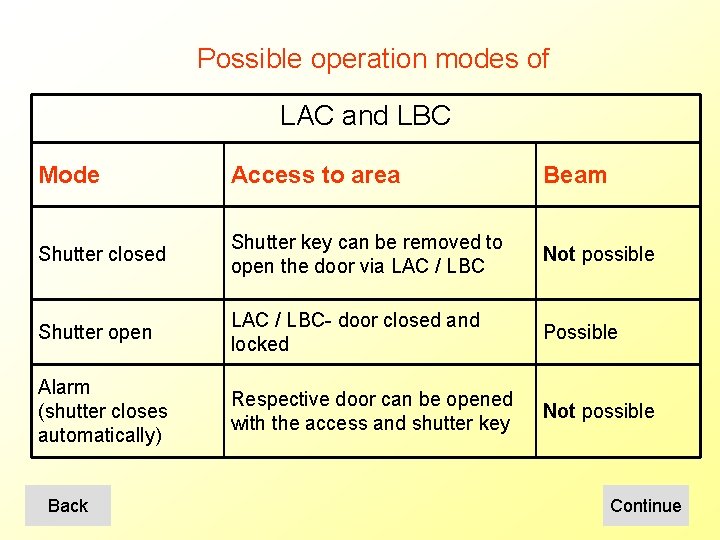
Possible operation modes of LAC and LBC Mode Access to area Beam Shutter closed Shutter key can be removed to open the door via LAC / LBC Not possible Shutter open LAC / LBC- door closed and locked Possible Alarm (shutter closes automatically) Respective door can be opened with the access and shutter key Not possible Back Continue
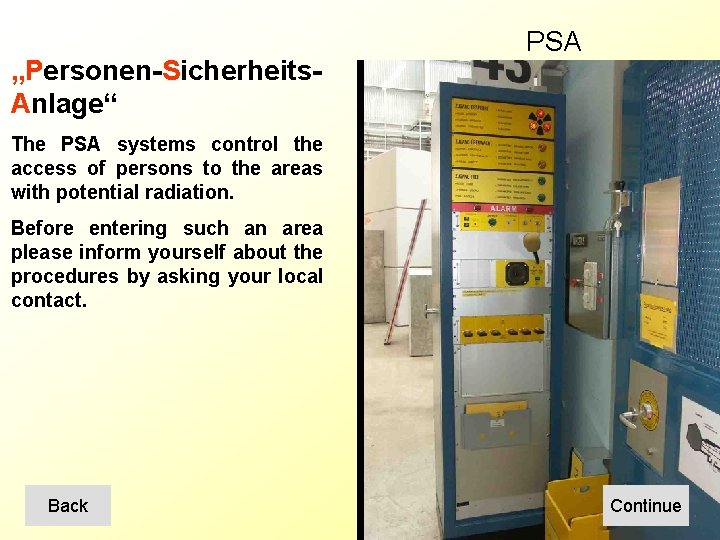
„Personen-Sicherheits. Anlage“ PSA The PSA systems control the access of persons to the areas with potential radiation. Before entering such an area please inform yourself about the procedures by asking your local contact. Back Continue
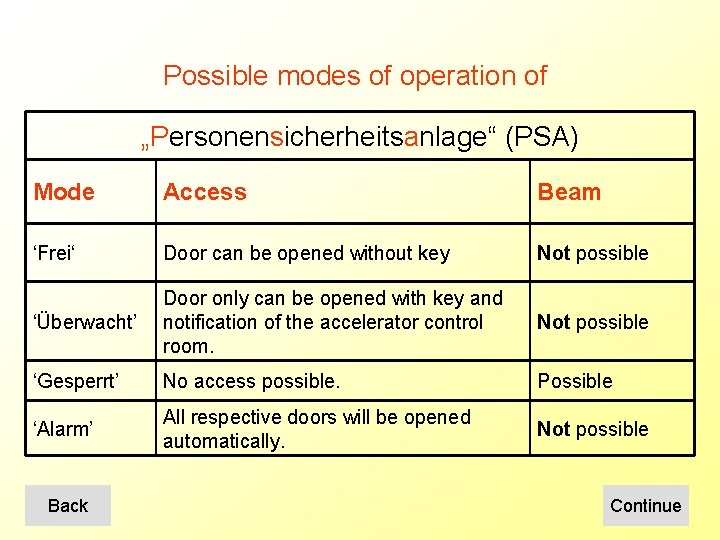
Possible modes of operation of „Personensicherheitsanlage“ (PSA) Mode Access Beam ‘Frei‘ Door can be opened without key Not possible ‘Überwacht’ Door only can be opened with key and notification of the accelerator control room. Not possible ‘Gesperrt’ No access possible. Possible ‘Alarm’ All respective doors will be opened automatically. Not possible Back Continue
You have completed the introduction to safety and radiation protection at PSI. Please completely fill in the form on the next page. To receive a dosimeter you have to present the completed form. If you have any further question your local contact will assist you. Back Other facilities Continue
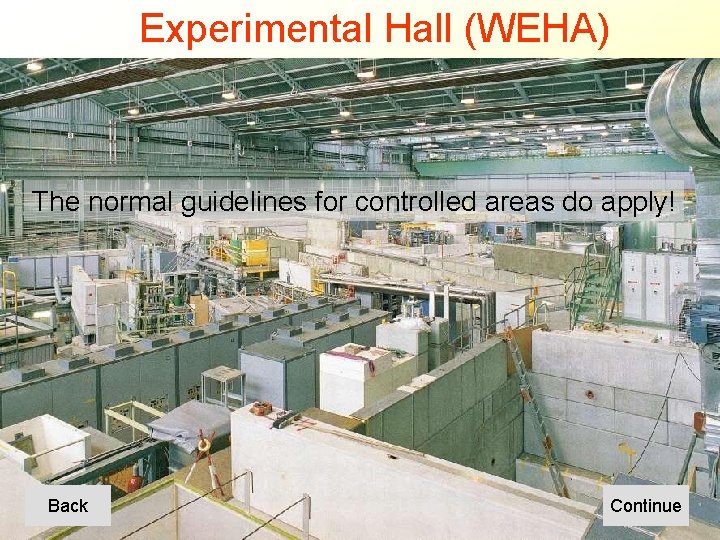
Experimental Hall (WEHA) The normal guidelines for controlled areas do apply! Back Continue
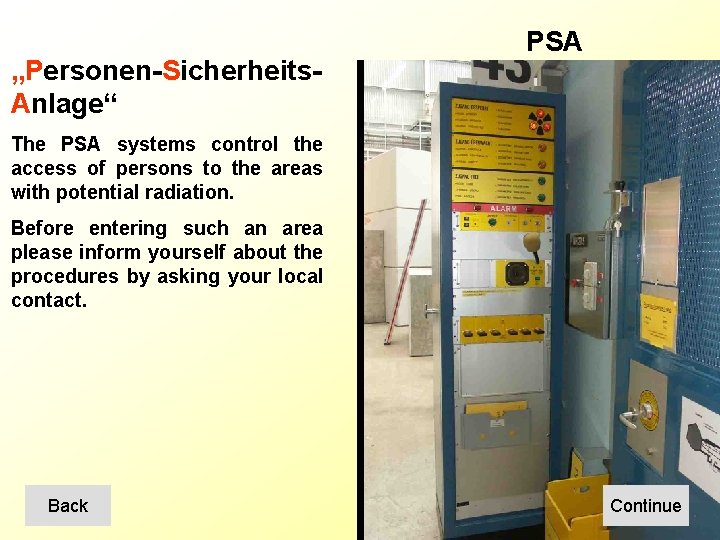
„Personen-Sicherheits. Anlage“ PSA The PSA systems control the access of persons to the areas with potential radiation. Before entering such an area please inform yourself about the procedures by asking your local contact. Back Continue
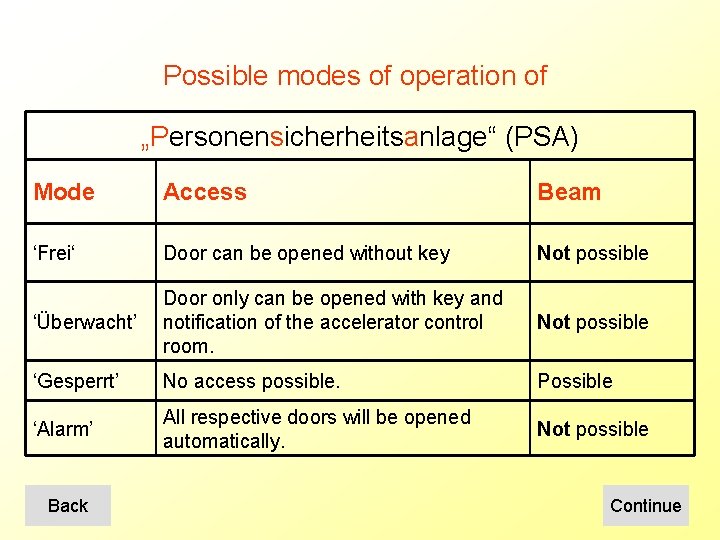
Possible modes of operation of „Personensicherheitsanlage“ (PSA) Mode Access Beam ‘Frei‘ Door can be opened without key Not possible ‘Überwacht’ Door only can be opened with key and notification of the accelerator control room. Not possible ‘Gesperrt’ No access possible. Possible ‘Alarm’ All respective doors will be opened automatically. Not possible Back Continue
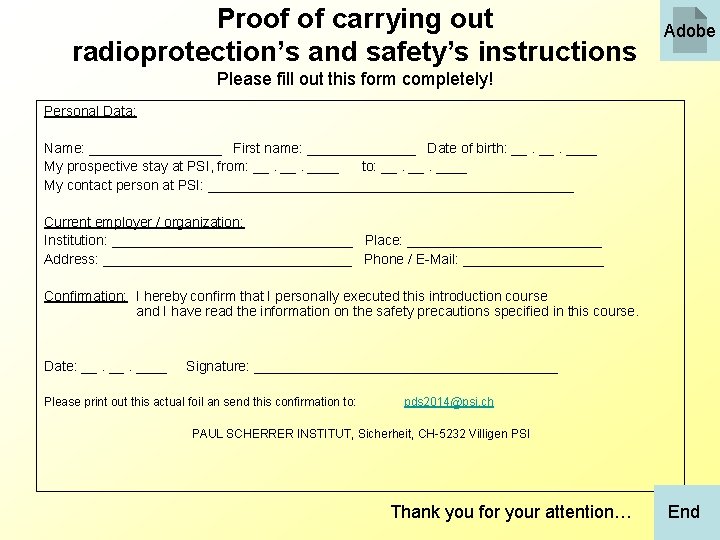
Proof of carrying out radioprotection’s and safety’s instructions Adobe Please fill out this form completely! Personal Data: Name: _________ First name: _______ Date of birth: __. ____ My prospective stay at PSI, from: __. ____ to: __. ____ My contact person at PSI: ________________________ Current employer / organization: Institution: ________________ Place: _____________ Address: ________________ Phone / E-Mail: _________ Confirmation: I hereby confirm that I personally executed this introduction course and I have read the information on the safety precautions specified in this course. Date: __. ____ Signature: ____________________ Please print out this actual foil an send this confirmation to: pds 2014@psi. ch PAUL SCHERRER INSTITUT, Sicherheit, CH-5232 Villigen PSI Thank you for your attention… End