
Radiation Protection and Minimization According to Modified Schordinger


- Slides: 14
Radiation Protection and Minimization According to Modified Schordinger Equation Abstract The study is concerned with deriving anew expression for the radioactive decay law by using the modified schordinger equation, to know how radiation can be emitted.
Ionizing radiation can ionize matter either directly or indirectly because it is energy exceeds the ionization potential of matter. 1 - Directly ionizing radiation (charged particles) electron, protons, Alpha particles, heavy ions. 2 - Indirectly ionizing radiation (neutral particles) photon, x-ray, gamma rays, and neutrons.
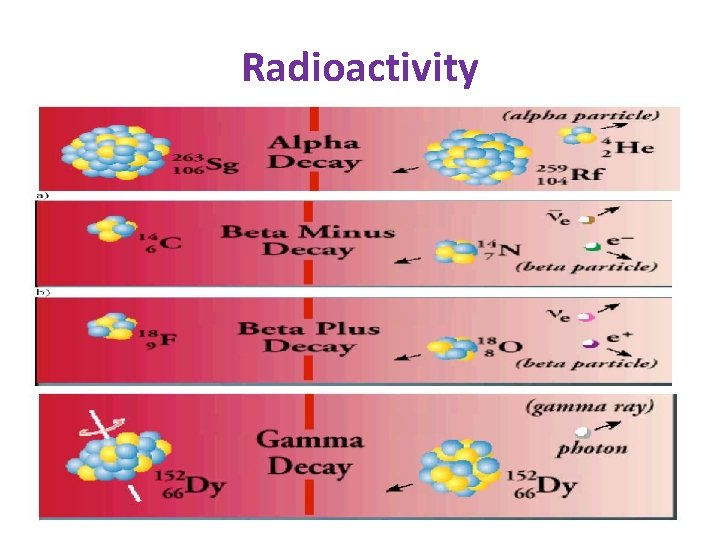
Radioactivity
• Neutrons are mostly released by nuclear fission (the splitting of atoms in a nuclear reactor), and hence are seldom encountered outside the core of a nuclear reactor. Thus they are not normally a problem outside nuclear plants. Fast neutrons can be very destructive to human tissue.
INTERACTION OF IONIZING RADIATION WITH MATTER • Types of radiation are direct ionizing radiation and indirect ionizing radiation. such as alpha particles, beta particles, electrons, are phenomena of direct ionizing radiation, because though coulomb interaction with matter it directly causes ionization and excitation of atoms. Indirect ionizing radiation (neutrons, γ-quantums) is radiation of particles or photons, which have no charge and during interaction with matter can transfer energy to charged particles, nuclei and atom electrons due to electromagnetic or nuclear interaction.
IONIZING RADIATION'S BIOLOGICAL EFFECTS • Radiation can come from the food we eat, the soil around us, or the building materials used to build our homes. It is very difficult to say if we suffer any biological damage from the naturally occurring radiation that has surrounded us since we arrived on the earth. If there is any damage, it does appear to be very slight, so slight as to be almost undetectable.
• Radiation does interact with the matter through which it passes and if the material happens to be human cells, the radiation could damage those cells. This section will explore the ways in which radiation causes damage to cells. There are two ways in which cells can be damaged by radiation, directly and indirectly.
• Direct Cell Damage • The cells of the human body generally consist of an outer cell membrane, an intercellular fluid, a nuclear membrane surrounding and small bodies within the nucleus called genes. The genes are made up of a material called DNA (deoxyribonucleic acid). Every cell in the body has this central core. It is responsible of control of the cell and replication. These responsibilities make the DNA extremely important to cell life and life of the whole organism. If radiation interacts with the DNA molecules it can cause the molecules to separate. In this case the radiation has directly affected the cell. If the cell can repair the damage, it may survive; if it can't it will die. Since the damage was directly caused, the affect is called Direct Cellular Damage.
• Indirect Cell Damage • A second type of cell damage is indirect cellular damage that occurs when radiation strikes the cytoplasm surrounding the nucleus rather than the nucleus itself. The cytoplasm is compose primarily of water and is the intercellular fluid. • When radiation interacts with a water molecule, certain free radicals can be formed. The free radicals are chemically reactive, and they can cause the cell to become chemically imbalanced; the result is cell damage. The effect is caused indirectly; the chemical changes brought about by the formation of the free radicals are what ultimately cause the cell damage. If the damage is so great the cell cannot repair itself, the result is the same as in direct cell damage, the cell dies.
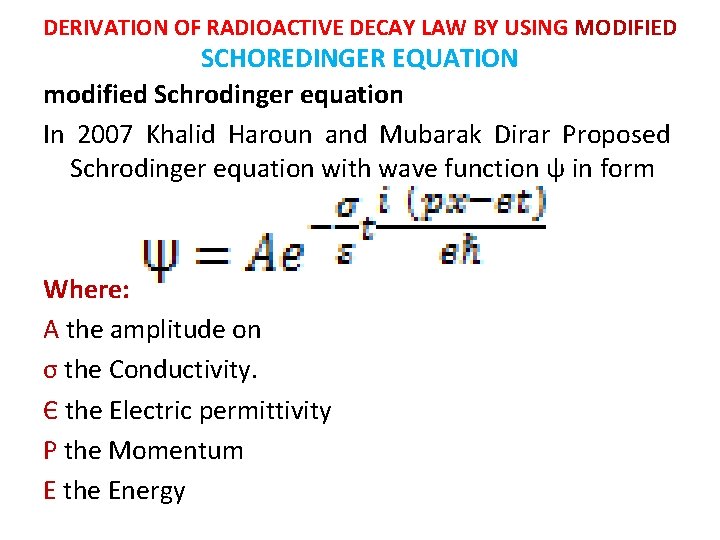
DERIVATION OF RADIOACTIVE DECAY LAW BY USING MODIFIED SCHOREDINGER EQUATION modified Schrodinger equation In 2007 Khalid Haroun and Mubarak Dirar Proposed Schrodinger equation with wave function ψ in form Where: A the amplitude on σ the Conductivity. Є the Electric permittivity P the Momentum E the Energy
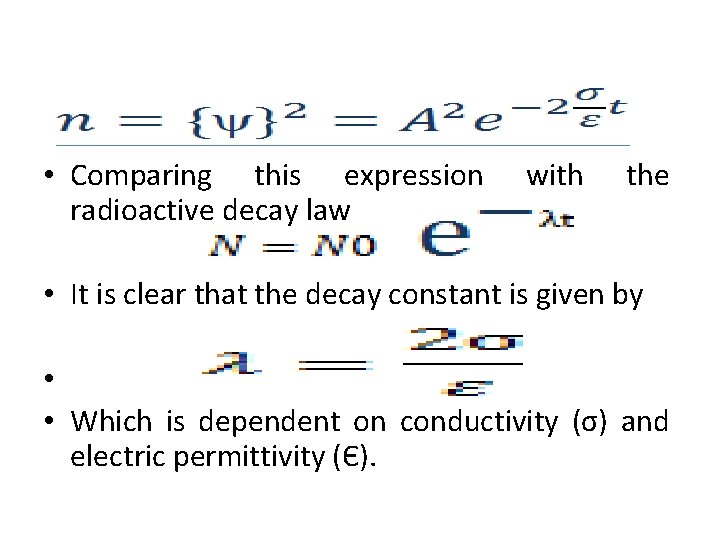
• Comparing this expression radioactive decay law with the • It is clear that the decay constant is given by • • Which is dependent on conductivity (σ) and electric permittivity (Є).
Discussion • According to the equation the radioactive decay constant parameter λ is dependent on conductivity as well as electric permittivity. The radiation can be prevented by minimizing the radioactive decay λ and making it approaches zero. This can be done by minimizing conductivity or increasing electric permittivity. • conclusions • Radiation protection and shielding need to know how to minimize radiation intensity. This work shows that such goal can be success by minimizing conductivity.
Thank you
Any question