
RADIATION LAB TIME DISTANCE SHIELDING Health Physics Society
RADIATION LAB TIME - DISTANCE - SHIELDING Health Physics Society Power Reactor Section Radiation Science Education

Time • Decrease the amount of time you spend near the source of radiation, and decrease the amount of radiation exposure you receive. • If you spend a lot of time on the beach, ultimately you get a sunburn. By reducing the amount of time you spend on the beach, you can avoid a sunburn.
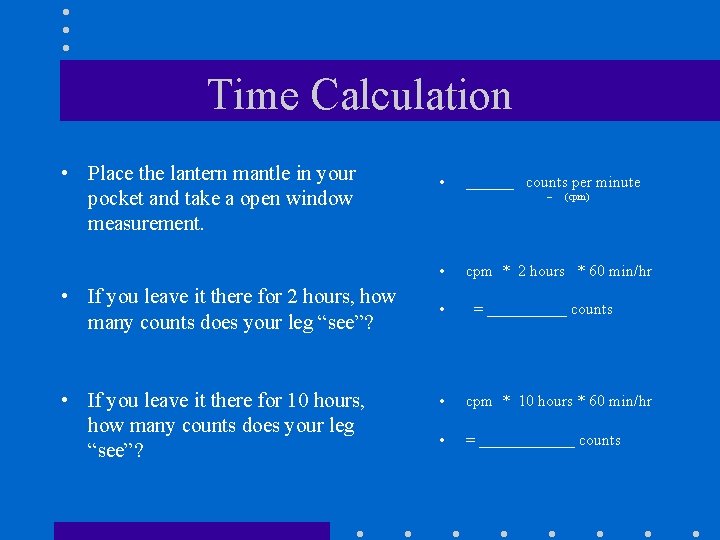
Time Calculation • Place the lantern mantle in your pocket and take a open window measurement. • – • • If you leave it there for 2 hours, how many counts does your leg “see”? • If you leave it there for 10 hours, how many counts does your leg “see”? ______ counts per minute • (cpm) cpm * 2 hours * 60 min/hr = _____ counts • cpm * 10 hours * 60 min/hr • = ______ counts

Distance • The farther away you are from a radiation source, the less exposure you will receive. • Compare this to sitting in front of a fireplace. You can sit directly in front or across the room. • If you are far from the source, your exposure will be much lower.
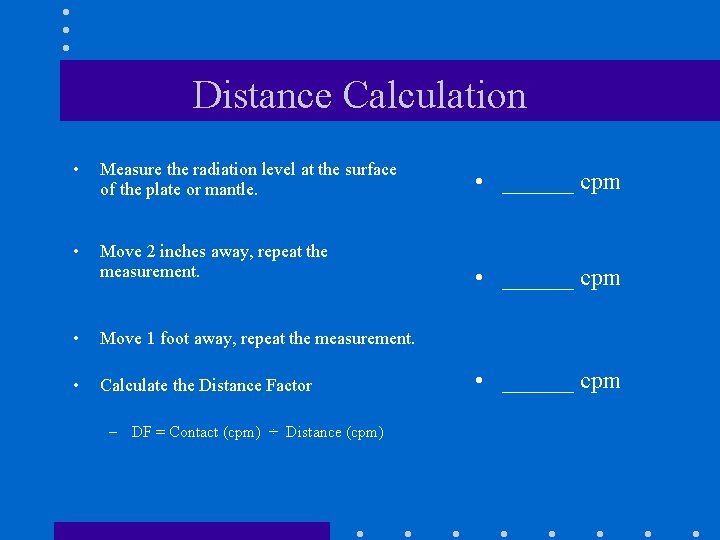
Distance Calculation • Measure the radiation level at the surface of the plate or mantle. • Move 2 inches away, repeat the measurement. • Move 1 foot away, repeat the measurement. • Calculate the Distance Factor – DF = Contact (cpm) ÷ Distance (cpm) • ______ cpm

Shielding • If you increase the shielding around a radiation source, it will decrease your exposure. • If you stand out in the rain without an umbrella, you will get wet. • But, if you use an umbrella to shield you from the rain, you will remain dry and protected.

Shielding Factor Calculation • Measure the radiation level on contact with a source using the open window detector. • ______ cpm • Place a light piece of material (wood) over the object and repeat the measurement. • ______ cpm • Place a heavy piece of material over the object and repeat the measurement. • ______ cpm • Calculate Shielding Factor. – SF = Contact (c/m) ÷ Shielded (c/m)

Types of Radiation

Detector Efficiency By Radiation Type Voltage Source Incident Ionizing Radiation + - + - Cathode - Electrical Current Anode + Measuring Device
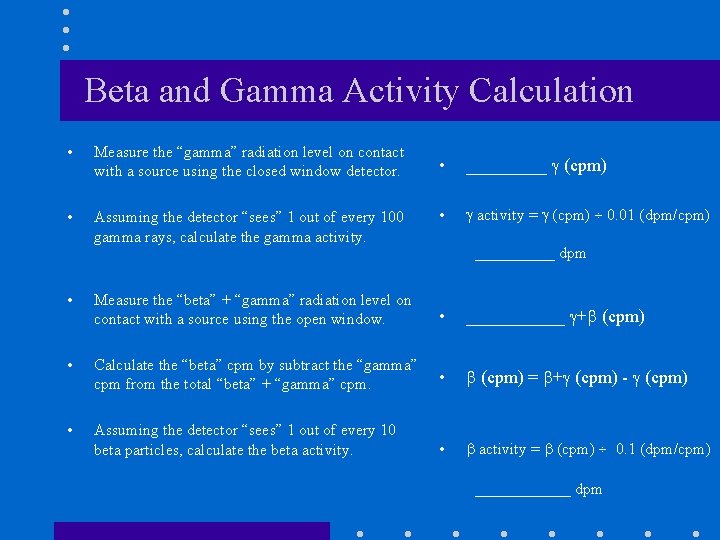
Beta and Gamma Activity Calculation • Measure the “gamma” radiation level on contact with a source using the closed window detector. • Assuming the detector “sees” 1 out of every 100 gamma rays, calculate the gamma activity. • _____ (cpm) • activity = (cpm) 0. 01 (dpm/cpm) _____ dpm • Measure the “beta” + “gamma” radiation level on contact with a source using the open window. • ______ + (cpm) • Calculate the “beta” cpm by subtract the “gamma” cpm from the total “beta” + “gamma” cpm. • (cpm) = + (cpm) - (cpm) • Assuming the detector “sees” 1 out of every 10 beta particles, calculate the beta activity. • activity = (cpm) 0. 1 (dpm/cpm) ______ dpm
- Slides: 10