
Radiation L O Describe an isotope understand properties
Radiation L. O: Describe an isotope understand properties of alpha, beta and gamma radiation Explain background radiation
Radiation • • Elements are unstable Release radiation to become more stable Random, cannot predict when it will happen Can release one of three types of radiation Alpha, beta, gamma Can become a new element Can release enough energy to split other atoms into ions (lose electrons)
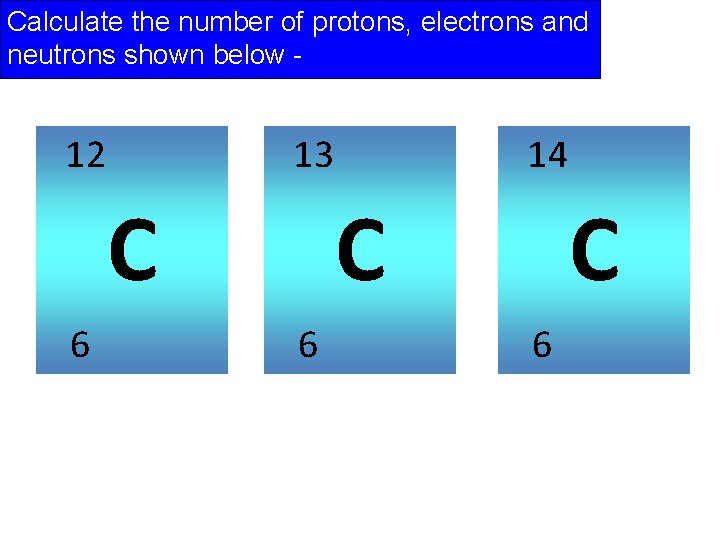
Calculate the number of protons, electrons and neutrons shown below - 12 13 C 6 14 C 6
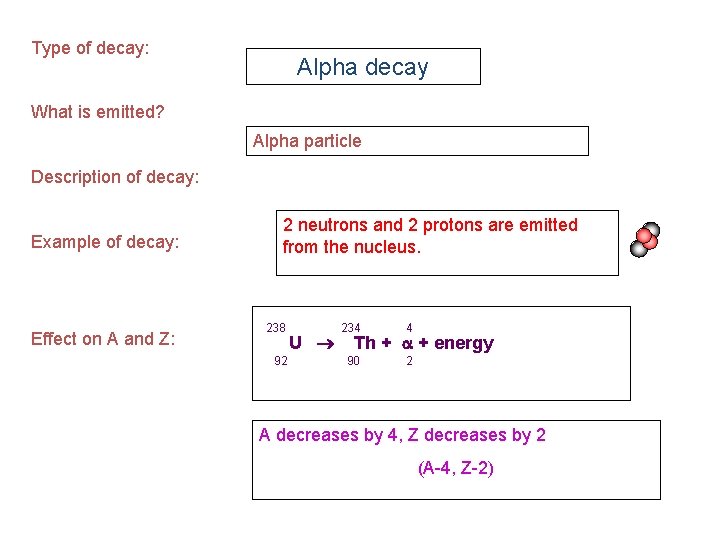
Type of decay: Alpha decay What is emitted? Alpha particle Description of decay: Example of decay: Effect on A and Z: 2 neutrons and 2 protons are emitted from the nucleus. 238 92 U 234 4 90 2 Th + + energy A decreases by 4, Z decreases by 2 (A-4, Z-2)
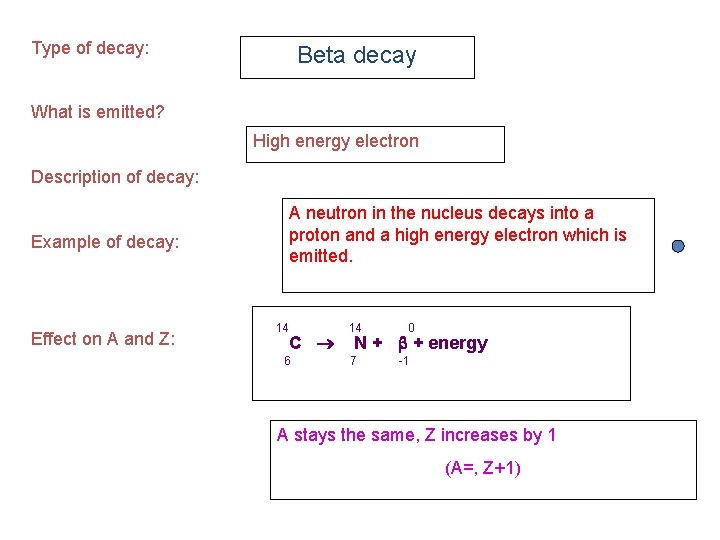
Type of decay: Beta decay What is emitted? High energy electron Description of decay: A neutron in the nucleus decays into a proton and a high energy electron which is emitted. Example of decay: Effect on A and Z: 14 C 6 14 0 N + + energy 7 -1 A stays the same, Z increases by 1 (A=, Z+1)
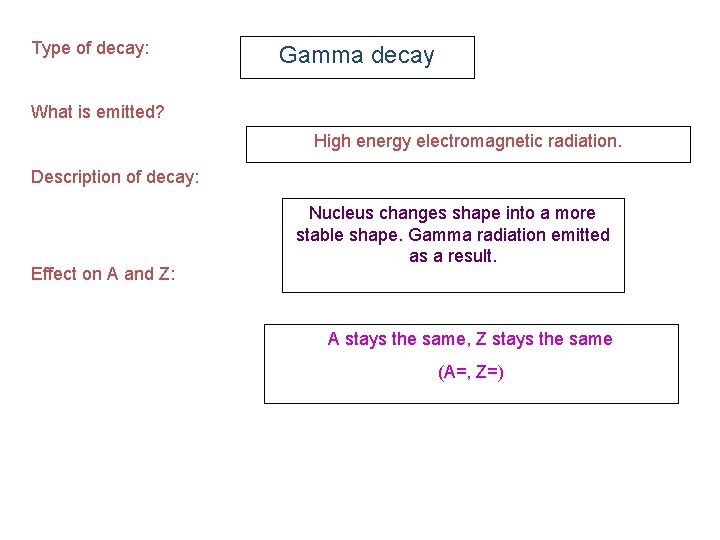
Type of decay: Gamma decay What is emitted? High energy electromagnetic radiation. Description of decay: Effect on A and Z: Nucleus changes shape into a more stable shape. Gamma radiation emitted as a result. A stays the same, Z stays the same (A=, Z=)

Examples • On board
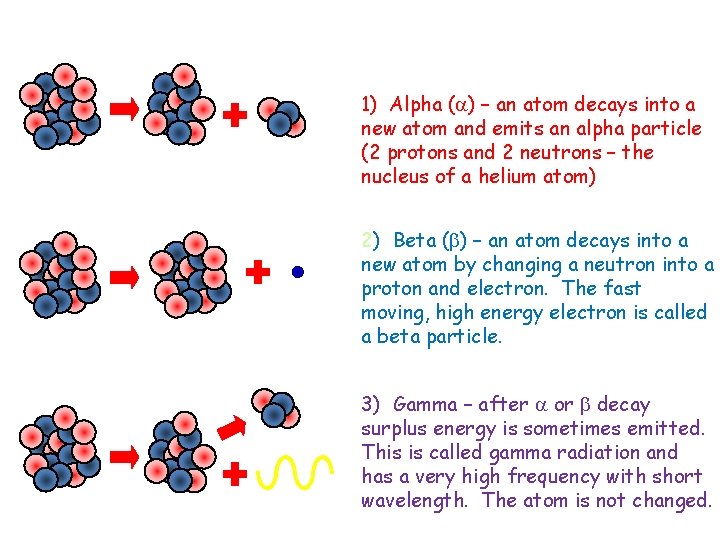
Types of radiation Unstable nucleus New nucleus Alpha particle Beta particle Unstable nucleus New nucleus Gamma radiation 1) Alpha ( ) – an atom decays into a new atom and emits an alpha particle (2 protons and 2 neutrons – the nucleus of a helium atom) 2) Beta ( ) – an atom decays into a new atom by changing a neutron into a proton and electron. The fast moving, high energy electron is called a beta particle. 3) Gamma – after or decay surplus energy is sometimes emitted. This is called gamma radiation and has a very high frequency with short wavelength. The atom is not changed.
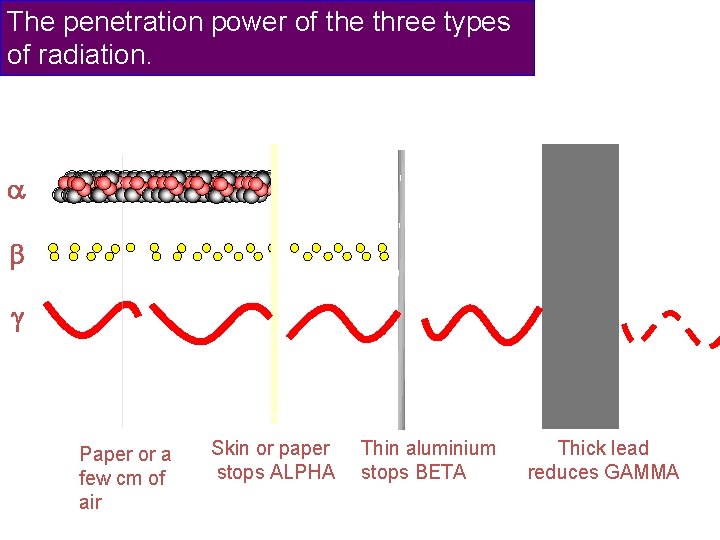
The penetration power of the three types of radiation. Paper or a few cm of air Skin or paper stops ALPHA Thin aluminium stops BETA Thick lead reduces GAMMA
Background radiation • Radiation from space, isotopes in the environment, radon gas in the earth, nuclear power stations/testing
The scattering experiment • • • Diagram Found that: Most particles passed straight through the foil A few particles were deflected at wide angles Some particles deflected straight back to the source
Conclusions • Alpha particles that passed straight through – implied they went through empty space • Atoms in gold foil contained a lot of empty space • Positively charged alpha particles deflected by repulsive force – central positive charge • The atom contains a positively charged core (nucleus)
• Few particles bounced straight back – must have collided with something small, but heavy • Nucleus is small but dense • Electrons did not appear to influence the particles movement • Electrons are not part of the inner atom (nucleus) but orbit the empty space
- Slides: 13