
Radiation induced point and clusterrelated defects with strong


- Slides: 24
Radiation induced point- and cluster-related defects with strong impact to damage properties of silicon detectors I. Pintiliea, E. Fretwurstb, A. Junkesb, G. Lindströmb a National b Institute of Materials Physics, Bucharest, Romania for Experimental Physics, University of Hamburg, Germany NSS, 21 October 2008, Dresden 1
Outline Motivation n Goals n Electrically active centers in SCR n Techniques n Material & Irradiations n Results n Point defects n Extended defects n n Summary & Conclusions NSS, 21 October 2008, Dresden 2
Motivation (CERN-RD 48) “Defect engineering” needed for SLHC application in the tracking area to improve the detectors radiation tolerance NSS, 21 October 2008, Dresden 3
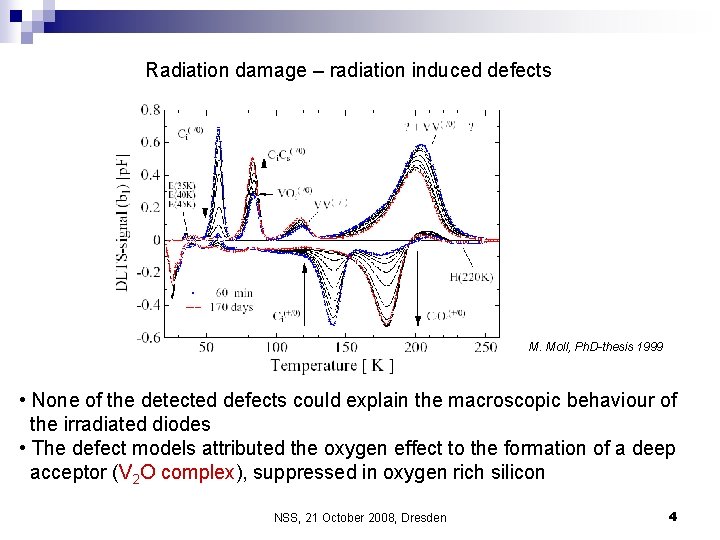
Radiation damage – radiation induced defects M. Moll, Ph. D-thesis 1999 • None of the detected defects could explain the macroscopic behaviour of the irradiated diodes • The defect models attributed the oxygen effect to the formation of a deep acceptor (V 2 O complex), suppressed in oxygen rich silicon NSS, 21 October 2008, Dresden 4
Goals n Search for still undetected defects responsible for the radiation damage, as seen at operating temperatures Point defects, predominant after gamma and electron irradiation ¨ Extended defects (clusters), responsible for hadron damage ¨ n Understand their formation and find ways to optimize the device performance NSS, 21 October 2008, Dresden 5
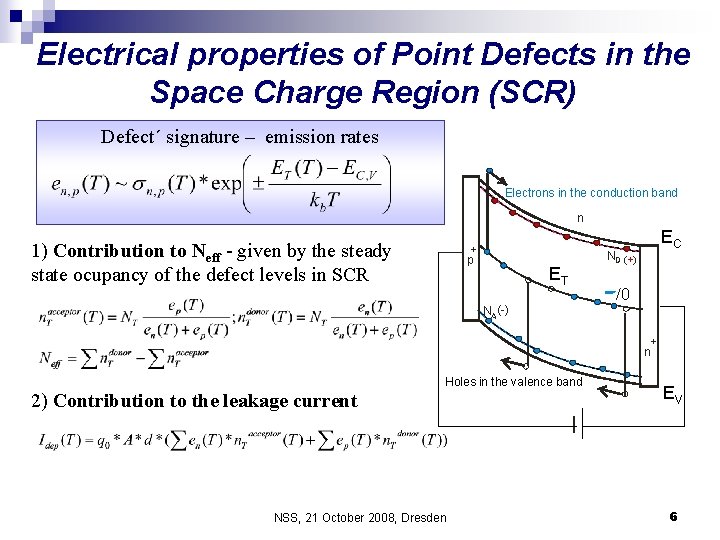
Electrical properties of Point Defects in the Space Charge Region (SCR) Defect´ signature – emission rates Electrons in the conduction band n 1) Contribution to Neff - given by the steady state ocupancy of the defect levels in SCR + p ET EC ND (+) /0 NA(-) + n Holes in the valence band 2) Contribution to the leakage current NSS, 21 October 2008, Dresden EV 6
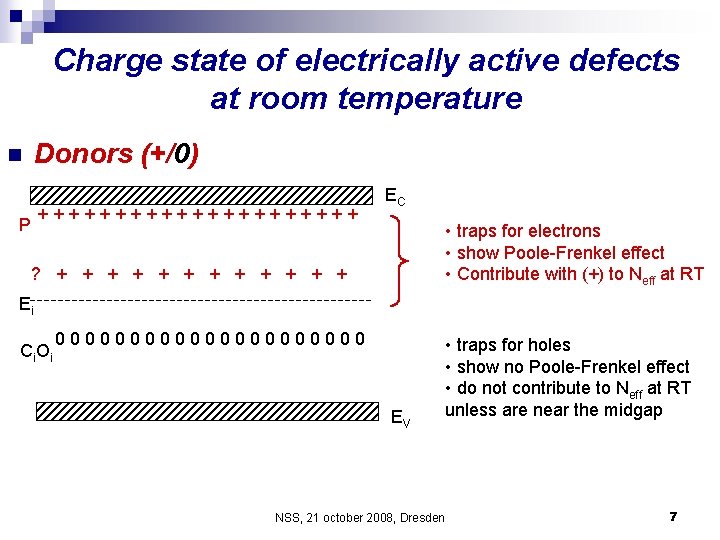
Charge state of electrically active defects at room temperature Donors (+/0) n +++++++++++ P EC • traps for electrons • show Poole-Frenkel effect • Contribute with (+) to Neff at RT ? + + + Ei Ci. Oi 00000000000 EV NSS, 21 october 2008, Dresden • traps for holes • show no Poole-Frenkel effect • do not contribute to Neff at RT unless are near the midgap 7
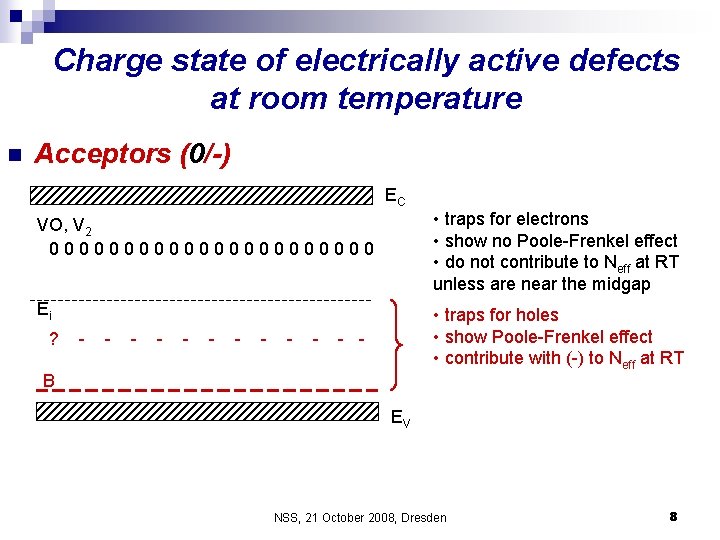
Charge state of electrically active defects at room temperature n Acceptors (0/-) EC VO, V 2 00000000000 • traps for electrons • show no Poole-Frenkel effect • do not contribute to Neff at RT unless are near the midgap Ei • traps for holes • show Poole-Frenkel effect • contribute with (-) to Neff at RT ? - - - B EV NSS, 21 October 2008, Dresden 8
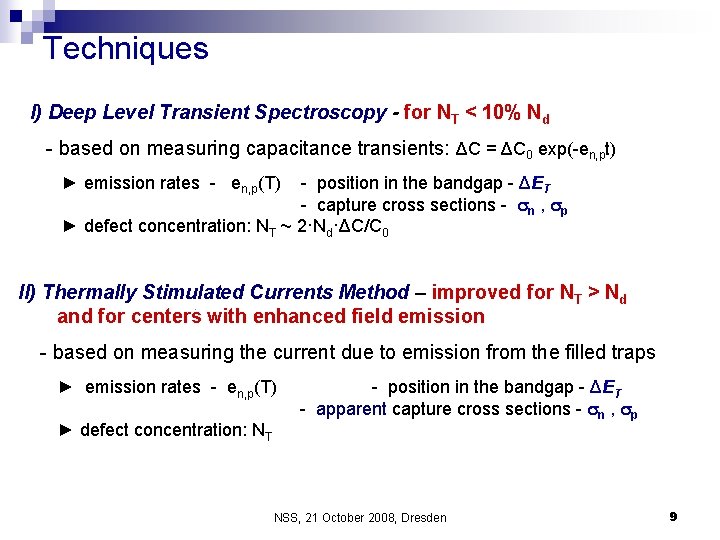
Techniques I) Deep Level Transient Spectroscopy - for NT < 10% Nd - based on measuring capacitance transients: ΔC = ΔC 0 exp(-en, pt) ► emission rates - en, p(T) - position in the bandgap - ΔET - capture cross sections - n , p ► defect concentration: NT ~ 2·Nd·ΔC/C 0 II) Thermally Stimulated Currents Method – improved for NT > Nd and for centers with enhanced field emission - based on measuring the current due to emission from the filled traps ► emission rates - en, p(T) ► defect concentration: NT - position in the bandgap - ΔET - apparent capture cross sections - n , p NSS, 21 October 2008, Dresden 9
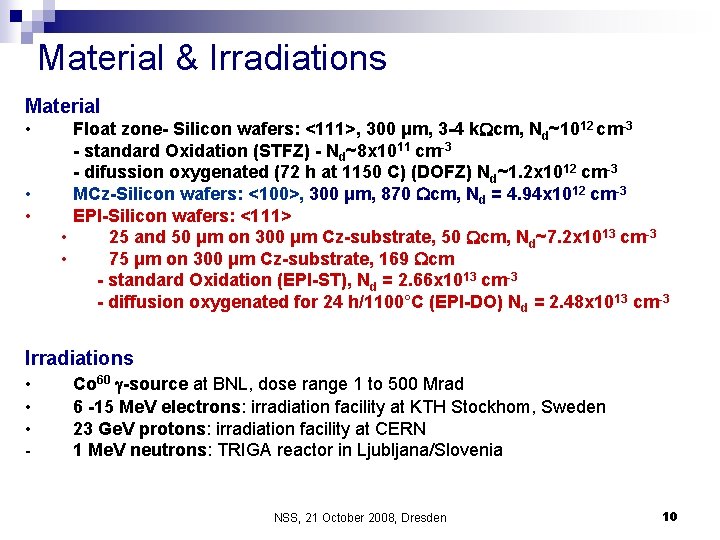
Material & Irradiations Material • • • Float zone- Silicon wafers: <111>, 300 μm, 3 -4 k cm, Nd~1012 cm-3 - standard Oxidation (STFZ) - Nd~8 x 1011 cm-3 - difussion oxygenated (72 h at 1150 C) (DOFZ) Nd~1. 2 x 1012 cm-3 MCz-Silicon wafers: <100>, 300 μm, 870 cm, Nd = 4. 94 x 1012 cm-3 EPI-Silicon wafers: <111> • 25 and 50 μm on 300 μm Cz-substrate, 50 cm, Nd~7. 2 x 1013 cm-3 • 75 μm on 300 μm Cz-substrate, 169 cm - standard Oxidation (EPI-ST), Nd = 2. 66 x 1013 cm-3 - diffusion oxygenated for 24 h/1100°C (EPI-DO) Nd = 2. 48 x 1013 cm-3 Irradiations • • • - Co 60 -source at BNL, dose range 1 to 500 Mrad 6 -15 Me. V electrons: irradiation facility at KTH Stockhom, Sweden 23 Ge. V protons: irradiation facility at CERN 1 Me. V neutrons: TRIGA reactor in Ljubljana/Slovenia NSS, 21 October 2008, Dresden 10
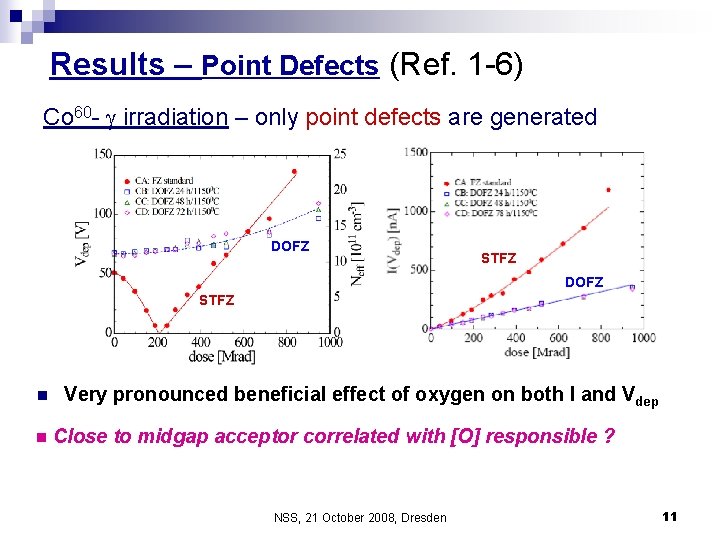
Results – Point Defects (Ref. 1 -6) Co 60 - irradiation – only point defects are generated DOFZ STFZ n n Very pronounced beneficial effect of oxygen on both I and Vdep Close to midgap acceptor correlated with [O] responsible ? NSS, 21 October 2008, Dresden 11
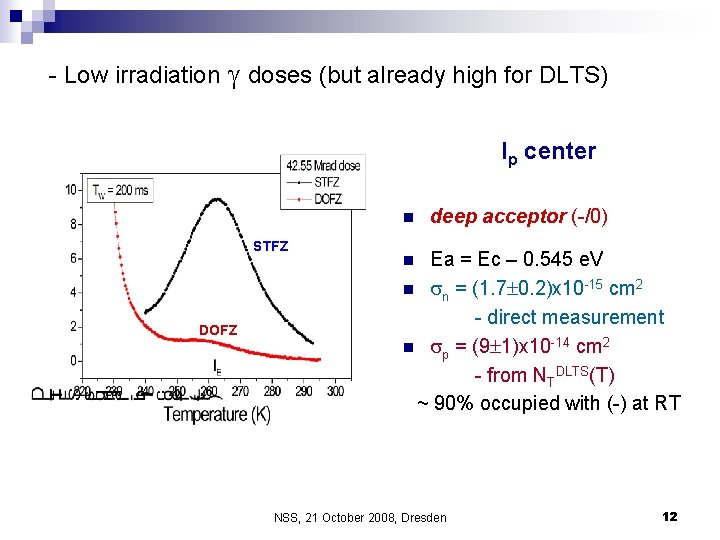
- Low irradiation doses (but already high for DLTS) Ip center n STFZ DOFZ deep acceptor (-/0) Ea = Ec – 0. 545 e. V n n = (1. 7 0. 2)x 10 -15 cm 2 - direct measurement n p = (9 1)x 10 -14 cm 2 - from NTDLTS(T) ~ 90% occupied with (-) at RT n NSS, 21 October 2008, Dresden 12
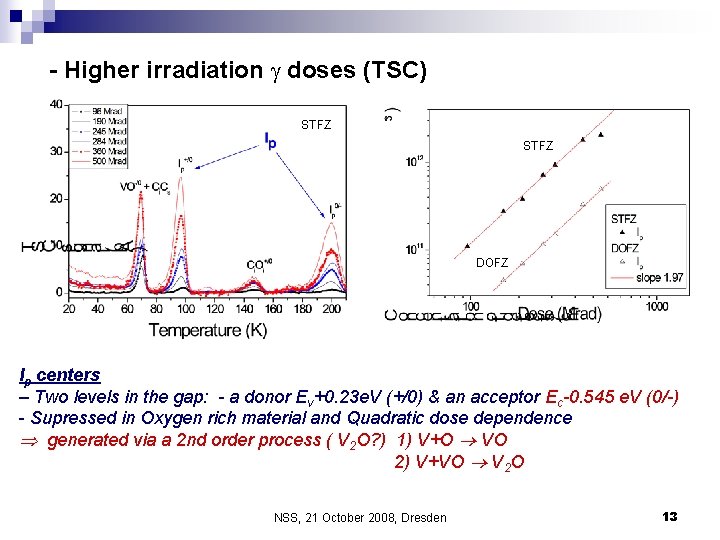
- Higher irradiation doses (TSC) STFZ DOFZ Ip centers – Two levels in the gap: - a donor Ev+0. 23 e. V (+/0) & an acceptor Ec-0. 545 e. V (0/-) - Supressed in Oxygen rich material and Quadratic dose dependence generated via a 2 nd order process ( V 2 O? ) 1) V+O VO 2) V+VO V 2 O NSS, 21 October 2008, Dresden 13
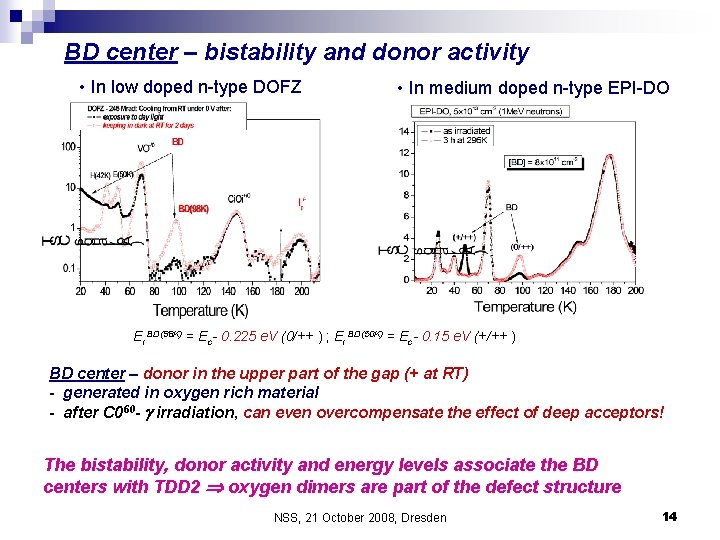
BD center – bistability and donor activity • In low doped n-type DOFZ • In medium doped n-type EPI-DO Ei BD(98 K) = Ec- 0. 225 e. V (0/++ ) ; Ei BD(50 K) = Ec- 0. 15 e. V (+/++ ) BD center – donor in the upper part of the gap (+ at RT) - generated in oxygen rich material - after C 060 - irradiation, can even overcompensate the effect of deep acceptors! The bistability, donor activity and energy levels associate the BD centers with TDD 2 oxygen dimers are part of the defect structure NSS, 21 October 2008, Dresden 14
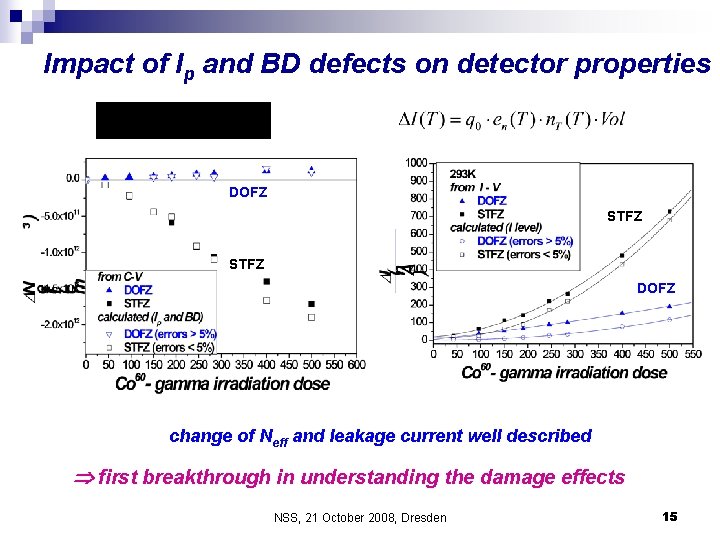
Impact of Ip and BD defects on detector properties DOFZ STFZ DOFZ change of Neff and leakage current well described first breakthrough in understanding the damage effects NSS, 21 October 2008, Dresden 15
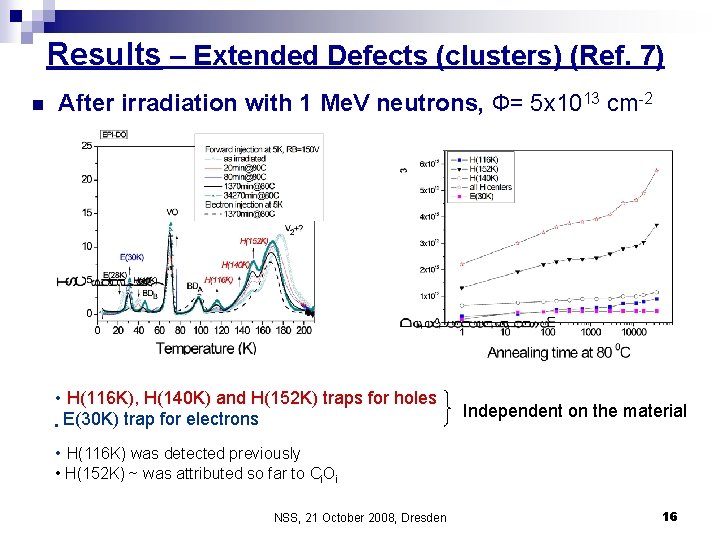
Results – Extended Defects (clusters) (Ref. 7) n After irradiation with 1 Me. V neutrons, Ф= 5 x 1013 cm-2 • H(116 K), H(140 K) and H(152 K) traps for holes • E(30 K) trap for electrons Independent on the material • H(116 K) was detected previously • H(152 K) ~ was attributed so far to Ci. Oi NSS, 21 October 2008, Dresden 16
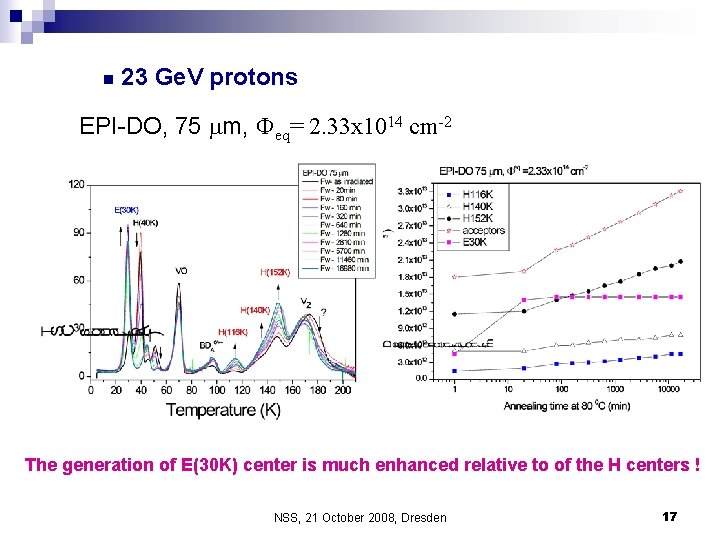
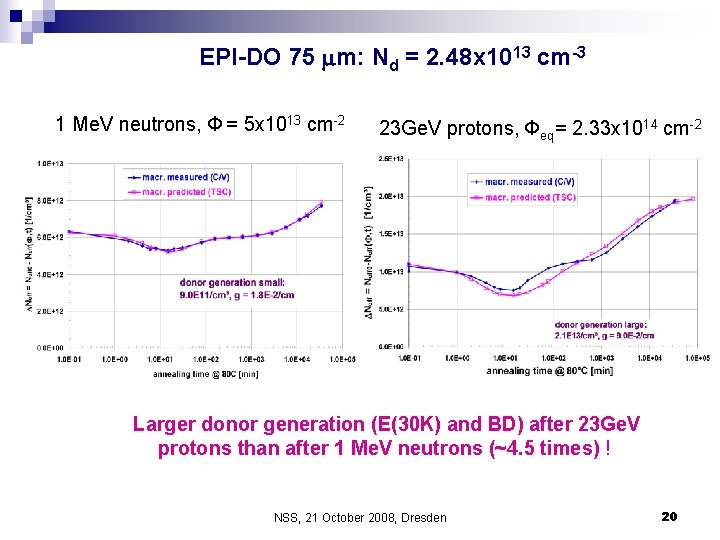
n 23 Ge. V protons EPI-DO, 75 m, Фeq= 2. 33 x 1014 cm-2 The generation of E(30 K) center is much enhanced relative to of the H centers ! NSS, 21 October 2008, Dresden 17
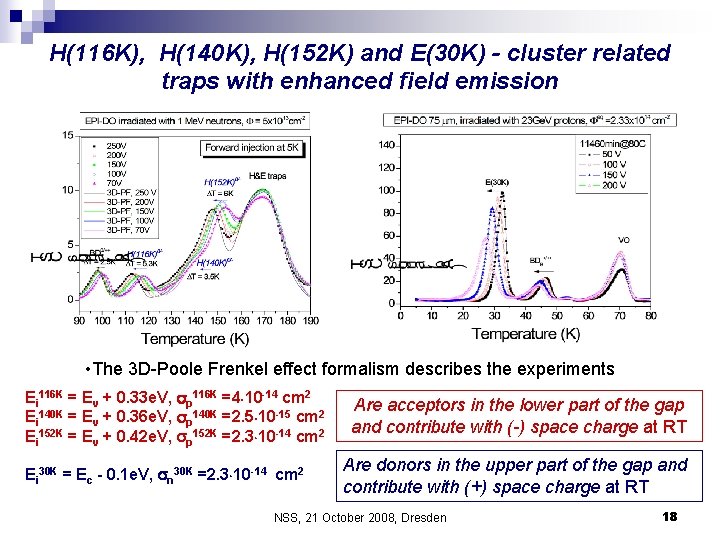
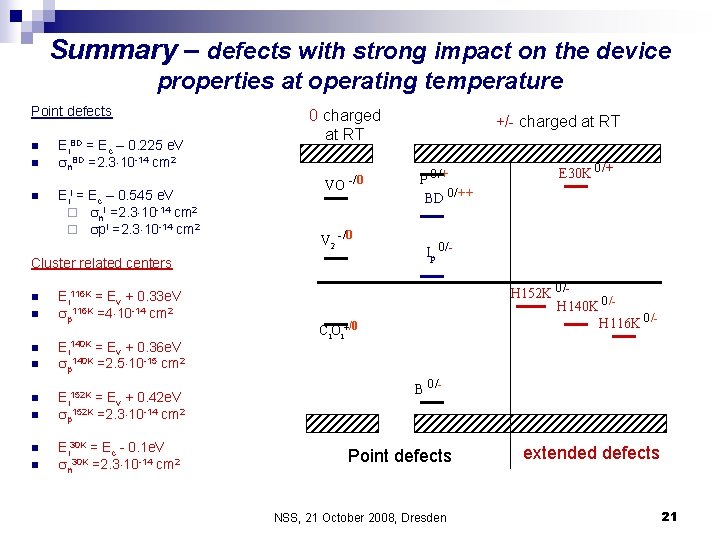
H(116 K), H(140 K), H(152 K) and E(30 K) - cluster related traps with enhanced field emission • The 3 D-Poole Frenkel effect formalism describes the experiments Ei 116 K = Ev + 0. 33 e. V, p 116 K =4 10 -14 cm 2 Ei 140 K = Ev + 0. 36 e. V, p 140 K =2. 5 10 -15 cm 2 Ei 152 K = Ev + 0. 42 e. V, p 152 K =2. 3 10 -14 cm 2 Ei 30 K = Ec - 0. 1 e. V, n 30 K =2. 3 10 -14 cm 2 Are acceptors in the lower part of the gap and contribute with (-) space charge at RT Are donors in the upper part of the gap and contribute with (+) space charge at RT NSS, 21 October 2008, Dresden 18
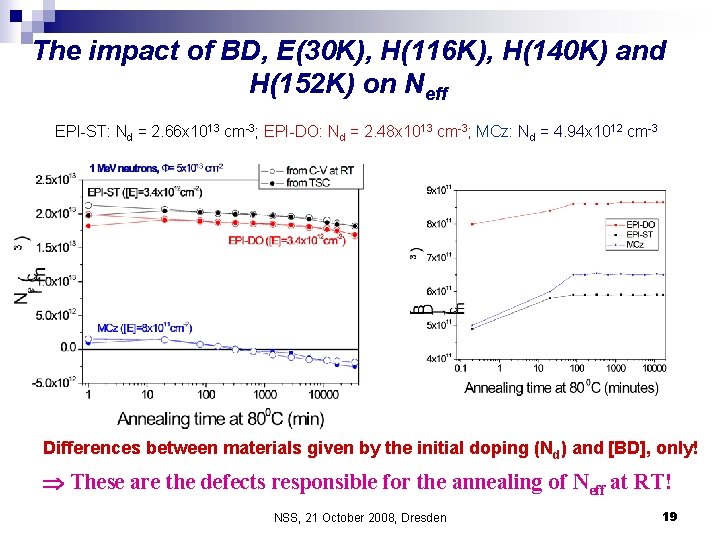
The impact of BD, E(30 K), H(116 K), H(140 K) and H(152 K) on Neff EPI-ST: Nd = 2. 66 x 1013 cm-3; EPI-DO: Nd = 2. 48 x 1013 cm-3; MCz: Nd = 4. 94 x 1012 cm-3 Differences between materials given by the initial doping (Nd) and [BD], only! These are the defects responsible for the annealing of Neff at RT! NSS, 21 October 2008, Dresden 19
EPI-DO 75 m: Nd = 2. 48 x 1013 cm-3 1 Me. V neutrons, Ф = 5 x 1013 cm-2 23 Ge. V protons, Фeq= 2. 33 x 1014 cm-2 Larger donor generation (E(30 K) and BD) after 23 Ge. V protons than after 1 Me. V neutrons (~4. 5 times) ! NSS, 21 October 2008, Dresden 20
Summary – defects with strong impact on the device properties at operating temperature Point defects n n n Ei. BD = Ec – 0. 225 e. V n. BD =2. 3 10 -14 cm 2 Ei. I = Ec – 0. 545 e. V ¨ n. I =2. 3 10 -14 cm 2 ¨ p. I =2. 3 10 -14 cm 2 0 charged at RT VO -/0 V 2 -/0 Cluster related centers n n n n Ei 116 K = Ev + 0. 33 e. V p 116 K =4 10 -14 cm 2 Ei 140 K = Ev + 0. 36 e. V p 140 K =2. 5 10 -15 cm 2 Ei 152 K = Ev + 0. 42 e. V p 152 K =2. 3 10 -14 cm 2 Ei 30 K = Ec - 0. 1 e. V n 30 K =2. 3 10 -14 cm 2 +/- charged at RT P 0/+ BD 0/++ E 30 K 0/+ Ip 0/H 152 K 0/H 140 K 0/H 116 K 0/- Ci. Oi+/0 B 0/- Point defects NSS, 21 October 2008, Dresden extended defects 21
Conclusions n Direct correlation between defect investigations and device properties can be achieved! n Point defects – dependent on the material defect engineering does work n Cluster related defects – independent on the material Possibility of compensation with point defects via defect engineering NSS, 21 October 2008, Dresden 22
Acknowledgements n n n Alexander von Humboldt Foundation University of Hamburg Zheng Li for Co 60 - gamma irradiations at BNL Gregor Kramberger for 1 Me. V neutron irradiations at Triga reactor Ljubljana Maurice Glasser for 23 Ge. V proton irradiations Ci. S, Erfurt, for processing the diodes NSS, 21 October 2008, Dresden 23
References 1) I. Pintilie, E. Fretwurst, G. Lindstroem and J. Stahl, APPL. PHYS. LETT. 81 (1): 165 -167 JUL 1 (2002) 2) I. Pintilie, E. Fretwurst, G. Lindstroem and J. Stahl, APPL. PHYS. LETT. 83 (15): 3216 -3216 OCT 13 (2003) 3) I. Pintilie, E. Fretwurst, G. Lindstroem and J. Stahl, NUCL. INSTR. & METH. IN PHYS. RES. 514 (1 -3): 18 -24 (2003) 4) I. Pintilie, E. Fretwurst, G. Kramberger, G. Lindstroem, Z. Li, J. Stahl, PHYSICA B-CONDENSED MATTER 340: 578, (2003) 5) I. Pintilie , M. Buda, E. Fretwurst, G. Lindstroem and J. Stahl, NUCL. INSTR. & METH. IN PHYS. RES. 556 (1): 197 -208 (2006) 6) E. Fretwurst, et al NUCL. INSTR. & METH. IN PHYS. RES. 583 (1), 58 -63, (2007) 7) I. Pintilie, E. Fretwurst, G. Lindstroem, Appl. Phys. Lett. 92, 024101 (2008)