
RADIATION HEALTH AND ENVIRONMENTAL PROTECTION AT THE CNSC




- Slides: 19
RADIATION, HEALTH AND ENVIRONMENTAL PROTECTION AT THE CNSC Presentation to al. PHa Annual Conference, June 10, 2003 Jim Blyth, Director General Directorate of Power Reactor Regulation Canadian Nuclear Safety Commission
Radiation, Health and Environmental Protection at the CNSC • Overview of the Canadian Nuclear Safety Commission (CNSC). • How CNSC staff carry out the mandate. • What CNSC requires of licensees to protect human health and the environment.
Nuclear Regulation in Canada Background • On June 1, 2000 the AECB became the Canadian Nuclear Safety Commission (CNSC) • Focus is protection of health, safety and the environment
Mandate of Operations Branch The Operations Branch is responsible for regulation of the development, production and use of nuclear energy, the production, possession, transport and use of nuclear substances and radiation devices.
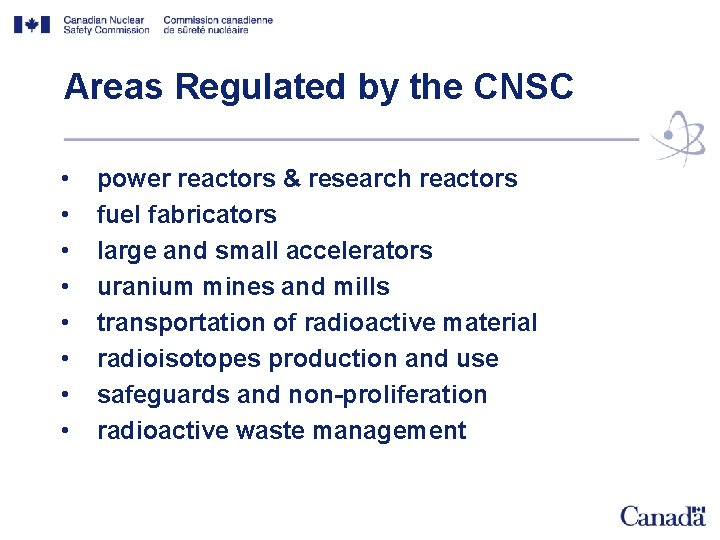
Areas Regulated by the CNSC • • power reactors & research reactors fuel fabricators large and small accelerators uranium mines and mills transportation of radioactive material radioisotopes production and use safeguards and non-proliferation radioactive waste management
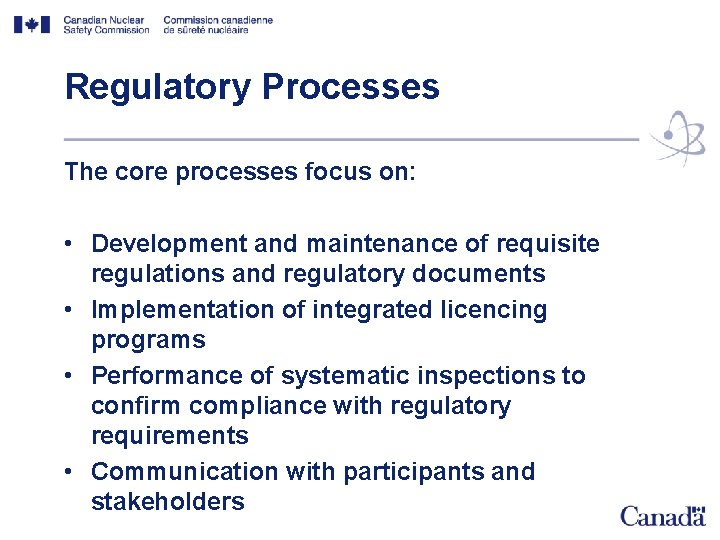
Regulatory Processes The core processes focus on: • Development and maintenance of requisite regulations and regulatory documents • Implementation of integrated licencing programs • Performance of systematic inspections to confirm compliance with regulatory requirements • Communication with participants and stakeholders
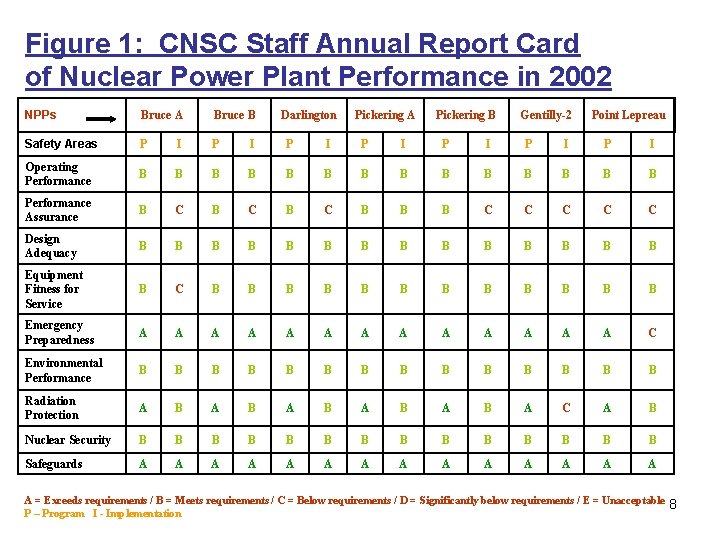
Figure 1: CNSC Staff Annual Report Card of Nuclear Power Plant Performance in 2002 NPPs Bruce A Bruce B Safety Areas P I P I Operating Performance B B B B Performance Assurance B C B C B B B C C C Design Adequacy B B B B Equipment Fitness for Service B C B B B Emergency Preparedness A A A A C Environmental Performance B B B B Radiation Protection A B A B A B A C A B Nuclear Security B B B B Safeguards A A A A Darlington Pickering A Pickering B Gentilly-2 Point Lepreau A = Exceeds requirements / B = Meets requirements / C = Below requirements / D = Significantly below requirements / E = Unacceptable P – Program I - Implementation 8
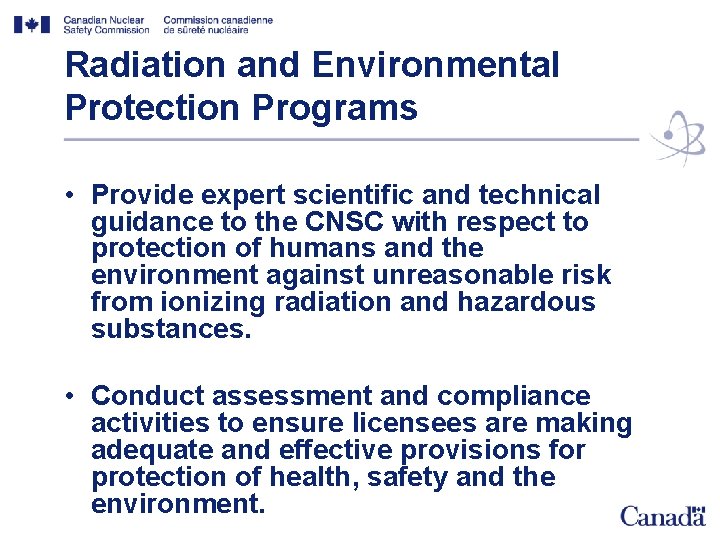
Radiation and Environmental Protection Programs • Provide expert scientific and technical guidance to the CNSC with respect to protection of humans and the environment against unreasonable risk from ionizing radiation and hazardous substances. • Conduct assessment and compliance activities to ensure licensees are making adequate and effective provisions for protection of health, safety and the environment.
CNSC Technical Specialists • CNSC’s radiation and environmental protection program is conducted by a wide range of technical specialists: – – – – – Internal and external dosimetry specialists Biologists (radiobiologist and environmental biologists) Environmental chemists and geochemists Hydrologists and hydrogeologists Contaminant environmental fate & transport specialists (e. g. atmospheric and aquatic dispersion) Environmental toxicologists Epidemiologist Environmental and radiation protection specialists Engineers, physicists
National and International Collaboration • National and international working groups, committees, organizations • Regulatory environment – Federal Acts and Regulations (CEAA, CEPA, Fisheries Act, Canada Labour Code) – Radiation protection based largely on ICRP 60. – Provincial regulatory requirements
Licencing Cycle • Site licence • Construction licence • Operation licence (includes commissioning) • Decommissioning licence • Licence to abandon
Assessment of Licence Application • Review of licensee programs in the areas of health, safety and the environment. • Assess potential effects on human and environmental health – Radiation protection regulations – Hazardous substances benchmarks developed by other agencies
Compliance Verification Methods used to verify compliance depending upon the degree and scope of the activity. • Type I Inspection (audit) • Type II Inspection (conventional inspection) • Evaluation (desk-top review)
The Commission & Public Hearings • • • Licence Application Notice of Public Hearing Day 1 – Applicant & CNSC staff Day 2 – Public Interventions, Updates Record of Decision
CNSC Regulatory Process Licensee Report Card (Risk Informed) Licence Application Renewal Assessment Licensing Program Recommend Renewal and Licence Period? Commission Designated Officer Renew Licence Authoriz e or Assessment Rating Risk Performance Rating Inspection Compliance Program Inspection Rating Evaluation Rating Audit Rating
Port Hope Health Studies • Residents concerned about health effects. • Radium and uranium processing industries: – local disposal of radioactive and other wastes. • Cancer Incidence (August 2000) • Cancer and General Mortality (June, 2002)
Saskatchewan Uranium Miners’ Cohort Study 1993 Joint Federal-Provincial Panel on Uranium Mining Developments in Northern Saskatchewan recommendations • Update Eldorado Study (1950 -present) • Feasibility Study of Modern Mining era (1975 future) • Study Working Group • Steering Committee