
Radiation hardness in ITER Diagnostics Robin Barnsley ITER
Radiation hardness in ITER Diagnostics Robin Barnsley ITER Diagnostics Division - Overview of Fusion and ITER - ITER Diagnostics - Labyrinth shielding - X-ray spectroscopy - Plasma modelling - Neutronics modelling - Radiation-hard detectors
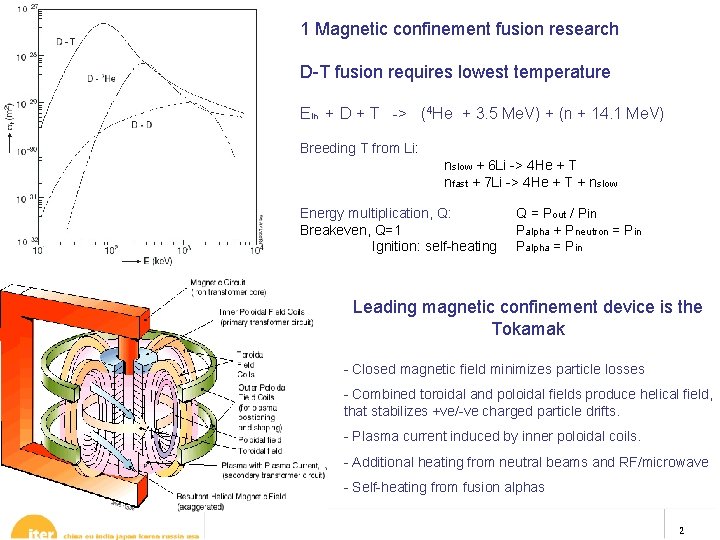
1 Magnetic confinement fusion research D-T fusion requires lowest temperature Ein + D + T -> (4 He + 3. 5 Me. V) + (n + 14. 1 Me. V) Breeding T from Li: nslow + 6 Li -> 4 He + T nfast + 7 Li -> 4 He + T + nslow Energy multiplication, Q: Breakeven, Q=1 Ignition: self-heating Q = Pout / Pin Palpha + Pneutron = Pin Palpha = Pin Leading magnetic confinement device is the Tokamak - Closed magnetic field minimizes particle losses - Combined toroidal and poloidal fields produce helical field, that stabilizes +ve/-ve charged particle drifts. - Plasma current induced by inner poloidal coils. - Additional heating from neutral beams and RF/microwave - Self-heating from fusion alphas 2
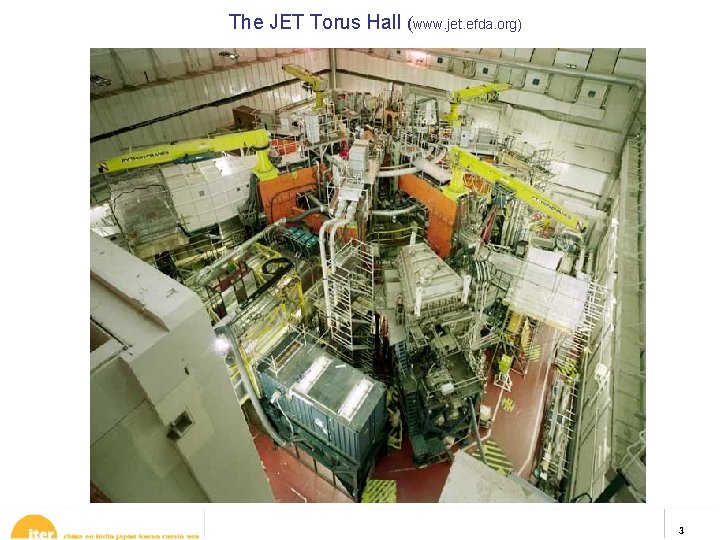
The JET Torus Hall (www. jet. efda. org) 3

Inside JET without and with plasma Remote-handling in-vessel since 1997 Visible radiation dominated by D near edge Core radiation mostly x-rays On JET 0. 5 < Prad < 5 MW 4
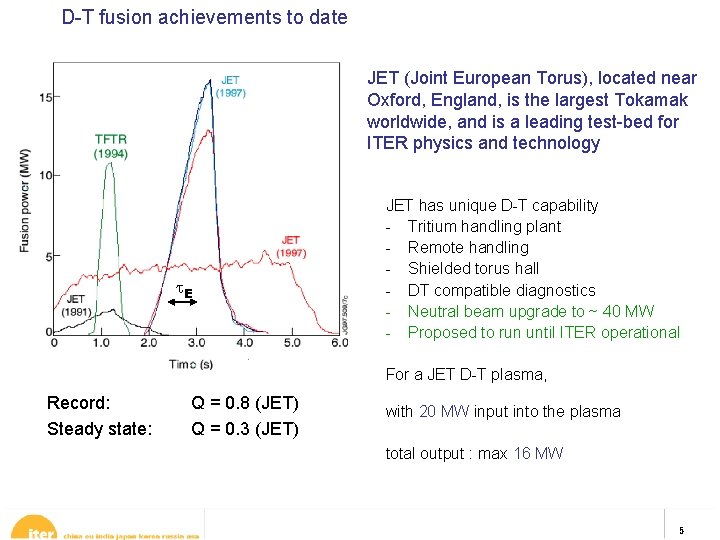
D-T fusion achievements to date JET (Joint European Torus), located near Oxford, England, is the largest Tokamak worldwide, and is a leading test-bed for ITER physics and technology E JET has unique D-T capability - Tritium handling plant - Remote handling - Shielded torus hall - DT compatible diagnostics - Neutral beam upgrade to ~ 40 MW - Proposed to run until ITER operational For a JET D-T plasma, Record: Steady state: Q = 0. 8 (JET) Q = 0. 3 (JET) with 20 MW input into the plasma total output : max 16 MW 5

Scaling to ITER from previous experiments Physics performance can be extrapolated better than factor 2. Technological developments ongoing for: - First wall: blanket and divertor modules. - Material properties under heavy neutron irradiation. AUG JET ITER 6

ITER overview Participating Teams all ratified by end of 2007 China, Europe, India, Japan, Russia, South Korea, USA. Construction site: Cadarache, St Paul les-Durance, Provence, France Goals: Develop and demonstrate the physics and technology required for a fusion power plant. Construction: 10 yrs. Began in 2008 with preparation of the site Operations: 10 yrs. Hydrogen phase > Deuterium phase > Low-duty D-T > High duty D-T 7

ITER (www. iter. org) - Superconducting Tokamak - Single-null divertor - Elongated, triangular plasma - Additional heating from RF, and negative-ion neutral-beams and R (m) 6. 2 a (m) 2 VP (m 3) 850 IP (MA) 15(17) Bt (T) d, k Paux (MW) 5. 3 1. 85, 0. 5 40 -90 Pa (MW) 80+ Q (Pfus/Pin) 10 Pfus(MW) 500 1 st EIROforum School on Instrumentation, CERN, 11 -15 May 2009, R Barnsley 8

ITER cross-section 1 st EIROforum School on Instrumentation, CERN, 11 -15 May 2009, R Barnsley 9
10
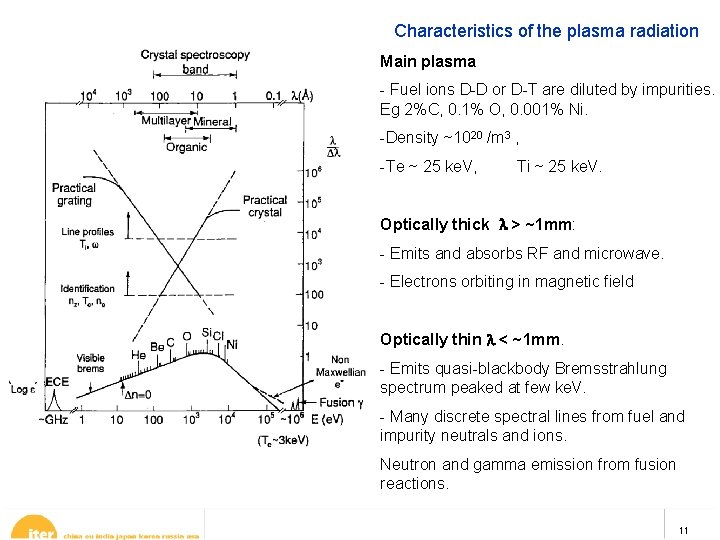
Characteristics of the plasma radiation Main plasma - Fuel ions D-D or D-T are diluted by impurities. Eg 2%C, 0. 1% O, 0. 001% Ni. -Density ~1020 /m 3 , -Te ~ 25 ke. V, Ti ~ 25 ke. V. Optically thick > ~1 mm: - Emits and absorbs RF and microwave. - Electrons orbiting in magnetic field Optically thin < ~1 mm. - Emits quasi-blackbody Bremsstrahlung spectrum peaked at few ke. V. - Many discrete spectral lines from fuel and impurity neutrals and ions. Neutron and gamma emission from fusion reactions. 11
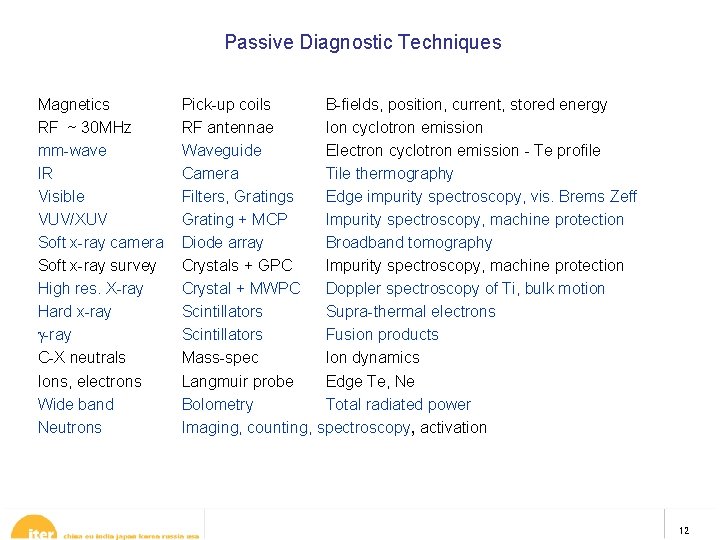
Passive Diagnostic Techniques Magnetics RF ~ 30 MHz mm-wave IR Visible VUV/XUV Soft x-ray camera Soft x-ray survey High res. X-ray Hard x-ray C-X neutrals Ions, electrons Wide band Neutrons Pick-up coils B-fields, position, current, stored energy RF antennae Ion cyclotron emission Waveguide Electron cyclotron emission - Te profile Camera Tile thermography Filters, Gratings Edge impurity spectroscopy, vis. Brems Zeff Grating + MCP Impurity spectroscopy, machine protection Diode array Broadband tomography Crystals + GPC Impurity spectroscopy, machine protection Crystal + MWPC Doppler spectroscopy of Ti, bulk motion Scintillators Supra-thermal electrons Scintillators Fusion products Mass-spec Ion dynamics Langmuir probe Edge Te, Ne Bolometry Total radiated power Imaging, counting, spectroscopy, activation 12

Active Diagnostic Techniques 1 MW, 1 GHz gryrotron mm-wave ~ 100 GHz FIR DCN laser 0. 2 mm Ruby laser Neutral beam 100 ke. V Lithium beam ~ 20 ke. V Heavy ion beam Laser ablation Collective Thomson scatt. Reflectometry Interferometer LIDAR Thomson Scattering Charge exchange spectr. Spectroscopy Vis spect, Mass spect Impurity injection Ion dynamics Plasma position Density profile Electron density and temp. Ion temp, impurity density Edge Te, Ne E-fields Impurity transport 13
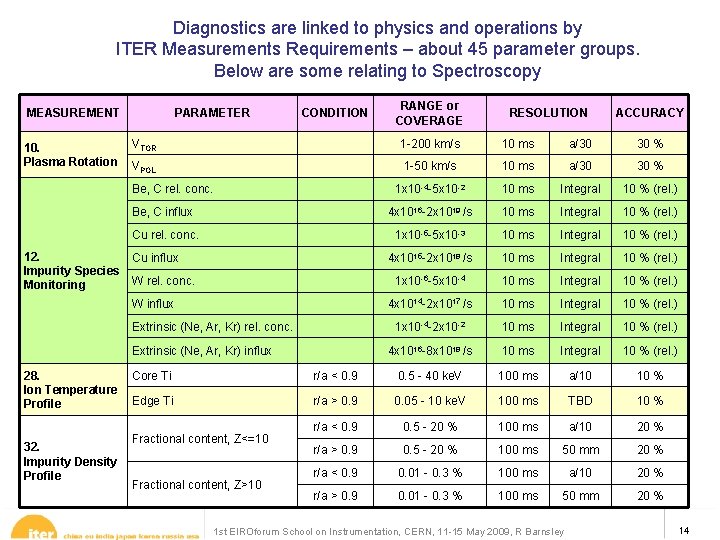
Diagnostics are linked to physics and operations by ITER Measurements Requirements – about 45 parameter groups. Below are some relating to Spectroscopy MEASUREMENT 10. Plasma Rotation PARAMETER CONDITION ACCURACY 1 -200 km/s 10 ms a/30 30 % VPOL 1 -50 km/s 10 ms a/30 30 % 1 x 10 -4 -5 x 10 -2 10 ms Integral 10 % (rel. ) Be, C influx 4 x 10¹⁶ -2 x 10¹⁹ /s 10 ms Integral 10 % (rel. ) Cu rel. conc. 1 x 10 -5 -5 x 10 -3 10 ms Integral 10 % (rel. ) 4 x 10¹⁵ -2 x 10¹⁸ /s 10 ms Integral 10 % (rel. ) 1 x 10 -6 -5 x 10 -4 10 ms Integral 10 % (rel. ) 4 x 10¹⁴ -2 x 10¹⁷ /s 10 ms Integral 10 % (rel. ) 1 x 10 -4 -2 x 10 -2 10 ms Integral 10 % (rel. ) 4 x 10¹⁶ -8 x 10¹⁸ /s 10 ms Integral 10 % (rel. ) 12. Cu influx Impurity Species W rel. conc. Monitoring W influx Extrinsic (Ne, Ar, Kr) rel. conc. Extrinsic (Ne, Ar, Kr) influx 32. Impurity Density Profile RESOLUTION VTOR Be, C rel. conc. 28. Ion Temperature Profile RANGE or COVERAGE Core Ti r/a < 0. 9 0. 5 - 40 ke. V 100 ms a/10 10 % Edge Ti r/a > 0. 9 0. 05 - 10 ke. V 100 ms TBD 10 % r/a < 0. 9 0. 5 - 20 % 100 ms a/10 20 % r/a > 0. 9 0. 5 - 20 % 100 ms 50 mm 20 % r/a < 0. 9 0. 01 - 0. 3 % 100 ms a/10 20 % r/a > 0. 9 0. 01 - 0. 3 % 100 ms 50 mm 20 % Fractional content, Z<=10 Fractional content, Z>10 1 st EIROforum School on Instrumentation, CERN, 11 -15 May 2009, R Barnsley 14
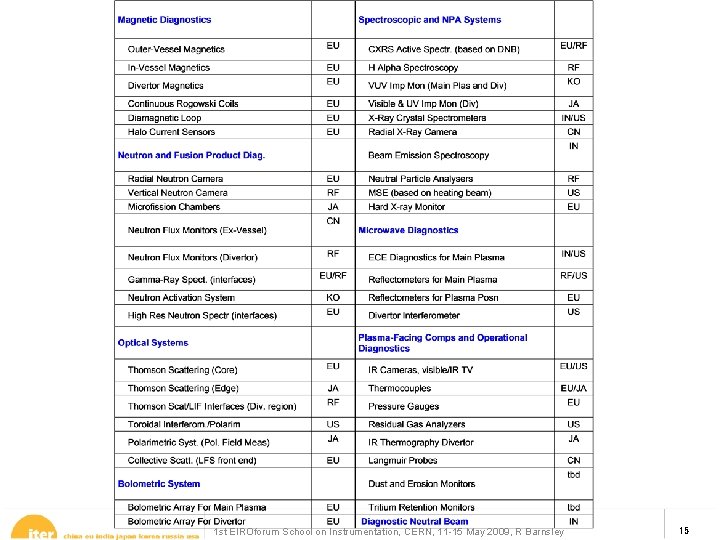
1 st EIROforum School on Instrumentation, CERN, 11 -15 May 2009, R Barnsley 15

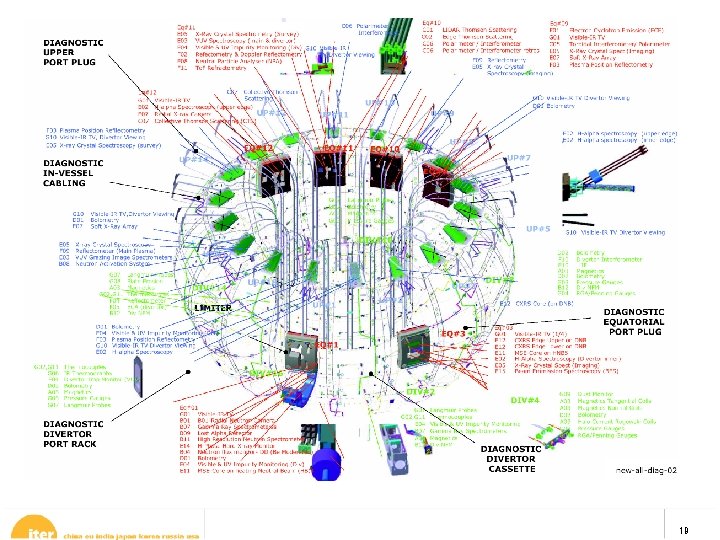
ITER diagnostics are port-based where possible Each diagnostic port-plug contains an integrated instrumentation package 1 st EIROforum School on Instrumentation, CERN, 11 -15 May 2009, R Barnsley 16

In-Vessel Distributed Diagnostics 17

Divertor, Equatorial & Upper Port Diagnostics 18
19
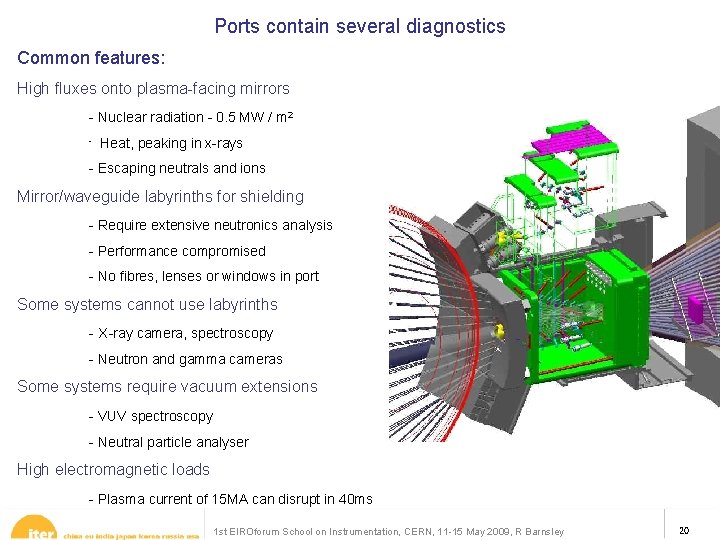
Ports contain several diagnostics Common features: High fluxes onto plasma-facing mirrors - Nuclear radiation - 0. 5 MW / m 2 - Heat, peaking in x-rays - Escaping neutrals and ions Mirror/waveguide labyrinths for shielding - Require extensive neutronics analysis - Performance compromised - No fibres, lenses or windows in port Some systems cannot use labyrinths - X-ray camera, spectroscopy - Neutron and gamma cameras Some systems require vacuum extensions - VUV spectroscopy - Neutral particle analyser High electromagnetic loads - Plasma current of 15 MA can disrupt in 40 ms 1 st EIROforum School on Instrumentation, CERN, 11 -15 May 2009, R Barnsley 20

Radiation issues according to location Location Neutron flux /cm 2. s Suitable technology Plasma - facing ~1014 Metal mirrors Retro-reflectors Waveguides In-vessel Behind blanket ~1012 Mineral-insulated cable Pick-up coils for magnetics Inside port-plug ~108 - Mirrors 1012 Replaceable detectors Behind port-plug < ~108 Optical fibres, lenses, CCD detectors, conventional electronics. “Almost anything” Issues Deposition and erosion by plasma. Maintenance: - possible if in-port - almost impossible if in-vessel Radiation induced, EMF, currents, insulation breakdown Maintenance almost impossible Some maintenance possible Easily maintainable 1 st EIROforum School on Instrumentation, CERN, 11 -15 May 2009, R Barnsley 21

Mirror labyrinth collection optics on ITER upper port #3 Neutronics by G. E. Shatalov, S. V. Sheludiakov, Kurchatov Inst. Moscow The neutron environment ranges from mild behind the port-plug to severe at the blanket. St. St: H 2 O 80: 20, Allowable activation at Flange behind Bio. Sh <100 u. Sv/hr <10 u. Sv/hr Normalized to 500 MW fusion power Neutron flux at flange ~ 1. 107 n/cm 2 s-1 This is less than inside JET torus hall. Equivalent to local dose <5 u. Sv/h (10 days after s/d) Total nuclear heating power to: BSM 420 k. W A 58 k. W B 0. 43 k. W C 9 W Addition power deposition in TFC ~10 W M 1 Heating ~2 W/cc Total Neutron flux ~6. 1013 n/cm 2 s-1 22
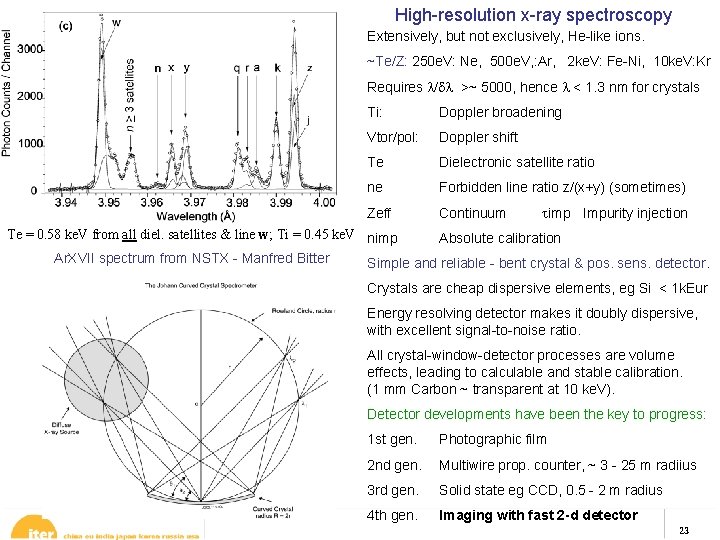
High-resolution x-ray spectroscopy Extensively, but not exclusively, He-like ions. ~Te/Z: 250 e. V: Ne, 500 e. V, : Ar, 2 ke. V: Fe-Ni, 10 ke. V: Kr Requires / >~ 5000, hence < 1. 3 nm for crystals Ti: Doppler broadening Vtor/pol: Doppler shift Te Dielectronic satellite ratio ne Forbidden line ratio z/(x+y) (sometimes) Zeff Continuum imp Impurity injection Te = 0. 58 ke. V from all diel. satellites & line w; Ti = 0. 45 ke. V nimp Absolute calibration Ar. XVII spectrum from NSTX - Manfred Bitter Simple and reliable - bent crystal & pos. sens. detector. Crystals are cheap dispersive elements, eg Si < 1 k. Eur Energy resolving detector makes it doubly dispersive, with excellent signal-to-noise ratio. All crystal-window-detector processes are volume effects, leading to calculable and stable calibration. (1 mm Carbon ~ transparent at 10 ke. V). Detector developments have been the key to progress: 1 st gen. Photographic film 2 nd gen. Multiwire prop. counter, ~ 3 - 25 m radiius 3 rd gen. Solid state eg CCD, 0. 5 - 2 m radius 4 th gen. Imaging with fast 2 -d detector 23
High resolution imaging crystal spectrometers Recent advances in active pixel detectors such as Pilatus and Medipix have enabled a new generation of imaging crystal spectrometer. The technique has moved quickly from demonstration, to routine production of a wide range of new physics results (Matt Reinke, John Rice, this meeting) The ITER design has been based on this principle since 2003 Extensive analysis and modelling has been performed: - Plasma emission modelling - Spectrometer sensitivity and signal estimates - Neutronics analysis to optimize the forward position of detectors 24

Advances in detector technology enable new measurement capability CERN-led Medipix 3 – in development Active pixel detector - Each pixel has analog pulse processing, thresholds, and digital counter - 256 x 256 array. Pixels 55 um square - Multiple enrgy windows - 1 us pulse-process time per pixel - Radiation-hard to ~1014 neutron/cm 2 Diagnostic applications - X-ray spectroscopy and imaging - Particle detection and spectroscopy - Fast visible and VUV framing (with MCP) - Neutron and gamma spectroscopy 25
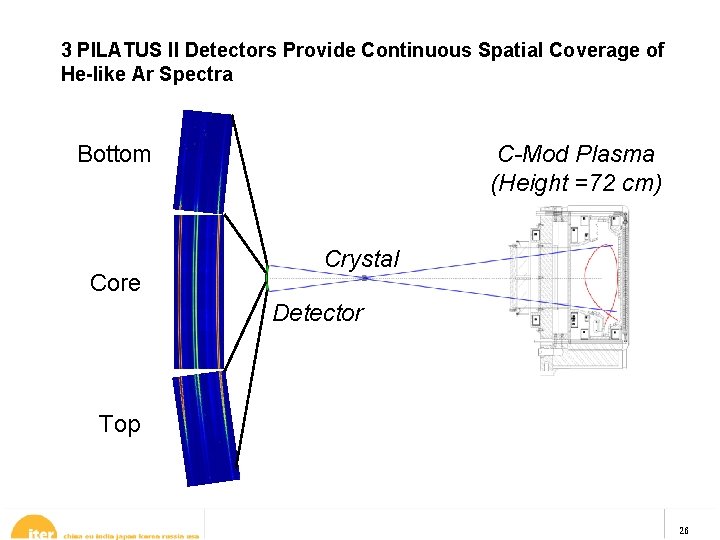
3 PILATUS II Detectors Provide Continuous Spatial Coverage of He-like Ar Spectra C-Mod Plasma (Height =72 cm) Bottom Core Crystal Detector Top 26
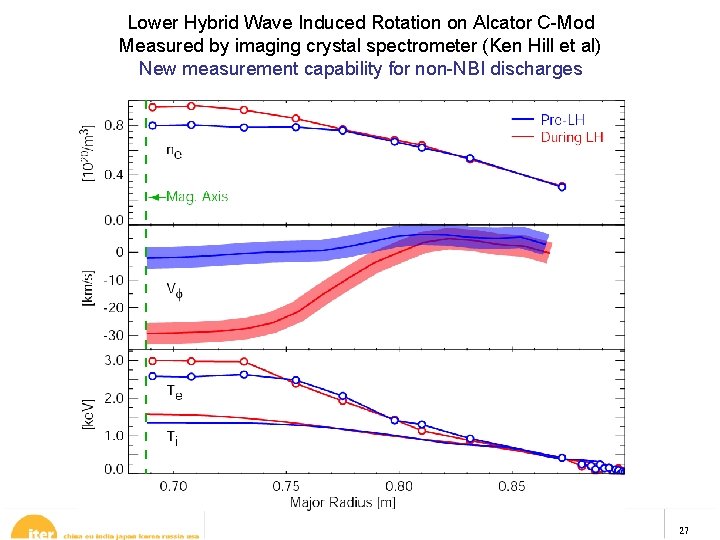
Lower Hybrid Wave Induced Rotation on Alcator C-Mod Measured by imaging crystal spectrometer (Ken Hill et al) New measurement capability for non-NBI discharges 27

High resolution imaging crystal spectrometer for ITER Plasma coverage by radial views Plasma coverage by toroidal views radial • Yellow represents view tunnel within the port plug and its virtual extension into the plasma • Aim is to view the tangent to all plasma flux surfaces • Spatial coverage drives detector height toroidal Crystal Detector View from top of plug 28

ITER impurity line emission and spectrometer signals Top left Modelled ITER radial profiles Top right Local emissivity of impurity spectral lines (O’Mullane, ADAS-SANCO) Bottom Simulated signals for imaging x-ray crystal spectrometer Incremental radiated powers for added impurity concentrations of 10 -5. ne are: Ar 0. 25 MW Fe 0. 8 MW Kr 1. 4 MW 1 st EIROforum School on Instrumentation, CERN, 11 -15 May 2009, R Barnsley 29
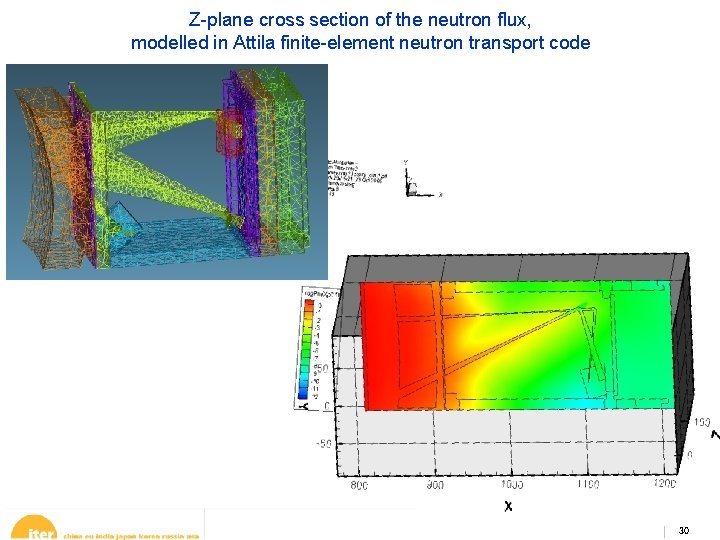
Z-plane cross section of the neutron flux, modelled in Attila finite-element neutron transport code 30
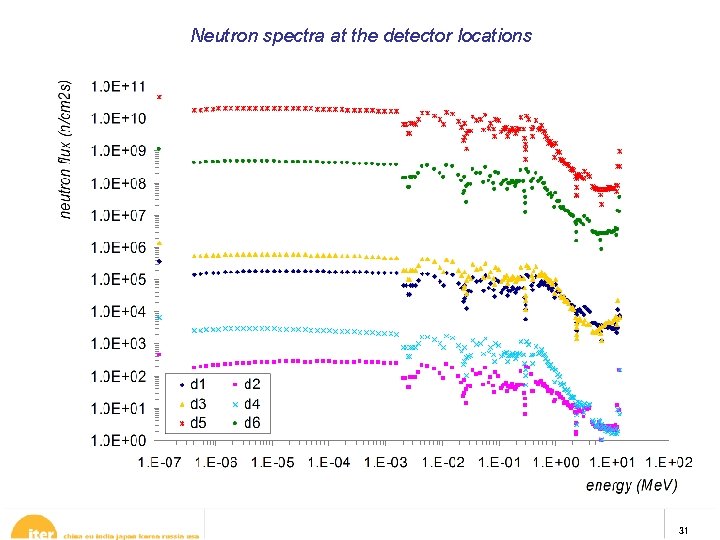
Neutron spectra at the detector locations 31
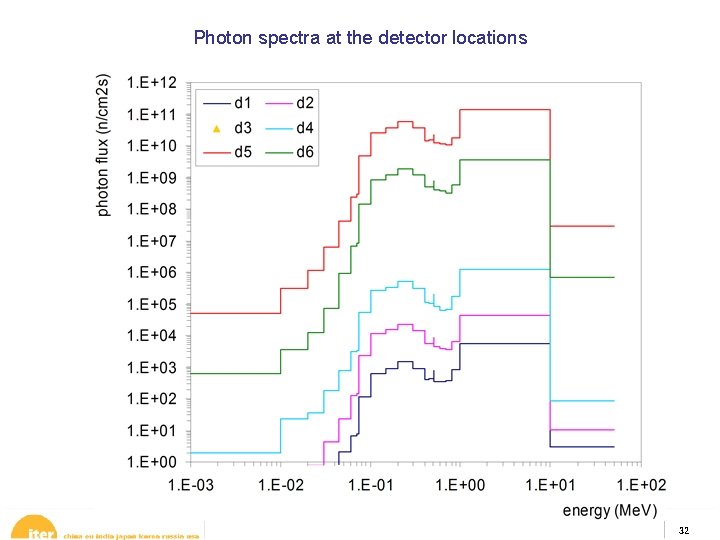
Photon spectra at the detector locations 32

Background and lifetime for a Medipix-like detector Saturation rate: 3. 1010 /cm 2. s (106 /s per 55 um pixel) Lifetime fluence of 1 Me. V neutrons: 1014 /cm 2 Detector location within port-plug X-ray – gamma background Neutron background Detector life (ITER life ~ 2. 107 s) Rear Mid Front Total gamma flux (ph/cm 2. s) 3. 104 9. 106 1. 1012 Fractional dead-time for 1% QDE 1. 10 -8 4. 10 -5 0. 33 Neutron flux > 1 ke. V (n/cm 2. s) 6. 106 1. 5. 108 5. 1011 Fractional dead-time for 1% QDE 2. 10 -6 5. 10 -4 0. 18 Time to reach fluence of 1014 n/cm 2 (s) 2. 1010 2. 107 500 33

High energy physics requires radiation-hard detectors SLHC core neutron fluence >10^16/cm^2 over 10 yrs 34
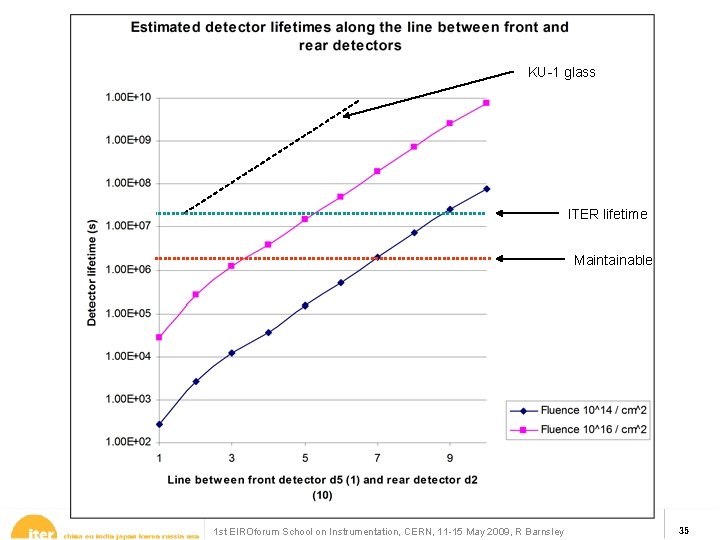
KU-1 glass ITER lifetime Maintainable 1 st EIROforum School on Instrumentation, CERN, 11 -15 May 2009, R Barnsley 35
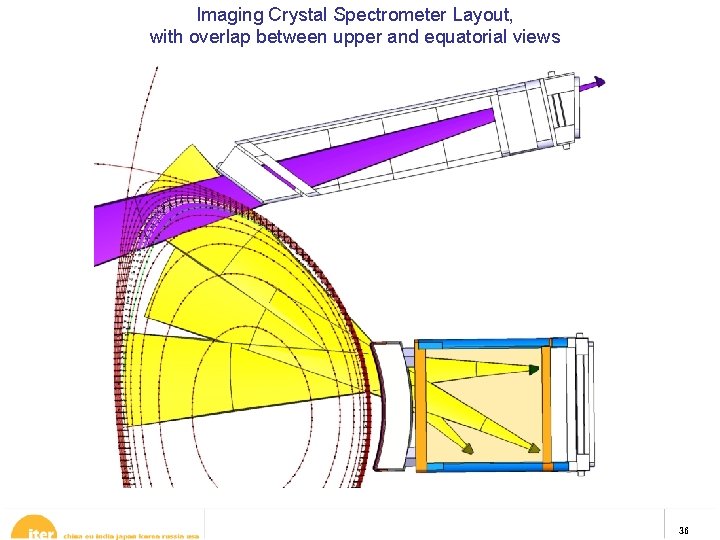
Imaging Crystal Spectrometer Layout, with overlap between upper and equatorial views 36
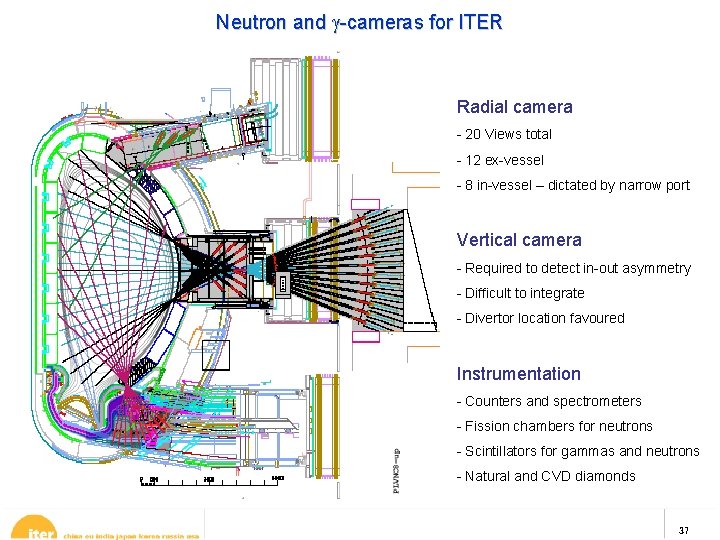
Neutron and -cameras for ITER Radial camera - 20 Views total - 12 ex-vessel - 8 in-vessel – dictated by narrow port Vertical camera - Required to detect in-out asymmetry - Difficult to integrate - Divertor location favoured Instrumentation - Counters and spectrometers - Fission chambers for neutrons - Scintillators for gammas and neutrons - Natural and CVD diamonds 37
Summary - The ITER diagnostic system deals with radiation in a number of ways: - Real hardness: waveguides, mirrors, mineral-insulated cables - Shielding: optical labyrinths, remote detectors - Use of radiation-hard detectors: x-ray spectroscopy and imaging - Neutronics modelling is essential to optimize diagnostic designs - ITER Diagnostics are entering the detailed design phase. - Construction time for a complete diagnostic system: ~ 6 yrs 38
- Slides: 38