
Radiation fundamental 4 Radiation Exchange Between Surfaces Enclosures
Radiation fundamental 4 Radiation Exchange Between Surfaces: Enclosures with Nonparticipating Media Juhun Song Pusan National University
Basic Concepts • Enclosures consist of two or more surfaces that envelop a region of space (typically gas-filled) and between which there is radiation transfer. Virtual, as well as real, surfaces may be introduced to form an enclosure. • A nonparticipating medium within the enclosure neither emits, absorbs, nor scatters radiation and hence has no effect on radiation exchange between the surfaces. • Each surface of the enclosure is assumed to be isothermal, opaque, diffuse and gray, and to be characterized by uniform radiosity and irradiation.

View Factor Integral The View Factor (also Configuration or Shape Factor) • The view factor, is a geometrical quantity corresponding to the fraction of the radiation leaving surface i that is intercepted by surface j. • The view factor integral provides a general expression for Consider exchange between differential areas • With Assume surface i emits and reflects diffusively,
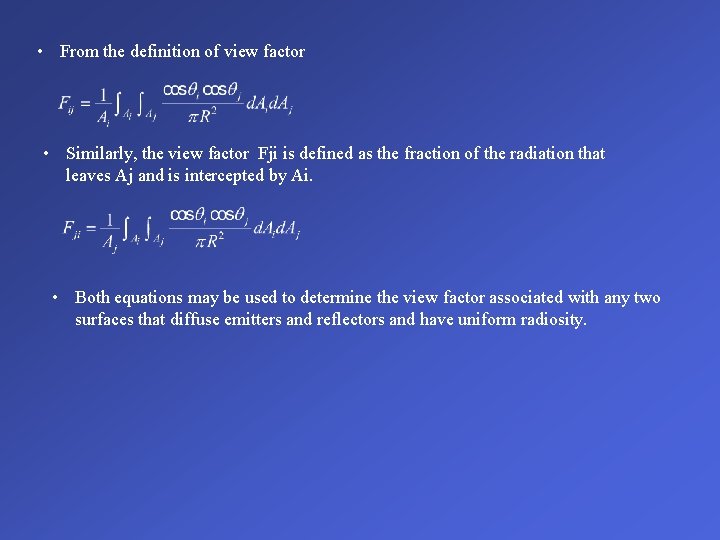
• From the definition of view factor • Similarly, the view factor Fji is defined as the fraction of the radiation that leaves Aj and is intercepted by Ai. • Both equations may be used to determine the view factor associated with any two surfaces that diffuse emitters and reflectors and have uniform radiosity.

View Factor Relations • Reciprocity Relation. With • Summation Rule for Enclosures. • This rule follows form the conservation requirement that all radiation leaving surface i must be intercepted by the enclosure surfaces. • The term Fii appearing in this summation represents the fraction of radiation that leaves surface I and is directly intercepted by i. - If surface is concave (오목한), it can see itself and Fii is nonzero. - For plane or convex surface(볼록한), Fii=0 • To calculate radiation exchange in an enclosure of N surfaces, a total of N 2 view factors is needed.

Ex 1) two surfaces enclosure involving spherical surfaces • Although the enclosure is characterized by N 2=4 (F 11, F 12, F 21, F 22), only N(N-1)/2=1 view factor needs be determined directly. • In this case, such as determination may be made by inspection. - F 11=0 - since all radiation leaving the inner surface must reach the outer surface(summation rule), F 12=1 - Reciprocity relation, - By summation rule,

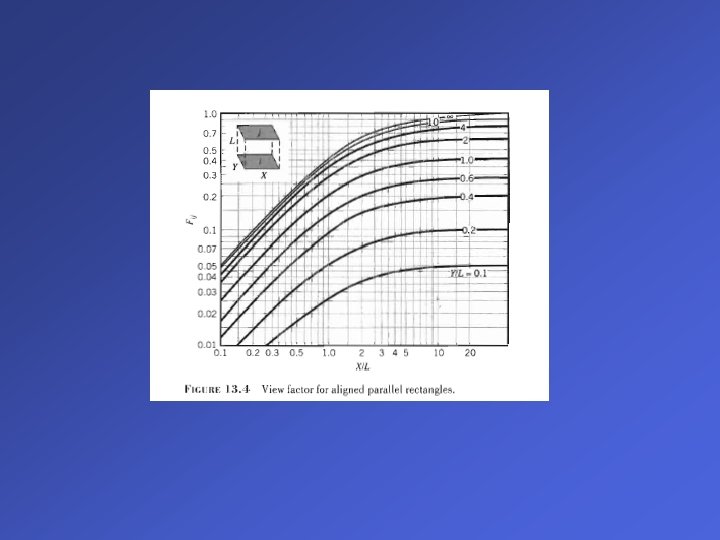
• For more complicated geometries, the view factor may be determined by solving the double integral of previous equation. Such solutions have been obtained for many different surface arrangements. They are available in equation, graphically(Figure 13. 4 to 13. 6), and tabular form (Table 13. 1 and 13. 2) • In this case, such as determination may be made by inspection. - F 11=0 - since all radiation leaving the inner surface must reach the outer surface(summation rule), F 12=1 - Reciprocity relation, - By summation rule,
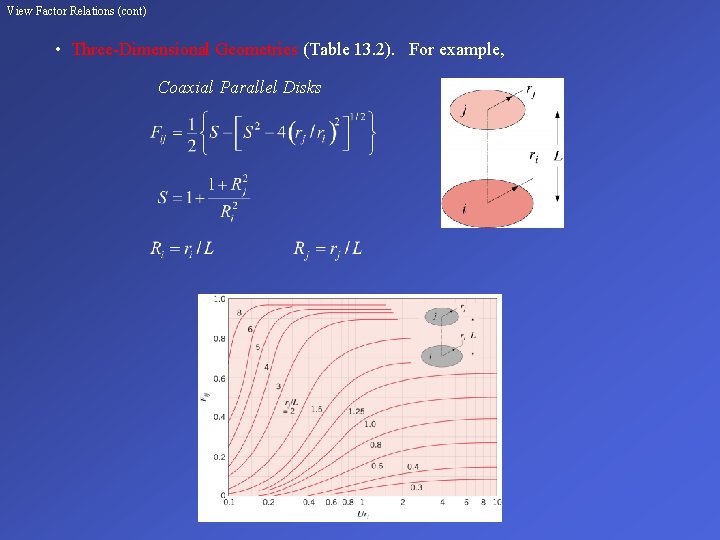
View Factor Relations (cont) • Three-Dimensional Geometries (Table 13. 2). For example, Coaxial Parallel Disks
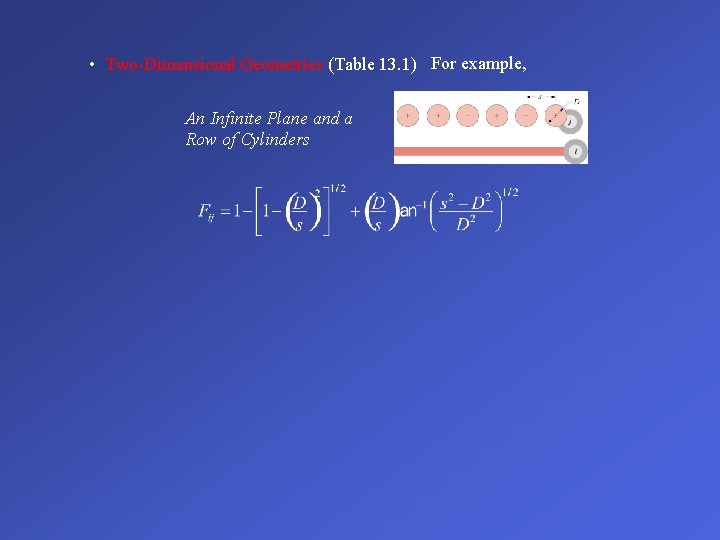
• Two-Dimensional Geometries (Table 13. 1) For example, An Infinite Plane and a Row of Cylinders
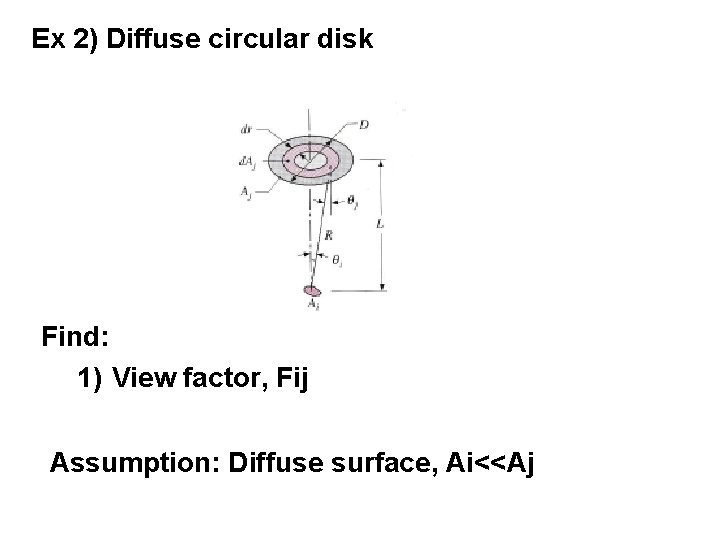
Ex 2) Diffuse circular disk Find: 1) View factor, Fij Assumption: Diffuse surface, Ai<<Aj
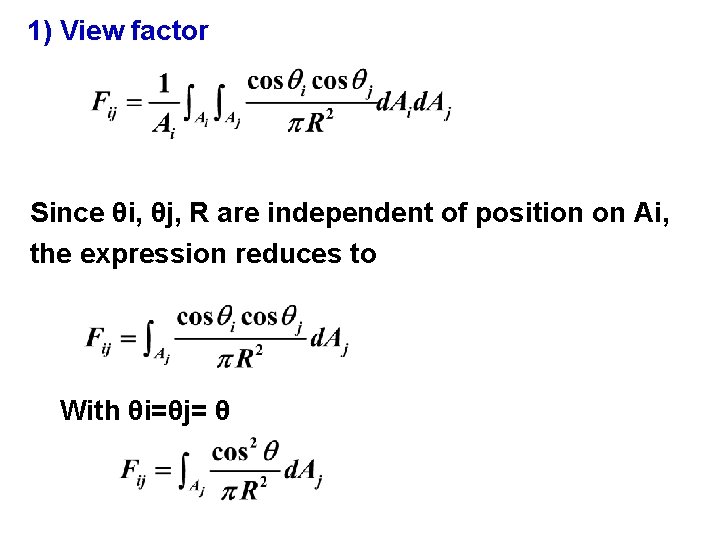
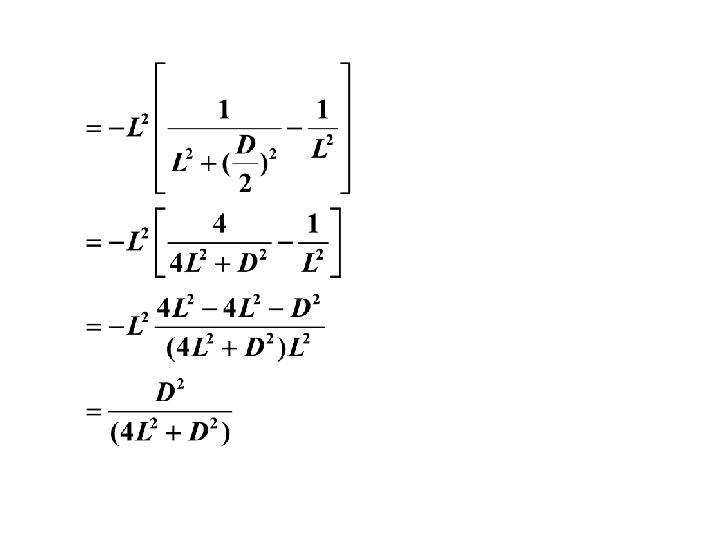
1) View factor Since θi, θj, R are independent of position on Ai, the expression reduces to With θi=θj= θ
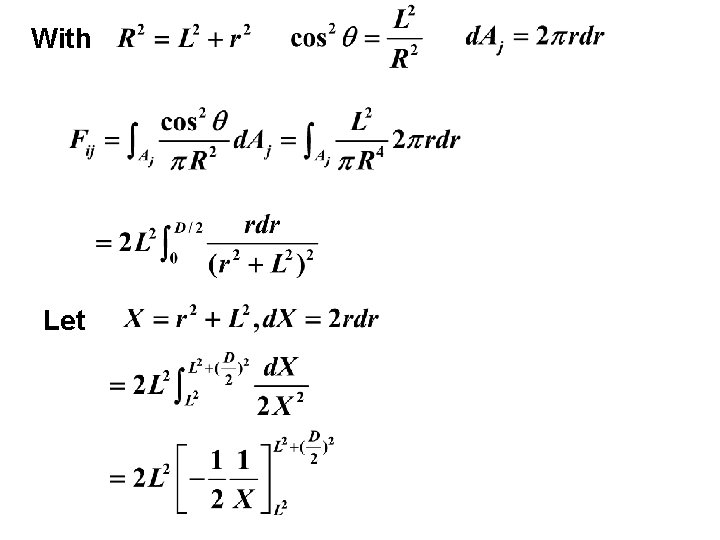
With Let
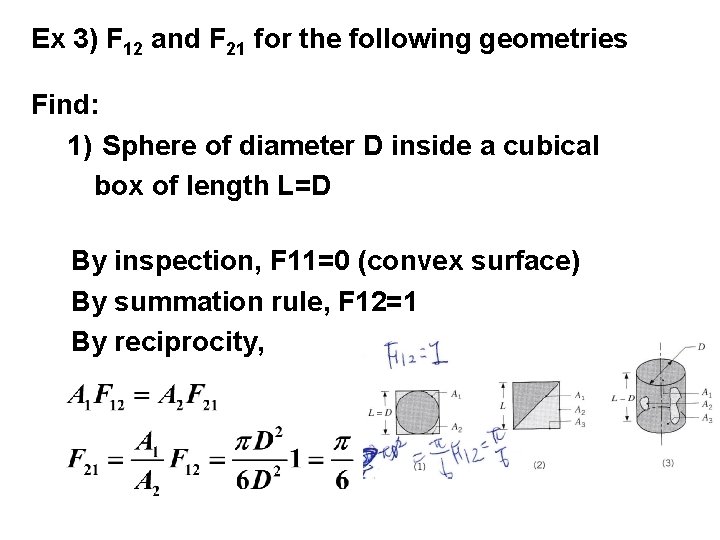
Ex 3) F 12 and F 21 for the following geometries Find: 1) Sphere of diameter D inside a cubical box of length L=D By inspection, F 11=0 (convex surface) By summation rule, F 12=1 By reciprocity,
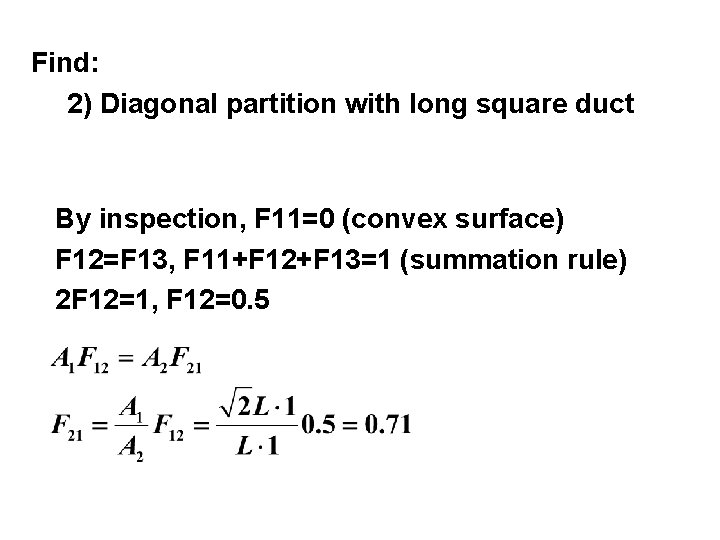
Find: 2) Diagonal partition with long square duct By inspection, F 11=0 (convex surface) F 12=F 13, F 11+F 12+F 13=1 (summation rule) 2 F 12=1, F 12=0. 5
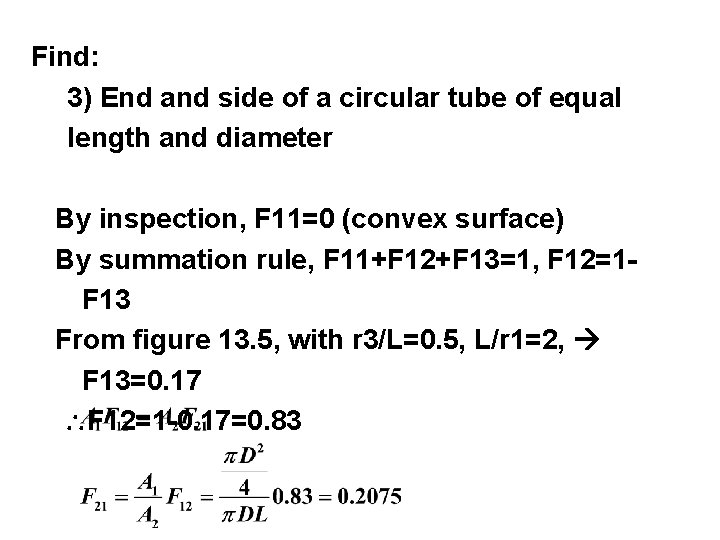
Find: 3) End and side of a circular tube of equal length and diameter By inspection, F 11=0 (convex surface) By summation rule, F 11+F 12+F 13=1, F 12=1 F 13 From figure 13. 5, with r 3/L=0. 5, L/r 1=2, F 13=0. 17 F 12=1 -0. 17=0. 83
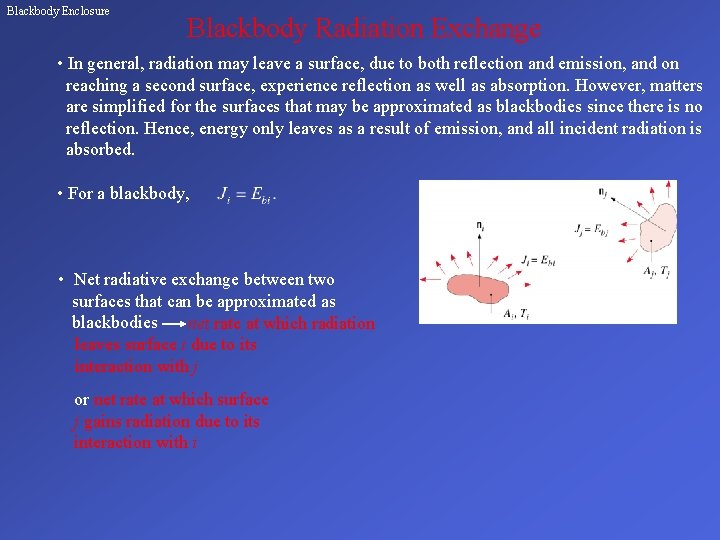
Blackbody Enclosure Blackbody Radiation Exchange • In general, radiation may leave a surface, due to both reflection and emission, and on reaching a second surface, experience reflection as well as absorption. However, matters are simplified for the surfaces that may be approximated as blackbodies since there is no reflection. Hence, energy only leaves as a result of emission, and all incident radiation is absorbed. • For a blackbody, • Net radiative exchange between two surfaces that can be approximated as blackbodies net rate at which radiation leaves surface i due to its interaction with j or net rate at which surface j gains radiation due to its interaction with i
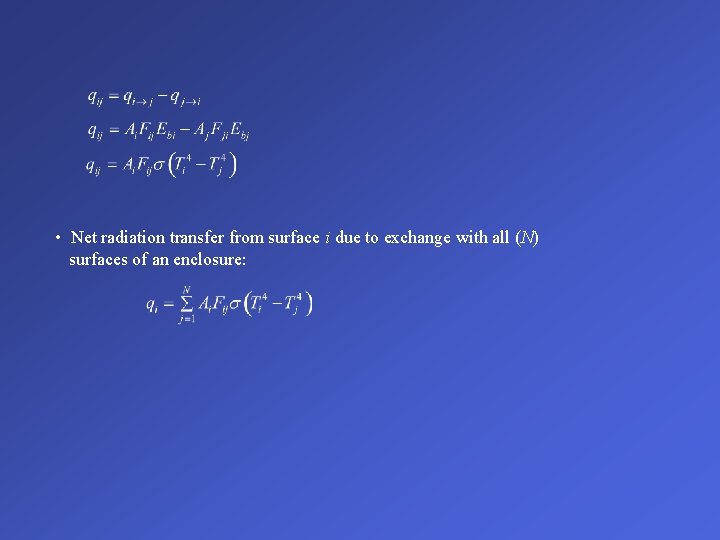
• Net radiation transfer from surface i due to exchange with all (N) surfaces of an enclosure:
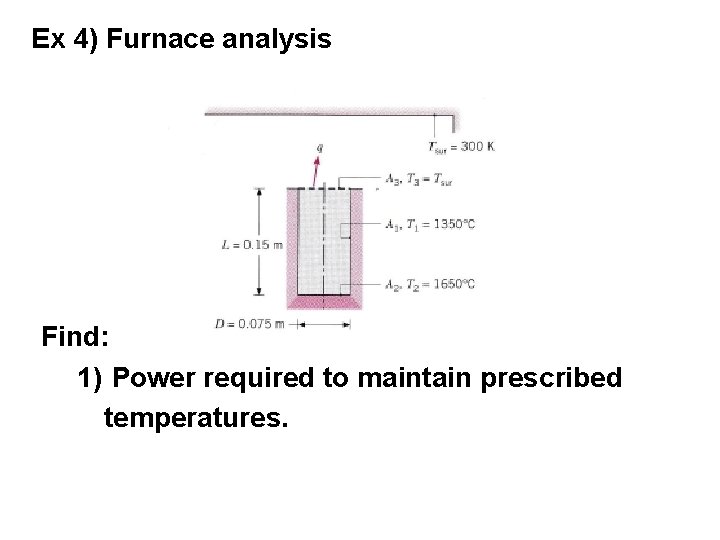
Ex 4) Furnace analysis Find: 1) Power required to maintain prescribed temperatures.
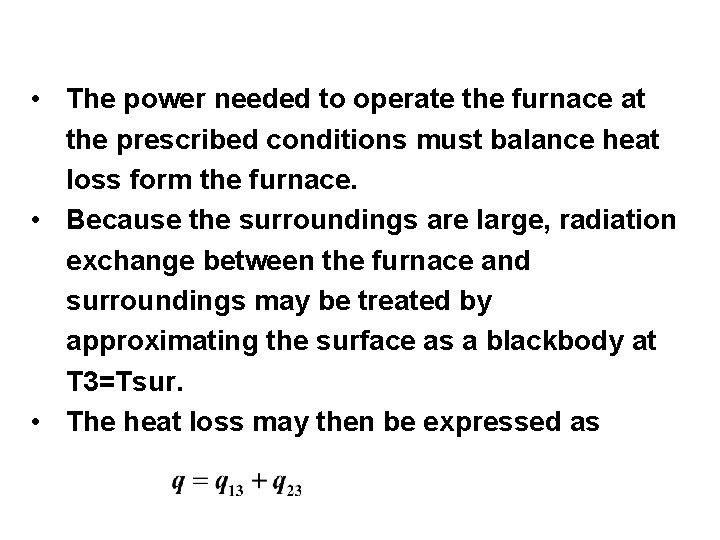
• The power needed to operate the furnace at the prescribed conditions must balance heat loss form the furnace. • Because the surroundings are large, radiation exchange between the furnace and surroundings may be treated by approximating the surface as a blackbody at T 3=Tsur. • The heat loss may then be expressed as
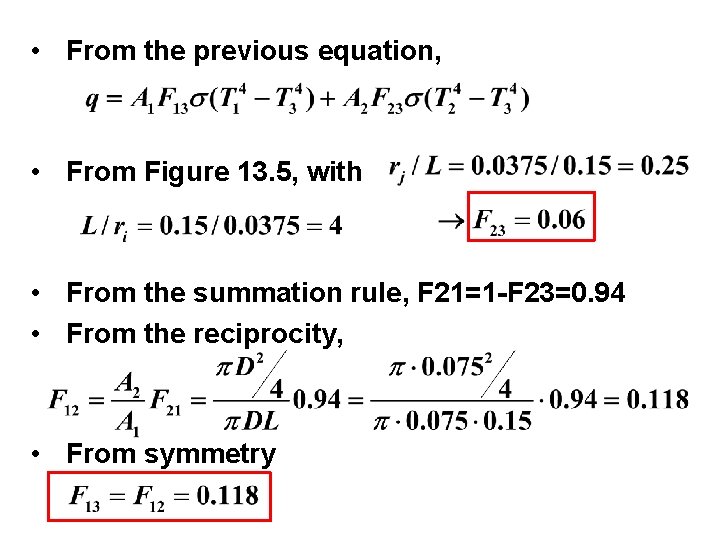
• From the previous equation, • From Figure 13. 5, with • From the summation rule, F 21=1 -F 23=0. 94 • From the reciprocity, • From symmetry
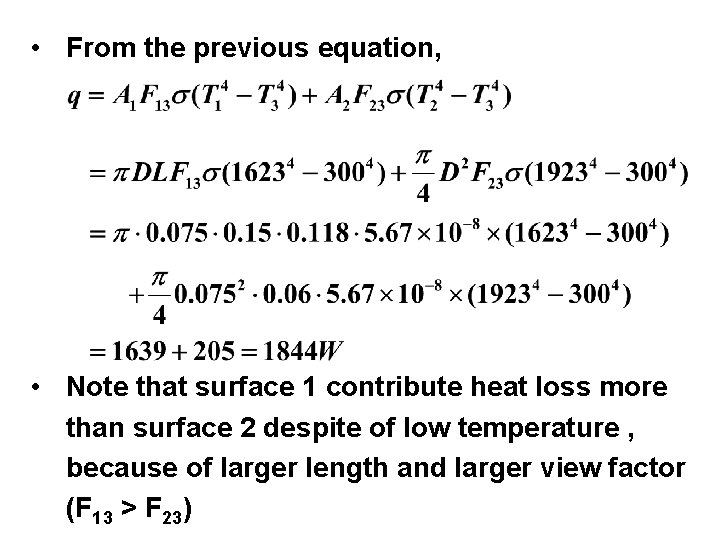
• From the previous equation, • Note that surface 1 contribute heat loss more than surface 2 despite of low temperature , because of larger length and larger view factor (F 13 > F 23)
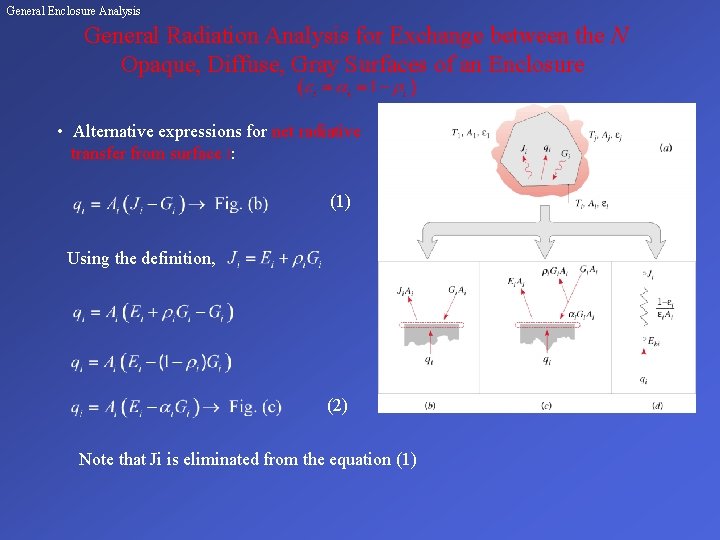
General Enclosure Analysis General Radiation Analysis for Exchange between the N Opaque, Diffuse, Gray Surfaces of an Enclosure • Alternative expressions for net radiative transfer from surface i: (1) Using the definition, (2) Note that Ji is eliminated from the equation (1)
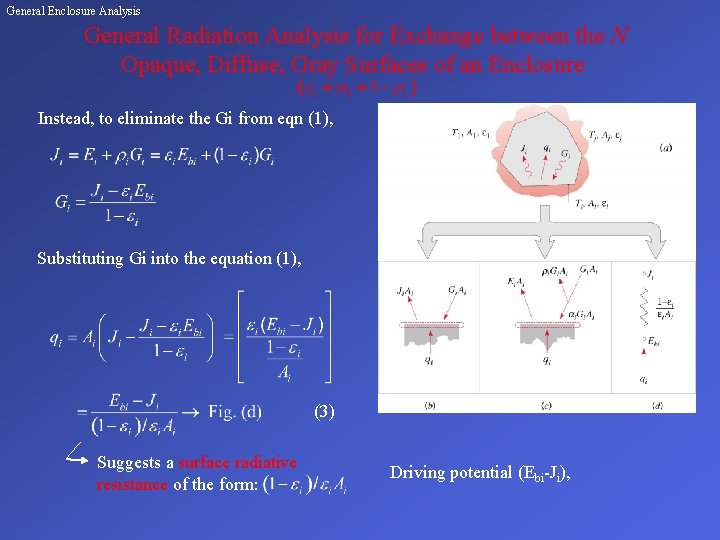
General Enclosure Analysis General Radiation Analysis for Exchange between the N Opaque, Diffuse, Gray Surfaces of an Enclosure Instead, to eliminate the Gi from eqn (1), Substituting Gi into the equation (1), (3) Suggests a surface radiative resistance of the form: Driving potential (Ebi-Ji),
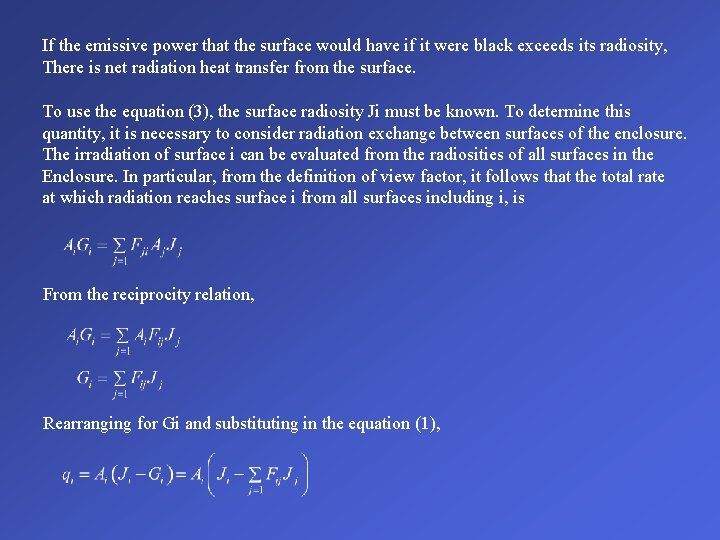
If the emissive power that the surface would have if it were black exceeds its radiosity, There is net radiation heat transfer from the surface. To use the equation (3), the surface radiosity Ji must be known. To determine this quantity, it is necessary to consider radiation exchange between surfaces of the enclosure. The irradiation of surface i can be evaluated from the radiosities of all surfaces in the Enclosure. In particular, from the definition of view factor, it follows that the total rate at which radiation reaches surface i from all surfaces including i, is From the reciprocity relation, Rearranging for Gi and substituting in the equation (1),
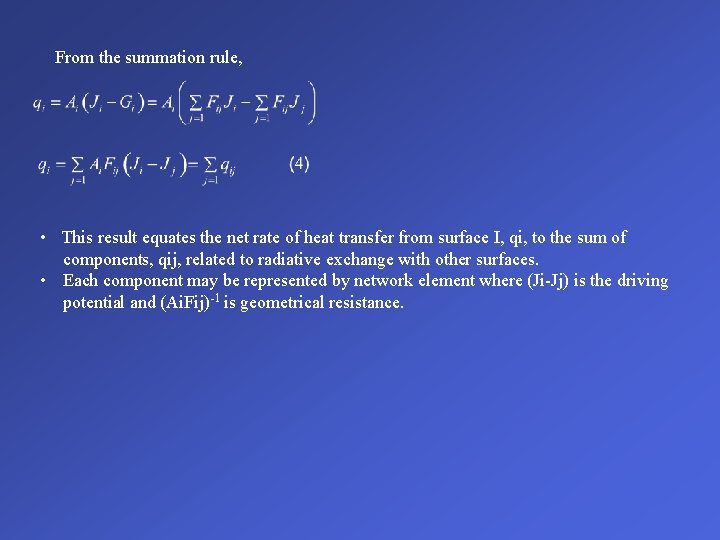
From the summation rule, • This result equates the net rate of heat transfer from surface I, qi, to the sum of components, qij, related to radiative exchange with other surfaces. • Each component may be represented by network element where (Ji-Jj) is the driving potential and (Ai. Fij)-1 is geometrical resistance.
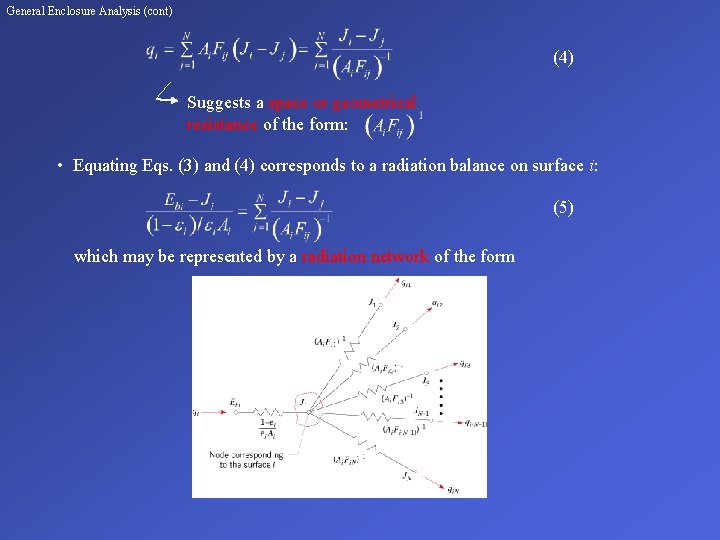
General Enclosure Analysis (cont) (4) Suggests a space or geometrical resistance of the form: • Equating Eqs. (3) and (4) corresponds to a radiation balance on surface i: (5) which may be represented by a radiation network of the form
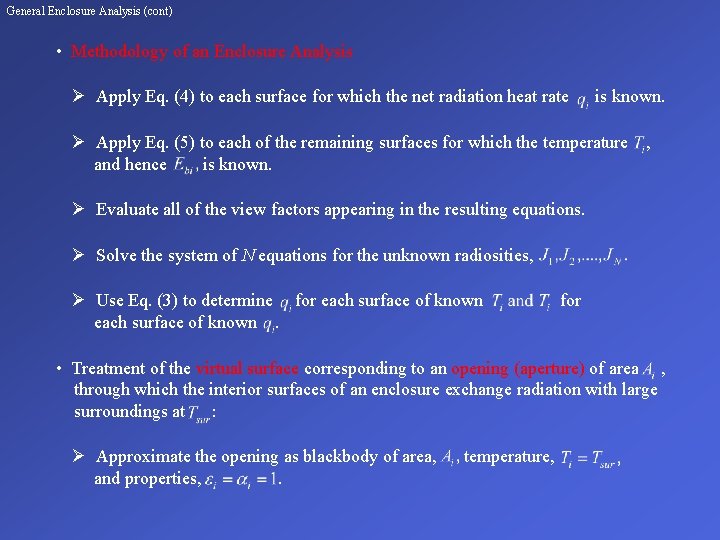
General Enclosure Analysis (cont) • Methodology of an Enclosure Analysis Ø Apply Eq. (4) to each surface for which the net radiation heat rate is known. Ø Apply Eq. (5) to each of the remaining surfaces for which the temperature , and hence is known. Ø Evaluate all of the view factors appearing in the resulting equations. Ø Solve the system of N equations for the unknown radiosities, Ø Use Eq. (3) to determine for each surface of known. for • Treatment of the virtual surface corresponding to an opening (aperture) of area , through which the interior surfaces of an enclosure exchange radiation with large surroundings at : Ø Approximate the opening as blackbody of area, and properties, . temperature,
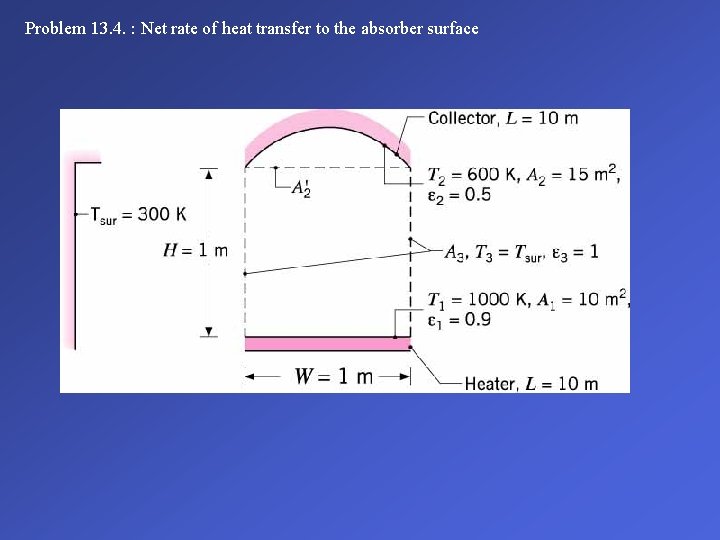
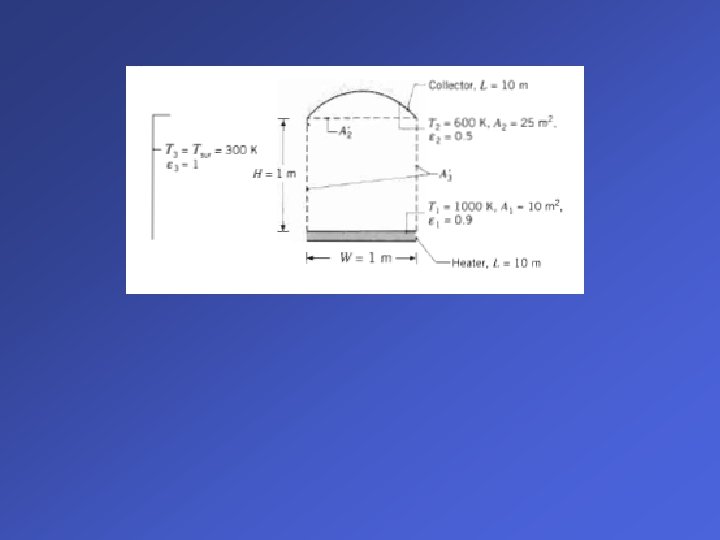
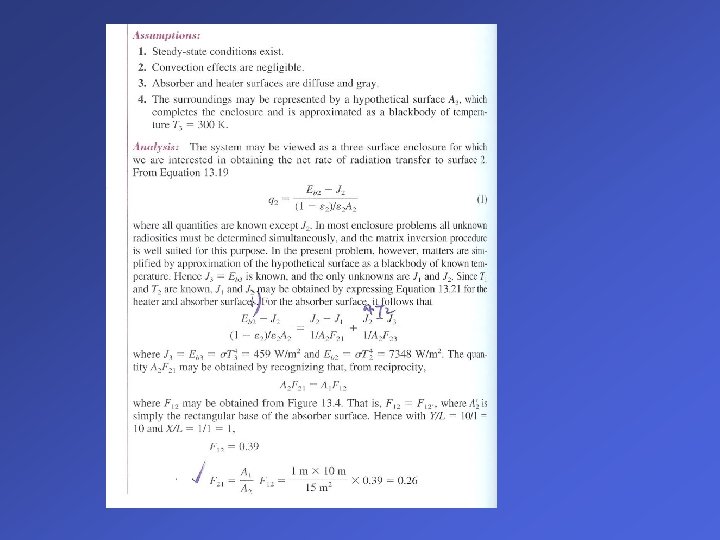
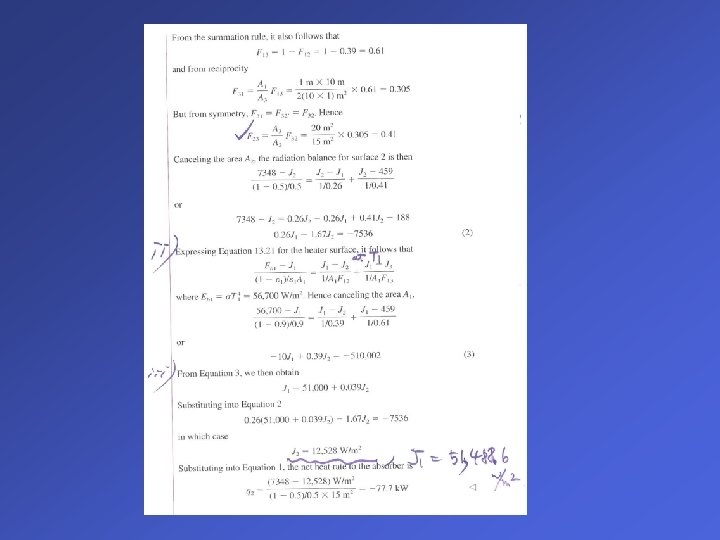
Problem 13. 4. : Net rate of heat transfer to the absorber surface
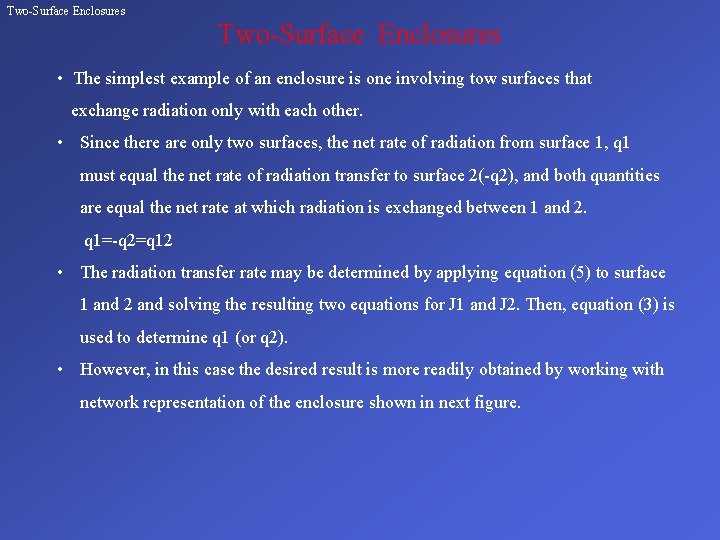
Two-Surface Enclosures • The simplest example of an enclosure is one involving tow surfaces that exchange radiation only with each other. • Since there are only two surfaces, the net rate of radiation from surface 1, q 1 must equal the net rate of radiation transfer to surface 2(-q 2), and both quantities are equal the net rate at which radiation is exchanged between 1 and 2. q 1=-q 2=q 12 • The radiation transfer rate may be determined by applying equation (5) to surface 1 and 2 and solving the resulting two equations for J 1 and J 2. Then, equation (3) is used to determine q 1 (or q 2). • However, in this case the desired result is more readily obtained by working with network representation of the enclosure shown in next figure.
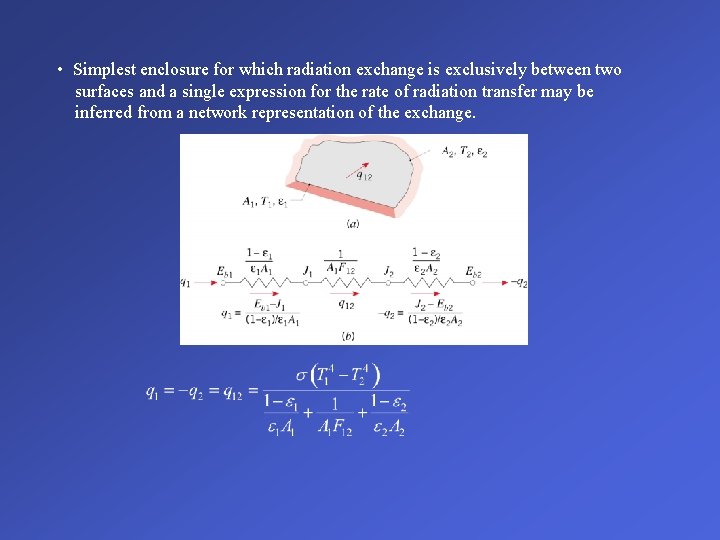
• Simplest enclosure for which radiation exchange is exclusively between two surfaces and a single expression for the rate of radiation transfer may be inferred from a network representation of the exchange.
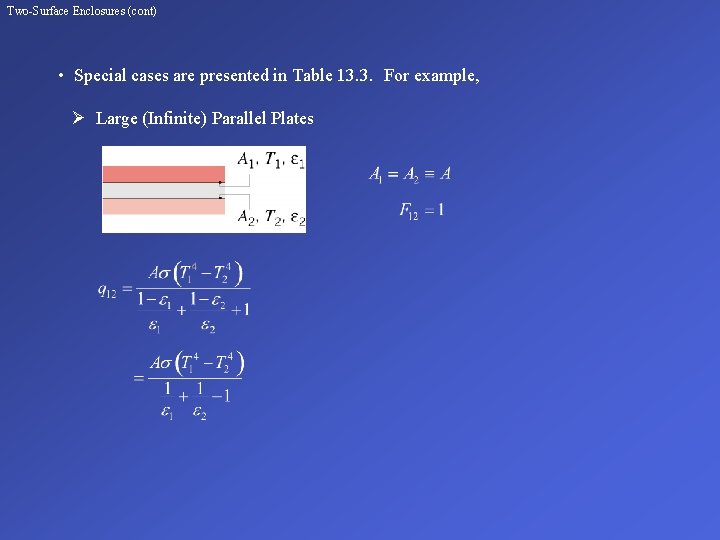
Two-Surface Enclosures (cont) • Special cases are presented in Table 13. 3. For example, Ø Large (Infinite) Parallel Plates
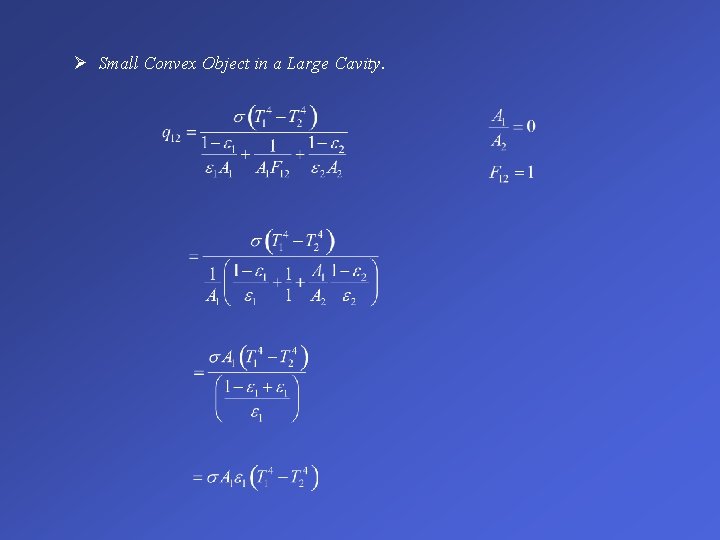
Ø Small Convex Object in a Large Cavity.
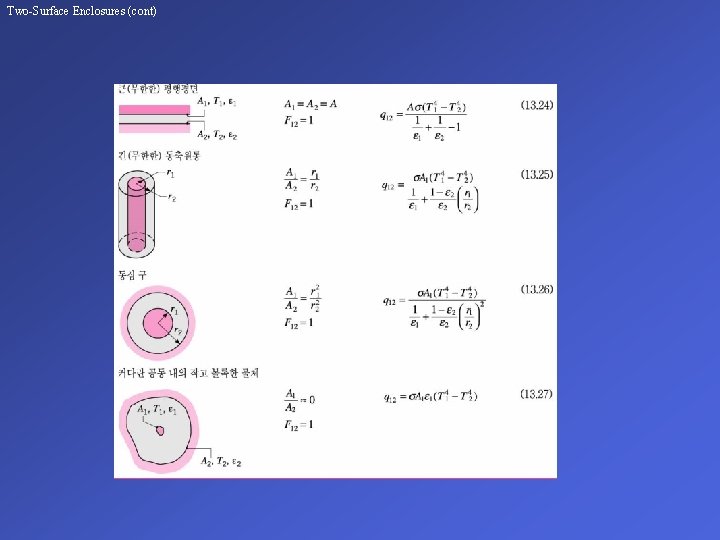
Two-Surface Enclosures (cont)
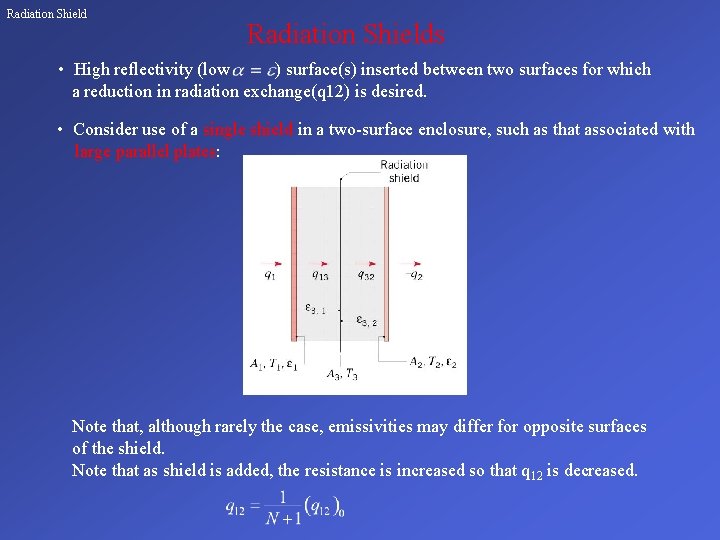
Radiation Shields • High reflectivity (low ) surface(s) inserted between two surfaces for which a reduction in radiation exchange(q 12) is desired. • Consider use of a single shield in a two-surface enclosure, such as that associated with large parallel plates: Note that, although rarely the case, emissivities may differ for opposite surfaces of the shield. Note that as shield is added, the resistance is increased so that q 12 is decreased.
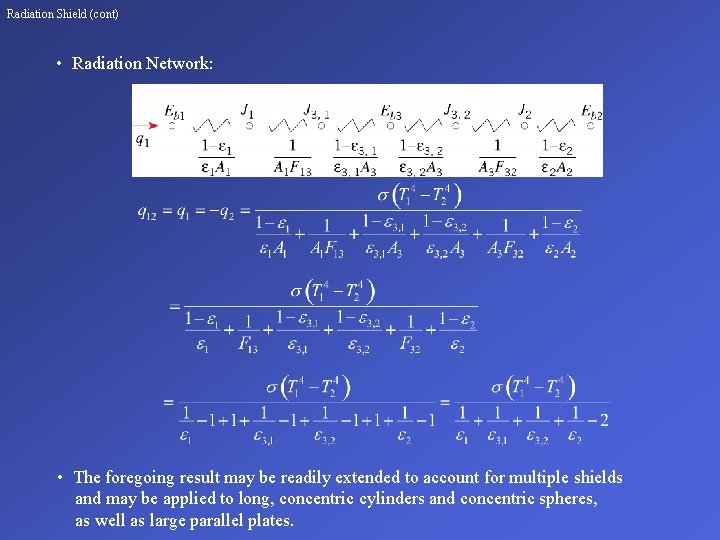
Radiation Shield (cont) • Radiation Network: • The foregoing result may be readily extended to account for multiple shields and may be applied to long, concentric cylinders and concentric spheres, as well as large parallel plates.
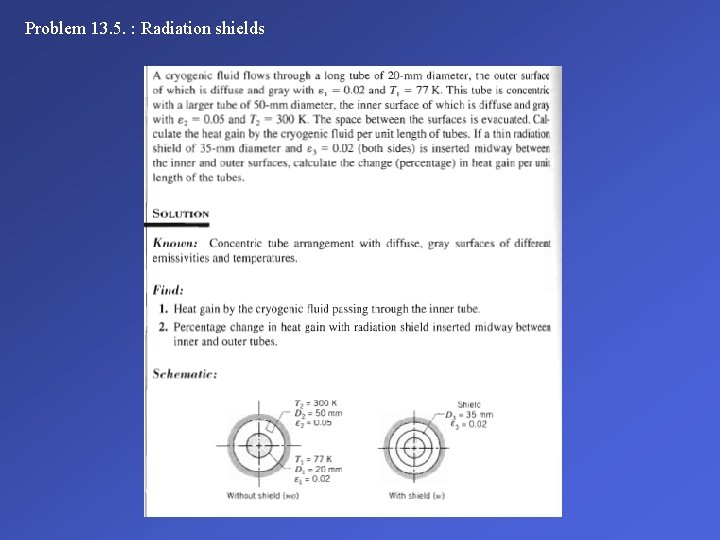
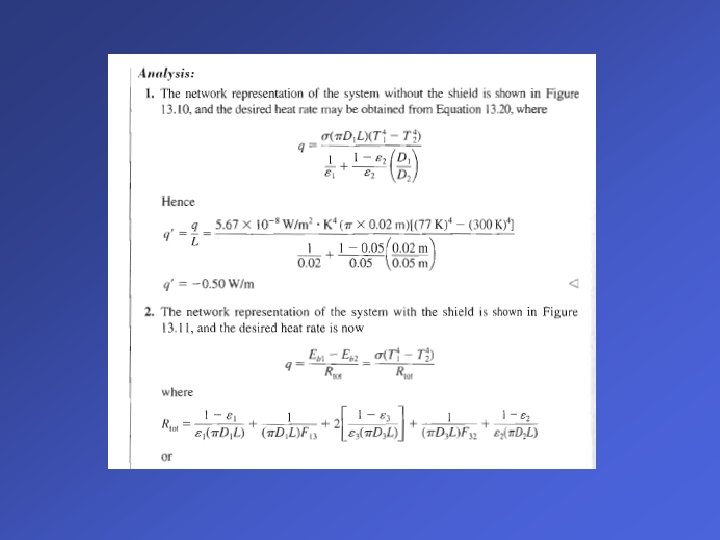
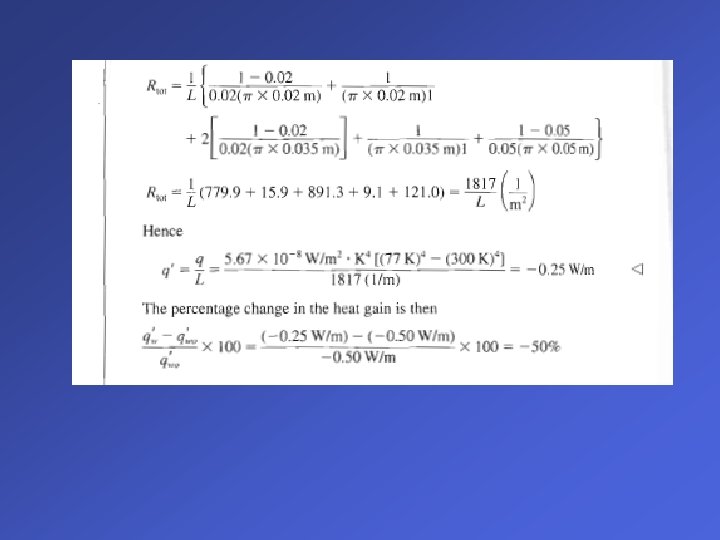
Problem 13. 5. : Radiation shields
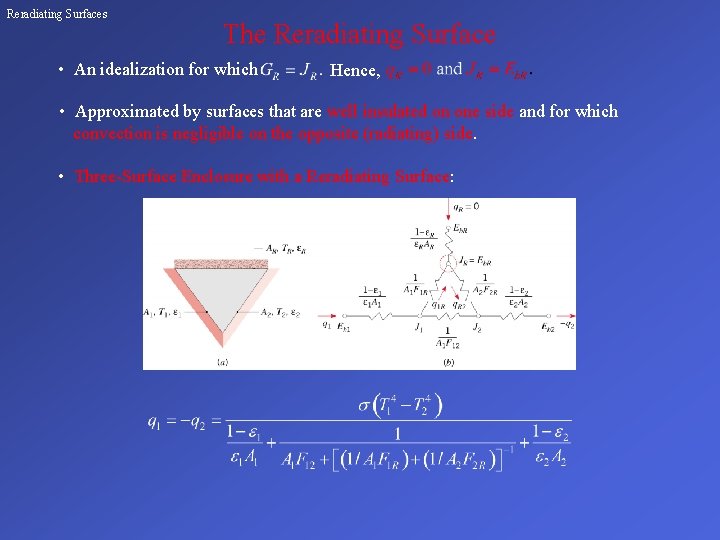
Reradiating Surfaces The Reradiating Surface • An idealization for which Hence, • Approximated by surfaces that are well insulated on one side and for which convection is negligible on the opposite (radiating) side. • Three-Surface Enclosure with a Reradiating Surface:
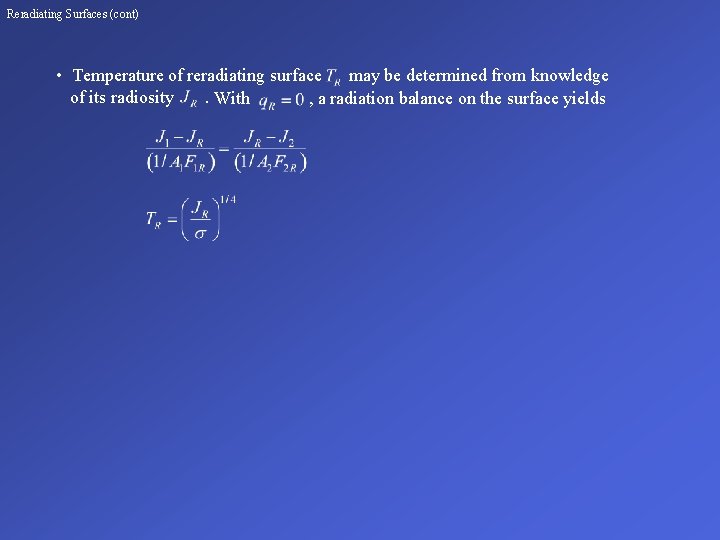
Reradiating Surfaces (cont) • Temperature of reradiating surface may be determined from knowledge of its radiosity. With , a radiation balance on the surface yields
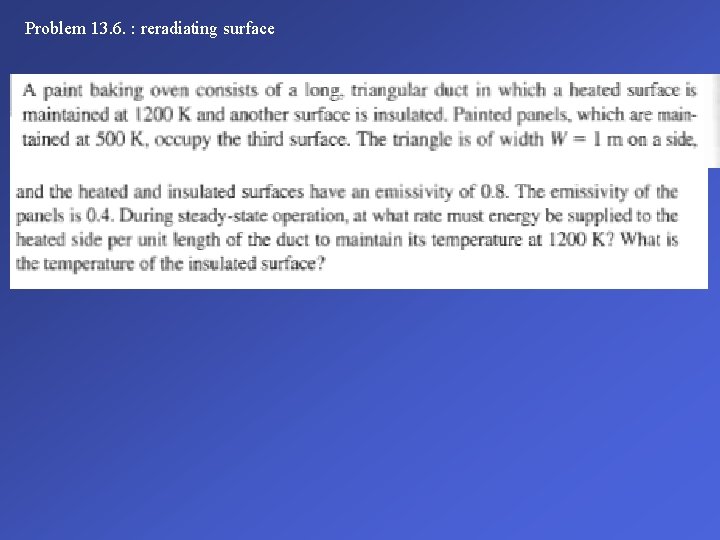
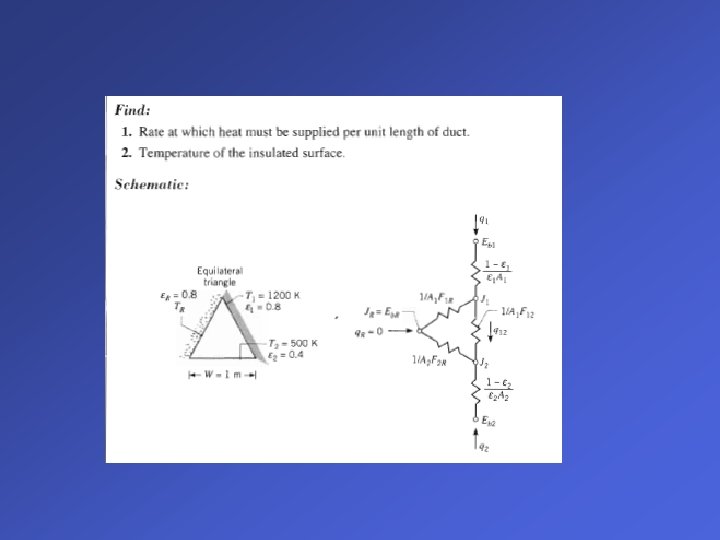
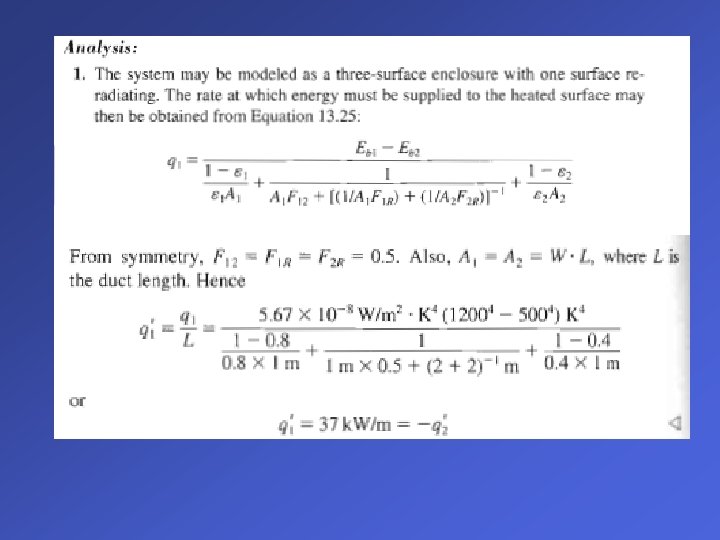
Problem 13. 6. : reradiating surface
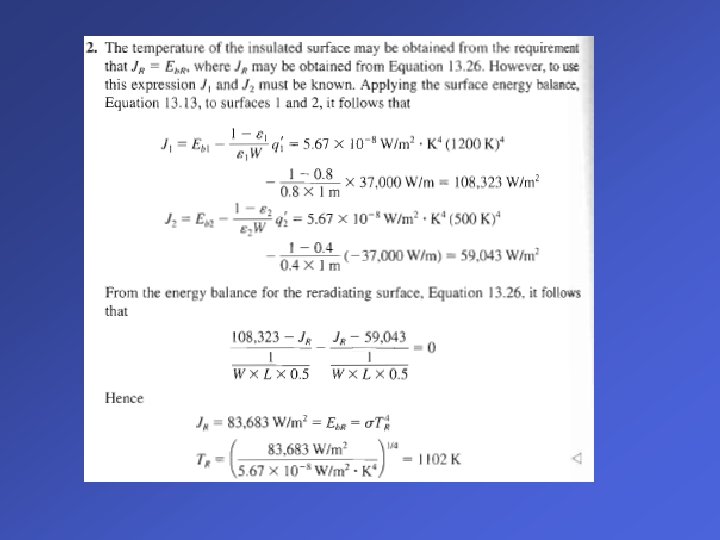
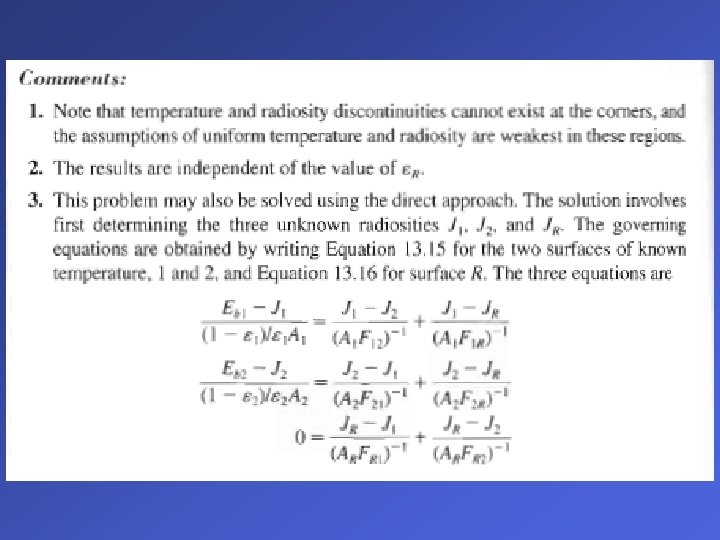
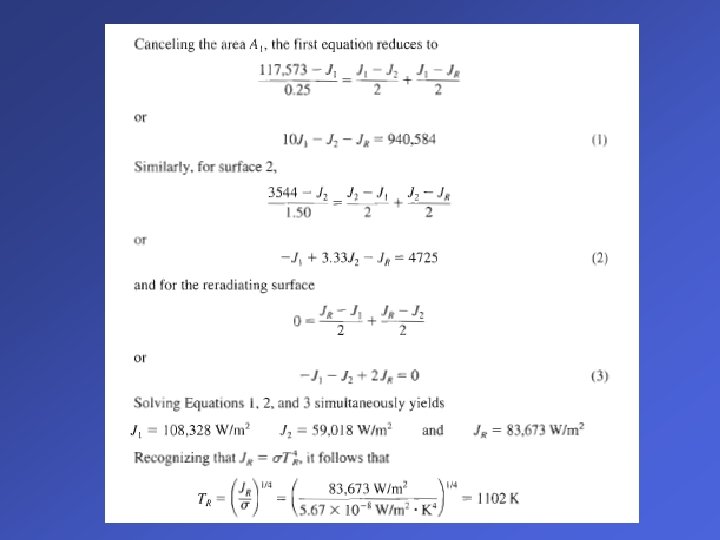
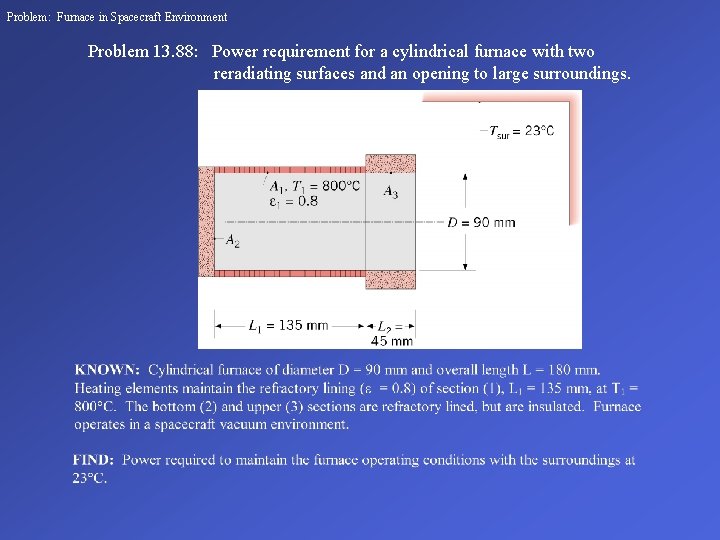
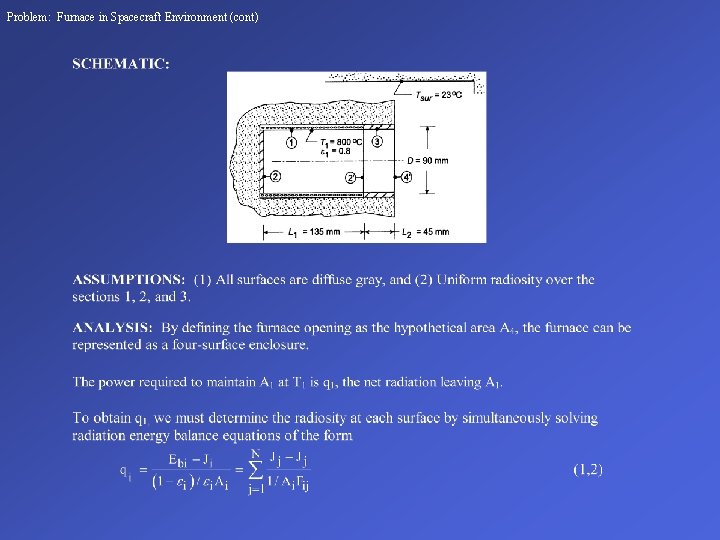
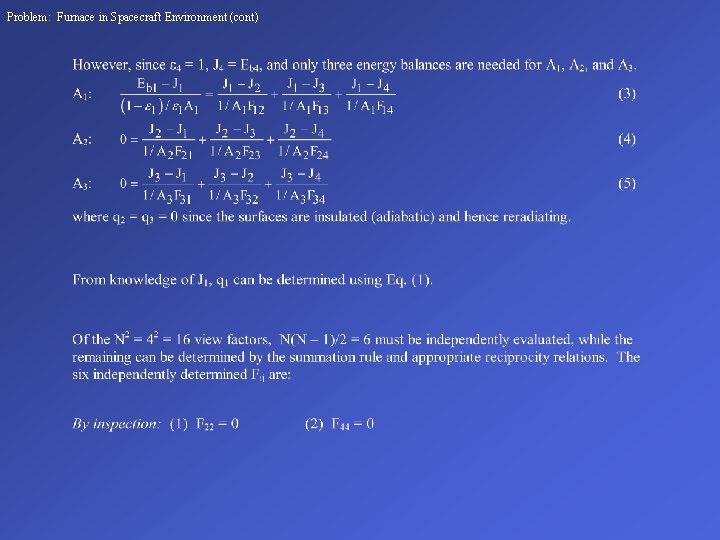
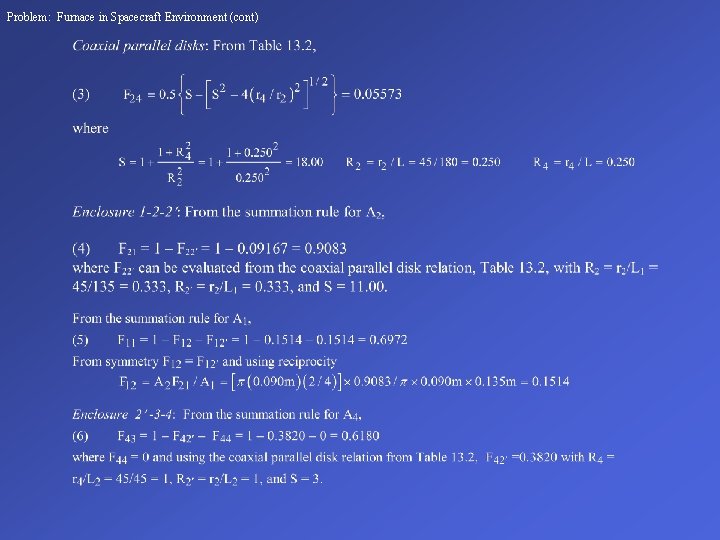
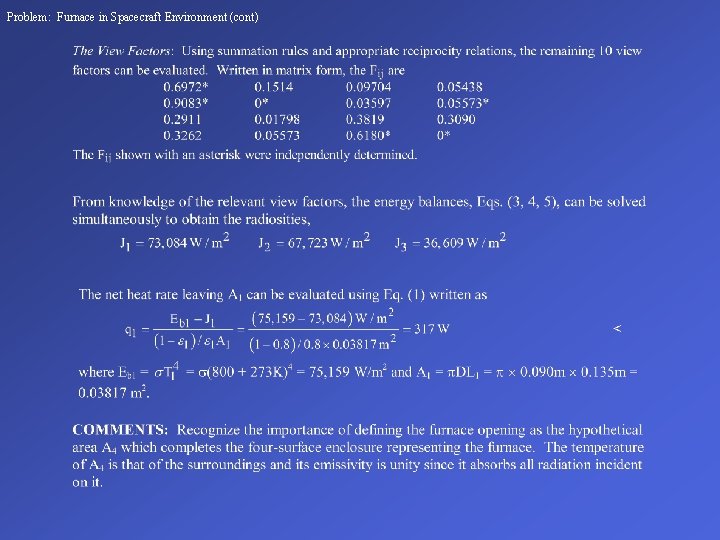
Problem: Furnace in Spacecraft Environment Problem 13. 88: Power requirement for a cylindrical furnace with two reradiating surfaces and an opening to large surroundings.
Problem: Furnace in Spacecraft Environment (cont)
Problem: Furnace in Spacecraft Environment (cont)
Problem: Furnace in Spacecraft Environment (cont)
Problem: Furnace in Spacecraft Environment (cont)
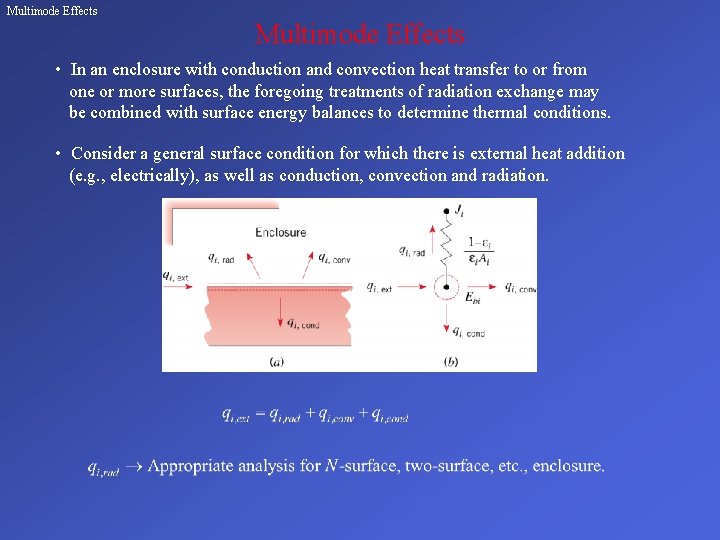
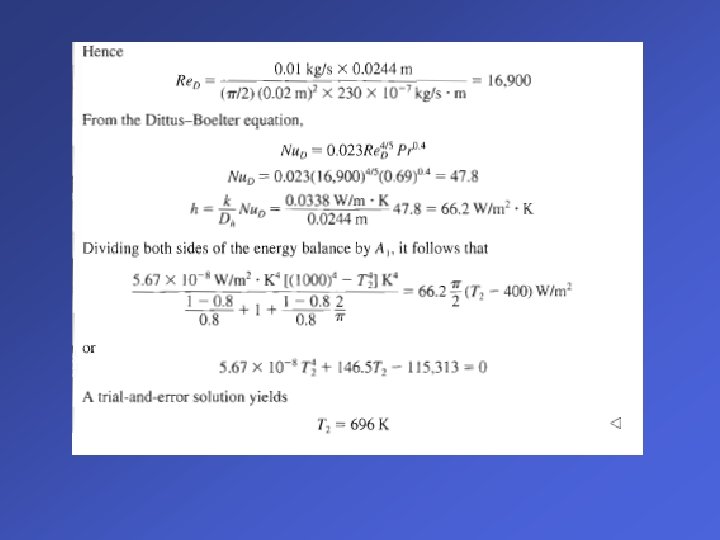
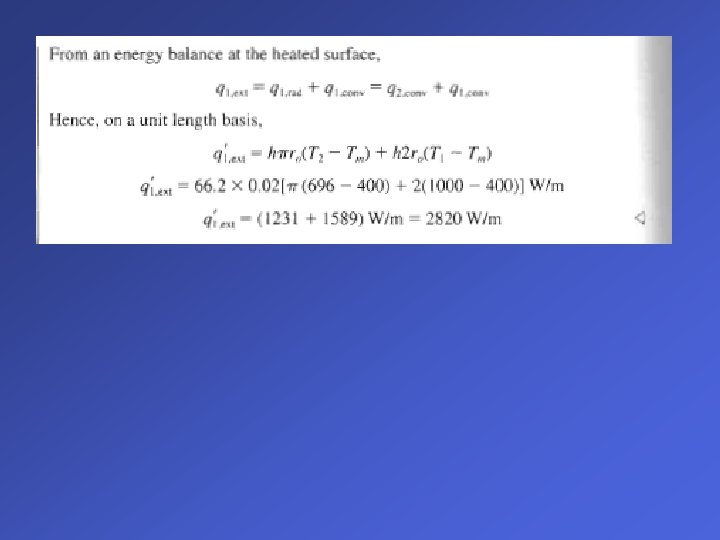
Multimode Effects • In an enclosure with conduction and convection heat transfer to or from one or more surfaces, the foregoing treatments of radiation exchange may be combined with surface energy balances to determine thermal conditions. • Consider a general surface condition for which there is external heat addition (e. g. , electrically), as well as conduction, convection and radiation.
• Hence, in general, qi, rad may be determined from equation (13. 19) or (13. 20), while for special cases such as two surface enclosure and a three surface enclosure with one reradiating surface, it may be determined from equations 13. 23 and 13. 30, respectively. • Conditions are simplified if the back of the surface is insulated, in which case qi, cond=0 Moreover, if there is no external heating and convection is negligible, the surface is reradiating.
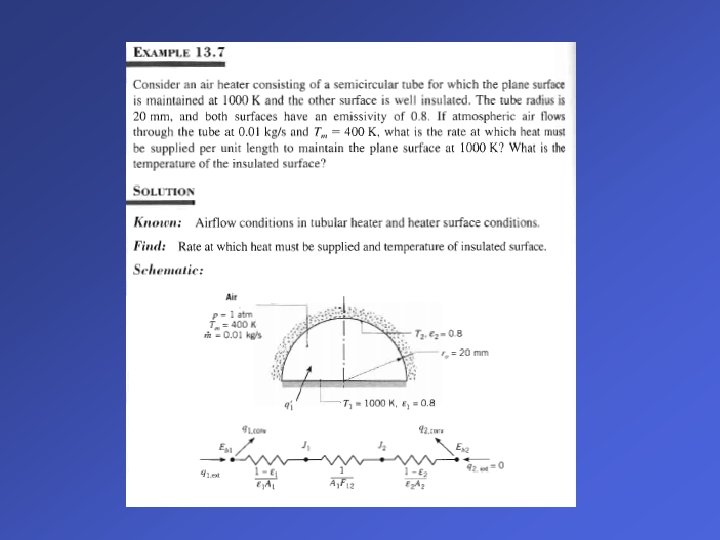
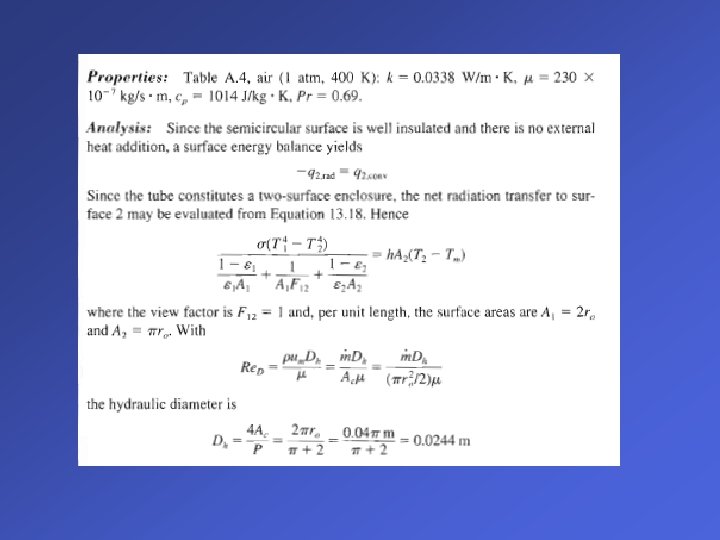
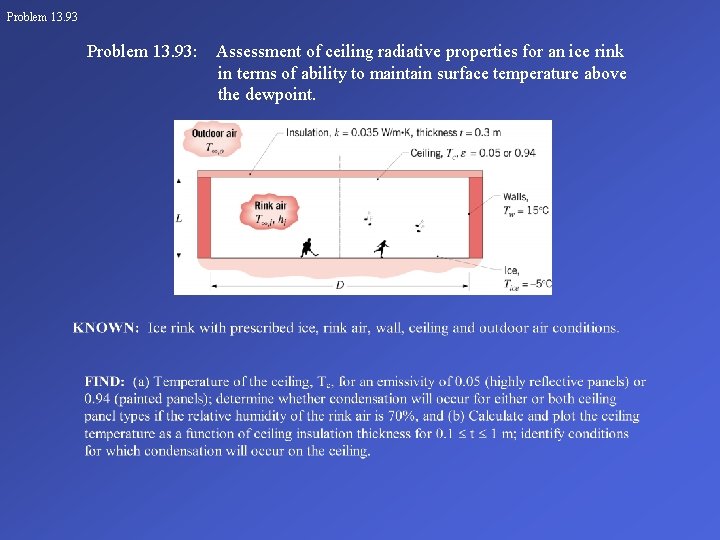
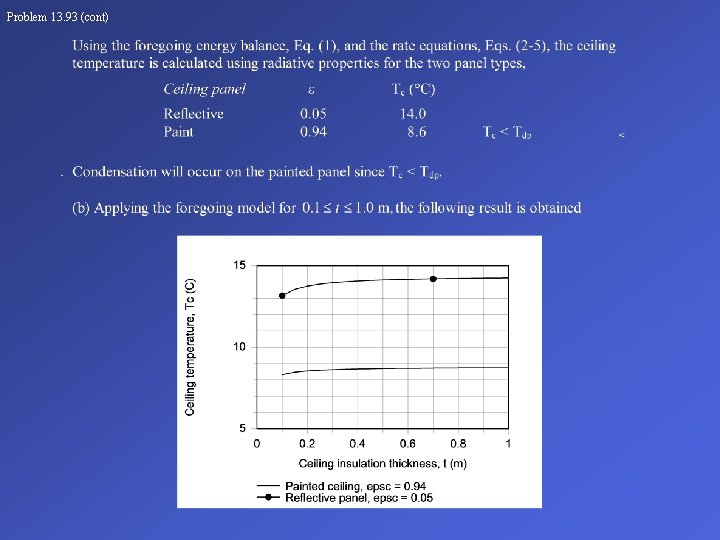
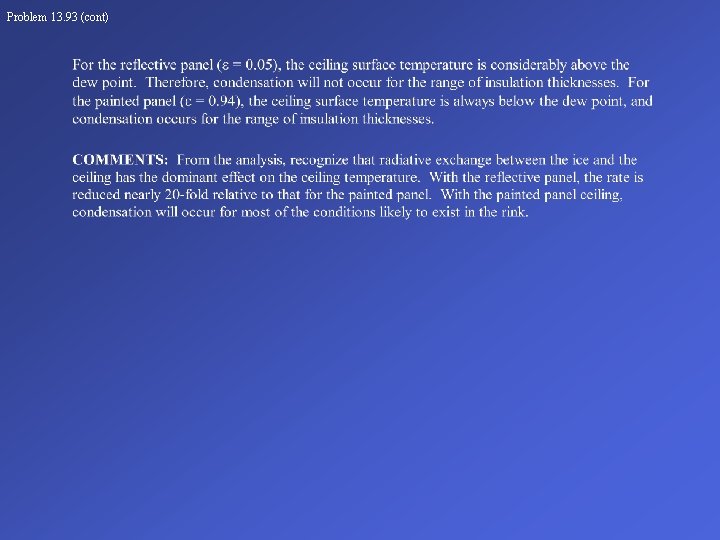
Problem 13. 93: Assessment of ceiling radiative properties for an ice rink in terms of ability to maintain surface temperature above the dewpoint.
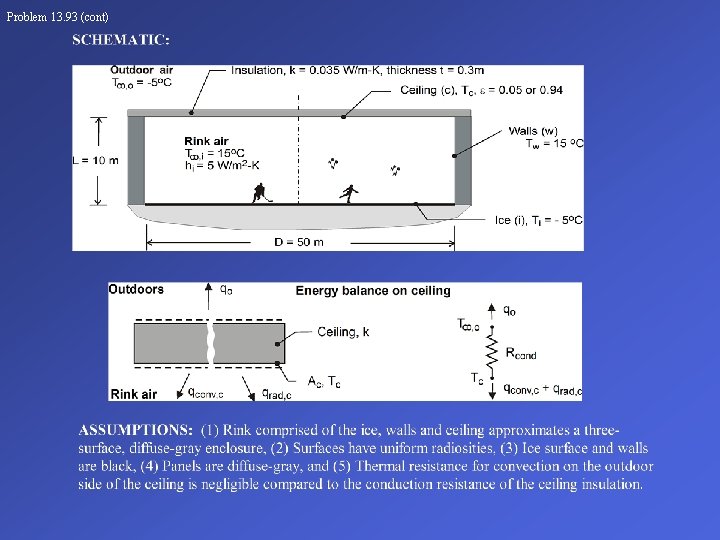
Problem 13. 93 (cont)
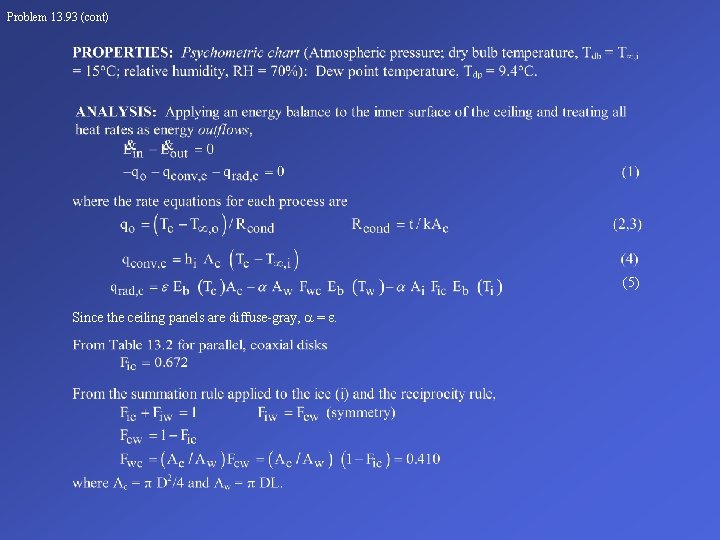
Problem 13. 93 (cont) (5) Since the ceiling panels are diffuse-gray, = .
Problem 13. 93 (cont)
Problem 13. 93 (cont)
- Slides: 67