
Radiation Cooled Target Design Peter Loveridge STFCRAL Mu
- Slides: 24
Radiation Cooled Target Design Peter Loveridge STFC/RAL Mu 2 e Target, Remote Handling, and Heat & Radiation Shield Review Nov 16 -18 2015 1
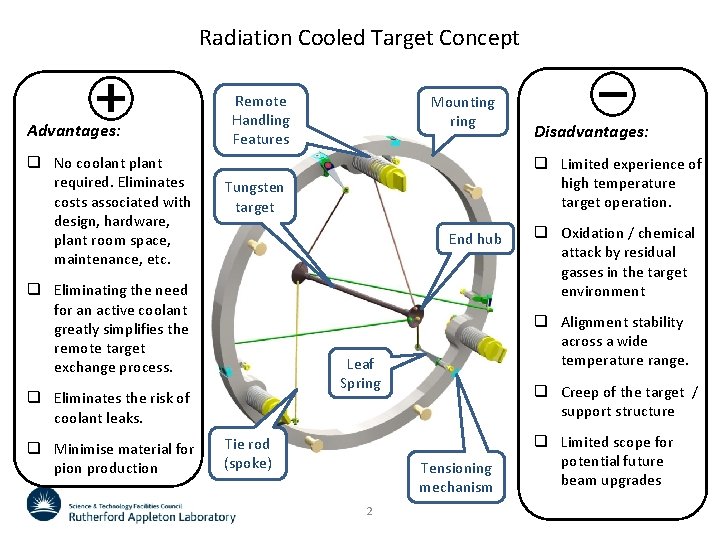
Radiation Cooled Target Concept Advantages: q No coolant plant required. Eliminates costs associated with design, hardware, plant room space, maintenance, etc. Remote Handling Features End hub Tie rod (spoke) q Creep of the target / support structure Tensioning mechanism 2 q Oxidation / chemical attack by residual gasses in the target environment q Alignment stability across a wide temperature range. Leaf Spring q Eliminates the risk of coolant leaks. Disadvantages: q Limited experience of high temperature target operation. Tungsten target q Eliminating the need for an active coolant greatly simplifies the remote target exchange process. q Minimise material for pion production Mounting ring q Limited scope for potential future beam upgrades
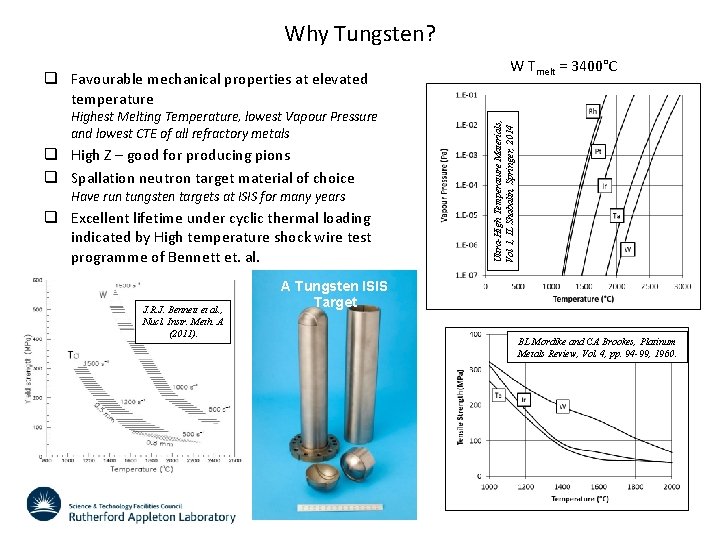
Why Tungsten? Highest Melting Temperature, lowest Vapour Pressure and lowest CTE of all refractory metals q High Z – good for producing pions q Spallation neutron target material of choice Have run tungsten targets at ISIS for many years q Excellent lifetime under cyclic thermal loading indicated by High temperature shock wire test programme of Bennett et. al. J. R. J. Bennett et al. , Nucl. Instr. Meth. A (2011). Ultra-High Temperature Materials, Vol 1, IL Shabalin, Springer, 2014 q Favourable mechanical properties at elevated temperature W Tmelt = 3400°C A Tungsten ISIS Target BL Mordike and CA Brookes, Platinum Metals Review, Vol. 4, pp. 94 -99, 1960. 3
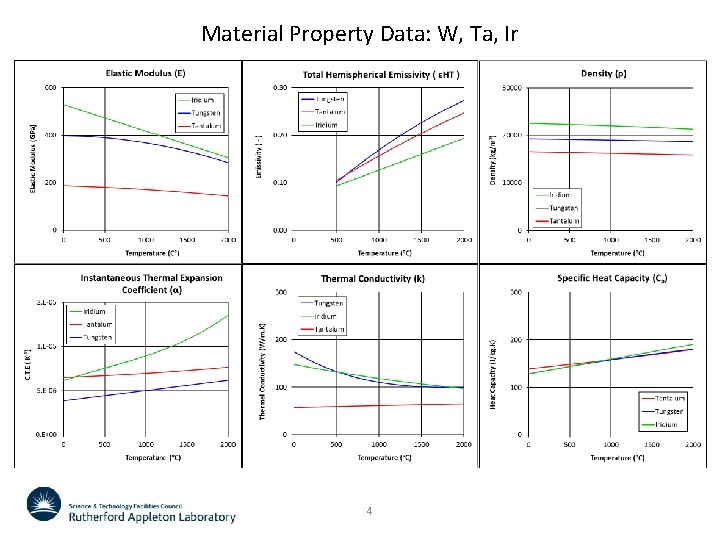
Material Property Data: W, Ta, Ir 4
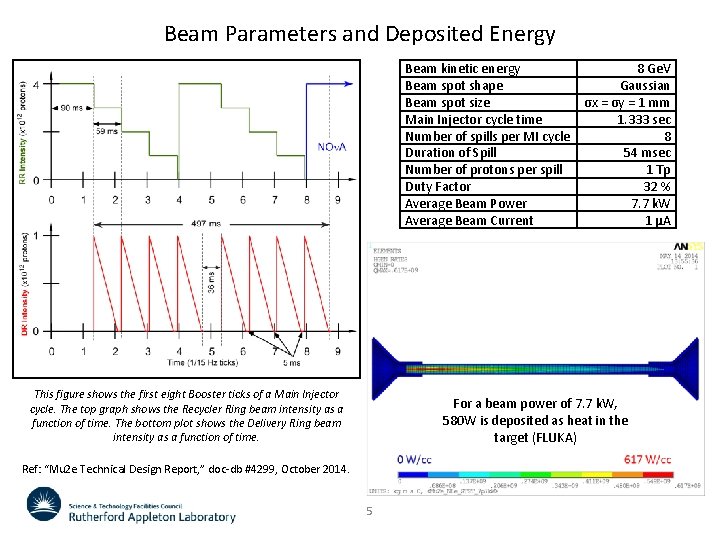
Beam Parameters and Deposited Energy Beam kinetic energy Beam spot shape Beam spot size Main Injector cycle time Number of spills per MI cycle Duration of Spill Number of protons per spill Duty Factor Average Beam Power Average Beam Current This figure shows the first eight Booster ticks of a Main Injector cycle. The top graph shows the Recycler Ring beam intensity as a function of time. The bottom plot shows the Delivery Ring beam intensity as a function of time. 8 Ge. V Gaussian σx = σy = 1 mm 1. 333 sec 8 54 msec 1 Tp 32 % 7. 7 k. W 1 μA For a beam power of 7. 7 k. W, 580 W is deposited as heat in the target (FLUKA) Ref: “Mu 2 e Technical Design Report, ” doc-db #4299, October 2014. 5
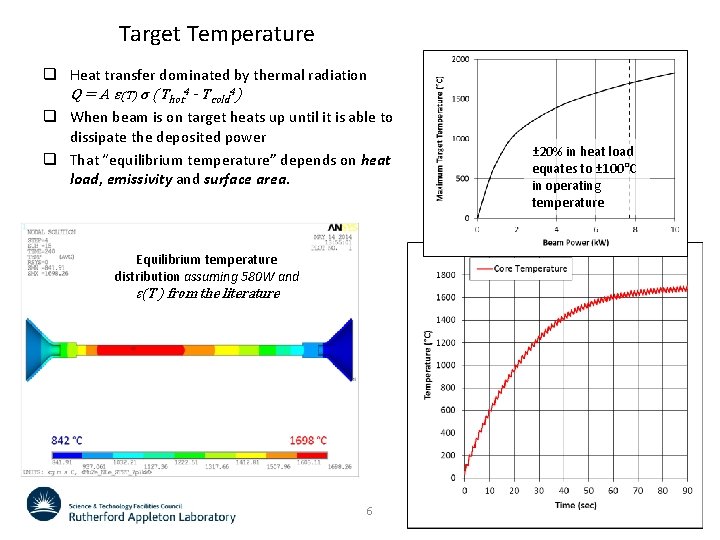
Target Temperature q Heat transfer dominated by thermal radiation Q = A ε(T) σ (Thot 4 - Tcold 4) q When beam is on target heats up until it is able to dissipate the deposited power q That “equilibrium temperature” depends on heat load, emissivity and surface area. Equilibrium temperature distribution assuming 580 W and ε(T ) from the literature 6 ± 20% in heat load equates to ± 100°C in operating temperature
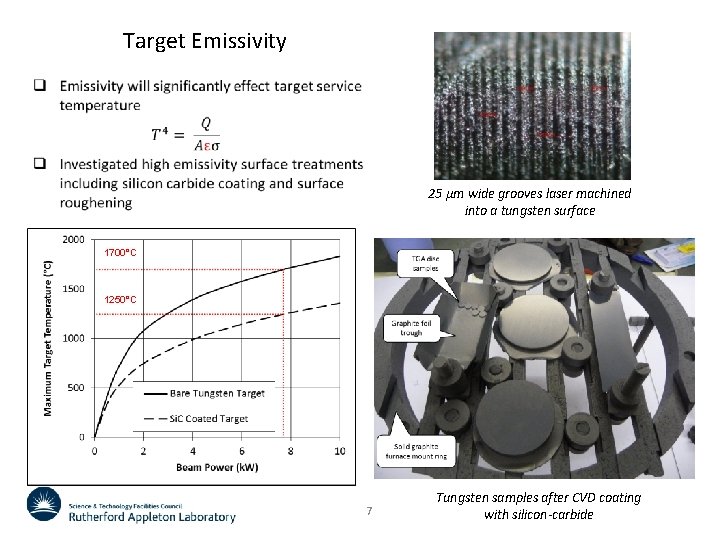
Target Emissivity 25 μm wide grooves laser machined into a tungsten surface 1700°C 1250°C 7 Tungsten samples after CVD coating with silicon-carbide
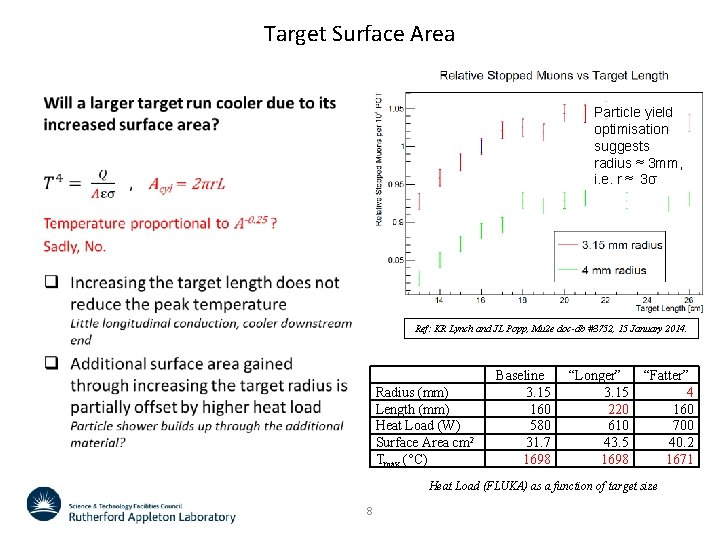
Target Surface Area Particle yield optimisation suggests radius ≈ 3 mm, i. e. r ≈ 3σ Ref: KR Lynch and JL Popp, Mu 2 e doc-db #3752, 15 January 2014. Radius (mm) Length (mm) Heat Load (W) Surface Area cm 2 Tmax (°C) Baseline 3. 15 160 580 31. 7 1698 “Longer” 3. 15 220 610 43. 5 1698 “Fatter” 4 160 700 40. 2 1671 Heat Load (FLUKA) as a function of target size 8
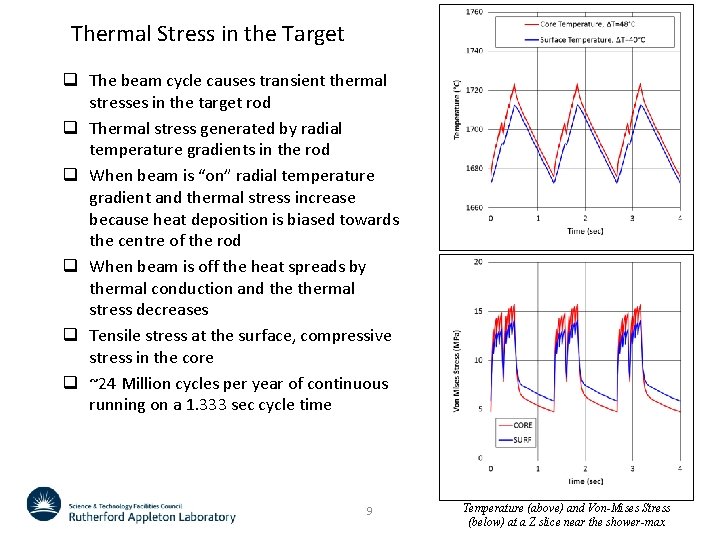
Thermal Stress in the Target q The beam cycle causes transient thermal stresses in the target rod q Thermal stress generated by radial temperature gradients in the rod q When beam is “on” radial temperature gradient and thermal stress increase because heat deposition is biased towards the centre of the rod q When beam is off the heat spreads by thermal conduction and thermal stress decreases q Tensile stress at the surface, compressive stress in the core q ~24 Million cycles per year of continuous running on a 1. 333 sec cycle time 9 Temperature (above) and Von-Mises Stress (below) at a Z slice near the shower-max
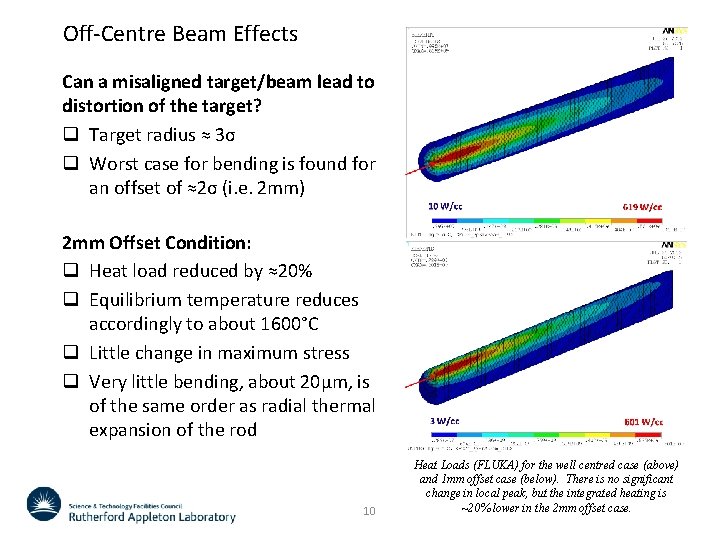
Off-Centre Beam Effects Can a misaligned target/beam lead to distortion of the target? q Target radius ≈ 3σ q Worst case for bending is found for an offset of ≈2σ (i. e. 2 mm) 2 mm Offset Condition: q Heat load reduced by ≈20% q Equilibrium temperature reduces accordingly to about 1600°C q Little change in maximum stress q Very little bending, about 20μm, is of the same order as radial thermal expansion of the rod 10 Heat Loads (FLUKA) for the well centred case (above) and 1 mm offset case (below). There is no significant change in local peak, but the integrated heating is ~20% lower in the 2 mm offset case.
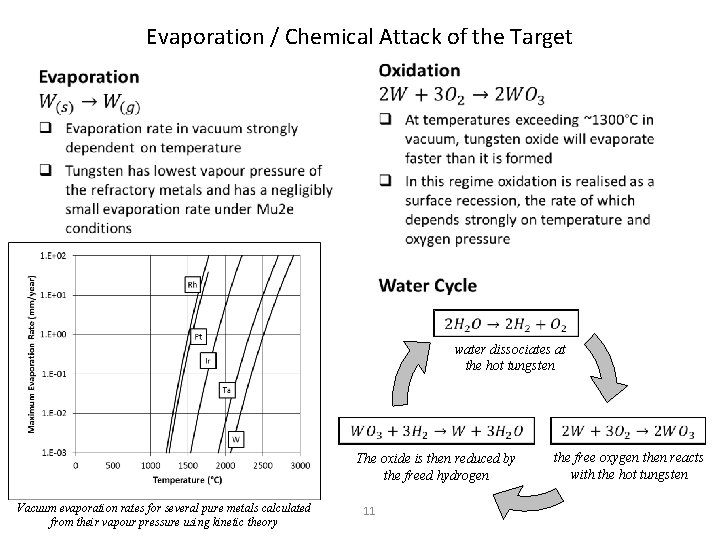
Evaporation / Chemical Attack of the Target water dissociates at the hot tungsten The oxide is then reduced by the freed hydrogen Vacuum evaporation rates for several pure metals calculated from their vapour pressure using kinetic theory 11 the free oxygen then reacts with the hot tungsten
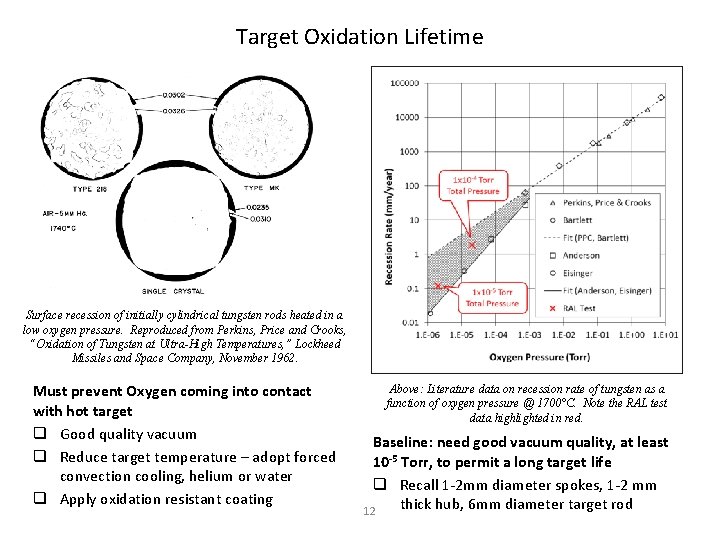
Target Oxidation Lifetime Surface recession of initially cylindrical tungsten rods heated in a low oxygen pressure. Reproduced from Perkins, Price and Crooks, “Oxidation of Tungsten at Ultra-High Temperatures, ” Lockheed Missiles and Space Company, November 1962. Must prevent Oxygen coming into contact with hot target q Good quality vacuum q Reduce target temperature – adopt forced convection cooling, helium or water q Apply oxidation resistant coating Above: Literature data on recession rate of tungsten as a function of oxygen pressure @ 1700°C. Note the RAL test data highlighted in red. Baseline: need good vacuum quality, at least 10 -5 Torr, to permit a long target life q Recall 1 -2 mm diameter spokes, 1 -2 mm thick hub, 6 mm diameter target rod 12
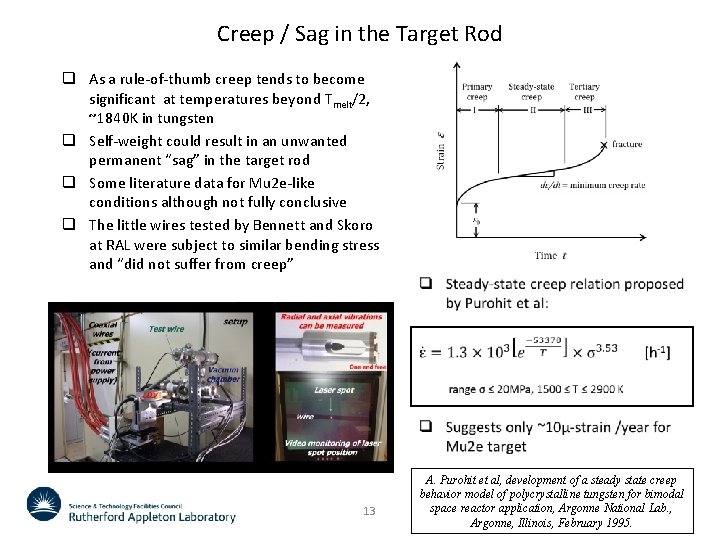
Creep / Sag in the Target Rod q As a rule-of-thumb creep tends to become significant at temperatures beyond Tmelt/2, ~1840 K in tungsten q Self-weight could result in an unwanted permanent “sag” in the target rod q Some literature data for Mu 2 e-like conditions although not fully conclusive q The little wires tested by Bennett and Skoro at RAL were subject to similar bending stress and “did not suffer from creep” 13 A. Purohit et al, development of a steady state creep behavior model of polycrystalline tungsten for bimodal space reactor application, Argonne National Lab. , Argonne, Illinois, February 1995.
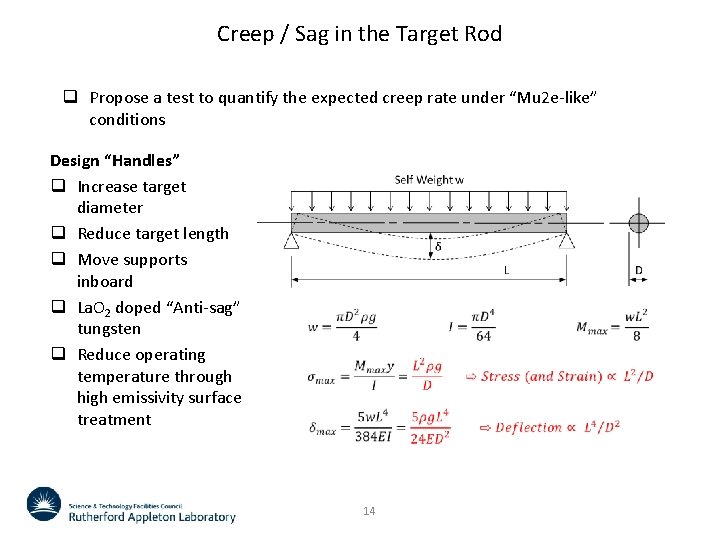
Creep / Sag in the Target Rod q Propose a test to quantify the expected creep rate under “Mu 2 e-like” conditions Design “Handles” q Increase target diameter q Reduce target length q Move supports inboard q La. O 2 doped “Anti-sag” tungsten q Reduce operating temperature through high emissivity surface treatment 14
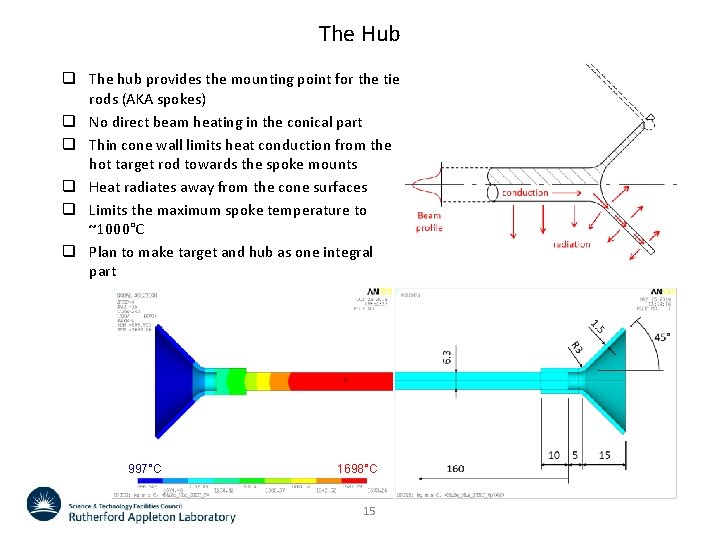
The Hub q The hub provides the mounting point for the tie rods (AKA spokes) q No direct beam heating in the conical part q Thin cone wall limits heat conduction from the hot target rod towards the spoke mounts q Heat radiates away from the cone surfaces q Limits the maximum spoke temperature to ~1000°C q Plan to make target and hub as one integral part 997°C 1698°C 15
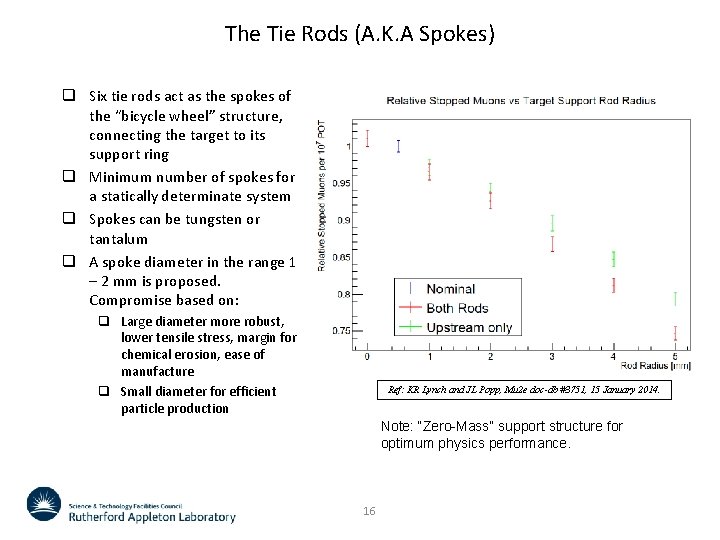
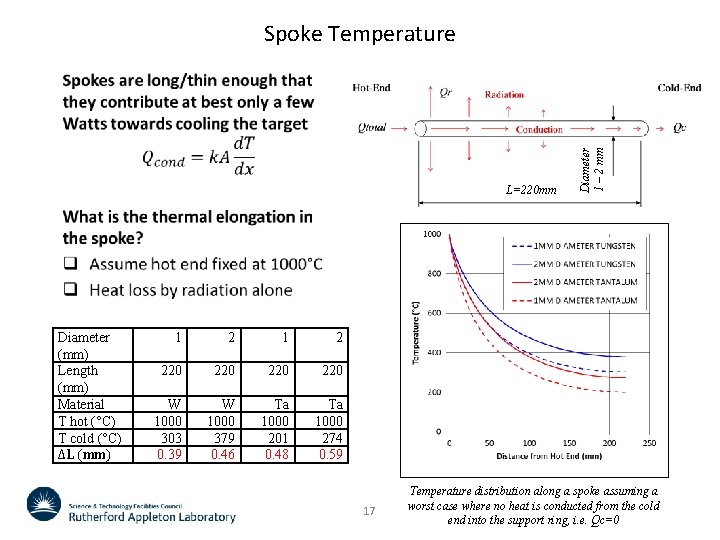
The Tie Rods (A. K. A Spokes) q Six tie rods act as the spokes of the “bicycle wheel” structure, connecting the target to its support ring q Minimum number of spokes for a statically determinate system q Spokes can be tungsten or tantalum q A spoke diameter in the range 1 – 2 mm is proposed. Compromise based on: q Large diameter more robust, lower tensile stress, margin for chemical erosion, ease of manufacture q Small diameter for efficient particle production Ref: KR Lynch and JL Popp, Mu 2 e doc-db #3751, 15 January 2014. Note: “Zero-Mass” support structure for optimum physics performance. 16
L=220 mm Diameter (mm) Length (mm) Material T hot (°C) T cold (°C) ΔL (mm) 1 2 220 220 W 1000 303 0. 39 W 1000 379 0. 46 Ta 1000 201 0. 48 Ta 1000 274 0. 59 17 Diameter 1 – 2 mm Spoke Temperature distribution along a spoke assuming a worst case where no heat is conducted from the cold end into the support ring, i. e. Qc=0
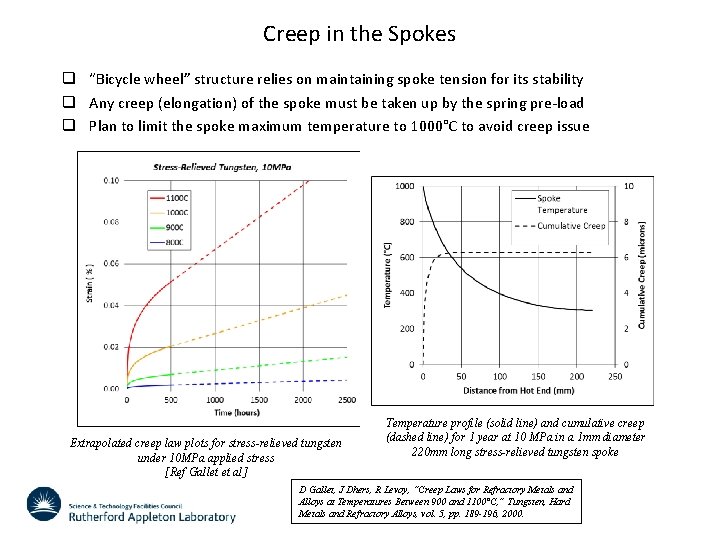
Creep in the Spokes q “Bicycle wheel” structure relies on maintaining spoke tension for its stability q Any creep (elongation) of the spoke must be taken up by the spring pre-load q Plan to limit the spoke maximum temperature to 1000°C to avoid creep issue Extrapolated creep law plots for stress-relieved tungsten under 10 MPa applied stress [Ref Gallet et al] Temperature profile (solid line) and cumulative creep (dashed line) for 1 year at 10 MPa in a 1 mm diameter 220 mm long stress-relieved tungsten spoke D Gallet, J Dhers, R Levoy, “Creep Laws for Refractory Metals and Alloys at Temperatures Between 900 and 1100°C, ” Tungsten, Hard 18 Alloys, vol. 5, pp. 189 -196, 2000. Metals and Refractory
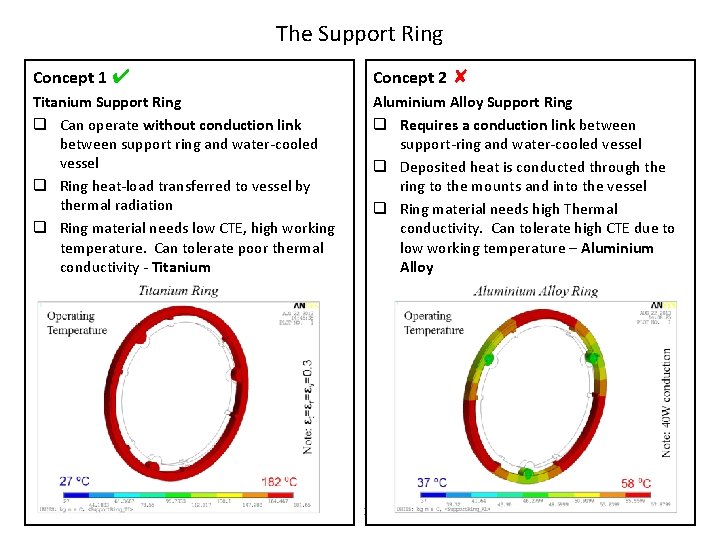
The Support Ring Concept 1 ✔ Concept 2 ✘ Titanium Support Ring q Can operate without conduction link between support ring and water-cooled vessel q Ring heat-load transferred to vessel by thermal radiation q Ring material needs low CTE, high working temperature. Can tolerate poor thermal conductivity - Titanium Aluminium Alloy Support Ring q Requires a conduction link between support-ring and water-cooled vessel q Deposited heat is conducted through the ring to the mounts and into the vessel q Ring material needs high Thermal conductivity. Can tolerate high CTE due to low working temperature – Aluminium Alloy 19
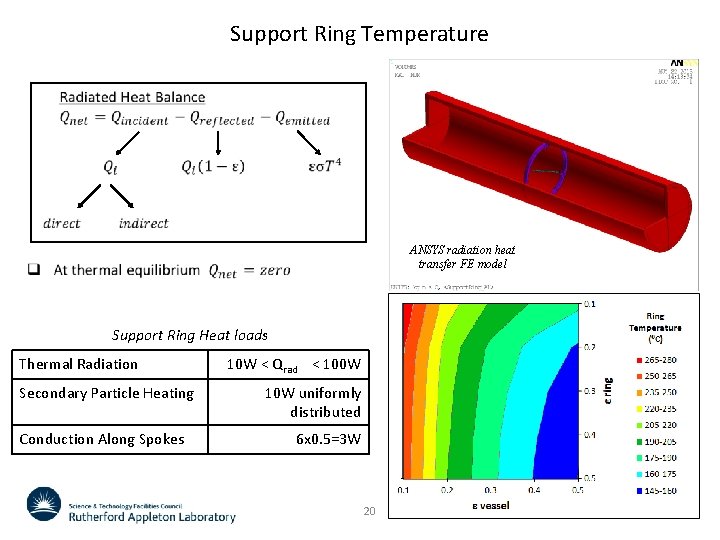
Support Ring Temperature • ANSYS radiation heat transfer FE model Support Ring Heat loads Thermal Radiation Secondary Particle Heating Conduction Along Spokes 10 W < Qrad < 100 W 10 W uniformly distributed 6 x 0. 5=3 W 20
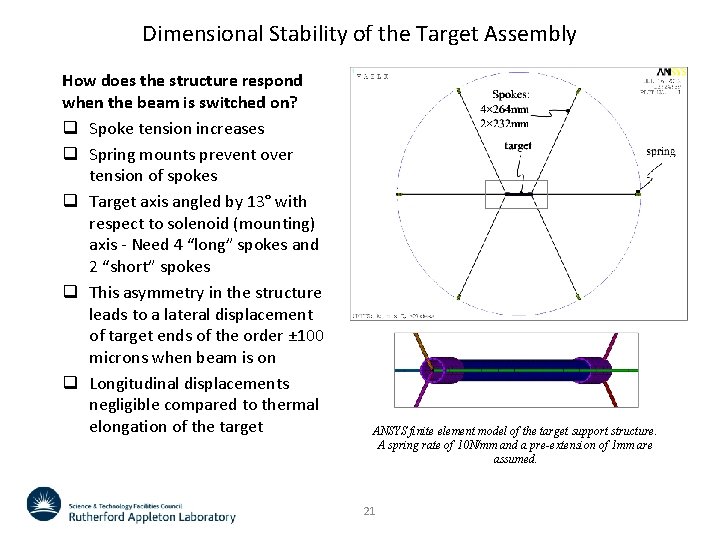
Dimensional Stability of the Target Assembly How does the structure respond when the beam is switched on? q Spoke tension increases q Spring mounts prevent over tension of spokes q Target axis angled by 13° with respect to solenoid (mounting) axis - Need 4 “long” spokes and 2 “short” spokes q This asymmetry in the structure leads to a lateral displacement of target ends of the order ± 100 microns when beam is on q Longitudinal displacements negligible compared to thermal elongation of the target ANSYS finite element model of the target support structure. A spring rate of 10 N/mm and a pre-extension of 1 mm are assumed. 21
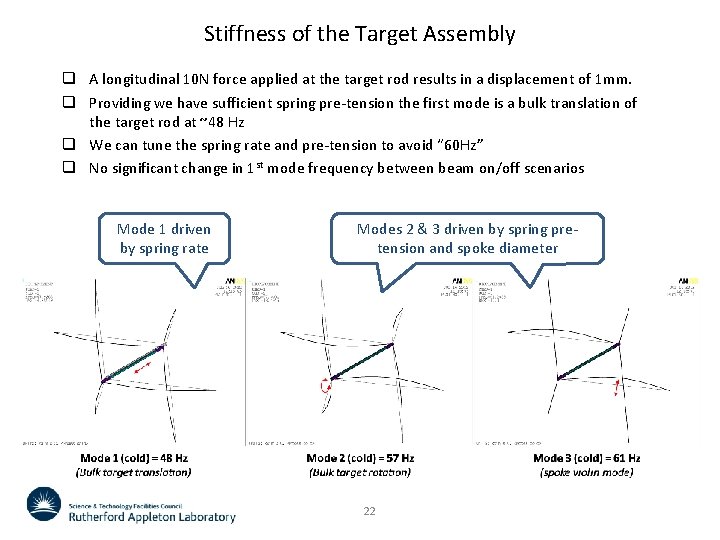
Stiffness of the Target Assembly q A longitudinal 10 N force applied at the target rod results in a displacement of 1 mm. q Providing we have sufficient spring pre-tension the first mode is a bulk translation of the target rod at ~48 Hz q We can tune the spring rate and pre-tension to avoid “ 60 Hz” q No significant change in 1 st mode frequency between beam on/off scenarios Mode 1 driven by spring rate Modes 2 & 3 driven by spring pretension and spoke diameter 22
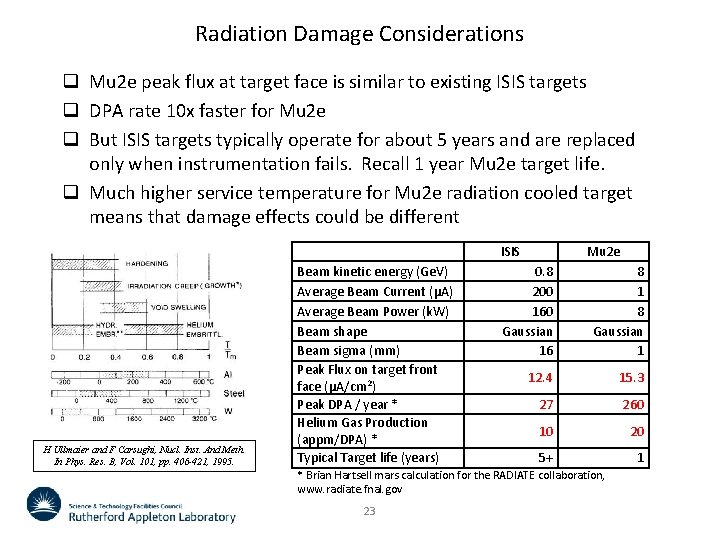
Radiation Damage Considerations q Mu 2 e peak flux at target face is similar to existing ISIS targets q DPA rate 10 x faster for Mu 2 e q But ISIS targets typically operate for about 5 years and are replaced only when instrumentation fails. Recall 1 year Mu 2 e target life. q Much higher service temperature for Mu 2 e radiation cooled target means that damage effects could be different ISIS H Ullmaier and F Carsughi, Nucl. Inst. And Meth. In Phys. Res. B, Vol. 101, pp. 406 -421, 1995. Beam kinetic energy (Ge. V) Average Beam Current (μA) Average Beam Power (k. W) Beam shape Beam sigma (mm) Peak Flux on target front face (μA/cm 2) Peak DPA / year * Helium Gas Production (appm/DPA) * Typical Target life (years) Mu 2 e 0. 8 200 160 Gaussian 16 8 1 8 Gaussian 1 12. 4 15. 3 27 260 10 20 5+ 1 * Brian Hartsell mars calculation for the RADIATE collaboration, www. radiate. fnal. gov 23
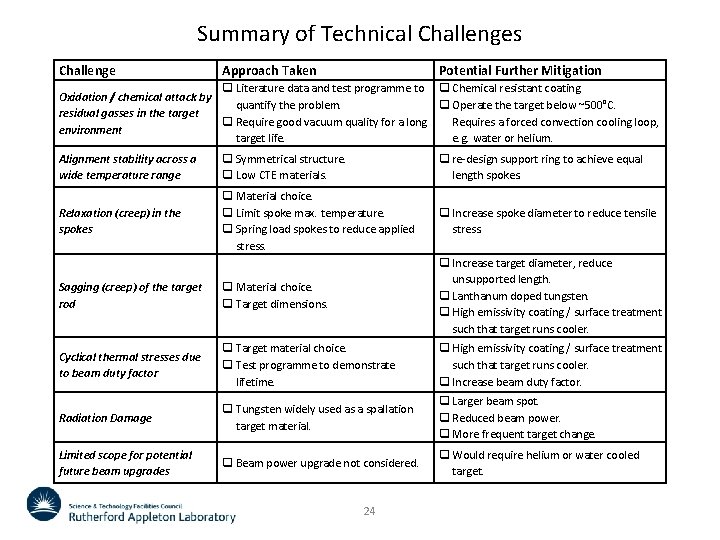
Summary of Technical Challenges Challenge Approach Taken Potential Further Mitigation q Literature data and test programme to q Chemical resistant coating Oxidation / chemical attack by quantify the problem. q Operate the target below ~500°C. residual gasses in the target q Require good vacuum quality for a long Requires a forced convection cooling loop, environment target life. e. g. water or helium. Alignment stability across a wide temperature range q Symmetrical structure. q Low CTE materials. q re-design support ring to achieve equal length spokes. Relaxation (creep) in the spokes q Material choice. q Limit spoke max. temperature. q Spring load spokes to reduce applied stress. q Increase spoke diameter to reduce tensile stress. Sagging (creep) of the target rod q Material choice. q Target dimensions. q Increase target diameter, reduce unsupported length. q Lanthanum doped tungsten. q High emissivity coating / surface treatment such that target runs cooler. Cyclical thermal stresses due to beam duty factor q Target material choice. q Test programme to demonstrate lifetime. q High emissivity coating / surface treatment such that target runs cooler. q Increase beam duty factor. Radiation Damage q Tungsten widely used as a spallation target material. q Larger beam spot. q Reduced beam power. q More frequent target change. Limited scope for potential future beam upgrades q Beam power upgrade not considered. q Would require helium or water cooled target. 24