
RADIATION BIOLOGY Lecture 4 By Dr Zaid Shaker
RADIATION BIOLOGY Lecture (4) By Dr. Zaid Shaker Naji
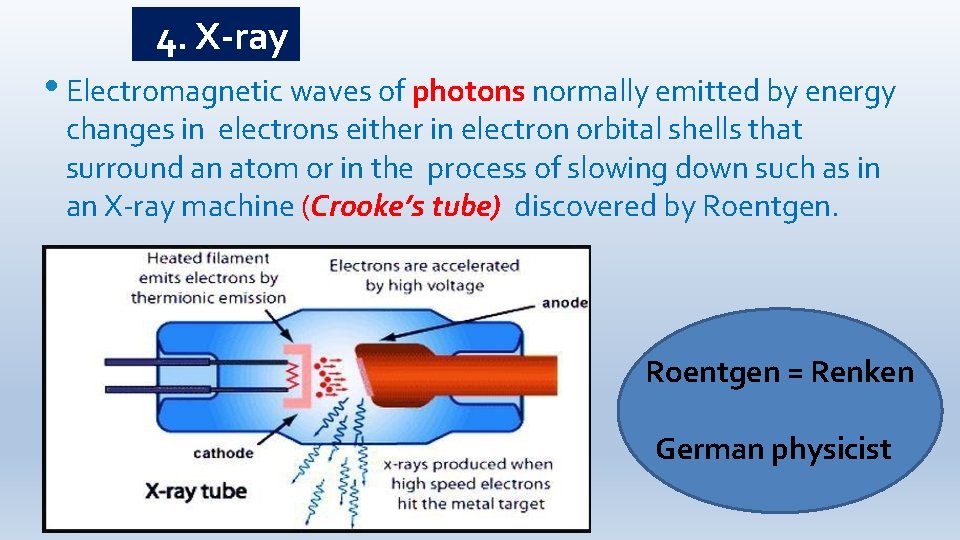
4. X-ray • Electromagnetic waves of photons normally emitted by energy changes in electrons either in electron orbital shells that surround an atom or in the process of slowing down such as in an X-ray machine (Crooke’s tube) discovered by Roentgen = Renken German physicist
5. Neutron Radiation • Neutrons are neutral particles with same mass of proton emitted during spontaneous or induced: nuclear fission nuclear fusion process other nuclear reactions • Neutrons are not directly ionizing radiation, but produce secondary events that occur as collisions with matter called: Scattering events Capture events
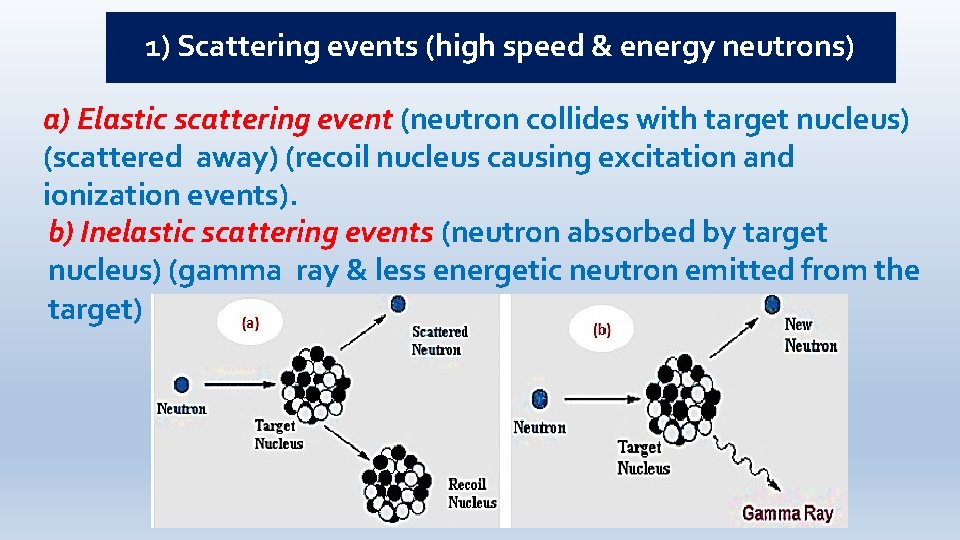
1) Scattering events (high speed & energy neutrons) a) Elastic scattering event (neutron collides with target nucleus) (scattered away) (recoil nucleus causing excitation and ionization events). b) Inelastic scattering events (neutron absorbed by target nucleus) (gamma ray & less energetic neutron emitted from the target)
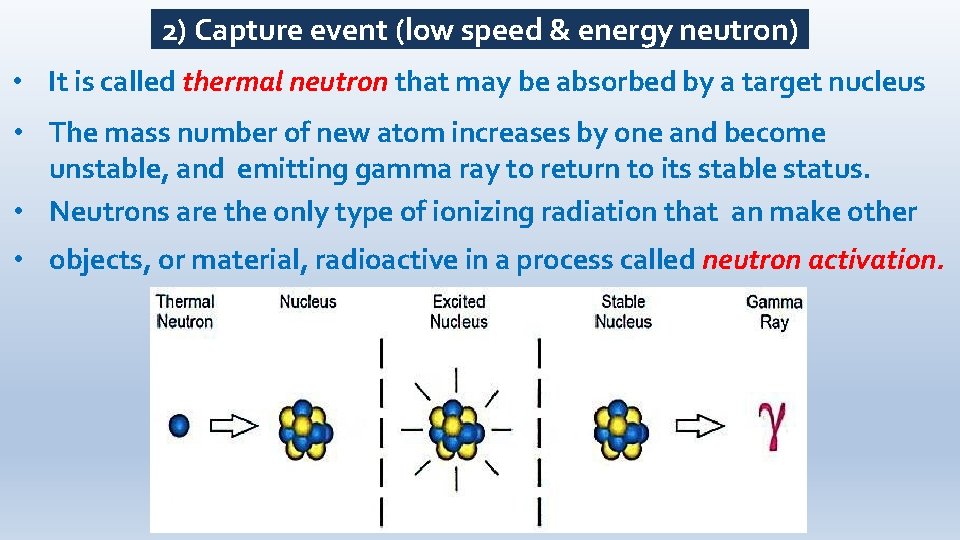
2) Capture event (low speed & energy neutron) • It is called thermal neutron that may be absorbed by a target nucleus • The mass number of new atom increases by one and become unstable, and emitting gamma ray to return to its stable status. • Neutrons are the only type of ionizing radiation that an make other • objects, or material, radioactive in a process called neutron activation.

Properties of Ionizing Radiations
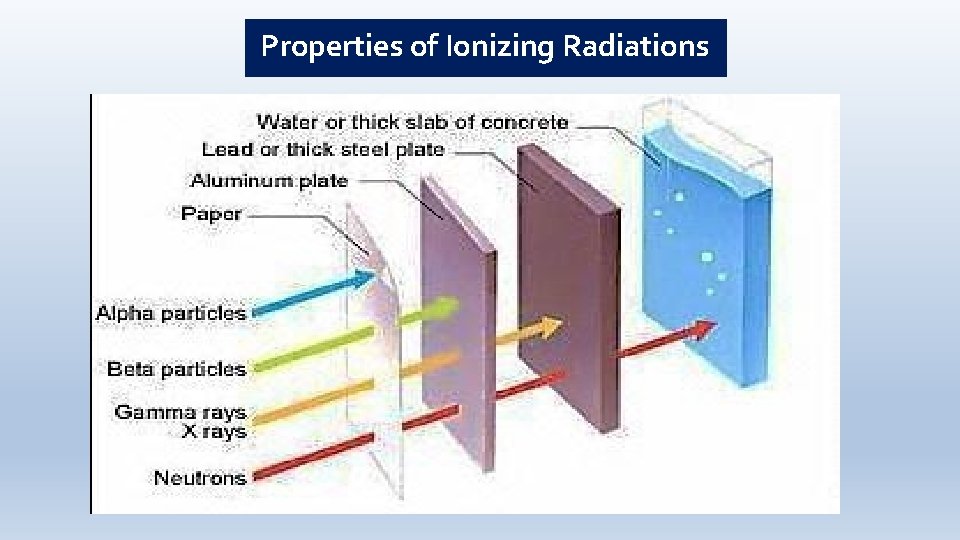
Properties of Ionizing Radiations
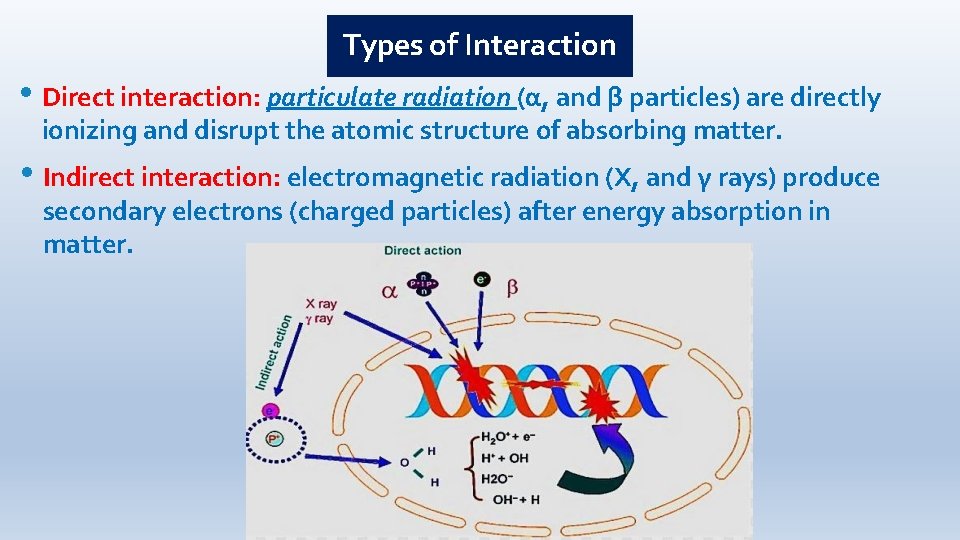
Types of Interaction • Direct interaction: particulate radiation (α, and β particles) are directly ionizing and disrupt the atomic structure of absorbing matter. • Indirect interaction: electromagnetic radiation (X, and γ rays) produce secondary electrons (charged particles) after energy absorption in matter.
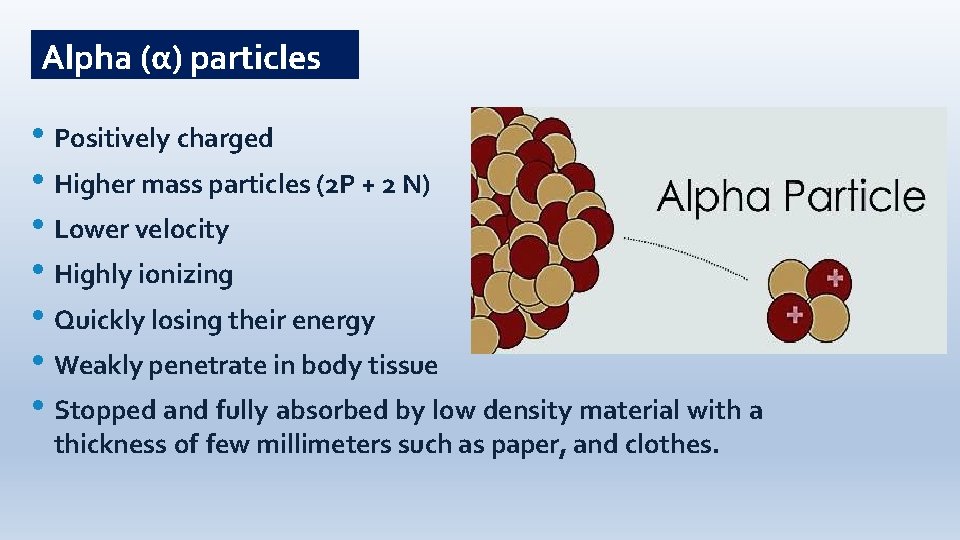
Alpha (α) particles • Positively charged • Higher mass particles (2 P + 2 N) • Lower velocity • Highly ionizing • Quickly losing their energy • Weakly penetrate in body tissue • Stopped and fully absorbed by low density material with a thickness of few millimeters such as paper, and clothes.
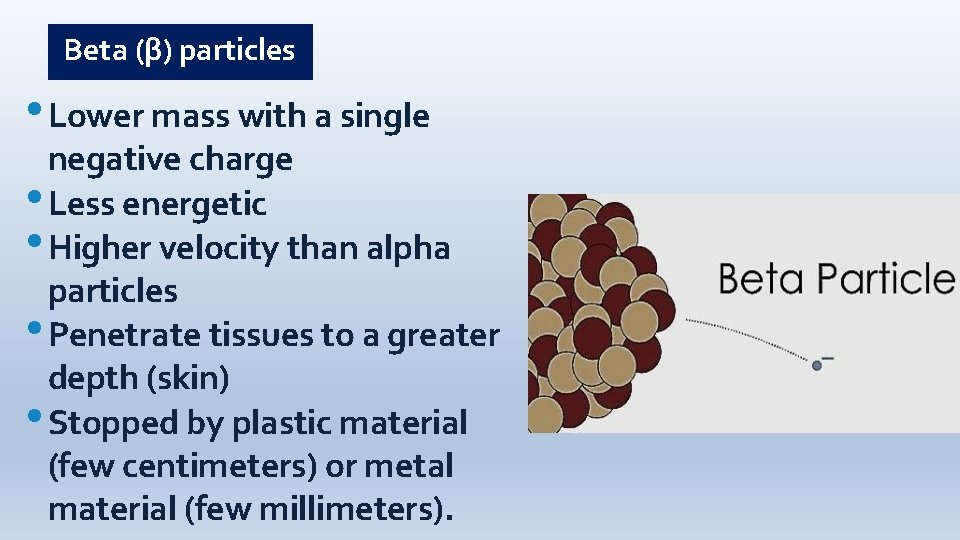
Beta (β) particles • Lower mass with a single negative charge • Less energetic • Higher velocity than alpha particles • Penetrate tissues to a greater depth (skin) • Stopped by plastic material (few centimeters) or metal material (few millimeters).
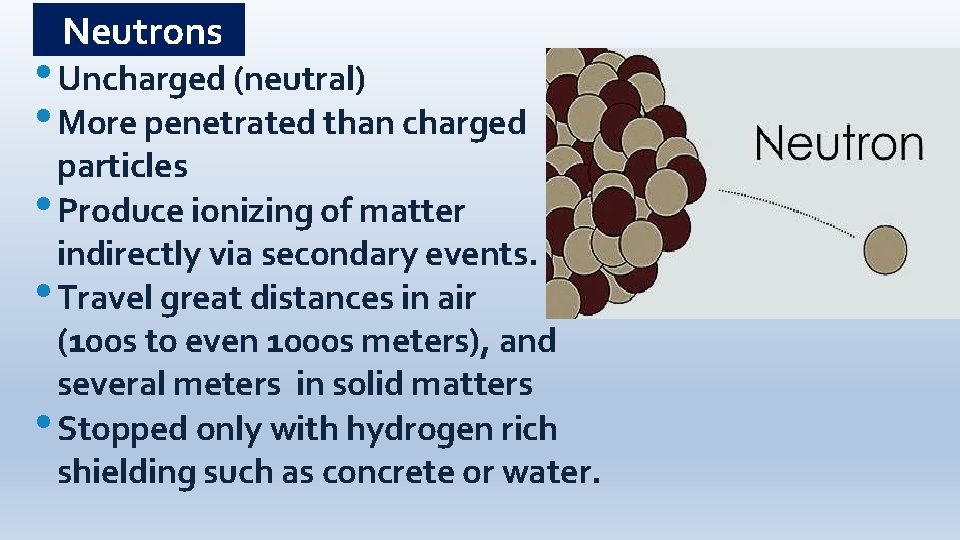
Neutrons • Uncharged (neutral) • More penetrated than charged particles • Produce ionizing of matter indirectly via secondary events. • Travel great distances in air (100 s to even 1000 s meters), and several meters in solid matters • Stopped only with hydrogen rich shielding such as concrete or water.
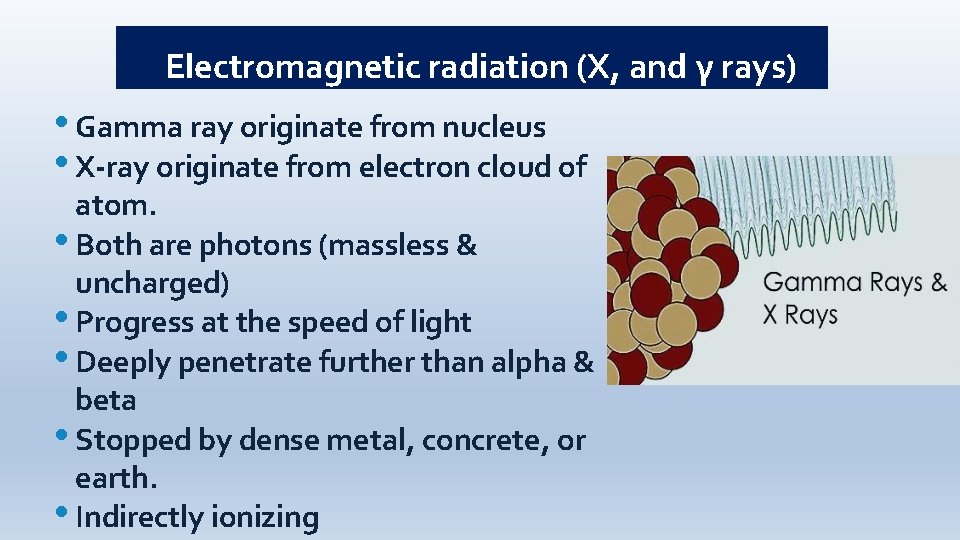
Electromagnetic radiation (X, and γ rays) • Gamma ray originate from nucleus • X-ray originate from electron cloud of atom. • Both are photons (massless & uncharged) • Progress at the speed of light • Deeply penetrate further than alpha & beta • Stopped by dense metal, concrete, or earth. • Indirectly ionizing
Sources of Radiation A. Natural Sources 1. Cosmic radiation 2. Terrestrial radiation 3. Internal Source B. Man - made Sources 1. Public exposure 2. Occupational exposure
Natural Source: Cosmic radiation • Charged particles from the sun and stars interact with the earth’s atmosphere and magnetic field to produce a shower of cosmic radiation consists of positively charged particles, as well as gamma radiation. • The exposure of an individual to cosmic rays is greater at higher elevations than at sea level because at higher elevations the amount of atmosphere shielding decreases and thus the dose of cosmic rays increases.
Natural Source: Terrestrial radiation • Ground, rocks, building materials and drinking water contained many radioactive materials such as radium, uranium and thorium which are ingested with food and water. • Radon gas is originated from the decay of natural uranium in soil, and when it is inhaled by human emits alpha radiation that cause lung cancer. • The dose from terrestrial sources also varies in different parts of the world according to the concentrations of uranium and thorium in their soil.
Natural Source: Internal radiation • We have various radioactive isotopes inside our bodies from birth such as: 1. potassium-40 2. tritium (3 H) 3. carbon-14 4. lead-210 • The variation in dose from one person to another is not as great as the variation in dose from cosmic and terrestrial sources.
Man - made Source: Public exposure The majority of people may exposed to radiation for one or several times during their life from. the following sources: a)Medical X-ray for diagnosis (chest X-ray) b)Nuclear medicine for therapy (iodine -131, Technetium - 99, Cobalt-60, and Cesium-137) c) Consumer products (tobacco, fuels (gas, coal), ophthalmic glass, televisions, airport X-ray systems, smoke detectors, building & road construction materials, etc. ). d)Residual fallout from nuclear weapons testing, shipment, and accidents.
Man - made Source: Occupational exposure • Some workers are exposed to artificial sources of radiation commonly used in the manufacturing and service industries such as: 1. Nuclear fuel cycle at a nuclear plant 2. X-ray machines 3. Radiography
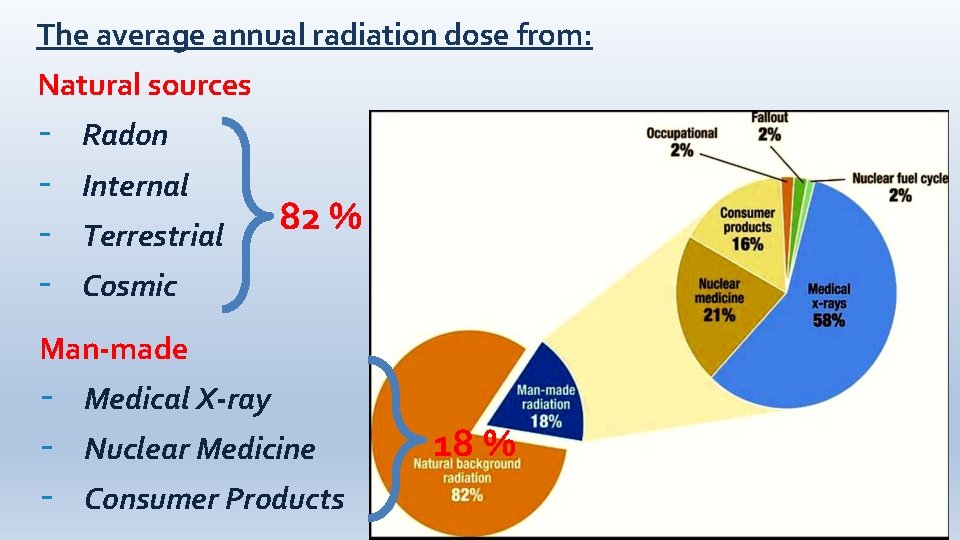
The average annual radiation dose from: Natural sources - Radon Internal Terrestrial 82 % Cosmic Man-made - Medical X-ray Nuclear Medicine Consumer Products 18 %

- Slides: 20