
Radiation All matter at a temperature above absolute
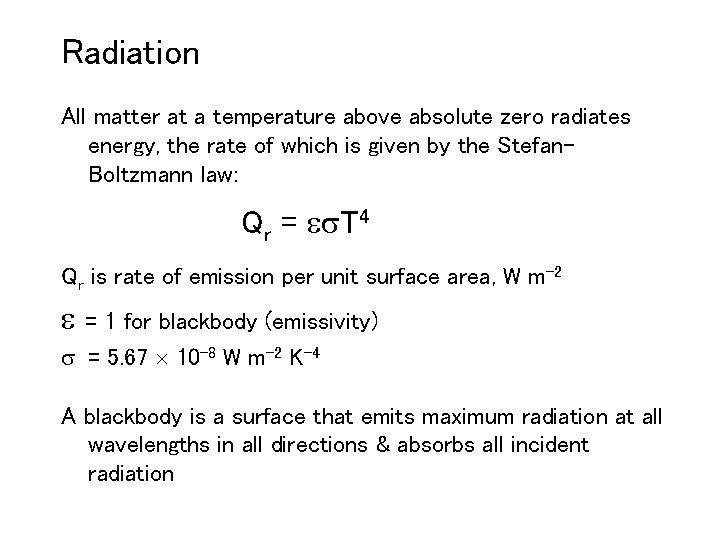
Radiation All matter at a temperature above absolute zero radiates energy, the rate of which is given by the Stefan. Boltzmann law: Qr = T 4 Qr is rate of emission per unit surface area, W m-2 = 1 for blackbody (emissivity) = 5. 67 10 -8 W m-2 K-4 A blackbody is a surface that emits maximum radiation at all wavelengths in all directions & absorbs all incident radiation
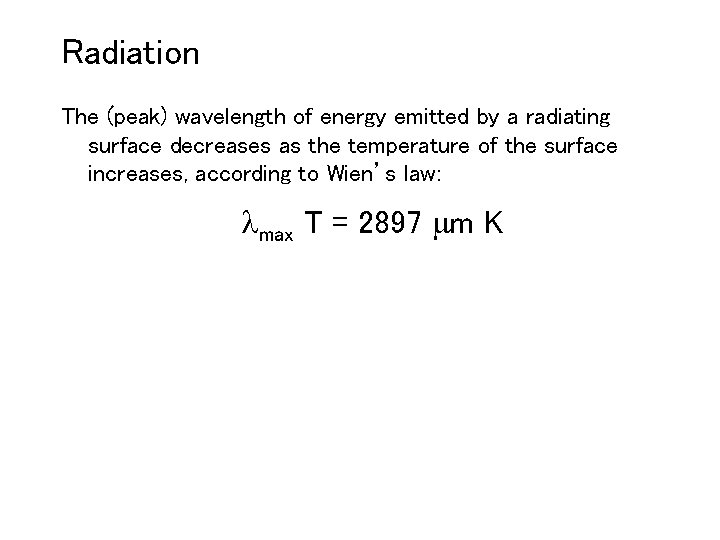
Radiation The (peak) wavelength of energy emitted by a radiating surface decreases as the temperature of the surface increases, according to Wien’s law: max T = 2897 m K
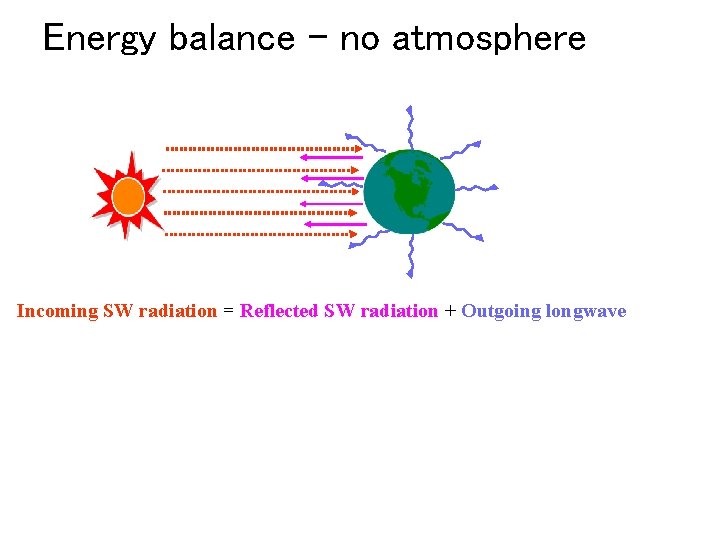
Energy balance - no atmosphere Incoming SW radiation = Reflected SW radiation + Outgoing longwave
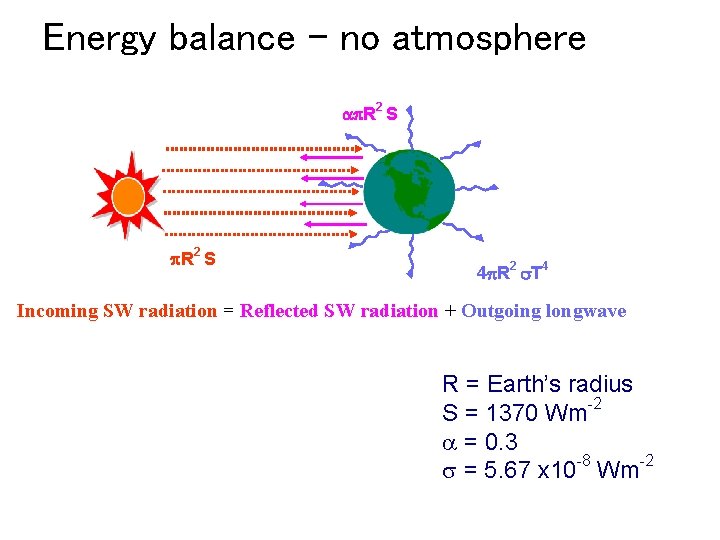
Energy balance - no atmosphere ap. R 2 S 4 p. R 2 s. T 4 Incoming SW radiation = Reflected SW radiation + Outgoing longwave R = Earth’s radius S = 1370 Wm-2 a = 0. 3 = 5. 67 x 10 -8 Wm-2
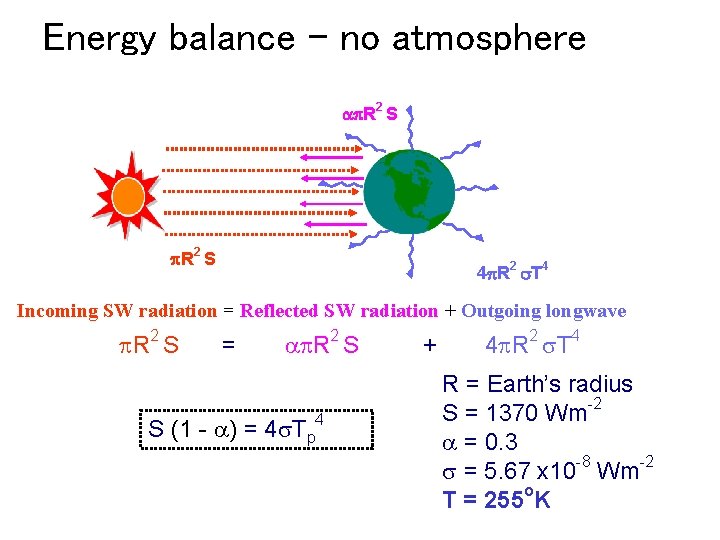
Energy balance - no atmosphere ap. R 2 S 4 p. R 2 s. T 4 Incoming SW radiation = Reflected SW radiation + Outgoing longwave R 2 S = a R 2 S S (1 - a) = 4 Tp 4 + 4 R 2 T 4 R = Earth’s radius S = 1370 Wm-2 a = 0. 3 = 5. 67 x 10 -8 Wm-2 T = 255 o. K
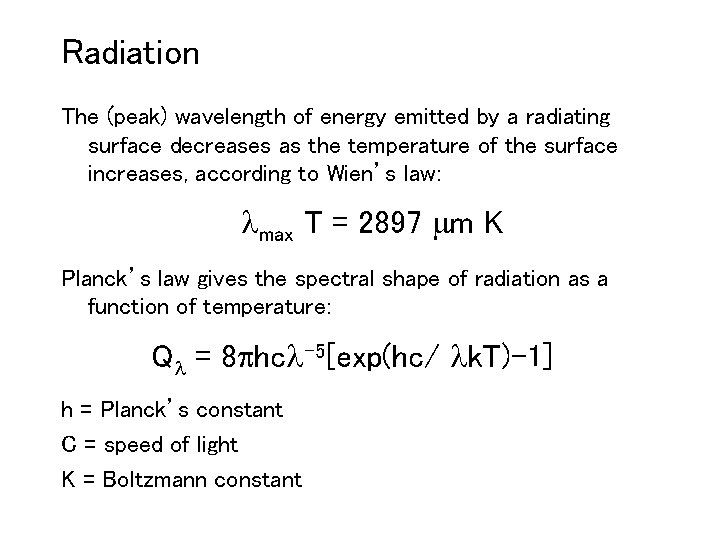
Radiation The (peak) wavelength of energy emitted by a radiating surface decreases as the temperature of the surface increases, according to Wien’s law: max T = 2897 m K Planck’s law gives the spectral shape of radiation as a function of temperature: Q = 8 hc -5[exp(hc/ k. T)-1] h = Planck’s constant C = speed of light K = Boltzmann constant
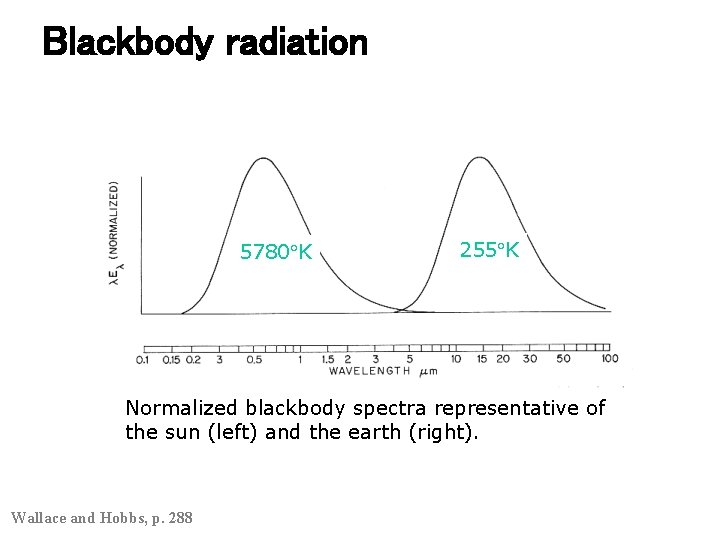
Blackbody radiation 5780 K 255 K Normalized blackbody spectra representative of the sun (left) and the earth (right). Wallace and Hobbs, p. 288
- Slides: 7