
RADIATION ACCIDENTS TERMINOLOGY SCOPE OF PROBLEM AND STATISTICS
RADIATION ACCIDENTS: TERMINOLOGY, SCOPE OF PROBLEM AND STATISTICS Module I - Radiation accidents
![WHAT is an accident? Accident [BSS, Glossary, p. 295, 1996]: “Any unintended event including](http://slidetodoc.com/presentation_image_h2/00ce2169c6028e3ea0ed441de441c38e/image-2.jpg "WHAT is an accident? Accident [BSS, Glossary, p. 295, 1996]: “Any unintended event including")
WHAT is an accident? Accident [BSS, Glossary, p. 295, 1996]: “Any unintended event including operating errors, equipment failures or other mishaps, the consequences or potential consequences of which are not negligible from the point of view of protection and safety. ” Module I. Medical I - Radiation accidents 2
What is a radiation accident? • A situation in which there is an unintentional exposure to ionizing radiation or radioactive contamination • Exposure may be real or suspected Module I. Medical I - Radiation accidents 3
Radiation accidents include Ø radiological and Ø nuclear accidents l • It is more appropriate and practical to use the term “nuclear and radiological emergency” for purposes of planning, preparedness and response Module I. Medical I - Radiation accidents 4
Statistics of radiation accidents, 1944– 2001 Radiation accidents are rare l In 1944 -2001 420 radiation accidents led to significant overexposure of at least one person l Among 3000 overexposed persons, 133 fatalities are registered l However, loss of control over radiation sources has recently lead to more severe accidents l Module I. 5
Main types of radiation accidents: involved groups l Accidents during work - workers radiography n irradiators (sealed sources and accelerators) n l Accidents due to loss of control over radiation sources - public exposure radiotherapy n orphan sources n l Accidents in medical applications - patients misadministration of radiopharmaceuticals n miscalculation of the dose for radiotherapy n Module I. Medical I - Radiation accidents 6
Where do radiation accidents occur? l l l l l Irradiation facilities Material testing (sealed sources) Material testing (X-ray devices) X-ray and radiotherapy devices (medicine, research) Isotope production facilities Unsealed radionuclides (medicine, research) Nuclear reactors Transportation ? ? ? Module I. Medical I - Radiation accidents 7

Radiation accidents by facility type, 1945 -2000 Module I. Medical I - Radiation accidents 8
Ionizing radiation: medical, industrial and consumer product applications Radiography techniques l Analytical techniques l Irradiation techniques l Techniques involving unsealed radioactive materials l Miscellaneous techniques l Module I. Medical I - Radiation accidents 9
Ionizing radiation: medical, industrial and consumer product applications Radiography techniques (industrial and medical) Industrial gamma and X-ray radiography (non-destructive testing) l Medical diagnostic radiography l Beta radiography l Neutron radiography l Module I. Medical I - Radiation accidents 10

Radiological accidents by source, 1945 -2000 Module I. Medical I - Radiation accidents 11
Ionizing radiation: medical, industrial and consumer product applications Analytical techniques l l l l l X-ray fluorescence Electron capture Neutron capture and activation analysis Gamma backscatter gauge X-ray fluorescence gauge Photon switching (level gauge) Selective gamma absorption Gamma scattering Thermalization of neutrons Neutron transmission Module I. Medical I - Radiation accidents 12
Ionizing radiation: medical, industrial and consumer product applications Irradiation techniques Radiation beam therapy (teletherapy) l Brachytherapy l Radiation sterilization and grafting l Food preservation l Module I. Medical I - Radiation accidents 13
Ionizing radiation: medical, industrial and consumer product applications Techniques involving unsealed radioactive materials Radioisotope tracer techniques l Therapeutic uses of radiopharmaceuticals l Self-luminous devices l Enhancement of electrical discharge l Uses of thorium l Module I. Medical I - Radiation accidents 14
Ionizing radiation: medical, industrial and consumer product applications Miscellaneous techniques l l l Static elimination Smoke detectors Lightning warning systems Dewpoint meters Nuclear batteries Module I. Medical I - Radiation accidents 15
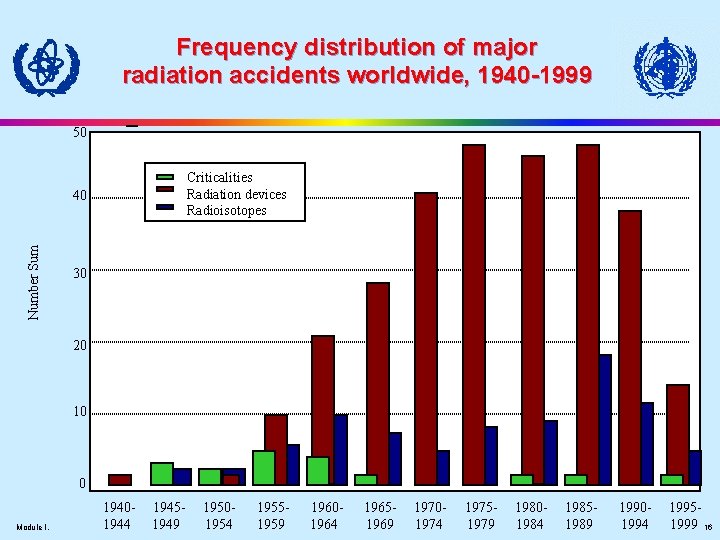
Frequency distribution of major radiation accidents worldwide, 1940 -1999 50 Criticalities Radiation devices Radioisotopes Number Sum 40 30 20 10 0 Module I. 19401944 19451949 19501954 19551959 19601964 19651969 19701974 19751979 19801984 19851989 19901994 19951999 16
Scale of radiation accidents l l Small scale radiation accidents n usually involve a small source term and few people n often come to light from observations by primary care physicians (mainly GPs) Large scale radiation accidents n usually involve a large source term and many people irradiated/contaminated n require specialist treatment in both primary and secondary medical facilities n can lead to widespread public health action to mitigate the effects of contamination. Module I. Medical I - Radiation accidents 17
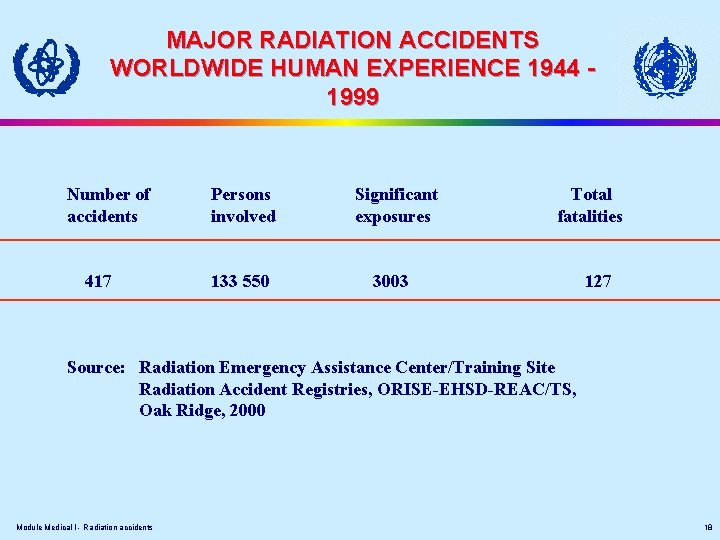
MAJOR RADIATION ACCIDENTS WORLDWIDE HUMAN EXPERIENCE 1944 1999 Number of accidents 417 Persons involved 133 550 Significant exposures Total fatalities 3003 127 Source: Radiation Emergency Assistance Center/Training Site Radiation Accident Registries, ORISE-EHSD-REAC/TS, Oak Ridge, 2000 Module I. Medical I - Radiation accidents 18
‘ORPHAN’ SOURCES Ø never subject to regulatory control or Ø initially regulated but then ü Ø abandoned ü lost or misplaced ü stolen or removed without authorization frequent cause of radiation accidents during the last 15 years Module I. 19
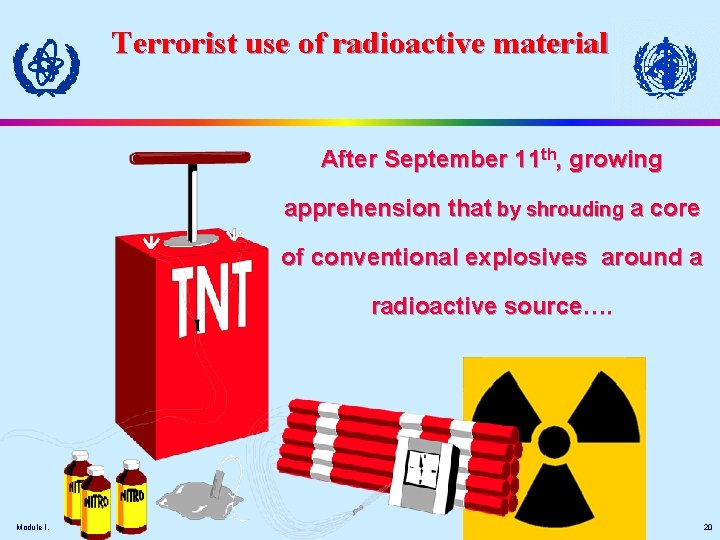
Terrorist use of radioactive material After September 11 th, growing apprehension that by shrouding a core of conventional explosives around a radioactive source…. Module I. 20
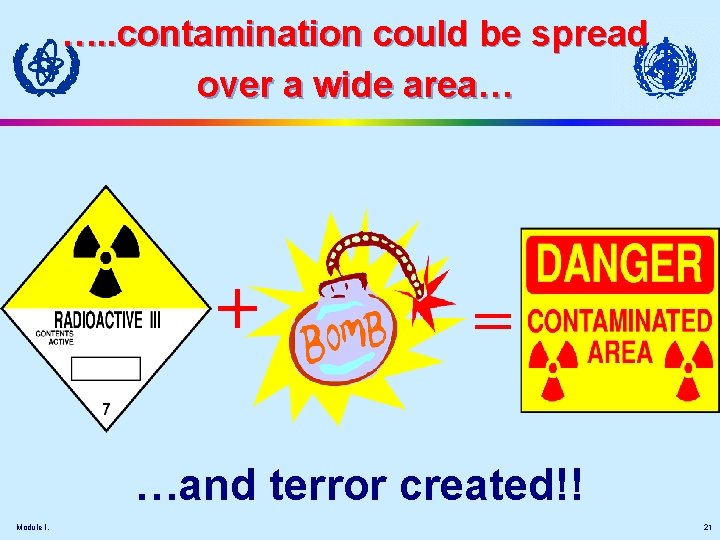
…. . contamination could be spread over a wide area… + = …and terror created!! Module I. 21
Radiation accidents by cause & medical management l Radiation accidents with unknown origin and late recognition: (e. g. Goiania, 1987; Estonia, 1994; Georgia, 1997 & 2001; Turkey, 1998/99; Thailand, 2000; Egypt, 2000 ) l Accidents with initially known radiation origin: (e. g. Iran, 1996; Peru, 1999 ) l Accidental exposure in medical applications: (e. g. Spain, 1990; Costa Rica, 1996, Panama, 2001) l Criticality accidents: (e. g. Sarov, Russia, 1997; Tokaimura, Japan, 1999) l Major nuclear accident: Chernobyl, USSR (1986) Module I. Medical I - Radiation accidents 22
Summary Frequent causes and application areas of radiological accidents u misuse of gamma sources and X-ray machines in industrial radiography and production control of gamma sources in sterilization and preservation of foodstuffs or for other purposes u misuse of ionizing radiation or misadministration of radioactive substances for diagnostic radiology, nuclear medicine and radiotherapy (X-ray generating machines and gamma ray sources, particle accelerators, and sealed or unsealed radionuclide sources) u negligent or unregulated disposal of radiation sources or radioactive waste Module I. Medical I - Radiation accidents 23
Lessons identified for prevention of radiation accidents Registration of all radiation sources and their control (during all phases of application, transport and disposal) l Safety culture l Regular training l Module I. Medical I - Radiation accidents 24
- Slides: 24