
Radiant Warmer o principles of operation function use

- Slides: 12
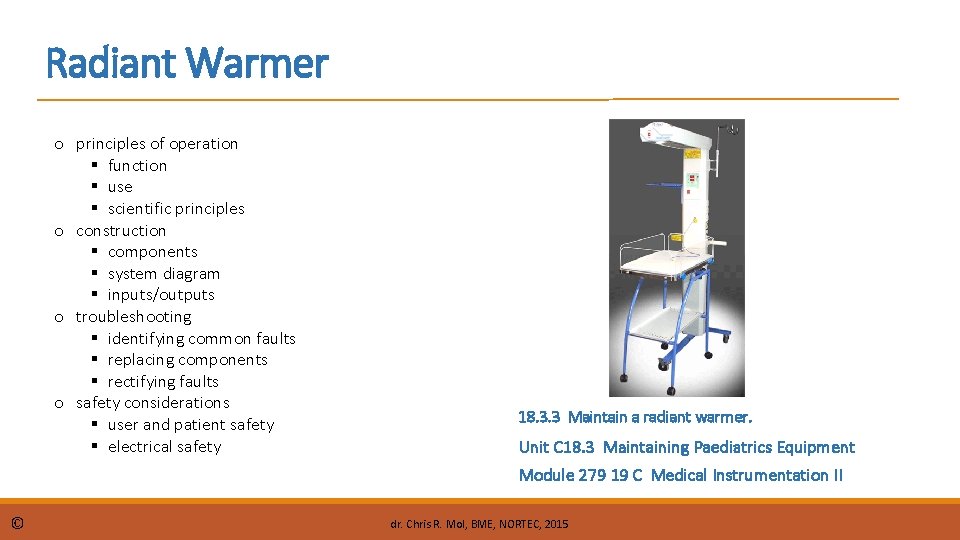
Radiant Warmer o principles of operation function use scientific principles o construction components system diagram inputs/outputs o troubleshooting identifying common faults replacing components rectifying faults o safety considerations user and patient safety electrical safety 18. 3. 3 Maintain a radiant warmer. Unit C 18. 3 Maintaining Paediatrics Equipment Module 279 19 C Medical Instrumentation II © dr. Chris R. Mol, BME, NORTEC, 2015
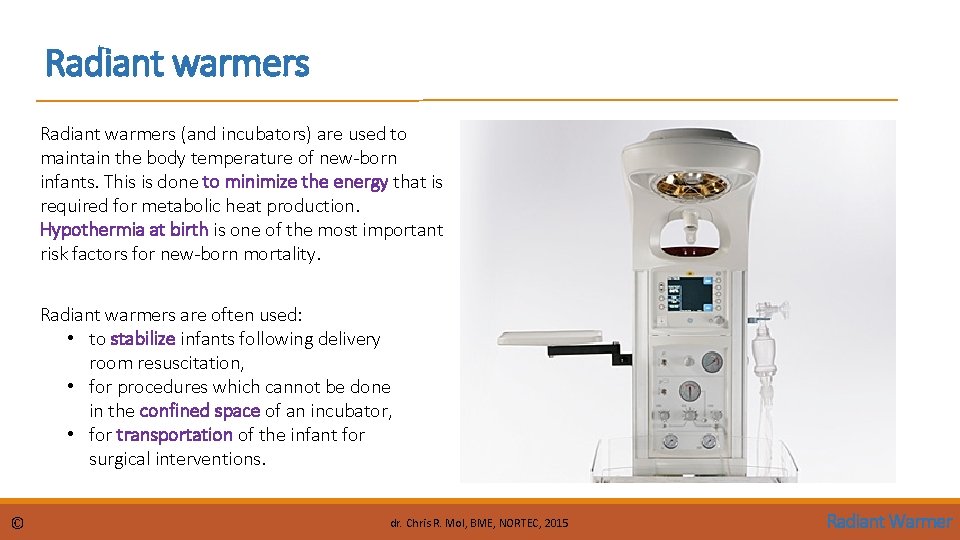
Radiant warmers (and incubators) are used to maintain the body temperature of new-born infants. This is done to minimize the energy that is required for metabolic heat production. Hypothermia at birth is one of the most important risk factors for new-born mortality. Radiant warmers are often used: • to stabilize infants following delivery room resuscitation, • for procedures which cannot be done in the confined space of an incubator, • for transportation of the infant for surgical interventions. © dr. Chris R. Mol, BME, NORTEC, 2015 Radiant Warmer
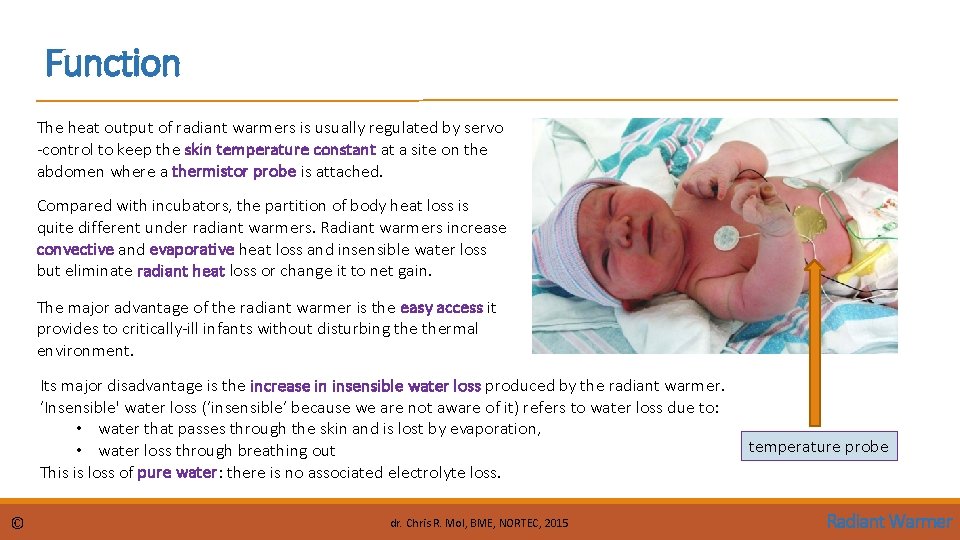
Function The heat output of radiant warmers is usually regulated by servo -control to keep the skin temperature constant at a site on the abdomen where a thermistor probe is attached. Compared with incubators, the partition of body heat loss is quite different under radiant warmers. Radiant warmers increase convective and evaporative heat loss and insensible water loss but eliminate radiant heat loss or change it to net gain. The major advantage of the radiant warmer is the easy access it provides to critically-ill infants without disturbing thermal environment. Its major disadvantage is the increase in insensible water loss produced by the radiant warmer. ‘Insensible' water loss (‘insensible’ because we are not aware of it) refers to water loss due to: • water that passes through the skin and is lost by evaporation, • water loss through breathing out This is loss of pure water: there is no associated electrolyte loss. © dr. Chris R. Mol, BME, NORTEC, 2015 temperature probe Radiant Warmer
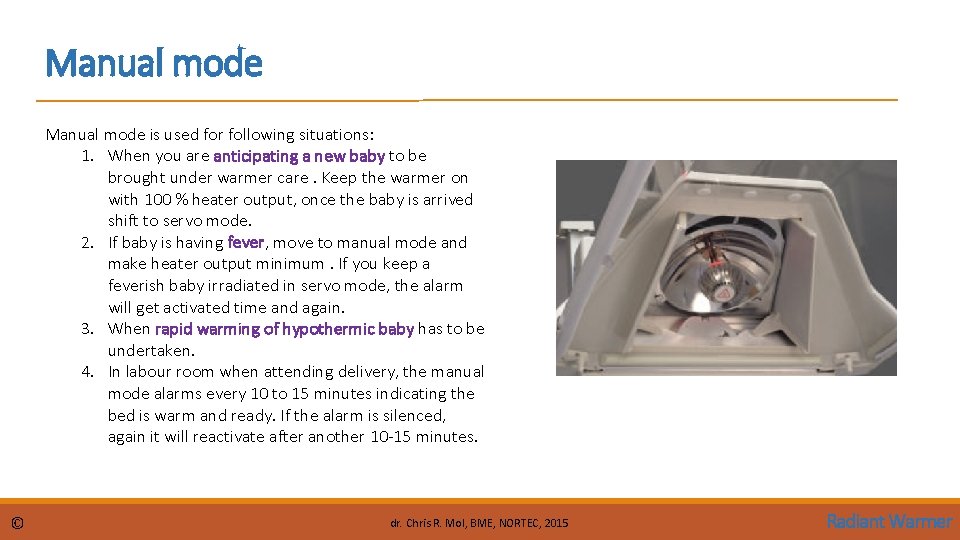
Manual mode is used for following situations: 1. When you are anticipating a new baby to be brought under warmer care. Keep the warmer on with 100 % heater output, once the baby is arrived shift to servo mode. 2. If baby is having fever, move to manual mode and make heater output minimum. If you keep a feverish baby irradiated in servo mode, the alarm will get activated time and again. 3. When rapid warming of hypothermic baby has to be undertaken. 4. In labour room when attending delivery, the manual mode alarms every 10 to 15 minutes indicating the bed is warm and ready. If the alarm is silenced, again it will reactivate after another 10 -15 minutes. © dr. Chris R. Mol, BME, NORTEC, 2015 Radiant Warmer
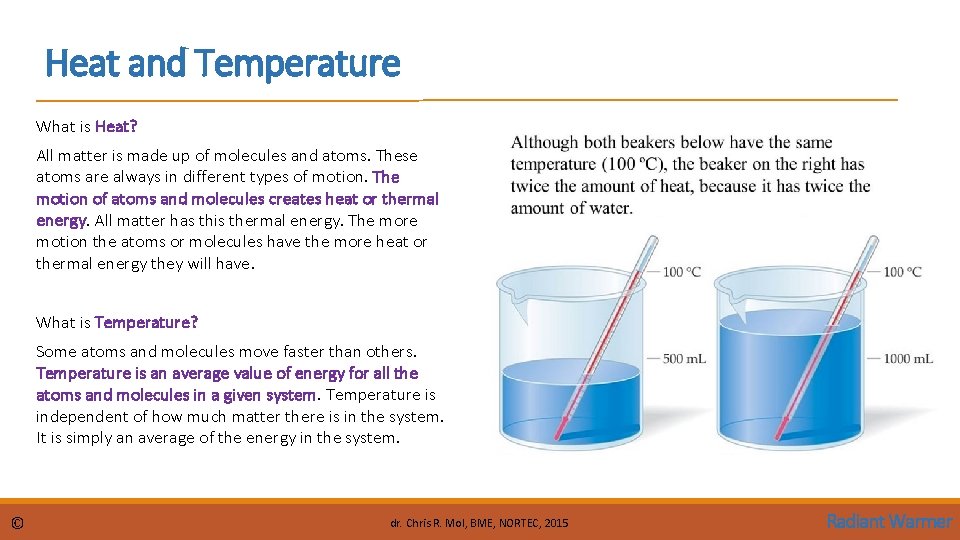
Heat and Temperature What is Heat? All matter is made up of molecules and atoms. These atoms are always in different types of motion. The motion of atoms and molecules creates heat or thermal energy. All matter has this thermal energy. The more motion the atoms or molecules have the more heat or thermal energy they will have. What is Temperature? Some atoms and molecules move faster than others. Temperature is an average value of energy for all the atoms and molecules in a given system. Temperature is independent of how much matter there is in the system. It is simply an average of the energy in the system. © dr. Chris R. Mol, BME, NORTEC, 2015 Radiant Warmer
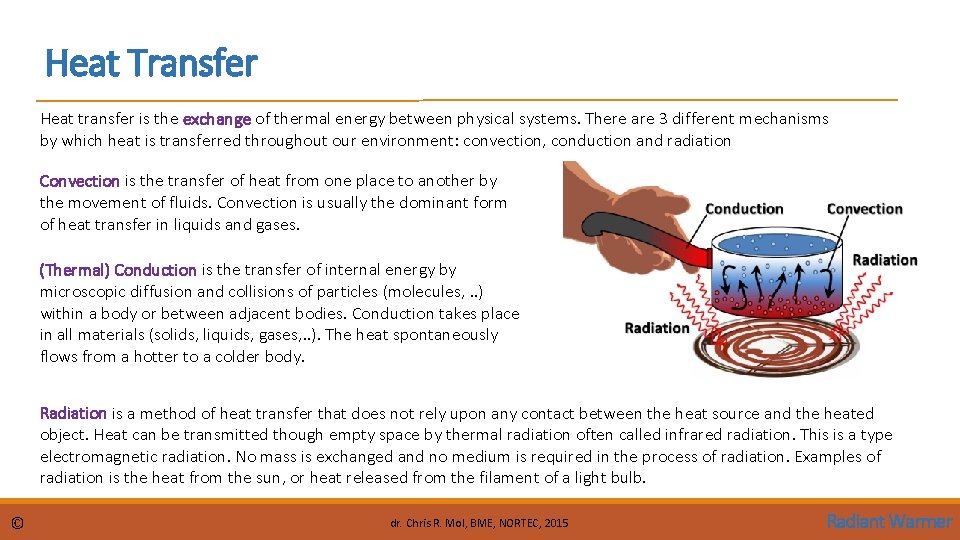
Heat Transfer Heat transfer is the exchange of thermal energy between physical systems. There are 3 different mechanisms by which heat is transferred throughout our environment: convection, conduction and radiation Convection is the transfer of heat from one place to another by the movement of fluids. Convection is usually the dominant form of heat transfer in liquids and gases. (Thermal) Conduction is the transfer of internal energy by microscopic diffusion and collisions of particles (molecules, . . ) within a body or between adjacent bodies. Conduction takes place in all materials (solids, liquids, gases, . . ). The heat spontaneously flows from a hotter to a colder body. Radiation is a method of heat transfer that does not rely upon any contact between the heat source and the heated object. Heat can be transmitted though empty space by thermal radiation often called infrared radiation. This is a type electromagnetic radiation. No mass is exchanged and no medium is required in the process of radiation. Examples of radiation is the heat from the sun, or heat released from the filament of a light bulb. © dr. Chris R. Mol, BME, NORTEC, 2015 Radiant Warmer
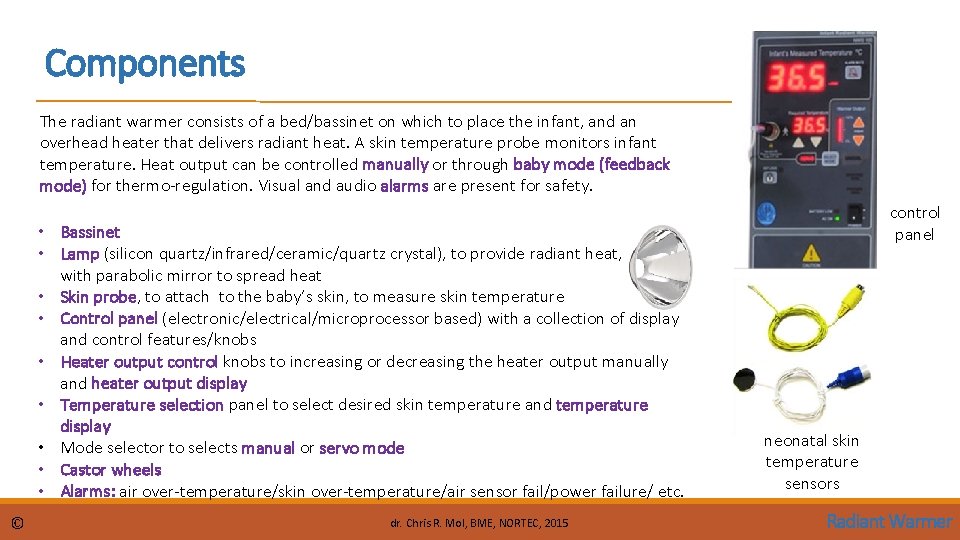
Components The radiant warmer consists of a bed/bassinet on which to place the infant, and an overhead heater that delivers radiant heat. A skin temperature probe monitors infant temperature. Heat output can be controlled manually or through baby mode (feedback mode) for thermo-regulation. Visual and audio alarms are present for safety. • Bassinet • Lamp (silicon quartz/infrared/ceramic/quartz crystal), to provide radiant heat, with parabolic mirror to spread heat • Skin probe, to attach to the baby’s skin, to measure skin temperature • Control panel (electronic/electrical/microprocessor based) with a collection of display and control features/knobs • Heater output control knobs to increasing or decreasing the heater output manually and heater output display • Temperature selection panel to select desired skin temperature and temperature display • Mode selector to selects manual or servo mode • Castor wheels • Alarms: air over-temperature/skin over-temperature/air sensor fail/power failure/ etc. © dr. Chris R. Mol, BME, NORTEC, 2015 control panel neonatal skin temperature sensors Radiant Warmer
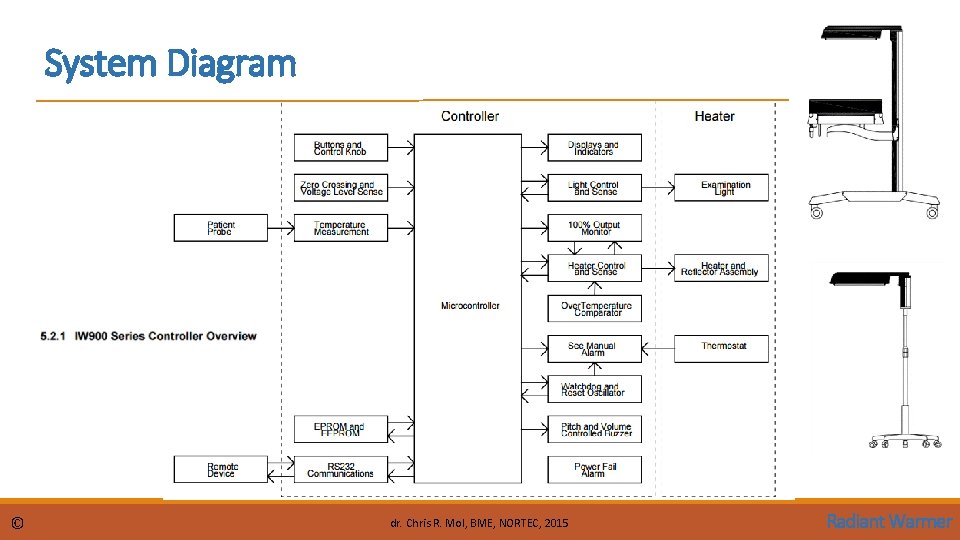
System Diagram © dr. Chris R. Mol, BME, NORTEC, 2015 Radiant Warmer
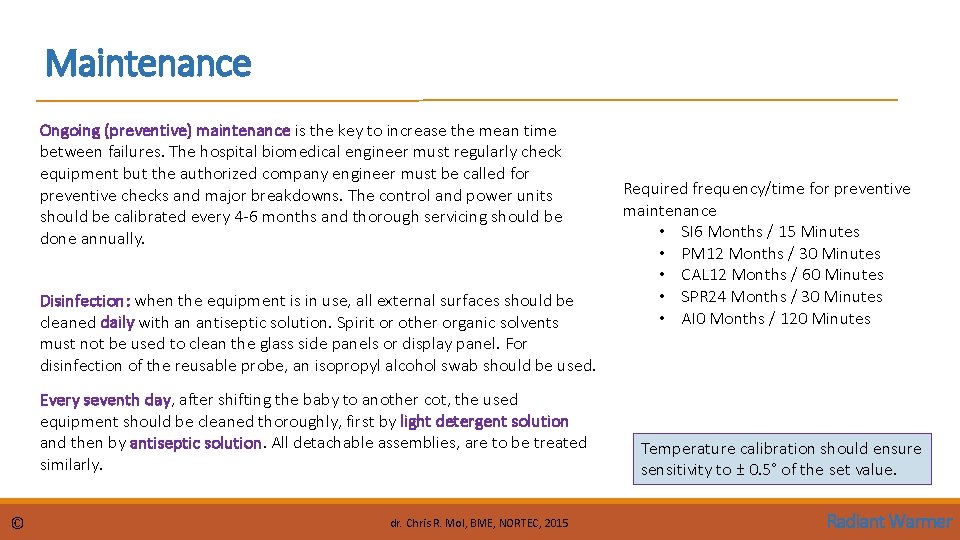
Maintenance Ongoing (preventive) maintenance is the key to increase the mean time between failures. The hospital biomedical engineer must regularly check equipment but the authorized company engineer must be called for preventive checks and major breakdowns. The control and power units should be calibrated every 4 -6 months and thorough servicing should be done annually. Disinfection: when the equipment is in use, all external surfaces should be cleaned daily with an antiseptic solution. Spirit or other organic solvents must not be used to clean the glass side panels or display panel. For disinfection of the reusable probe, an isopropyl alcohol swab should be used. Every seventh day, after shifting the baby to another cot, the used equipment should be cleaned thoroughly, first by light detergent solution and then by antiseptic solution. All detachable assemblies, are to be treated similarly. © dr. Chris R. Mol, BME, NORTEC, 2015 Required frequency/time for preventive maintenance • SI 6 Months / 15 Minutes • PM 12 Months / 30 Minutes • CAL 12 Months / 60 Minutes • SPR 24 Months / 30 Minutes • AI 0 Months / 120 Minutes Temperature calibration should ensure sensitivity to ± 0. 5° of the set value. Radiant Warmer
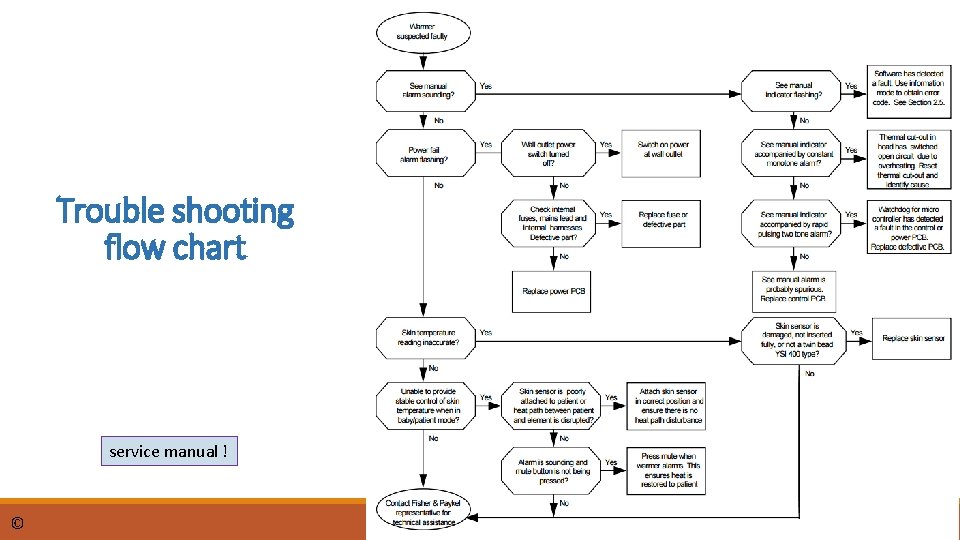
Trouble shooting flow chart service manual ! © dr. Chris R. Mol, BME, NORTEC, 2015 Radiant Warmer
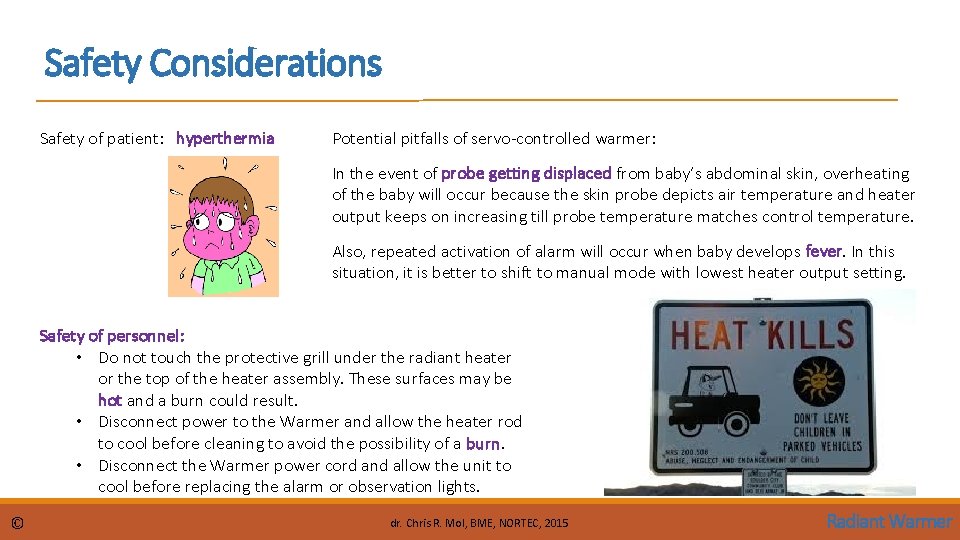
Safety Considerations Safety of patient: hyperthermia Potential pitfalls of servo-controlled warmer: In the event of probe getting displaced from baby’s abdominal skin, overheating of the baby will occur because the skin probe depicts air temperature and heater output keeps on increasing till probe temperature matches control temperature. Also, repeated activation of alarm will occur when baby develops fever. In this situation, it is better to shift to manual mode with lowest heater output setting. Safety of personnel: • Do not touch the protective grill under the radiant heater or the top of the heater assembly. These surfaces may be hot and a burn could result. • Disconnect power to the Warmer and allow the heater rod to cool before cleaning to avoid the possibility of a burn. • Disconnect the Warmer power cord and allow the unit to cool before replacing the alarm or observation lights. © dr. Chris R. Mol, BME, NORTEC, 2015 Radiant Warmer
END The creation of this presentation was supported by a grant from THET: see https: //www. thet. org/