
Radial Basis Function Network Dimensionality reduction by clustering
Radial Basis Function Network: Dimensionality reduction by clustering.
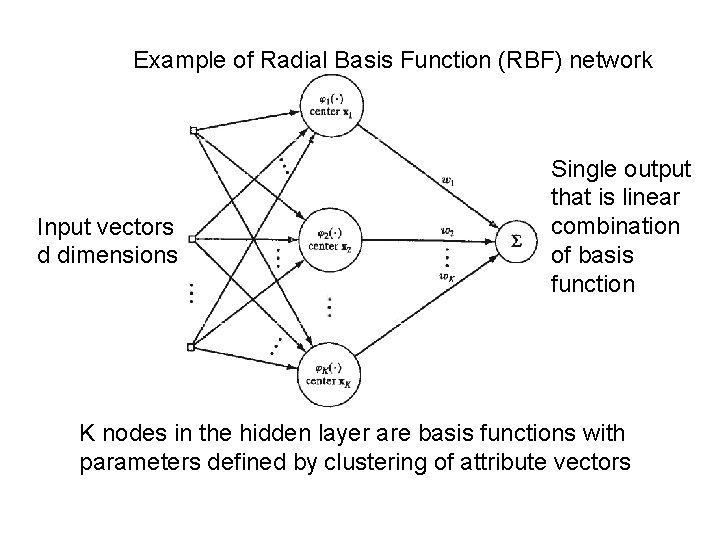
Example of Radial Basis Function (RBF) network Input vectors d dimensions Single output that is linear combination of basis function K nodes in the hidden layer are basis functions with parameters defined by clustering of attribute vectors
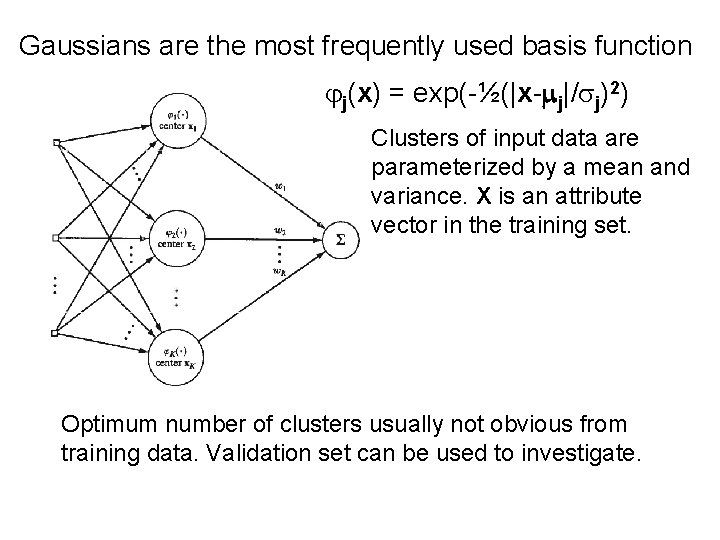
Gaussians are the most frequently used basis function jj(x) = exp(-½(|x-mj|/sj)2) Clusters of input data are parameterized by a mean and variance. X is an attribute vector in the training set. Optimum number of clusters usually not obvious from training data. Validation set can be used to investigate.
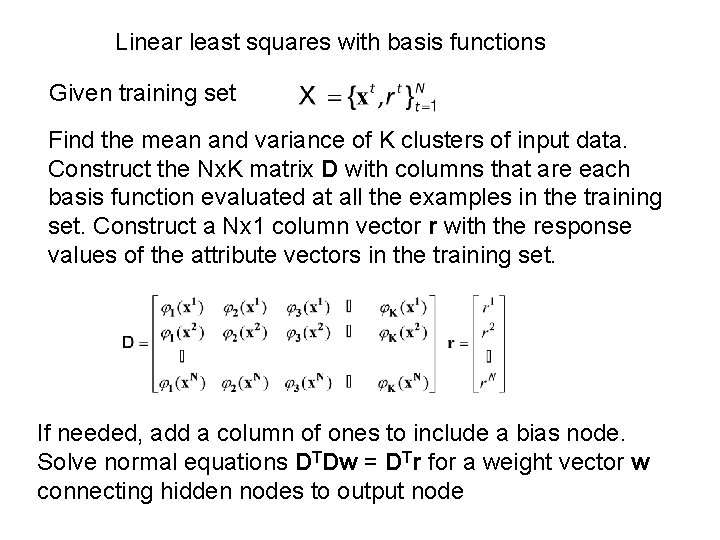
Linear least squares with basis functions Given training set Find the mean and variance of K clusters of input data. Construct the Nx. K matrix D with columns that are each basis function evaluated at all the examples in the training set. Construct a Nx 1 column vector r with the response values of the attribute vectors in the training set. If needed, add a column of ones to include a bias node. Solve normal equations DTDw = DTr for a weight vector w connecting hidden nodes to output node
RBF networks perform best with large datasets With large datasets, expect redundancy (i. e. multiple examples expressing the same general pattern) In RBF network, hidden layer is a feature-space representation of the data where averaging has been used to reduce noise.
Background on clustering Clustering is unsupervised learning to find regularities in data. In clustering, we look for regularities as group membership Assume we know the best number of clusters, K Given K and dataset X, we find the size of each cluster P(Gi) and its component density pi(x|Gi), the probability that attribute vector x belongs to cluster i. 6
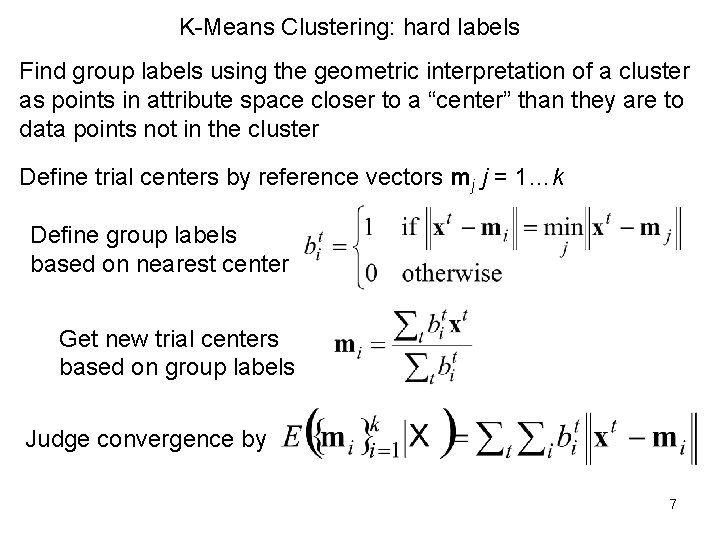
K-Means Clustering: hard labels Find group labels using the geometric interpretation of a cluster as points in attribute space closer to a “center” than they are to data points not in the cluster Define trial centers by reference vectors mj j = 1…k Define group labels based on nearest center Get new trial centers based on group labels Judge convergence by 7
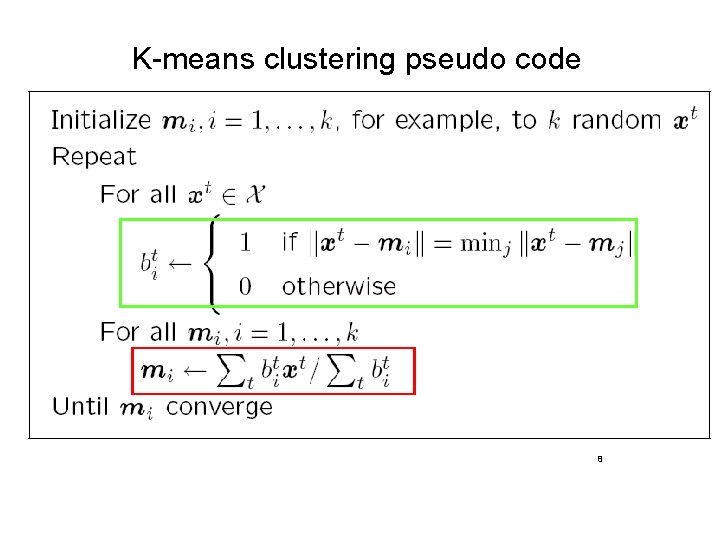
K-means clustering pseudo code 8
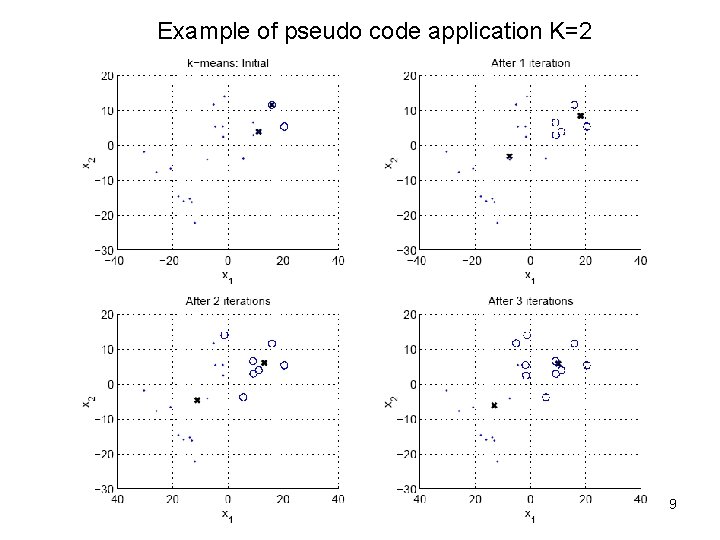
Example of pseudo code application K=2 9
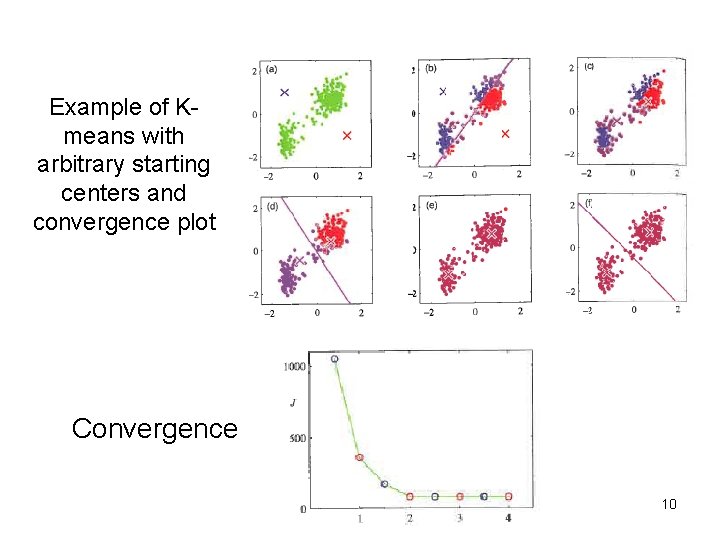
Example of Kmeans with arbitrary starting centers and convergence plot Convergence 10
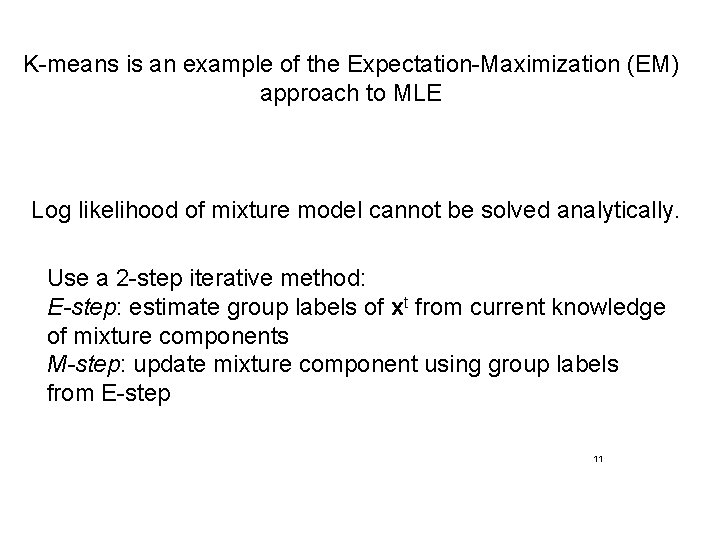
K-means is an example of the Expectation-Maximization (EM) approach to MLE Log likelihood of mixture model cannot be solved analytically. Use a 2 -step iterative method: E-step: estimate group labels of xt from current knowledge of mixture components M-step: update mixture component using group labels from E-step 11
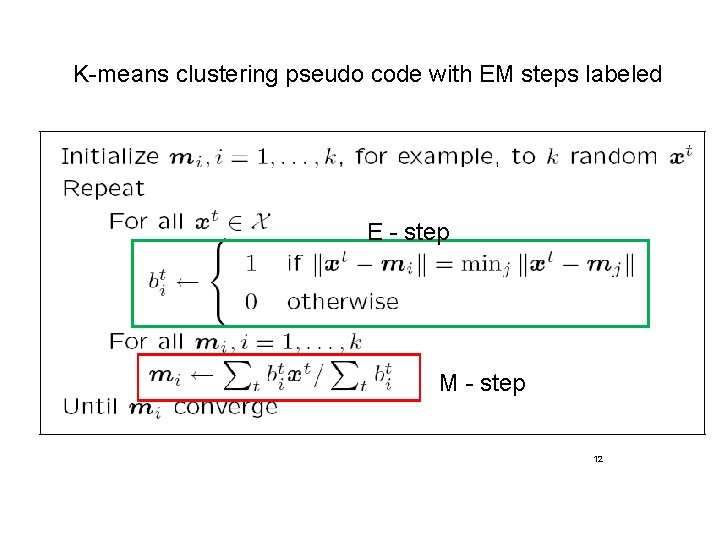
K-means clustering pseudo code with EM steps labeled E - step M - step 12
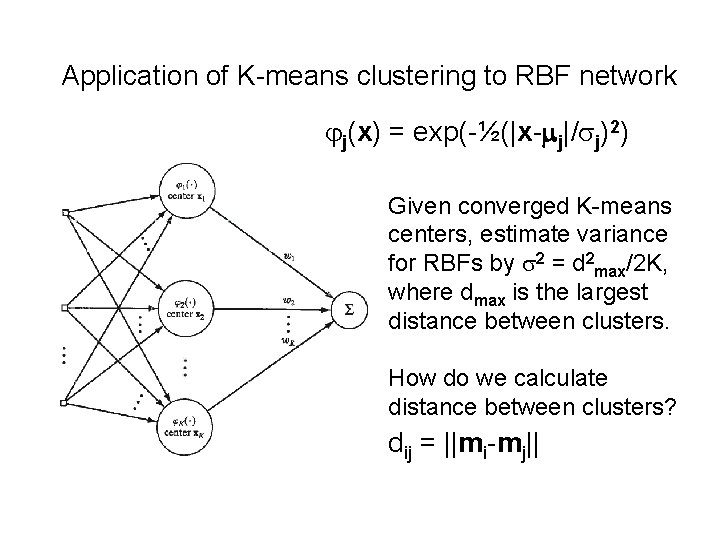
Application of K-means clustering to RBF network jj(x) = exp(-½(|x-mj|/sj)2) Given converged K-means centers, estimate variance for RBFs by s 2 = d 2 max/2 K, where dmax is the largest distance between clusters. How do we calculate distance between clusters? dij = ||mi-mj||
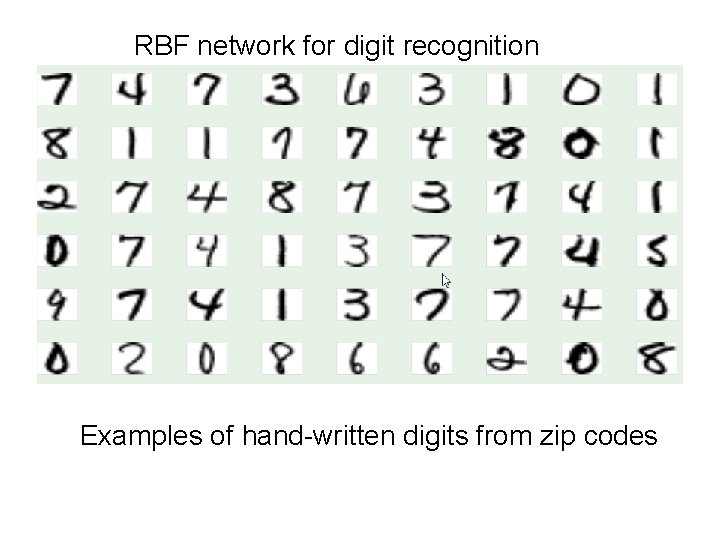
RBF network for digit recognition Examples of hand-written digits from zip codes
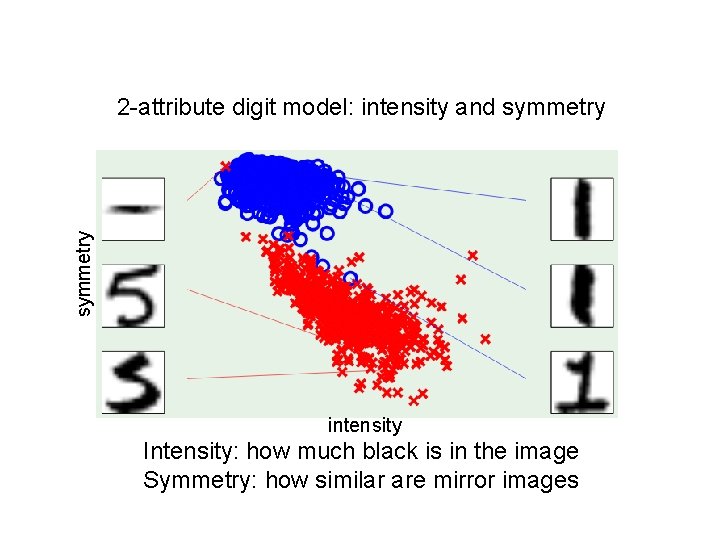
symmetry 2 -attribute digit model: intensity and symmetry intensity Intensity: how much black is in the image Symmetry: how similar are mirror images
Assignment 15 Use Weka’s RBFnetwork to distinguish hand-written digits 1 vs 5. Load Weka’s RBFnetwork from package manager under Tools on the main menu. Use 1 -5 -1561 -no name. csv for training. Use 1 -5 -424 -no name. csv for testing. After loading the test set, select output predictions under more options. Choose CSV. Run with default settings. Save the results buffer that contains predictions of model on test -set examples. Edit to 2 columns, actual and predicted. Use software like that for HW 7 to calculate the accuracy of predictions in each class, the overall accuracy, and the confusion matrix with column sums equal to class size.
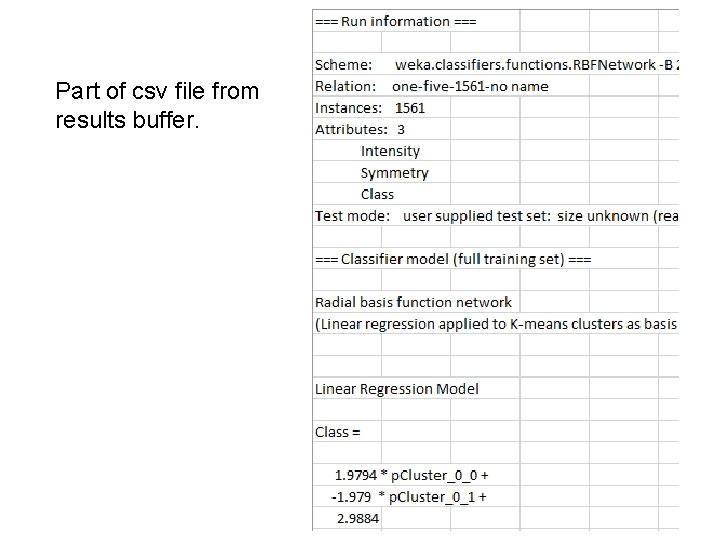
Part of csv file from results buffer.
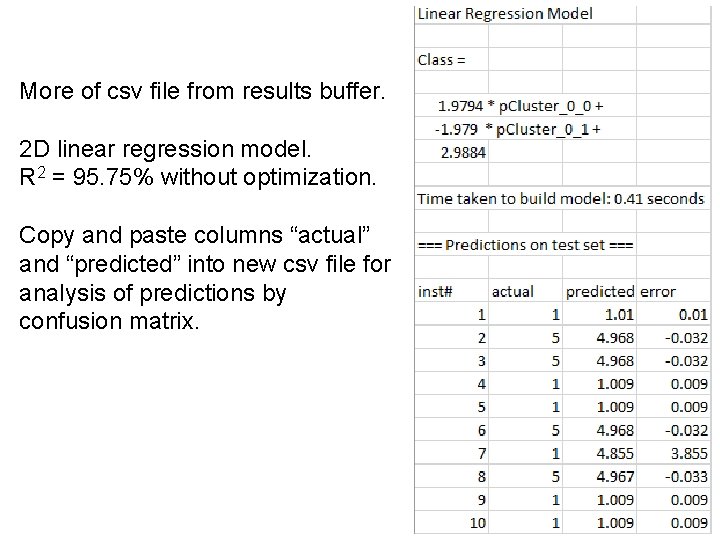
More of csv file from results buffer. 2 D linear regression model. R 2 = 95. 75% without optimization. Copy and paste columns “actual” and “predicted” into new csv file for analysis of predictions by confusion matrix.
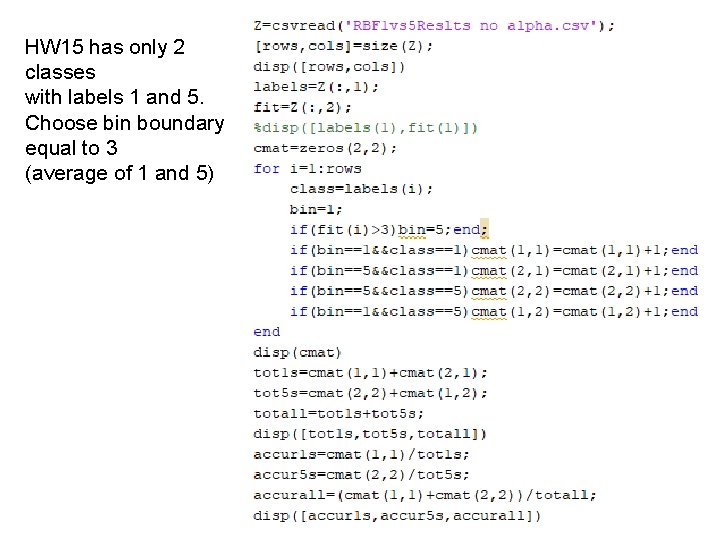
HW 15 has only 2 classes with labels 1 and 5. Choose bin boundary equal to 3 (average of 1 and 5)

- Slides: 20