
Radcliffe Housing Society Organisation review and restructure Full
- Slides: 24
Radcliffe Housing Society Organisation review and restructure Full Report & Findings - January 2020 1
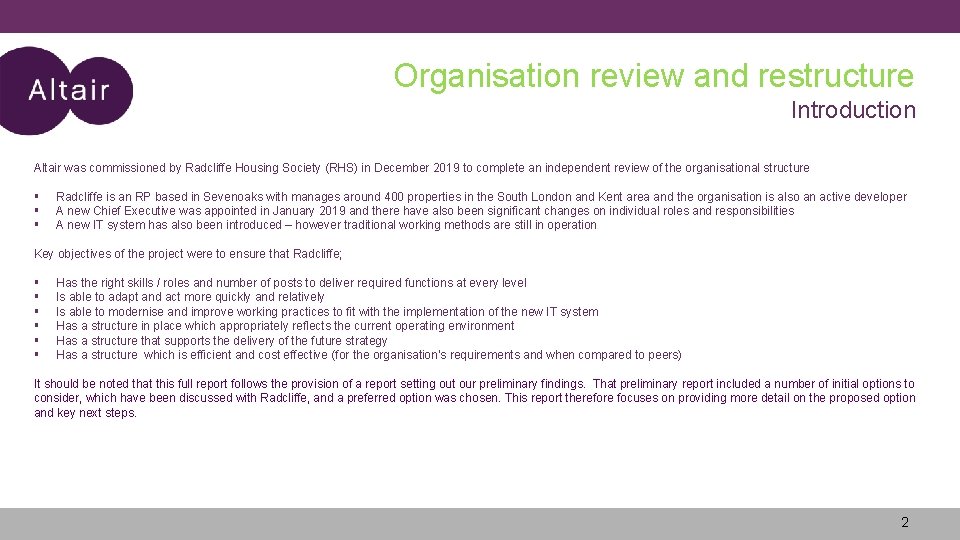
Organisation review and restructure Introduction Altair was commissioned by Radcliffe Housing Society (RHS) in December 2019 to complete an independent review of the organisational structure Radcliffe is an RP based in Sevenoaks with manages around 400 properties in the South London and Kent area and the organisation is also an active developer A new Chief Executive was appointed in January 2019 and there have also been significant changes on individual roles and responsibilities A new IT system has also been introduced – however traditional working methods are still in operation Key objectives of the project were to ensure that Radcliffe; Has the right skills / roles and number of posts to deliver required functions at every level Is able to adapt and act more quickly and relatively Is able to modernise and improve working practices to fit with the implementation of the new IT system Has a structure in place which appropriately reflects the current operating environment Has a structure that supports the delivery of the future strategy Has a structure which is efficient and cost effective (for the organisation’s requirements and when compared to peers) It should be noted that this full report follows the provision of a report setting out our preliminary findings. That preliminary report included a number of initial options to consider, which have been discussed with Radcliffe, and a preferred option was chosen. This report therefore focuses on providing more detail on the proposed option and key next steps. 2
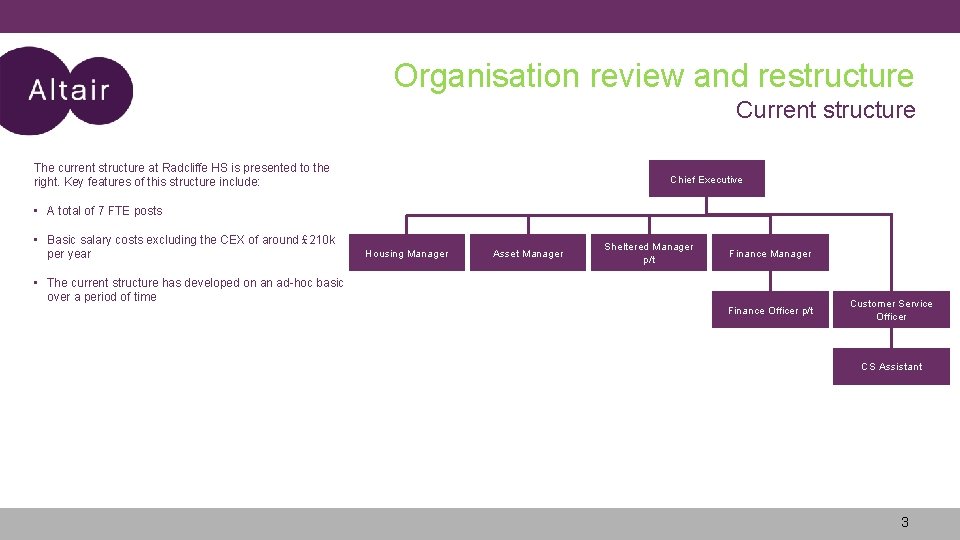
Organisation review and restructure Current structure The current structure at Radcliffe HS is presented to the right. Key features of this structure include: Chief Executive • A total of 7 FTE posts • Basic salary costs excluding the CEX of around £ 210 k per year Housing Manager Asset Manager Sheltered Manager p/t Finance Manager • The current structure has developed on an ad-hoc basic over a period of time Finance Officer p/t Customer Service Officer CS Assistant 3
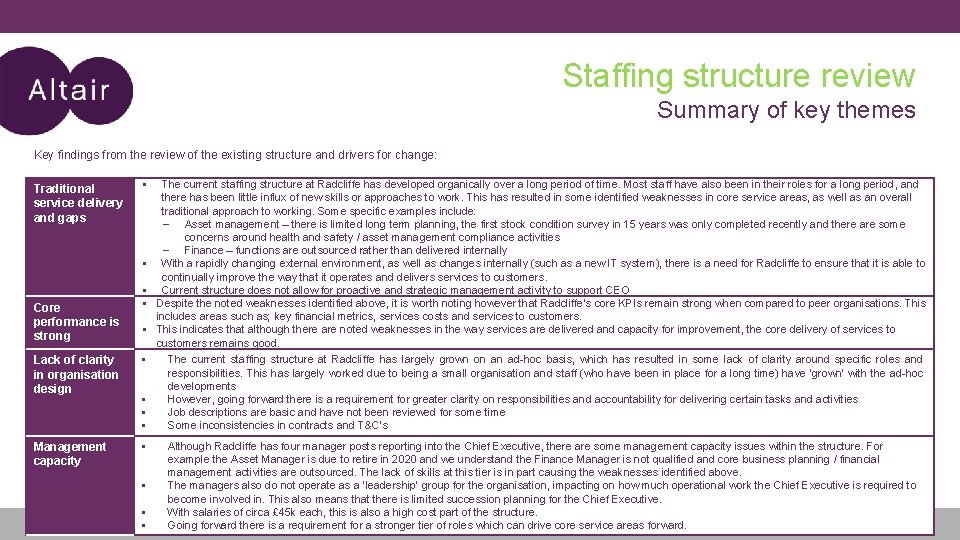
Staffing structure review Summary of key themes Key findings from the review of the existing structure and drivers for change: Traditional service delivery and gaps Core performance is strong Lack of clarity in organisation design Management capacity The current staffing structure at Radcliffe has developed organically over a long period of time. Most staff have also been in their roles for a long period, and there has been little influx of new skills or approaches to work. This has resulted in some identified weaknesses in core service areas, as well as an overall traditional approach to working. Some specific examples include: Asset management – there is limited long term planning, the first stock condition survey in 15 years was only completed recently and there are some concerns around health and safety / asset management compliance activities Finance – functions are outsourced rather than delivered internally With a rapidly changing external environment, as well as changes internally (such as a new IT system), there is a need for Radcliffe to ensure that it is able to continually improve the way that it operates and delivers services to customers. Current structure does not allow for proactive and strategic management activity to support CEO Despite the noted weaknesses identified above, it is worth noting however that Radcliffe’s core KPIs remain strong when compared to peer organisations. This includes areas such as; key financial metrics, services costs and services to customers. This indicates that although there are noted weaknesses in the way services are delivered and capacity for improvement, the core delivery of services to customers remains good. The current staffing structure at Radcliffe has largely grown on an ad-hoc basis, which has resulted in some lack of clarity around specific roles and responsibilities. This has largely worked due to being a small organisation and staff (who have been in place for a long time) have ‘grown’ with the ad-hoc developments However, going forward there is a requirement for greater clarity on responsibilities and accountability for delivering certain tasks and activities Job descriptions are basic and have not been reviewed for some time Some inconsistencies in contracts and T&C’s Although Radcliffe has four manager posts reporting into the Chief Executive, there are some management capacity issues within the structure. For example the Asset Manager is due to retire in 2020 and we understand the Finance Manager is not qualified and core business planning / financial management activities are outsourced. The lack of skills at this tier is in part causing the weaknesses identified above. The managers also do not operate as a ‘leadership’ group for the organisation, impacting on how much operational work the Chief Executive is required to become involved in. This also means that there is limited succession planning for the Chief Executive. With salaries of circa £ 45 k each, this is also a high cost part of the structure. 4 Going forward there is a requirement for a stronger tier of roles which can drive core service areas forward.
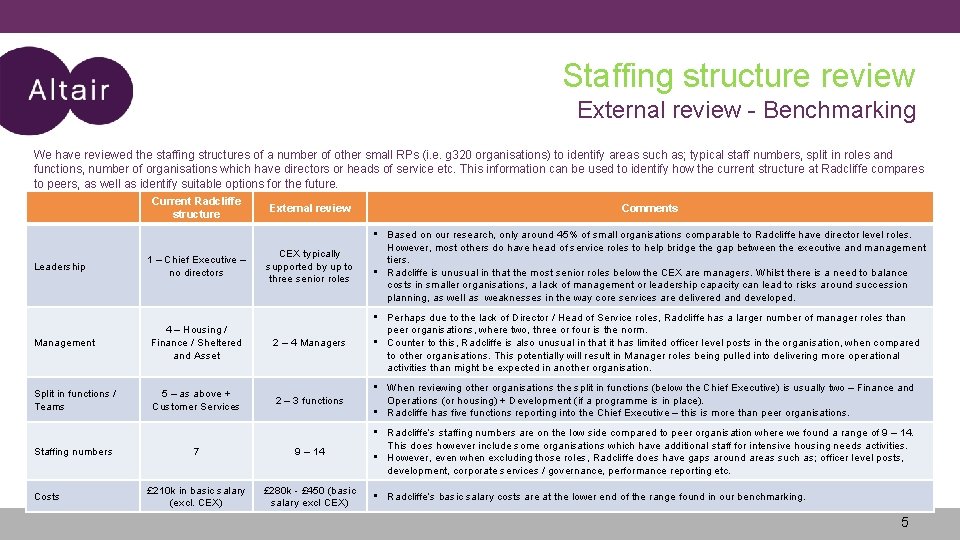
Staffing structure review External review - Benchmarking We have reviewed the staffing structures of a number of other small RPs (i. e. g 320 organisations) to identify areas such as; typical staff numbers, split in roles and functions, number of organisations which have directors or heads of service etc. This information can be used to identify how the current structure at Radcliffe compares to peers, as well as identify suitable options for the future. Current Radcliffe structure External review Comments CEX typically supported by up to three senior roles • Based on our research, only around 45% of small organisations comparable to Radcliffe have director level roles. However, most others do have head of service roles to help bridge the gap between the executive and management tiers. • Radcliffe is unusual in that the most senior roles below the CEX are managers. Whilst there is a need to balance costs in smaller organisations, a lack of management or leadership capacity can lead to risks around succession planning, as well as weaknesses in the way core services are delivered and developed. Management 4 – Housing / Finance / Sheltered and Asset 2 – 4 Managers • Perhaps due to the lack of Director / Head of Service roles, Radcliffe has a larger number of manager roles than peer organisations, where two, three or four is the norm. • Counter to this, Radcliffe is also unusual in that it has limited officer level posts in the organisation, when compared to other organisations. This potentially will result in Manager roles being pulled into delivering more operational activities than might be expected in another organisation. Split in functions / Teams 5 – as above + Customer Services 2 – 3 functions • When reviewing other organisations the split in functions (below the Chief Executive) is usually two – Finance and Operations (or housing) + Development (if a programme is in place). • Radcliffe has five functions reporting into the Chief Executive – this is more than peer organisations. 7 9 – 14 • Radcliffe’s staffing numbers are on the low side compared to peer organisation where we found a range of 9 – 14. This does however include some organisations which have additional staff for intensive housing needs activities. • However, even when excluding those roles, Radcliffe does have gaps around areas such as; officer level posts, development, corporate services / governance, performance reporting etc. £ 210 k in basic salary (excl. CEX) £ 280 k - £ 450 (basic salary excl CEX) Leadership Staffing numbers Costs 1 – Chief Executive – no directors • Radcliffe’s basic salary costs are at the lower end of the range found in our benchmarking. 5
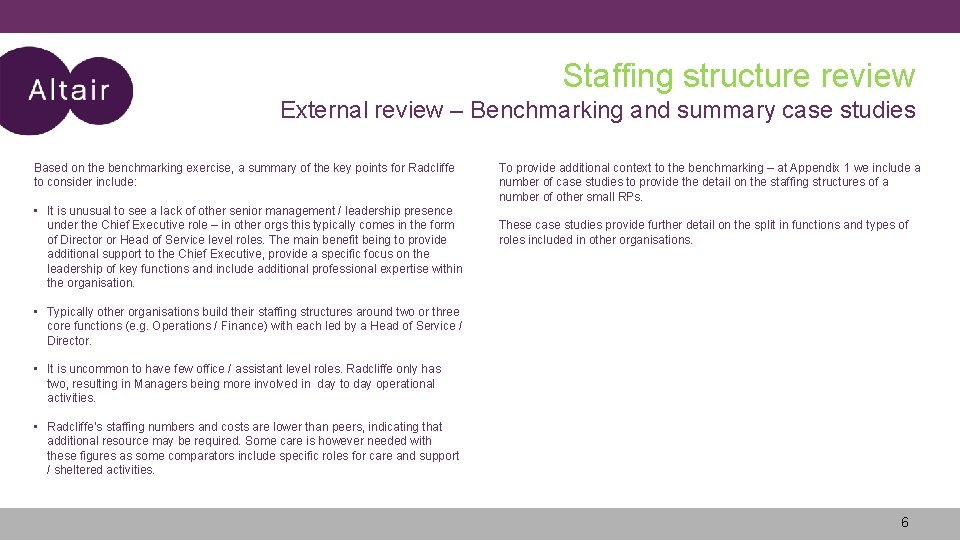
Staffing structure review External review – Benchmarking and summary case studies Based on the benchmarking exercise, a summary of the key points for Radcliffe to consider include: • It is unusual to see a lack of other senior management / leadership presence under the Chief Executive role – in other orgs this typically comes in the form of Director or Head of Service level roles. The main benefit being to provide additional support to the Chief Executive, provide a specific focus on the leadership of key functions and include additional professional expertise within the organisation. To provide additional context to the benchmarking – at Appendix 1 we include a number of case studies to provide the detail on the staffing structures of a number of other small RPs. These case studies provide further detail on the split in functions and types of roles included in other organisations. • Typically other organisations build their staffing structures around two or three core functions (e. g. Operations / Finance) with each led by a Head of Service / Director. • It is uncommon to have few office / assistant level roles. Radcliffe only has two, resulting in Managers being more involved in day to day operational activities. • Radcliffe’s staffing numbers and costs are lower than peers, indicating that additional resource may be required. Some care is however needed with these figures as some comparators include specific roles for care and support / sheltered activities. 6
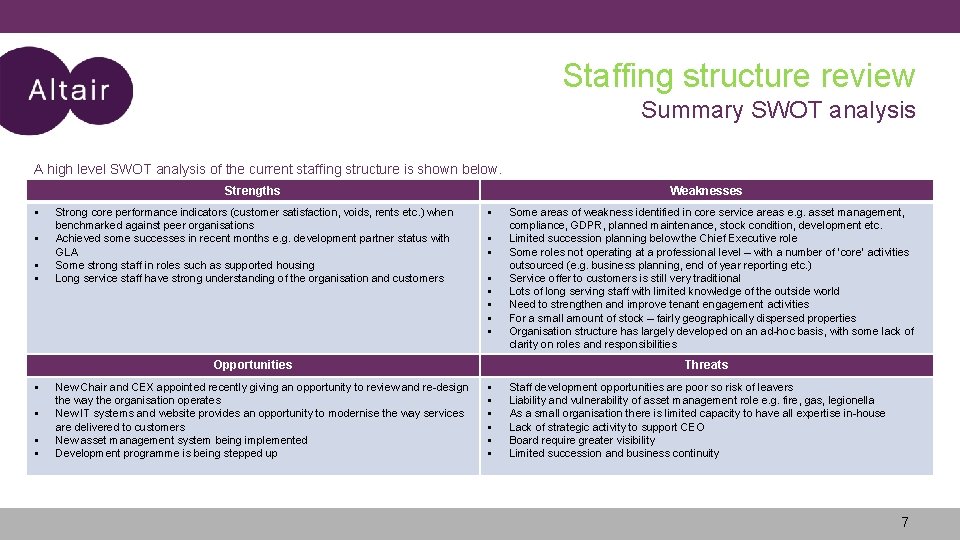
Staffing structure review Summary SWOT analysis A high level SWOT analysis of the current staffing structure is shown below. Strengths Strong core performance indicators (customer satisfaction, voids, rents etc. ) when benchmarked against peer organisations Achieved some successes in recent months e. g. development partner status with GLA Some strong staff in roles such as supported housing Long service staff have strong understanding of the organisation and customers Weaknesses Opportunities New Chair and CEX appointed recently giving an opportunity to review and re-design the way the organisation operates New IT systems and website provides an opportunity to modernise the way services are delivered to customers New asset management system being implemented Development programme is being stepped up Some areas of weakness identified in core service areas e. g. asset management, compliance, GDPR, planned maintenance, stock condition, development etc. Limited succession planning below the Chief Executive role Some roles not operating at a professional level – with a number of ‘core’ activities outsourced (e. g. business planning, end of year reporting etc. ) Service offer to customers is still very traditional Lots of long serving staff with limited knowledge of the outside world Need to strengthen and improve tenant engagement activities For a small amount of stock – fairly geographically dispersed properties Organisation structure has largely developed on an ad-hoc basis, with some lack of clarity on roles and responsibilities Threats Staff development opportunities are poor so risk of leavers Liability and vulnerability of asset management role e. g. fire, gas, legionella As a small organisation there is limited capacity to have all expertise in-house Lack of strategic activity to support CEO Board require greater visibility Limited succession and business continuity 7
Staffing Structure Review Proposed Structure
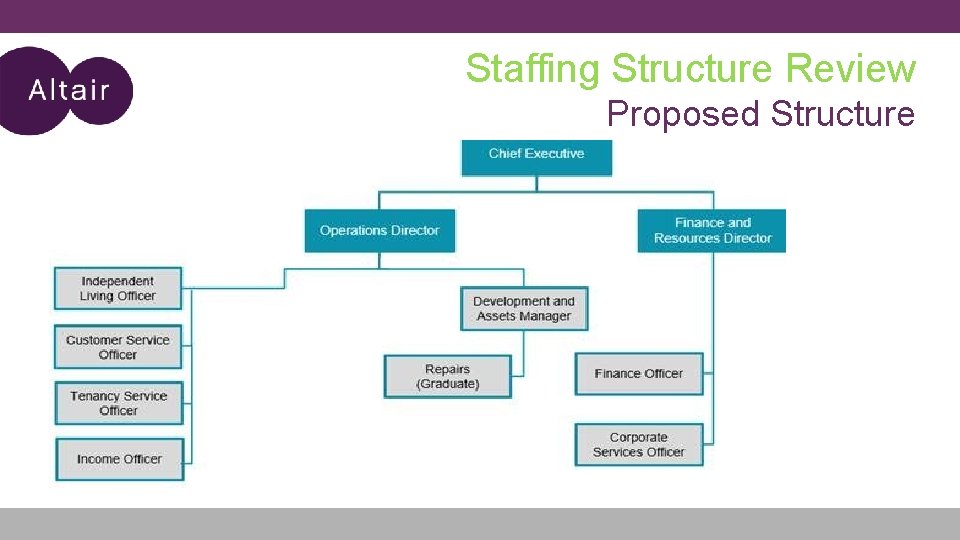
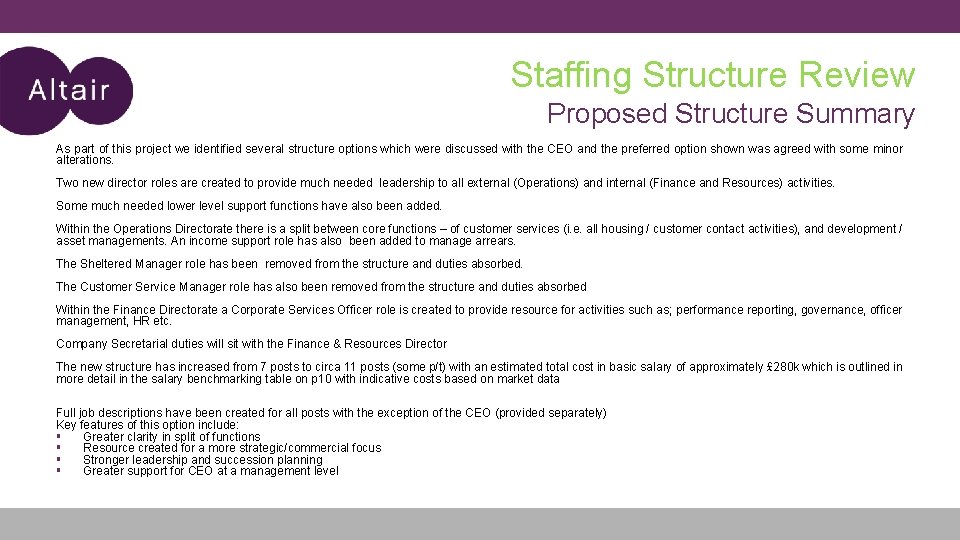
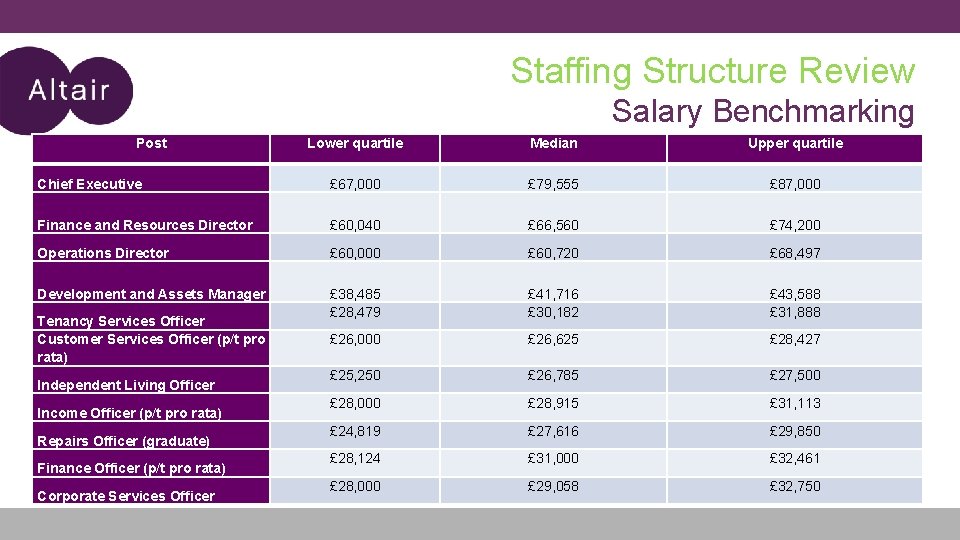
Staffing Structure Review Proposed Structure Summary As part of this project we identified several structure options which were discussed with the CEO and the preferred option shown was agreed with some minor alterations. Two new director roles are created to provide much needed leadership to all external (Operations) and internal (Finance and Resources) activities. Some much needed lower level support functions have also been added. Within the Operations Directorate there is a split between core functions – of customer services (i. e. all housing / customer contact activities), and development / asset managements. An income support role has also been added to manage arrears. The Sheltered Manager role has been removed from the structure and duties absorbed. The Customer Service Manager role has also been removed from the structure and duties absorbed Within the Finance Directorate a Corporate Services Officer role is created to provide resource for activities such as; performance reporting, governance, officer management, HR etc. Company Secretarial duties will sit with the Finance & Resources Director The new structure has increased from 7 posts to circa 11 posts (some p/t) with an estimated total cost in basic salary of approximately £ 280 k which is outlined in more detail in the salary benchmarking table on p 10 with indicative costs based on market data Full job descriptions have been created for all posts with the exception of the CEO (provided separately) Key features of this option include: Greater clarity in split of functions Resource created for a more strategic/commercial focus Stronger leadership and succession planning Greater support for CEO at a management level
Staffing Structure Review Salary Benchmarking Post Lower quartile Median Upper quartile Chief Executive £ 67, 000 £ 79, 555 £ 87, 000 Finance and Resources Director £ 60, 040 £ 66, 560 £ 74, 200 Operations Director £ 60, 000 £ 60, 720 £ 68, 497 Development and Assets Manager £ 38, 485 £ 28, 479 £ 41, 716 £ 30, 182 £ 43, 588 £ 31, 888 £ 26, 000 £ 26, 625 £ 28, 427 £ 25, 250 £ 26, 785 £ 27, 500 £ 28, 000 £ 28, 915 £ 31, 113 £ 24, 819 £ 27, 616 £ 29, 850 £ 28, 124 £ 31, 000 £ 32, 461 £ 28, 000 £ 29, 058 £ 32, 750 Tenancy Services Officer Customer Services Officer (p/t pro rata) Independent Living Officer Income Officer (p/t pro rata) Repairs Officer (graduate) Finance Officer (p/t pro rata) Corporate Services Officer
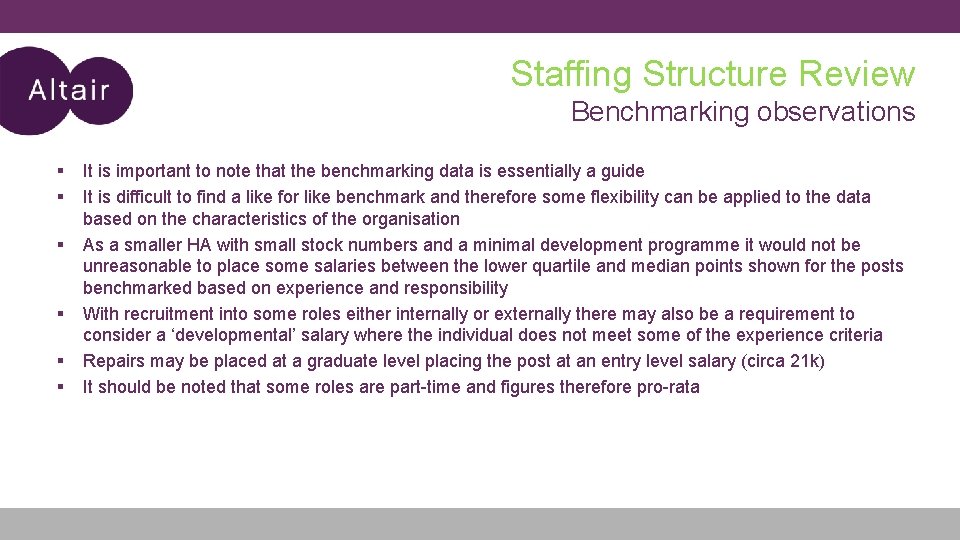
Staffing Structure Review Benchmarking observations It is important to note that the benchmarking data is essentially a guide It is difficult to find a like for like benchmark and therefore some flexibility can be applied to the data based on the characteristics of the organisation As a smaller HA with small stock numbers and a minimal development programme it would not be unreasonable to place some salaries between the lower quartile and median points shown for the posts benchmarked based on experience and responsibility With recruitment into some roles either internally or externally there may also be a requirement to consider a ‘developmental’ salary where the individual does not meet some of the experience criteria Repairs may be placed at a graduate level placing the post at an entry level salary (circa 21 k) It should be noted that some roles are part-time and figures therefore pro-rata
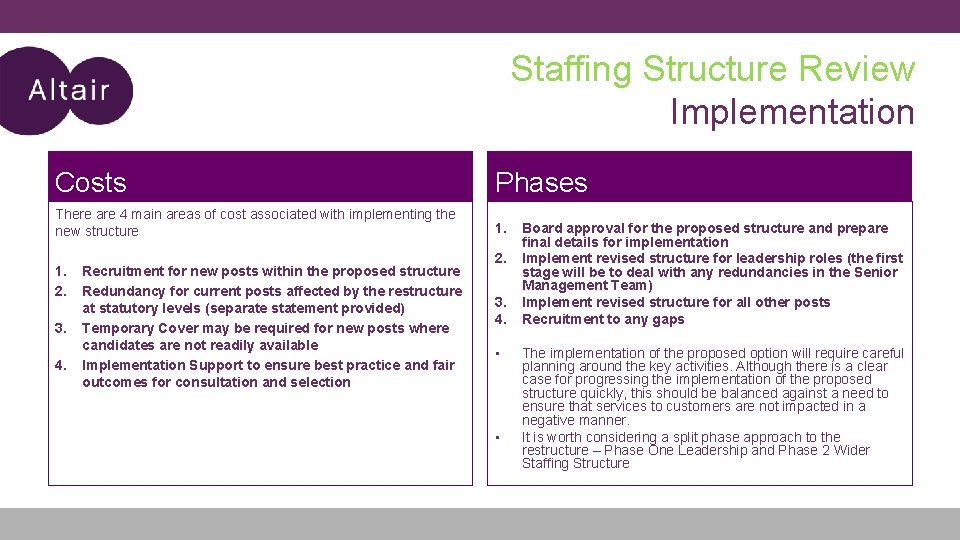
Staffing Structure Review Implementation Costs Phases There are 4 main areas of cost associated with implementing the new structure 1. 2. 3. 4. Recruitment for new posts within the proposed structure Redundancy for current posts affected by the restructure at statutory levels (separate statement provided) Temporary Cover may be required for new posts where candidates are not readily available Implementation Support to ensure best practice and fair outcomes for consultation and selection 2. 3. 4. • • Board approval for the proposed structure and prepare final details for implementation Implement revised structure for leadership roles (the first stage will be to deal with any redundancies in the Senior Management Team) Implement revised structure for all other posts Recruitment to any gaps The implementation of the proposed option will require careful planning around the key activities. Although there is a clear case for progressing the implementation of the proposed structure quickly, this should be balanced against a need to ensure that services to customers are not impacted in a negative manner. It is worth considering a split phase approach to the restructure – Phase One Leadership and Phase 2 Wider Staffing Structure
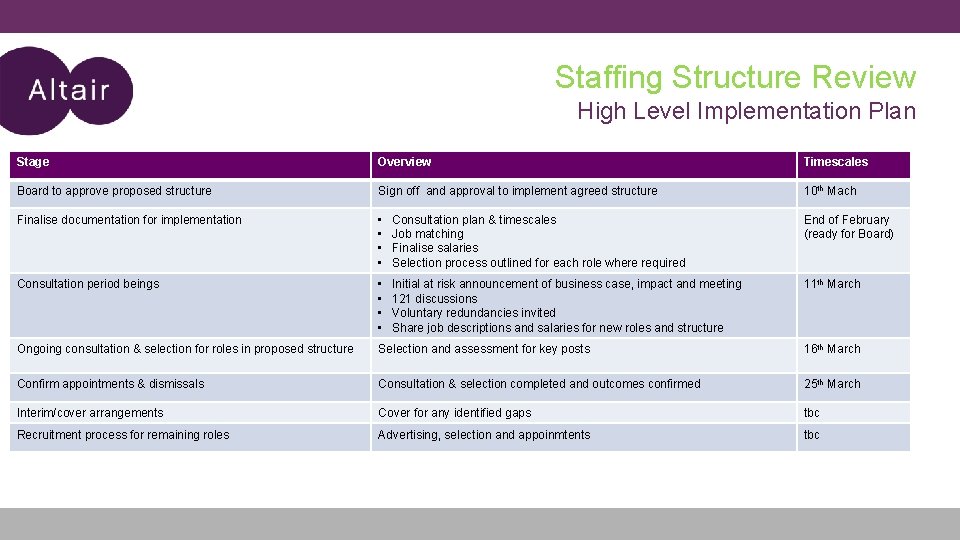
Staffing Structure Review High Level Implementation Plan Stage Overview Timescales Board to approve proposed structure Sign off and approval to implement agreed structure 10 th Mach Finalise documentation for implementation • • Consultation plan & timescales Job matching Finalise salaries Selection process outlined for each role where required End of February (ready for Board) Consultation period beings • • Initial at risk announcement of business case, impact and meeting 121 discussions Voluntary redundancies invited Share job descriptions and salaries for new roles and structure 11 th March Ongoing consultation & selection for roles in proposed structure Selection and assessment for key posts 16 th March Confirm appointments & dismissals Consultation & selection completed and outcomes confirmed 25 th March Interim/cover arrangements Cover for any identified gaps tbc Recruitment process for remaining roles Advertising, selection and appoinmtents tbc
Appendix 1 – Options discussed
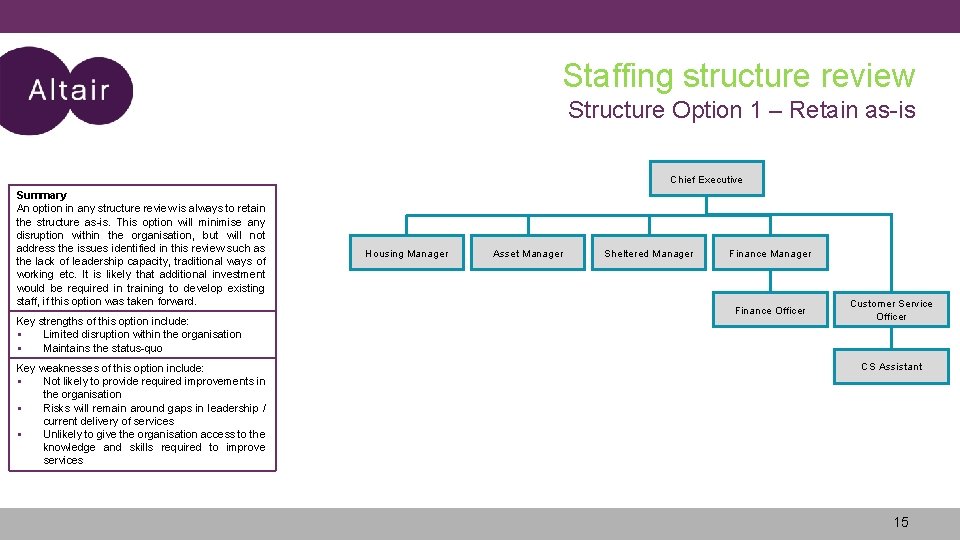
Staffing structure review Structure Option 1 – Retain as-is Chief Executive Summary An option in any structure review is always to retain the structure as-is. This option will minimise any disruption within the organisation, but will not address the issues identified in this review such as the lack of leadership capacity, traditional ways of working etc. It is likely that additional investment would be required in training to develop existing staff, if this option was taken forward. Key strengths of this option include: Limited disruption within the organisation Maintains the status-quo Key weaknesses of this option include: Not likely to provide required improvements in the organisation Risks will remain around gaps in leadership / current delivery of services Unlikely to give the organisation access to the knowledge and skills required to improve services Housing Manager Asset Manager Sheltered Manager Finance Officer Customer Service Officer CS Assistant 15
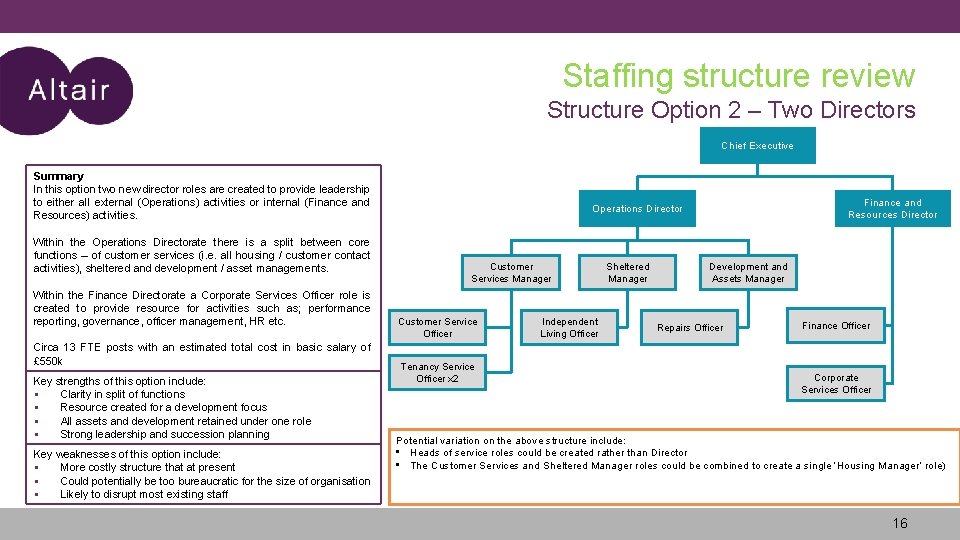
Staffing structure review Structure Option 2 – Two Directors Chief Executive Summary In this option two new director roles are created to provide leadership to either all external (Operations) activities or internal (Finance and Resources) activities. Within the Operations Directorate there is a split between core functions – of customer services (i. e. all housing / customer contact activities), sheltered and development / asset managements. Within the Finance Directorate a Corporate Services Officer role is created to provide resource for activities such as; performance reporting, governance, officer management, HR etc. Circa 13 FTE posts with an estimated total cost in basic salary of £ 550 k Key strengths of this option include: Clarity in split of functions Resource created for a development focus All assets and development retained under one role Strong leadership and succession planning Key weaknesses of this option include: More costly structure that at present Could potentially be too bureaucratic for the size of organisation Likely to disrupt most existing staff Finance and Resources Director Operations Director Customer Services Manager Customer Service Officer Tenancy Service Officer x 2 Independent Living Officer Sheltered Manager Development and Assets Manager Repairs Officer Finance Officer Corporate Services Officer Potential variation on the above structure include: • Heads of service roles could be created rather than Director • The Customer Services and Sheltered Manager roles could be combined to create a single ‘Housing Manager’ role) 16
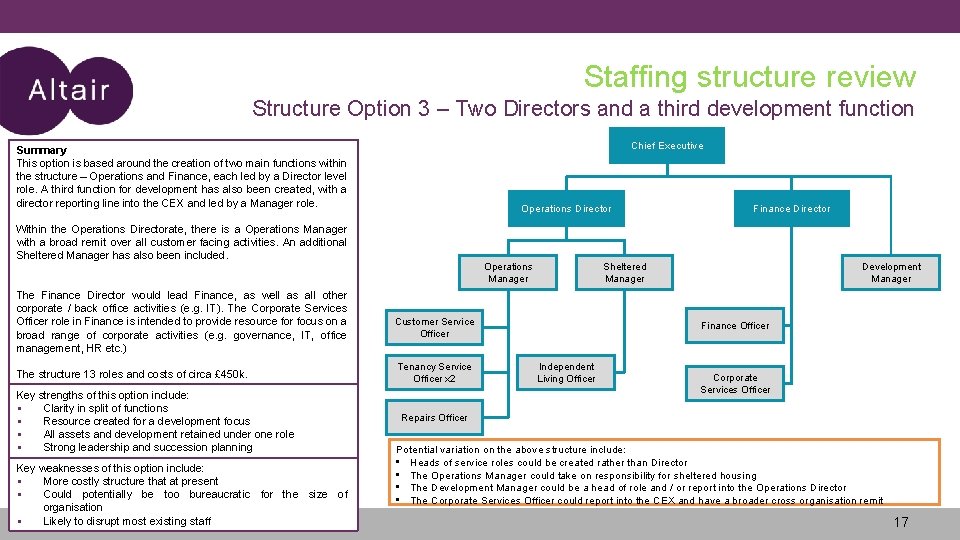
Staffing structure review Structure Option 3 – Two Directors and a third development function Chief Executive Summary This option is based around the creation of two main functions within the structure – Operations and Finance, each led by a Director level role. A third function for development has also been created, with a director reporting line into the CEX and led by a Manager role. Operations Director Within the Operations Directorate, there is a Operations Manager with a broad remit over all customer facing activities. An additional Sheltered Manager has also been included. The Finance Director would lead Finance, as well as all other corporate / back office activities (e. g. IT). The Corporate Services Officer role in Finance is intended to provide resource for focus on a broad range of corporate activities (e. g. governance, IT, office management, HR etc. ) The structure 13 roles and costs of circa £ 450 k. Key strengths of this option include: Clarity in split of functions Resource created for a development focus All assets and development retained under one role Strong leadership and succession planning Key weaknesses of this option include: More costly structure that at present Could potentially be too bureaucratic for the size of organisation Likely to disrupt most existing staff Operations Manager Sheltered Manager Customer Service Officer Tenancy Service Officer x 2 Finance Director Development Manager Finance Officer Independent Living Officer Corporate Services Officer Repairs Officer Potential variation on the above structure include: • Heads of service roles could be created rather than Director • The Operations Manager could take on responsibility for sheltered housing • The Development Manager could be a head of role and / or report into the Operations Director • The Corporate Services Officer could report into the CEX and have a broader cross organisation remit 17
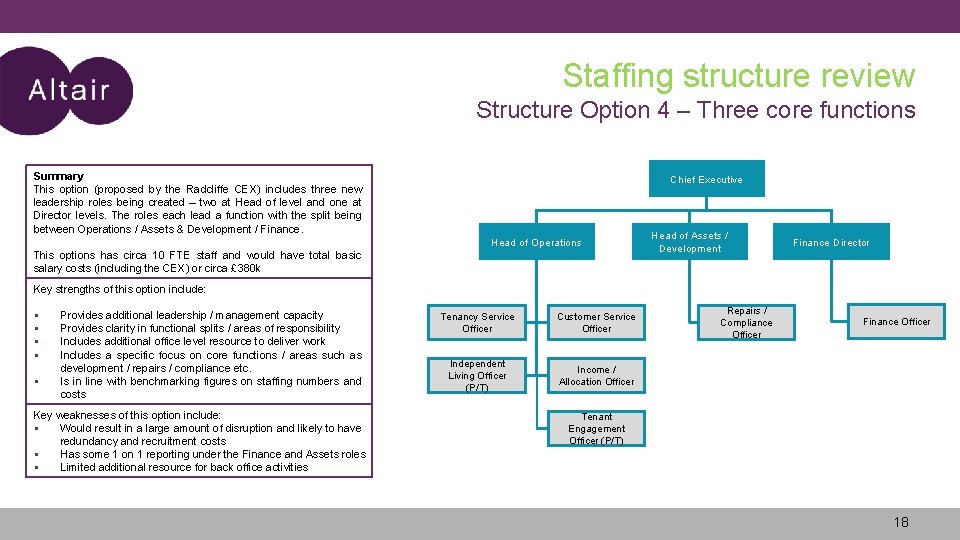
Staffing structure review Structure Option 4 – Three core functions Summary This option (proposed by the Radcliffe CEX) includes three new leadership roles being created – two at Head of level and one at Director levels. The roles each lead a function with the split being between Operations / Assets & Development / Finance. Chief Executive Head of Operations This options has circa 10 FTE staff and would have total basic salary costs (including the CEX) or circa £ 380 k Head of Assets / Development Finance Director Key strengths of this option include: Provides additional leadership / management capacity Provides clarity in functional splits / areas of responsibility Includes additional office level resource to deliver work Includes a specific focus on core functions / areas such as development / repairs / compliance etc. Is in line with benchmarking figures on staffing numbers and costs Key weaknesses of this option include: Would result in a large amount of disruption and likely to have redundancy and recruitment costs Has some 1 on 1 reporting under the Finance and Assets roles Limited additional resource for back office activities Tenancy Service Officer Customer Service Officer Independent Living Officer (P/T) Income / Allocation Officer Repairs / Compliance Officer Finance Officer Tenant Engagement Officer (P/T) 18
Appendix 2 – Case study examples 19
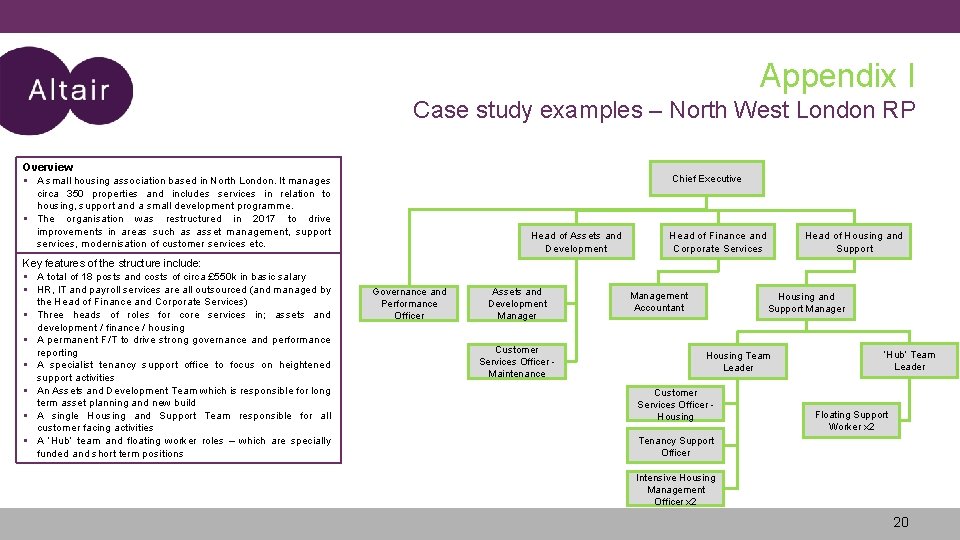
Appendix I Case study examples – North West London RP Overview A small housing association based in North London. It manages circa 350 properties and includes services in relation to housing, support and a small development programme. The organisation was restructured in 2017 to drive improvements in areas such as asset management, support services, modernisation of customer services etc. Key features of the structure include: A total of 18 posts and costs of circa £ 550 k in basic salary HR, IT and payroll services are all outsourced (and managed by the Head of Finance and Corporate Services) Three heads of roles for core services in; assets and development / finance / housing A permanent F/T to drive strong governance and performance reporting A specialist tenancy support office to focus on heightened support activities An Assets and Development Team which is responsible for long term asset planning and new build A single Housing and Support Team responsible for all customer facing activities A ‘Hub’ team and floating worker roles – which are specially funded and short term positions Chief Executive Head of Assets and Development Governance and Performance Officer Assets and Development Manager Customer Services Officer Maintenance Head of Finance and Corporate Services Management Accountant Head of Housing and Support Manager Housing Team Leader Customer Services Officer Housing ‘Hub’ Team Leader Floating Support Worker x 2 Tenancy Support Officer Intensive Housing Management Officer x 2 20
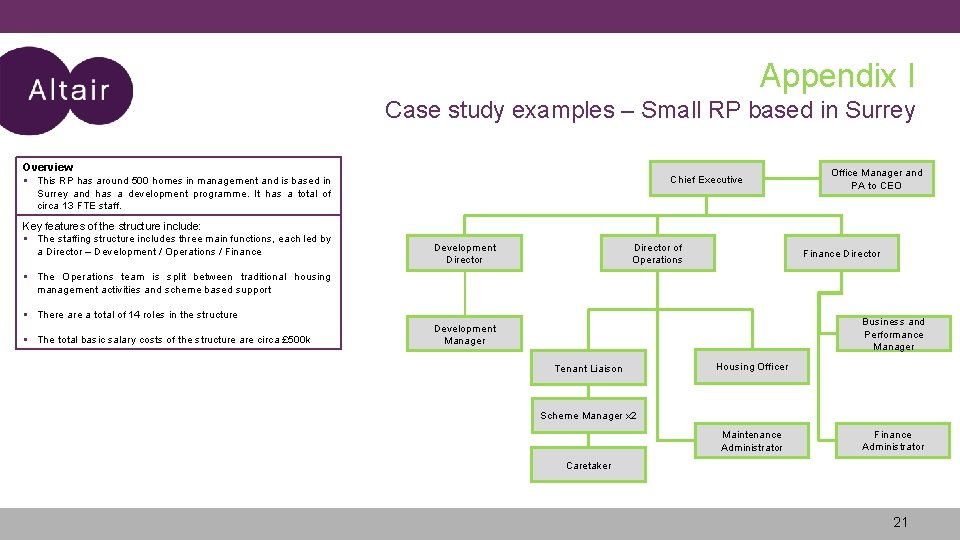
Appendix I Case study examples – Small RP based in Surrey Overview This RP has around 500 homes in management and is based in Surrey and has a development programme. It has a total of circa 13 FTE staff. Key features of the structure include: The staffing structure includes three main functions, each led by a Director – Development / Operations / Finance Chief Executive Development Director of Operations Office Manager and PA to CEO Finance Director The Operations team is split between traditional housing management activities and scheme based support There a total of 14 roles in the structure The total basic salary costs of the structure are circa £ 500 k Business and Performance Manager Development Manager Tenant Liaison Housing Officer Scheme Manager x 2 Maintenance Administrator Finance Administrator Caretaker 21
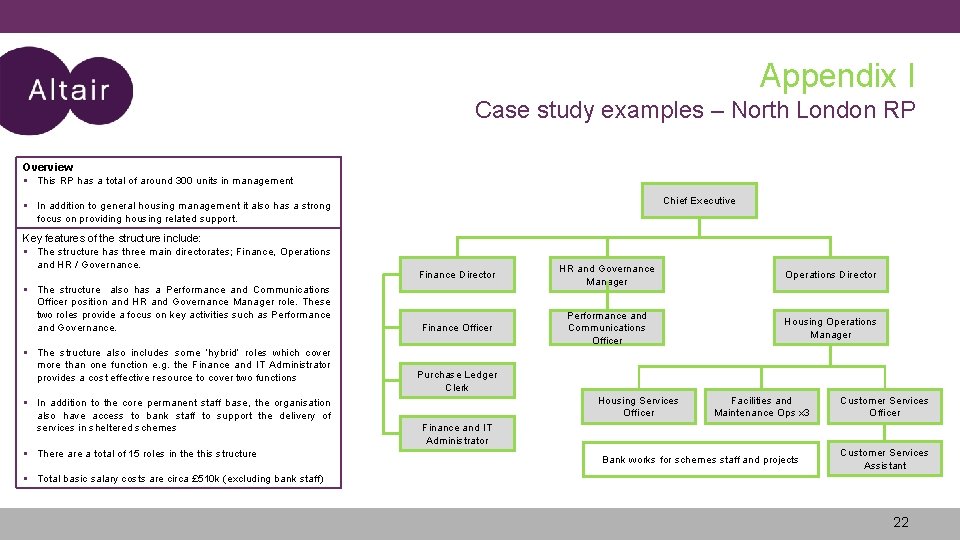
Appendix I Case study examples – North London RP Overview This RP has a total of around 300 units in management Chief Executive In addition to general housing management it also has a strong focus on providing housing related support. Key features of the structure include: The structure has three main directorates; Finance, Operations and HR / Governance. The structure also has a Performance and Communications Officer position and HR and Governance Manager role. These two roles provide a focus on key activities such as Performance and Governance. The structure also includes some ‘hybrid’ roles which cover more than one function e. g. the Finance and IT Administrator provides a cost effective resource to cover two functions In addition to the core permanent staff base, the organisation also have access to bank staff to support the delivery of services in sheltered schemes There a total of 15 roles in the this structure Finance Director HR and Governance Manager Operations Director Finance Officer Performance and Communications Officer Housing Operations Manager Purchase Ledger Clerk Housing Services Officer Facilities and Maintenance Ops x 3 Customer Services Officer Finance and IT Administrator Bank works for schemes staff and projects Customer Services Assistant Total basic salary costs are circa £ 510 k (excluding bank staff) 22
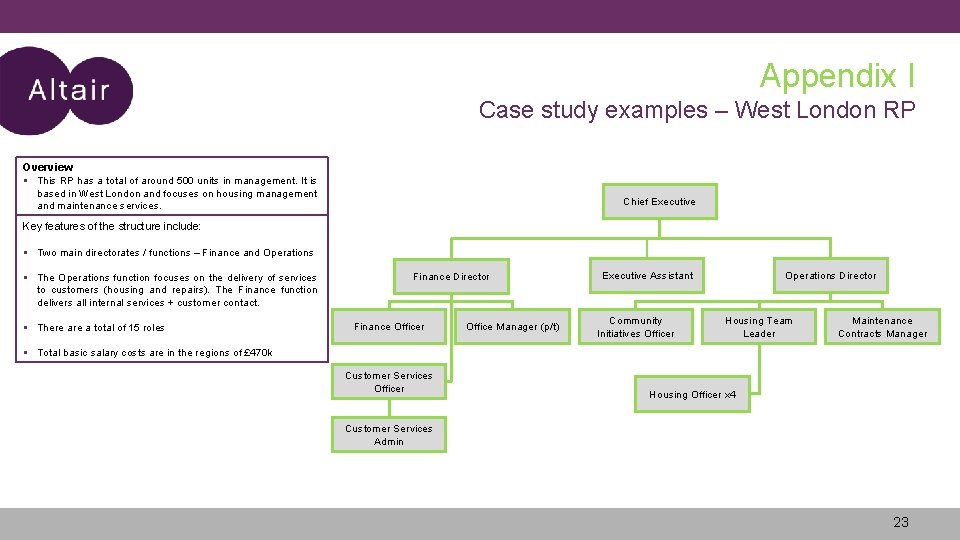
Appendix I Case study examples – West London RP Overview This RP has a total of around 500 units in management. It is based in West London and focuses on housing management and maintenance services. Chief Executive Key features of the structure include: Two main directorates / functions – Finance and Operations The Operations function focuses on the delivery of services to customers (housing and repairs). The Finance function delivers all internal services + customer contact. There a total of 15 roles Finance Director Finance Officer Office Manager (p/t) Executive Assistant Community Initiatives Officer Operations Director Housing Team Leader Maintenance Contracts Manager Total basic salary costs are in the regions of £ 470 k Customer Services Officer Housing Officer x 4 Customer Services Admin 23
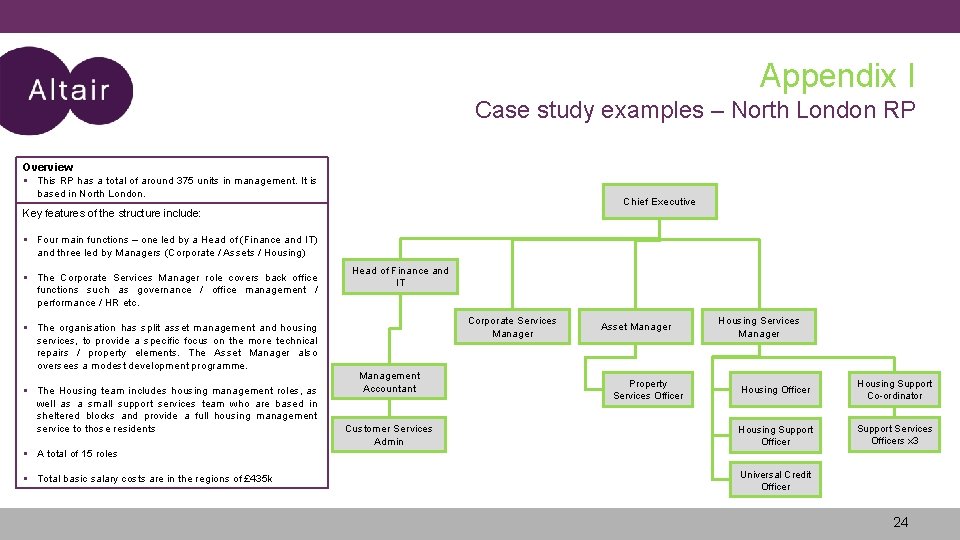
Appendix I Case study examples – North London RP Overview This RP has a total of around 375 units in management. It is based in North London. Chief Executive Key features of the structure include: Four main functions – one led by a Head of (Finance and IT) and three led by Managers (Corporate / Assets / Housing) The Corporate Services Manager role covers back office functions such as governance / office management / performance / HR etc. The organisation has split asset management and housing services, to provide a specific focus on the more technical repairs / property elements. The Asset Manager also oversees a modest development programme. The Housing team includes housing management roles, as well as a small support services team who are based in sheltered blocks and provide a full housing management service to those residents Head of Finance and IT Corporate Services Manager Management Accountant Customer Services Admin Asset Manager Property Services Officer Housing Services Manager Housing Officer Housing Support Co-ordinator Housing Support Officer Support Services Officers x 3 A total of 15 roles Total basic salary costs are in the regions of £ 435 k Universal Credit Officer 24