
Radar vs Uboats Allied Radars vs Uboat Radar
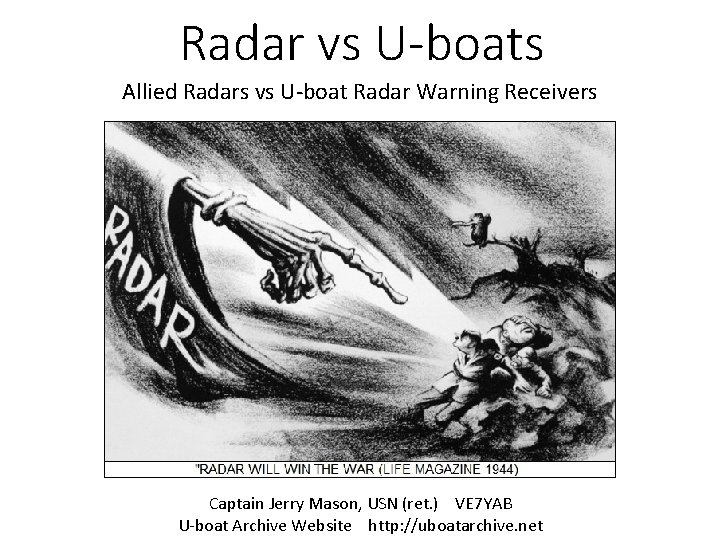
Radar vs U-boats Allied Radars vs U-boat Radar Warning Receivers Captain Jerry Mason, USN (ret. ) VE 7 YAB U-boat Archive Website http: //uboatarchive. net
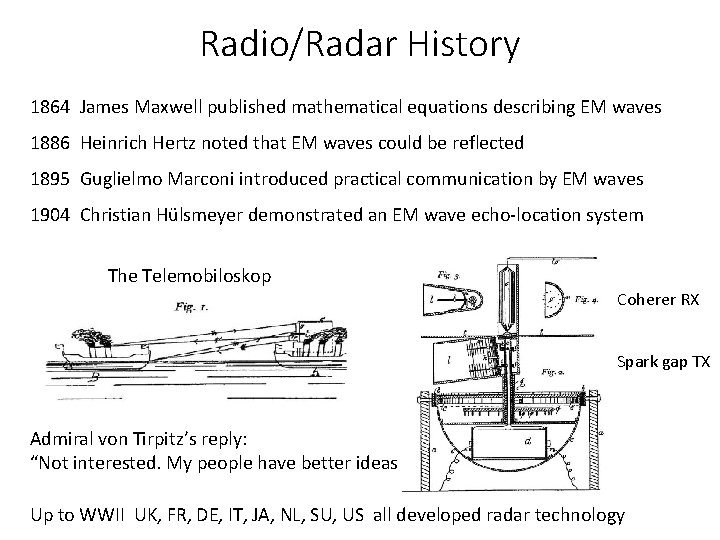
Radio/Radar History 1864 James Maxwell published mathematical equations describing EM waves 1886 Heinrich Hertz noted that EM waves could be reflected 1895 Guglielmo Marconi introduced practical communication by EM waves 1904 Christian Hülsmeyer demonstrated an EM wave echo-location system The Telemobiloskop Coherer RX Spark gap TX Admiral von Tirpitz’s reply: “Not interested. My people have better ideas!” Up to WWII UK, FR, DE, IT, JA, NL, SU, US all developed radar technology
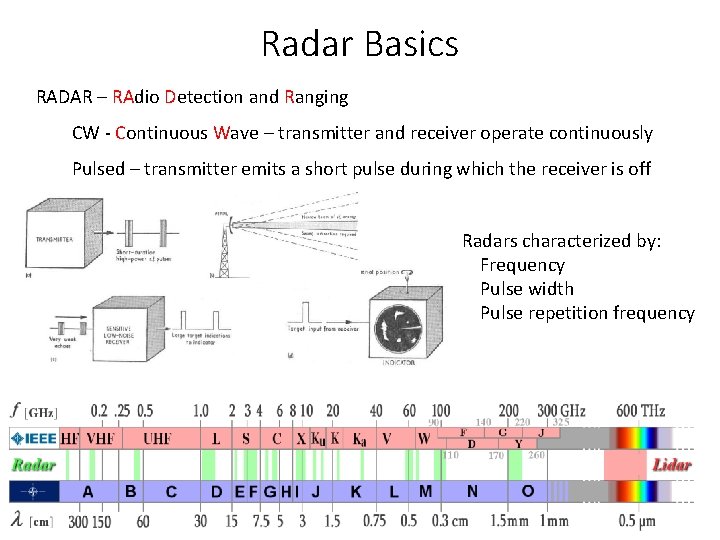
Radar Basics RADAR – RAdio Detection and Ranging CW - Continuous Wave – transmitter and receiver operate continuously Pulsed – transmitter emits a short pulse during which the receiver is off Radars characterized by: Frequency Pulse width Pulse repetition frequency
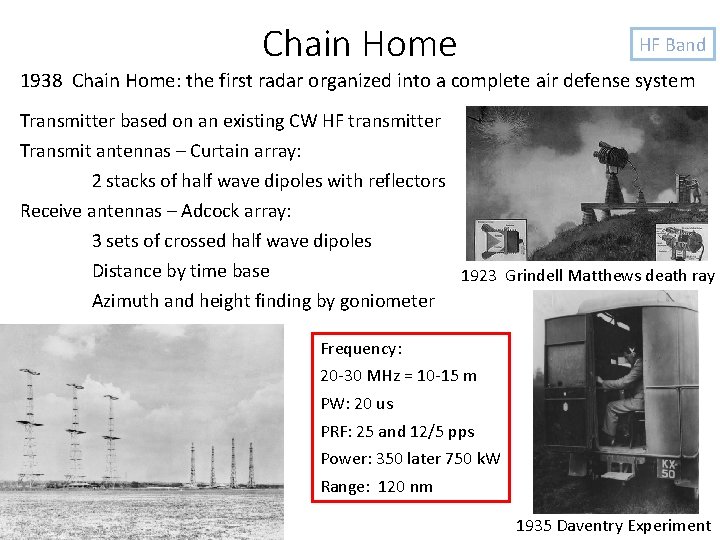
Chain Home HF Band 1938 Chain Home: the first radar organized into a complete air defense system Transmitter based on an existing CW HF transmitter Transmit antennas – Curtain array: 2 stacks of half wave dipoles with reflectors Receive antennas – Adcock array: 3 sets of crossed half wave dipoles Distance by time base 1923 Grindell Matthews death ray Azimuth and height finding by goniometer Frequency: 20 -30 MHz = 10 -15 m PW: 20 us PRF: 25 and 12/5 pps Power: 350 later 750 k. W Range: 120 nm 1935 Daventry Experiment
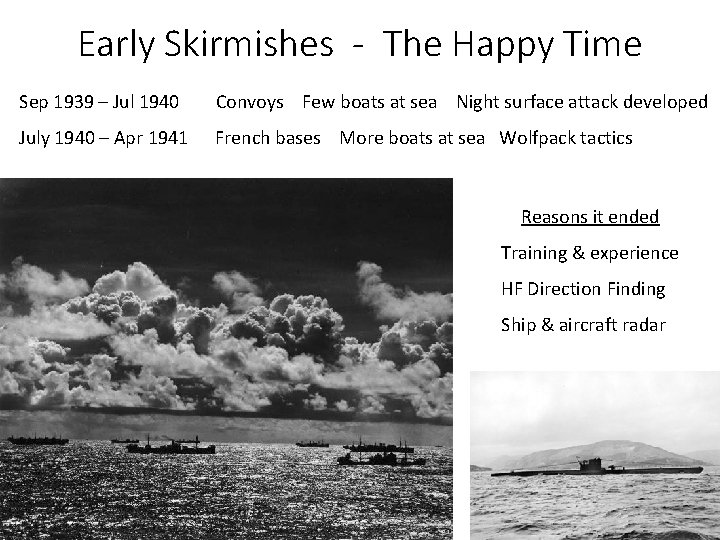
Early Skirmishes - The Happy Time Sep 1939 – Jul 1940 Convoys Few boats at sea Night surface attack developed July 1940 – Apr 1941 French bases More boats at sea Wolfpack tactics Reasons it ended Training & experience HF Direction Finding Ship & aircraft radar
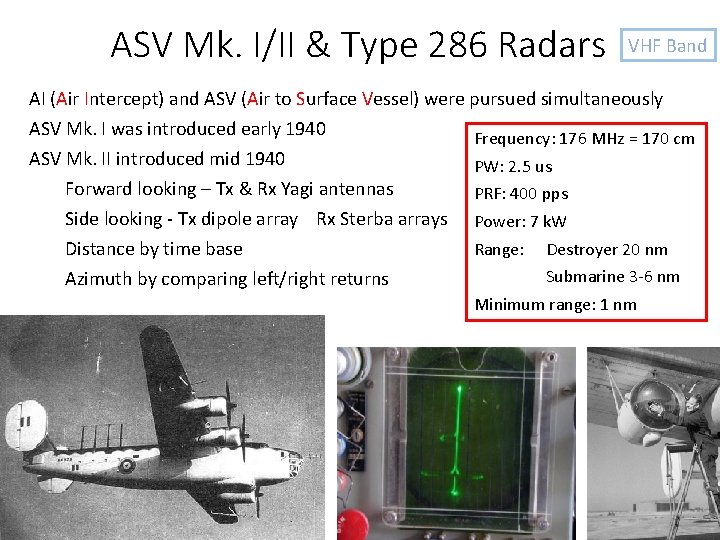
ASV Mk. I/II & Type 286 Radars VHF Band AI (Air Intercept) and ASV (Air to Surface Vessel) were pursued simultaneously ASV Mk. I was introduced early 1940 ASV Mk. II introduced mid 1940 Forward looking – Tx & Rx Yagi antennas Side looking - Tx dipole array Rx Sterba arrays Distance by time base Azimuth by comparing left/right returns Frequency: 176 MHz = 170 cm PW: 2. 5 us PRF: 400 pps Power: 7 k. W Range: Destroyer 20 nm Submarine 3 -6 nm Minimum range: 1 nm
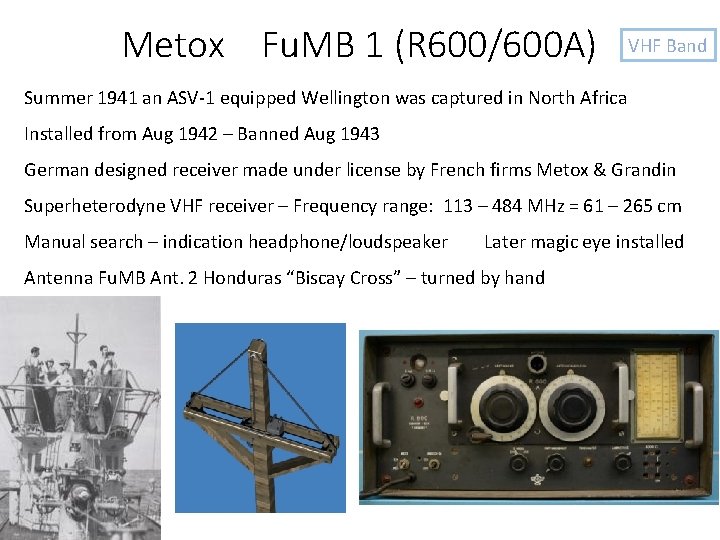
Metox Fu. MB 1 (R 600/600 A) VHF Band Summer 1941 an ASV-1 equipped Wellington was captured in North Africa Installed from Aug 1942 – Banned Aug 1943 German designed receiver made under license by French firms Metox & Grandin Superheterodyne VHF receiver – Frequency range: 113 – 484 MHz = 61 – 265 cm Manual search – indication headphone/loudspeaker Later magic eye installed Antenna Fu. MB Ant. 2 Honduras “Biscay Cross” – turned by hand
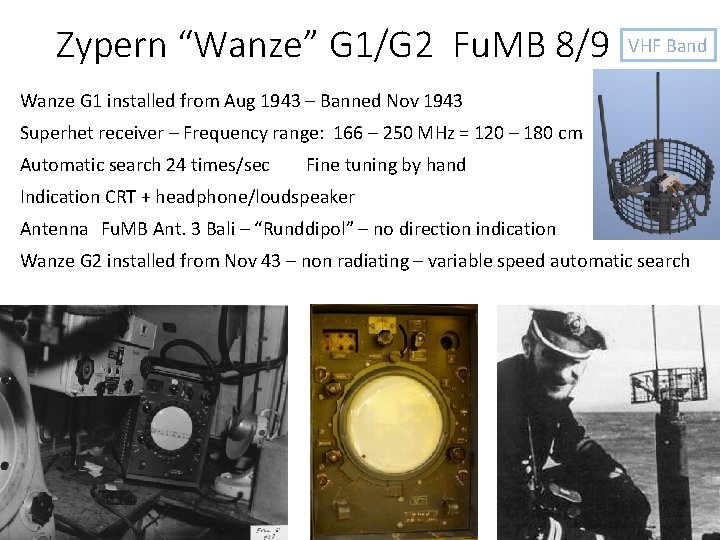
Zypern “Wanze” G 1/G 2 Fu. MB 8/9 VHF Band Wanze G 1 installed from Aug 1943 – Banned Nov 1943 Superhet receiver – Frequency range: 166 – 250 MHz = 120 – 180 cm Automatic search 24 times/sec Fine tuning by hand Indication CRT + headphone/loudspeaker Antenna Fu. MB Ant. 3 Bali – “Runddipol” – no direction indication Wanze G 2 installed from Nov 43 – non radiating – variable speed automatic search
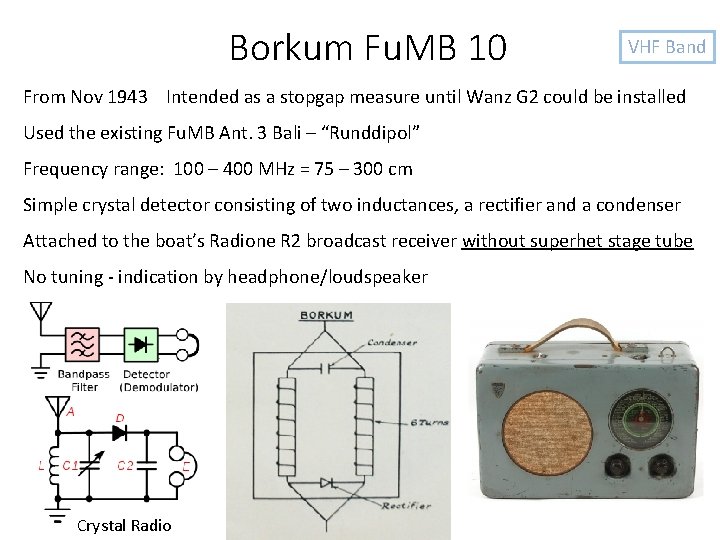
Borkum Fu. MB 10 VHF Band From Nov 1943 Intended as a stopgap measure until Wanz G 2 could be installed Used the existing Fu. MB Ant. 3 Bali – “Runddipol” Frequency range: 100 – 400 MHz = 75 – 300 cm Simple crystal detector consisting of two inductances, a rectifier and a condenser Attached to the boat’s Radione R 2 broadcast receiver without superhet stage tube No tuning - indication by headphone/loudspeaker Crystal Radio
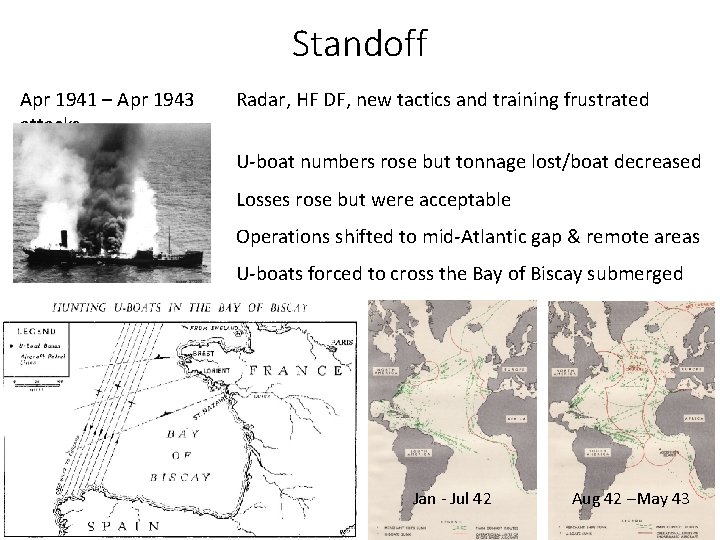
Standoff Apr 1941 – Apr 1943 attacks Radar, HF DF, new tactics and training frustrated U-boat numbers rose but tonnage lost/boat decreased Losses rose but were acceptable Operations shifted to mid-Atlantic gap & remote areas U-boats forced to cross the Bay of Biscay submerged Jan - Jul 42 Aug 42 –May 43
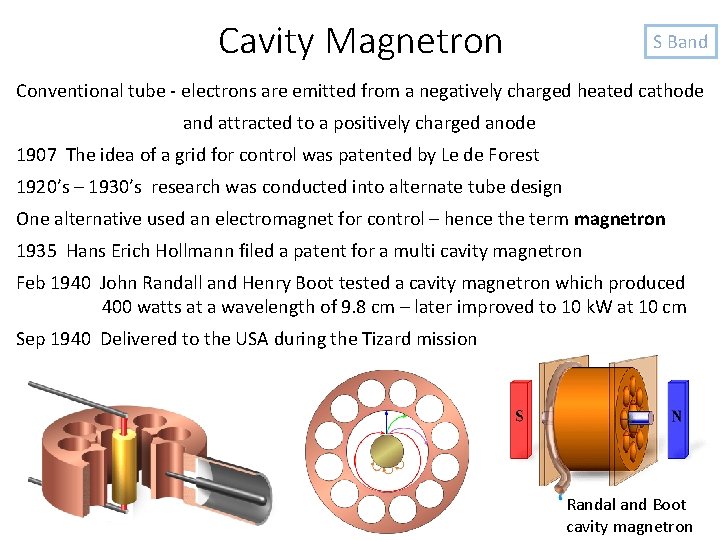
Cavity Magnetron S Band Conventional tube - electrons are emitted from a negatively charged heated cathode and attracted to a positively charged anode 1907 The idea of a grid for control was patented by Le de Forest 1920’s – 1930’s research was conducted into alternate tube design One alternative used an electromagnet for control – hence the term magnetron 1935 Hans Erich Hollmann filed a patent for a multi cavity magnetron Feb 1940 John Randall and Henry Boot tested a cavity magnetron which produced 400 watts at a wavelength of 9. 8 cm – later improved to 10 k. W at 10 cm Sep 1940 Delivered to the USA during the Tizard mission Randal and Boot cavity magnetron
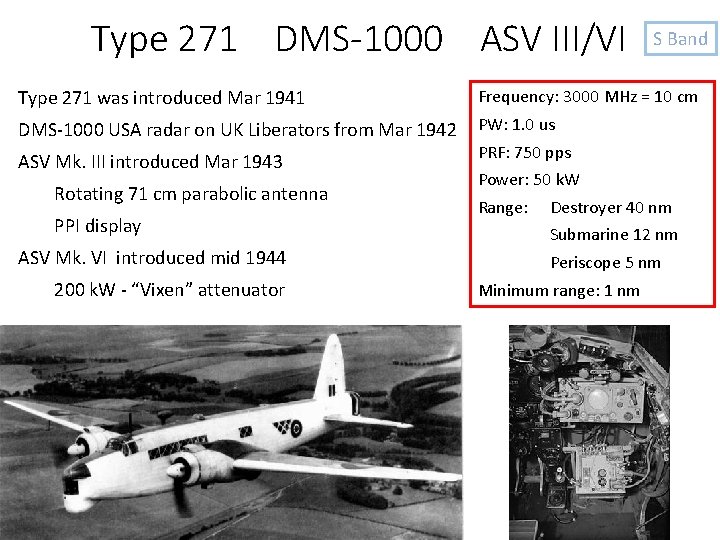
Type 271 DMS-1000 ASV III/VI S Band Type 271 was introduced Mar 1941 Frequency: 3000 MHz = 10 cm DMS-1000 USA radar on UK Liberators from Mar 1942 PW: 1. 0 us ASV Mk. III introduced Mar 1943 Rotating 71 cm parabolic antenna PPI display ASV Mk. VI introduced mid 1944 200 k. W - “Vixen” attenuator PRF: 750 pps Power: 50 k. W Range: Destroyer 40 nm Submarine 12 nm Periscope 5 nm Minimum range: 1 nm
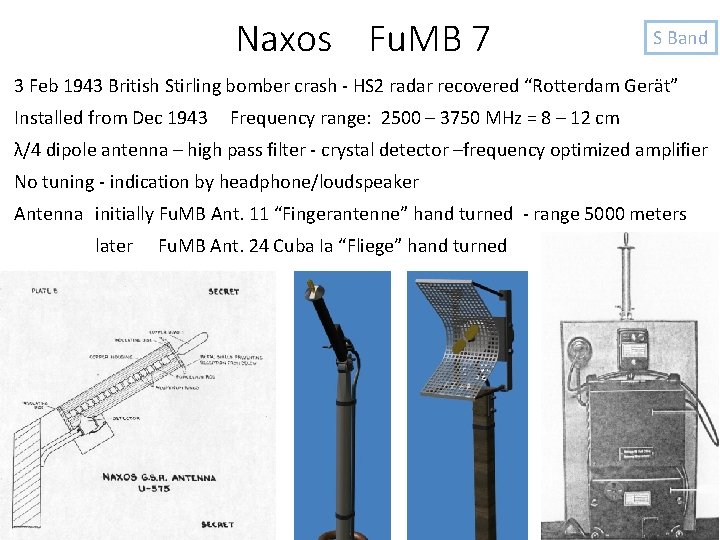
Naxos Fu. MB 7 S Band 3 Feb 1943 British Stirling bomber crash - HS 2 radar recovered “Rotterdam Gerät” Installed from Dec 1943 Frequency range: 2500 – 3750 MHz = 8 – 12 cm λ/4 dipole antenna – high pass filter - crystal detector –frequency optimized amplifier No tuning - indication by headphone/loudspeaker Antenna initially Fu. MB Ant. 11 “Fingerantenne” hand turned - range 5000 meters later Fu. MB Ant. 24 Cuba Ia “Fliege” hand turned
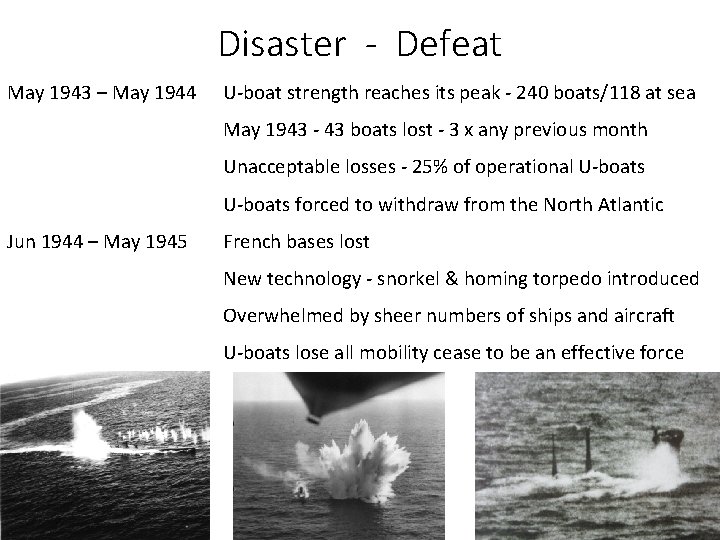
Disaster - Defeat May 1943 – May 1944 U-boat strength reaches its peak - 240 boats/118 at sea May 1943 - 43 boats lost - 3 x any previous month Unacceptable losses - 25% of operational U-boats forced to withdraw from the North Atlantic Jun 1944 – May 1945 French bases lost New technology - snorkel & homing torpedo introduced Overwhelmed by sheer numbers of ships and aircraft U-boats lose all mobility cease to be an effective force
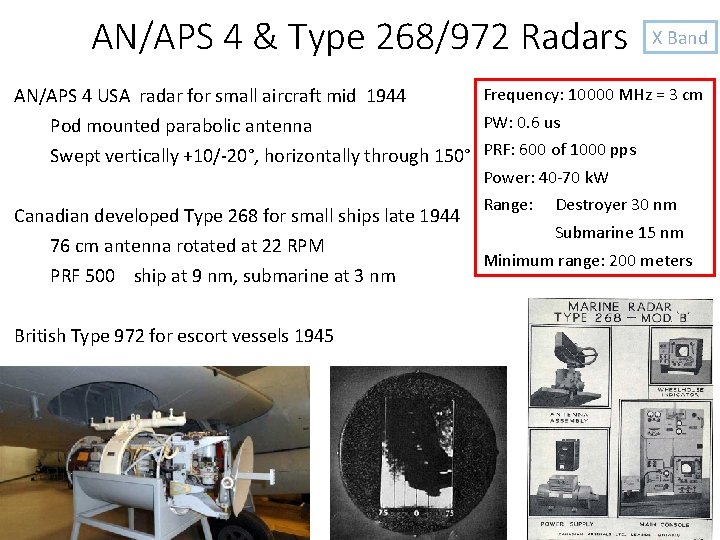
AN/APS 4 & Type 268/972 Radars AN/APS 4 USA radar for small aircraft mid 1944 X Band Frequency: 10000 MHz = 3 cm PW: 0. 6 us Pod mounted parabolic antenna Swept vertically +10/-20°, horizontally through 150° PRF: 600 of 1000 pps Power: 40 -70 k. W Canadian developed Type 268 for small ships late 1944 76 cm antenna rotated at 22 RPM PRF 500 ship at 9 nm, submarine at 3 nm British Type 972 for escort vessels 1945 Range: Destroyer 30 nm Submarine 15 nm Minimum range: 200 meters
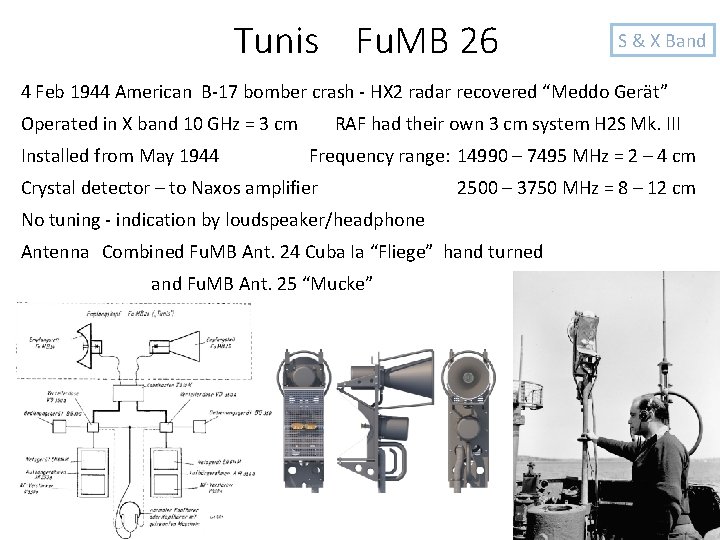
Tunis Fu. MB 26 S & X Band 4 Feb 1944 American B-17 bomber crash - HX 2 radar recovered “Meddo Gerät” Operated in X band 10 GHz = 3 cm Installed from May 1944 RAF had their own 3 cm system H 2 S Mk. III Frequency range: 14990 – 7495 MHz = 2 – 4 cm Crystal detector – to Naxos amplifier 2500 – 3750 MHz = 8 – 12 cm No tuning - indication by loudspeaker/headphone Antenna Combined Fu. MB Ant. 24 Cuba Ia “Fliege” hand turned and Fu. MB Ant. 25 “Mucke”
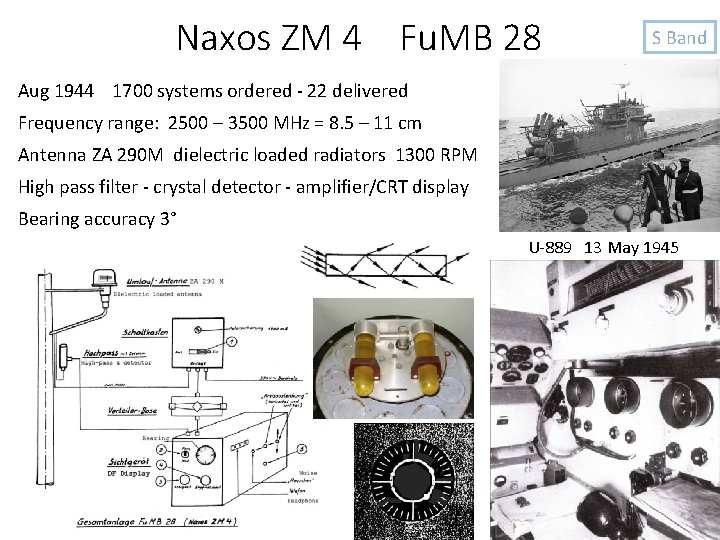
Naxos ZM 4 Fu. MB 28 S Band Aug 1944 1700 systems ordered - 22 delivered Frequency range: 2500 – 3500 MHz = 8. 5 – 11 cm Antenna ZA 290 M dielectric loaded radiators 1300 RPM High pass filter - crystal detector - amplifier/CRT display Bearing accuracy 3° U-889 13 May 1945
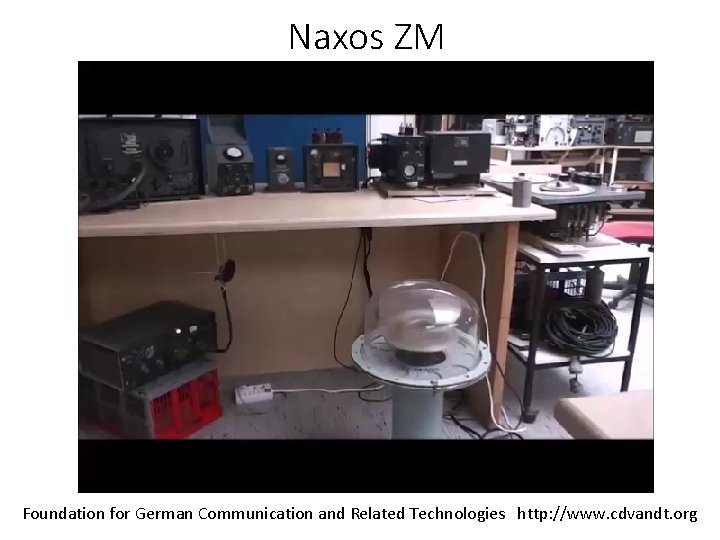
Naxos ZM Foundation for German Communication and Related Technologies http: //www. cdvandt. org
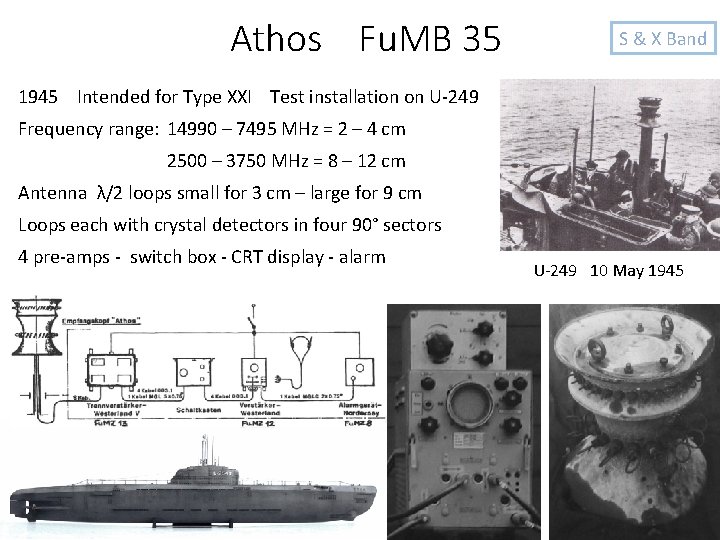
Athos Fu. MB 35 S & X Band 1945 Intended for Type XXI Test installation on U-249 Frequency range: 14990 – 7495 MHz = 2 – 4 cm 2500 – 3750 MHz = 8 – 12 cm Antenna λ/2 loops small for 3 cm – large for 9 cm Loops each with crystal detectors in four 90° sectors 4 pre-amps - switch box - CRT display - alarm U-249 10 May 1945
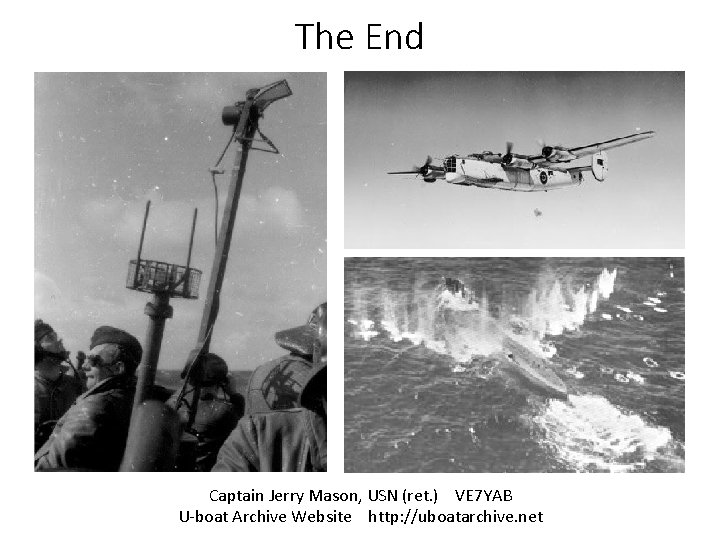
The End Captain Jerry Mason, USN (ret. ) VE 7 YAB U-boat Archive Website http: //uboatarchive. net
- Slides: 20