
RADAR Reflective Agent with Distributed Adaptive Reasoning Scheduling
RADAR Reflective Agent with Distributed Adaptive Reasoning Scheduling with uncertain resources: Representation and utility function Ulas Bardak, Eugene Fink, and Jaime Carbonell

Purpose • Automation of office tasks, such as scheduling and resource allocation • Help not only in routine situations, but also under crisis conditions
Challenges • Intelligent performance of office-management tasks • Dealing with uncertainty and unexpected situations • Collaboration with users
Conference planning Scheduling of talks at a conference, and related allocation of rooms and equipment, in a crisis situation. • Unexpected major change in space availability; for example, closing of a building • Continuous stream of minor changes; for example, schedule changes and unforeseen equipment needs
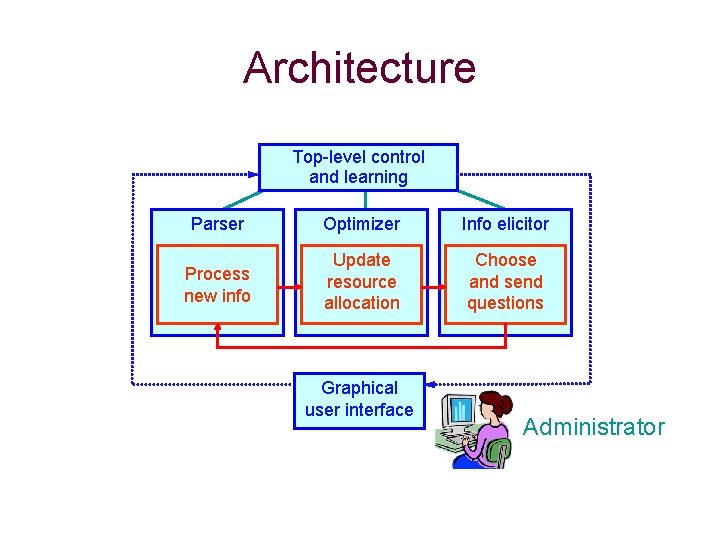
Architecture Top-level control and learning Parser Optimizer Info elicitor Process new info Update resource allocation Choose and send questions Graphical user interface Administrator
Uncertainty The system allows uncertainty in the representation of all variables and functions in optimization problems. • Uncertain nominals • Uncertain integers • Uncertain utility
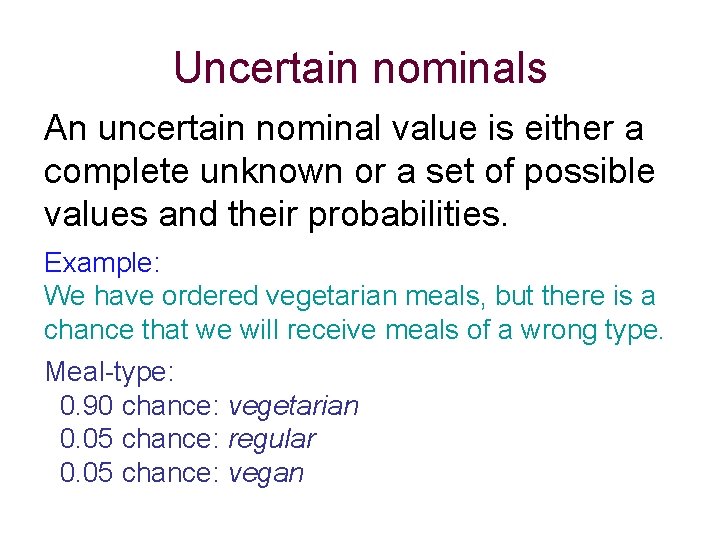
Uncertain nominals An uncertain nominal value is either a complete unknown or a set of possible values and their probabilities. Example: We have ordered vegetarian meals, but there is a chance that we will receive meals of a wrong type. Meal-type: 0. 90 chance: vegetarian 0. 05 chance: regular 0. 05 chance: vegan
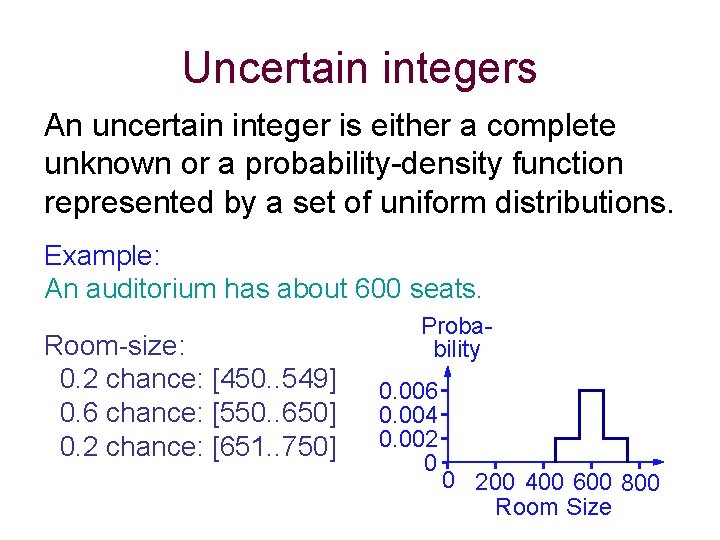
Uncertain integers An uncertain integer is either a complete unknown or a probability-density function represented by a set of uniform distributions. Example: An auditorium has about 600 seats. Room-size: 0. 2 chance: [450. . 549] 0. 6 chance: [550. . 650] 0. 2 chance: [651. . 750] Probability 0. 006 0. 004 0. 002 0 0 200 400 600 800 Room Size
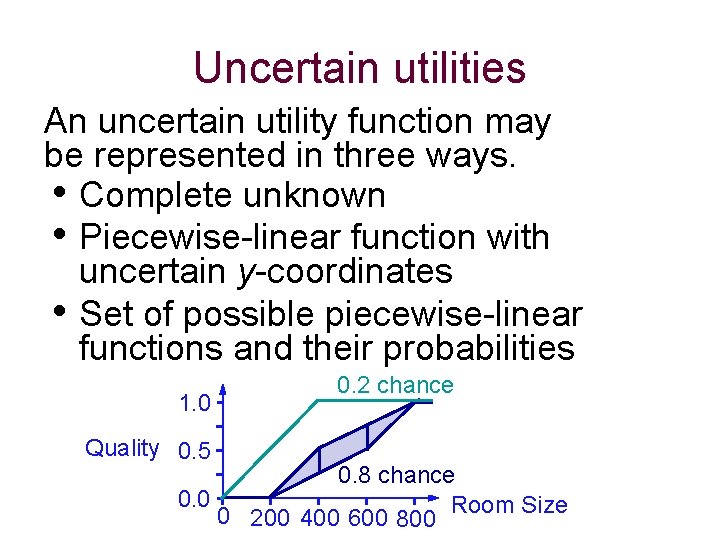
Uncertain utilities An uncertain utility function may be represented in three ways. • Complete unknown • Piecewise-linear function with uncertain y-coordinates • Set of possible piecewise-linear functions and their probabilities 1. 0 Quality 0. 5 0. 2 chance 0. 8 chance 0. 0 0 200 400 600 800 Room Size
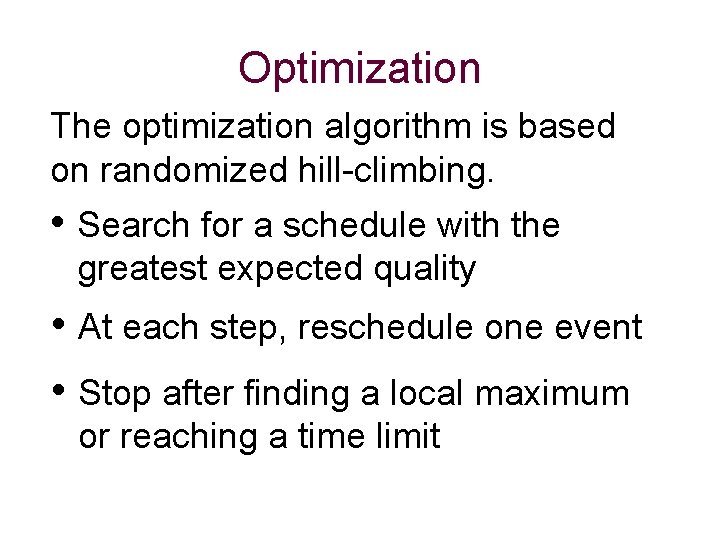
Optimization The optimization algorithm is based on randomized hill-climbing. • Search for a schedule with the greatest expected quality • At each step, reschedule one event • Stop after finding a local maximum or reaching a time limit
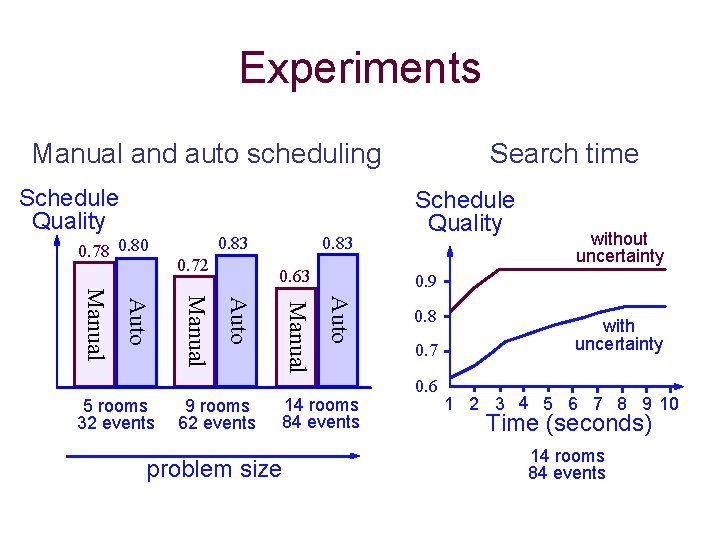
Experiments Manual and auto scheduling Schedule Quality 0. 78 0. 80 0. 72 0. 63 14 rooms 84 events problem size Schedule Quality without uncertainty 0. 9 Auto 9 rooms 62 events Manual Auto Manual 5 rooms 32 events 0. 83 Search time 0. 8 0. 7 0. 6 with uncertainty 1 2 3 4 5 6 7 8 9 10 Time (seconds) 14 rooms 84 events
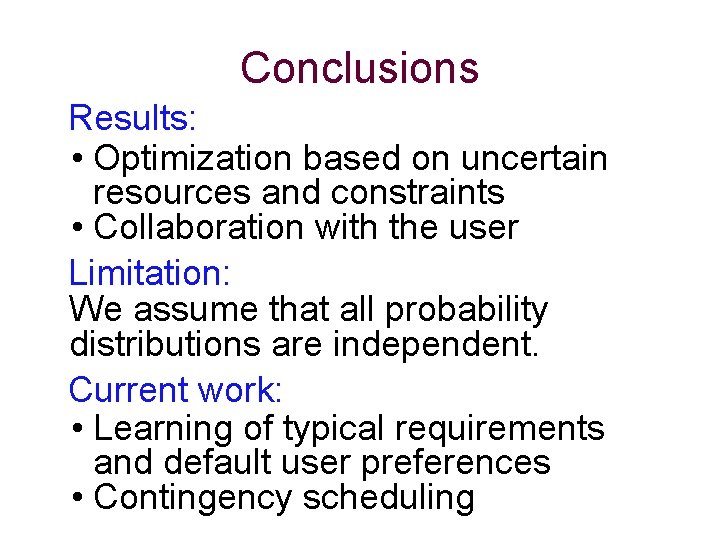
Conclusions Results: • Optimization based on uncertain resources and constraints • Collaboration with the user Limitation: We assume that all probability distributions are independent. Current work: • Learning of typical requirements and default user preferences • Contingency scheduling
- Slides: 12