
Radar Project Pulse Compression Radar By Hamdi M
Radar Project Pulse Compression Radar By: Hamdi M. Joudeh and Yousef Al-Yazji Supervisor: Dr. Mohamed Ouda 1
Introduction: l. Radars can be classified according to the waveforms: - Continuous Wave (CW) Radars. - Pulsed Radars (PR). We are concerned in Pulsed Radars: - Train of pulsed waveforms. - Transmitted periodically. 2
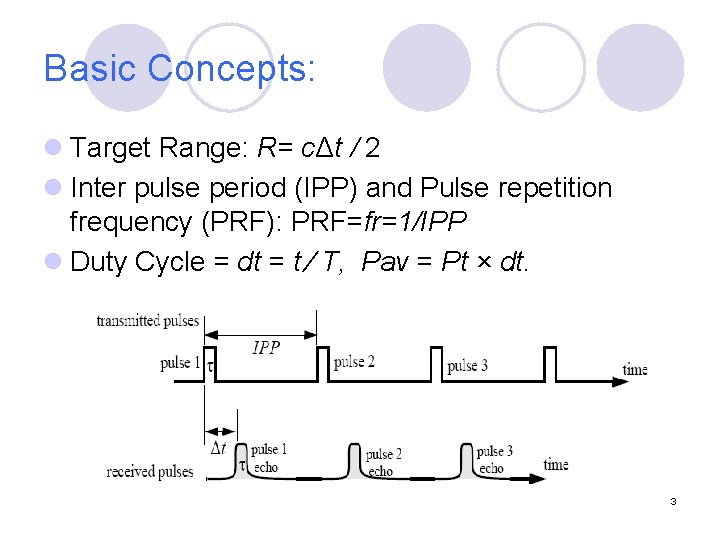
Basic Concepts: l Target Range: R= cΔt / 2 l Inter pulse period (IPP) and Pulse repetition frequency (PRF): PRF=fr=1/IPP l Duty Cycle = dt = t ⁄ T, Pav = Pt × dt. 3
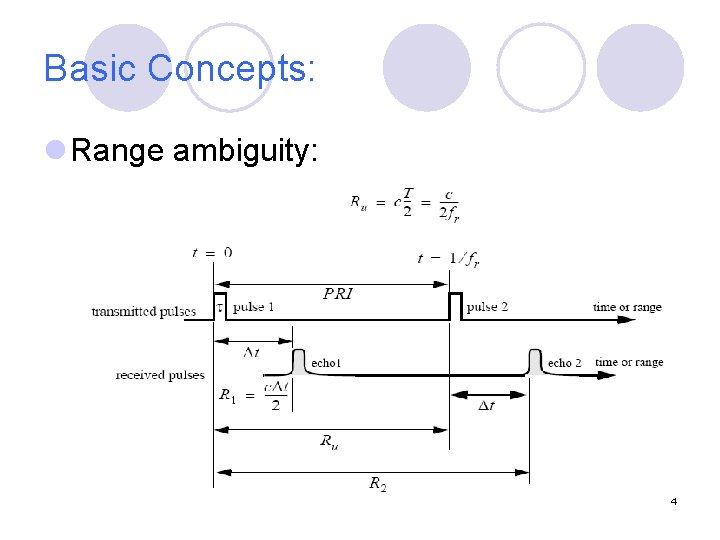
Basic Concepts: l Range ambiguity: 4
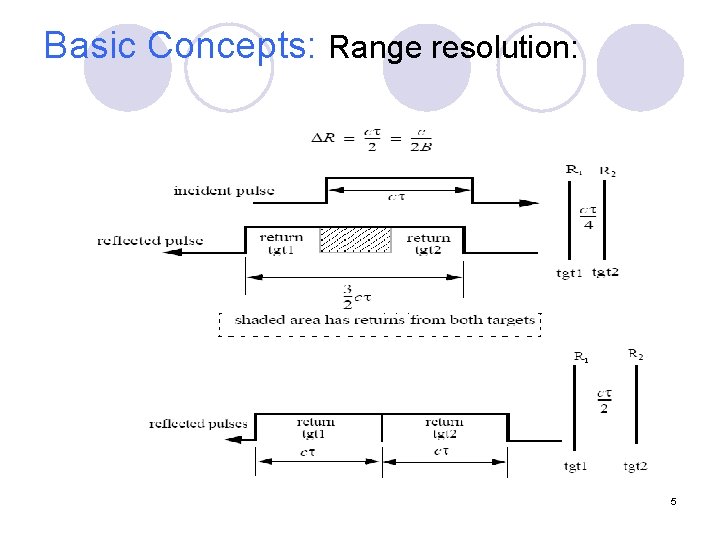
Basic Concepts: Range resolution: 5
Pulse Compression: l Short pulses are used to increase range resolution. l Short pulses = decreased average power. l Decreased average power=Decreased detection capability. l Pulse compression = Increased average power + Increased Range resolution. 6
Advantages of pulse compression: l. Maintain the pulse repetition frequency (PRF). l. The avoidance of using high peak power. l. Increases the interference immunity. l. Increases range resolution while maintaining detection capability. 7
The concept of pulse compression: l 1 - Generation of a coded waveform: (various types). l 2 - Detection and processing of the echo: (achieved by a compression filter). l The actual compression process takes place in the receiver by the matched filter or a correlation process. 8
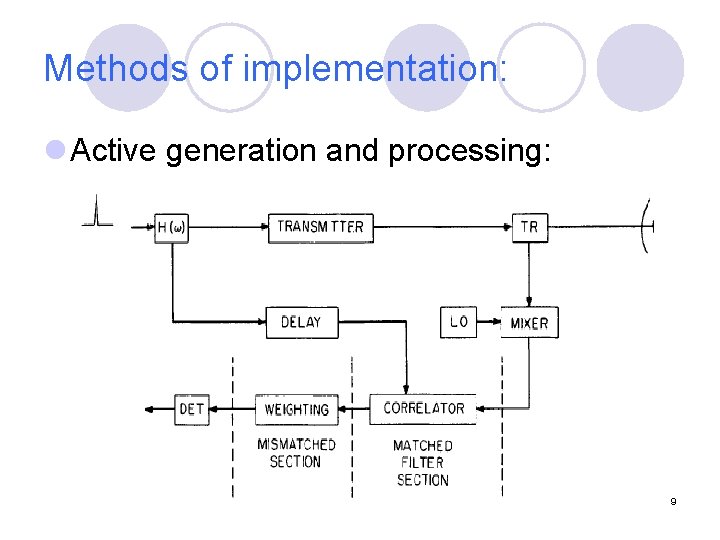
Methods of implementation: l Active generation and processing: 9
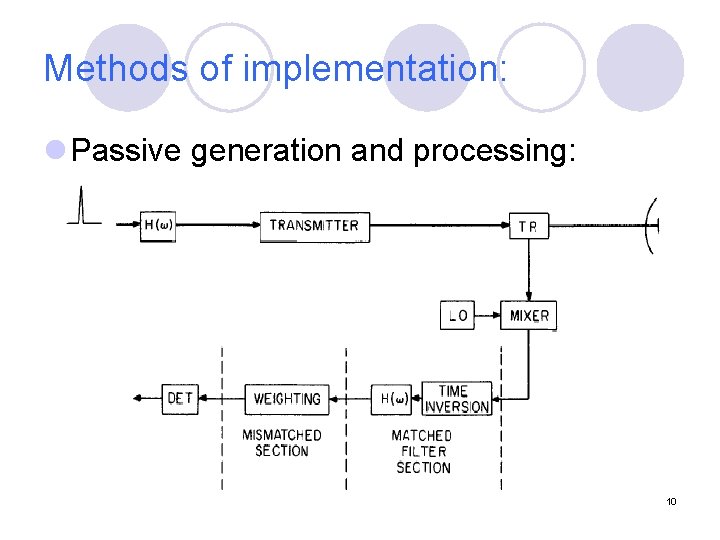
Methods of implementation: l Passive generation and processing: 10
Types of pulse compression: Linear FM: Advantages l. Easiest to generate. l. The largest number of generation and processing approaches. l. SNR is fairly insensitive to Doppler shifts. 11
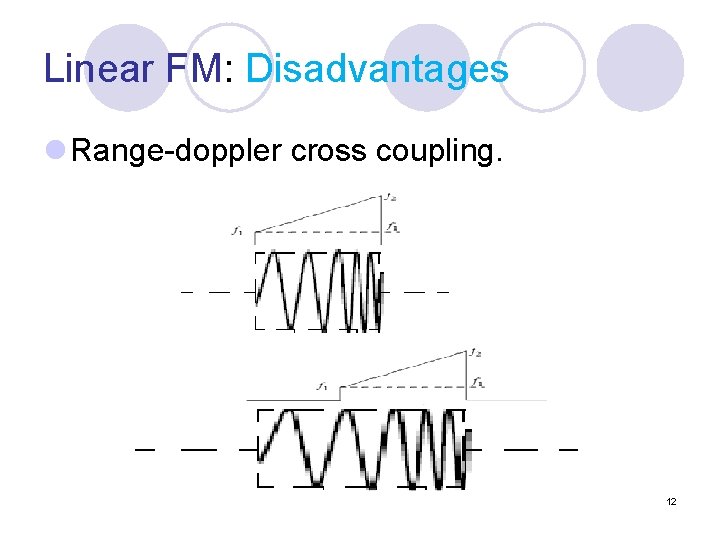
Linear FM: Disadvantages l Range-doppler cross coupling. 12
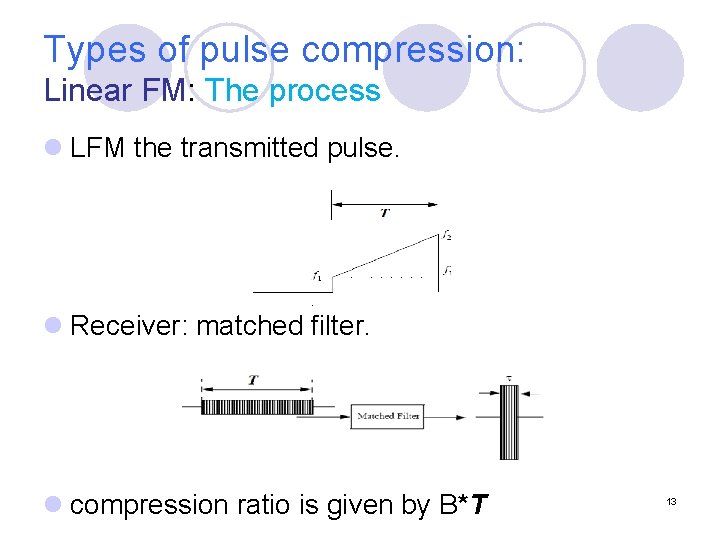
Types of pulse compression: Linear FM: The process l LFM the transmitted pulse. l Receiver: matched filter. l compression ratio is given by B*T 13
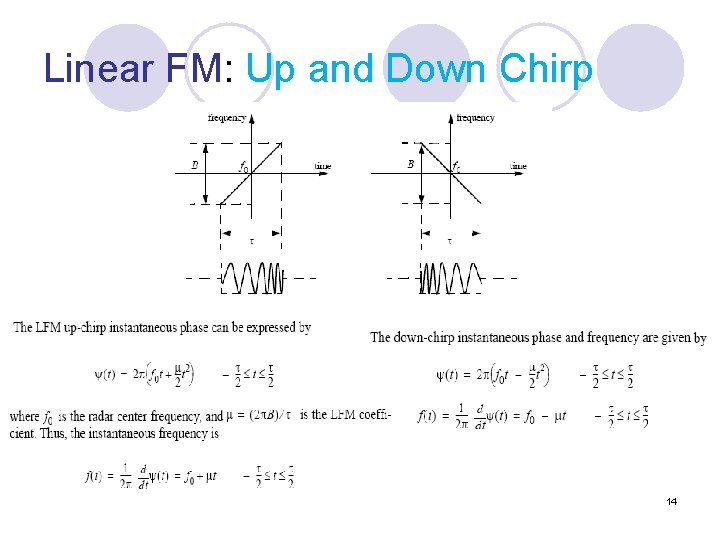
Linear FM: Up and Down Chirp 14
Linear FM: Compression l Compression Ratio=T/t. l ∆R = C*t/2. l Higher Compression Ratio = Better range resolution. l Compression Ratio=B*T. l wideband LFM modulation = Higher compression ratio. 15
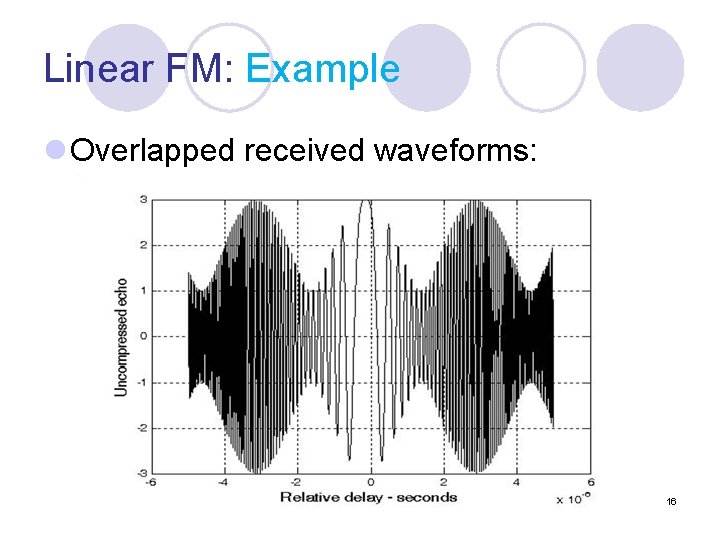
Linear FM: Example l Overlapped received waveforms: 16
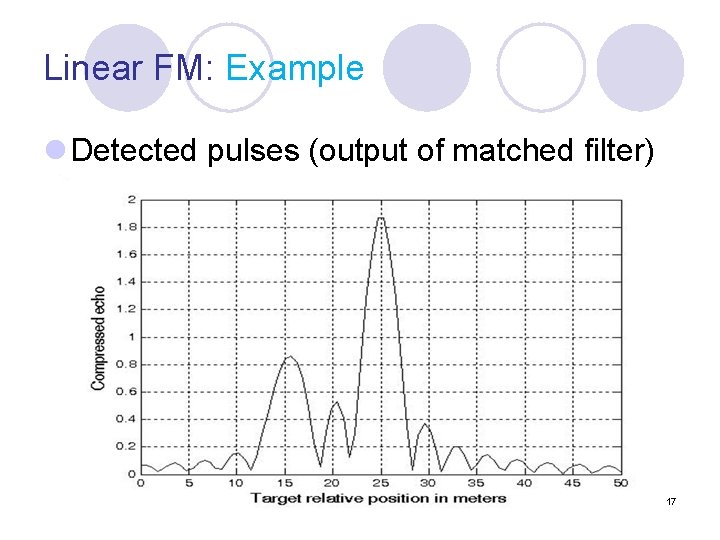
Linear FM: Example l Detected pulses (output of matched filter) 17
Phase Coded: Introduction l Long Pulse with duration(T) divided to (N) coded sub-pulses with duration(t). l Uncoded pulse (T), ∆R = C*T/2. l Duration of compressed pulse = duration of sub-pulse = t. l Compression ratio = B*T = T/t. l New ∆R = C*t/2 (better). 18

Phase Coded: Codes used l binary codes, sequence of either +1 or -1. l Phase of sinusoidal carrier alternates between 0° and 180° due to sub-pulse. 19
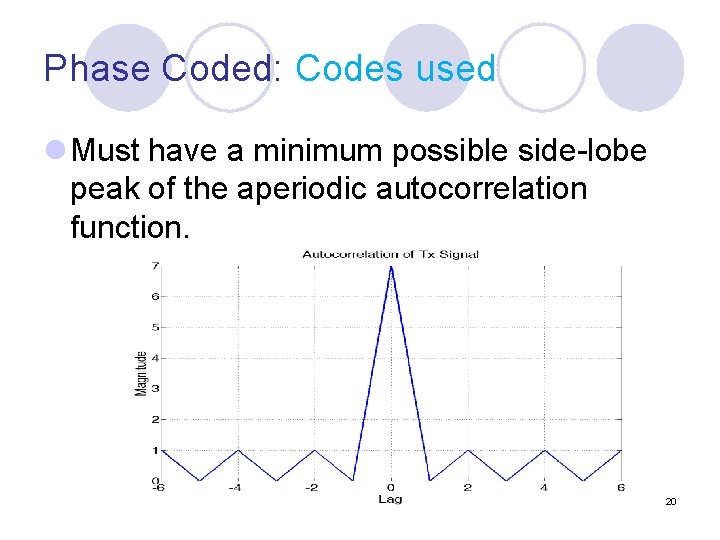
Phase Coded: Codes used l Must have a minimum possible side-lobe peak of the aperiodic autocorrelation function. 20
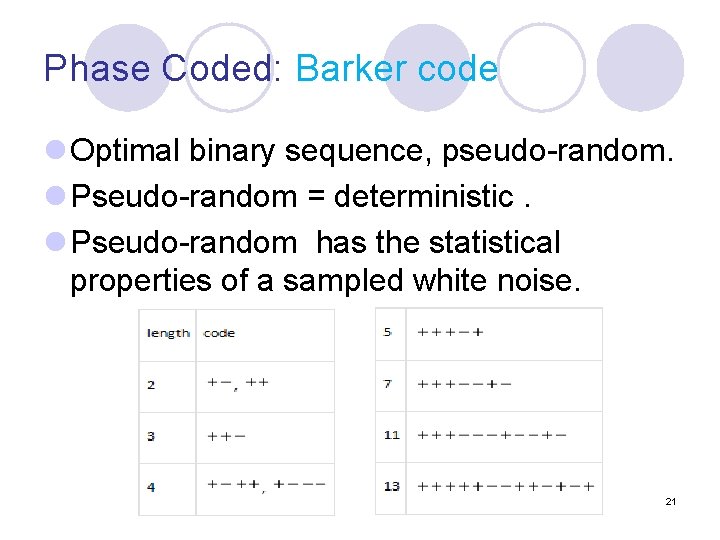
Phase Coded: Barker code l Optimal binary sequence, pseudo-random. l Pseudo-random = deterministic. l Pseudo-random has the statistical properties of a sampled white noise. 21

Phase Coded: Auto correlation function of the Barker sequence l Peak = N, 2Δt wide at base. 22

Phase Coded: Detection and compression lcompressed pulse is obtained in the receiver by correlation or matched filtering. lcompression ratio = N = T/t. lhalf-amplitude width = t = sub-pulse width. l∆R = C*t/2. 23

Phase Coded: Auto Correlation MATLAB example. l Two un-coded overlapped long pulses. 24
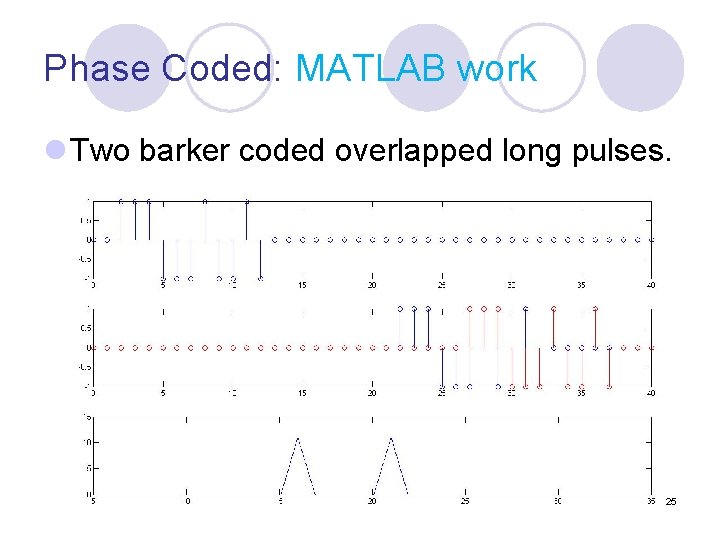
Phase Coded: MATLAB work l Two barker coded overlapped long pulses. 25
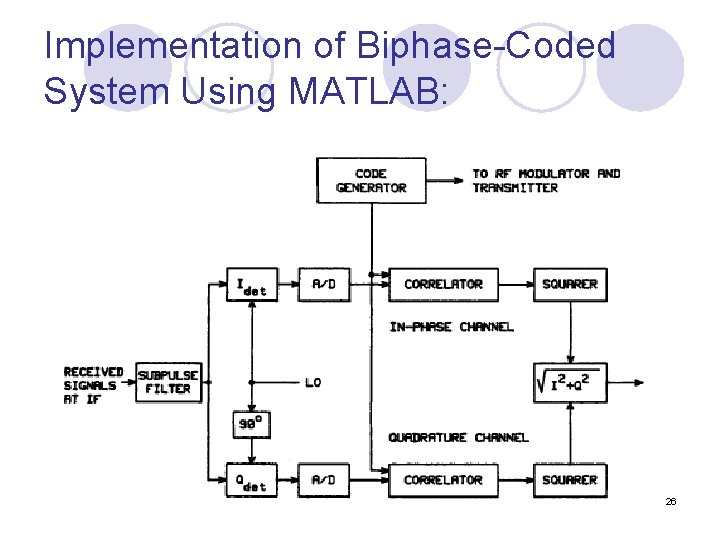
Implementation of Biphase-Coded System Using MATLAB: 26
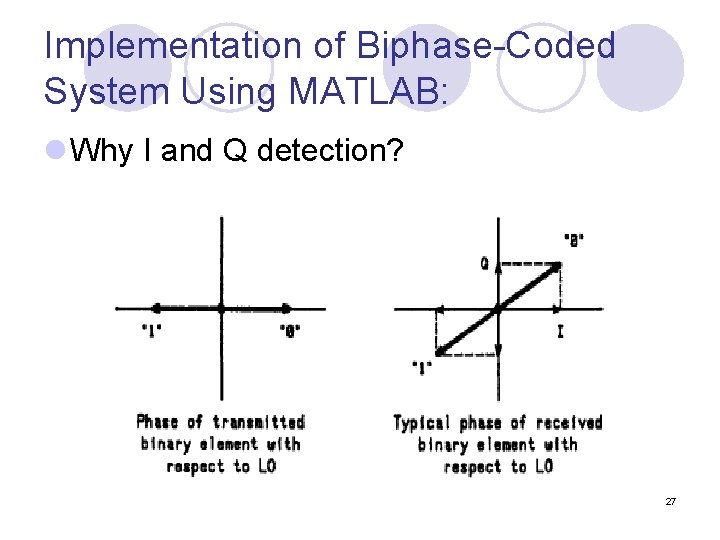
Implementation of Biphase-Coded System Using MATLAB: l Why I and Q detection? 27
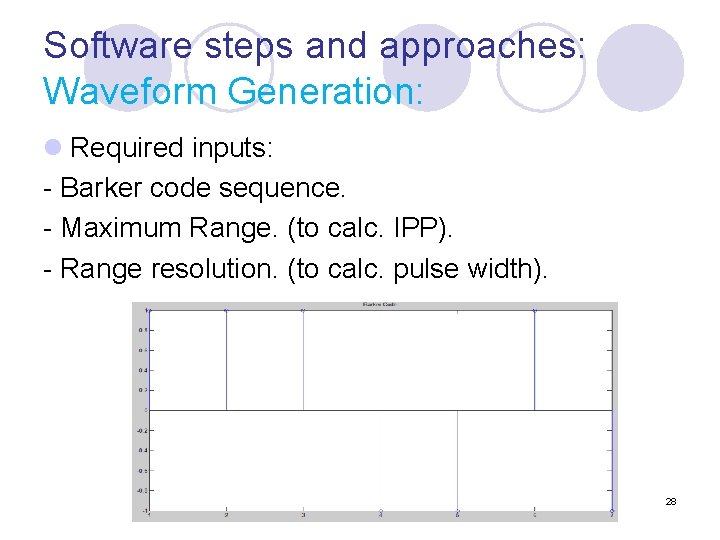
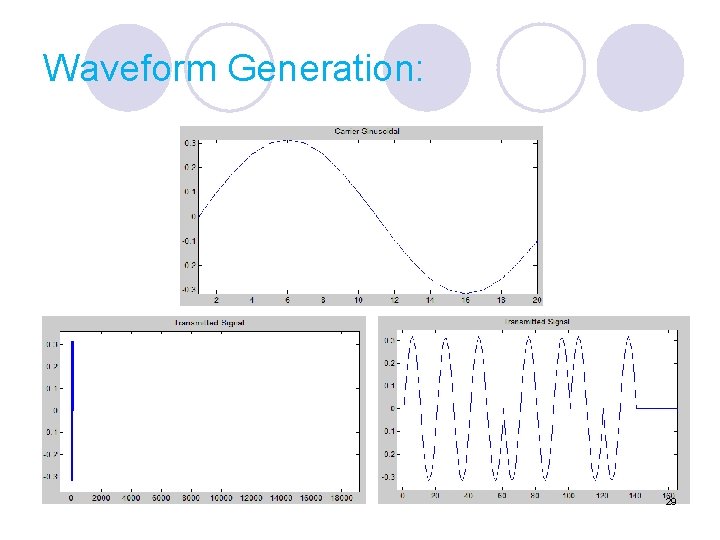
Software steps and approaches: Waveform Generation: l Required inputs: - Barker code sequence. - Maximum Range. (to calc. IPP). - Range resolution. (to calc. pulse width). 28
Waveform Generation: 29
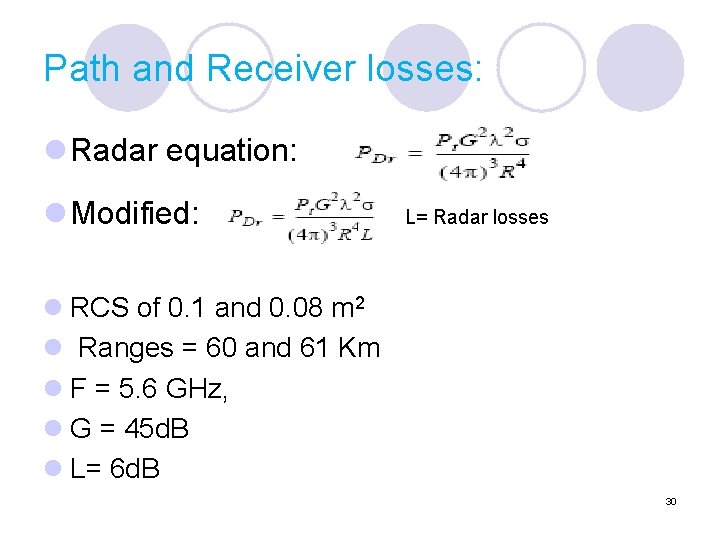
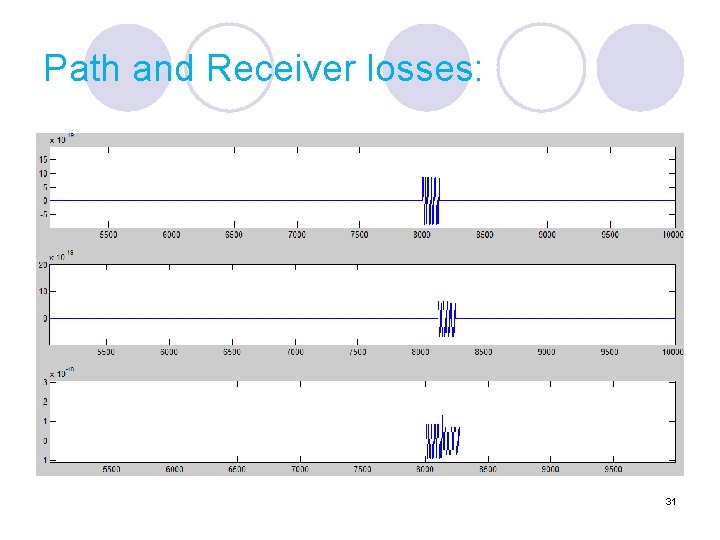
Path and Receiver losses: l Radar equation: l Modified: L= Radar losses l RCS of 0. 1 and 0. 08 m 2 l Ranges = 60 and 61 Km l F = 5. 6 GHz, l G = 45 d. B l L= 6 d. B 30
Path and Receiver losses: 31
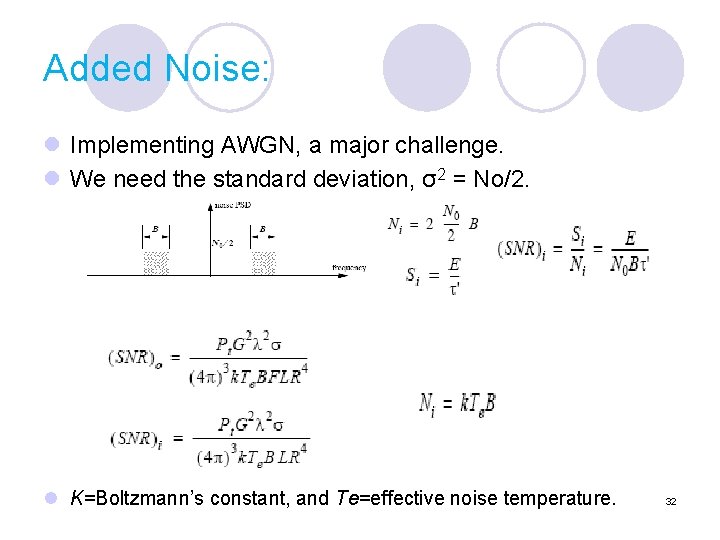
Added Noise: l Implementing AWGN, a major challenge. l We need the standard deviation, σ2 = No/2. l K=Boltzmann’s constant, and Te=effective noise temperature. 32
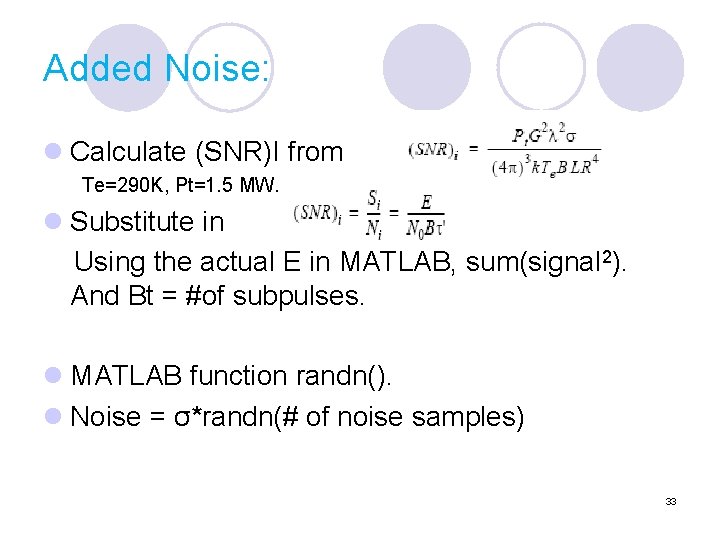
Added Noise: l Calculate (SNR)I from Te=290 K, Pt=1. 5 MW. l Substitute in Using the actual E in MATLAB, sum(signal 2). And Bt = #of subpulses. l MATLAB function randn(). l Noise = σ*randn(# of noise samples) 33
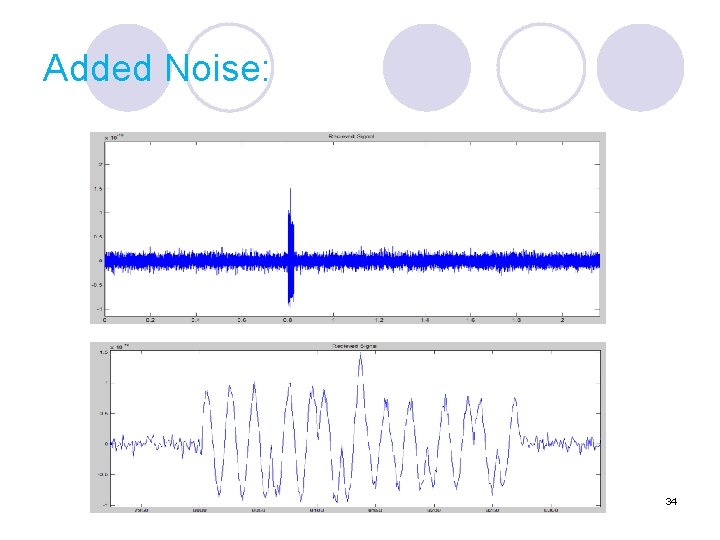
Added Noise: 34
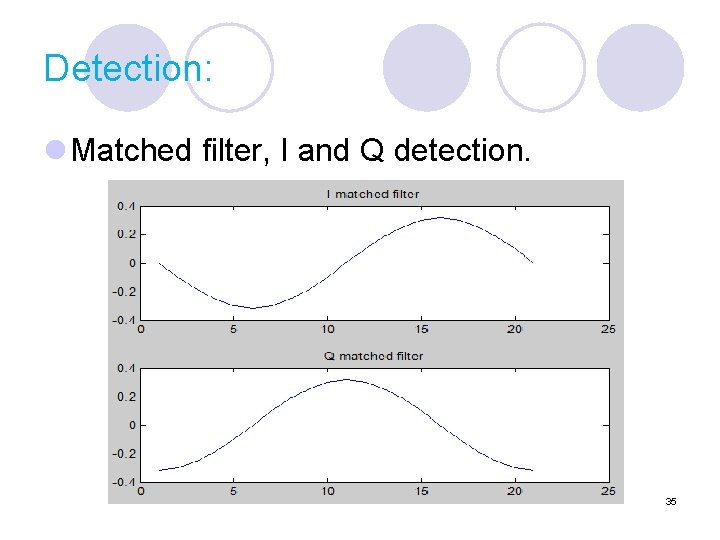
Detection: l Matched filter, I and Q detection. 35
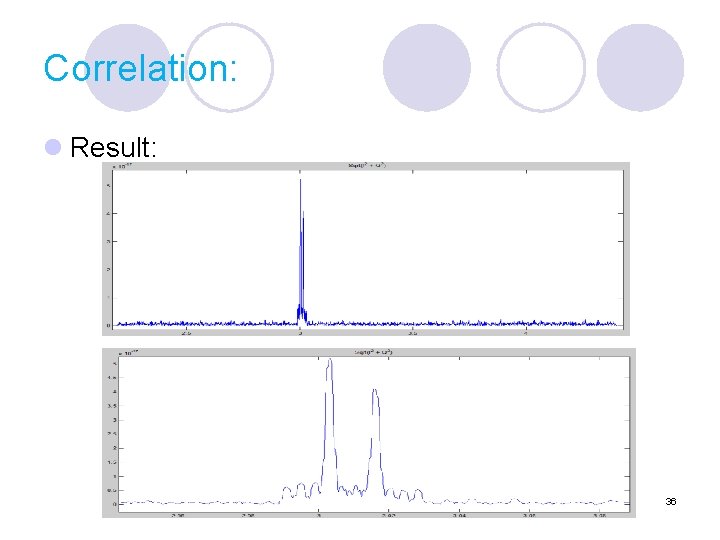
Correlation: l Result: 36
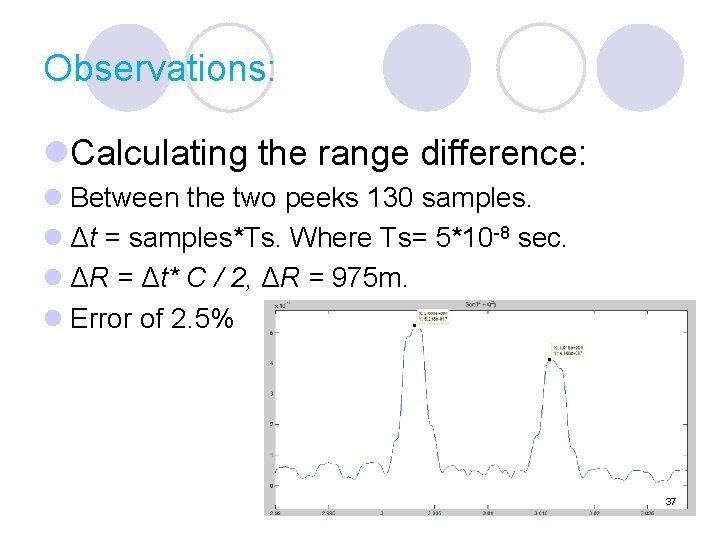
Observations: l. Calculating the range difference: l Between the two peeks 130 samples. l Δt = samples*Ts. Where Ts= 5*10 -8 sec. l ΔR = Δt* C / 2, ΔR = 975 m. l Error of 2. 5% 37
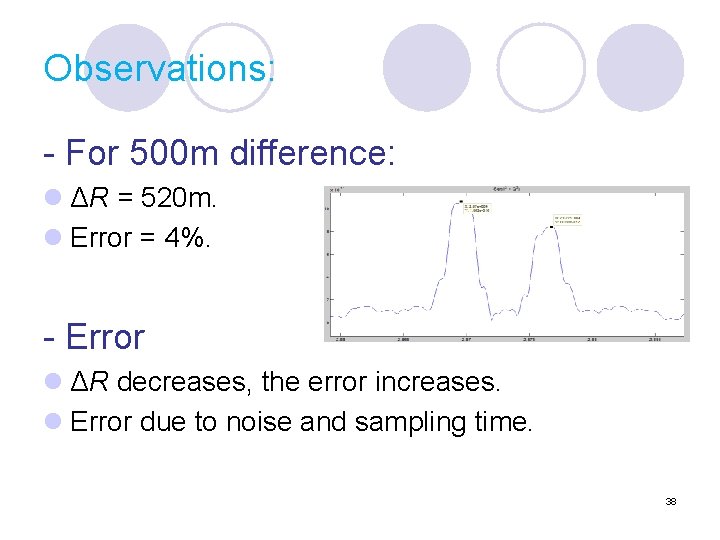
Observations: - For 500 m difference: l ΔR = 520 m. l Error = 4%. - Error l ΔR decreases, the error increases. l Error due to noise and sampling time. 38
References: l Radar Handbook - 2 nd Ed. - M. I. Skolnik. l MATLAB Simulations for Radar Systems Design, Bassem R. Mahafza and Atef Z. Elsherbeni. l Digital Communications - Fundamentals and Applications 2 nd Edition - Bernard Sklar. l http: //mathworld. wolfram. com/Barker. Code. ht ml 39

Thank You for your attention 40
- Slides: 40