
Radar And Navigational Aids Types Of Mixers In
- Slides: 23
Radar And Navigational Aids Types Of Mixers In Radar Receivers Jayaraman (1053) Kaushik (1059) Ikram (3009) Vignesh (3010)
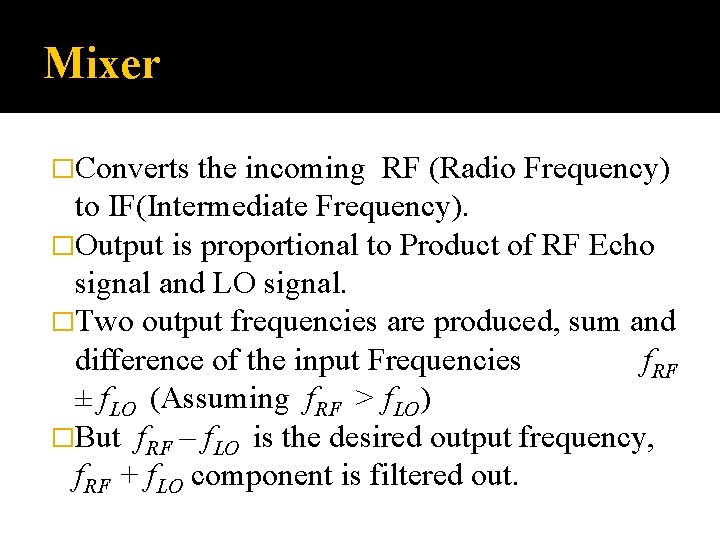
Mixer �Converts the incoming RF (Radio Frequency) to IF(Intermediate Frequency). �Output is proportional to Product of RF Echo signal and LO signal. �Two output frequencies are produced, sum and difference of the input Frequencies f. RF ± f. LO (Assuming f. RF > f. LO) �But f. RF – f. LO is the desired output frequency, f. RF + f. LO component is filtered out.
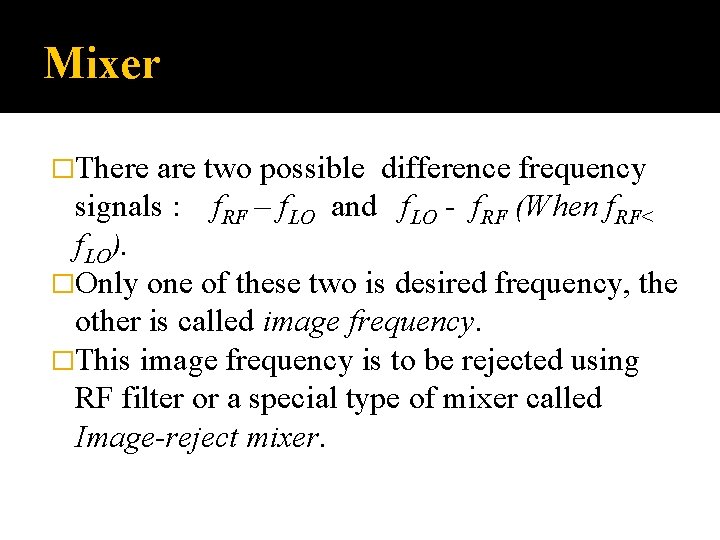
Mixer �There are two possible difference frequency signals : f. RF – f. LO and f. LO - f. RF (When f. RF< f. LO). �Only one of these two is desired frequency, the other is called image frequency. �This image frequency is to be rejected using RF filter or a special type of mixer called Image-reject mixer.
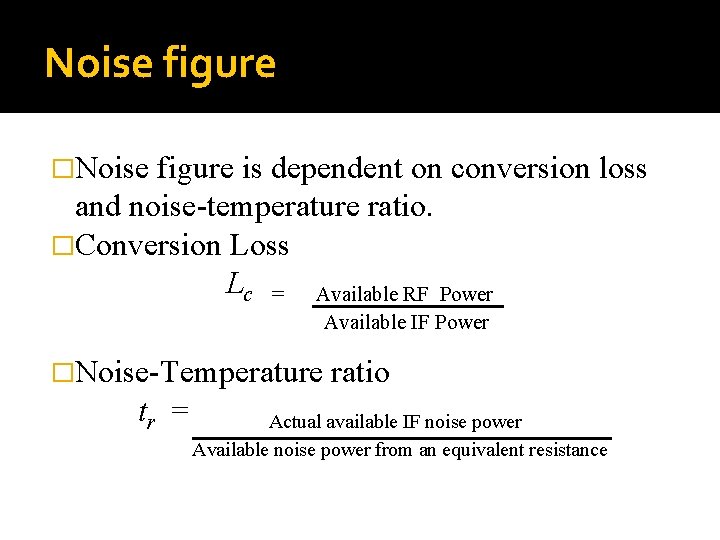
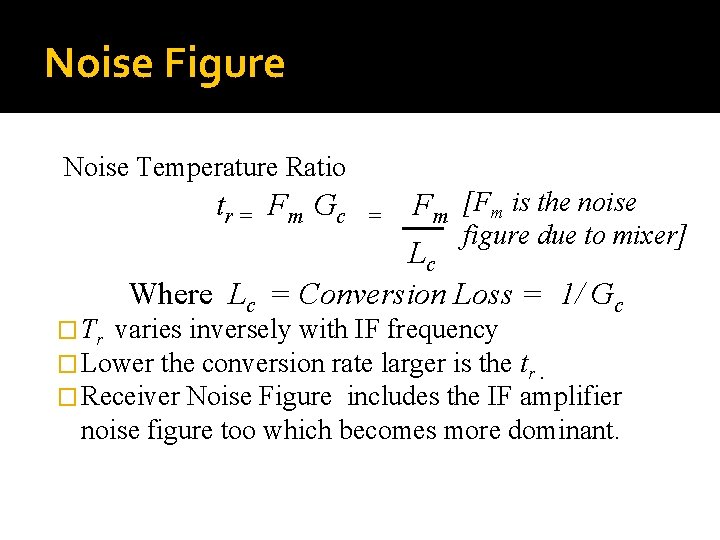
Noise figure �Noise figure is dependent on conversion loss and noise-temperature ratio. �Conversion Loss Lc = Available RF Power Available IF Power �Noise-Temperature ratio tr = Actual available IF noise power Available noise power from an equivalent resistance
Noise Figure Noise Temperature Ratio t r = F m Gc = Fm [Fm is the noise figure due to mixer] Lc Where Lc = Conversion Loss = 1/ Gc � Tr varies inversely with IF frequency � Lower the conversion rate larger is the tr. � Receiver Noise Figure includes the IF amplifier noise figure too which becomes more dominant.
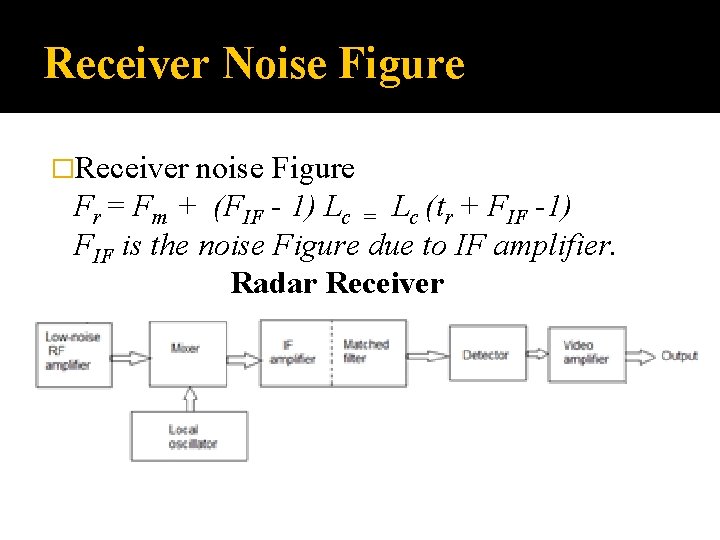
Receiver Noise Figure �Receiver noise Figure Fr = Fm + (FIF - 1) Lc = Lc (tr + FIF -1) FIF is the noise Figure due to IF amplifier. Radar Receiver
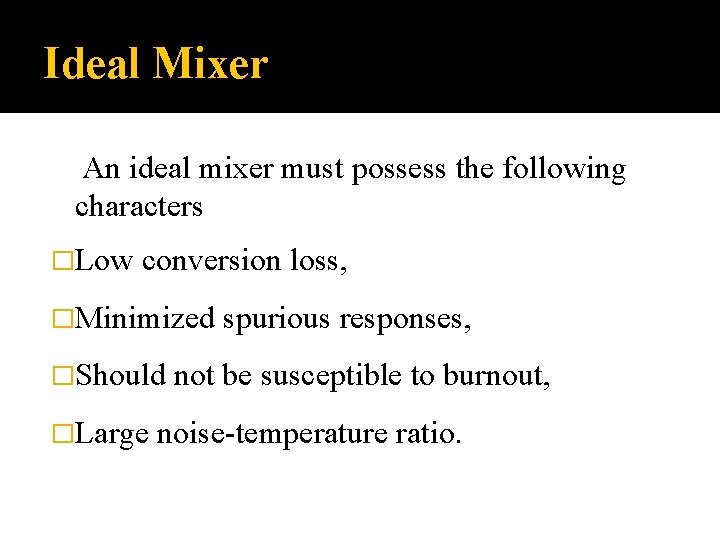
Ideal Mixer An ideal mixer must possess the following characters �Low conversion loss, �Minimized spurious responses, �Should not be susceptible to burnout, �Large noise-temperature ratio.
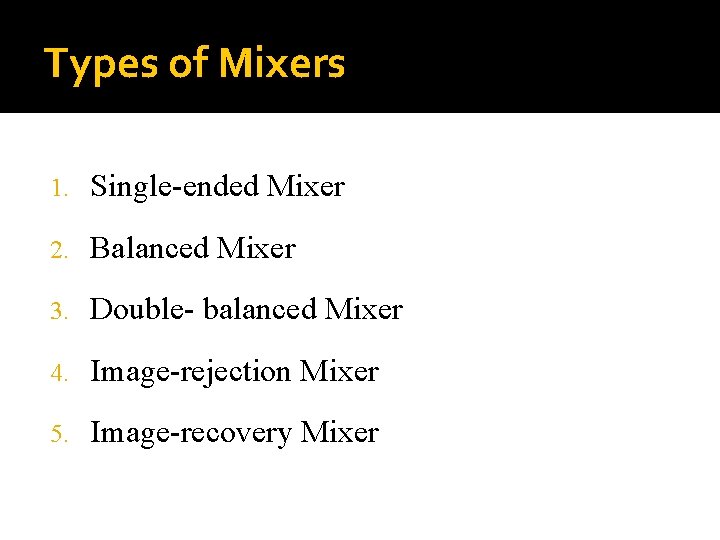
Types of Mixers 1. Single-ended Mixer 2. Balanced Mixer 3. Double- balanced Mixer 4. Image-rejection Mixer 5. Image-recovery Mixer
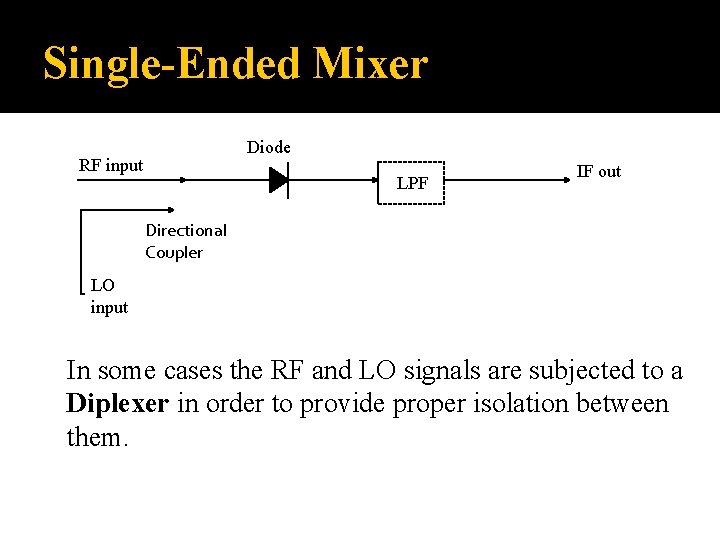
Single-ended Mixer � Also called as an unbalanced or crystal mixer. � Uses a single diode that terminates a transmission line, LO is inserted via a directional coupler. � An LPF after the diode filters out RF and LO signals allowing only IF. � The unwanted Image frequency is short circuited or Open circuited.
Single-ended Mixer � Diode being a non-linear device produces inter- modulation products, called Spurious responses. (When mf. RF + nf. LO = f. IF ) �Taylor proposed a mixer chart to determine the RF and LO frequencies that are free from spurious responses. �A Mixer chart is a graphical representation of wanted and unwanted (spurious) mixing products in-band out-of-band.
Single-Ended Mixer �Presence of two or more RF signals also results in spurious responses. �LO noise is to be removed by an RF filter between LO and Mixer. �Single conversion receivers suppress these spurious responses.
Single-Ended Mixer Diode RF input LPF IF out Directional Coupler LO input In some cases the RF and LO signals are subjected to a Diplexer in order to provide proper isolation between them.
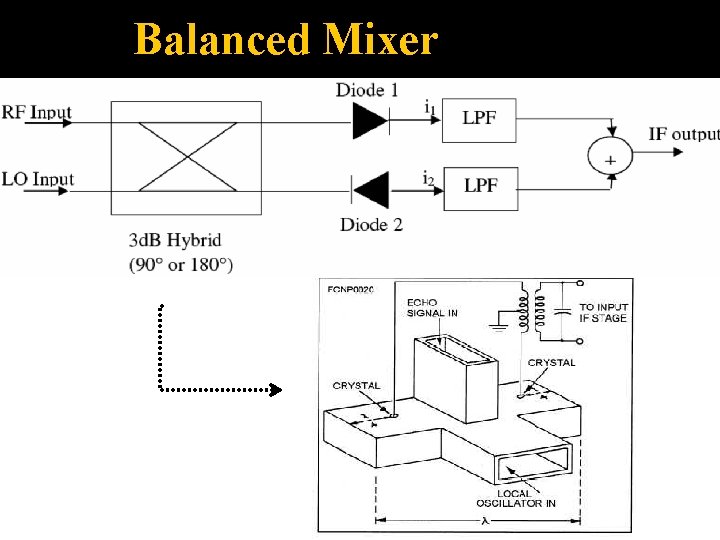
Balanced Mixer �Two single ended mixer in parallel and 180 o out of phase. �A 4 -port junction such as magic-T, hybrid junction or 3 d. B coupler is used. �LO and RF signals are applied at ports 1 and 2, their sum and difference is obtained at ports 3 and 4. �Diode mixers are present at ports output of ports 3 & 4.
Balanced Mixer
Balanced Mixer IF signal = Difference of the outputs of the two diode mixers. Perks: �LO noise at the two diode mixers are in phase and gets cancelled out �Suppresses the even harmonics of either LO signal or the RF signals.
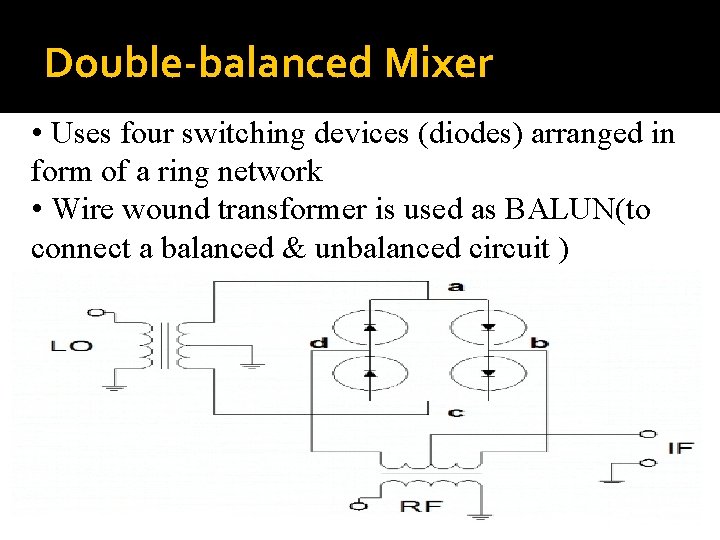
Double-balanced Mixer • Uses four switching devices (diodes) arranged in form of a ring network • Wire wound transformer is used as BALUN(to connect a balanced & unbalanced circuit )
Double-balanced Mixer Advantages: �Better isolation between RF and LO ports. �Permits wide bandwidth. �Suppresses even harmonics of both LO and RF ports. Drawbacks: �High LO drive required. �Increased cost and complexity.
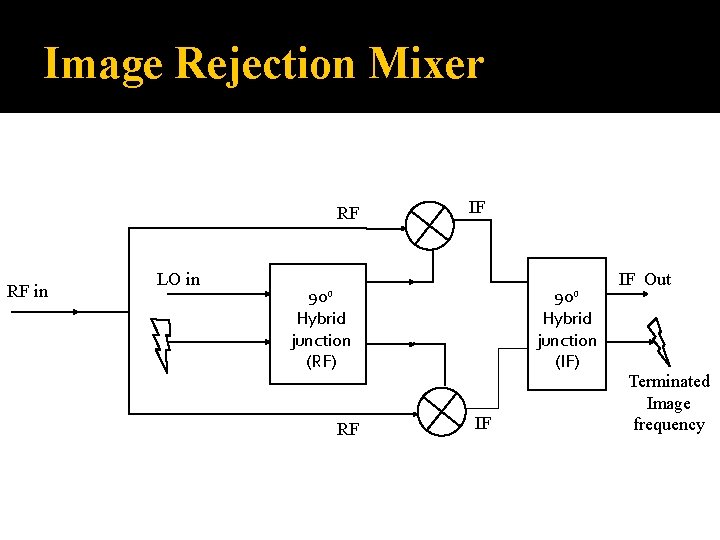
Image-Rejection Mixer �The RF signal is split into two and fed into two individual mixers. �LO signal is split into two using a 90 o Hybrid junction. �A second hybrid junction (IF) imparts another 90 o phase shift to separate the image frequency. �The port with the image frequency is match terminated.
Image Rejection Mixer RF in LO in IF 90 o Hybrid junction (RF) RF Hybrid junction (IF) IF IF Out Terminated Image frequency
Image-rejection Mixer Advantages �High Dynamic range �Good VSWR. �Low Inter-modulation Products. �Less susceptibility to Burn out. Drawback: �Provides only 30 d. B image rejection, which may not be suitable for some applications. �High noise figure.
Image Rejection Mixer �Dynamic Range of a radar receiver is the Ratio of max input signal power to minimum input signal power without degradation in performance. �Third order modulation product affects the dynamic range of radar. �Third-order distortion products are produced by a nonlinear device when two tones closely spaced in frequency are fed into its input
Image-recovery Mixer / Image. Enhanced �It is a modified version of Image-rejection mixer. �Mixer conversion loss is reduced by terminating a diode in a reactance at the image frequency. �The improvement using this image enhancement is as low as 1 or 2 d. B. �Band pass filtering around the input source prevents the image frequency from entering into the mixer again.
Reference � INTRODUCTION TO RADAR SYSTEMS, 3 rd Edition, Meril. L. Skolnik. � Practical RF Circuit Design for Modern Wireless Systems, Volume 2 By Rowan Gilmore, Les Besser. � http: //www. microwaves 101. com/ � http: //www. radartutorial. eu/ � Mixer Basics Primer A Tutorial for RF & Microwave Mixers by: Ferenc Marki & Christopher Marki, Ph. D