
Rad Hard By Software for Space Multicore Processing

Rad Hard By Software for Space Multicore Processing David Bueno, Eric Grobelny, Dave Campagna, Dave Kessler, and Matt Clark Honeywell Space Electronic Systems, Clearwater, FL HPEC 2008 Workshop September 25, 2008
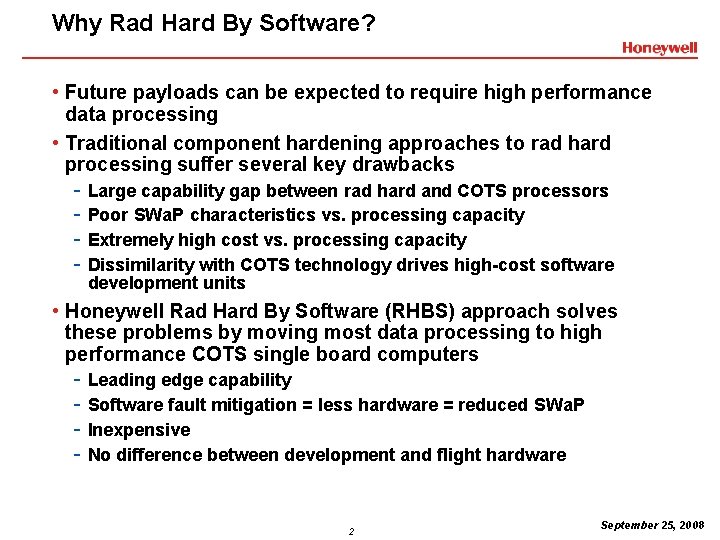
Why Rad Hard By Software? • Future payloads can be expected to require high performance data processing • Traditional component hardening approaches to rad hard processing suffer several key drawbacks - Large capability gap between rad hard and COTS processors - Poor SWa. P characteristics vs. processing capacity - Extremely high cost vs. processing capacity - Dissimilarity with COTS technology drives high-cost software development units • Honeywell Rad Hard By Software (RHBS) approach solves these problems by moving most data processing to high performance COTS single board computers - Leading edge capability - Software fault mitigation = less hardware = reduced SWa. P - Inexpensive - No difference between development and flight hardware 2 September 25, 2008
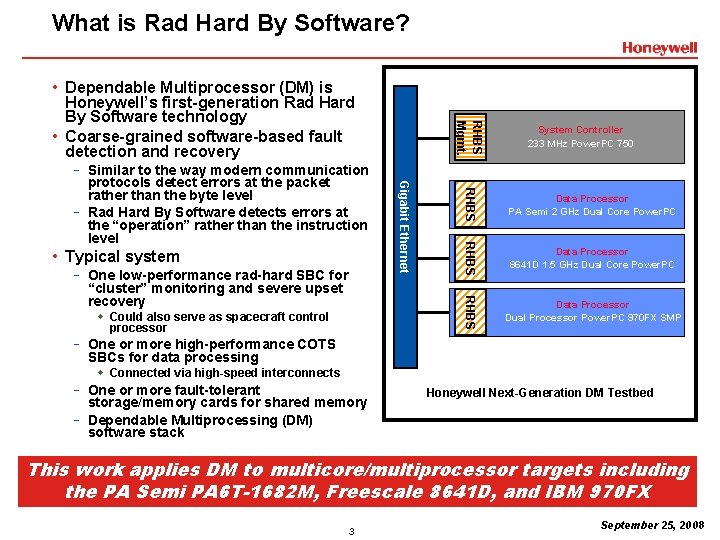
What is Rad Hard By Software? processor Data Processor 8641 D 1. 5 GHz Dual Core Power. PC RHBS w Could also serve as spacecraft control Data Processor PA Semi 2 GHz Dual Core Power. PC RHBS “cluster” monitoring and severe upset recovery System Controller 233 MHz Power. PC 750 RHBS • Typical system - One low-performance rad-hard SBC for Gigabit Ethernet - protocols detect errors at the packet rather than the byte level Rad Hard By Software detects errors at the “operation” rather than the instruction level RHBS Mgmt. • Dependable Multiprocessor (DM) is Honeywell’s first-generation Rad Hard By Software technology • Coarse-grained software-based fault detection and recovery - Similar to the way modern communication Data Processor Dual Processor Power. PC 970 FX SMP - One or more high-performance COTS SBCs for data processing w Connected via high-speed interconnects - One or more fault-tolerant - storage/memory cards for shared memory Dependable Multiprocessing (DM) software stack Honeywell Next-Generation DM Testbed This work applies DM to multicore/multiprocessor targets including the PA Semi PA 6 T-1682 M, Freescale 8641 D, and IBM 970 FX 3 September 25, 2008
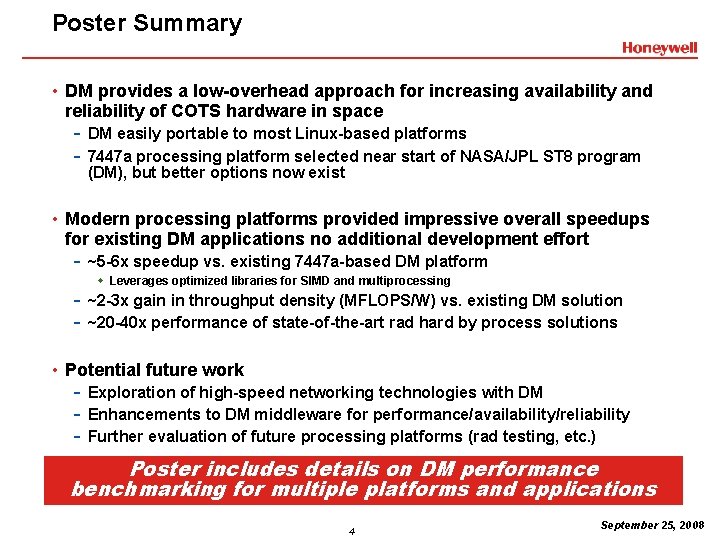
Poster Summary • DM provides a low-overhead approach for increasing availability and reliability of COTS hardware in space - DM easily portable to most Linux-based platforms - 7447 a processing platform selected near start of NASA/JPL ST 8 program (DM), but better options now exist • Modern processing platforms provided impressive overall speedups for existing DM applications no additional development effort - ~5 -6 x speedup vs. existing 7447 a-based DM platform w Leverages optimized libraries for SIMD and multiprocessing - ~2 -3 x gain in throughput density (MFLOPS/W) vs. existing DM solution - ~20 -40 x performance of state-of-the-art rad hard by process solutions • Potential future work - Exploration of high-speed networking technologies with DM - Enhancements to DM middleware for performance/availability/reliability - Further evaluation of future processing platforms (rad testing, etc. ) Poster includes details on DM performance benchmarking for multiple platforms and applications 4 September 25, 2008
- Slides: 4