
Rad Cube The Space Weather Monitoring Satellite Dr
Rad. Cube: The Space Weather Monitoring Satellite Dr Andrea Stradi, environmental researcher on behalf of Mr Balazs Zabori, project manager MTA Centre for Energy Research C 3 S Electronics Development LLC
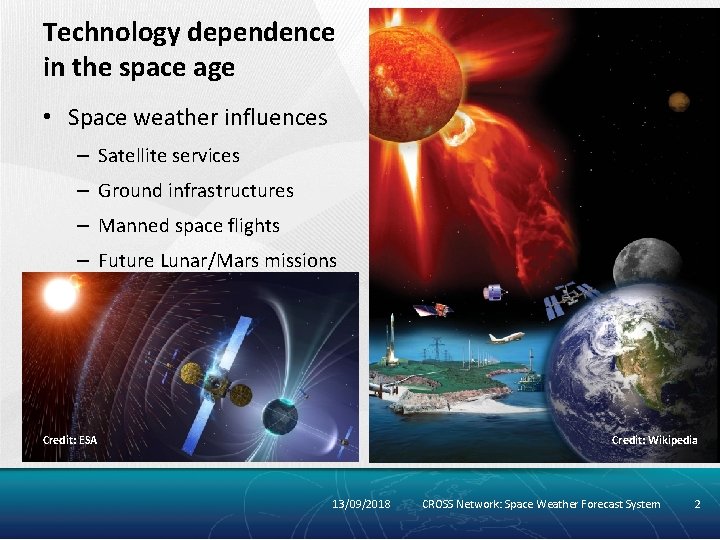
Technology dependence in the space age • Space weather influences – Satellite services – Ground infrastructures – Manned space flights – Future Lunar/Mars missions Credit: ESA Credit: Wikipedia 13/09/2018 CROSS Network: Space Weather Forecast System 2
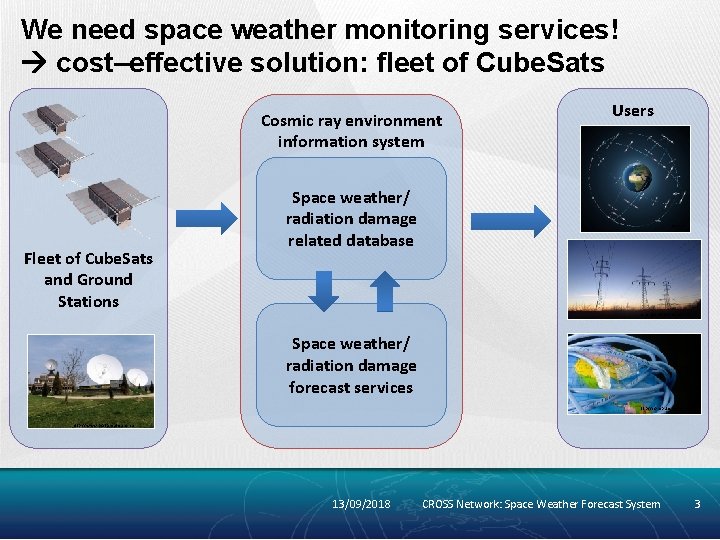
We need space weather monitoring services! cost–effective solution: fleet of Cube. Sats Cosmic ray environment information system Fleet of Cube. Sats and Ground Stations Users Space weather/ radiation damage related database esa. int energiaportal. mvmp. hu Space weather/ radiation damage forecast services http: //computerworld. hu http: //www. postamuzeum. hu 13/09/2018 CROSS Network: Space Weather Forecast System 3
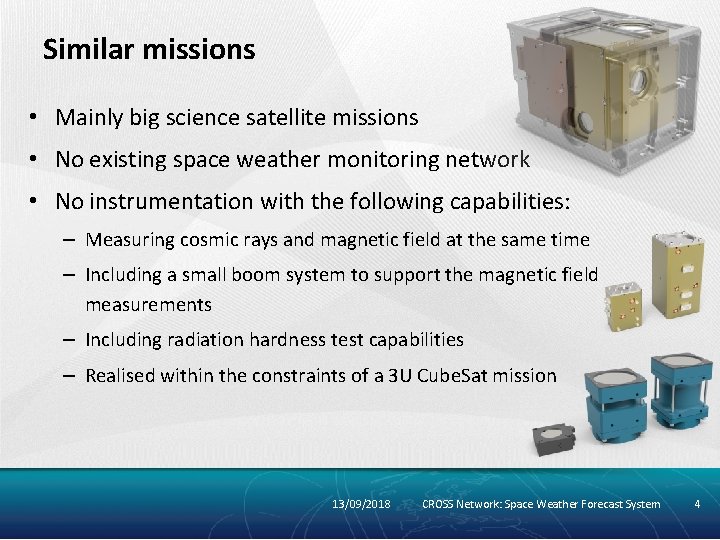
Similar missions • Mainly big science satellite missions • No existing space weather monitoring network • No instrumentation with the following capabilities: – Measuring cosmic rays and magnetic field at the same time – Including a small boom system to support the magnetic field measurements – Including radiation hardness test capabilities – Realised within the constraints of a 3 U Cube. Sat mission 13/09/2018 CROSS Network: Space Weather Forecast System 4
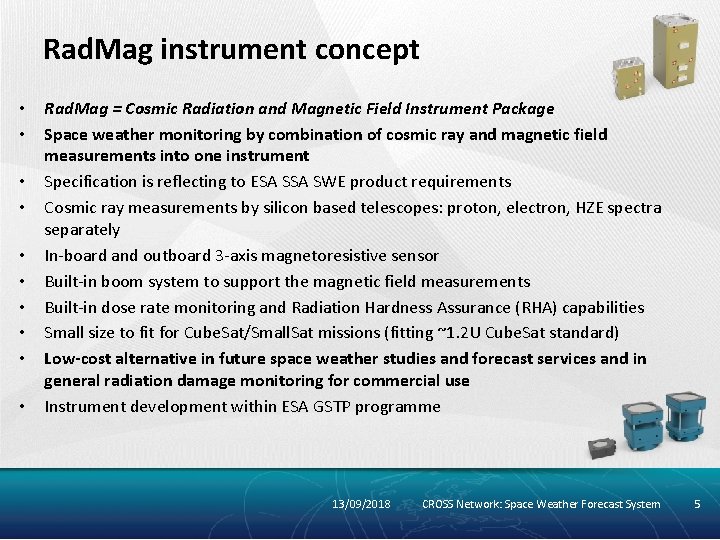
Rad. Mag instrument concept • • • Rad. Mag = Cosmic Radiation and Magnetic Field Instrument Package Space weather monitoring by combination of cosmic ray and magnetic field measurements into one instrument Specification is reflecting to ESA SWE product requirements Cosmic ray measurements by silicon based telescopes: proton, electron, HZE spectra separately In-board and outboard 3 -axis magnetoresistive sensor Built-in boom system to support the magnetic field measurements Built-in dose rate monitoring and Radiation Hardness Assurance (RHA) capabilities Small size to fit for Cube. Sat/Small. Sat missions (fitting ~1. 2 U Cube. Sat standard) Low-cost alternative in future space weather studies and forecast services and in general radiation damage monitoring for commercial use Instrument development within ESA GSTP programme 13/09/2018 CROSS Network: Space Weather Forecast System 5
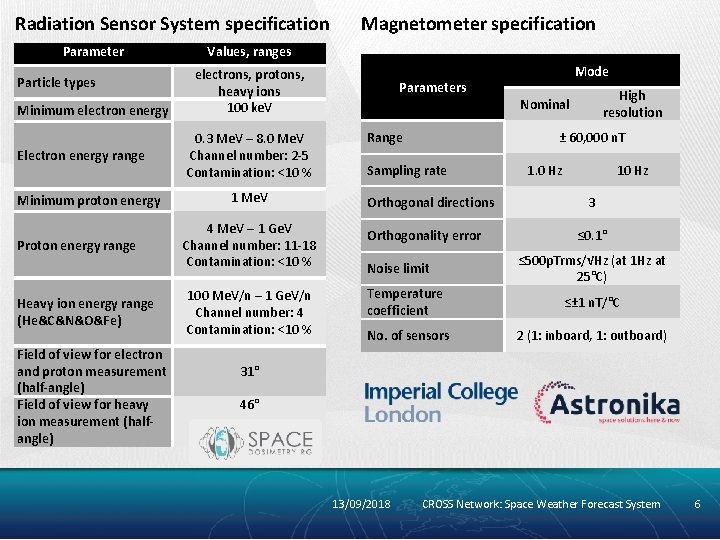
Radiation Sensor System specification Parameter Particle types Minimum electron energy Electron energy range Minimum proton energy Proton energy range Heavy ion energy range (He&C&N&O&Fe) Field of view for electron and proton measurement (half-angle) Field of view for heavy ion measurement (halfangle) Magnetometer specification Values, ranges electrons, protons, heavy ions 100 ke. V 0. 3 Me. V – 8. 0 Me. V Channel number: 2 -5 Contamination: <10 % 1 Me. V 4 Me. V – 1 Ge. V Channel number: 11 -18 Contamination: <10 % 100 Me. V/n – 1 Ge. V/n Channel number: 4 Contamination: <10 % Parameters Range Mode High resolution Nominal ± 60, 000 n. T Sampling rate Orthogonal directions Orthogonality error Noise limit Temperature coefficient No. of sensors 1. 0 Hz 10 Hz 3 ≤ 0. 1° ≤ 500 p. Trms/√Hz (at 1 Hz at 25°C) ≤± 1 n. T/°C 2 (1: inboard, 1: outboard) 31° 46° 13/09/2018 CROSS Network: Space Weather Forecast System 6
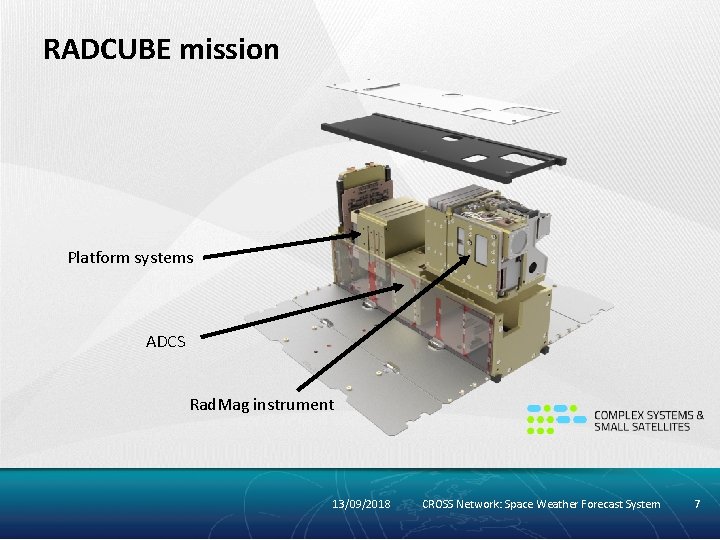
RADCUBE mission Platform systems ADCS Rad. Mag instrument 13/09/2018 CROSS Network: Space Weather Forecast System 7
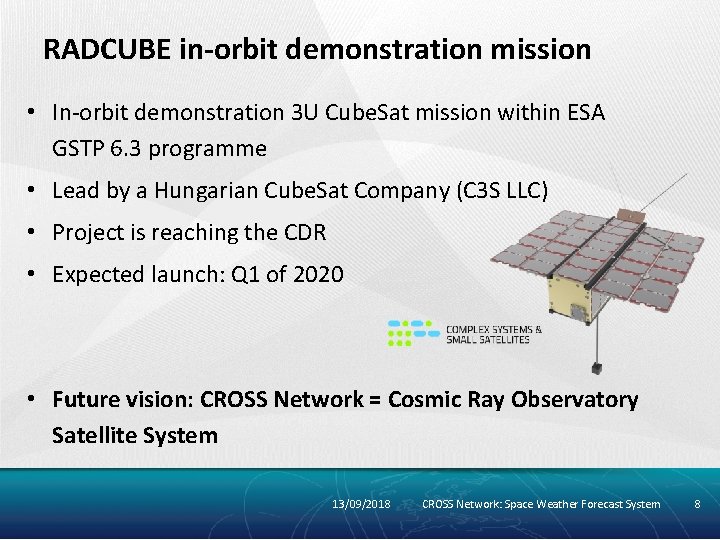
RADCUBE in-orbit demonstration mission • In-orbit demonstration 3 U Cube. Sat mission within ESA GSTP 6. 3 programme • Lead by a Hungarian Cube. Sat Company (C 3 S LLC) • Project is reaching the CDR • Expected launch: Q 1 of 2020 • Future vision: CROSS Network = Cosmic Ray Observatory Satellite System 13/09/2018 CROSS Network: Space Weather Forecast System 8
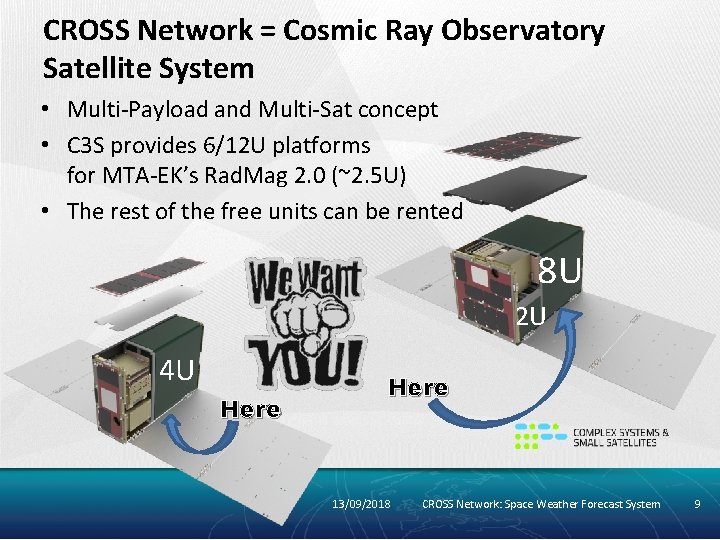
CROSS Network = Cosmic Ray Observatory Satellite System • Multi-Payload and Multi-Sat concept • C 3 S provides 6/12 U platforms for MTA-EK’s Rad. Mag 2. 0 (~2. 5 U) • The rest of the free units can be rented 8 U 2 U 4 U Here 13/09/2018 CROSS Network: Space Weather Forecast System 9
Summary • New space weather monitoring instrument development: Rad. Mag • Unique combination of cosmic ray and magnetic field measurements into one instrument – Very small size to fit for Cube. Sat/Small. Sat missions (fitting ~1. 2 U Cube. Sat standard) – Built-in boom system to support the magnetic field measurements – Relatively low-cost alternative for future space weather studies and in general radiation damage monitoring for commercial use • Instrument development just now passed PDR and moving into phase C • 1 st IOD Mission: RADCUBE 3 U Cube. Sat – Expected launch is Q 1 2020 • Future vision (CROSS Network): Cube. Sat/Small. Sat constellation for space weather and radiation damage monitoring services 13/09/2018 CROSS Network: Space Weather Forecast System 10
Thank you for your attention! Web: spacedosimetry. com E-mail: zabori. balazs@energia. mta. hu
- Slides: 11