
RAD 222 Upper extremity part 2 forearm elbow
RAD 222 Upper extremity part 2 (forearm, elbow, humerus) 1
Technical Points Positioning principles as for upper limb applies to lower limb. k. V should be lower to medium (50 – 70) KVp. For all parts discussed, center and align the long axis of the part to central ray (CR) and to long axis of the film. No secondary radiation grid used Radiation protection has to be well observed, using the special gonad shields over pelvic region, or the lead apron as necessary FFD is generally 40 inches (100 cm). Optimal contrast and density will allow visualization of bony cortical margins soft tissue structures. 2
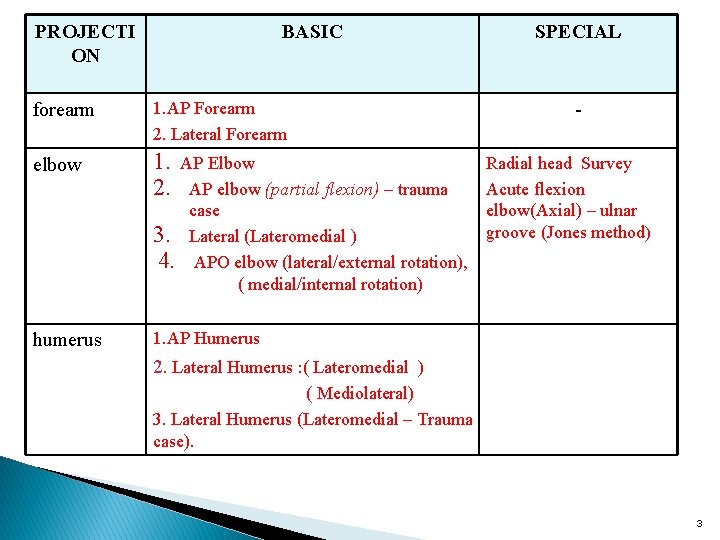
PROJECTI ON BASIC forearm 1. AP Forearm 2. Lateral Forearm elbow 1. 2. humerus 1. AP Humerus AP Elbow AP elbow (partial flexion) – trauma case 3. Lateral (Lateromedial ) 4. APO elbow (lateral/external rotation), ( medial/internal rotation) SPECIAL Radial head Survey Acute flexion elbow(Axial) – ulnar groove (Jones method) 2. Lateral Humerus : ( Lateromedial ) ( Mediolateral) 3. Lateral Humerus (Lateromedial – Trauma case). 3
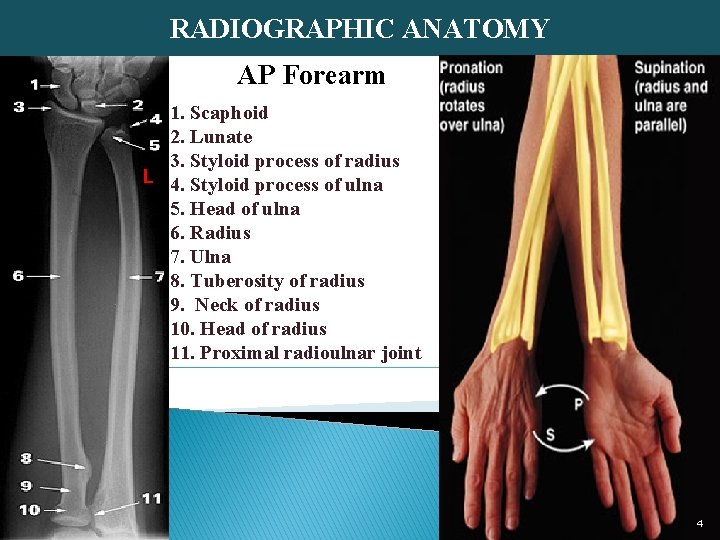
RADIOGRAPHIC ANATOMY AP Forearm 1. Scaphoid 2. Lunate 3. Styloid process of radius L 4. Styloid process of ulna 5. Head of ulna 6. Radius 7. Ulna 8. Tuberosity of radius 9. Neck of radius 10. Head of radius 11. Proximal radioulnar joint 4
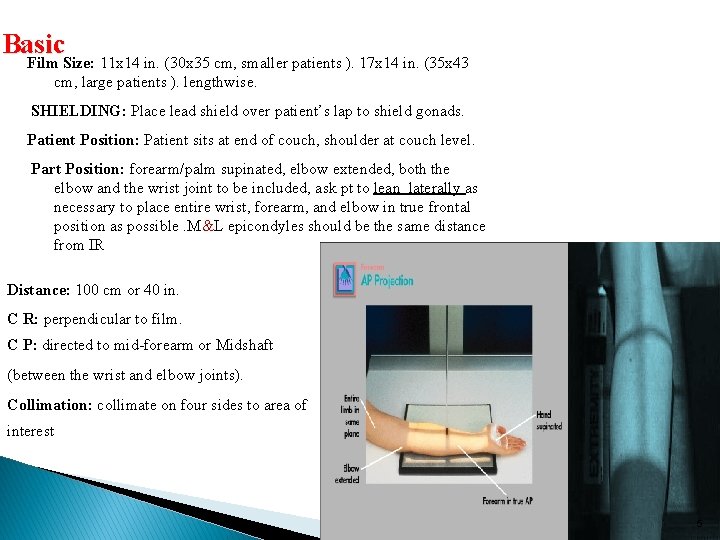
Basic Film Size: 11 x 14 in. (30 x 35 cm, smaller patients ). 17 x 14 in. (35 x 43 cm, large patients ). lengthwise. SHIELDING: Place lead shield over patient’s lap to shield gonads. Patient Position: Patient sits at end of couch, shoulder at couch level. Part Position: forearm/palm supinated, elbow extended, both the elbow and the wrist joint to be included, ask pt to lean laterally as necessary to place entire wrist, forearm, and elbow in true frontal position as possible. M&L epicondyles should be the same distance from IR Distance: 100 cm or 40 in. C R: perpendicular to film. C P: directed to mid-forearm or Midshaft (between the wrist and elbow joints). Collimation: collimate on four sides to area of interest 5
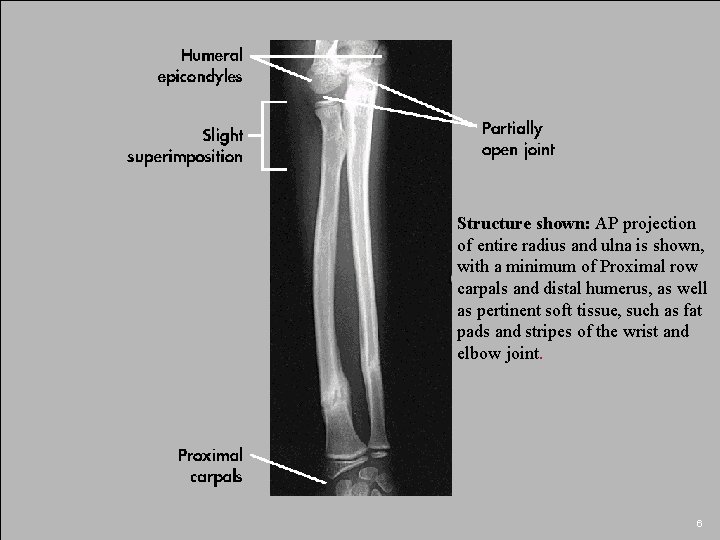
Structure shown: AP projection of entire radius and ulna is shown, with a minimum of Proximal row carpals and distal humerus, as well as pertinent soft tissue, such as fat pads and stripes of the wrist and elbow joint. 6
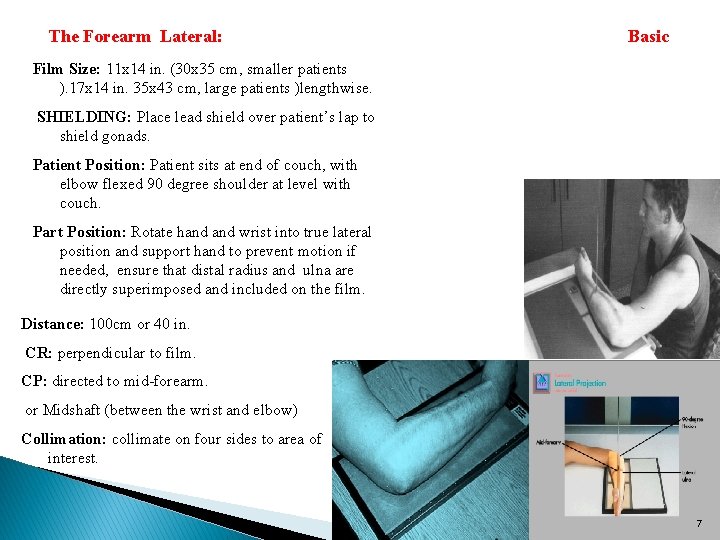
The Forearm Lateral: Basic Film Size: 11 x 14 in. (30 x 35 cm, smaller patients ). 17 x 14 in. 35 x 43 cm, large patients )lengthwise. SHIELDING: Place lead shield over patient’s lap to shield gonads. Patient Position: Patient sits at end of couch, with elbow flexed 90 degree shoulder at level with couch. Part Position: Rotate hand wrist into true lateral position and support hand to prevent motion if needed, ensure that distal radius and ulna are directly superimposed and included on the film. Distance: 100 cm or 40 in. CR: perpendicular to film. CP: directed to mid-forearm. or Midshaft (between the wrist and elbow) Collimation: collimate on four sides to area of interest. 7
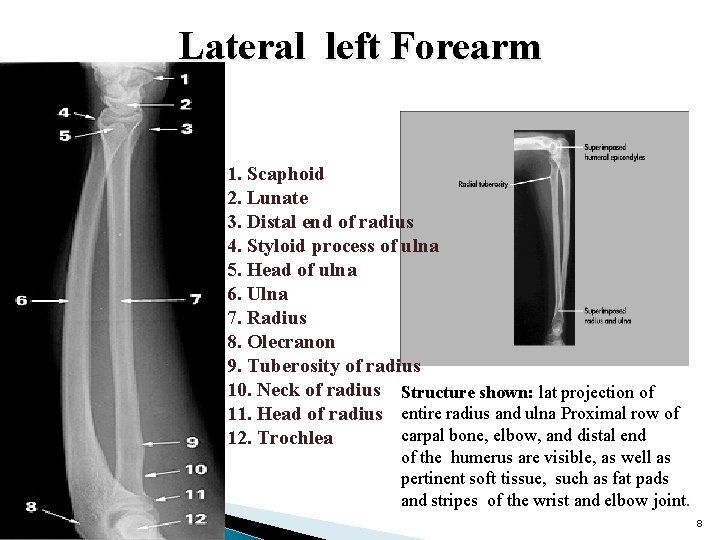
Lateral left Forearm 1. Scaphoid 2. Lunate 3. Distal end of radius 4. Styloid process of ulna 5. Head of ulna 6. Ulna 7. Radius 8. Olecranon 9. Tuberosity of radius 10. Neck of radius Structure shown: lat projection of 11. Head of radius entire radius and ulna Proximal row of carpal bone, elbow, and distal end 12. Trochlea of the humerus are visible, as well as pertinent soft tissue, such as fat pads and stripes of the wrist and elbow joint. 8
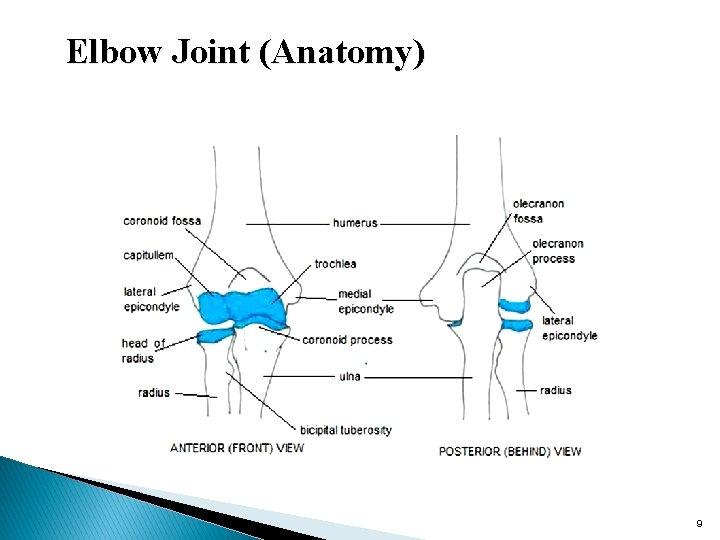
Elbow Joint (Anatomy) 9
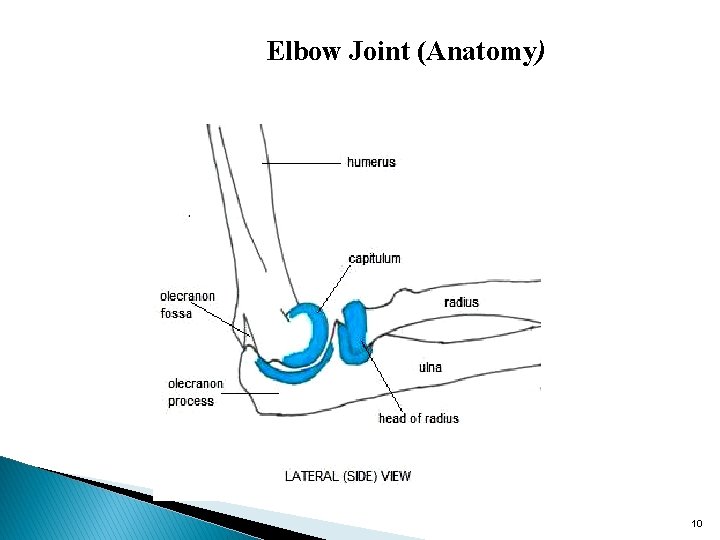
Elbow Joint (Anatomy) 10

AP Elbow Basic Film Size: 10 x 12 in. (24 x 30 cm) crosswise. SHIELDING: Place lead shield over pelvic area. Patient Position Patient sits at end of couch, shoulder at couch level. Part Position: forearm supinated, elbow extended on the film, patient then leans laterally to make a true AP position. epicondyles should be parallel to the IR, support hand as needed to prevent motion Distance: 100 cm or 40 in. C R: perpendicular to film. C P: directed to mid-elbow joint, which is approximately (0. 75 in ( 2 cm) distal to midpoint of a line between epicondyles). Collimation: collimate on four sides to area of interest 11

RADIOGRAPHIC ANATOMY AP Elbow 1. Lateral supracondylar ridge 2. Medial supracondylar ridge 3. Olecranon fossa 4. Medial epicondyle 5. Lateral epicondyle 6. Capitulum 7. Olecranon 8. Trochlea 9. Coronoid process of ulna Structure shown: distal 10. Proximal radioulnar joint humerus, elbow joint space , and proximal radius and 11. Head of radius ulna are visible. 12. Neck of radius 13. Tuberosity of radius 14. Ulna 12
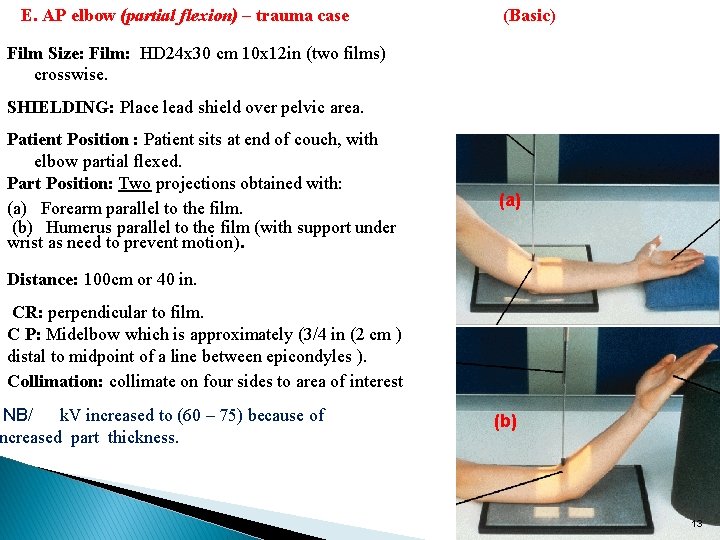
E. AP elbow (partial flexion) – trauma case (Basic) Film Size: Film: HD 24 x 30 cm 10 x 12 in (two films) crosswise. SHIELDING: Place lead shield over pelvic area. Patient Position : Patient sits at end of couch, with elbow partial flexed. Part Position: Two projections obtained with: (a) Forearm parallel to the film. (b) Humerus parallel to the film (with support under wrist as need to prevent motion). (a) Distance: 100 cm or 40 in. CR: perpendicular to film. C P: Midelbow which is approximately (3/4 in (2 cm ) distal to midpoint of a line between epicondyles ). Collimation: collimate on four sides to area of interest NB/ k. V increased to (60 – 75) because of ncreased part thickness. (b) 13
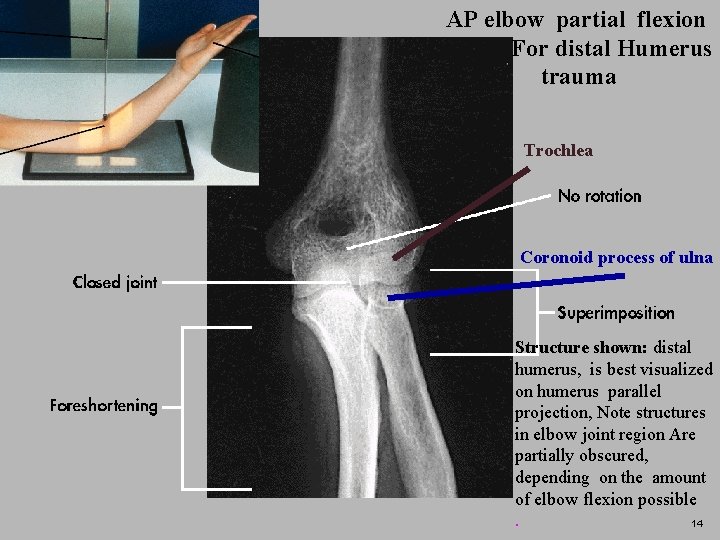
AP elbow partial flexion For distal Humerus trauma Trochlea Coronoid process of ulna Structure shown: distal humerus, is best visualized on humerus parallel projection, Note structures in elbow joint region Are partially obscured, depending on the amount of elbow flexion possible. 14
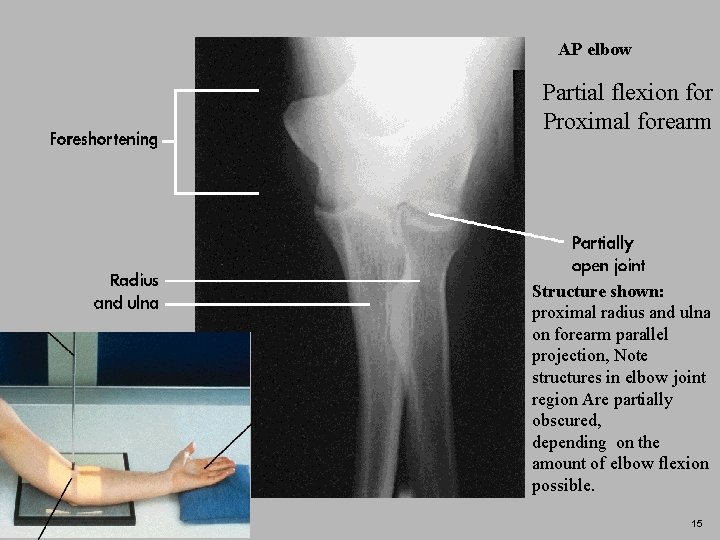
AP elbow Partial flexion for Proximal forearm Structure shown: proximal radius and ulna on forearm parallel projection, Note structures in elbow joint region Are partially obscured, depending on the amount of elbow flexion possible. 15
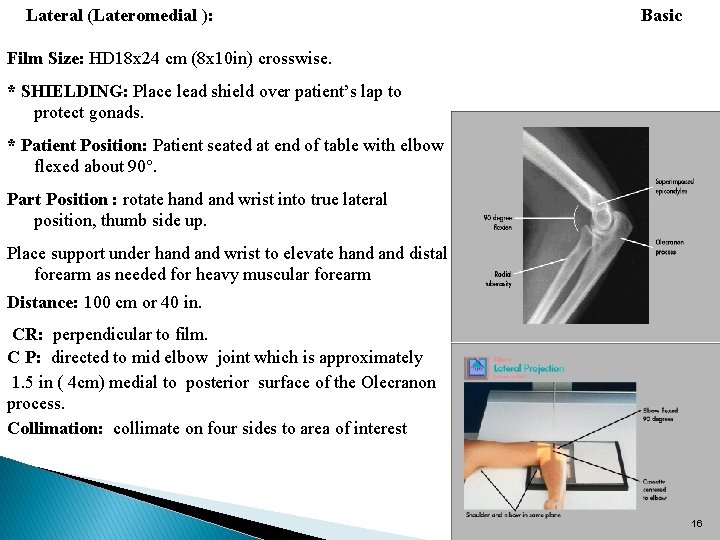
Lateral (Lateromedial ): Basic Film Size: HD 18 x 24 cm (8 x 10 in) crosswise. * SHIELDING: Place lead shield over patient’s lap to protect gonads. * Patient Position: Patient seated at end of table with elbow flexed about 90. Part Position : rotate hand wrist into true lateral position, thumb side up. Place support under hand wrist to elevate hand distal forearm as needed for heavy muscular forearm Distance: 100 cm or 40 in. CR: perpendicular to film. C P: directed to mid elbow joint which is approximately 1. 5 in ( 4 cm) medial to posterior surface of the Olecranon process. Collimation: collimate on four sides to area of interest 16
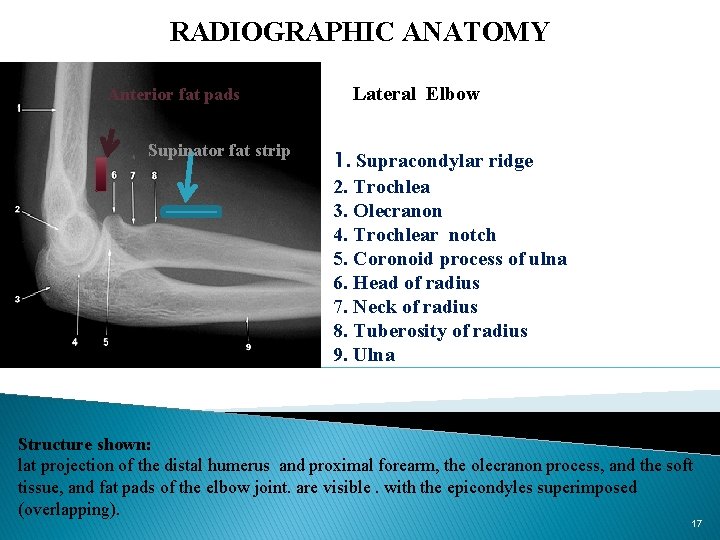
RADIOGRAPHIC ANATOMY Anterior fat pads Supinator fat strip Lateral Elbow 1. Supracondylar ridge 2. Trochlea 3. Olecranon 4. Trochlear notch 5. Coronoid process of ulna 6. Head of radius 7. Neck of radius 8. Tuberosity of radius 9. Ulna Structure shown: lat projection of the distal humerus and proximal forearm, the olecranon process, and the soft tissue, and fat pads of the elbow joint. are visible. with the epicondyles superimposed (overlapping). 17
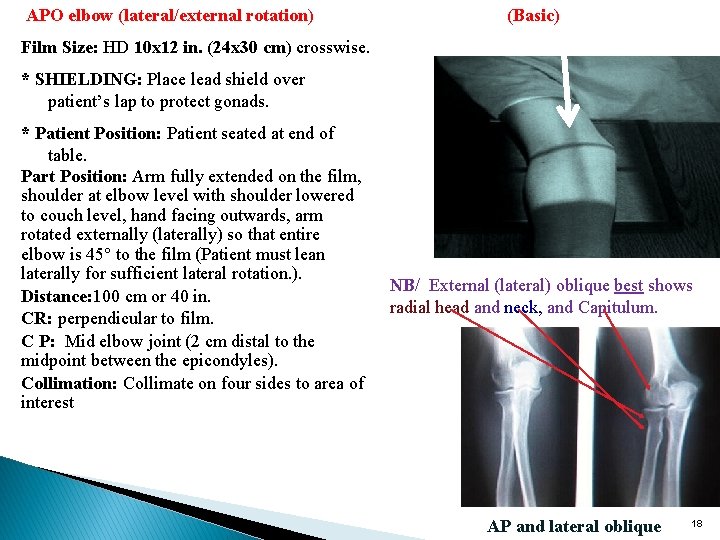
APO elbow (lateral/external rotation) (Basic) Film Size: HD 10 x 12 in. (24 x 30 cm) crosswise. * SHIELDING: Place lead shield over patient’s lap to protect gonads. * Patient Position: Patient seated at end of table. Part Position: Arm fully extended on the film, shoulder at elbow level with shoulder lowered to couch level, hand facing outwards, arm rotated externally (laterally) so that entire elbow is 45 to the film (Patient must lean laterally for sufficient lateral rotation. ). Distance: 100 cm or 40 in. CR: perpendicular to film. C P: Mid elbow joint (2 cm distal to the midpoint between the epicondyles). Collimation: Collimate on four sides to area of interest NB/ External (lateral) oblique best shows radial head and neck, and Capitulum. AP and lateral oblique 18
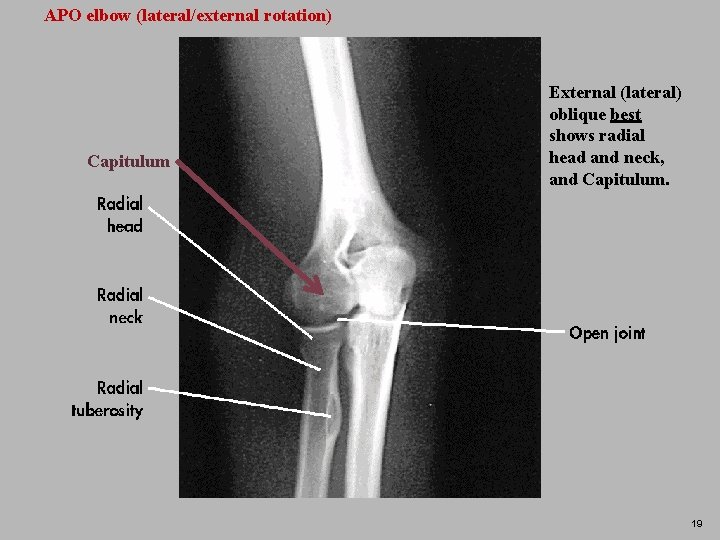
APO elbow (lateral/external rotation) Capitulum External (lateral) oblique best shows radial head and neck, and Capitulum. 19
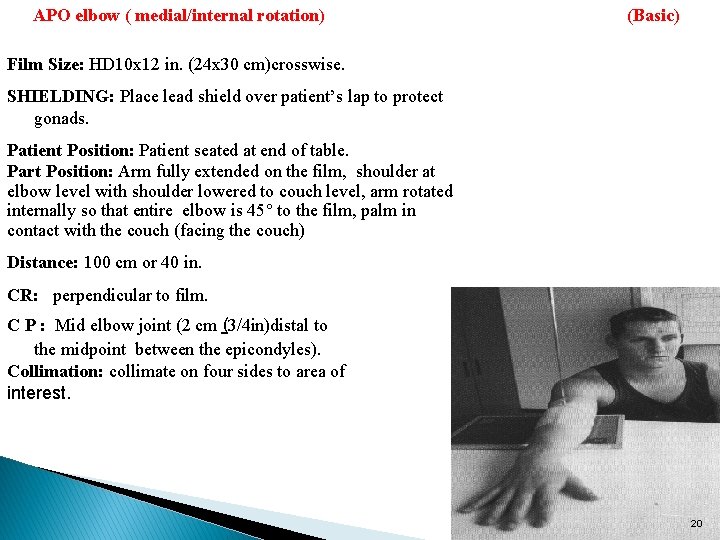
APO elbow ( medial/internal rotation) (Basic) Film Size: HD 10 x 12 in. (24 x 30 cm)crosswise. SHIELDING: Place lead shield over patient’s lap to protect gonads. Patient Position: Patient seated at end of table. Part Position: Arm fully extended on the film, shoulder at elbow level with shoulder lowered to couch level, arm rotated internally so that entire elbow is 45 to the film, palm in contact with the couch (facing the couch) Distance: 100 cm or 40 in. CR: perpendicular to film. C P : Mid elbow joint (2 cm (3/4 in)distal to the midpoint between the epicondyles). Collimation: collimate on four sides to area of interest. 20
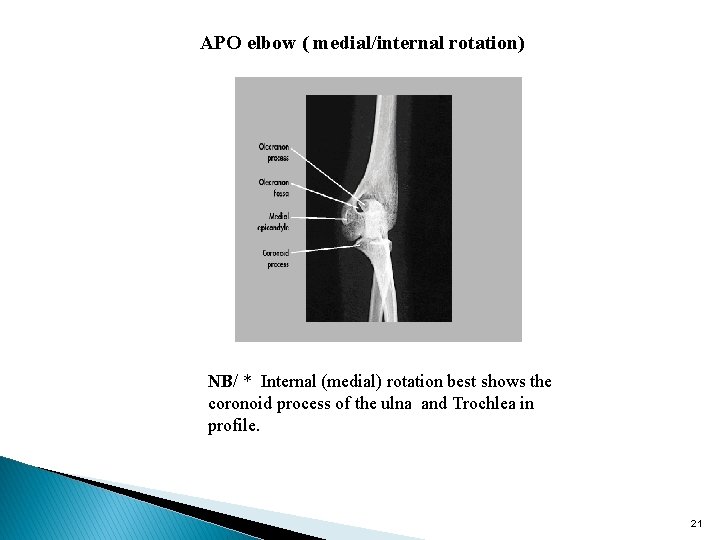
APO elbow ( medial/internal rotation) NB/ * Internal (medial) rotation best shows the coronoid process of the ulna and Trochlea in profile. 21
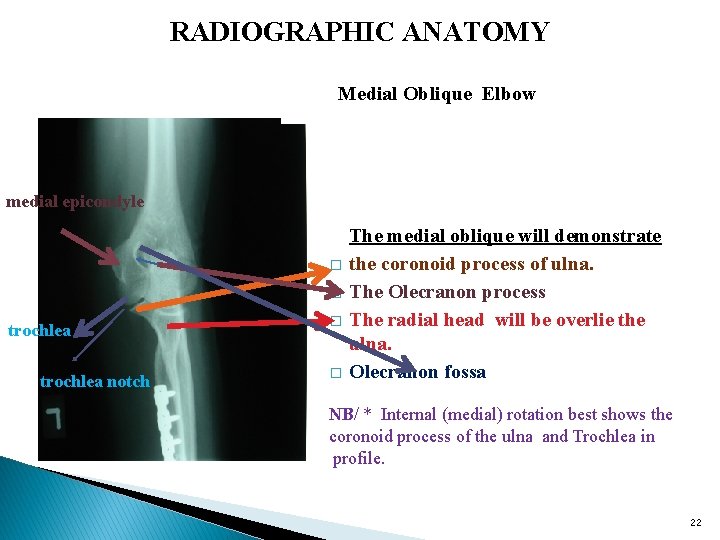
RADIOGRAPHIC ANATOMY Medial Oblique Elbow medial epicondyle trochlea notch The medial oblique will demonstrate � the coronoid process of ulna. � The Olecranon process � The radial head will be overlie the ulna. � Olecranon fossa NB/ * Internal (medial) rotation best shows the coronoid process of the ulna and Trochlea in profile. 22
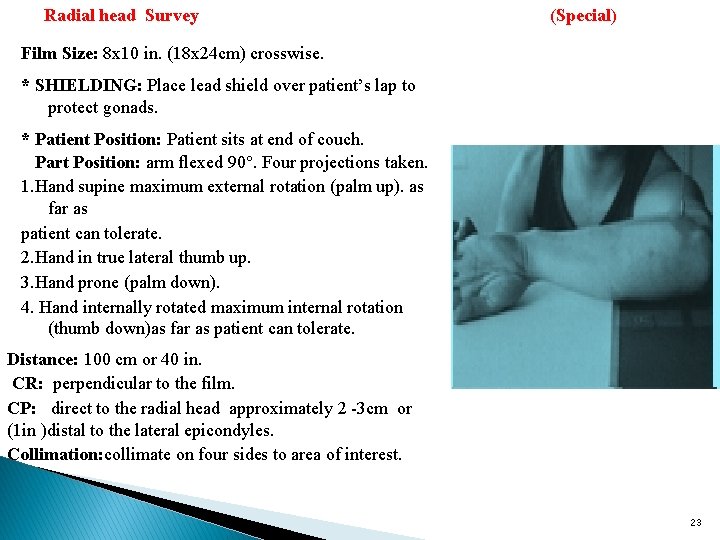
Radial head Survey (Special) Film Size: 8 x 10 in. (18 x 24 cm) crosswise. * SHIELDING: Place lead shield over patient’s lap to protect gonads. * Patient Position: Patient sits at end of couch. Part Position: arm flexed 90. Four projections taken. 1. Hand supine maximum external rotation (palm up). as far as patient can tolerate. 2. Hand in true lateral thumb up. 3. Hand prone (palm down). 4. Hand internally rotated maximum internal rotation (thumb down)as far as patient can tolerate. Distance: 100 cm or 40 in. CR: perpendicular to the film. CP: direct to the radial head approximately 2 -3 cm or (1 in )distal to the lateral epicondyles. Collimation: collimate on four sides to area of interest. 23
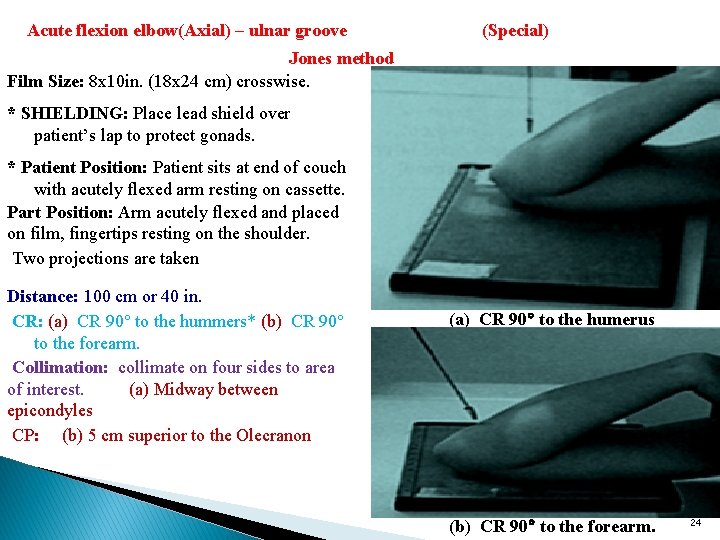
Acute flexion elbow(Axial) – ulnar groove (Special) Jones method Film Size: 8 x 10 in. (18 x 24 cm) crosswise. * SHIELDING: Place lead shield over patient’s lap to protect gonads. * Patient Position: Patient sits at end of couch with acutely flexed arm resting on cassette. Part Position: Arm acutely flexed and placed on film, fingertips resting on the shoulder. Two projections are taken Distance: 100 cm or 40 in. CR: (a) CR 90 to the hummers* (b) CR 90 to the forearm. Collimation: collimate on four sides to area of interest. (a) Midway between epicondyles CP: (b) 5 cm superior to the Olecranon (a) CR 90 to the humerus (b) CR 90 to the forearm. 24
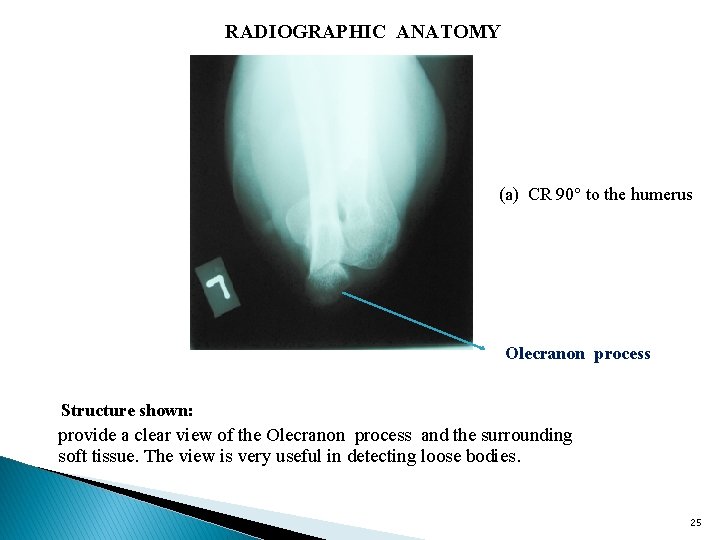
RADIOGRAPHIC ANATOMY (a) CR 90 to the humerus Olecranon process Structure shown: provide a clear view of the Olecranon process and the surrounding soft tissue. The view is very useful in detecting loose bodies. 25
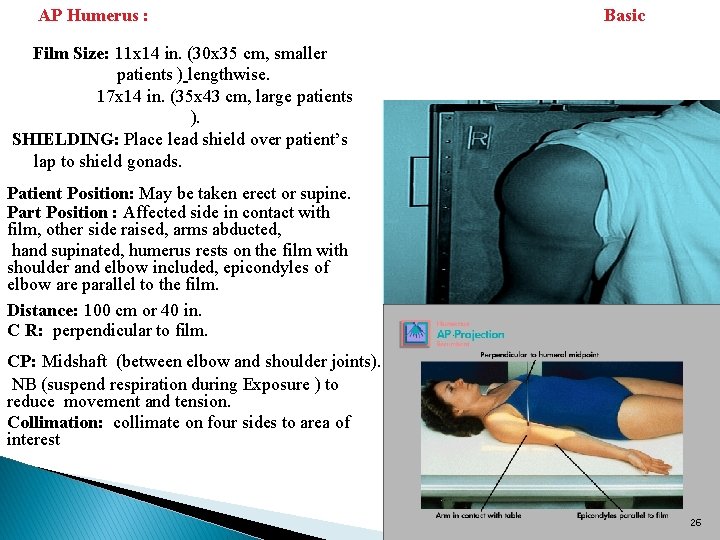
AP Humerus : Basic Film Size: 11 x 14 in. (30 x 35 cm, smaller patients ) lengthwise. 17 x 14 in. (35 x 43 cm, large patients ). SHIELDING: Place lead shield over patient’s lap to shield gonads. Patient Position: May be taken erect or supine. Part Position : Affected side in contact with film, other side raised, arms abducted, hand supinated, humerus rests on the film with shoulder and elbow included, epicondyles of elbow are parallel to the film. Distance: 100 cm or 40 in. C R: perpendicular to film. CP: Midshaft (between elbow and shoulder joints). NB (suspend respiration during Exposure ) to reduce movement and tension. Collimation: collimate on four sides to area of interest 26
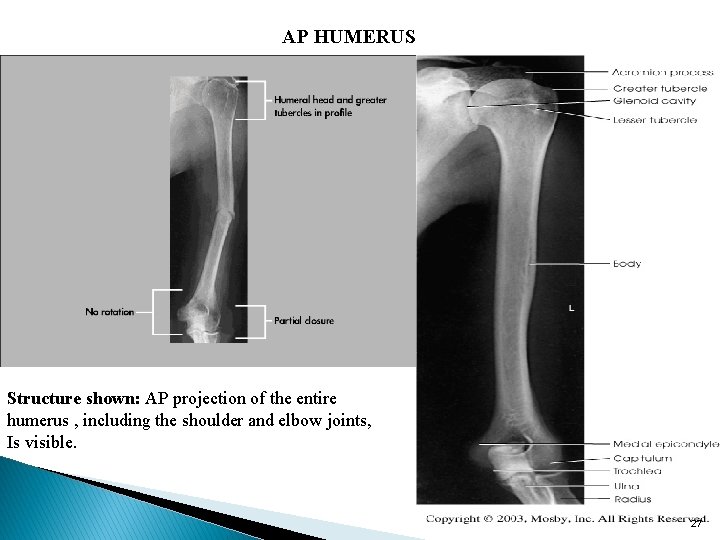
AP HUMERUS Structure shown: AP projection of the entire humerus , including the shoulder and elbow joints, Is visible. 27
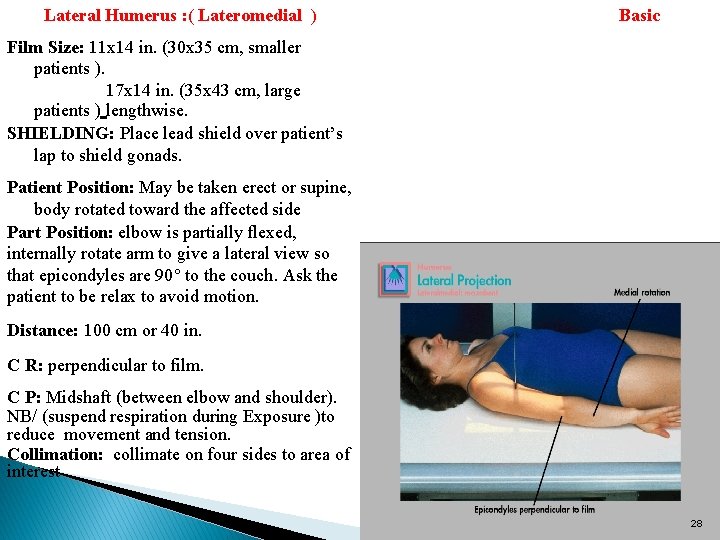
Lateral Humerus : ( Lateromedial ) Basic Film Size: 11 x 14 in. (30 x 35 cm, smaller patients ). 17 x 14 in. (35 x 43 cm, large patients ) lengthwise. SHIELDING: Place lead shield over patient’s lap to shield gonads. Patient Position: May be taken erect or supine, body rotated toward the affected side Part Position: elbow is partially flexed, internally rotate arm to give a lateral view so that epicondyles are 90 to the couch. Ask the patient to be relax to avoid motion. Distance: 100 cm or 40 in. C R: perpendicular to film. C P: Midshaft (between elbow and shoulder). NB/ (suspend respiration during Exposure )to reduce movement and tension. Collimation: collimate on four sides to area of interest 28
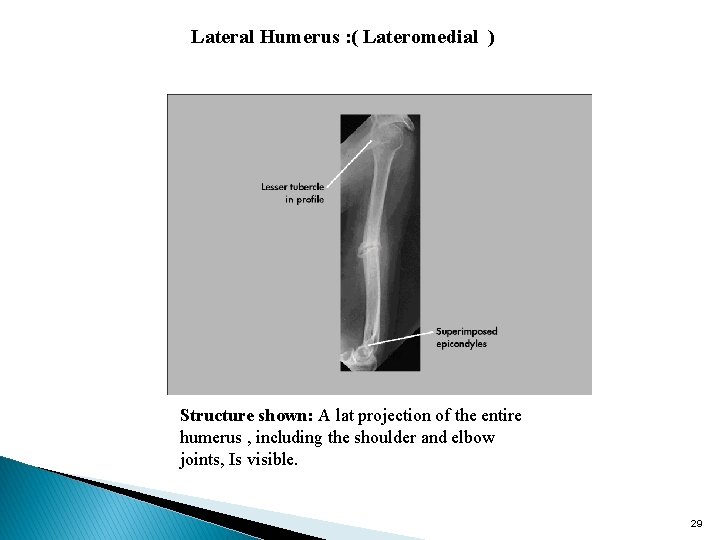
Lateral Humerus : ( Lateromedial ) Structure shown: A lat projection of the entire humerus , including the shoulder and elbow joints, Is visible. 29
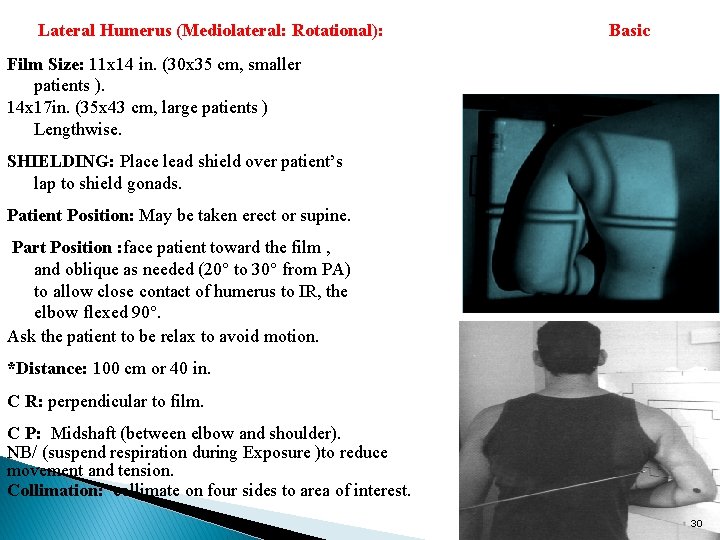
Lateral Humerus (Mediolateral: Rotational): Basic Film Size: 11 x 14 in. (30 x 35 cm, smaller patients ). 14 x 17 in. (35 x 43 cm, large patients ) Lengthwise. SHIELDING: Place lead shield over patient’s lap to shield gonads. Patient Position: May be taken erect or supine. Part Position : face patient toward the film , and oblique as needed (20 to 30 from PA) to allow close contact of humerus to IR, the elbow flexed 90. Ask the patient to be relax to avoid motion. *Distance: 100 cm or 40 in. C R: perpendicular to film. C P: Midshaft (between elbow and shoulder). NB/ (suspend respiration during Exposure )to reduce movement and tension. Collimation: collimate on four sides to area of interest. 30
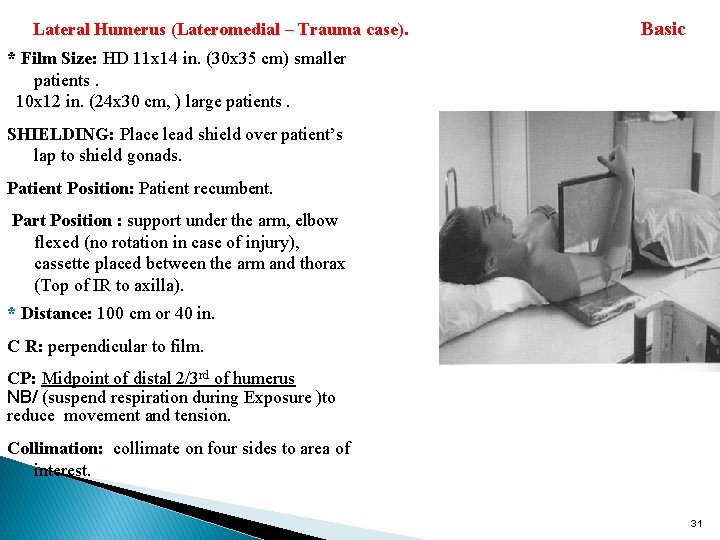
Lateral Humerus (Lateromedial – Trauma case). Basic * Film Size: HD 11 x 14 in. (30 x 35 cm) smaller patients. 10 x 12 in. (24 x 30 cm, ) large patients. SHIELDING: Place lead shield over patient’s lap to shield gonads. Patient Position: Patient recumbent. Part Position : support under the arm, elbow flexed (no rotation in case of injury), cassette placed between the arm and thorax (Top of IR to axilla). * Distance: 100 cm or 40 in. C R: perpendicular to film. CP: Midpoint of distal 2/3 rd of humerus NB/ (suspend respiration during Exposure )to reduce movement and tension. Collimation: collimate on four sides to area of interest. 31
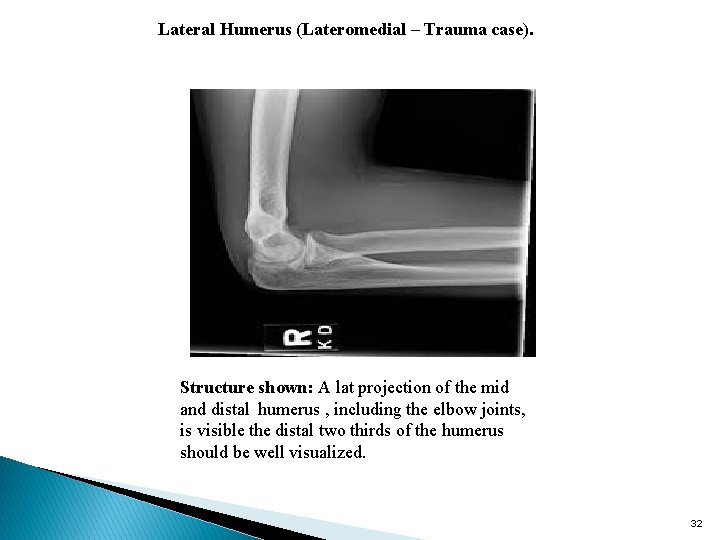
Lateral Humerus (Lateromedial – Trauma case). Structure shown: A lat projection of the mid and distal humerus , including the elbow joints, is visible the distal two thirds of the humerus should be well visualized. 32
- Slides: 32