
Race Management Training Scheme S Club Race Officer
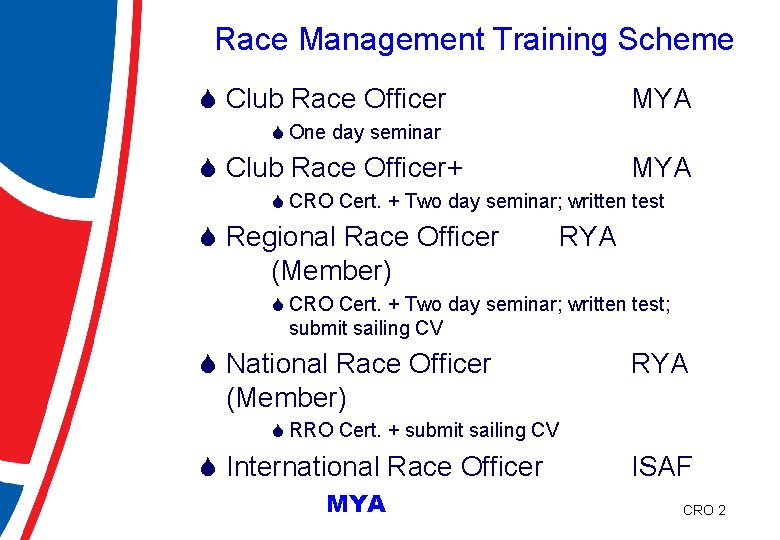
Race Management Training Scheme S Club Race Officer MYA S One day seminar S Club Race Officer+ MYA S CRO Cert. + Two day seminar; written test S Regional Race Officer (Member) RYA S CRO Cert. + Two day seminar; written test; submit sailing CV S National Race Officer (Member) RYA S RRO Cert. + submit sailing CV S International Race Officer MYA ISAF CRO 2

Race Management Publications S ISAF Racing Rules of Sailing S including the Standard Sailing Instructions Guide S including the Standard Notice of Race Guide S ISAF Racing Rules of Sailing – Appendix E S MYA Standard Sailing Instructions S Club Sailing Instructions MYA CRO 3
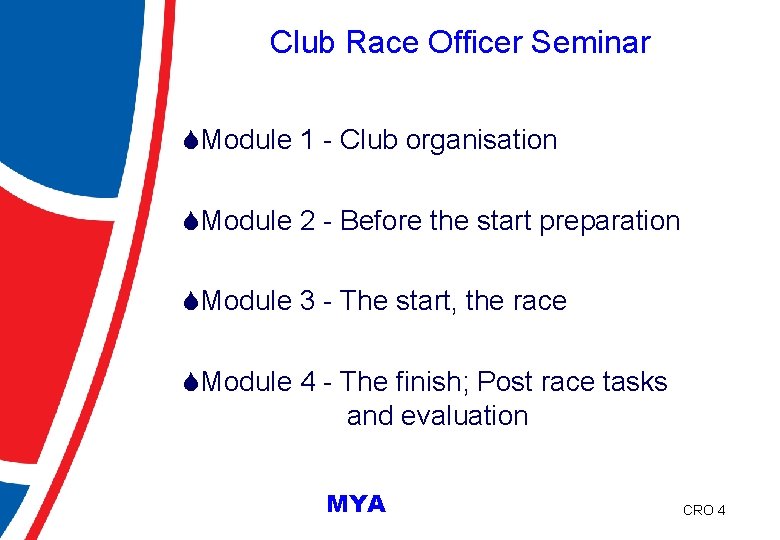
Club Race Officer Seminar SModule 1 - Club organisation SModule 2 - Before the start preparation SModule 3 - The start, the race SModule 4 - The finish; Post race tasks and evaluation MYA CRO 4
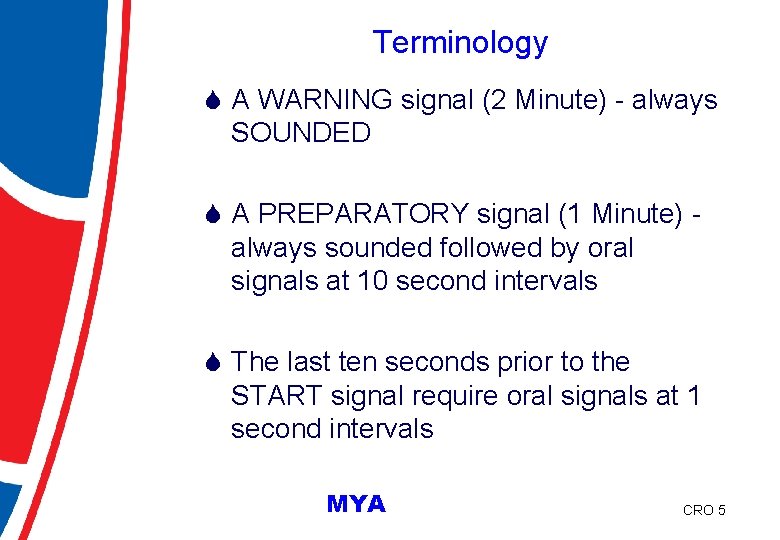
Terminology S A WARNING signal (2 Minute) - always SOUNDED S A PREPARATORY signal (1 Minute) always sounded followed by oral signals at 10 second intervals S The last ten seconds prior to the START signal require oral signals at 1 second intervals MYA CRO 5
Module 1 Club Organisation MYA CRO 6
Group Discussion S How does your club organise its Race Management? S Does the system work? S What are the main difficulties? S Where can it be improved? MYA CRO 7
Club Race Management Is designed to: S Make the most of the club organisation S Give member satisfaction - good sailing S Prepare for events requiring greater expertise S Give members the chance to see the other side of racing MYA CRO 8
Who are the members? Club members fall into three distinct groups S Beginners / Learners S Experienced recreational racers S The Open Meeting experts MYA CRO 9
Learners (of all ages) require S Space S no-one carving them up S Tolerance S while they learn S Chance to finish the race S without being cursed by the Race Officer MYA CRO 10
Experienced recreational racers require S Enjoyable racing S Competitive sailing at their level S A regular pattern to the racing S don't want to have to think too much! S Time to talk about the race afterwards MYA CRO 11
Open Meeting experts require S Competition in which they stand a fair chance of winning S Good organisation S accurate start lines S true beats S correctly angled reaches S Emphasis on learning & trying things out S Remember - for many of these, club racing is a training session, but is also an opportunity to help others improve their sailing MYA CRO 12
Group discussion S How does your Club communicate with its members? S Are the methods used effective? Do members react positively? S Can the dissemination of information to members be improved? S Do you consider the three points above MYA CRO 13
To give competitor satisfaction, the club organisation needs to S Communicate efficiently S Follow a regular pattern in its organisational structure S Have an efficient method of encouraging members into taking and accepting responsibility S GET AWAY FROM THE 'ONE-MAN BAND' MYA CRO 14
Group discussion S Risk assessment is carried out by the Club when producing it’s own club sailing programme. S What are the areas where your club needs to assess the risks? S Has your club carried out such a risk assessment? MYA CRO 15
Safety at the Lakeside S Clubs should be aware of the risks involved such as; S Duty of care to Competitors & Race Officials S Trip hazards S Members of the Public S Competitor Health issues MYA CRO 16
Module 2 Before the start preparation MYA CRO 17
Race Officer Duty - Preparation S Long before the day S go on duty with a good race officer S observe S make notes Club Race Officer 2014 MYA CRO 18
Race Officer Duty - Preparation S D-day minus 7 S Contact Sailing Secretary / Race Manager (or be contacted) S Get a copy of the Club’s Race Management Guide S Check S programme is to run as scheduled S race team members are all available S experience (balance) of team is OK S all equipment is operational MYA CRO 19
Group discussion S What starting equipment would you expect the club to supply? S What personal equipment does a Club Race Officer need to provide? MYA CRO 20
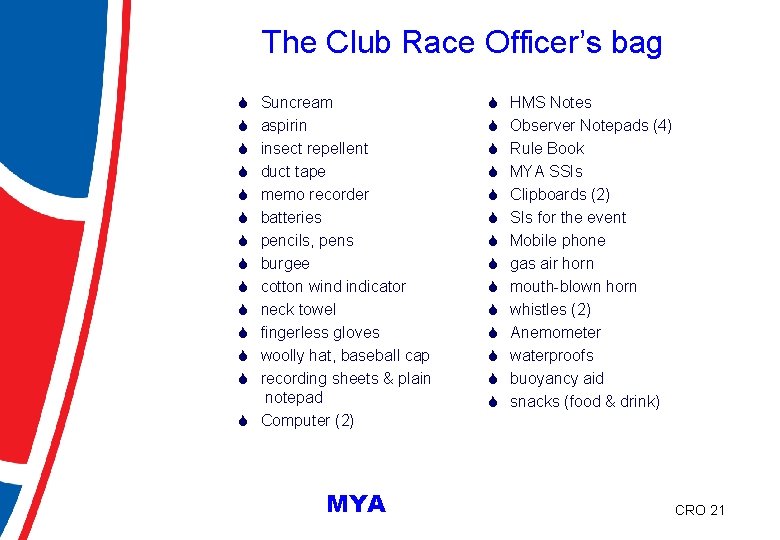
The Club Race Officer’s bag S S S Suncream aspirin insect repellent duct tape memo recorder batteries pencils, pens burgee cotton wind indicator neck towel fingerless gloves woolly hat, baseball cap recording sheets & plain notepad S Computer (2) MYA S S S S HMS Notes Observer Notepads (4) Rule Book MYA SSIs Clipboards (2) SIs for the event Mobile phone gas air horn mouth-blown horn whistles (2) Anemometer waterproofs buoyancy aid snacks (food & drink) CRO 21
Race Officer’s Equipment S The previous slide shows what could be needed ! S Normally the Club provides everything S Notice / Heat / Course Boards should be available S Observer notepads should identify, Front; Middle; back of Fleet MYA CRO 22
Race Officer Duty - Preparation S D- day minus 5 S Check personal equipment S Re-read Racing Rules – S Appendix E S MYA SSIs S D-day minus 1 S Watch TV weather forecasts - get a picture of what is happening, fronts etc S If bad weather is predicted then arrange additional coverage if required S Re-read Club Sailing Instructions MYA CRO 23
Race Officer Duty - Preparation S Start minus 1 -2 hours S Arrive at Club with latest forecast S Check that all starting equipment is in order S Check wind again S Unlock/prepare equipment S From forecast and current observation predict wind strength and direction at start-time S Check all helpers have arrived and equipment is all working S If too strong/light prepare to postpone MYA CRO 24
Pre-Start Preparation S Course & Rescue Boat afloat and ready S Watches ready S wound / batteries OK S set to correct (real) time S Recording Sheets ready and pencils sharp S Starting Equipment operational MYA CRO 25
Module 3 The start, the race MYA CRO 26
Group discussion S The Sailing Instructions are one method of communication between the Race Officer and the Competitor. S What is the second and equally important method of communicating your intentions to the competitor when on the water? S How do you utilise this method efficiently? MYA CRO 27
Courses S not all course suit all boats S club fixed marks can predetermine the course S club water sometimes restricts the course S a windward start is a always preferable S a true beat is always welcomed MYA CRO 28
Classic Courses S These assume clear air and water S Olympic course S Triangle or triangle / sausage MYA CRO 29
Courses S Trapezoid (new Olympic course) S Triangle / Sausage variations S Windward /Leeward course MYA CRO 30
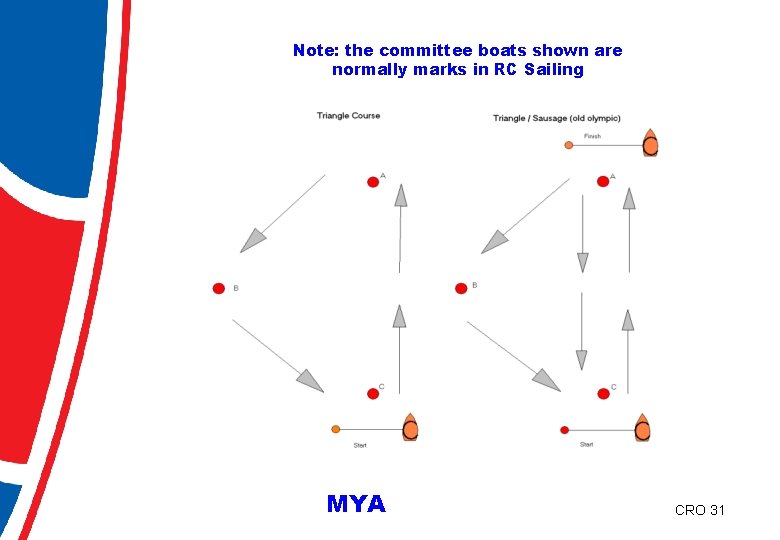
Note: the committee boats shown are normally marks in RC Sailing MYA CRO 31
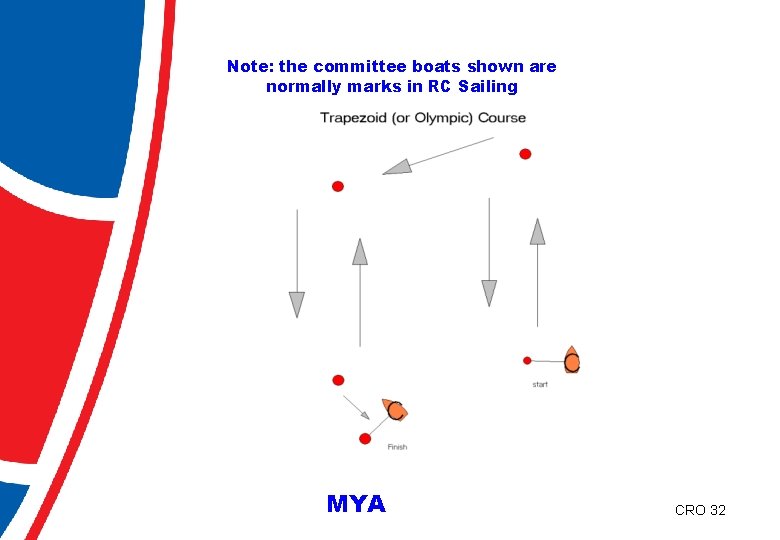
Note: the committee boats shown are normally marks in RC Sailing MYA CRO 32
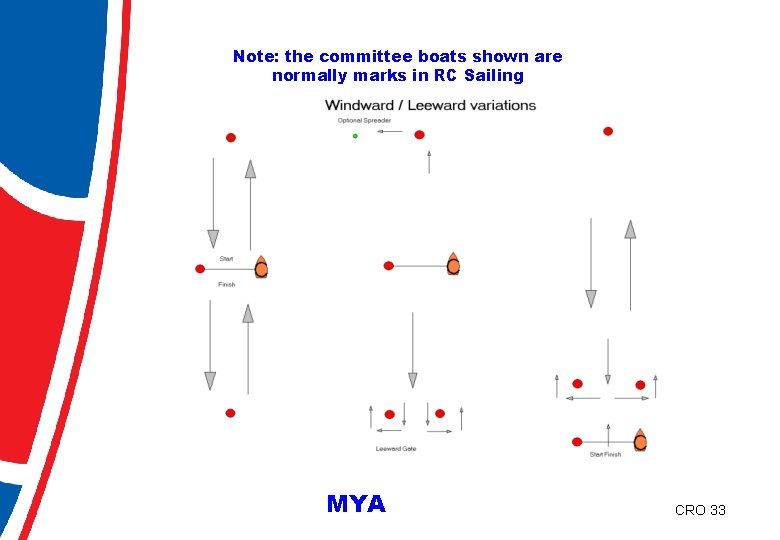
Note: the committee boats shown are normally marks in RC Sailing MYA CRO 33
Setting a Course S Refer to recommended courses in Club’s Race Manual S Check that marks shown on recommended course actually are in situ S Select a course that is suitable for S the PREDICTED wind strength and direction S the tide S Prepare course display, double-check that rounding sides of marks are correctly displayed S NO LOOPING OF MARKS! S Seek advice if necessary S Confirm choice with duty Race Manager or get someone else to check S Note start and finish line positions MYA CRO 34
Group discussion S What are the features of a ‘good’ course? S Can you achieve this on the water where your club races? S Does your club have a set of standard course configurations? S Are you able to amend these standard course configurations by inserting additional marks? MYA CRO 35
Decision Time! S A Race Officer must use his/her judgement to S decide length of start line S how many last minute starters? S how much bias is necessary? S how shifty is the wind? S any current to be considered? S postpone the start S organisation not ready (race team, rescue) S wind - too little, too much S start the race MYA CRO 36
Postponement Calls S These can be used for ANY REASON WHATSOEVER! S Use them as the panic button - a cry for help S Reasons can include S buoy drifting S major wind shift leading to heavily biased line S mistiming between signals S misfiring of sound signals S etc. MYA CRO 37
Before the Warning Signal S The Race Officer must signal or otherwise designate the course S use the method described in the club sailing instructions S The Race Officer may remove and substitute a new course signal MYA CRO 38
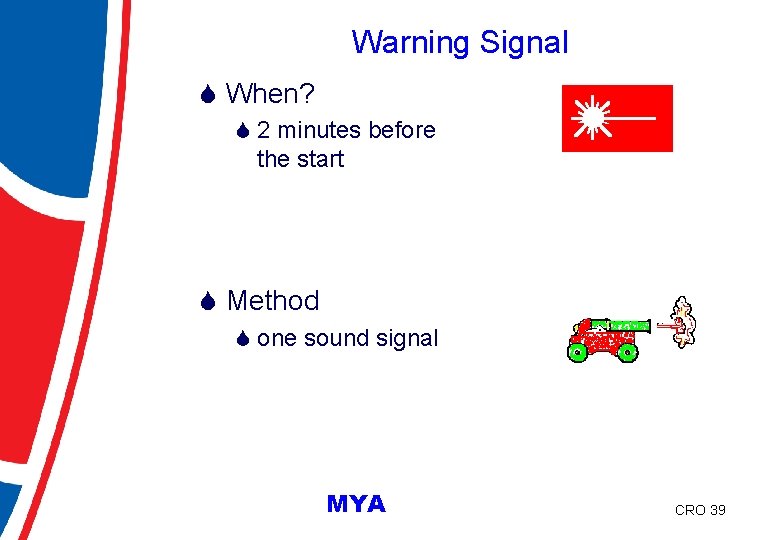
Warning Signal S When? S 2 minutes before the start S Method S one sound signal MYA CRO 39
Before the Preparatory Signal S The Race Officer may shift a starting mark S This allows the Race Officer to ‘fine tune’ the start line. S This is best done by watching the fleet as they ‘look’ at the start line. Watch their angle of approach to the start line. S Try to get a line where the angle of approach on Port and the angle of approach on Starboard are the same. MYA CRO 40
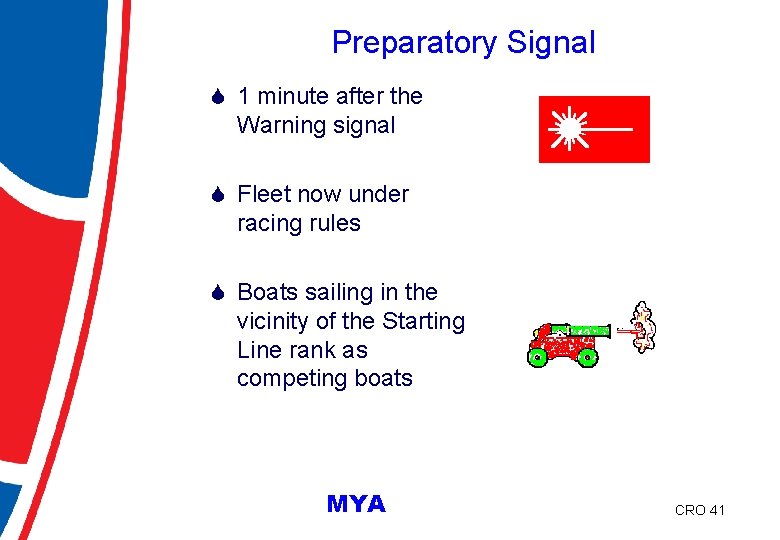
Preparatory Signal S 1 minute after the Warning signal S Fleet now under racing rules S Boats sailing in the vicinity of the Starting Line rank as competing boats MYA CRO 41
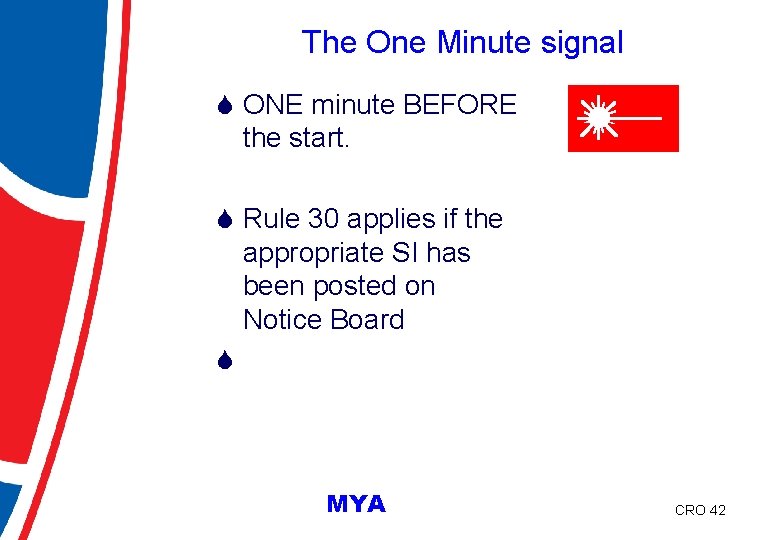
The One Minute signal S ONE minute BEFORE the start. S Rule 30 applies if the appropriate SI has been posted on Notice Board S MYA CRO 42
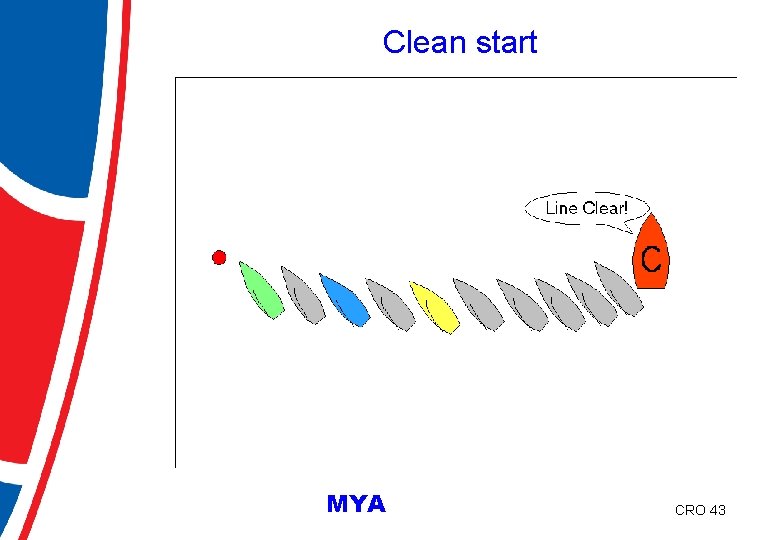
Clean start MYA CRO 43
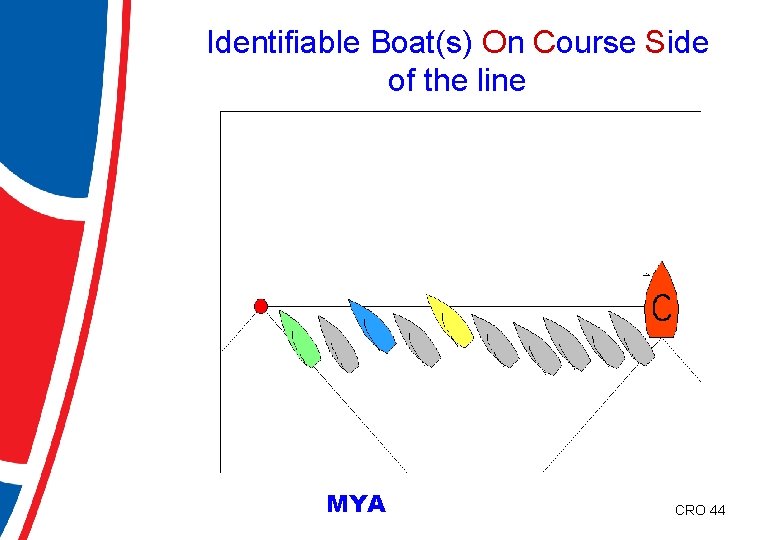
Identifiable Boat(s) On Course Side of the line MYA CRO 44
Identifiable Boat(s) On Course Side of the line S Call “Recall XX” twice or more as required S record OCS on race the sheet S watch the boat(s) to see if they return MYA CRO 45
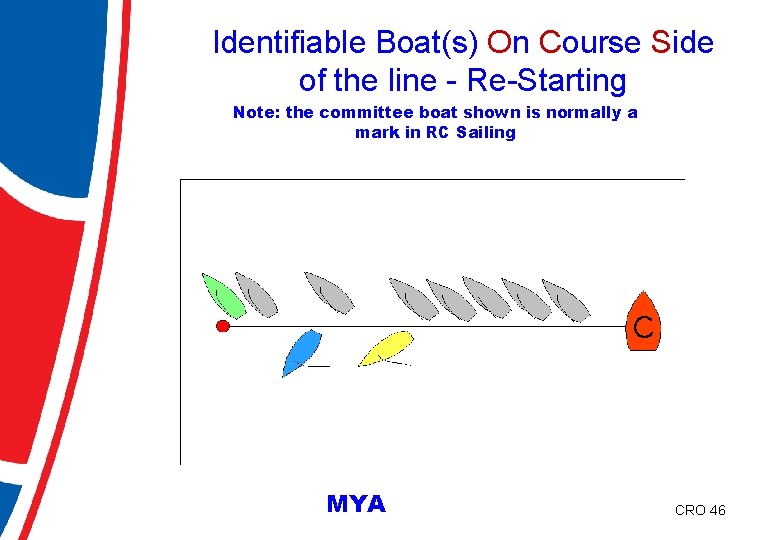
Identifiable Boat(s) On Course Side of the line - Re-Starting Note: the committee boat shown is normally a mark in RC Sailing MYA CRO 46
Identifiable Boat(s) On Course Side of the line - Re-Starting S When all have returned behind the start line S delete OCS S If some do not return, record as OCS MYA No sound signal required! CRO 47
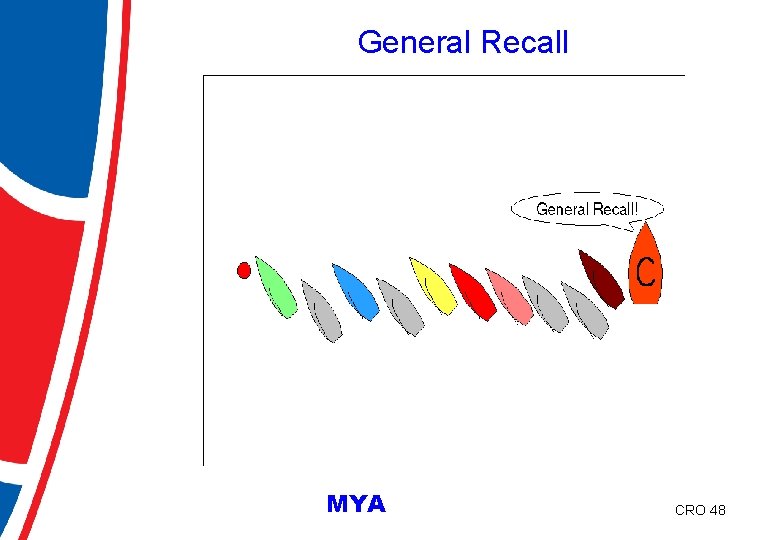
General Recall MYA CRO 48
General Recall S To be used S when there are several unidentified OCSs or S if there is an error in procedure S Method S Call “General Recall” twice S Re-start S with one minute signal MYA CRO 49
Group discussion S After a General Recall does your club send the offending fleet to the ‘back of the queue? S What are the advantages and disadvantages of this system? MYA CRO 50
After the start race control S To remain in control of the race, the Race Officer must, at regular intervals, check: S Time S by timing boats on various legs of the course S calculating the approximate finishing time for the first yacht S comparing this time with the time limit, and preparing to shorten course if necessary MYA CRO 51
After the start race control S To remain in control of the race, the Race Officer must, at regular intervals, check: S Recording of Yachts S ensure that recorders have positions of each yacht at end of each round S keep track of leaders S keep track of 'tail-end charlies’ relative to leaders MYA CRO 52
Module 4 The Finish, post race tasks and evaluation MYA CRO 53
Finishing the Race S The Race Officer has to S set a finishing line S (in most clubs this is frequently the same as the starting line) S has the race team set up for the finish S Observer with sound signal S Timekeeper ready to record finishing times S Recorder ready to record sail numbers and times S Collect Protest forms and Observer Notepads MYA CRO 54
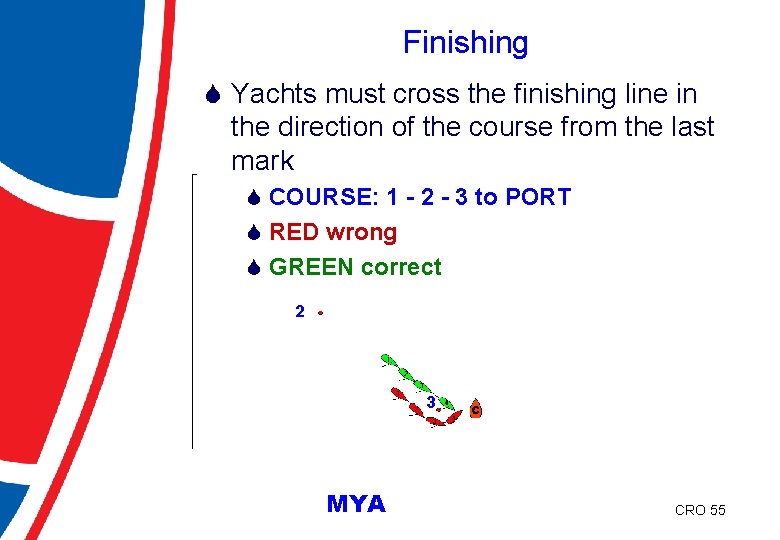
Finishing S Yachts must cross the finishing line in the direction of the course from the last mark S COURSE: 1 - 2 - 3 to PORT S RED wrong S GREEN correct 2 3 MYA CRO 55
FINALLY S Tidy up S Give out and receive protest forms, noting relevant times S Present the results in the agreed manner required by the results secretary S Prepare, if required, a brief report on the race for the Press Officer S Report any defects in the equipment S Ensure that all equipment is securely locked away S GO TO THE BAR AND RECEIVE PRAISE FOR A GOOD JOB WELL DONE!!! MYA CRO 56
Evaluation S Always evaluate your performance S Talk to the sailors in the bar after the race about the course you set S Always seek advice when necessary S Talk to the more experienced Race Officers to see where you can improve MYA CRO 57
- Slides: 57