
Race Ethnicity Social Structure and Crime CHAPTER 3
- Slides: 35
Race, Ethnicity, Social Structure, and Crime CHAPTER 3
LEARNING OBJECTIVES (SLIDE 1 OF 2) After reading this chapter: § You will be able to knowledgeably discuss inequalities in income and wealth with respect to race and ethnicity. § You will better understand the nature and extent of inequality in American society with respect to racial and ethnic minorities. § You will be able to explain whether the social and economic gap between whites and people of color narrowing or growing. © 2018 Cengage. May not be scanned, copied or duplicated, or posted to a publicly accessible website, in whole or in part.
LEARNING OBJECTIVES (SLIDE 2 OF 2) § You will understand how inherited wealth perpetuates § § inequality in terms of opportunities for employment and education. You will understand what we know about the relationship between social and economic inequality and crime, and how the leading theories of crime help explain that relationship. You will be knowledgeable about the impact of reform efforts designed to reduce inequality, including the civil rights movement and different anti-poverty efforts. © 2018 Cengage. May not be scanned, copied or duplicated, or posted to a publicly accessible website, in whole or in part.
TWO SOCIETIES 1968 Kerner Commission § “…our Nation is moving toward two societies, one black, one white—separate & unequal. ” 2010 Reality § Unemployment is up and job opportunities are down o The unemployment rate for African Americans teens was twice the rate for Whites (8. 8% vs 4. 3%) and 37% higher for Hispanics (5. 9% vs 4. 3%) © 2018 Cengage. May not be scanned, copied or duplicated, or posted to a publicly accessible website, in whole or in part.
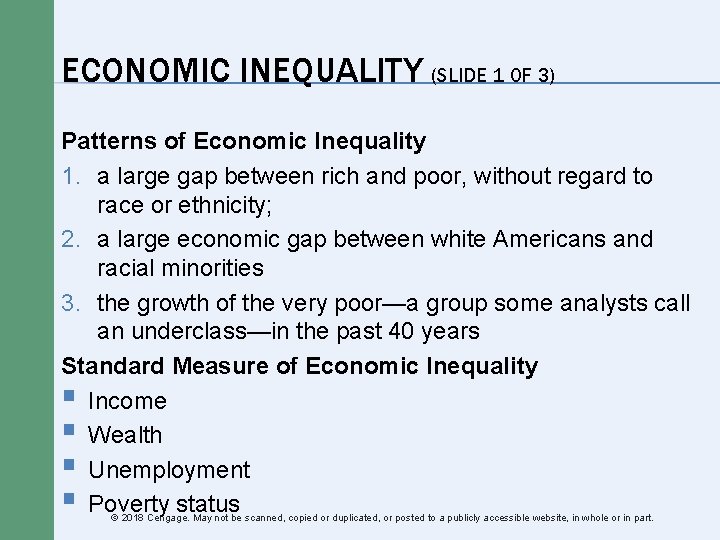
ECONOMIC INEQUALITY (SLIDE 1 OF 3) Patterns of Economic Inequality 1. a large gap between rich and poor, without regard to race or ethnicity; 2. a large economic gap between white Americans and racial minorities 3. the growth of the very poor—a group some analysts call an underclass—in the past 40 years Standard Measure of Economic Inequality § Income § Wealth § Unemployment § Poverty status © 2018 Cengage. May not be scanned, copied or duplicated, or posted to a publicly accessible website, in whole or in part.
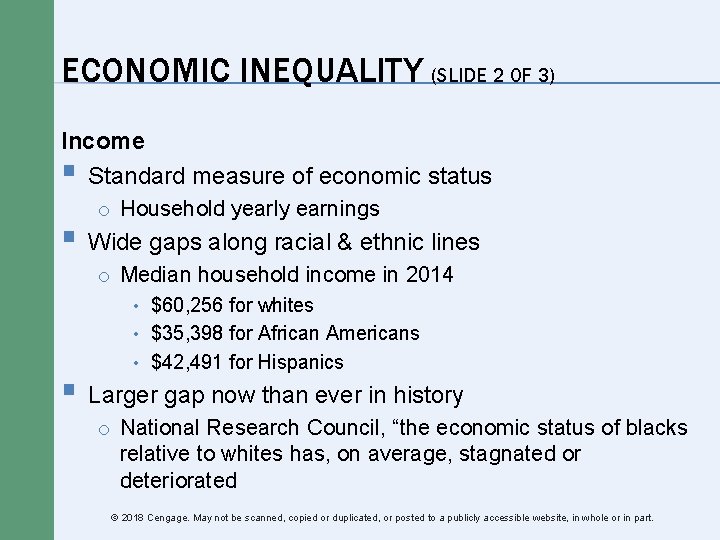
ECONOMIC INEQUALITY (SLIDE 2 OF 3) Income § Standard measure of economic status o Household yearly earnings § Wide gaps along racial & ethnic lines o Median household income in 2014 $60, 256 for whites • $35, 398 for African Americans • $42, 491 for Hispanics • § Larger gap now than ever in history o National Research Council, “the economic status of blacks relative to whites has, on average, stagnated or deteriorated © 2018 Cengage. May not be scanned, copied or duplicated, or posted to a publicly accessible website, in whole or in part.
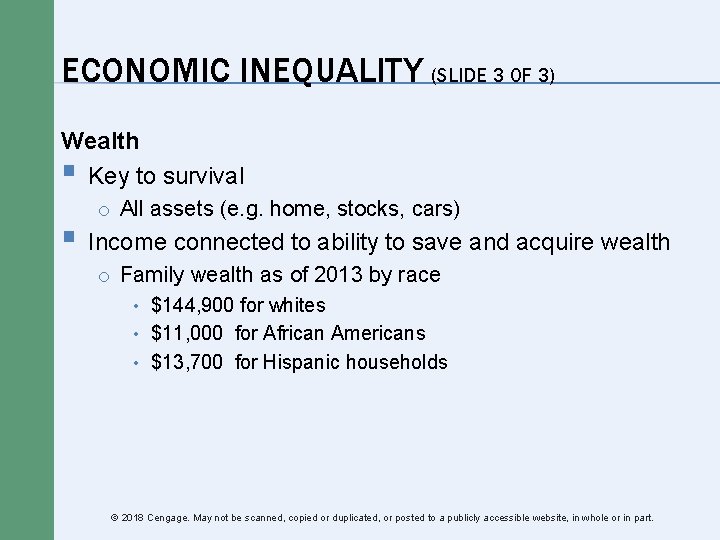
ECONOMIC INEQUALITY (SLIDE 3 OF 3) Wealth § Key to survival o All assets (e. g. home, stocks, cars) § Income connected to ability to save and acquire wealth o Family wealth as of 2013 by race $144, 900 for whites • $11, 000 for African Americans • $13, 700 for Hispanic households • © 2018 Cengage. May not be scanned, copied or duplicated, or posted to a publicly accessible website, in whole or in part.
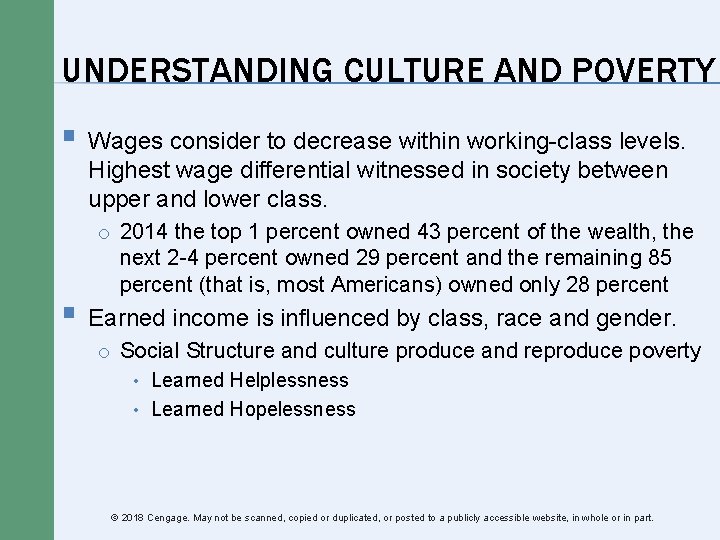
UNDERSTANDING CULTURE AND POVERTY § Wages consider to decrease within working-class levels. Highest wage differential witnessed in society between upper and lower class. o 2014 the top 1 percent owned 43 percent of the wealth, the next 2 -4 percent owned 29 percent and the remaining 85 percent (that is, most Americans) owned only 28 percent § Earned income is influenced by class, race and gender. o Social Structure and culture produce and reproduce poverty Learned Helplessness • Learned Hopelessness • © 2018 Cengage. May not be scanned, copied or duplicated, or posted to a publicly accessible website, in whole or in part.
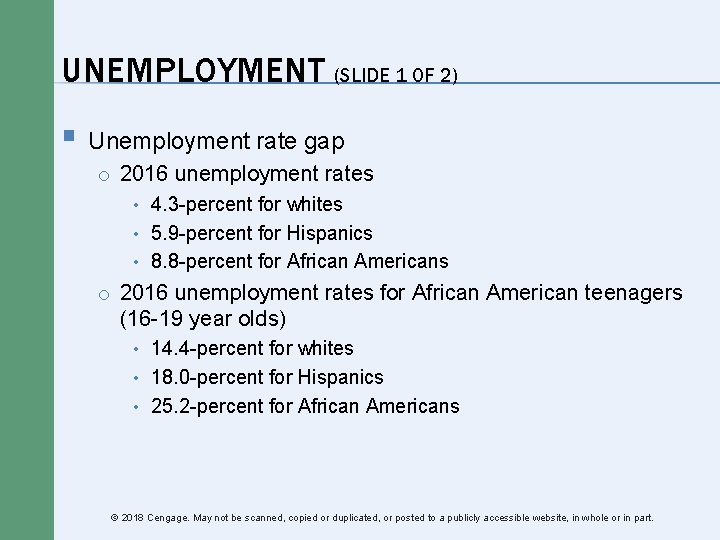
UNEMPLOYMENT (SLIDE 1 OF 2) § Unemployment rate gap o 2016 unemployment rates 4. 3 -percent for whites • 5. 9 -percent for Hispanics • 8. 8 -percent for African Americans • o 2016 unemployment rates for African American teenagers (16 -19 year olds) 14. 4 -percent for whites • 18. 0 -percent for Hispanics • 25. 2 -percent for African Americans • © 2018 Cengage. May not be scanned, copied or duplicated, or posted to a publicly accessible website, in whole or in part.
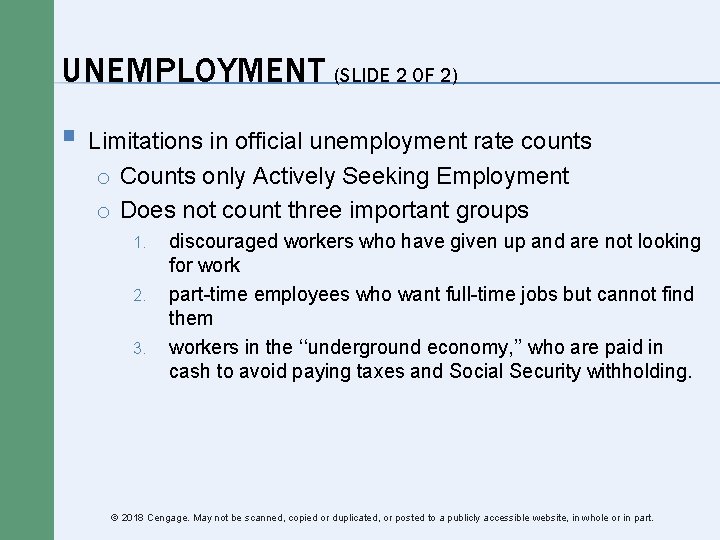
UNEMPLOYMENT (SLIDE 2 OF 2) § Limitations in official unemployment rate counts o Counts only Actively Seeking Employment o Does not count three important groups 1. 2. 3. discouraged workers who have given up and are not looking for work part-time employees who want full-time jobs but cannot find them workers in the ‘‘underground economy, ’’ who are paid in cash to avoid paying taxes and Social Security withholding. © 2018 Cengage. May not be scanned, copied or duplicated, or posted to a publicly accessible website, in whole or in part.
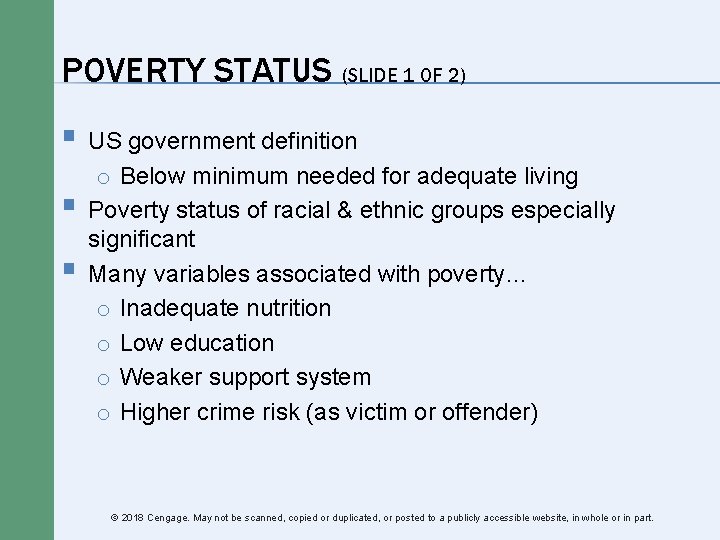
POVERTY STATUS (SLIDE 1 OF 2) § US government definition § § o Below minimum needed for adequate living Poverty status of racial & ethnic groups especially significant Many variables associated with poverty… o Inadequate nutrition o Low education o Weaker support system o Higher crime risk (as victim or offender) © 2018 Cengage. May not be scanned, copied or duplicated, or posted to a publicly accessible website, in whole or in part.
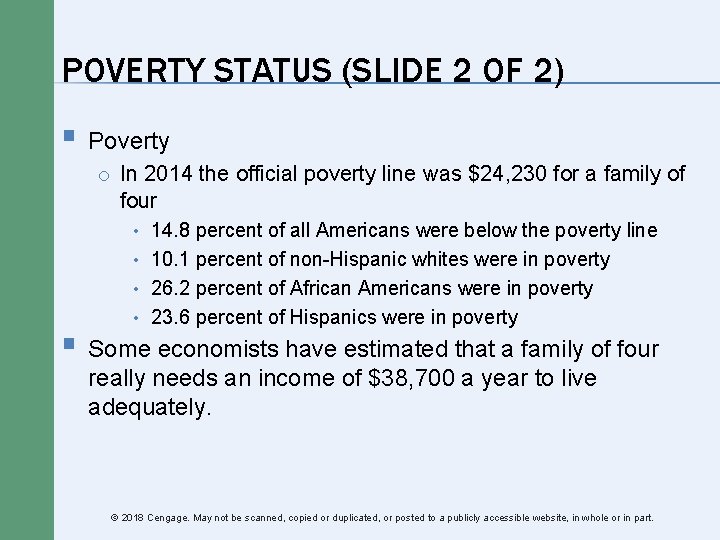
POVERTY STATUS (SLIDE 2 OF 2) § Poverty o In 2014 the official poverty line was $24, 230 for a family of four 14. 8 percent of all Americans were below the poverty line • 10. 1 percent of non-Hispanic whites were in poverty • 26. 2 percent of African Americans were in poverty • 23. 6 percent of Hispanics were in poverty • § Some economists have estimated that a family of four really needs an income of $38, 700 a year to live adequately. © 2018 Cengage. May not be scanned, copied or duplicated, or posted to a publicly accessible website, in whole or in part.
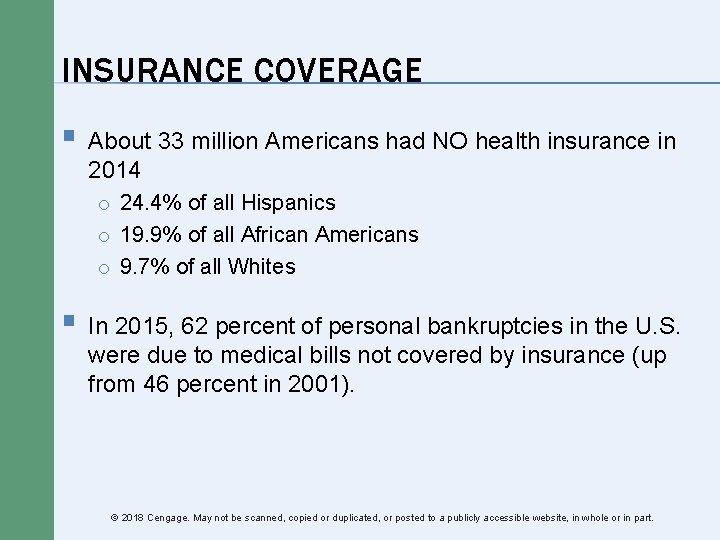
INSURANCE COVERAGE § About 33 million Americans had NO health insurance in 2014 o 24. 4% of all Hispanics o 19. 9% of all African Americans o 9. 7% of all Whites § In 2015, 62 percent of personal bankruptcies in the U. S. were due to medical bills not covered by insurance (up from 46 percent in 2001). © 2018 Cengage. May not be scanned, copied or duplicated, or posted to a publicly accessible website, in whole or in part.
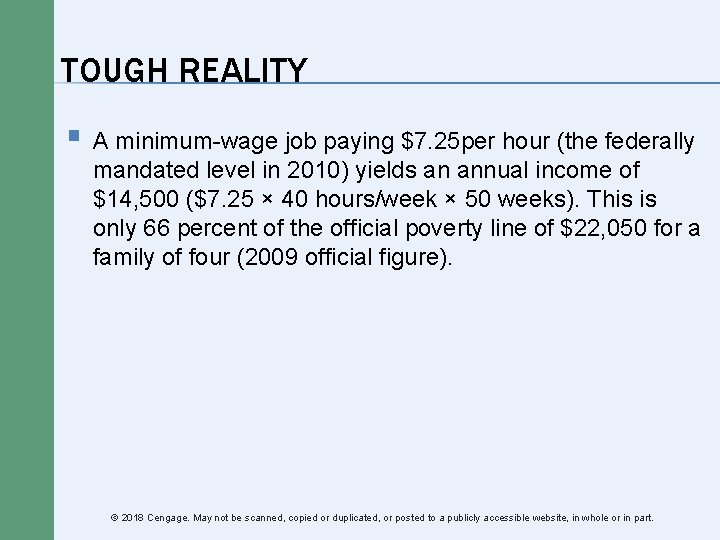
TOUGH REALITY § A minimum-wage job paying $7. 25 per hour (the federally mandated level in 2010) yields an annual income of $14, 500 ($7. 25 × 40 hours/week × 50 weeks). This is only 66 percent of the official poverty line of $22, 050 for a family of four (2009 official figure). © 2018 Cengage. May not be scanned, copied or duplicated, or posted to a publicly accessible website, in whole or in part.
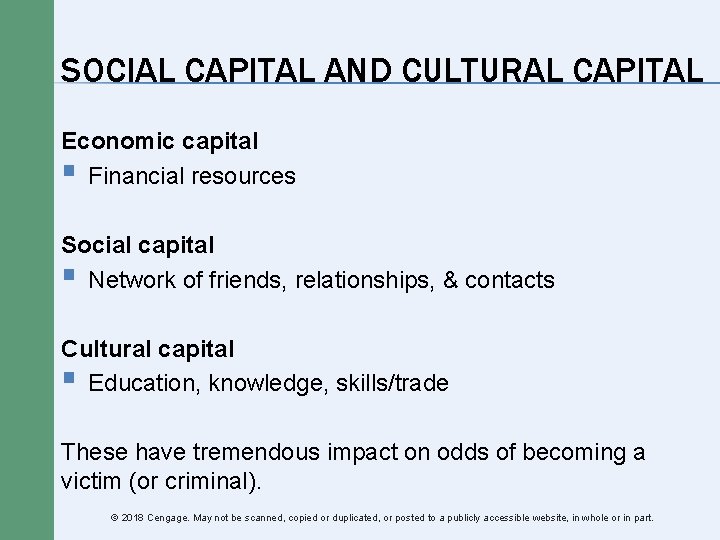
SOCIAL CAPITAL AND CULTURAL CAPITAL Economic capital § Financial resources Social capital § Network of friends, relationships, & contacts Cultural capital § Education, knowledge, skills/trade These have tremendous impact on odds of becoming a victim (or criminal). © 2018 Cengage. May not be scanned, copied or duplicated, or posted to a publicly accessible website, in whole or in part.
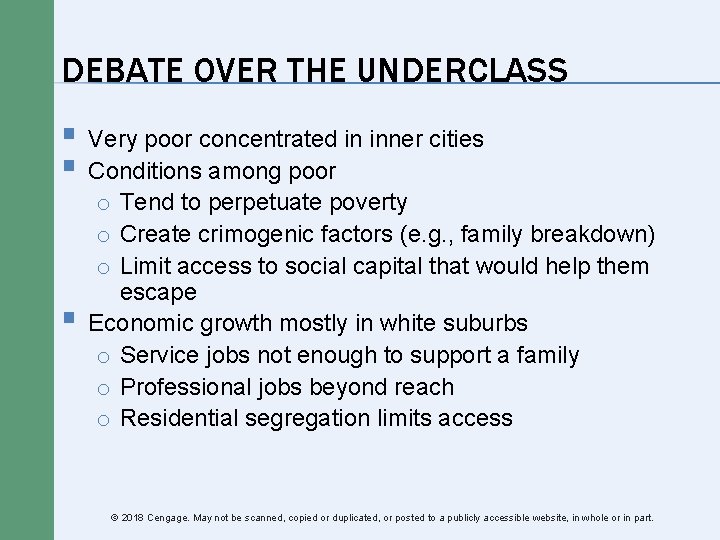
DEBATE OVER THE UNDERCLASS § Very poor concentrated in inner cities § Conditions among poor § o Tend to perpetuate poverty o Create crimogenic factors (e. g. , family breakdown) o Limit access to social capital that would help them escape Economic growth mostly in white suburbs o Service jobs not enough to support a family o Professional jobs beyond reach o Residential segregation limits access © 2018 Cengage. May not be scanned, copied or duplicated, or posted to a publicly accessible website, in whole or in part.
COMMUNITY SOCIAL STRUCTURE Communities made up of smaller communities Aspects of community: § Spatial distribution of population § Patterns of neighborhood interaction § Neighborhood composition Social structure has a significant impact on crime © 2018 Cengage. May not be scanned, copied or duplicated, or posted to a publicly accessible website, in whole or in part.
RESIDENTIAL SEGREGATION § Segregation has always existed historically… o By race, ethnicity, income § Efforts have been made to preserve it… o By restrictions, steering, redlining, poll tax, etc. § Limited government efforts have been made to intervene © 2018 Cengage. May not be scanned, copied or duplicated, or posted to a publicly accessible website, in whole or in part.
CRIME AND NEIGHBORHOOD DETERIORATION (SLIDE 1 OF 2) Residential segregation & crime § Residents suffer high rates of predatory crimes o In 2014 the household burglary rate was almost three and a half times higher for the poorest households (less than $7, 500 annual income) than the highest income group ($75, 000 a year or more). § Encourages residents to pursue crime § Direct impact on crime for those in low income areas crime © 2018 Cengage. May not be scanned, copied or duplicated, or posted to a publicly accessible website, in whole or in part.
CRIME AND NEIGHBORHOOD DETERIORATION (SLIDE 2 OF 2) Impact of crime & drugs § Direct economic & physical impact on victims § Fear of crime impacts quality of life § Pushes people out of neighborhood § Impacts ability to get insurance § If drug activity dominates a neighborhood, it is difficult for parents to protect children from impact © 2018 Cengage. May not be scanned, copied or duplicated, or posted to a publicly accessible website, in whole or in part.
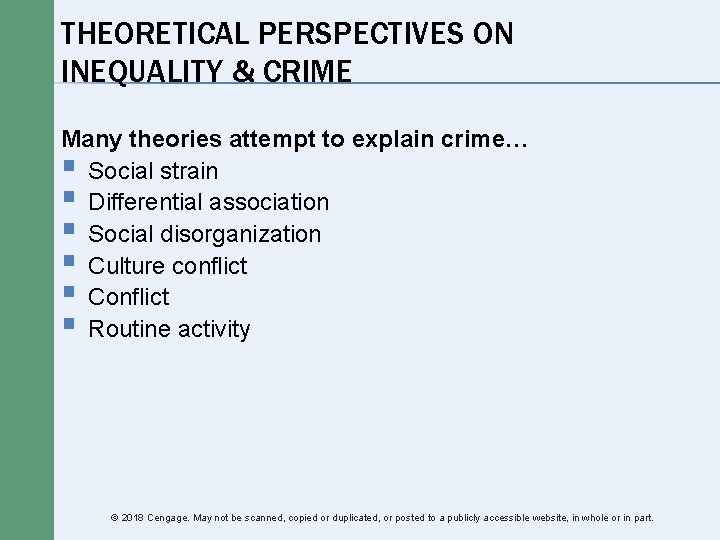
THEORETICAL PERSPECTIVES ON INEQUALITY & CRIME Many theories attempt to explain crime… § Social strain § Differential association § Social disorganization § Culture conflict § Conflict § Routine activity © 2018 Cengage. May not be scanned, copied or duplicated, or posted to a publicly accessible website, in whole or in part.
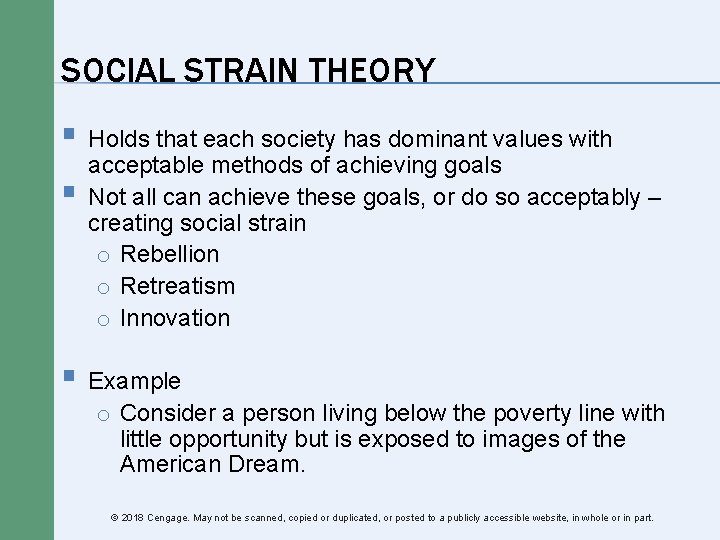
SOCIAL STRAIN THEORY § Holds that each society has dominant values with § acceptable methods of achieving goals Not all can achieve these goals, or do so acceptably – creating social strain o Rebellion o Retreatism o Innovation § Example o Consider a person living below the poverty line with little opportunity but is exposed to images of the American Dream. © 2018 Cengage. May not be scanned, copied or duplicated, or posted to a publicly accessible website, in whole or in part.
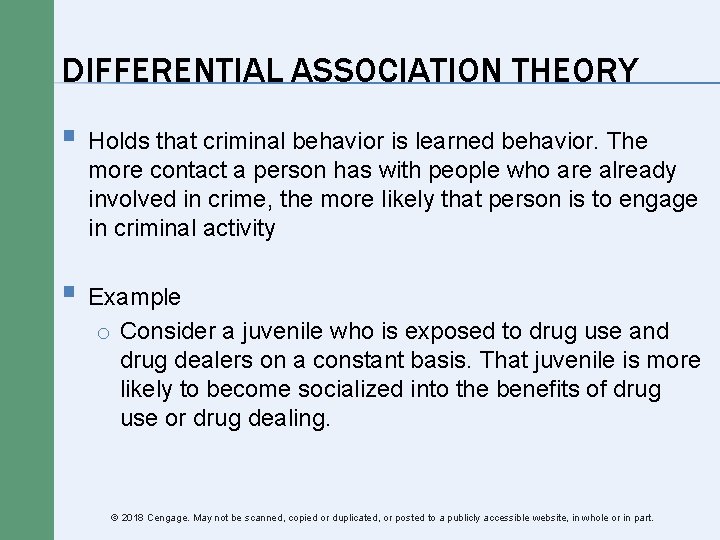
DIFFERENTIAL ASSOCIATION THEORY § Holds that criminal behavior is learned behavior. The more contact a person has with people who are already involved in crime, the more likely that person is to engage in criminal activity § Example o Consider a juvenile who is exposed to drug use and drug dealers on a constant basis. That juvenile is more likely to become socialized into the benefits of drug use or drug dealing. © 2018 Cengage. May not be scanned, copied or duplicated, or posted to a publicly accessible website, in whole or in part.
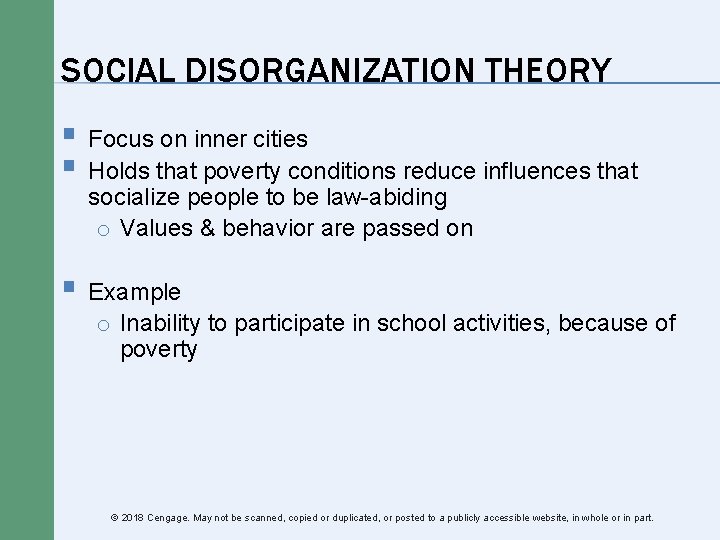
SOCIAL DISORGANIZATION THEORY § Focus on inner cities § Holds that poverty conditions reduce influences that socialize people to be law-abiding o Values & behavior are passed on § Example o Inability to participate in school activities, because of poverty © 2018 Cengage. May not be scanned, copied or duplicated, or posted to a publicly accessible website, in whole or in part.
CULTURE CONFLICT THEORY § Holds that crime is a matter of definition and is common where there is less agreement on social values o Majority defines social norms and determines what is or is not criminal § Example o Prohibition © 2018 Cengage. May not be scanned, copied or duplicated, or posted to a publicly accessible website, in whole or in part.
CONFLICT THEORY § Holds that CJ administration reflects realities of social inequalities o Powerful groups use CJ system to maintain dominant position § Example o Segregation Era • Legal disenfranchisement of African Americans limited their access to equal justice and other “privileges” © 2018 Cengage. May not be scanned, copied or duplicated, or posted to a publicly accessible website, in whole or in part.
ROUTINE ACTIVITY THEORY § Shifts focus from offenders to incidents § Stresses role of daily routine(s) in either… o Reinforcing social control, thus preventing crime o Undermining social control, thus increasing crime § Example o From 1940 -1970, kids spent increased time with no direct parental supervision © 2018 Cengage. May not be scanned, copied or duplicated, or posted to a publicly accessible website, in whole or in part.
“POVERTY PARADOX” § Continuation of poverty cycle in the America despite § efforts to address such poverty Civil rights movement fought to achieve o Equal rights o Economic empowerment o Access to education o Impact on government policy © 2018 Cengage. May not be scanned, copied or duplicated, or posted to a publicly accessible website, in whole or in part.
MAJOR EXPLANATIONS FOR POVERTY PERSISTENCE § Inadequate welfare system § Transformation of economy, eliminating many earning § § possibilities “Poverty culture, ” encouraging lack of effort to escape poverty Debate over social structure vs. individual character © 2018 Cengage. May not be scanned, copied or duplicated, or posted to a publicly accessible website, in whole or in part.
THE IMPACT OF THE CIVIL RIGHTS MOVEMENT § Turning point in US history § Significantly limited segregation and expanded § guarantees of equal rights Had profound impact on American social structure o Number of African American elected officials increased dramatically, from 33 nationwide in 1941 to 1, 469 in 1965 and 8, 830 in 1998. o The total number of Hispanic elected officials increased from 3, 174 in 1985 to 5, 129 in 2007 © 2018 Cengage. May not be scanned, copied or duplicated, or posted to a publicly accessible website, in whole or in part.
ATTACK ON ECONOMIC INEQUALITY § Democratic and Republican policies have o Created great controversy o Had varied impact on poverty o Affected all racial & ethnic groups § The civil rights movement has o Opened many doors o Not addressed increasing underclass conditions © 2018 Cengage. May not be scanned, copied or duplicated, or posted to a publicly accessible website, in whole or in part.
CONCLUSION § American social structure impacts relationship of race, ethnicity, and crime § Race and ethnicity are linked to economic and other forms of inequality § Poverty is directly connected to resource access and disenfranchisement § Various theories attempt to explain link between inequality and criminal behavior © 2018 Cengage. May not be scanned, copied or duplicated, or posted to a publicly accessible website, in whole or in part.
KEY TERMS (SLIDE 1 OF 3) § Civil rights § Community § Conflict § Cultural capital § Culture conflict § Differential association § Economic inequality § Economic specialization § Income © 2018 Cengage. May not be scanned, copied or duplicated, or posted to a publicly accessible website, in whole or in part.
KEY TERMS (SLIDE 2 OF 3) § Innovation § Networking § Poverty § Public sector § Rebellion § Residential segregation § Retreatism § Routine activity § Social activity © 2018 Cengage. May not be scanned, copied or duplicated, or posted to a publicly accessible website, in whole or in part.
KEY TERMS (SLIDE 3 OF 3) § Social capital § Social disorganization § Social strain § Social structure § Supply-side economics § Underclass § Wealth © 2018 Cengage. May not be scanned, copied or duplicated, or posted to a publicly accessible website, in whole or in part.