
RACE CONDITIONS AND SYNCHRONIZATION Lecture 24 CS 2110

- Slides: 29
RACE CONDITIONS AND SYNCHRONIZATION Lecture 24 – CS 2110 – Spring 2014
Reminder 2 A “race condition” arises if two threads try and share some data One updates it and the other reads it, or both update the data In such cases it is possible that we could see the data “in the middle” of being updated A “race condition”: correctness depends on the update racing to completion without the reader managing to glimpse the in-progress update Synchronization (aka mutual exclusion) solves this
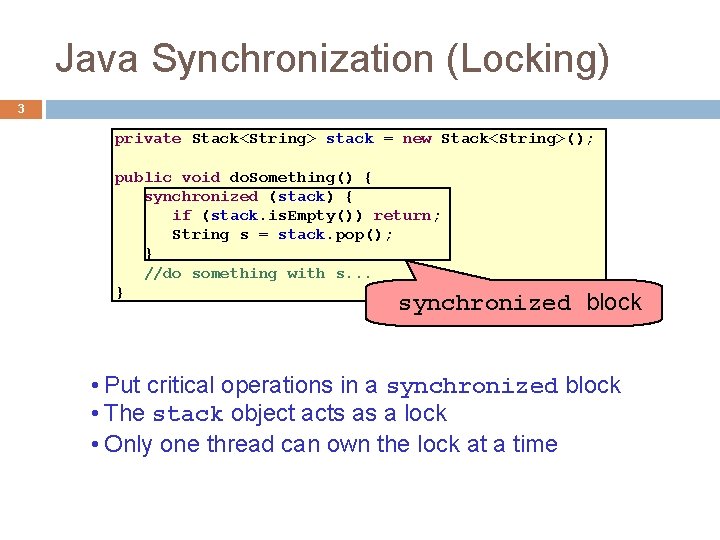
Java Synchronization (Locking) 3 private Stack<String> stack = new Stack<String>(); public void do. Something() { synchronized (stack) { if (stack. is. Empty()) return; String s = stack. pop(); } //do something with s. . . } synchronized block • Put critical operations in a synchronized block • The stack object acts as a lock • Only one thread can own the lock at a time
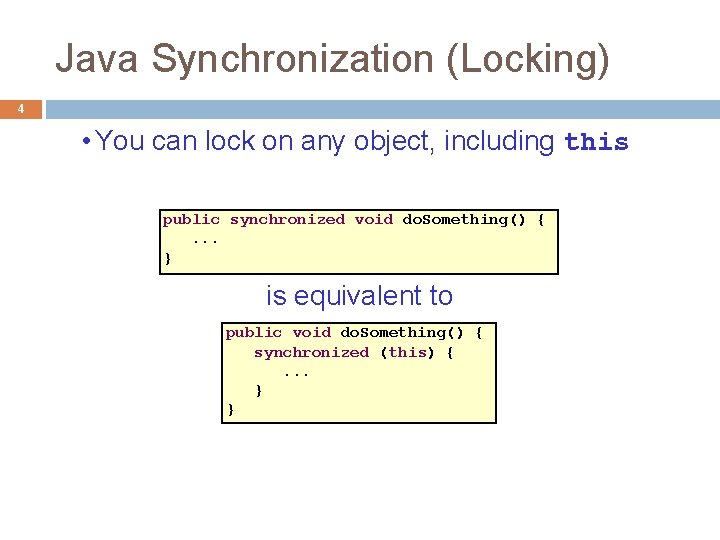
Java Synchronization (Locking) 4 • You can lock on any object, including this public synchronized void do. Something() {. . . } is equivalent to public void do. Something() { synchronized (this) {. . . } }
How locking works 5 Only one thread can “hold” a lock at a time If several request the same lock, Java somehow decides which will get it The lock is released when the thread leaves the synchronization block synchronized(some. Object) { protected code } The protected code has a mutual exclusion guarantee: At most one thread can be in it When released, some other thread can acquire the lock
Locks are associated with objects 6 Every Object has its own built-in lock Just the same, some applications prefer to create special classes of objects to use just for locking This is a stylistic decision and you should agree on it with your teammates or learn the company policy if you work at a company Code is “thread safe” if it can handle multiple threads using it… otherwise it is “unsafe”
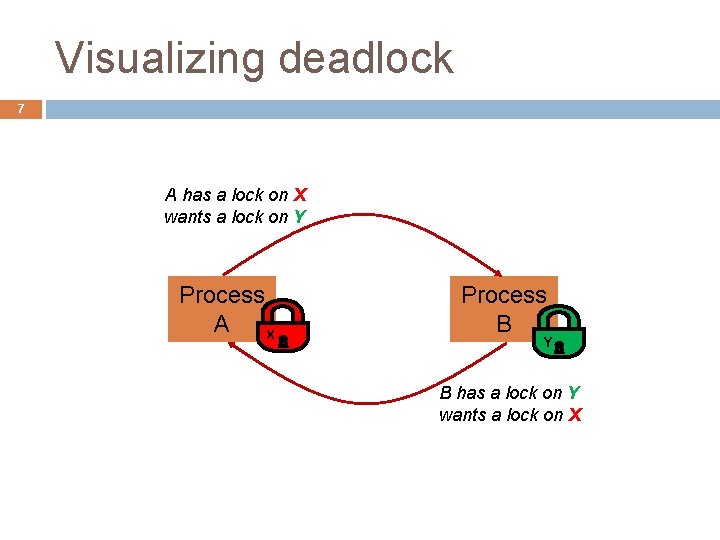
Visualizing deadlock 7 A has a lock on X wants a lock on Y Process A X Process B Y B has a lock on Y wants a lock on X
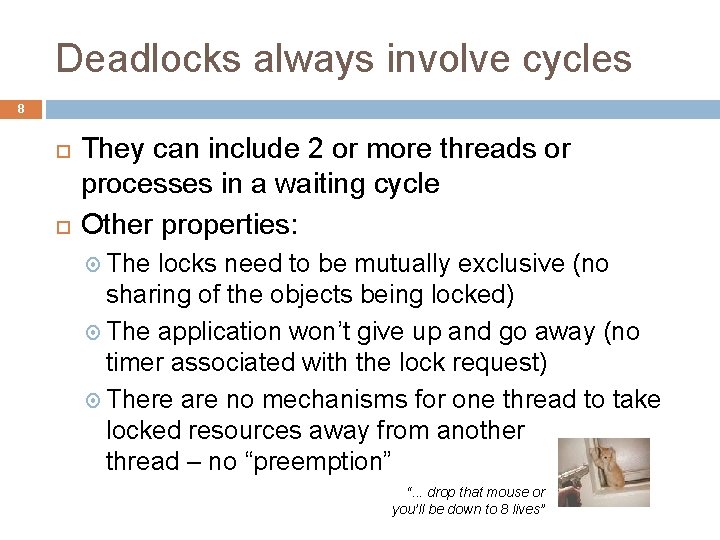
Deadlocks always involve cycles 8 They can include 2 or more threads or processes in a waiting cycle Other properties: The locks need to be mutually exclusive (no sharing of the objects being locked) The application won’t give up and go away (no timer associated with the lock request) There are no mechanisms for one thread to take locked resources away from another thread – no “preemption” “. . . drop that mouse or you’ll be down to 8 lives”
Dealing with deadlocks 9 We recommend designing code to either Acquire a lock, use it, then promptly release it, or . . . acquire locks in some “fixed” order Example, suppose that we have objects a, b, c, . . . Now suppose that threads sometimes lock sets of objects but always do so in alphabetical order Can a lock-wait cycle arise? . . . without cycles, no deadlocks can occur!
Higher level abstractions 10 Locking is a very low-level way to deal with synchronization Very nuts-and-bolts So many programmers work with higher level concepts. Sort of like ADTs for synchronization We’ll just look at one example today There are many others; take cs 4410 to learn more
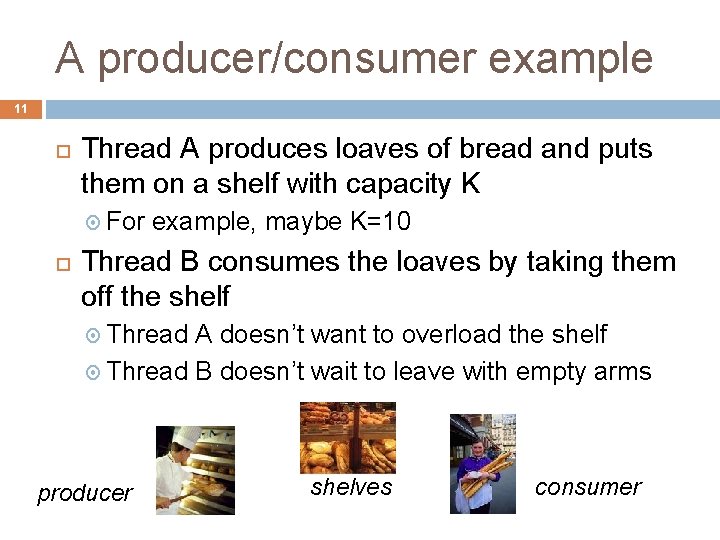
A producer/consumer example 11 Thread A produces loaves of bread and puts them on a shelf with capacity K For example, maybe K=10 Thread B consumes the loaves by taking them off the shelf Thread A doesn’t want to overload the shelf Thread B doesn’t wait to leave with empty arms producer shelves consumer
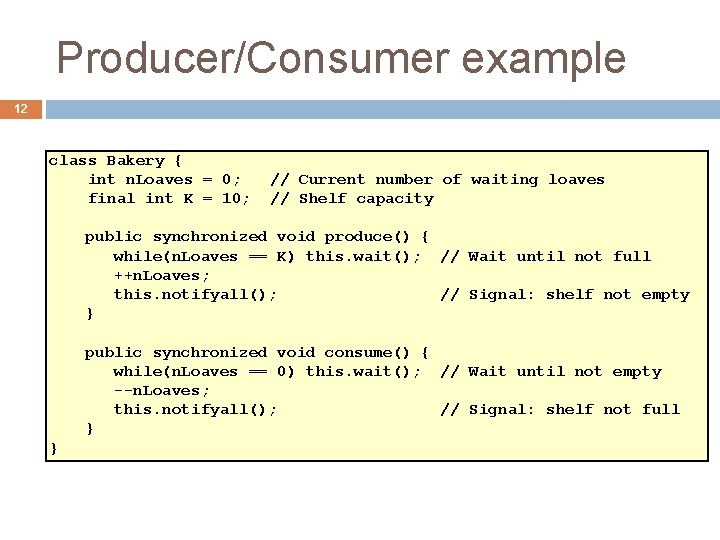
Producer/Consumer example 12 class Bakery { int n. Loaves = 0; final int K = 10; // Current number of waiting loaves // Shelf capacity public synchronized void produce() { while(n. Loaves == K) this. wait(); // Wait until not full ++n. Loaves; this. notifyall(); // Signal: shelf not empty } public synchronized void consume() { while(n. Loaves == 0) this. wait(); // Wait until not empty --n. Loaves; this. notifyall(); // Signal: shelf not full } }
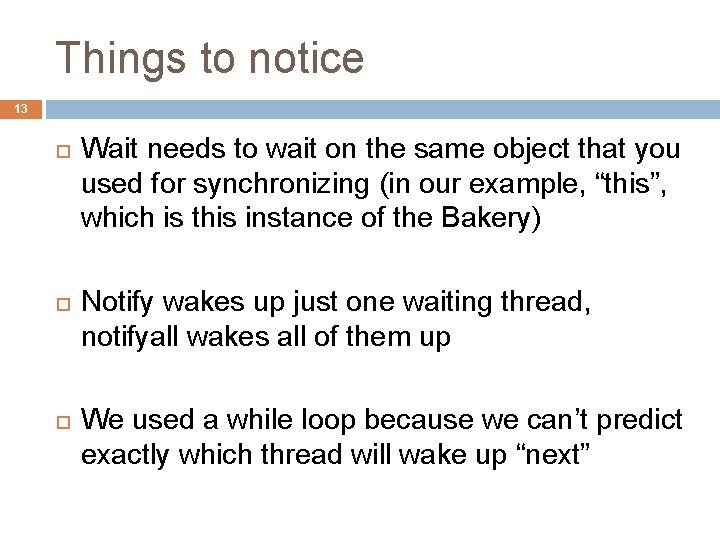
Things to notice 13 Wait needs to wait on the same object that you used for synchronizing (in our example, “this”, which is this instance of the Bakery) Notify wakes up just one waiting thread, notifyall wakes all of them up We used a while loop because we can’t predict exactly which thread will wake up “next”
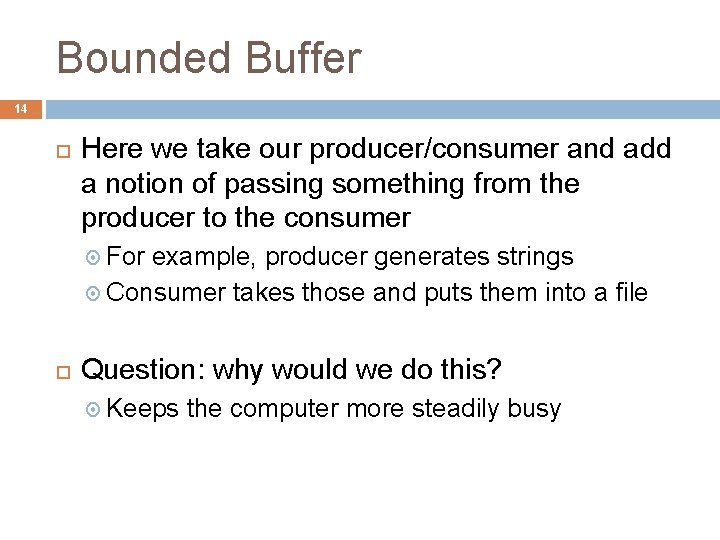
Bounded Buffer 14 Here we take our producer/consumer and add a notion of passing something from the producer to the consumer For example, producer generates strings Consumer takes those and puts them into a file Question: why would we do this? Keeps the computer more steadily busy
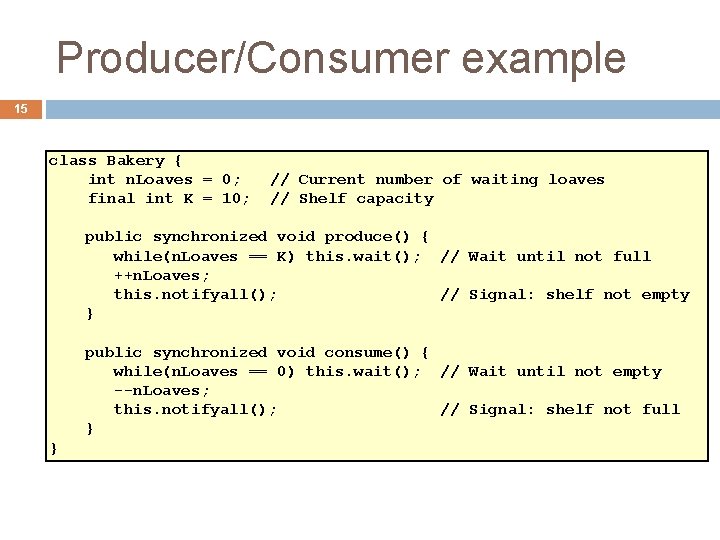
Producer/Consumer example 15 class Bakery { int n. Loaves = 0; final int K = 10; // Current number of waiting loaves // Shelf capacity public synchronized void produce() { while(n. Loaves == K) this. wait(); // Wait until not full ++n. Loaves; this. notifyall(); // Signal: shelf not empty } public synchronized void consume() { while(n. Loaves == 0) this. wait(); // Wait until not empty --n. Loaves; this. notifyall(); // Signal: shelf not full } }
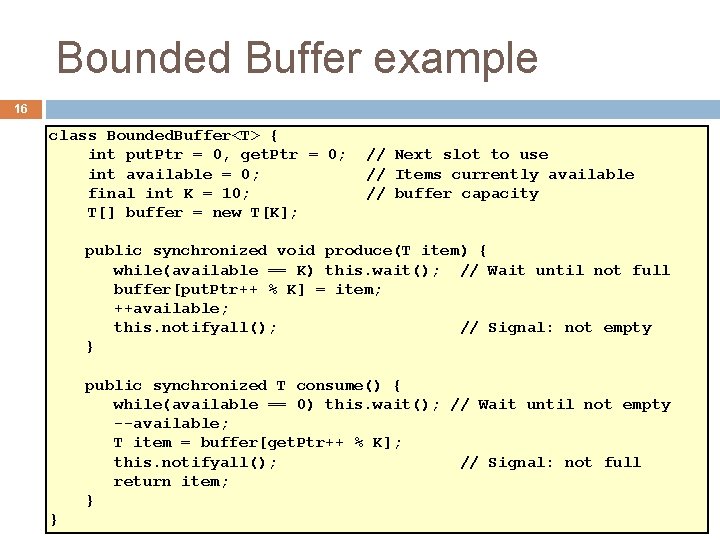
Bounded Buffer example 16 class Bounded. Buffer<T> { int put. Ptr = 0, get. Ptr = 0; int available = 0; final int K = 10; T[] buffer = new T[K]; // Next slot to use // Items currently available // buffer capacity public synchronized void produce(T item) { while(available == K) this. wait(); // Wait until not full buffer[put. Ptr++ % K] = item; ++available; this. notifyall(); // Signal: not empty } public synchronized T consume() { while(available == 0) this. wait(); // Wait until not empty --available; T item = buffer[get. Ptr++ % K]; this. notifyall(); // Signal: not full return item; } }
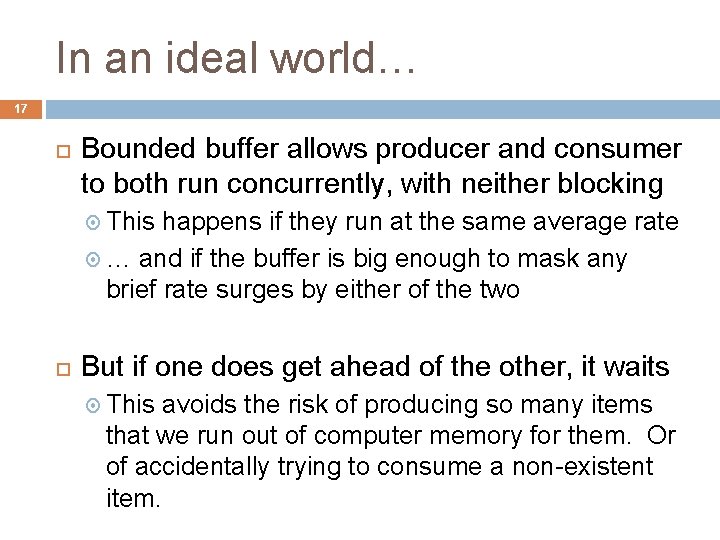
In an ideal world… 17 Bounded buffer allows producer and consumer to both run concurrently, with neither blocking This happens if they run at the same average rate … and if the buffer is big enough to mask any brief rate surges by either of the two But if one does get ahead of the other, it waits This avoids the risk of producing so many items that we run out of computer memory for them. Or of accidentally trying to consume a non-existent item.
Trickier example 18 Suppose we want to use locking in a BST Goal: allow multiple threads to search the tree But don’t want an insertion to cause a search thread to throw an exception
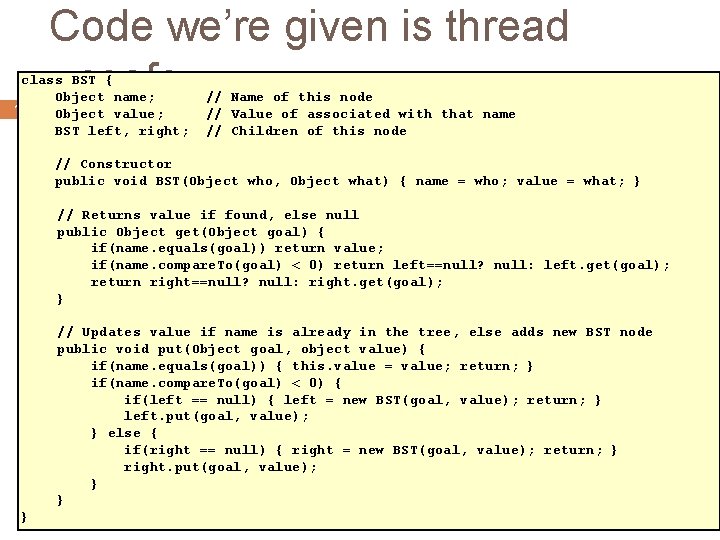
Code we’re given is thread unsafe class BST { Object name; 19 Object value; BST left, right; // Name of this node // Value of associated with that name // Children of this node // Constructor public void BST(Object who, Object what) { name = who; value = what; } // Returns value if found, else null public Object get(Object goal) { if(name. equals(goal)) return value; if(name. compare. To(goal) < 0) return left==null? null: left. get(goal); return right==null? null: right. get(goal); } // Updates value if name is already in the tree, else adds new BST node public void put(Object goal, object value) { if(name. equals(goal)) { this. value = value; return; } if(name. compare. To(goal) < 0) { if(left == null) { left = new BST(goal, value); return; } left. put(goal, value); } else { if(right == null) { right = new BST(goal, value); return; } right. put(goal, value); } } }
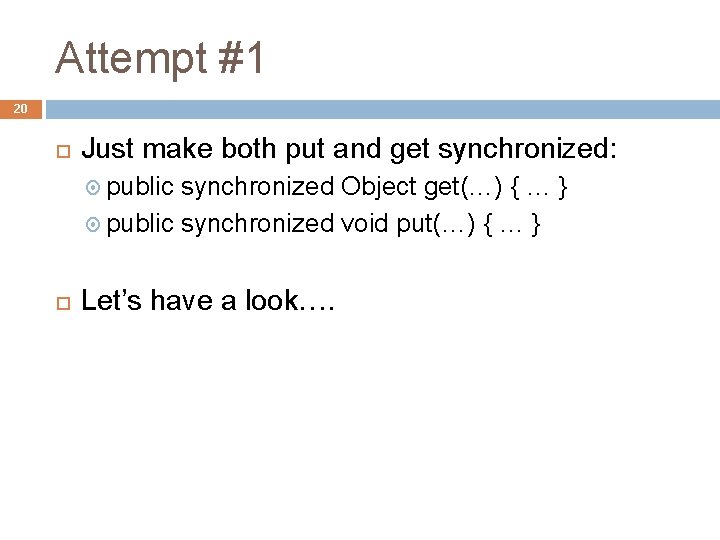
Attempt #1 20 Just make both put and get synchronized: public synchronized Object get(…) { … } public synchronized void put(…) { … } Let’s have a look….
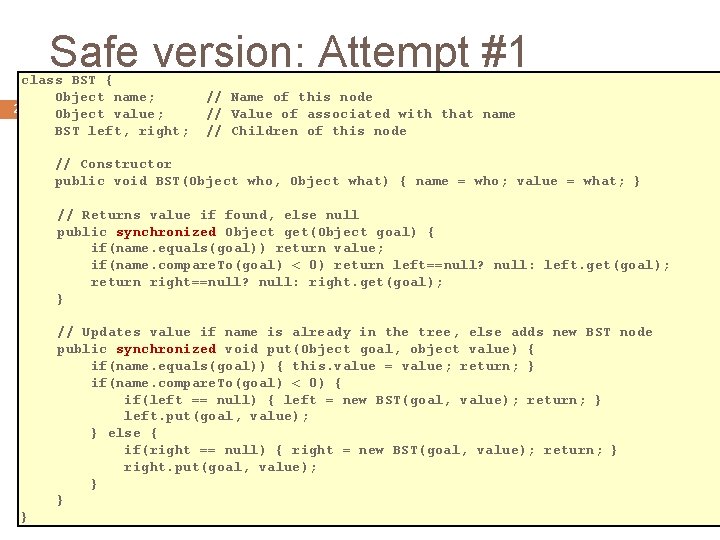
Safe version: Attempt #1 class BST { Object name; 21 Object value; BST left, right; // Name of this node // Value of associated with that name // Children of this node // Constructor public void BST(Object who, Object what) { name = who; value = what; } // Returns value if found, else null public synchronized Object get(Object goal) { if(name. equals(goal)) return value; if(name. compare. To(goal) < 0) return left==null? null: left. get(goal); return right==null? null: right. get(goal); } // Updates value if name is already in the tree, else adds new BST node public synchronized void put(Object goal, object value) { if(name. equals(goal)) { this. value = value; return; } if(name. compare. To(goal) < 0) { if(left == null) { left = new BST(goal, value); return; } left. put(goal, value); } else { if(right == null) { right = new BST(goal, value); return; } right. put(goal, value); } } }
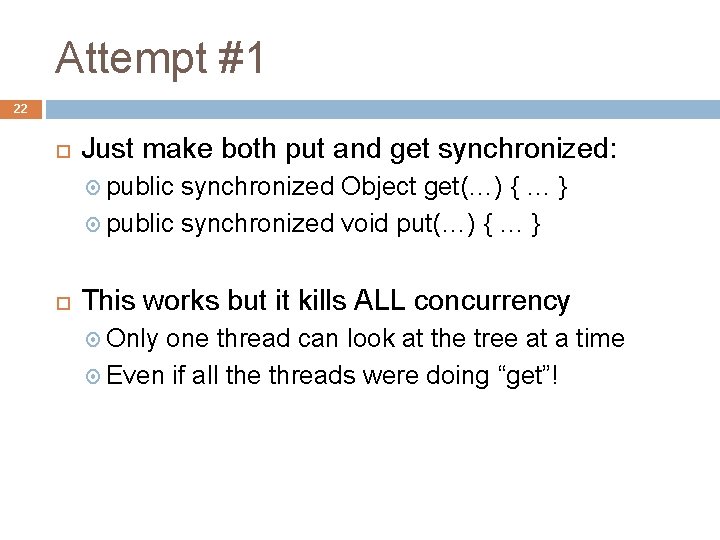
Attempt #1 22 Just make both put and get synchronized: public synchronized Object get(…) { … } public synchronized void put(…) { … } This works but it kills ALL concurrency Only one thread can look at the tree at a time Even if all the threads were doing “get”!
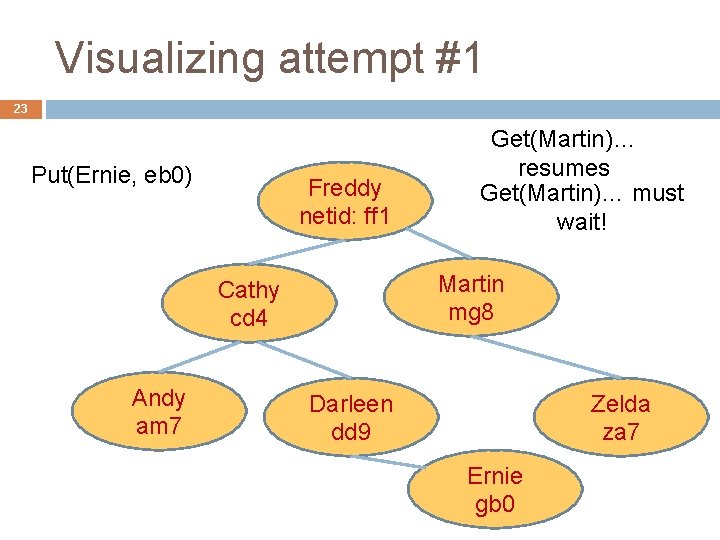
Visualizing attempt #1 23 Put(Ernie, eb 0) Freddy netid: ff 1 Martin mg 8 Cathy cd 4 Andy am 7 Get(Martin)… resumes Get(Martin)… must wait! Darleen dd 9 Zelda za 7 Ernie gb 0
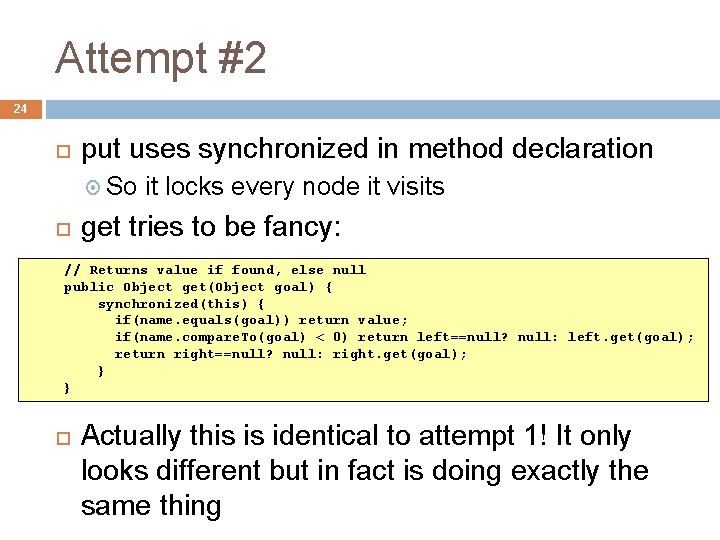
Attempt #2 24 put uses synchronized in method declaration So it locks every node it visits get tries to be fancy: // Returns value if found, else null public Object get(Object goal) { synchronized(this) { if(name. equals(goal)) return value; if(name. compare. To(goal) < 0) return left==null? null: left. get(goal); return right==null? null: right. get(goal); } } Actually this is identical to attempt 1! It only looks different but in fact is doing exactly the same thing
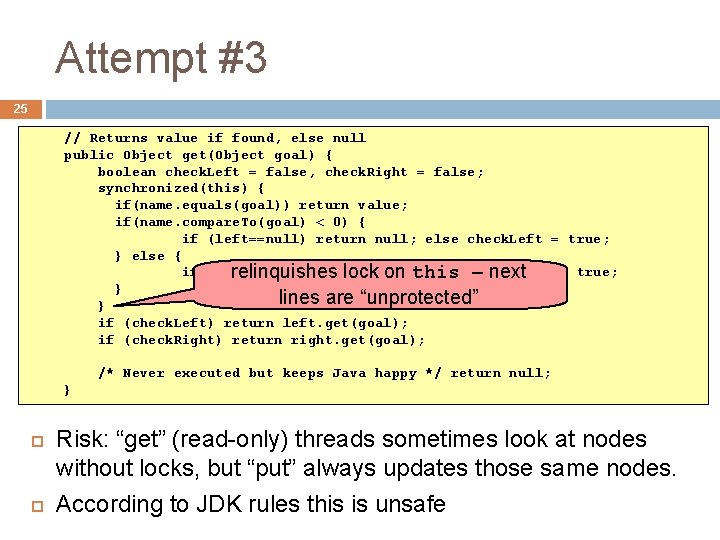
Attempt #3 25 // Returns value if found, else null public Object get(Object goal) { boolean check. Left = false, check. Right = false; synchronized(this) { if(name. equals(goal)) return value; if(name. compare. To(goal) < 0) { if (left==null) return null; else check. Left = true; } else { if(right==null) return else check. Right = true; relinquishes locknull; on this – next } lines are “unprotected” } if (check. Left) return left. get(goal); if (check. Right) return right. get(goal); /* Never executed but keeps Java happy */ return null; } Risk: “get” (read-only) threads sometimes look at nodes without locks, but “put” always updates those same nodes. According to JDK rules this is unsafe
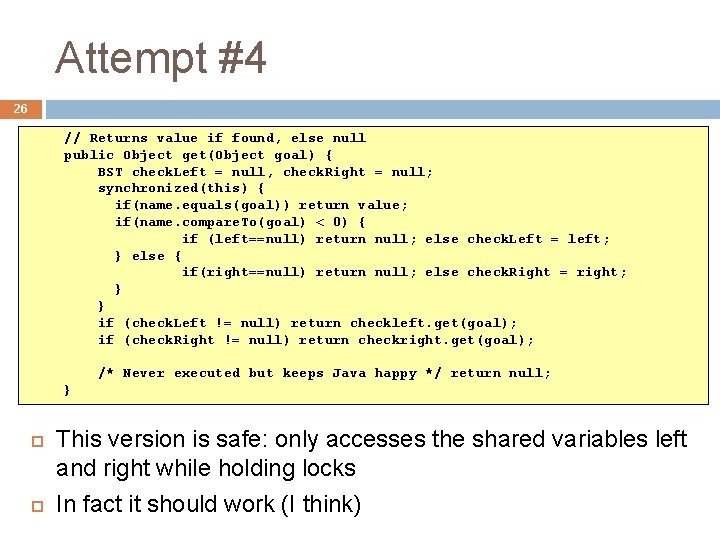
Attempt #4 26 // Returns value if found, else null public Object get(Object goal) { BST check. Left = null, check. Right = null; synchronized(this) { if(name. equals(goal)) return value; if(name. compare. To(goal) < 0) { if (left==null) return null; else check. Left = left; } else { if(right==null) return null; else check. Right = right; } } if (check. Left != null) return checkleft. get(goal); if (check. Right != null) return checkright. get(goal); /* Never executed but keeps Java happy */ return null; } This version is safe: only accesses the shared variables left and right while holding locks In fact it should work (I think)
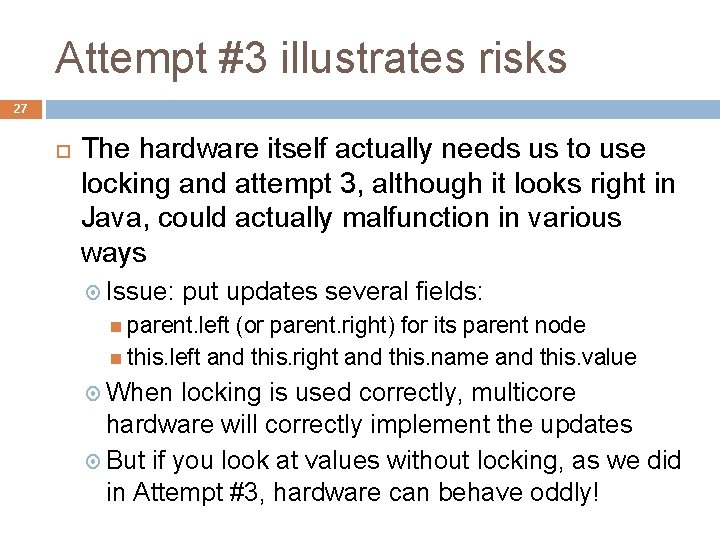
Attempt #3 illustrates risks 27 The hardware itself actually needs us to use locking and attempt 3, although it looks right in Java, could actually malfunction in various ways Issue: put updates several fields: parent. left (or parent. right) for its parent node this. left and this. right and this. name and this. value When locking is used correctly, multicore hardware will correctly implement the updates But if you look at values without locking, as we did in Attempt #3, hardware can behave oddly!
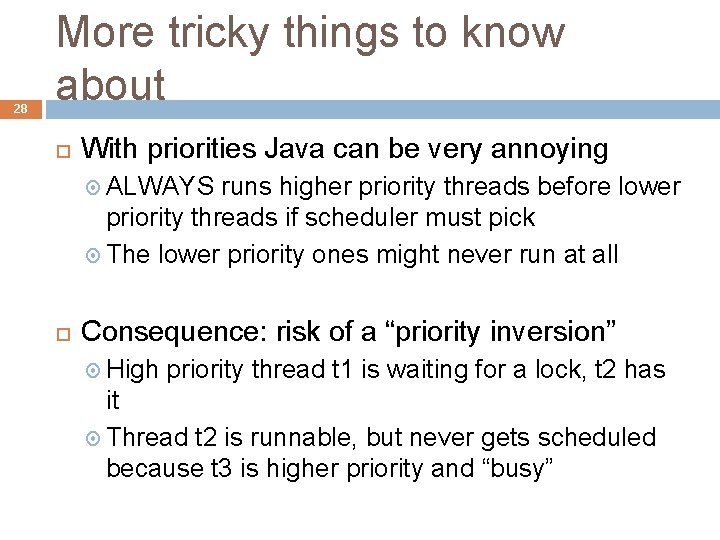
28 More tricky things to know about With priorities Java can be very annoying ALWAYS runs higher priority threads before lower priority threads if scheduler must pick The lower priority ones might never run at all Consequence: risk of a “priority inversion” High priority thread t 1 is waiting for a lock, t 2 has it Thread t 2 is runnable, but never gets scheduled because t 3 is higher priority and “busy”
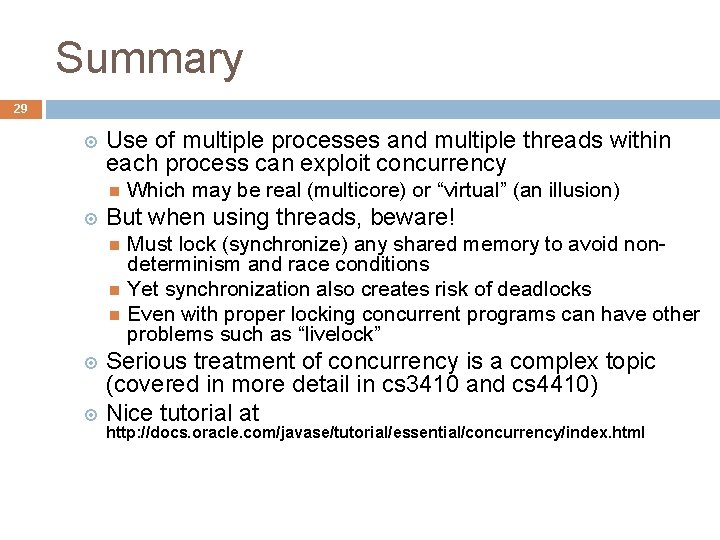
Summary 29 Use of multiple processes and multiple threads within each process can exploit concurrency Which may be real (multicore) or “virtual” (an illusion) But when using threads, beware! Must lock (synchronize) any shared memory to avoid nondeterminism and race conditions Yet synchronization also creates risk of deadlocks Even with proper locking concurrent programs can have other problems such as “livelock” Serious treatment of concurrency is a complex topic (covered in more detail in cs 3410 and cs 4410) Nice tutorial at http: //docs. oracle. com/javase/tutorial/essential/concurrency/index. html