
R R R Design Patterns CSE 870 Advanced
- Slides: 51
R R R Design Patterns CSE 870: Advanced Software Engineering (Design Patterns): Cheng
R R R Acknowledgements Materials based on a number of sources – D. Levine and D. Schmidt – R. Helm – Gamma et al – S. Konrad CSE 870: Advanced Software Engineering (Design Patterns): Cheng
R R R Motivation • Developing software is hard • Designing reusable software is more challenging – finding good objects and abstractions – flexibility, modularity, elegance reuse – takes time for them to emerge, trial and error • Successful designs do exist – exhibit recurring class and object structures CSE 870: Advanced Software Engineering (Design Patterns): Cheng
R R R Design Pattern • Describes recurring design structure – names, abstracts from concrete designs – identifies classes, collaborations, responsibilities – applicability, trade-offs, consequences CSE 870: Advanced Software Engineering (Design Patterns): Cheng
R R R Becoming a Chess Master • First learn rules and physical requirements – e. g. , names of pieces, legal movements, chess board geometry and orientation, etc. • Then learn principles – e. g, relative value of certain pieces, strategic value of center squares, power of a threat, etc. • To become a Master of chess, one must study the games of other masters – These games contain patterns that must be understood, memorized, and applied repeatedly. • There are hundreds of these patterns CSE 870: Advanced Software Engineering (Design Patterns): Cheng
R R R Becoming a Software Design Master • First learn rules – e. g. , algorithms, data structures, and languages of software. • Then learn principles – e. g. , structured programming, modular programming, object-oriented programming, etc. • To become a Master of SW design, one must study the designs of other masters – These designs contain patterns that must be understood, memorized, and applied repeatedly. • There are hundreds of these patterns CSE 870: Advanced Software Engineering (Design Patterns): Cheng
R R R Design Patterns • Design patterns represent solutions to problems that arise when developing software within a particular context – “Patterns == problem/solution pairs in a context” • Patterns capture the static and dynamic structure and collaboration among key participants in software designs – Especially good for describing how and why to resolve nonfunctional issues • Patterns facilitate reuse of successful software architectures and designs. CSE 870: Advanced Software Engineering (Design Patterns): Cheng
R R R Design Patterns: Applications • Wide variety of application domains: – drawing editors, banking, CAD, CAE, cellular network management, telecomm switches, program visualization • Wide variety of technical areas: – user interface, communications, persistent objects, O/S kernels, distributed systems CSE 870: Advanced Software Engineering (Design Patterns): Cheng
R R R What Is a Design Pattern (1) “Each pattern describes a problem which occurs over and over again in our environment and then describes the core of the solution to that problem, in such a way that you can use this solution a million times over, without ever doing it in the same way twice” Christopher Alexander, A Pattern Language, 1977 Context: City Planning and Building architectures CSE 870: Advanced Software Engineering (Design Patterns): Cheng
R R R What Is a Design Pattern (2) A pattern has 4 essential elements: • Pattern name • Problem • Solution • Consequences CSE 870: Advanced Software Engineering (Design Patterns): Cheng
R R R Pattern Name • A handle used to describe: • a design problem, • its solutions and • its consequences • Increases design vocabulary • Makes it possible to design at a higher level of abstraction • Enhances communication But finding a good name is often difficult CSE 870: Advanced Software Engineering (Design Patterns): Cheng
R R R Problem • Describes when to apply the pattern • Explains the problem and its context • Might describe specific design problems or class or object structures • May contain a list of conditions • must be met • before it makes sense to apply the pattern CSE 870: Advanced Software Engineering (Design Patterns): Cheng
R R R Solution • Describes the elements that make up the • design, • their relationships, • responsibilities and • collaborations • Does not describe specific concrete implementation • Abstract description of design problems and • how the pattern solves it CSE 870: Advanced Software Engineering (Design Patterns): Cheng
R R R Consequences • Results and trade-offs of applying the pattern • Critical for: • evaluate design alternatives and • understand costs and • understand benefits of applying the pattern • Includes the impacts of a pattern on a system’s: • flexibility, • extensibility • portability CSE 870: Advanced Software Engineering (Design Patterns): Cheng
R R R Design Patterns Are NOT • Designs that can be encoded in classes and reused as is (i. e. linked lists, hash tables) • Complex domain-specific designs (for an entire application or subsystem) They are: “Descriptions of communicating objects and classes that are customized to solve a general design problem in a particular context. ” CSE 870: Advanced Software Engineering (Design Patterns): Cheng
R R R Where Design Patterns Are Used • Object-Oriented Programming Languages: • more amenable to implementing design patterns • Procedural languages: need to define • Inheritance, • Polymorphism and • Encapsulation CSE 870: Advanced Software Engineering (Design Patterns): Cheng
R R R How to Describe Design Patterns • Graphical notation is not sufficient • In order to reuse design decisions, • alternatives and trade-offs that led to the decisions are important • Concrete examples are also important CSE 870: Advanced Software Engineering (Design Patterns): Cheng
R R R A Design Pattern • Describes a recurring design structure – names, abstracts from concrete designs – identifies classes, collaborations, responsibilities – applicability, trade-offs, consequences CSE 870: Advanced Software Engineering (Design Patterns): Cheng
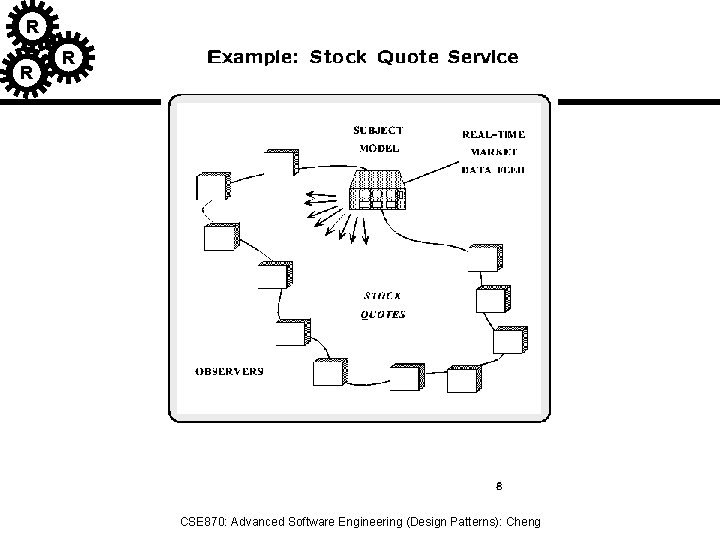
R R R CSE 870: Advanced Software Engineering (Design Patterns): Cheng
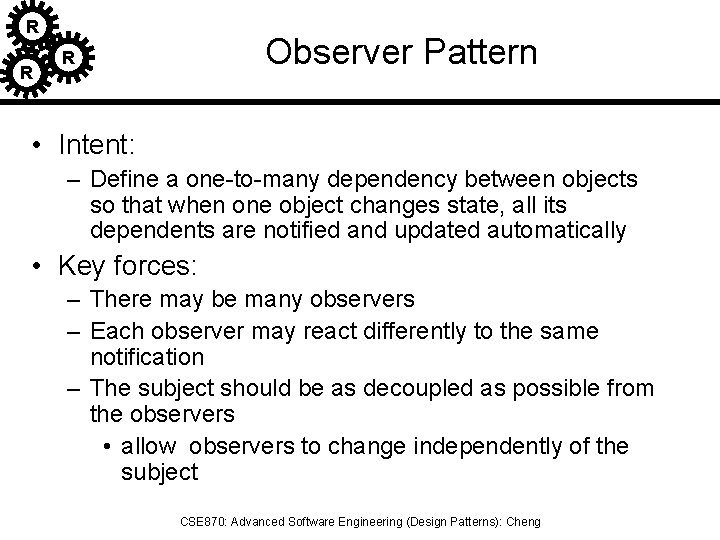
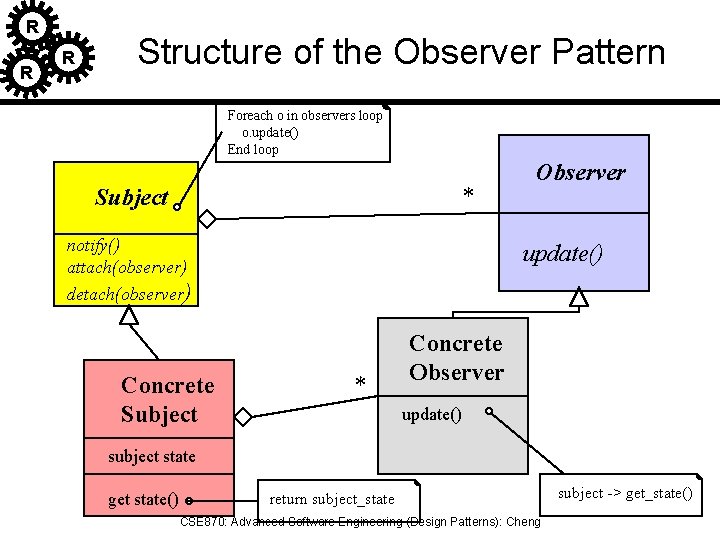
R R Observer Pattern R • Intent: – Define a one-to-many dependency between objects so that when one object changes state, all its dependents are notified and updated automatically • Key forces: – There may be many observers – Each observer may react differently to the same notification – The subject should be as decoupled as possible from the observers • allow observers to change independently of the subject CSE 870: Advanced Software Engineering (Design Patterns): Cheng
R R R Structure of the Observer Pattern Foreach o in observers loop o. update() End loop * Subject notify() attach(observer) Observer update() detach(observer) Concrete Subject * Concrete Observer update() subject state get state() return subject_state CSE 870: Advanced Software Engineering (Design Patterns): Cheng subject -> get_state()
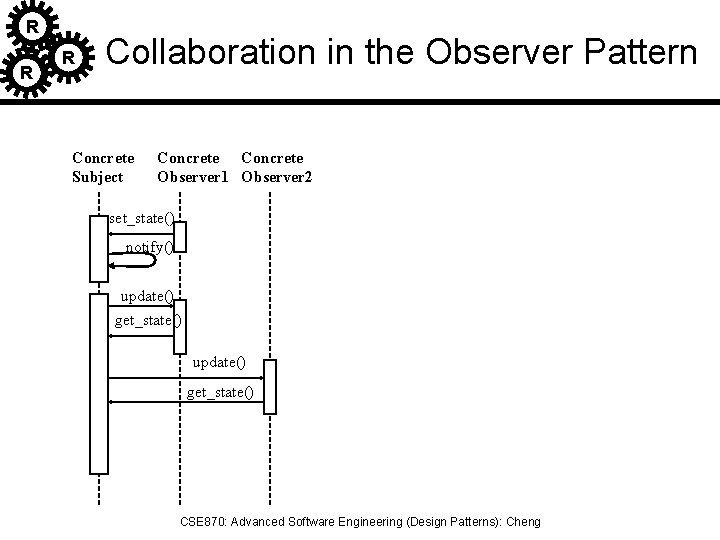
R R R Collaboration in the Observer Pattern Concrete Subject Concrete Observer 1 Observer 2 set_state() notify() update() get_state() CSE 870: Advanced Software Engineering (Design Patterns): Cheng
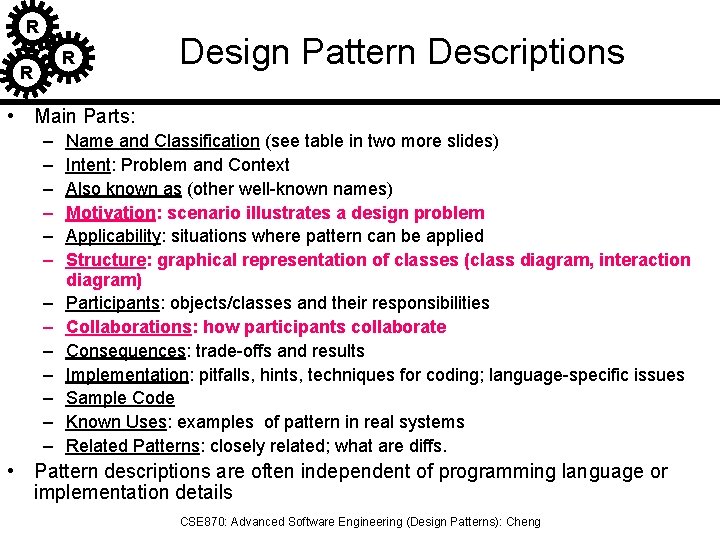
R R R Design Pattern Descriptions • Main Parts: – – – – Name and Classification (see table in two more slides) Intent: Problem and Context Also known as (other well-known names) Motivation: scenario illustrates a design problem Applicability: situations where pattern can be applied Structure: graphical representation of classes (class diagram, interaction diagram) Participants: objects/classes and their responsibilities Collaborations: how participants collaborate Consequences: trade-offs and results Implementation: pitfalls, hints, techniques for coding; language-specific issues Sample Code Known Uses: examples of pattern in real systems Related Patterns: closely related; what are diffs. • Pattern descriptions are often independent of programming language or implementation details CSE 870: Advanced Software Engineering (Design Patterns): Cheng
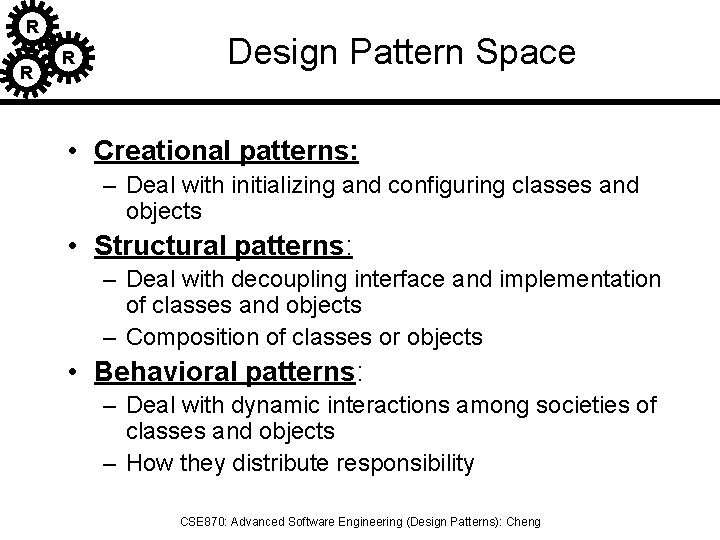
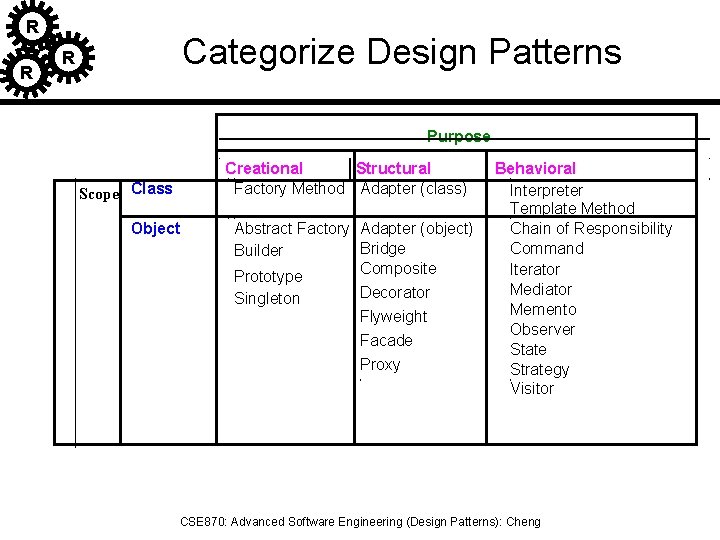
R R R Design Pattern Space • Creational patterns: – Deal with initializing and configuring classes and objects • Structural patterns: – Deal with decoupling interface and implementation of classes and objects – Composition of classes or objects • Behavioral patterns: – Deal with dynamic interactions among societies of classes and objects – How they distribute responsibility CSE 870: Advanced Software Engineering (Design Patterns): Cheng
R R Categorize Design Patterns R Purpose Creational Structural Factory Method Adapter (class) Scope Class Object Abstract Factory Adapter (object) Bridge Builder Composite Prototype Decorator Singleton Flyweight Facade Proxy Behavioral Interpreter Template Method Chain of Responsibility Command Iterator Mediator Memento Observer State Strategy Visitor CSE 870: Advanced Software Engineering (Design Patterns): Cheng
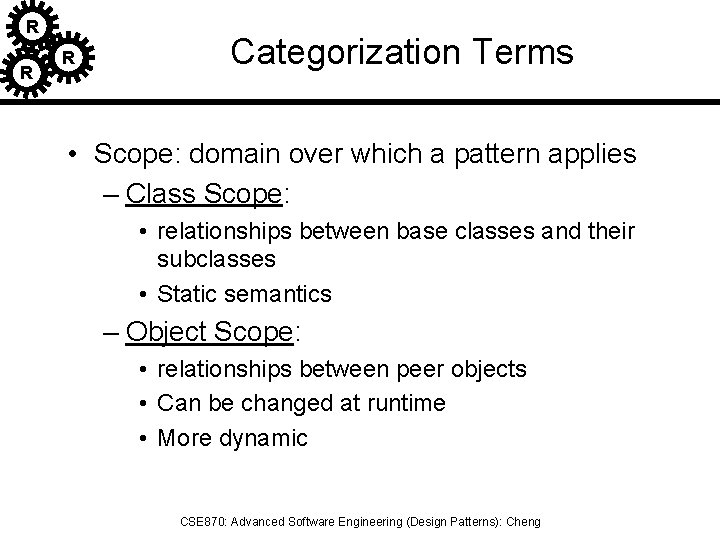
R R R Categorization Terms • Scope: domain over which a pattern applies – Class Scope: • relationships between base classes and their subclasses • Static semantics – Object Scope: • relationships between peer objects • Can be changed at runtime • More dynamic CSE 870: Advanced Software Engineering (Design Patterns): Cheng
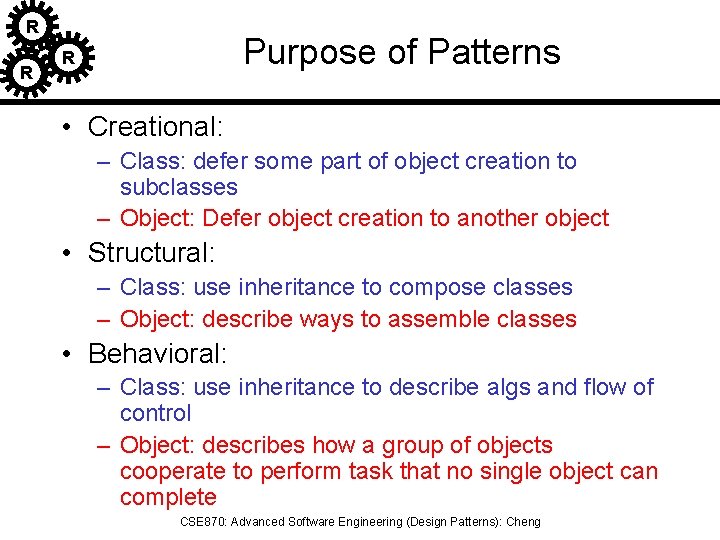
R R Purpose of Patterns R • Creational: – Class: defer some part of object creation to subclasses – Object: Defer object creation to another object • Structural: – Class: use inheritance to compose classes – Object: describe ways to assemble classes • Behavioral: – Class: use inheritance to describe algs and flow of control – Object: describes how a group of objects cooperate to perform task that no single object can complete CSE 870: Advanced Software Engineering (Design Patterns): Cheng
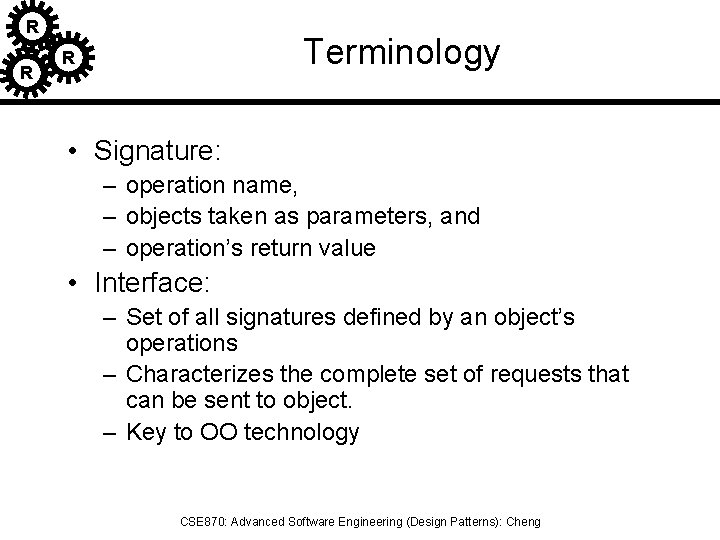
R R Terminology R • Signature: – operation name, – objects taken as parameters, and – operation’s return value • Interface: – Set of all signatures defined by an object’s operations – Characterizes the complete set of requests that can be sent to object. – Key to OO technology CSE 870: Advanced Software Engineering (Design Patterns): Cheng
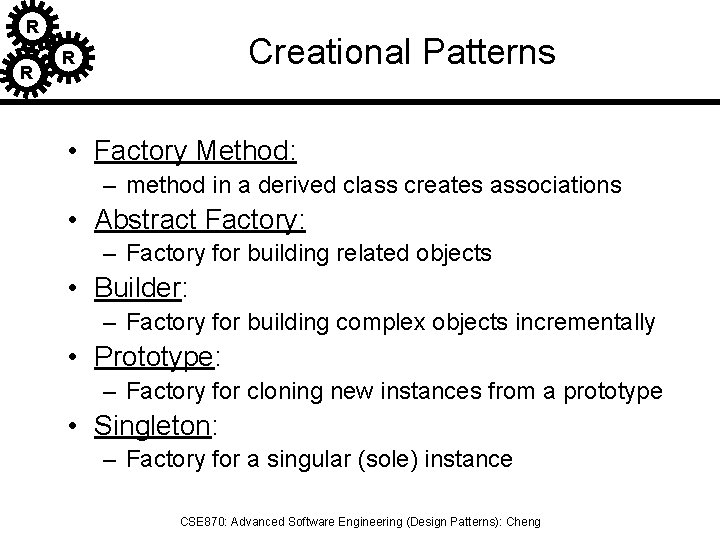
R R Creational Patterns R • Factory Method: – method in a derived class creates associations • Abstract Factory: – Factory for building related objects • Builder: – Factory for building complex objects incrementally • Prototype: – Factory for cloning new instances from a prototype • Singleton: – Factory for a singular (sole) instance CSE 870: Advanced Software Engineering (Design Patterns): Cheng
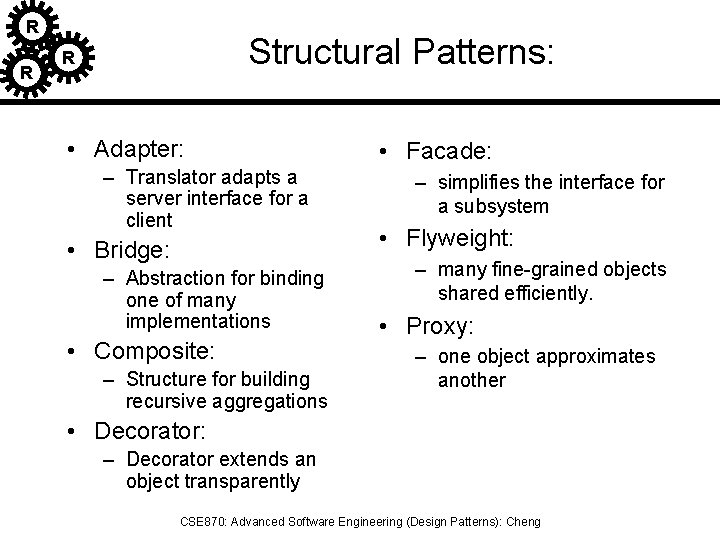
R R Structural Patterns: R • Adapter: – Translator adapts a server interface for a client • Bridge: – Abstraction for binding one of many implementations • Composite: – Structure for building recursive aggregations • Facade: – simplifies the interface for a subsystem • Flyweight: – many fine-grained objects shared efficiently. • Proxy: – one object approximates another • Decorator: – Decorator extends an object transparently CSE 870: Advanced Software Engineering (Design Patterns): Cheng
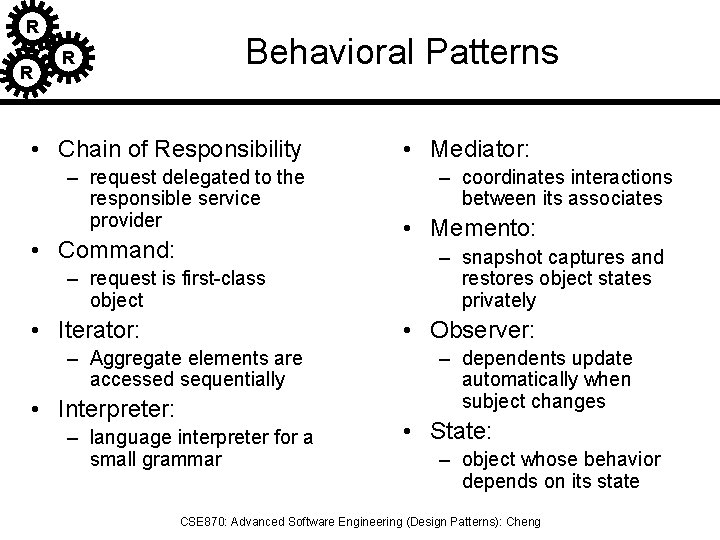
R R R Behavioral Patterns • Chain of Responsibility – request delegated to the responsible service provider • Command: – request is first-class object • Iterator: • Mediator: – coordinates interactions between its associates • Memento: – snapshot captures and restores object states privately • Observer: – Aggregate elements are accessed sequentially • Interpreter: – language interpreter for a small grammar – dependents update automatically when subject changes • State: – object whose behavior depends on its state CSE 870: Advanced Software Engineering (Design Patterns): Cheng
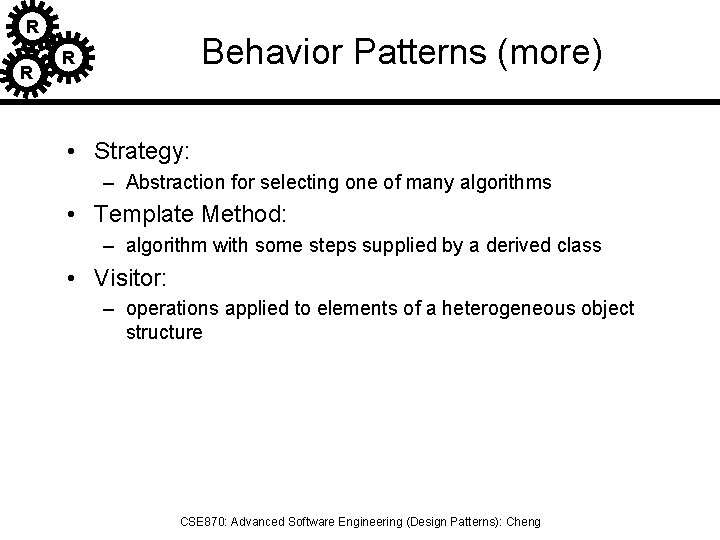
R R Behavior Patterns (more) R • Strategy: – Abstraction for selecting one of many algorithms • Template Method: – algorithm with some steps supplied by a derived class • Visitor: – operations applied to elements of a heterogeneous object structure CSE 870: Advanced Software Engineering (Design Patterns): Cheng
R R R When to Use Patterns • Solutions to problems that recur with variations – No need for reuse if problem only arises in one context • Solutions that require several steps: – Not all problems need all steps – Patterns can be overkill if solution is a simple linear set of instructions • Solutions where the solver is more interested in the existence of the solution than its complete derivation – Patterns leave out too much to be useful to someone who really wants to understand • They can be a temporary bridge CSE 870: Advanced Software Engineering (Design Patterns): Cheng
R R What Makes it a Pattern R A Pattern must: – Solve a problem • must be useful – Have a context • describe where the solution can be used – Recur – Teach • provide sufficient understanding to tailor the solution – have a name • referenced consistently • relevant in other situations CSE 870: Advanced Software Engineering (Design Patterns): Cheng
R R R Class Scope • Class Creational: abstract how objects are instantiated – hide specifics of creation process – may want to delay specifying a class name explicitly when instantiating an object – just want a specific protocol CSE 870: Advanced Software Engineering (Design Patterns): Cheng
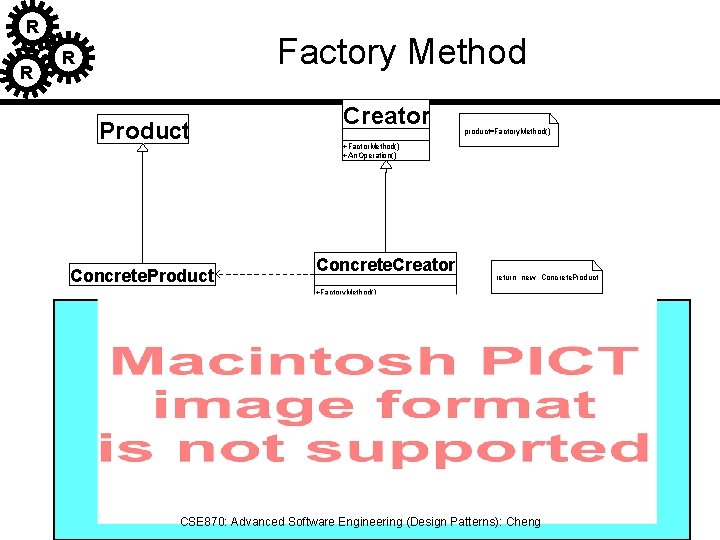
R R R Example Class Creational • Use of Factory Method: instantiate members in base classes with objects created by subclasses. • Abstract Application class: create application-specific documents conforming to particular Document type • Application instantiates these Document objects by calling the factory method Do. Make. Document • Method is overridden in classes derived from Application • Subclass Draw. Application overrides Do. Make. Document to return a Draw. Document object CSE 870: Advanced Software Engineering (Design Patterns): Cheng
R R Factory Method R Product Concrete. Product Creator product=Factory. Method() +Factor. Method() +An. Operation() Concrete. Creator return new Concrete. Product +Factory. Method() CSE 870: Advanced Software Engineering (Design Patterns): Cheng
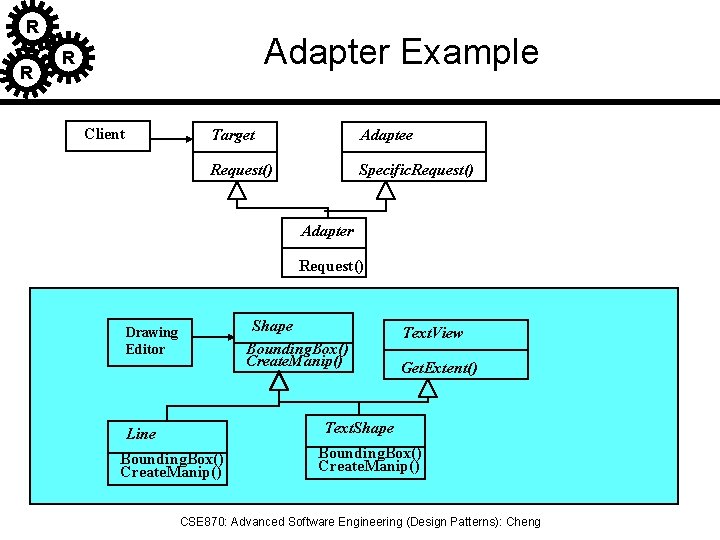
R R Class Structural R • Class Structural: use inheritance to compose protocols or code • Example: – Adapter Pattern: makes one interface (Adaptee’s) conform to another --> uniform abstraction of different interfaces. – Class Adapter inherits privately from an Adaptee class. – Adapter then expresses its interface in terms of the Adaptee’s. CSE 870: Advanced Software Engineering (Design Patterns): Cheng
R R Adapter Example R Client Target Adaptee Request() Specific. Request() Adapter Request() Shape Bounding. Box() Create. Manip() Drawing Editor Text. View Get. Extent() Text. Shape Line Bounding. Box() Create. Manip() CSE 870: Advanced Software Engineering (Design Patterns): Cheng
R R R Class Behavioral • Class Behavioral: capture how classes cooperate with their subclasses to satisfy semantics. – Template Method: defines algorithms step by step. – Each step can invoke an abstract method (that must be defined by the subclass) or a base method. – Subclass must implement specific behavior to provide required services CSE 870: Advanced Software Engineering (Design Patterns): Cheng
R R R Object Scope • Object Patterns all apply various forms of non -recursive object composition. • Object Composition: most powerful form of reuse • Reuse of a collection of objects is better achieved through variations of their composition, rather than through subclassing. CSE 870: Advanced Software Engineering (Design Patterns): Cheng
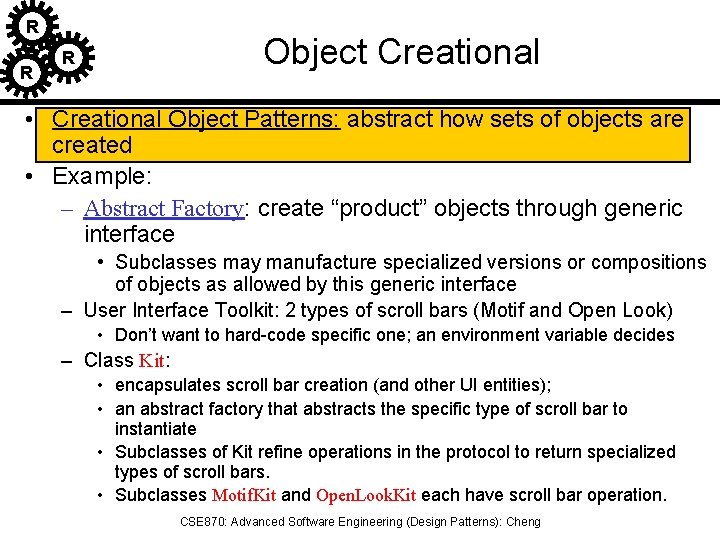
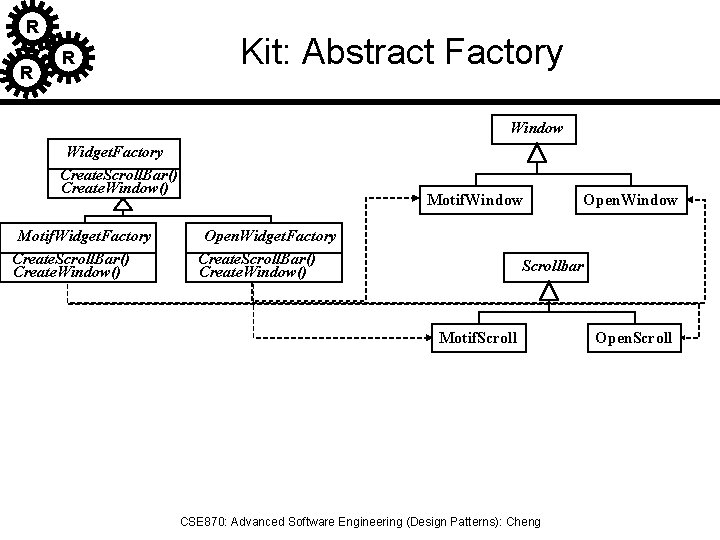
R R Object Creational R • Creational Object Patterns: abstract how sets of objects are created • Example: – Abstract Factory: create “product” objects through generic interface • Subclasses may manufacture specialized versions or compositions of objects as allowed by this generic interface – User Interface Toolkit: 2 types of scroll bars (Motif and Open Look) • Don’t want to hard-code specific one; an environment variable decides – Class Kit: • encapsulates scroll bar creation (and other UI entities); • an abstract factory that abstracts the specific type of scroll bar to instantiate • Subclasses of Kit refine operations in the protocol to return specialized types of scroll bars. • Subclasses Motif. Kit and Open. Look. Kit each have scroll bar operation. CSE 870: Advanced Software Engineering (Design Patterns): Cheng
R R R Kit: Abstract Factory Window Widget. Factory Create. Scroll. Bar() Create. Window() Motif. Window Open. Widget. Factory Create. Scroll. Bar() Create. Window() Open. Window Scrollbar Motif. Scroll CSE 870: Advanced Software Engineering (Design Patterns): Cheng Open. Scroll
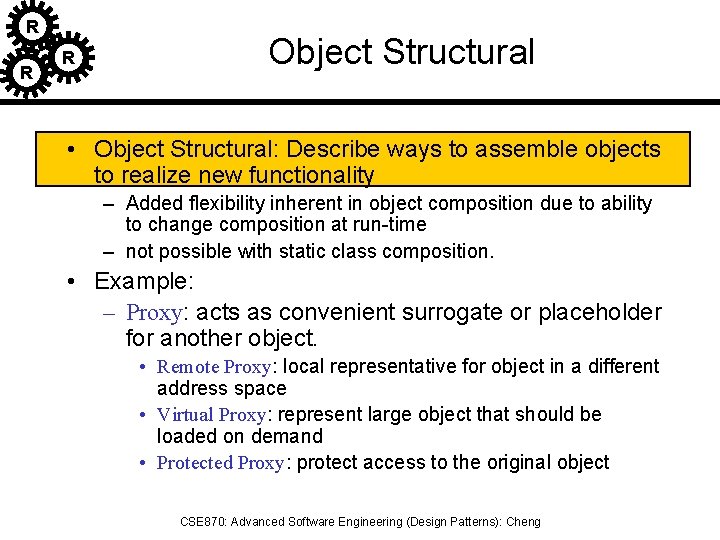
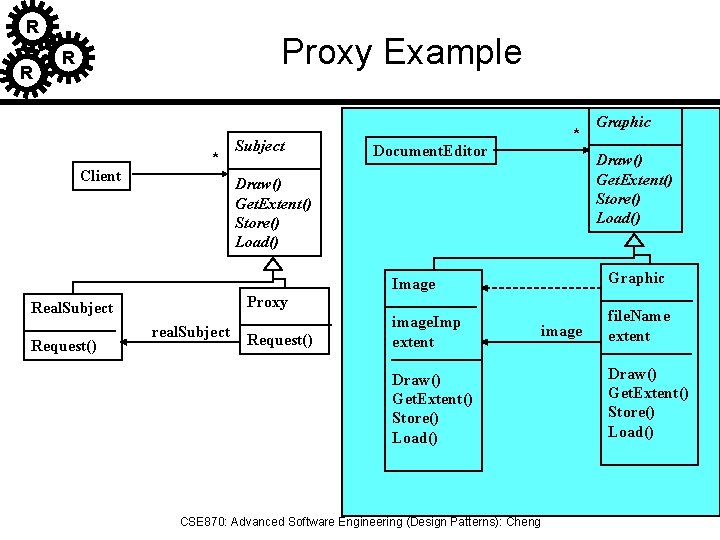
R R R Object Structural • Object Structural: Describe ways to assemble objects to realize new functionality – Added flexibility inherent in object composition due to ability to change composition at run-time – not possible with static class composition. • Example: – Proxy: acts as convenient surrogate or placeholder for another object. • Remote Proxy: local representative for object in a different address space • Virtual Proxy: represent large object that should be loaded on demand • Protected Proxy: protect access to the original object CSE 870: Advanced Software Engineering (Design Patterns): Cheng
R R Proxy Example R * Client Subject Document. Editor * Draw() Get. Extent() Store() Load() Graphic Image Proxy Real. Subject Request() real. Subject Request() image. Imp extent Draw() Get. Extent() Store() Load() CSE 870: Advanced Software Engineering (Design Patterns): Cheng Graphic image file. Name extent Draw() Get. Extent() Store() Load()
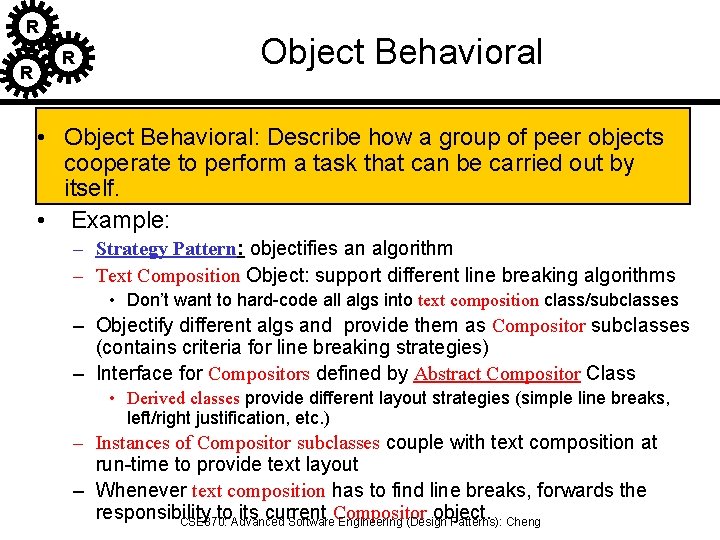
R R R Object Behavioral • Object Behavioral: Describe how a group of peer objects cooperate to perform a task that can be carried out by itself. • Example: – Strategy Pattern: objectifies an algorithm – Text Composition Object: support different line breaking algorithms • Don’t want to hard-code all algs into text composition class/subclasses – Objectify different algs and provide them as Compositor subclasses (contains criteria for line breaking strategies) – Interface for Compositors defined by Abstract Compositor Class • Derived classes provide different layout strategies (simple line breaks, left/right justification, etc. ) – Instances of Compositor subclasses couple with text composition at run-time to provide text layout – Whenever text composition has to find line breaks, forwards the responsibility to its current Compositor object. CSE 870: Advanced Software Engineering (Design Patterns): Cheng
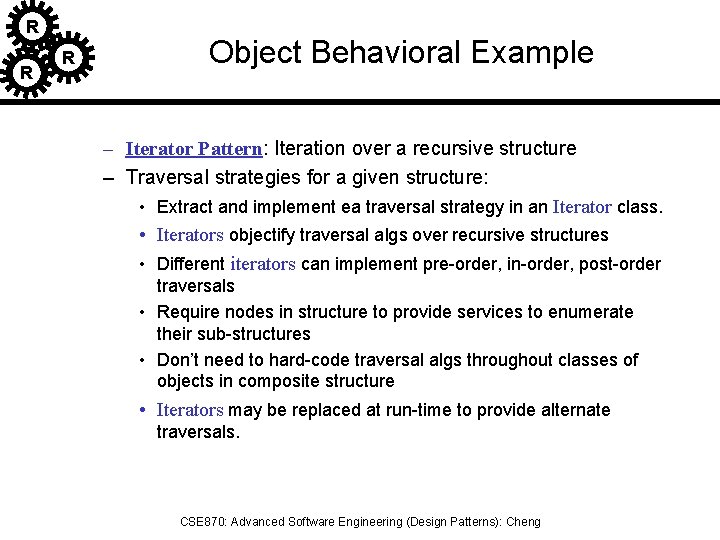
R R R Object Behavioral Example – Iterator Pattern: Iteration over a recursive structure – Traversal strategies for a given structure: • Extract and implement ea traversal strategy in an Iterator class. • Iterators objectify traversal algs over recursive structures • Different iterators can implement pre-order, in-order, post-order traversals • Require nodes in structure to provide services to enumerate their sub-structures • Don’t need to hard-code traversal algs throughout classes of objects in composite structure • Iterators may be replaced at run-time to provide alternate traversals. CSE 870: Advanced Software Engineering (Design Patterns): Cheng
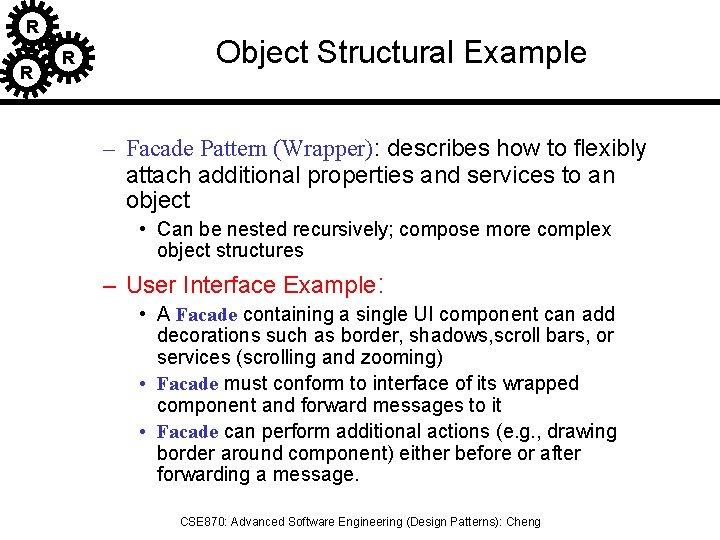
R R R Object Structural Example – Facade Pattern (Wrapper): describes how to flexibly attach additional properties and services to an object • Can be nested recursively; compose more complex object structures – User Interface Example: • A Facade containing a single UI component can add decorations such as border, shadows, scroll bars, or services (scrolling and zooming) • Facade must conform to interface of its wrapped component and forward messages to it • Facade can perform additional actions (e. g. , drawing border around component) either before or after forwarding a message. CSE 870: Advanced Software Engineering (Design Patterns): Cheng
R R R Benefits of Design Patterns • Design patterns enable large-scale reuse of software architectures – also help document systems • Patterns explicitly capture expert knowledge and design tradeoffs – make it more widely available • Patterns help improve developer communication – Pattern names form a vocabulary • Patterns help ease the transition to OO technology CSE 870: Advanced Software Engineering (Design Patterns): Cheng
R R R Drawbacks to Design Patterns • • Patterns do not lead to direct code reuse Patterns are deceptively simple Teams may suffer from pattern overload Patterns are validated by experience and discussion rather than by automated testing • Integrating patterns into a SW development process is a human-intensive activity. CSE 870: Advanced Software Engineering (Design Patterns): Cheng
R R R Suggestions for Effective Pattern Use • Do not recast everything as a pattern – Instead, develop strategic domain patterns and reuse existing tactical patterns • Institutionalize rewards for developing patterns • Directly involve pattern authors with application developers and domain experts • Clearly document when patterns apply and do not apply • Manage expectations carefully. CSE 870: Advanced Software Engineering (Design Patterns): Cheng