
R Pauls Eight Elements of Thought Pauls Wheel



- Slides: 10
R. Paul’s Eight Elements of Thought / Paul’s Wheel of Reasoning A useful critical thinking tool to question claims, ideas, perspectives
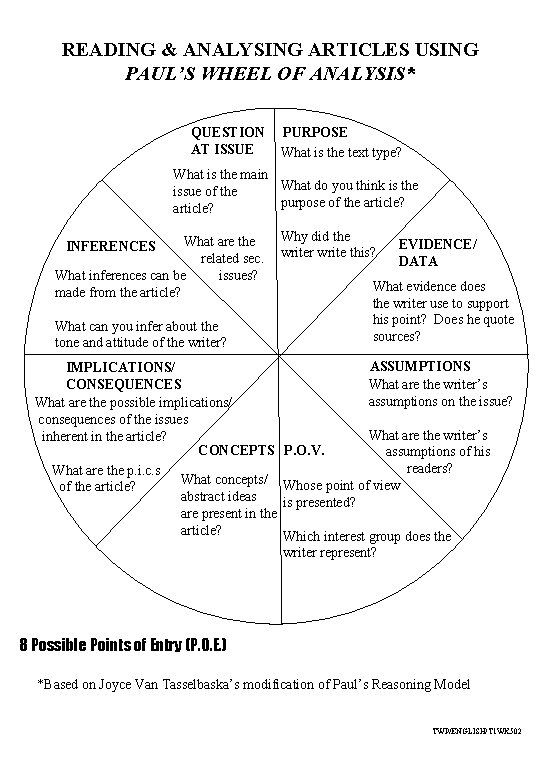
READING & ANALYSING ARTICLES USING PAUL’S WHEEL OF ANALYSIS* QUESTION AT ISSUE PURPOSE What is the text type? What is the main What do you think is the issue of the purpose of the article? What are the related sec. issues? What inferences can be made from the article? INFERENCES What can you infer about the tone and attitude of the writer? IMPLICATIONS/ CONSEQUENCES What are the possible implications/ consequences of the issues inherent in the article? CONCEPTS What are the p. i. c. s What concepts/ of the article? abstract ideas are present in the article? Why did the writer write this? EVIDENCE/ DATA What evidence does the writer use to support his point? Does he quote sources? ASSUMPTIONS What are the writer’s assumptions on the issue? What are the writer’s P. O. V. assumptions of his readers? Whose point of view is presented? Which interest group does the writer represent? 8 Possible Points of Entry (P. O. E. ) *Based on Joyce Van Tasselbaska’s modification of Paul’s Reasoning Model TWP/ENGLISH/T 1 WK 502
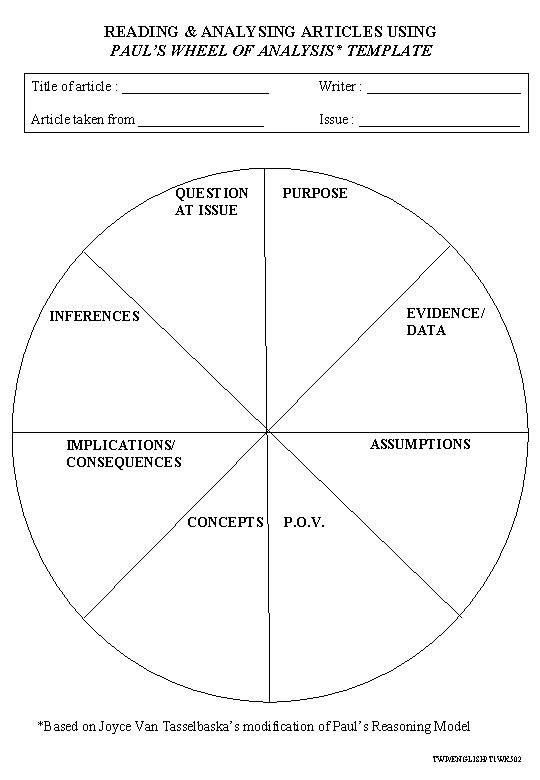
READING & ANALYSING ARTICLES USING PAUL’S WHEEL OF ANALYSIS* TEMPLATE Title of article : ___________ Writer : ___________ Article taken from _________ Issue : ____________ QUESTION AT ISSUE PURPOSE EVIDENCE/ DATA INFERENCES ASSUMPTIONS IMPLICATIONS/ CONSEQUENCES CONCEPTS P. O. V. *Based on Joyce Van Tasselbaska’s modification of Paul’s Reasoning Model TWP/ENGLISH/T 1 WK 502
Question at Issue • When we attempt to reason, there must be a question at issue or a problem to be solved • We should be able to formulate the question to be answered or the issue to be addressed when we reason • Likewise, we should be able to identify the question at hand in articles when we read.
Evidence / Data • We must be able to support our point of view with reasons or evidence. • The presence of evidence distinguishes mere opinions from reasoned judgment. • We can evaluate the strength of an argument by examining the supporting data / evidence.
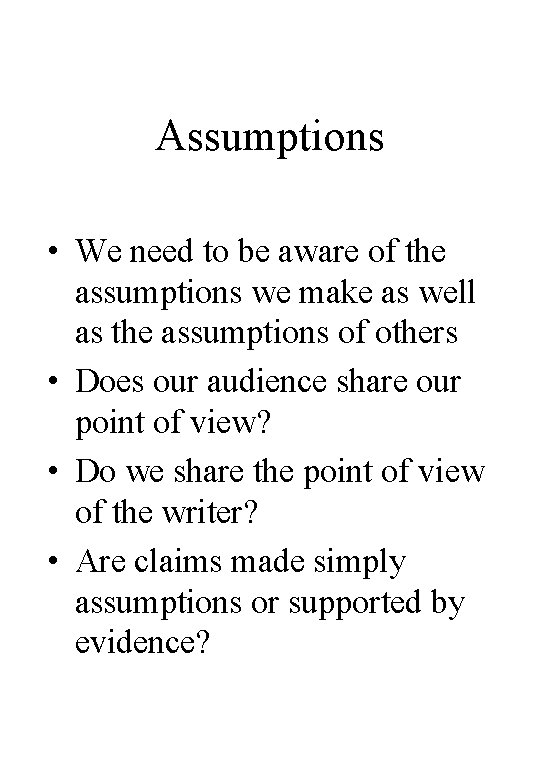
Assumptions • We need to be aware of the assumptions we make as well as the assumptions of others • Does our audience share our point of view? • Do we share the point of view of the writer? • Are claims made simply assumptions or supported by evidence?
Point of View • As we take on an issue, we are influenced by our own POV and experiences. • E. g. $100 for a shirt might be cheap to some, but ridiculously expensive to others • We need to identify the POV of the writer and his frames of reference.
Concepts • What are the key ideas / theories presented? • Are they logical? • Are they significantly subscribed to in the academic community?
Implications • What are the consequences of the course of path we support? • What are, for example, the implications of writing an essay portraying Adolf Hitler as a great, moral leader?
Inferences • Are we making reasoned and logical inferences / conclusions based on the raw data that we have?