
R packages for Topological data analysis Presentation Supervision


- Slides: 16
R packages for Topological data analysis Presentation: Supervision: Amal AKKARI Pr. My Ismail Mamouni
Plan • p. Hom | Description | p. Hom main functions � � � • TDA � The Vietoris-Rips Construction The Lazy-Witness Construction Homology Computation | Description | TDA main functions | Persistent Homology Sample on manifolds Distance Functions Density Estimators Persistent Homology Over a Grid Rips Diagrams
R package p. Hom The p. Hom package is an R package that computes the persistent homology of geometric datasets. Persistent homology is an algebraic tool that allows one to understand the topological characteristics of a given dataset across all spatial scales. It may be thought of as an extension of clustering to higher-dimensional homological properties. The purpose of this package is to make these tools available to the statistical community.
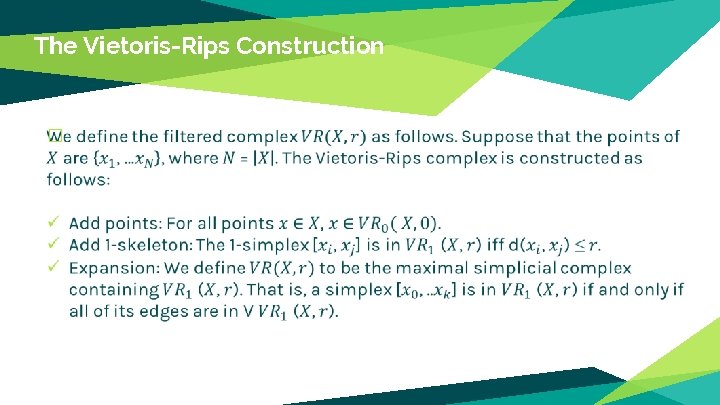
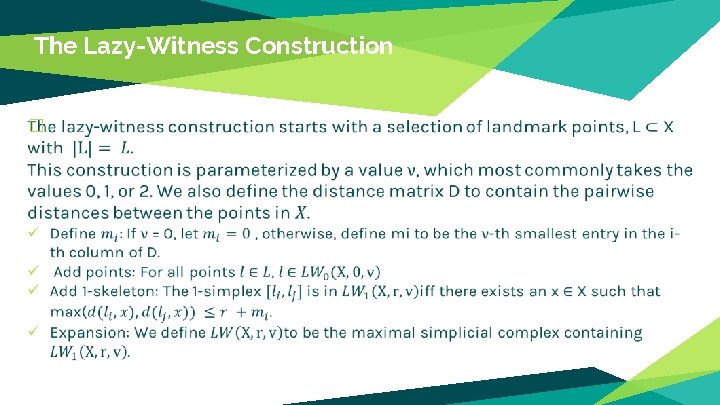
p. Hom main functions Construct a filtered simplicial complex given a geometric dataset ü The Vietoris-Rips Construction ü The Lazy-Witness Construction Compute the persistent homology of the filtered complex
The Vietoris-Rips Construction �
The Lazy-Witness Construction �
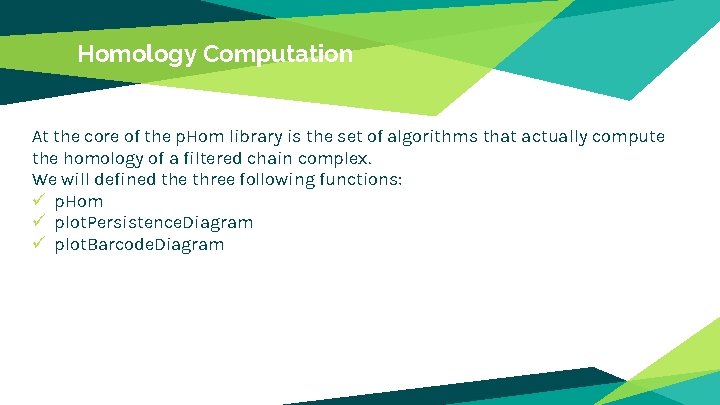
Homology Computation At the core of the p. Hom library is the set of algorithms that actually compute the homology of a filtered chain complex. We will defined the three following functions: ü p. Hom ü plot. Persistence. Diagram ü plot. Barcode. Diagram
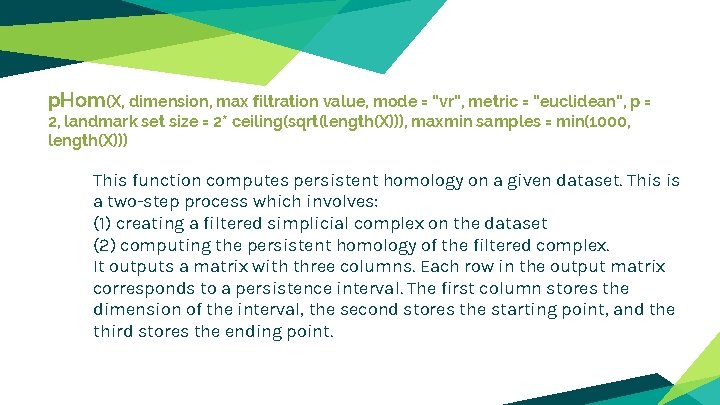
p. Hom(X, dimension, max filtration value, mode = “vr”, metric = “euclidean”, p = 2, landmark set size = 2* ceiling(sqrt(length(X))), maxmin samples = min(1000, length(X))) This function computes persistent homology on a given dataset. This is a two-step process which involves: (1) creating a filtered simplicial complex on the dataset (2) computing the persistent homology of the filtered complex. It outputs a matrix with three columns. Each row in the output matrix corresponds to a persistence interval. The first column stores the dimension of the interval, the second stores the starting point, and the third stores the ending point.
plot. Persistence. Diagram(intervals, max dim, max f, title=”Persistence Diagram”) This function plots a persistence diagram from a given set of intervals.
plot. Barcode. Diagram(intervals, dimension, max f, title=”Persistence Diagram”) This function plots a set of intervals as a set of line-segments.
R package TDA Topological Data Analysis (TDA) refers to a collection of methods for finding topological structure in data, In particular it provides functions for the statistical analysis of persistent homology and for density clustering. For that, this package provides an R interface for the efficient algorithms of the C++ libraries GUDHI, Dionysus and PHAT.
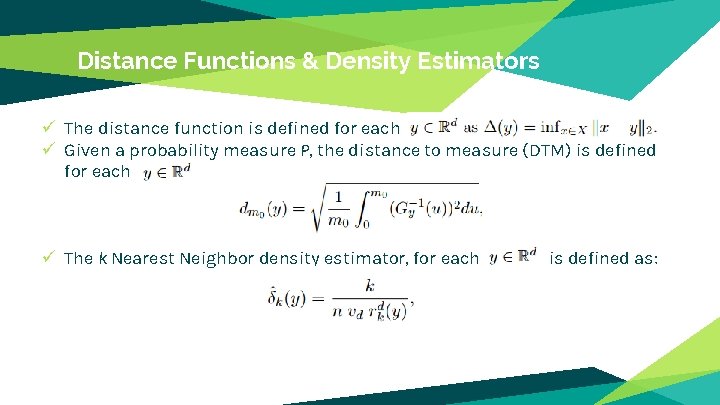
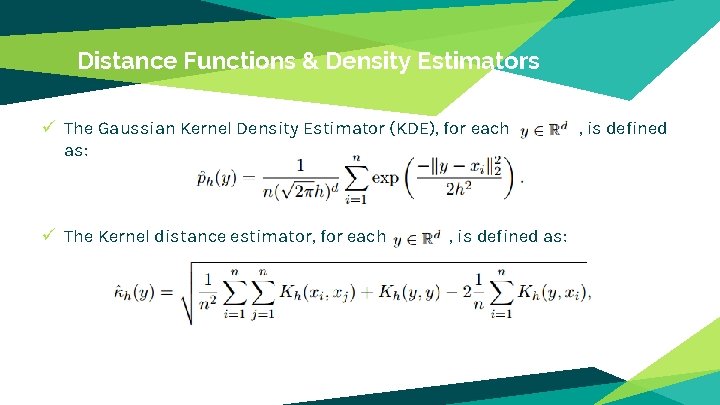
TDA main functions Distance Functions & Density Estimators ü ü ü distance function distance to a measure k. NN density estimator kernel distance Persistent Homology ü Persistent Homology Over a Grid ü Rips Diagrams density clustering
Distance Functions & Density Estimators ü The distance function is defined for each ü Given a probability measure P, the distance to measure (DTM) is defined for each ü The k Nearest Neighbor density estimator, for each is defined as:
Distance Functions & Density Estimators ü The Gaussian Kernel Density Estimator (KDE), for each as: ü The Kernel distance estimator, for each , is defined as: , is defined
Persistent Homology Lab session
Thanks! Any questions?