
R Lauwereins Imec 2001 Digital design Combinatorial circuits
© R. Lauwereins Imec 2001 Digital design Combinatorial circuits Sequential circuits FSMD design VHDL 1 Course contents • Digital design • Combinatorial circuits: without status • Sequential circuits: with status è FSMD design: hardwired processors • Language based HW design: VHDL
© R. Lauwereins Imec 2001 Digital design Combinatorial circuits Sequential circuits FSMD design VHDL 2 FSMD design è FSMDs • Models • Synthesis techniques
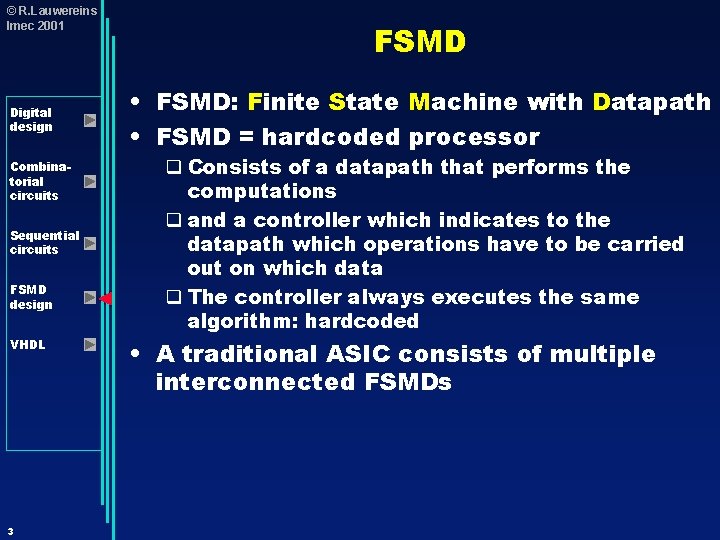
© R. Lauwereins Imec 2001 Digital design Combinatorial circuits Sequential circuits FSMD design VHDL 3 FSMD • FSMD: Finite State Machine with Datapath • FSMD = hardcoded processor q Consists of a datapath that performs the computations q and a controller which indicates to the datapath which operations have to be carried out on which data q The controller always executes the same algorithm: hardcoded • A traditional ASIC consists of multiple interconnected FSMDs
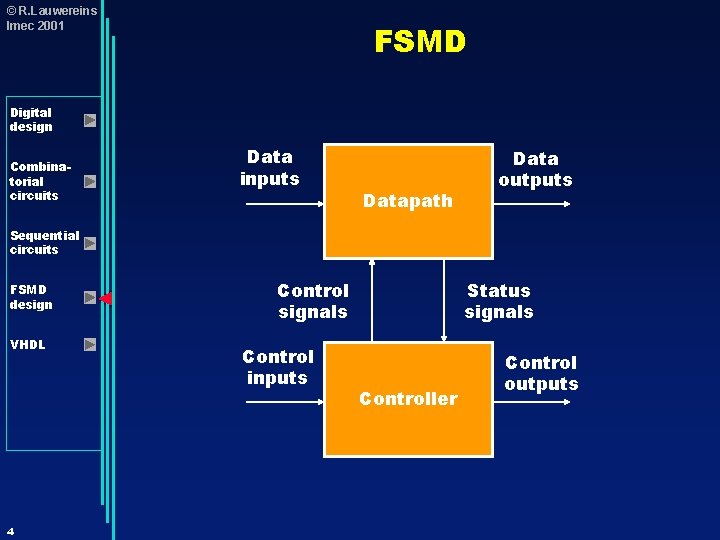
© R. Lauwereins Imec 2001 FSMD Digital design Combinatorial circuits Data inputs Datapath Data outputs Sequential circuits FSMD design VHDL 4 Control signals Control inputs Status signals Controller Control outputs
© R. Lauwereins Imec 2001 Digital design Combinatorial circuits Sequential circuits FSMD design VHDL 5 FSMD design • FSMDs q Datapath design q Controller design • Models • Synthesis techniques
© R. Lauwereins Imec 2001 Digital design Combinatorial circuits Sequential circuits FSMD design VHDL 6 FSMD design • FSMDs þ Datapath design q Controller design • Models • Synthesis techniques
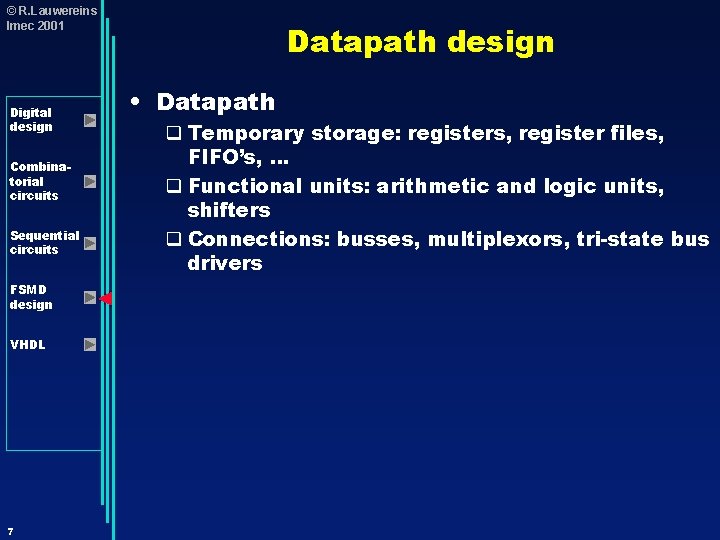
© R. Lauwereins Imec 2001 Digital design Combinatorial circuits Sequential circuits FSMD design VHDL 7 Datapath design • Datapath q Temporary storage: registers, register files, FIFO’s, … q Functional units: arithmetic and logic units, shifters q Connections: busses, multiplexors, tri-state bus drivers
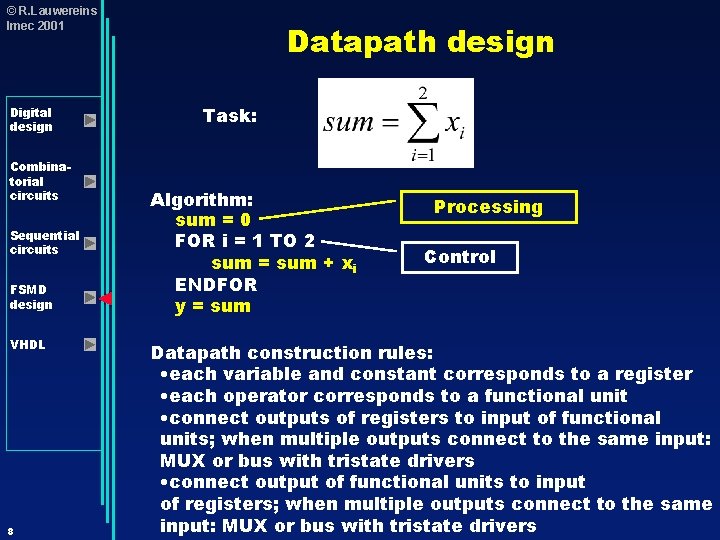
© R. Lauwereins Imec 2001 Digital design Combinatorial circuits Sequential circuits FSMD design VHDL 8 Datapath design Task: Algorithm: sum = 0 FOR i = 1 TO 2 sum = sum + xi ENDFOR y = sum Processing Control Datapath construction rules: • each variable and constant corresponds to a register • each operator corresponds to a functional unit • connect outputs of registers to input of functional units; when multiple outputs connect to the same input: MUX or bus with tristate drivers • connect output of functional units to input of registers; when multiple outputs connect to the same input: MUX or bus with tristate drivers
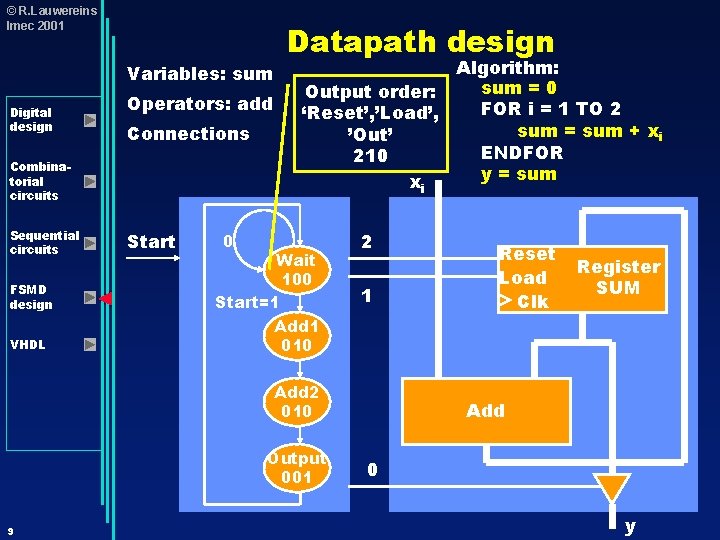
© R. Lauwereins Imec 2001 Variables: sum Digital design Operators: add Connections Combinatorial circuits Sequential circuits FSMD design VHDL Start Datapath design Output order: ‘Reset’, ’Load’, ’Out’ 210 xi 0 Wait 100 Start=1 2 1 Reset Load Clk Register SUM Add 1 010 Add 2 010 Output 001 9 Algorithm: sum = 0 FOR i = 1 TO 2 sum = sum + xi ENDFOR y = sum Add 0 y
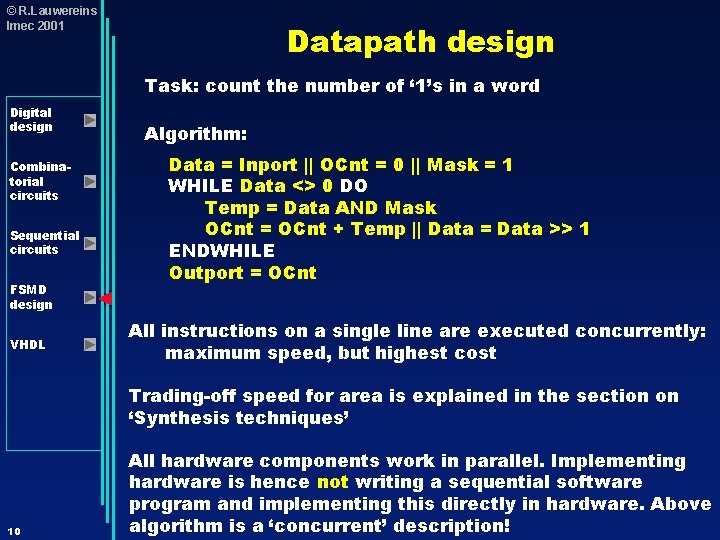
© R. Lauwereins Imec 2001 Datapath design Task: count the number of ‘ 1’s in a word Digital design Combinatorial circuits Sequential circuits FSMD design VHDL Algorithm: Data = Inport || OCnt = 0 || Mask = 1 WHILE Data <> 0 DO Temp = Data AND Mask OCnt = OCnt + Temp || Data = Data >> 1 ENDWHILE Outport = OCnt All instructions on a single line are executed concurrently: maximum speed, but highest cost Trading-off speed for area is explained in the section on ‘Synthesis techniques’ 10 All hardware components work in parallel. Implementing hardware is hence not writing a sequential software program and implementing this directly in hardware. Above algorithm is a ‘concurrent’ description!
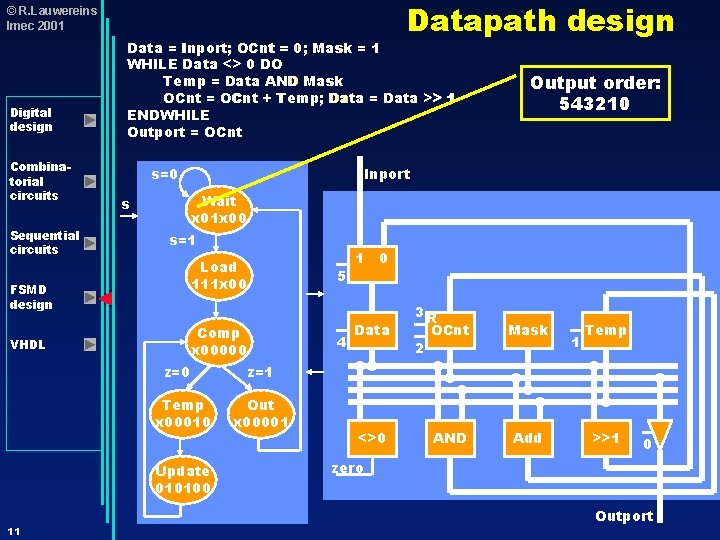
Datapath design © R. Lauwereins Imec 2001 Digital design Combinatorial circuits Sequential circuits Data = Inport; OCnt = 0; Mask = 1 WHILE Data <> 0 DO Temp = Data AND Mask OCnt = OCnt + Temp; Data = Data >> 1 ENDWHILE Outport = OCnt s=0 Inport Wait x 01 x 00 s s=1 Load 111 x 00 FSMD design 5 Comp x 00000 VHDL z=0 Temp x 00010 Update 010100 11 Output order: 543210 4 1 0 Data 3 R OCnt 2 <>0 AND Mask 1 Temp z=1 Out x 00001 Add >>1 0 zero Outport
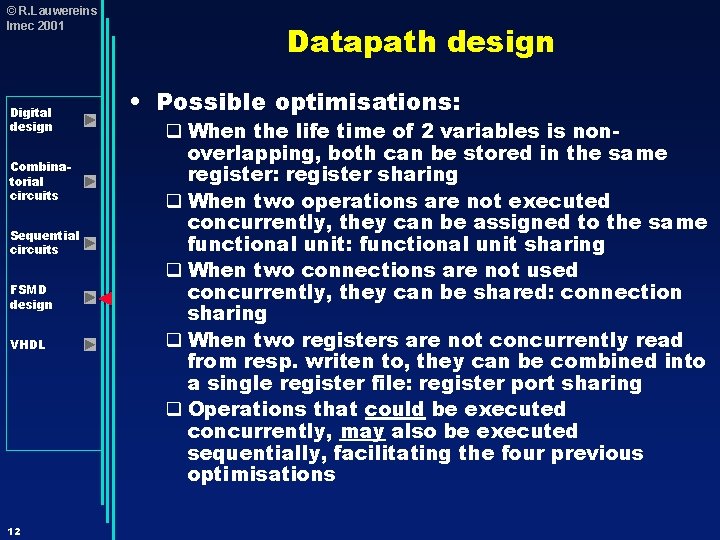
© R. Lauwereins Imec 2001 Digital design Combinatorial circuits Sequential circuits FSMD design VHDL 12 Datapath design • Possible optimisations: q When the life time of 2 variables is nonoverlapping, both can be stored in the same register: register sharing q When two operations are not executed concurrently, they can be assigned to the same functional unit: functional unit sharing q When two connections are not used concurrently, they can be shared: connection sharing q When two registers are not concurrently read from resp. writen to, they can be combined into a single register file: register port sharing q Operations that could be executed concurrently, may also be executed sequentially, facilitating the four previous optimisations
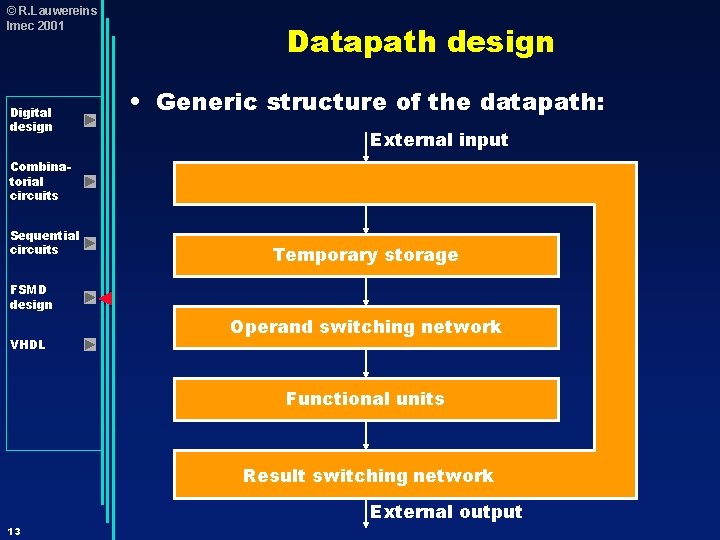
© R. Lauwereins Imec 2001 Digital design Datapath design • Generic structure of the datapath: External input Combinatorial circuits Sequential circuits Temporary storage FSMD design VHDL Operand switching network Functional units Result switching network 13 External output
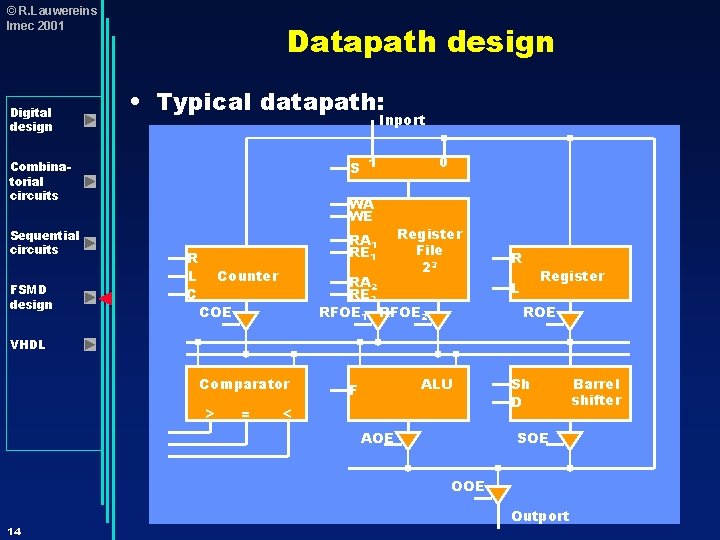
© R. Lauwereins Imec 2001 Digital design Datapath design • Typical datapath: Inport S 1 Combinatorial circuits Sequential circuits FSMD design WA WE R L C RA 1 RE 1 Counter 0 Register File 23 RA 2 RE 2 RFOE 1 RFOE 2 COE R Register L ROE VHDL Comparator > = ALU F < AOE Sh D SOE OOE 14 Outport Barrel shifter
© R. Lauwereins Imec 2001 Digital design Combinatorial circuits Sequential circuits FSMD design VHDL 15 Datapath design • In the datapath of previous slide a few decisions have been taken: q Only 1 i. o. 2 result busses ALU and Barrel shifter cannot be used concurrently q Only 2 i. o. 4 operand busses e. g. Compare and ALU work on the same set of data q 9 registers with only 2 write ports and 3 read ports q Inport can only feed the register file
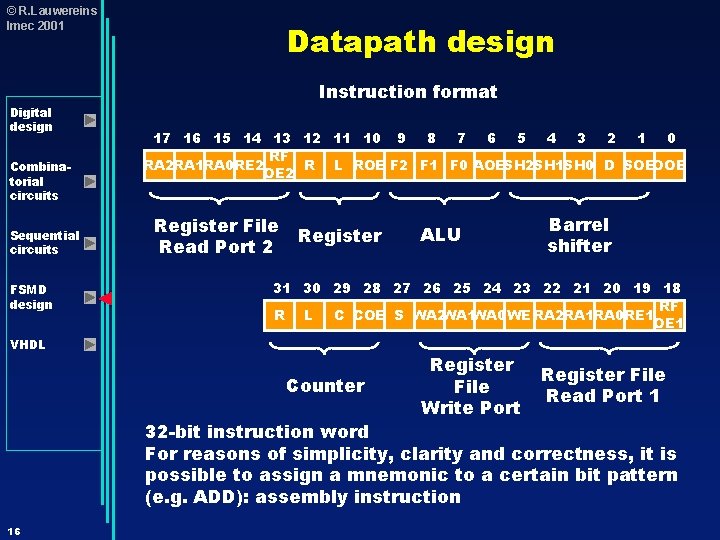
© R. Lauwereins Imec 2001 Digital design Combinatorial circuits Sequential circuits FSMD design Datapath design Instruction format 17 16 15 14 13 12 11 10 9 8 7 6 5 4 3 2 1 0 RF RA 2 RA 1 RA 0 RE 2 R L ROE F 2 F 1 F 0 AOESH 2 SH 1 SH 0 D SOEOOE OE 2 Register File Read Port 2 Register ALU Barrel shifter 31 30 29 28 27 26 25 24 23 22 21 20 19 18 RF R L C COE S WA 2 WA 1 WA 0 WE RA 2 RA 1 RA 0 RE 1 OE 1 VHDL Counter Register File Write Port Register File Read Port 1 32 -bit instruction word For reasons of simplicity, clarity and correctness, it is possible to assign a mnemonic to a certain bit pattern (e. g. ADD): assembly instruction 16
© R. Lauwereins Imec 2001 Digital design Combinatorial circuits Sequential circuits FSMD design VHDL 17 Datapath design • The size of the instruction word may be reduced, since several operations cannot be executed concurrently q Either Register File Read Port 2, either Register Read Port connects to the 1 st Operand Bus (-1) q Either Register File Read Port 1, either Counter Read Port connects to the 2 nd Operand Bus (-1) q ALU & Shift cannot occur concurrently: 1 bit needed to select the operator and 4 bits control the operator (-2) q When the ALU operator is active, its output may immediately be placed on the result bus; idem for the Barrel shifter (-2) q For the counter the ‘Count’ and ‘Load’ operations are exclusive (-1) • Additional limitations to concurrency may be introduced at the cost of increased execution time
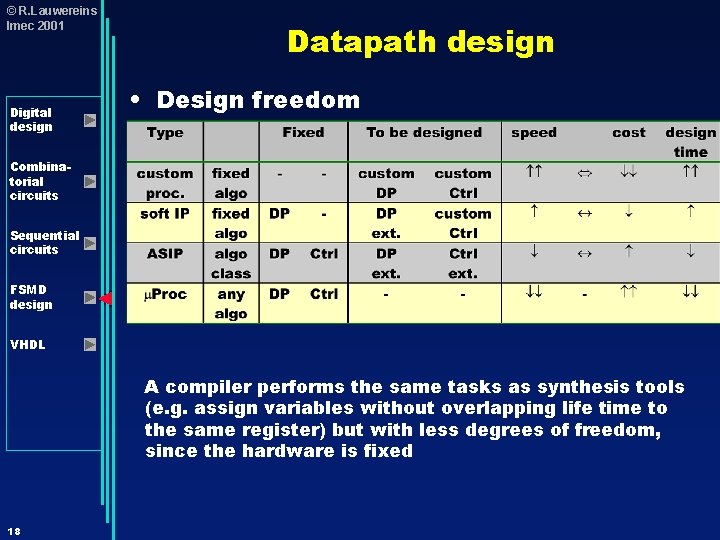
© R. Lauwereins Imec 2001 Digital design Datapath design • Design freedom Combinatorial circuits Sequential circuits FSMD design VHDL A compiler performs the same tasks as synthesis tools (e. g. assign variables without overlapping life time to the same register) but with less degrees of freedom, since the hardware is fixed 18
© R. Lauwereins Imec 2001 Digital design Combinatorial circuits Sequential circuits FSMD design VHDL 19 FSMD design • FSMDs q Datapath design þ Controller design • Models • Synthesis techniques
© R. Lauwereins Imec 2001 Digital design Combinatorial circuits Sequential circuits FSMD design VHDL 20 Controller design • The controller has been designed each time using the design method for FSMs as discussed before • For a large number of states this is a tedious job • Next slides present alternative design methods, that lead to a faster design process in several cases
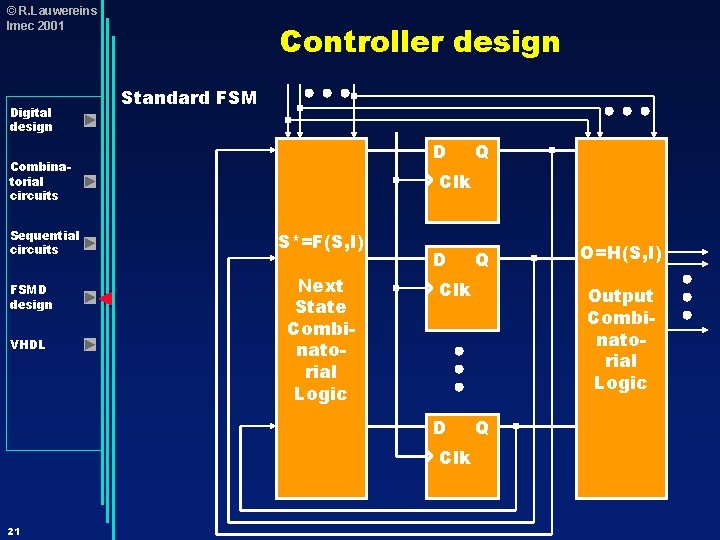
© R. Lauwereins Imec 2001 Digital design Controller design Standard FSM D Combinatorial circuits Sequential circuits FSMD design VHDL Clk S*=F(S, I) Next State Combinatorial Logic D Q Clk D Clk 21 Q O=H(S, I) Output Combinatorial Logic Q
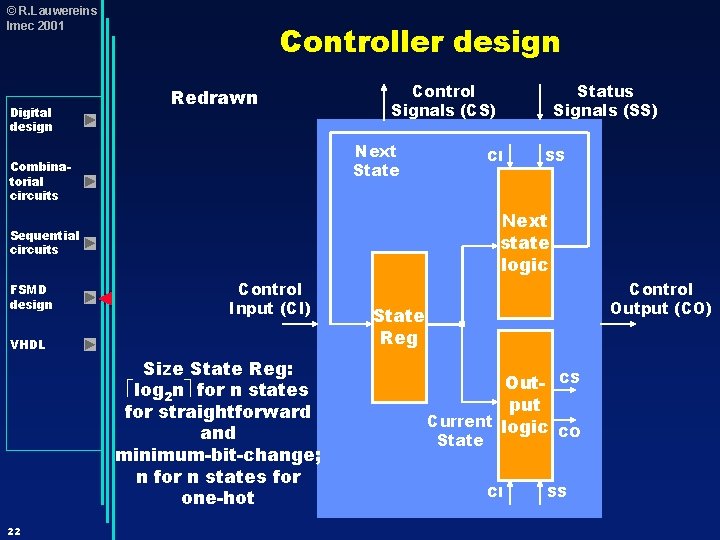
© R. Lauwereins Imec 2001 Digital design Controller design Redrawn Control Signals (CS) Next State Combinatorial circuits CI Control Input (CI) VHDL Size State Reg: log 2 n for n states for straightforward and minimum-bit-change; n for n states for one-hot 22 SS Next state logic Sequential circuits FSMD design Status Signals (SS) Control Output (CO) State Reg Output Current logic State CI CS CO SS
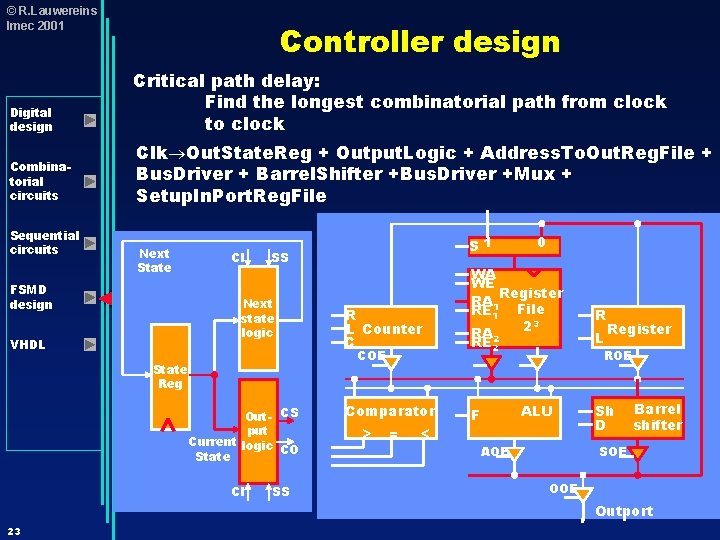
© R. Lauwereins Imec 2001 Controller design Digital design Critical path delay: Find the longest combinatorial path from clock to clock Combinatorial circuits Clk Out. State. Reg + Output. Logic + Address. To. Out. Reg. File + Bus. Driver + Barrel. Shifter +Bus. Driver +Mux + Setup. In. Port. Reg. File Sequential circuits Next State FSMD design CI SS Next state logic VHDL R L Counter C COE State Reg Out- CS put Current logic CO State CI 23 S 1 SS Comparator > = < 0 WA WE Register RA 1 File RE 1 23 RA 2 RE 2 RFOE 1 RFOE 2 F ALU AOE R L Register ROE Sh D Barrel shifter SOE Outport
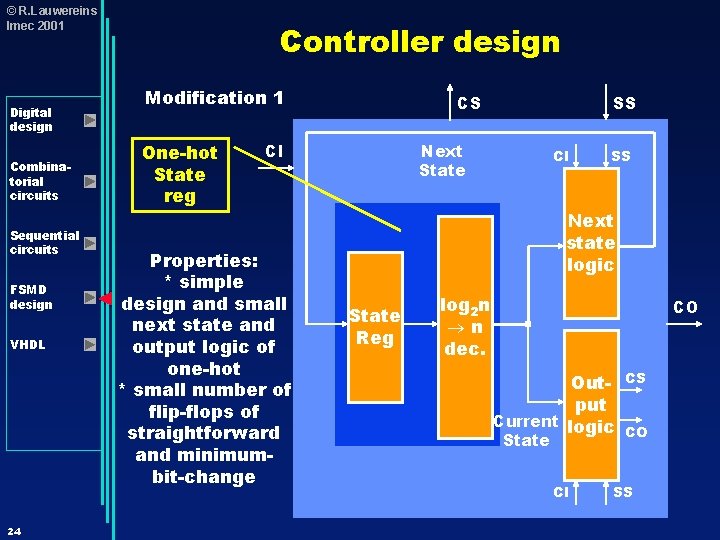
© R. Lauwereins Imec 2001 Digital design Combinatorial circuits Sequential circuits FSMD design VHDL 24 Controller design Modification 1 One-hot State reg CS CI Properties: * simple design and small next state and output logic of one-hot * small number of flip-flops of straightforward and minimumbit-change SS Next State CI SS Next state logic State Reg log 2 n n dec. CO Output Current logic State CI CS CO SS
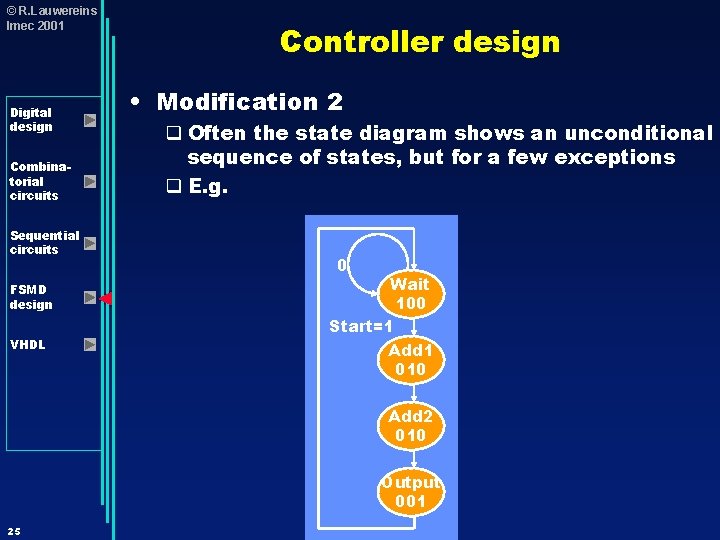
© R. Lauwereins Imec 2001 Digital design Combinatorial circuits Sequential circuits FSMD design VHDL Controller design • Modification 2 q Often the state diagram shows an unconditional sequence of states, but for a few exceptions q E. g. 0 Wait 100 Start=1 Add 1 010 Add 2 010 Output 001 25
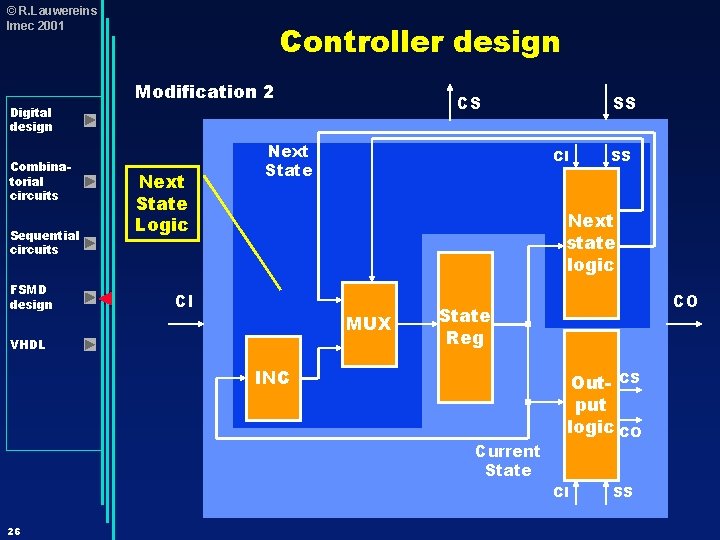
© R. Lauwereins Imec 2001 Digital design Combinatorial circuits Sequential circuits FSMD design Controller design Modification 2 Next State Logic CS Next State SS CI Next state logic CI MUX VHDL CO State Reg INC Current State Out- CS put logic CO CI 26 SS SS
© R. Lauwereins Imec 2001 Digital design Combinatorial circuits Sequential circuits FSMD design VHDL 27 Controller design • Advantage of modification 2: q The next state logic is very simple: ðfor unconditional next state: select the INC ðonly for conditional next state the hardware should generate the next state • Implementation of the INC: q ripple carry chain of Half Adders q INC and State Reg together form a synchronous counter
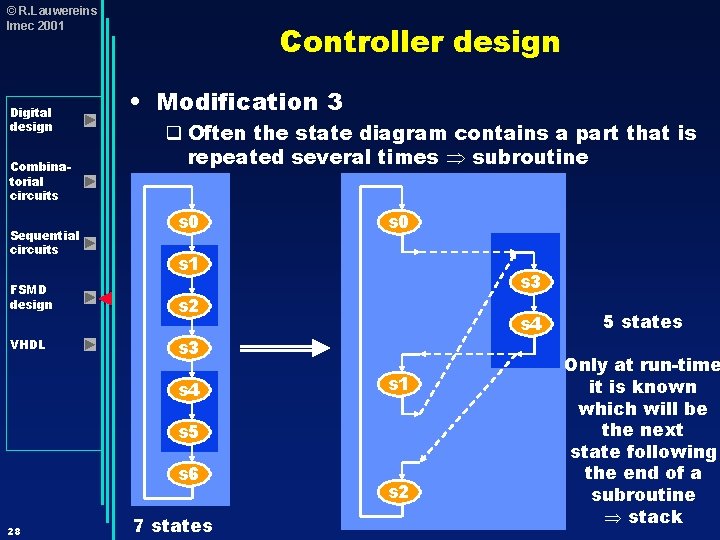
© R. Lauwereins Imec 2001 Digital design Combinatorial circuits Sequential circuits FSMD design VHDL Controller design • Modification 3 q Often the state diagram contains a part that is repeated several times subroutine s 0 s 1 s 3 s 2 s 4 s 3 s 4 s 1 s 5 s 6 28 7 states s 2 5 states Only at run-time it is known which will be the next state following the end of a subroutine stack
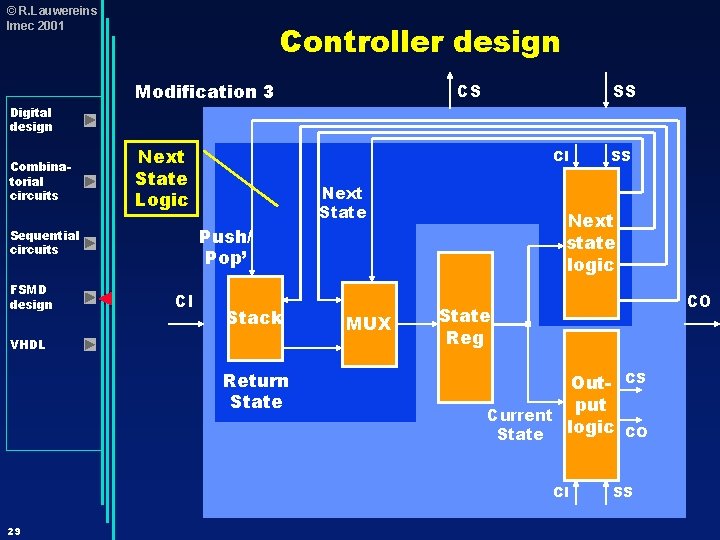
© R. Lauwereins Imec 2001 Digital design Combinatorial circuits Controller design Modification 3 Next State Logic FSMD design CI SS CI Push/ Pop’ Sequential circuits CS Stack VHDL Return State Next State MUX Next state logic CO State Reg Output Current State logic CI 29 SS CS CO SS
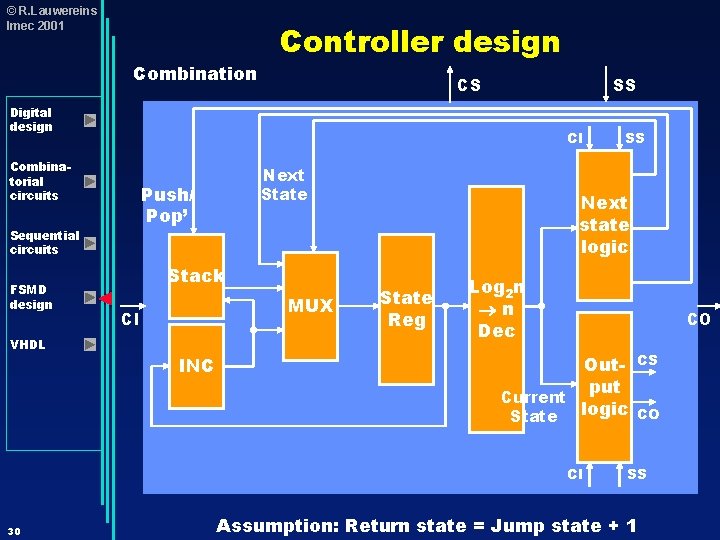
© R. Lauwereins Imec 2001 Combination Controller design CS SS Digital design CI Combinatorial circuits Push/ Pop’ Sequential circuits FSMD design VHDL Next State Stack MUX CI INC Next state logic State Reg Log 2 n n Dec CO Output Current State logic CI 30 SS CS CO SS Assumption: Return state = Jump state + 1
© R. Lauwereins Imec 2001 Digital design Combinatorial circuits Sequential circuits FSMD design VHDL 31 Controller design • Implementation of the next state logic and the output logic q Either construct via Karnaugh a minimal ANDOR implementation q Either put the truth table in a ROM-table (this method is called microprogrammed control)
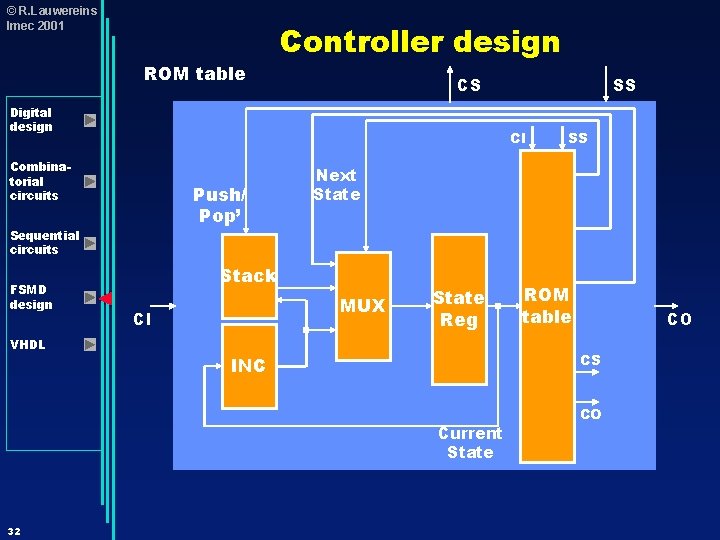
© R. Lauwereins Imec 2001 ROM table Controller design CS Digital design CI Combinatorial circuits Push/ Pop’ Sequential circuits FSMD design VHDL Stack MUX CI SS Next State Reg ROM table CO CS INC Current State 32 SS CO
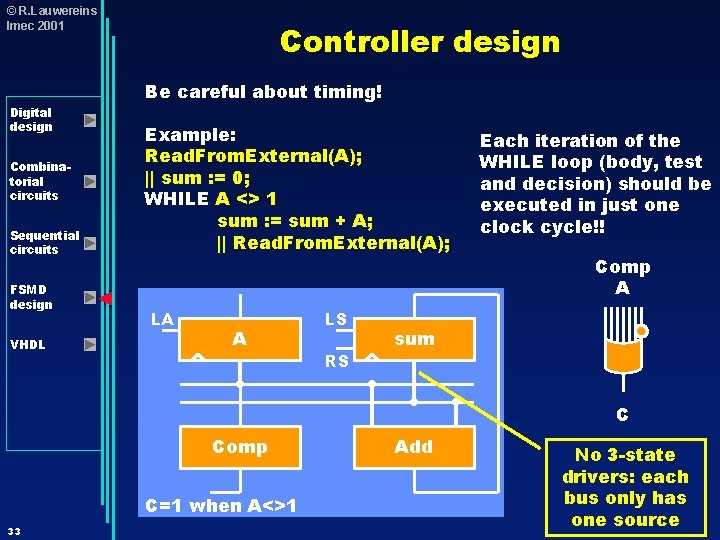
© R. Lauwereins Imec 2001 Digital design Combinatorial circuits Sequential circuits FSMD design VHDL Controller design Be careful about timing! Example: Read. From. External(A); || sum : = 0; WHILE A <> 1 sum : = sum + A; || Read. From. External(A); LA A LS RS Each iteration of the WHILE loop (body, test and decision) should be executed in just one clock cycle!! Comp A sum C Comp C=1 when A<>1 33 Add No 3 -state drivers: each bus only has one source
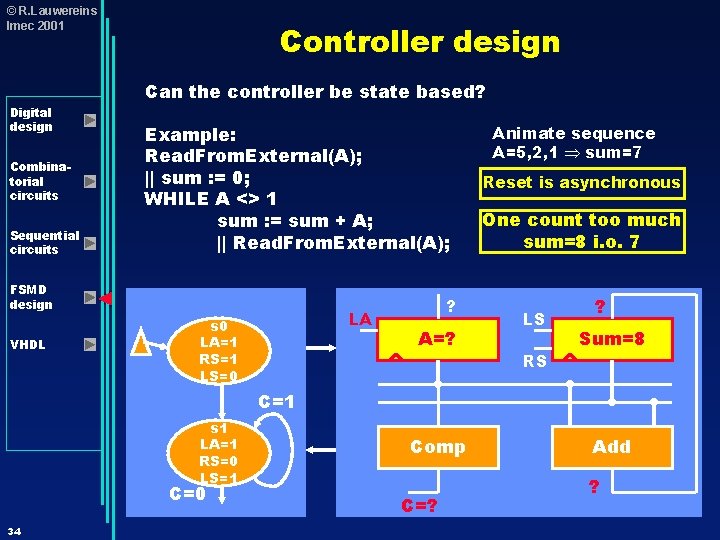
© R. Lauwereins Imec 2001 Digital design Combinatorial circuits Sequential circuits Controller design Can the controller be state based? Example: Read. From. External(A); || sum : = 0; WHILE A <> 1 sum : = sum + A; || Read. From. External(A); FSMD design VHDL LA s 0 LA=1 RS=1 LS=0 Animate sequence A=5, 2, 1 sum=7 Reset is asynchronous One count too much sum=8 i. o. 7 2 1 ? 5 A=1 A=? A A=2 LS RS 5 7 8 ? Sum=0 Sum=7 Sum=8 Sum=? sum Sum=5 C=1 s 1 LA=1 RS=0 LS=1 C=0 34 Comp C=1 when C=1 C=0 C=? A<>1 Add 8 5 ? 7
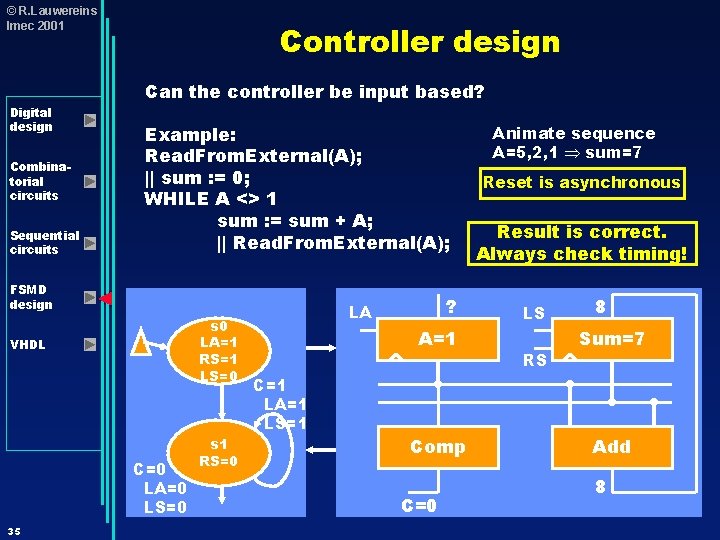
© R. Lauwereins Imec 2001 Digital design Combinatorial circuits Sequential circuits Controller design Can the controller be input based? Example: Read. From. External(A); || sum : = 0; WHILE A <> 1 sum : = sum + A; || Read. From. External(A); FSMD design s 0 LA=1 RS=1 LS=0 VHDL C=0 LA=0 LS=0 35 s 1 RS=0 LA LA C=1 LA=1 LS=1 Animate sequence A=5, 2, 1 sum=7 Reset is asynchronous Result is correct. Always check timing! 5 2 1 ? A=5 A=2 A=1 A=? A Comp C=1 when C=1 C=0 C=? A<>1 LS LS RS 5 7 8 ? Sum=0 Sum=5 Sum=7 Sum=? sum Add 7 ? 5 8
© R. Lauwereins Imec 2001 Digital design Combinatorial circuits Sequential circuits FSMD design VHDL 36 FSMD design • FSMDs • Models q State-action table q Algorithmic-state-machine chart • Synthesis techniques
© R. Lauwereins Imec 2001 Digital design Combinatorial circuits Sequential circuits FSMD design VHDL 37 FSMD design • FSMDs • Models þ State-action table q Algorithmic-state-machine chart • Synthesis techniques
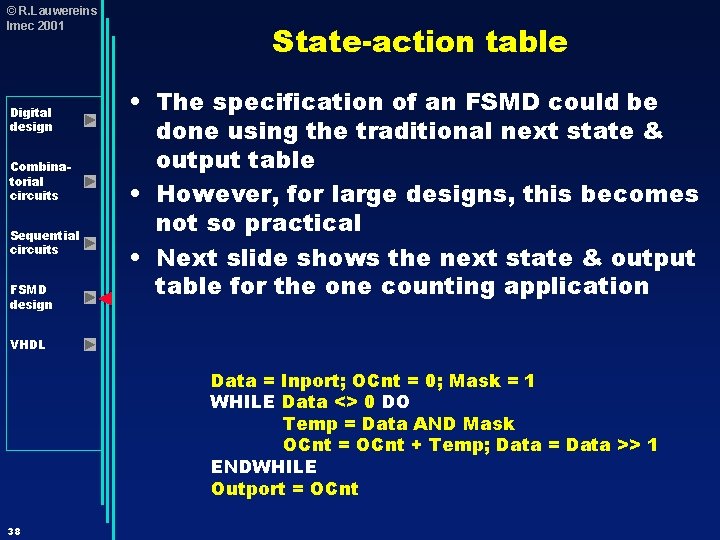
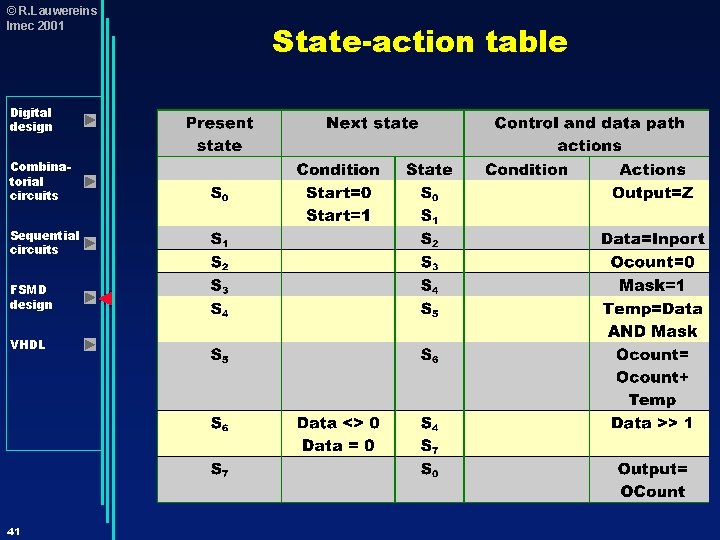
© R. Lauwereins Imec 2001 Digital design Combinatorial circuits Sequential circuits FSMD design State-action table • The specification of an FSMD could be done using the traditional next state & output table • However, for large designs, this becomes not so practical • Next slide shows the next state & output table for the one counting application VHDL Data = Inport; OCnt = 0; Mask = 1 WHILE Data <> 0 DO Temp = Data AND Mask OCnt = OCnt + Temp; Data = Data >> 1 ENDWHILE Outport = OCnt 38
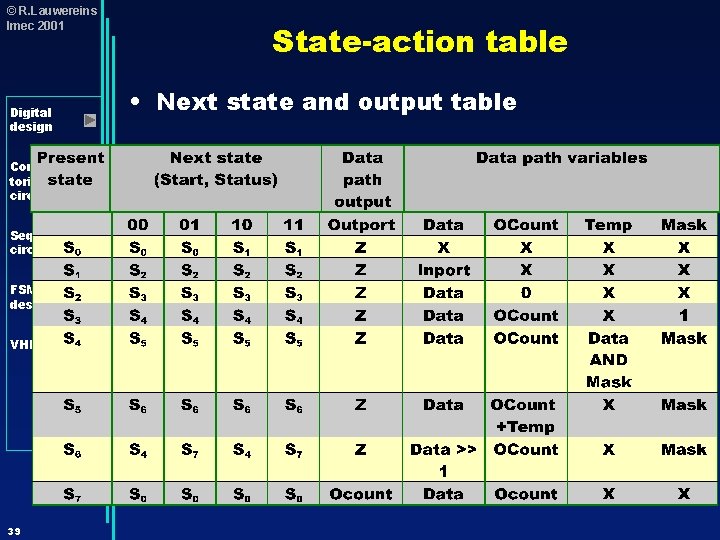
© R. Lauwereins Imec 2001 Digital design Combinatorial circuits Sequential circuits FSMD design VHDL 39 State-action table • Next state and output table
© R. Lauwereins Imec 2001 Digital design Combinatorial circuits Sequential circuits FSMD design VHDL 40 State-action table • The next state and output table do not offer a good overview q often the next state is only dependent on a few of the inputs q often, the data path variables do not change • Hence, the same information as in the next state and output table is presented in a more condensed form: the state action table (See next slide)
© R. Lauwereins Imec 2001 Digital design Combinatorial circuits Sequential circuits FSMD design VHDL 41 State-action table
© R. Lauwereins Imec 2001 Digital design Combinatorial circuits Sequential circuits FSMD design VHDL 42 FSMD design • FSMDs • Models q State-action table þ Algorithmic-state-machine chart • Synthesis techniques
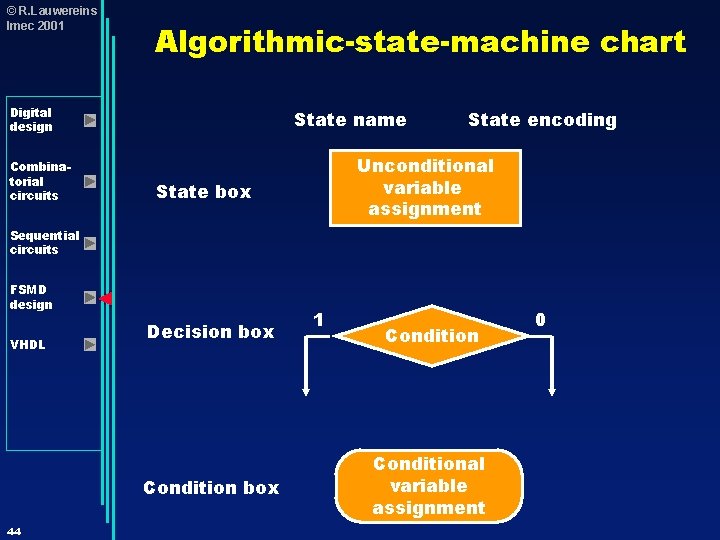
© R. Lauwereins Imec 2001 Digital design Combinatorial circuits Sequential circuits FSMD design VHDL 43 Algorithmic-state-machine chart • An algorithmic-state-machine chart (ASM chart) is an alternative visualization method for the state action table • It shows loops, conditions and next states in a way which is easier to understand for a human being • Each row in the state action table translates to an ASM block • ASM blocks are constructed out of three types of elements: state boxes, decision boxes and condition boxes
© R. Lauwereins Imec 2001 Algorithmic-state-machine chart Digital design Combinatorial circuits State name State encoding Unconditional variable assignment State box Sequential circuits FSMD design VHDL Decision box Condition box 44 1 Conditional variable assignment 0
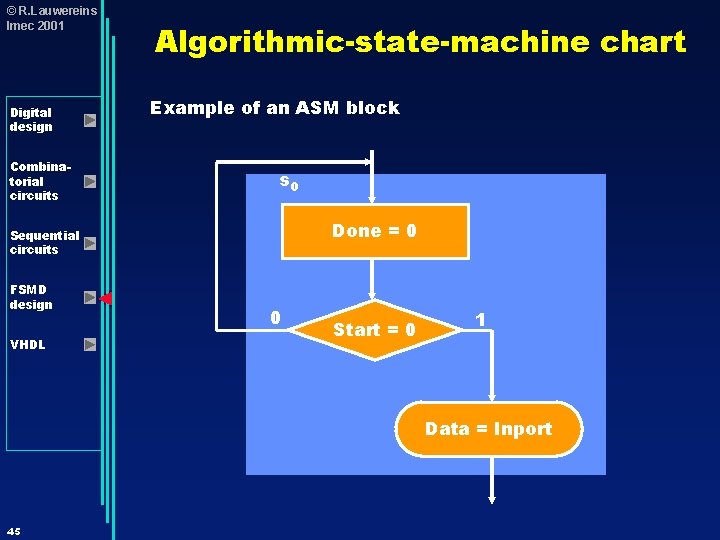
© R. Lauwereins Imec 2001 Digital design Combinatorial circuits Algorithmic-state-machine chart Example of an ASM block s 0 Done = 0 Sequential circuits FSMD design VHDL 0 Start = 0 1 Data = Inport 45
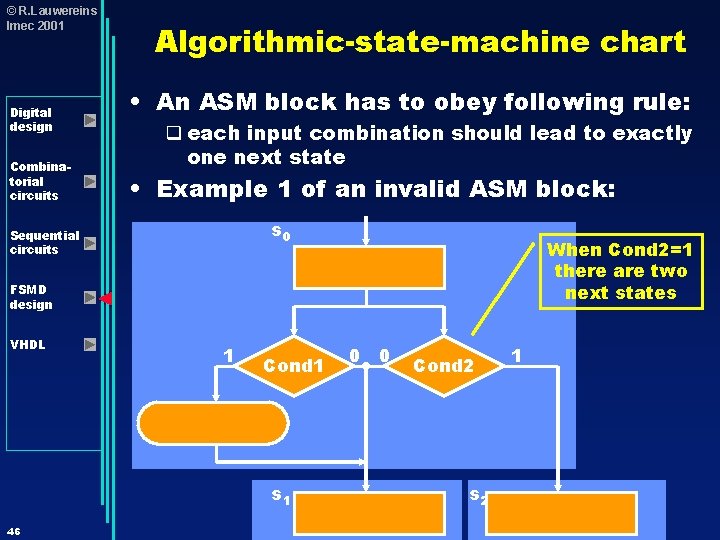
© R. Lauwereins Imec 2001 Digital design Combinatorial circuits Algorithmic-state-machine chart • An ASM block has to obey following rule: q each input combination should lead to exactly one next state • Example 1 of an invalid ASM block: s 0 Sequential circuits When Cond 2=1 there are two next states FSMD design VHDL 1 Cond 1 s 1 46 0 0 Cond 2 s 2 1
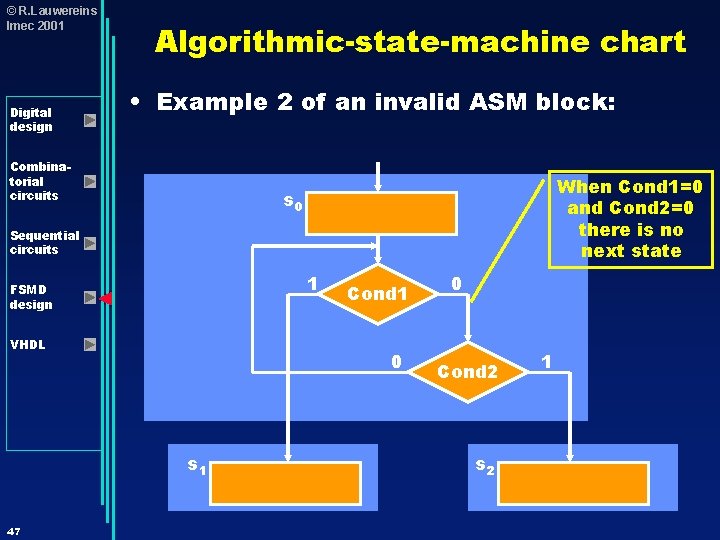
© R. Lauwereins Imec 2001 Digital design Algorithmic-state-machine chart • Example 2 of an invalid ASM block: Combinatorial circuits When Cond 1=0 and Cond 2=0 there is no next state s 0 Sequential circuits 1 FSMD design VHDL 0 s 1 47 Cond 1 0 Cond 2 s 2 1
© R. Lauwereins Imec 2001 Digital design Combinatorial circuits Sequential circuits FSMD design VHDL 48 Algorithmic-state-machine chart • An ASM chart representing a state-based or Moore type FSMD has no condition boxes, since all outputs only depend on the state; all assignments to variables are done in state boxes • An ASM chart representing an input-based or Mealy type FSMD has state boxes as well as condition boxes; variable assignments that only depend on the state are done within the state boxes; variable assignments that depend on input conditions are done in condition boxes
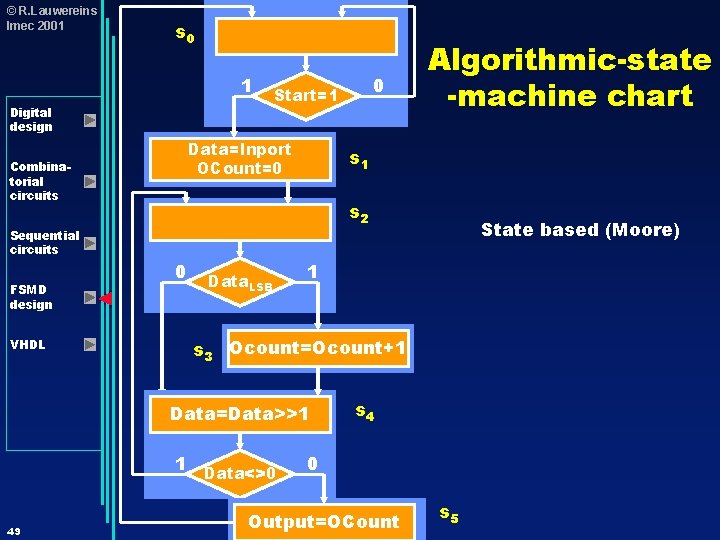
© R. Lauwereins Imec 2001 s 0 1 Digital design Data=Inport OCount=0 Combinatorial circuits 0 Start=1 Algorithmic-state -machine chart s 1 s 2 State based (Moore) Sequential circuits FSMD design VHDL 0 Data. LSB 1 s 3 Ocount=Ocount+1 Data=Data>>1 1 Data<>0 49 s 4 0 Output=OCount s 5
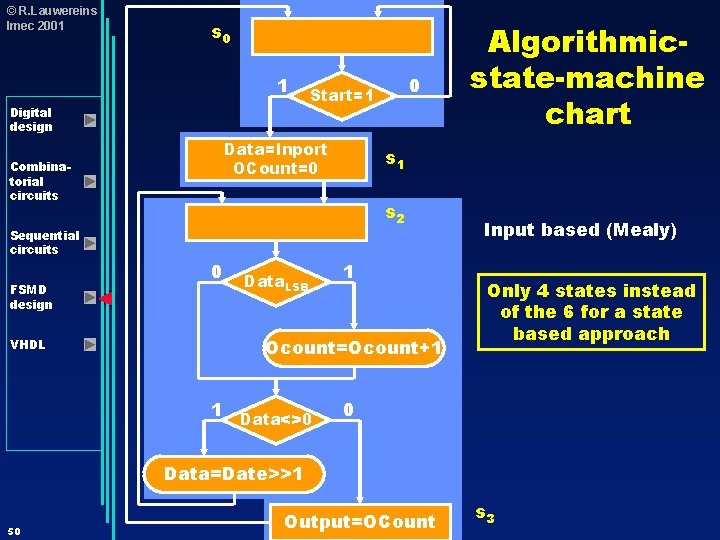
© R. Lauwereins Imec 2001 s 0 1 Digital design Data=Inport OCount=0 Combinatorial circuits 0 Start=1 s 2 Sequential circuits FSMD design VHDL 0 Data. LSB 1 Ocount=Ocount+1 1 Data<>0 Algorithmicstate-machine chart Input based (Mealy) Only 4 states instead of the 6 for a state based approach 0 Data=Date>>1 50 Output=OCount s 3
© R. Lauwereins Imec 2001 Digital design Combinatorial circuits Sequential circuits FSMD design VHDL 51 FSMD design • FSMDs • Models • Synthesis techniques q Basic principles q Merging ðRegister sharing (variable merging) ðFunctional-unit sharing (operator merging) ðBus sharing (connection merging) ðRegister port sharing (register merging)
© R. Lauwereins Imec 2001 Digital design Combinatorial circuits Sequential circuits FSMD design VHDL 52 FSMD design • FSMDs • Models • Synthesis techniques þ Basic principles q Merging ðRegister sharing (variable merging) ðFunctional-unit sharing (operator merging) ðBus sharing (connection merging) ðRegister port sharing (register merging)
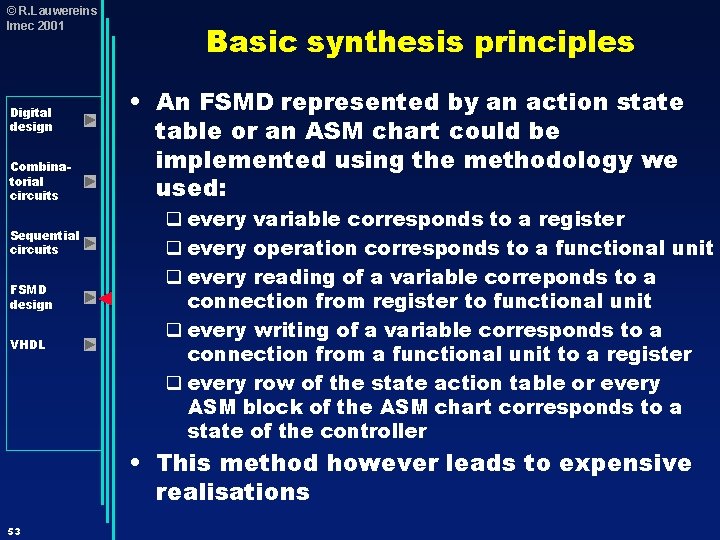
© R. Lauwereins Imec 2001 Digital design Combinatorial circuits Sequential circuits FSMD design VHDL Basic synthesis principles • An FSMD represented by an action state table or an ASM chart could be implemented using the methodology we used: q every variable corresponds to a register q every operation corresponds to a functional unit q every reading of a variable correponds to a connection from register to functional unit q every writing of a variable corresponds to a connection from a functional unit to a register q every row of the state action table or every ASM block of the ASM chart corresponds to a state of the controller • This method however leads to expensive realisations 53
© R. Lauwereins Imec 2001 Digital design Combinatorial circuits Sequential circuits FSMD design VHDL Basic synthesis principles • Minimization requires two steps: q First, the controller can be minimized by ðminimizing the number of states via combining equivalent states ðchoosing the best state encoding scheme ðselecting the appropriate flip-flop type ðminimizing the next state and output logic q Second, the data path should be minimized according to the principles already mentioned: 54 ðWhen the life time of 2 variables is non-overlapping, both can be stored in the same register: register sharing
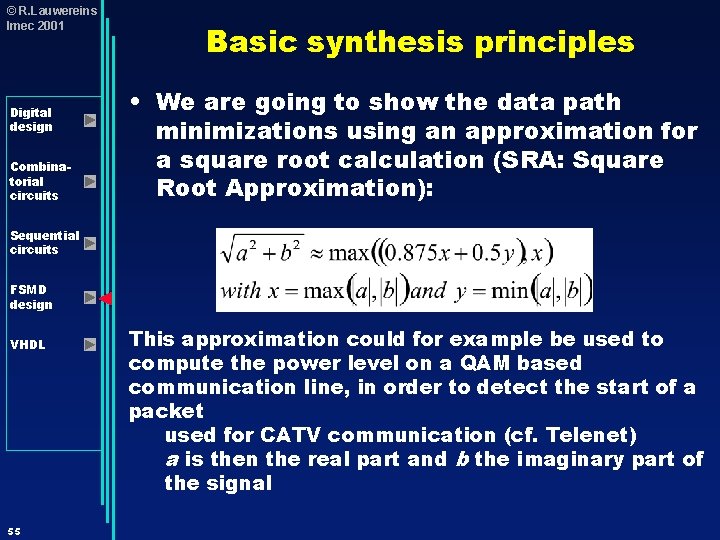
© R. Lauwereins Imec 2001 Digital design Combinatorial circuits Basic synthesis principles • We are going to show the data path minimizations using an approximation for a square root calculation (SRA: Square Root Approximation): Sequential circuits FSMD design VHDL 55 This approximation could for example be used to compute the power level on a QAM based communication line, in order to detect the start of a packet used for CATV communication (cf. Telenet) a is then the real part and b the imaginary part of the signal
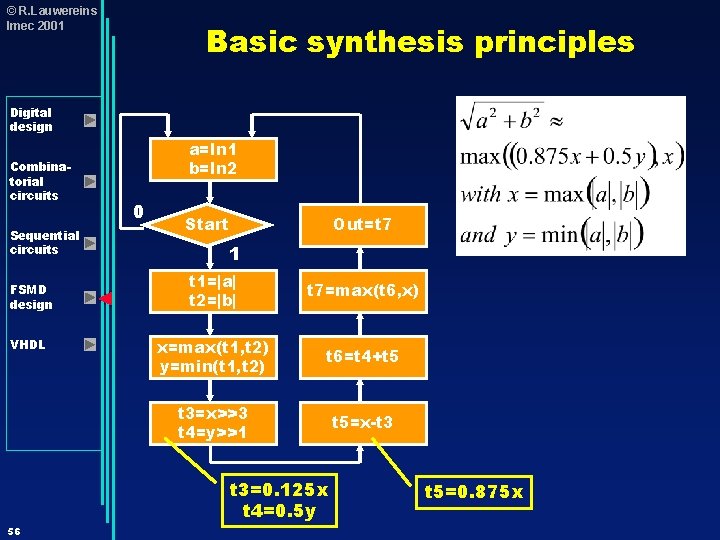
© R. Lauwereins Imec 2001 Basic synthesis principles Digital design Combinatorial circuits Sequential circuits FSMD design VHDL a=In 1 b=In 2 0 Start Out=t 7 1 t 1=|a| t 2=|b| t 7=max(t 6, x) x=max(t 1, t 2) y=min(t 1, t 2) t 6=t 4+t 5 t 3=x>>3 t 4=y>>1 t 5=x-t 3 t 3=0. 125 x t 4=0. 5 y 56 t 5=0. 875 x
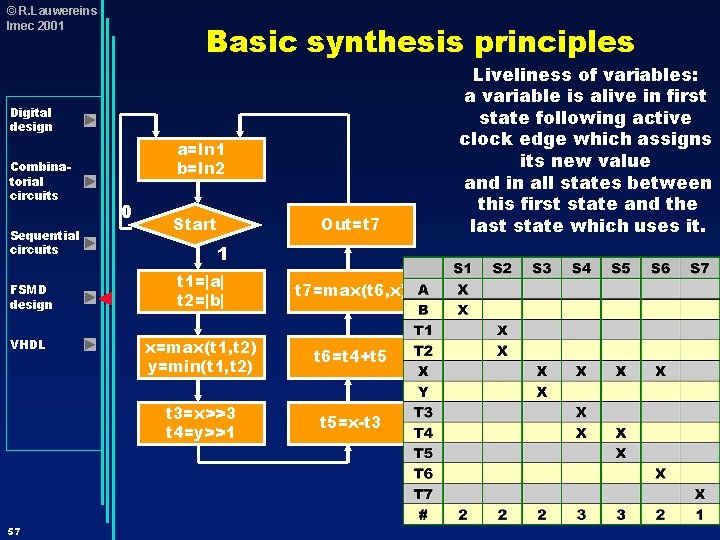
© R. Lauwereins Imec 2001 Basic synthesis principles Digital design Combinatorial circuits Sequential circuits FSMD design VHDL 57 a=In 1 b=In 2 0 Start Out=t 7 1 t 1=|a| t 2=|b| t 7=max(t 6, x) x=max(t 1, t 2) y=min(t 1, t 2) t 6=t 4+t 5 t 3=x>>3 t 4=y>>1 t 5=x-t 3 Liveliness of variables: a variable is alive in first state following active clock edge which assigns its new value and in all states between this first state and the last state which uses it.
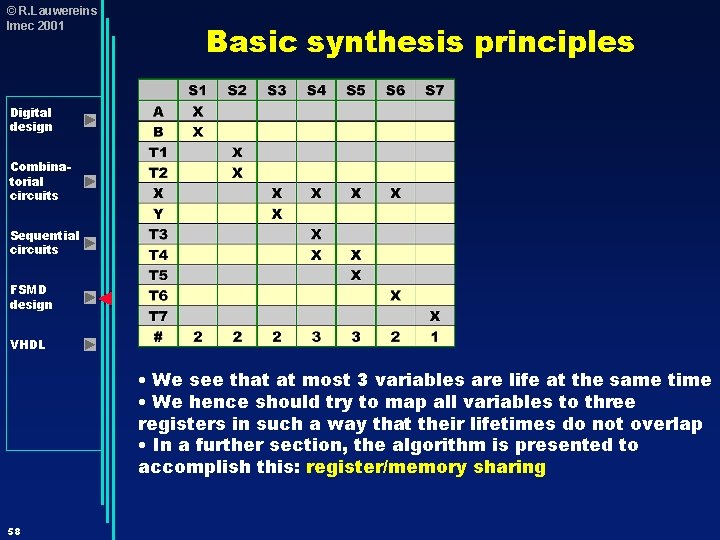
© R. Lauwereins Imec 2001 Basic synthesis principles Digital design Combinatorial circuits Sequential circuits FSMD design VHDL • We see that at most 3 variables are life at the same time • We hence should try to map all variables to three registers in such a way that their lifetimes do not overlap • In a further section, the algorithm is presented to accomplish this: register/memory sharing 58
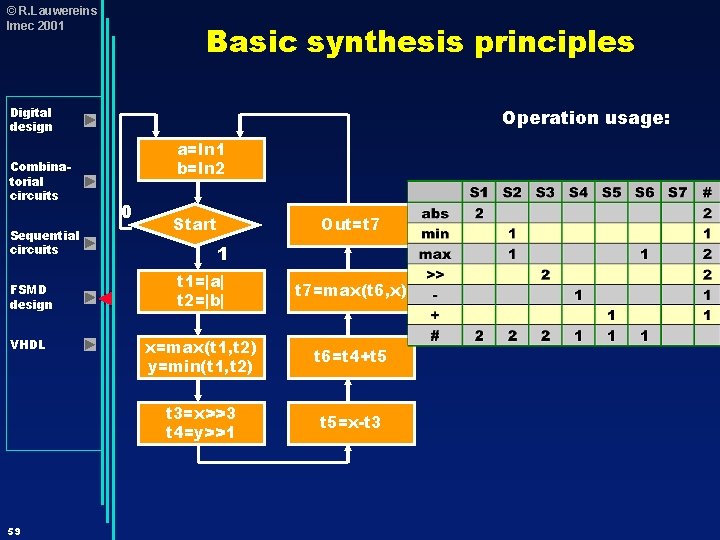
© R. Lauwereins Imec 2001 Basic synthesis principles Digital design Combinatorial circuits Sequential circuits FSMD design VHDL 59 Operation usage: a=In 1 b=In 2 0 Start Out=t 7 1 t 1=|a| t 2=|b| t 7=max(t 6, x) x=max(t 1, t 2) y=min(t 1, t 2) t 6=t 4+t 5 t 3=x>>3 t 4=y>>1 t 5=x-t 3
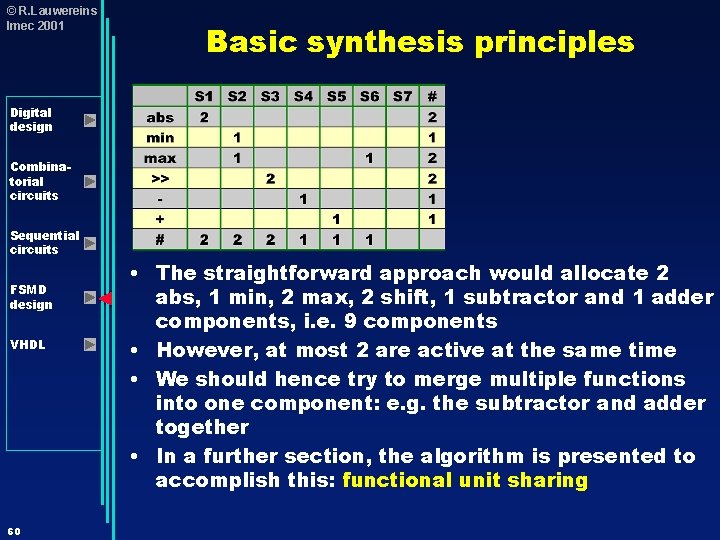
© R. Lauwereins Imec 2001 Basic synthesis principles Digital design Combinatorial circuits Sequential circuits FSMD design VHDL 60 • The straightforward approach would allocate 2 abs, 1 min, 2 max, 2 shift, 1 subtractor and 1 adder components, i. e. 9 components • However, at most 2 are active at the same time • We should hence try to merge multiple functions into one component: e. g. the subtractor and adder together • In a further section, the algorithm is presented to accomplish this: functional unit sharing
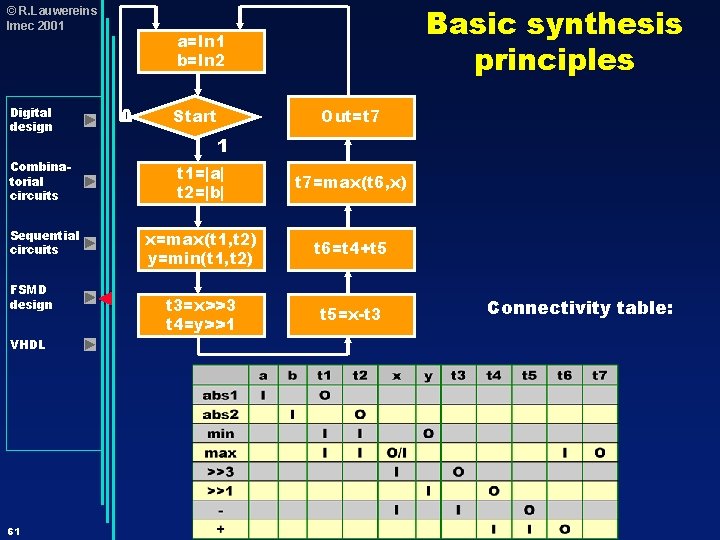
© R. Lauwereins Imec 2001 Digital design Combinatorial circuits Sequential circuits FSMD design VHDL 61 Basic synthesis principles a=In 1 b=In 2 0 Start Out=t 7 1 t 1=|a| t 2=|b| t 7=max(t 6, x) x=max(t 1, t 2) y=min(t 1, t 2) t 6=t 4+t 5 t 3=x>>3 t 4=y>>1 t 5=x-t 3 Connectivity table:
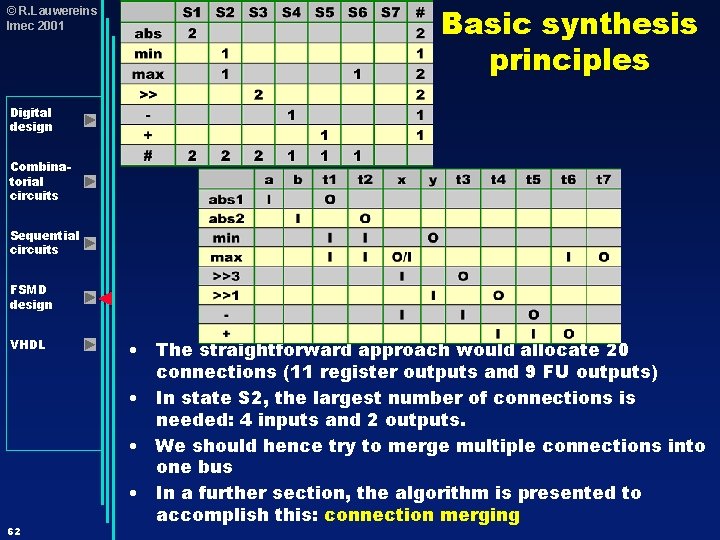
© R. Lauwereins Imec 2001 Basic synthesis principles Digital design Combinatorial circuits Sequential circuits FSMD design VHDL 62 • The straightforward approach would allocate 20 connections (11 register outputs and 9 FU outputs) • In state S 2, the largest number of connections is needed: 4 inputs and 2 outputs. • We should hence try to merge multiple connections into one bus • In a further section, the algorithm is presented to accomplish this: connection merging
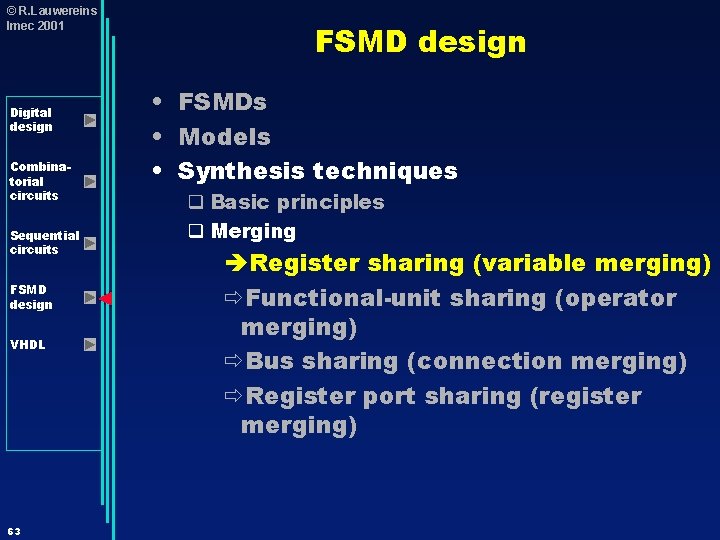
© R. Lauwereins Imec 2001 Digital design Combinatorial circuits Sequential circuits FSMD design VHDL 63 FSMD design • FSMDs • Models • Synthesis techniques q Basic principles q Merging èRegister sharing (variable merging) ðFunctional-unit sharing (operator merging) ðBus sharing (connection merging) ðRegister port sharing (register merging)

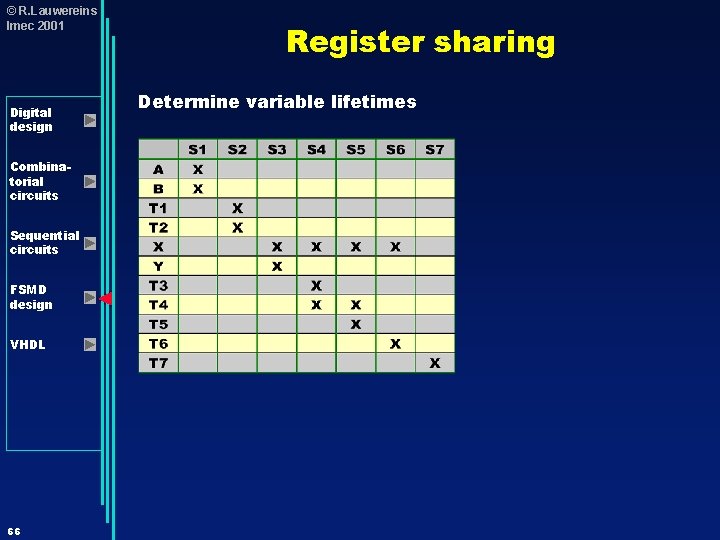
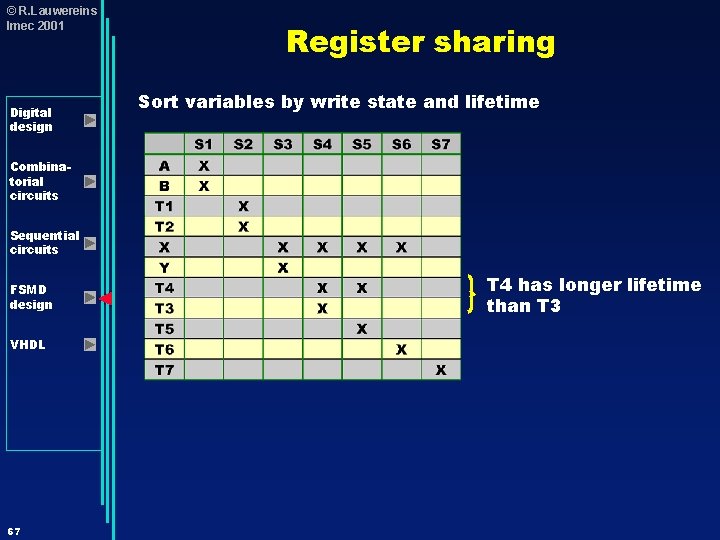
© R. Lauwereins Imec 2001 Digital design Combinatorial circuits Sequential circuits FSMD design VHDL 64 Register sharing • Definition of the lifetime of a variable: q The set of states in which the variable is alive q starting at the state following the state in which it is assigned a new value (write state) q ending at every state in which its value is used (read state) q and all the states on each path between the write state and a read state. q Note that a variable may be written more than once (multiple assignments) q and that a single written value may be read multiple times. • After determining the lifetime of the variables, we have to group variables with non-overlapping lifetimes and assign each group to a single variable. We should hence find the smallest number of groups.
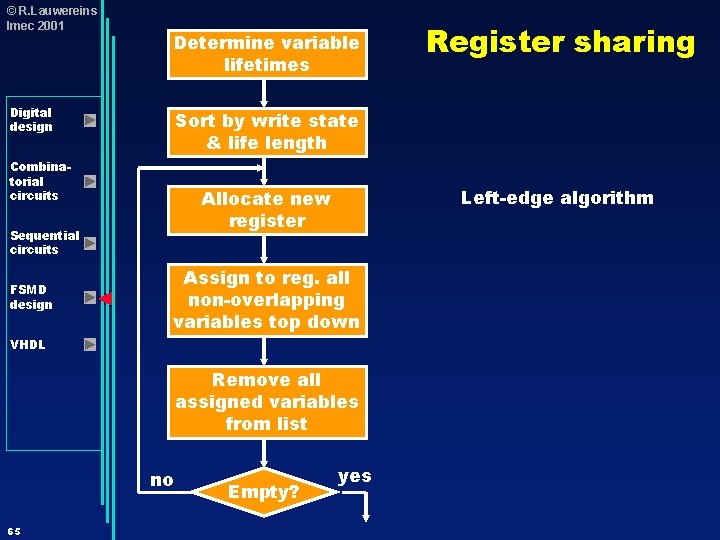
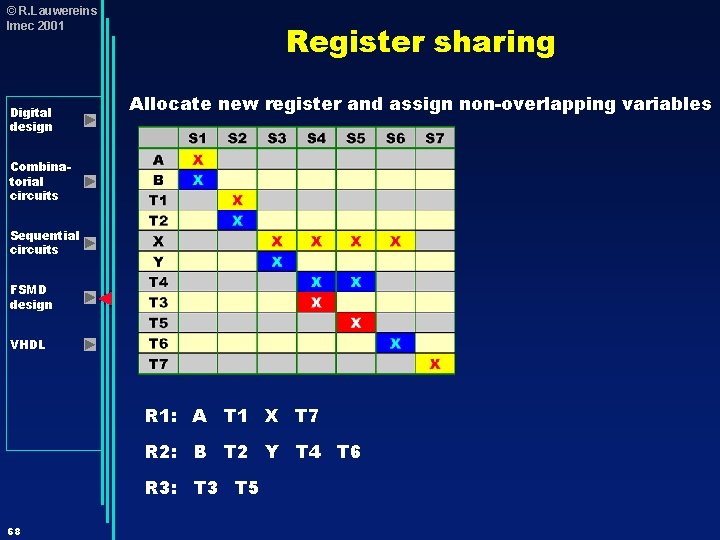
© R. Lauwereins Imec 2001 Determine variable lifetimes Digital design Sort by write state & life length Combinatorial circuits Left-edge algorithm Allocate new register Sequential circuits FSMD design Assign to reg. all non-overlapping variables top down VHDL Remove all assigned variables from list no 65 Register sharing Empty? yes
© R. Lauwereins Imec 2001 Digital design Combinatorial circuits Sequential circuits FSMD design VHDL 66 Register sharing Determine variable lifetimes
© R. Lauwereins Imec 2001 Digital design Register sharing Sort variables by write state and lifetime Combinatorial circuits Sequential circuits FSMD design VHDL 67 T 4 has longer lifetime than T 3
© R. Lauwereins Imec 2001 Digital design Register sharing Allocate new register and assign non-overlapping variables Combinatorial circuits Sequential circuits FSMD design VHDL R 1: A T 1 X T 7 R 2: B T 2 Y T 4 T 6 R 3: T 3 T 5 68
© R. Lauwereins Imec 2001 Register sharing In 1 In 2 Digital design Combinatorial circuits MUX MUX R 1: a, t 1, x, t 7 R 2: b, t 2, y t 4, t 6 R 3: t 3, t 5 Sequential circuits FSMD design VHDL |a| Out 69 |b| min max + - >>1 >>3
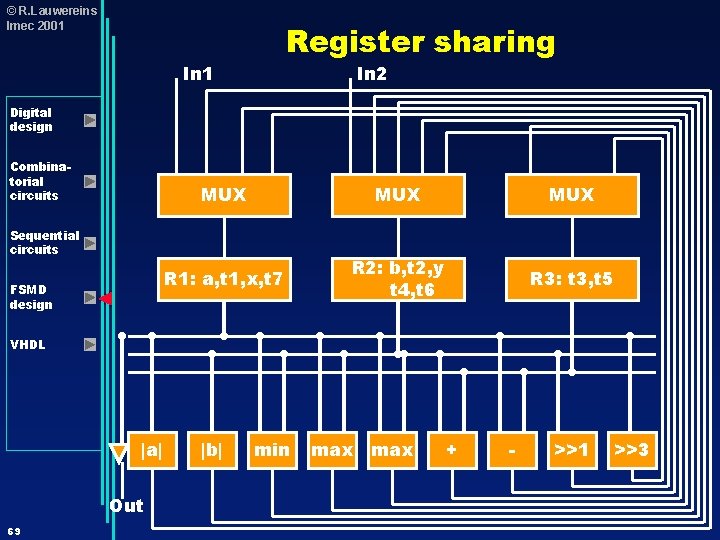
© R. Lauwereins Imec 2001 Digital design Combinatorial circuits Sequential circuits FSMD design VHDL 70 Register sharing • The left-edge algorithm finds an assignment with the smallest number of registers • There exist however multiple possible variable-to-register assignments with the smallest number of registers • We hence can use a second cost criterion to find the best assignment q First criterion: smallest number of registers q Second criterion: minimize the number of ports of the MUX and DEMUX circuits ðpreferably map two variables to the same register that are the same (e. g. left) input of the same functional unit ðpreferably map two variables to the
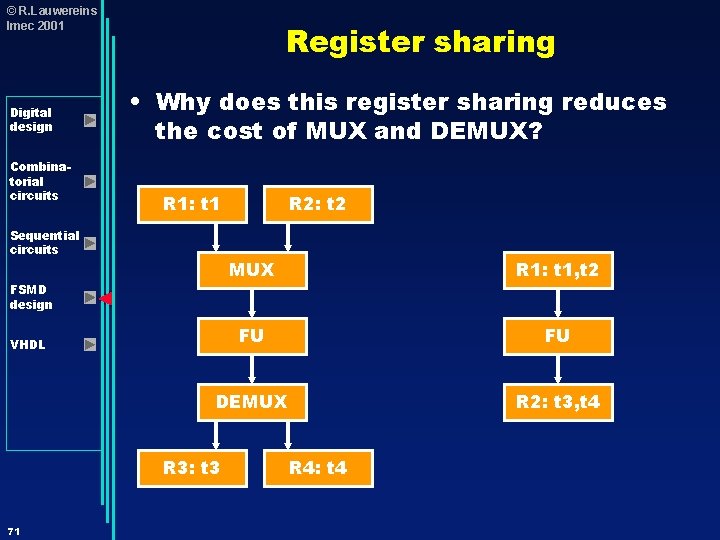
© R. Lauwereins Imec 2001 Digital design Combinatorial circuits Register sharing • Why does this register sharing reduces the cost of MUX and DEMUX? R 1: t 1 Sequential circuits MUX R 1: t 1, t 2 FU FU DEMUX R 2: t 3, t 4 FSMD design VHDL R 3: t 3 71 R 2: t 2 R 4: t 4
© R. Lauwereins Imec 2001 Digital design Combinatorial circuits Sequential circuits FSMD design VHDL 72 Register sharing • We should hence determine which variables are the same input of the same functional unit and which variables are the same output of the same FU • However, at this stage of the design, before operator merging, each operator is implemented in a different FU such that no variables share the same input or output

© R. Lauwereins Imec 2001 Digital design Combinatorial circuits Sequential circuits FSMD design VHDL Register sharing • Does this mean that we should do operator merging before register sharing? q Register sharing: (1) minimize registers and (2) minimize size of MUX/DEMUX ðThe latter is only known after operator merging q Operator merging: merge operators where the combined cost of MUX/DEMUX/Combined. FU is smaller than the cost of two FUs ðThe cost of the MUX/DEMUX is only known after register merging q This deadlock situation is typical for all optimization steps in hardware synthesis (and software compilation)!! Solution: 73 ðFirst optimize those things that give the largest cost improvement; use
© R. Lauwereins Imec 2001 Digital design Combinatorial circuits Sequential circuits FSMD design VHDL 74 Register sharing • What gives the biggest cost influence: register sharing or operator merging q In most cases, register sharing has a higher cost impact: ðthere are more variables than FUs ðmerging two registers in one does not increase the cost of the register; merging two different FUs in one makes this single FU more expensive than each of the original FUs separately ðit is easier to quickly estimate which operators will be merged, than to see which variables will be merged q We hence mostly do register sharing first
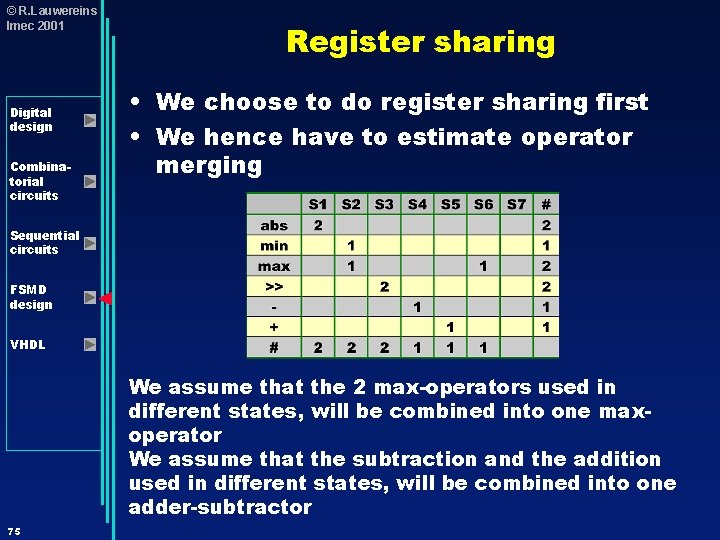
© R. Lauwereins Imec 2001 Digital design Combinatorial circuits Register sharing • We choose to do register sharing first • We hence have to estimate operator merging Sequential circuits FSMD design VHDL We assume that the 2 max-operators used in different states, will be combined into one maxoperator We assume that the subtraction and the addition used in different states, will be combined into one adder-subtractor 75
© R. Lauwereins Imec 2001 Digital design Combinatorial circuits Sequential circuits FSMD design VHDL 76 Register sharing • Method for register sharing, combined with MUX/DEMUX cost reduction: q Build a compatibility graph q Perform a max-cut graph partitioning
© R. Lauwereins Imec 2001 Digital design Combinatorial circuits Sequential circuits FSMD design VHDL 77 Register sharing • Build a compatibility graph q Nodes are variables ðHint: sort the nodes graphically according to the left-edge merging since this will already separate incompatible variables with overlapping lifetime q Incompatibility edges are drawn between two variables with overlapping lifetime: they cannot be merged q Priority edges are drawn between two variables that are the same input of the same FU or the same output of the same FU. A weight on this edge indicates how many times the two variables drive the same input of the same FU plus how many times they are the same output of the same FU.
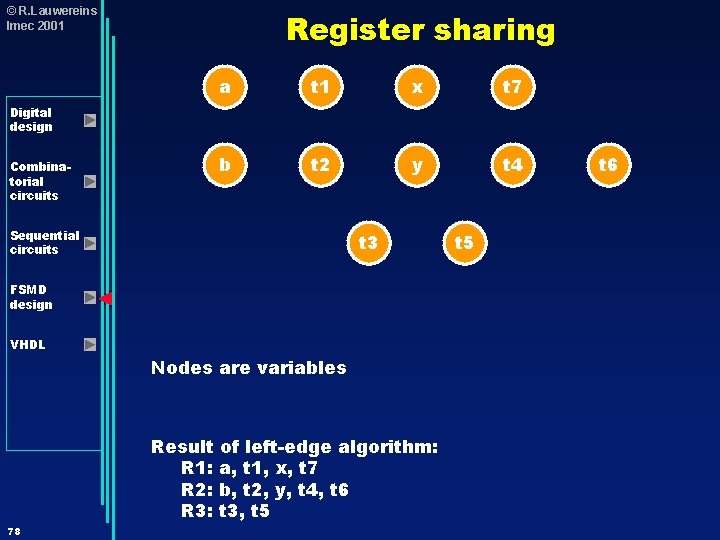
© R. Lauwereins Imec 2001 Register sharing a t 1 x t 7 b t 2 y t 4 Digital design Combinatorial circuits Sequential circuits t 3 FSMD design VHDL Nodes are variables Result of left-edge algorithm: R 1: a, t 1, x, t 7 R 2: b, t 2, y, t 4, t 6 R 3: t 3, t 5 78 t 5 t 6
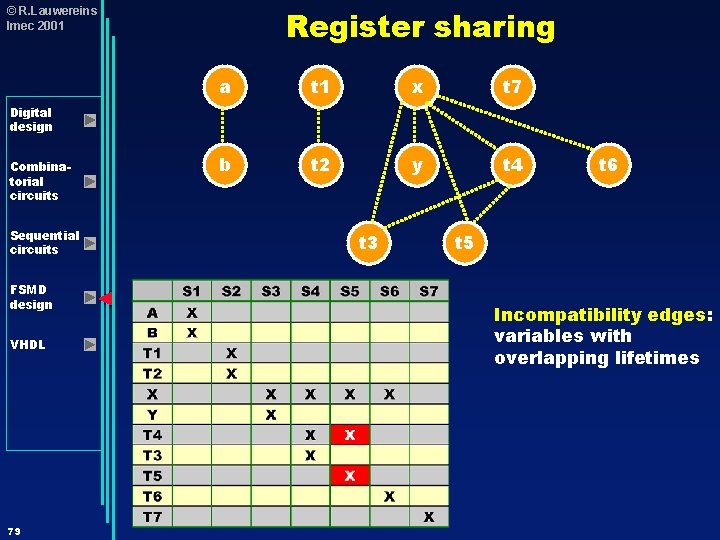
Register sharing © R. Lauwereins Imec 2001 a t 1 x t 7 b t 2 y t 4 Digital design Combinatorial circuits Sequential circuits FSMD design VHDL 79 t 3 t 6 t 5 Incompatibility edges: variables with overlapping lifetimes
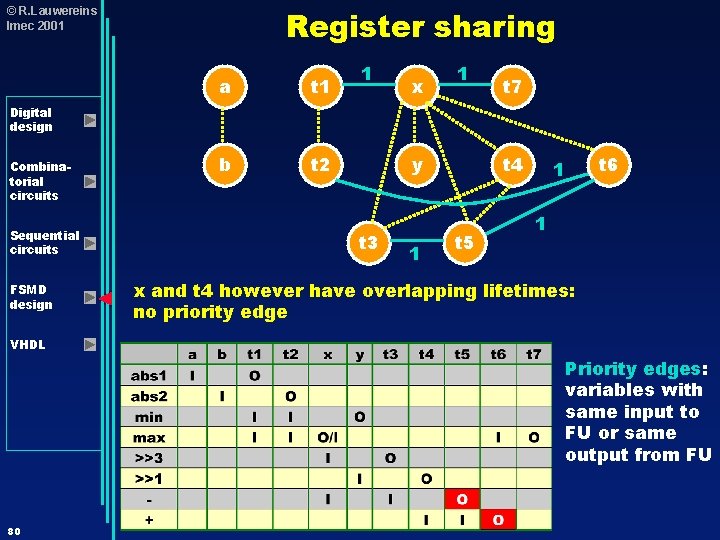
Register sharing © R. Lauwereins Imec 2001 a t 1 b t 2 1 x 1 t 7 Digital design Combinatorial circuits Sequential circuits FSMD design y t 3 1 t 4 t 5 1 t 6 1 x and t 4 however have overlapping lifetimes: no priority edge VHDL Priority edges: variables with same input to FU or same output from FU 80
© R. Lauwereins Imec 2001 Digital design Combinatorial circuits Sequential circuits FSMD design VHDL 81 Register sharing • Perform a max-cut graph partitioning q Divide the graph in the minimum number of clusters of compatible nodes, such that the total weight is maximized. q Total weight is computed by summing all weights of priority edges within a cluster (a priority edge crossing cluster boundaries is not counted) • We are going to do this optimization visually • See course on optimization techniques for max-cut graph partitioning optimization algorithm
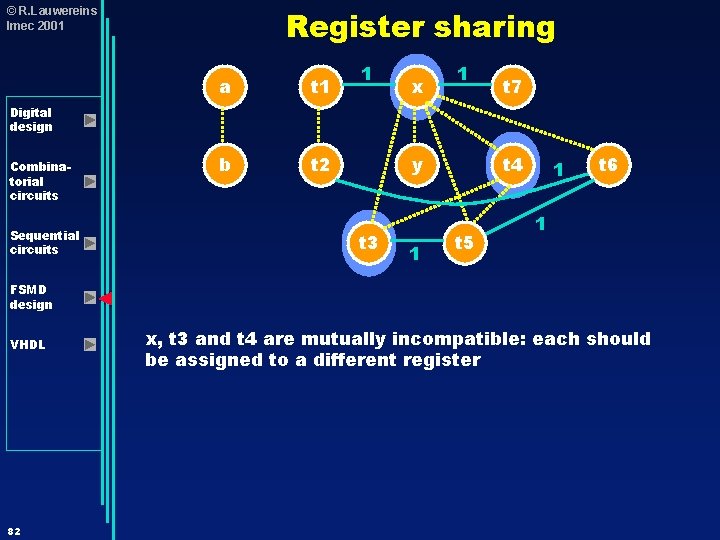
Register sharing © R. Lauwereins Imec 2001 a t 1 b t 2 1 x 1 t 7 Digital design Combinatorial circuits Sequential circuits y t 3 1 t 4 t 5 1 t 6 1 FSMD design VHDL 82 x, t 3 and t 4 are mutually incompatible: each should be assigned to a different register
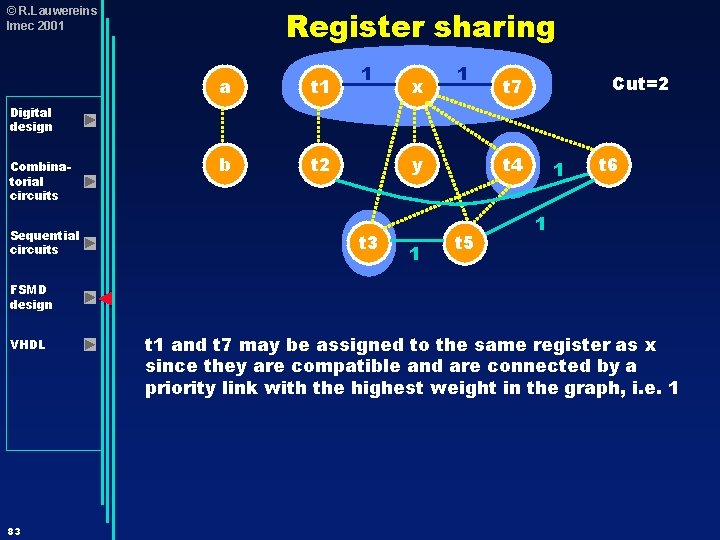
Register sharing © R. Lauwereins Imec 2001 a t 1 b t 2 1 x 1 Cut=2 t 7 Digital design Combinatorial circuits Sequential circuits y t 3 1 t 4 t 5 1 t 6 1 FSMD design VHDL 83 t 1 and t 7 may be assigned to the same register as x since they are compatible and are connected by a priority link with the highest weight in the graph, i. e. 1
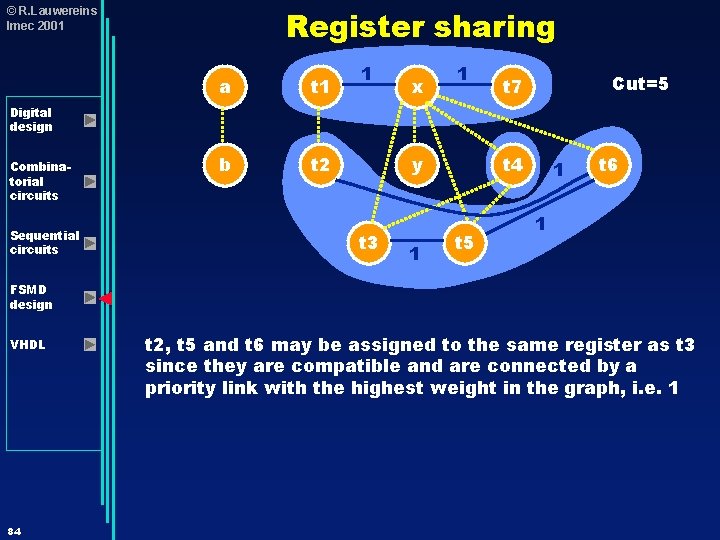
Register sharing © R. Lauwereins Imec 2001 a t 1 b t 2 1 x 1 Cut=5 t 7 Digital design Combinatorial circuits Sequential circuits y t 3 1 t 4 t 5 1 t 6 1 FSMD design VHDL 84 t 2, t 5 and t 6 may be assigned to the same register as t 3 since they are compatible and are connected by a priority link with the highest weight in the graph, i. e. 1
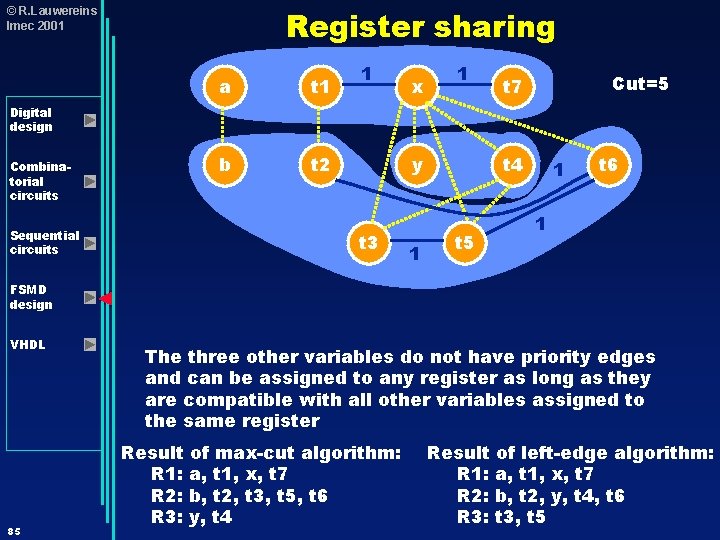
Register sharing © R. Lauwereins Imec 2001 a t 1 b t 2 1 x 1 Cut=5 t 7 Digital design Combinatorial circuits Sequential circuits y t 3 1 t 4 t 5 1 t 6 1 FSMD design VHDL 85 The three other variables do not have priority edges and can be assigned to any register as long as they are compatible with all other variables assigned to the same register Result of max-cut algorithm: R 1: a, t 1, x, t 7 R 2: b, t 2, t 3, t 5, t 6 R 3: y, t 4 Result of left-edge algorithm: R 1: a, t 1, x, t 7 R 2: b, t 2, y, t 4, t 6 R 3: t 3, t 5
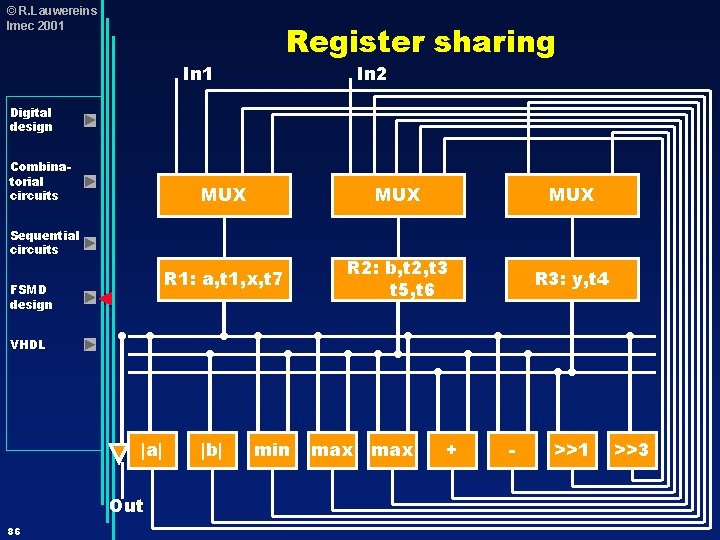
© R. Lauwereins Imec 2001 Register sharing In 1 In 2 Digital design Combinatorial circuits MUX MUX R 1: a, t 1, x, t 7 R 2: b, t 2, t 3 t 5, t 6 R 3: y, t 4 Sequential circuits FSMD design VHDL |a| Out 86 |b| min max + - >>1 >>3
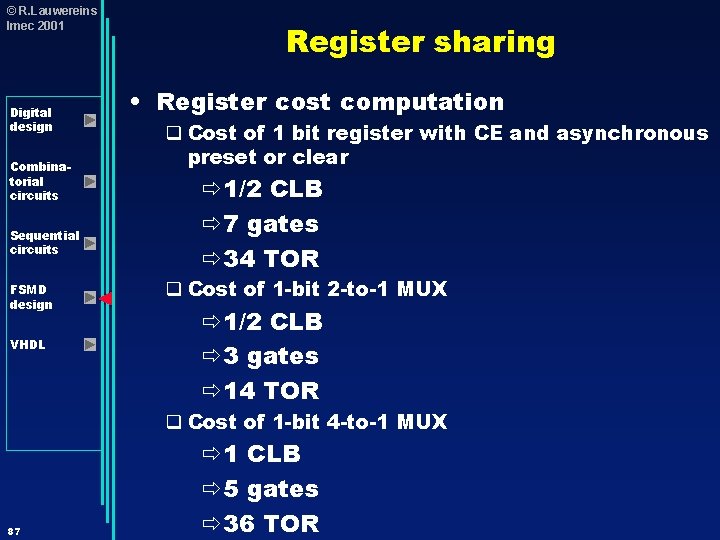
© R. Lauwereins Imec 2001 Digital design Combinatorial circuits Sequential circuits FSMD design VHDL Register sharing • Register cost computation q Cost of 1 bit register with CE and asynchronous preset or clear ð 1/2 CLB ð 7 gates ð 34 TOR q Cost of 1 -bit 2 -to-1 MUX ð 1/2 CLB ð 3 gates ð 14 TOR q Cost of 1 -bit 4 -to-1 MUX 87 ð 1 CLB ð 5 gates ð 36 TOR
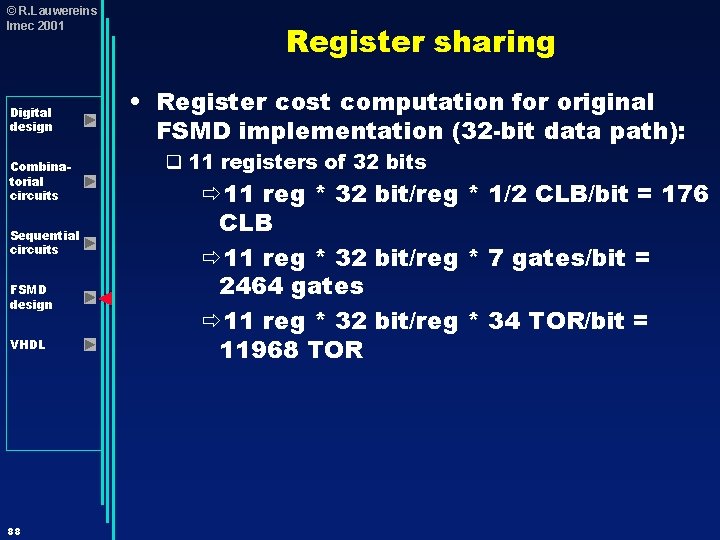
© R. Lauwereins Imec 2001 Digital design Combinatorial circuits Sequential circuits FSMD design VHDL 88 Register sharing • Register cost computation for original FSMD implementation (32 -bit data path): q 11 registers of 32 bits ð 11 reg * 32 bit/reg * 1/2 CLB/bit = 176 CLB ð 11 reg * 32 bit/reg * 7 gates/bit = 2464 gates ð 11 reg * 32 bit/reg * 34 TOR/bit = 11968 TOR
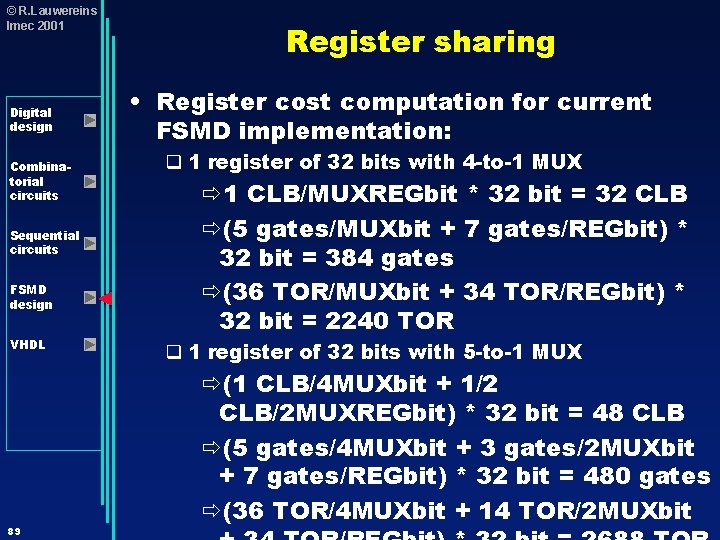
© R. Lauwereins Imec 2001 Digital design Combinatorial circuits Sequential circuits FSMD design VHDL 89 Register sharing • Register cost computation for current FSMD implementation: q 1 register of 32 bits with 4 -to-1 MUX ð 1 CLB/MUXREGbit * 32 bit = 32 CLB ð(5 gates/MUXbit + 7 gates/REGbit) * 32 bit = 384 gates ð(36 TOR/MUXbit + 34 TOR/REGbit) * 32 bit = 2240 TOR q 1 register of 32 bits with 5 -to-1 MUX ð(1 CLB/4 MUXbit + 1/2 CLB/2 MUXREGbit) * 32 bit = 48 CLB ð(5 gates/4 MUXbit + 3 gates/2 MUXbit + 7 gates/REGbit) * 32 bit = 480 gates ð(36 TOR/4 MUXbit + 14 TOR/2 MUXbit
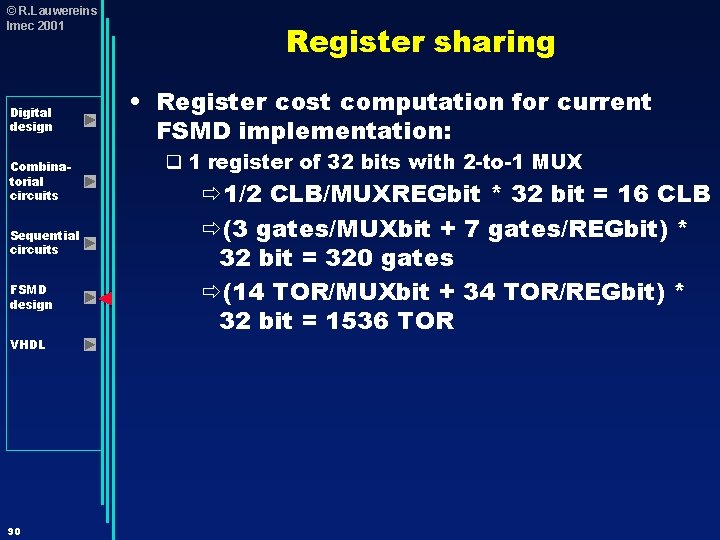
© R. Lauwereins Imec 2001 Digital design Combinatorial circuits Sequential circuits FSMD design VHDL 90 Register sharing • Register cost computation for current FSMD implementation: q 1 register of 32 bits with 2 -to-1 MUX ð 1/2 CLB/MUXREGbit * 32 bit = 16 CLB ð(3 gates/MUXbit + 7 gates/REGbit) * 32 bit = 320 gates ð(14 TOR/MUXbit + 34 TOR/REGbit) * 32 bit = 1536 TOR
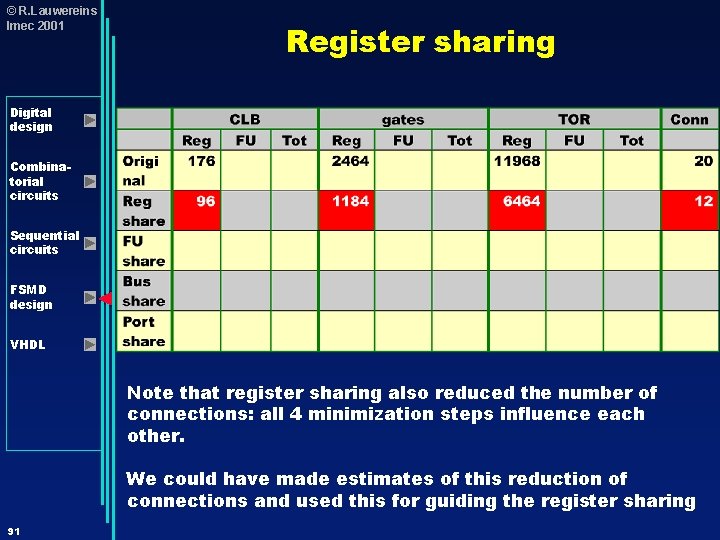
© R. Lauwereins Imec 2001 Register sharing Digital design Combinatorial circuits Sequential circuits FSMD design VHDL Note that register sharing also reduced the number of connections: all 4 minimization steps influence each other. We could have made estimates of this reduction of connections and used this for guiding the register sharing 91
© R. Lauwereins Imec 2001 Digital design Combinatorial circuits Sequential circuits FSMD design VHDL 92 FSMD design • FSMDs • Models • Synthesis techniques q Basic principles q Merging ðRegister sharing (variable merging) èFunctional-unit sharing (operator merging) ðBus sharing (connection merging) ðRegister port sharing (register merging)
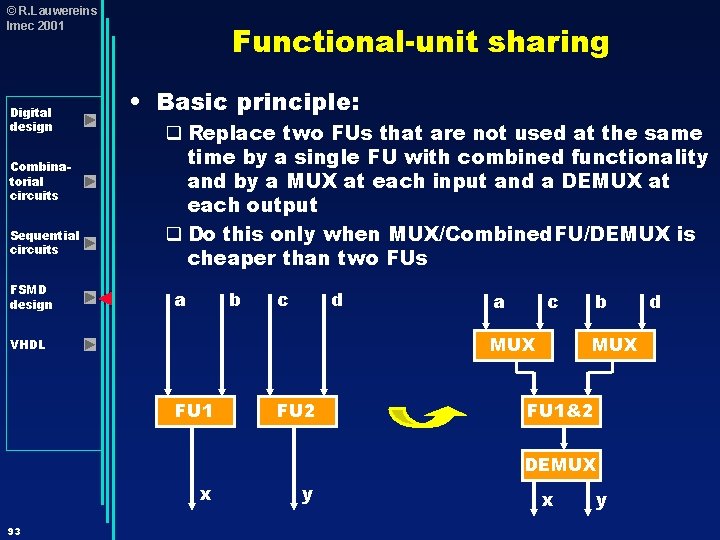
© R. Lauwereins Imec 2001 Digital design Combinatorial circuits Sequential circuits FSMD design Functional-unit sharing • Basic principle: q Replace two FUs that are not used at the same time by a single FU with combined functionality and by a MUX at each input and a DEMUX at each output q Do this only when MUX/Combined. FU/DEMUX is cheaper than two FUs a b c d a c MUX VHDL FU 1 FU 2 b MUX FU 1&2 DEMUX x 93 y x y d
© R. Lauwereins Imec 2001 Digital design Combinatorial circuits Sequential circuits FSMD design VHDL 94 Functional-unit sharing • When register sharing did a correct guess for FU sharing, the cost of the extra MUX and DEMUX will be small since input and output variables of both FUs will often be assigned to the same register • Which units can be shared: q identical units (cf. 2 MAX units) q different units (cf. ADD and SUBTRACT)
© R. Lauwereins Imec 2001 Digital design Combinatorial circuits Sequential circuits FSMD design VHDL 95 Functional-unit sharing • Build a compatibility graph q Nodes are operators q Incompatibility edges are drawn between two operators that are used in the same state: they cannot be merged q Priority edges are drawn between two (or a group of n) operators that can be merged into the same FU. A weight on this edge indicates how large the cost saving is by merging the two (or n) operators.
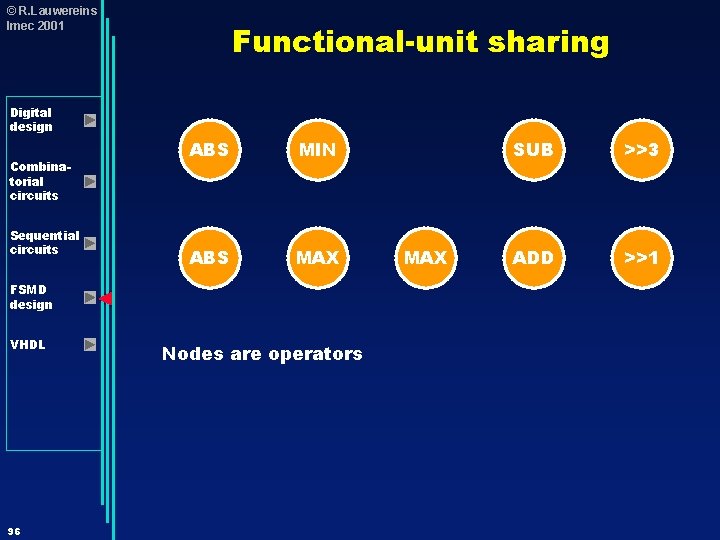
© R. Lauwereins Imec 2001 Functional-unit sharing Digital design Combinatorial circuits Sequential circuits ABS MIN ABS MAX FSMD design VHDL 96 Nodes are operators MAX SUB >>3 ADD >>1
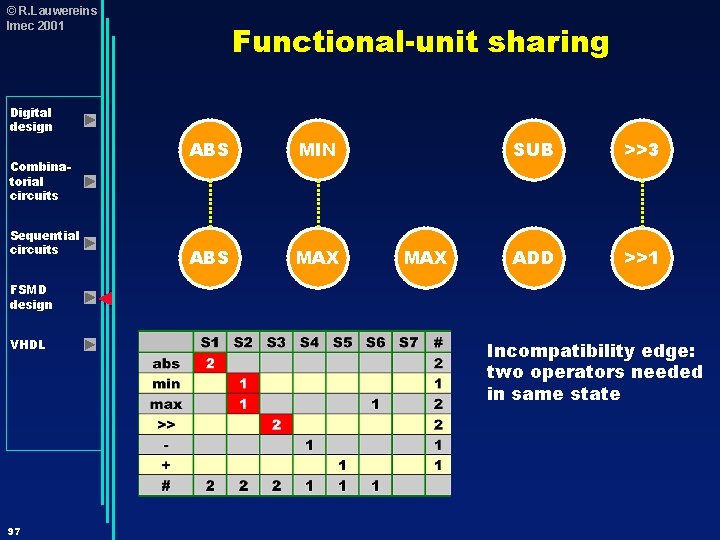
© R. Lauwereins Imec 2001 Functional-unit sharing Digital design Combinatorial circuits Sequential circuits ABS MIN ABS MAX SUB >>3 ADD >>1 FSMD design VHDL 97 Incompatibility edge: two operators needed in same state
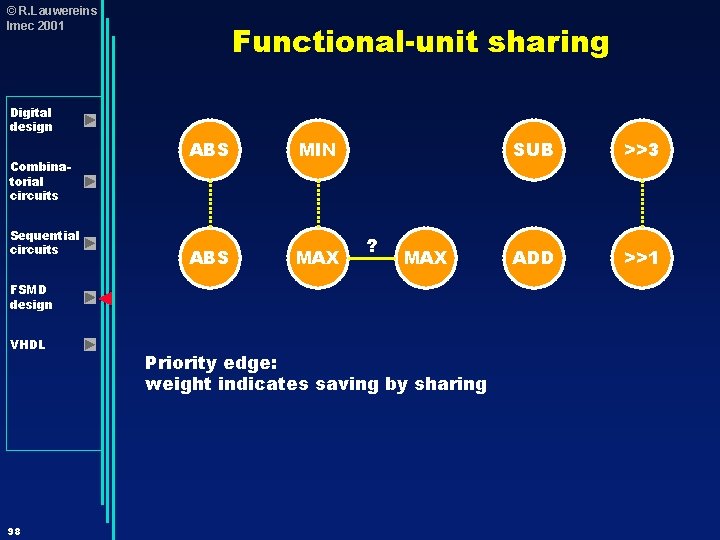
© R. Lauwereins Imec 2001 Functional-unit sharing Digital design Combinatorial circuits Sequential circuits ABS MIN ABS MAX ? MAX FSMD design VHDL 98 Priority edge: weight indicates saving by sharing SUB >>3 ADD >>1
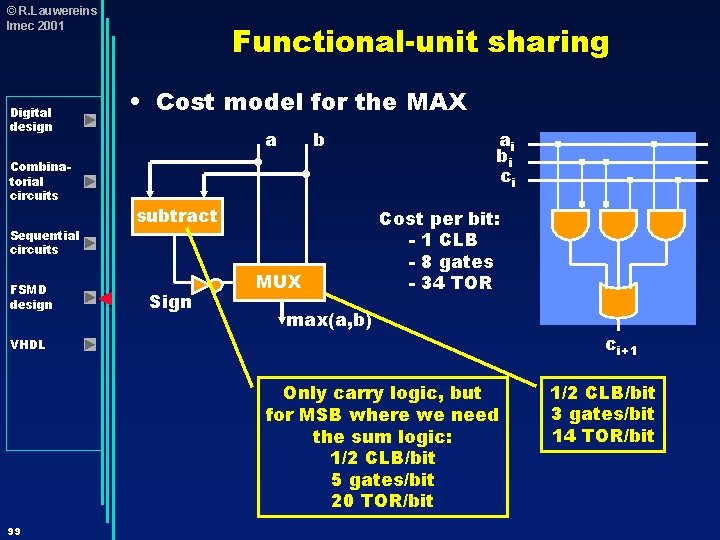
© R. Lauwereins Imec 2001 Digital design Combinatorial circuits Sequential circuits FSMD design Functional-unit sharing • Cost model for the MAX a b subtract Sign MUX ai bi ci Cost per bit: - 1 CLB - 8 gates - 34 TOR max(a, b) VHDL Only carry logic, but for MSB where we need the sum logic: 1/2 CLB/bit 5 gates/bit 20 TOR/bit 99 ci+1 1/2 CLB/bit 3 gates/bit 14 TOR/bit
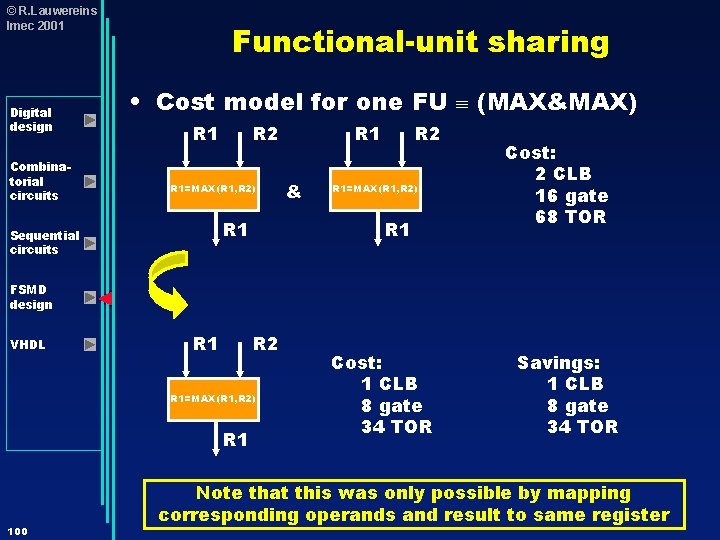
© R. Lauwereins Imec 2001 Digital design Combinatorial circuits Functional-unit sharing • Cost model for one FU (MAX&MAX) R 1 R 2 R 1=MAX(R 1, R 2) R 1 Sequential circuits R 1 & R 2 R 1=MAX(R 1, R 2) R 1 Cost: 2 CLB 16 gate 68 TOR FSMD design VHDL R 1 R 2 R 1=MAX(R 1, R 2) R 1 100 Cost: 1 CLB 8 gate 34 TOR Savings: 1 CLB 8 gate 34 TOR Note that this was only possible by mapping corresponding operands and result to same register
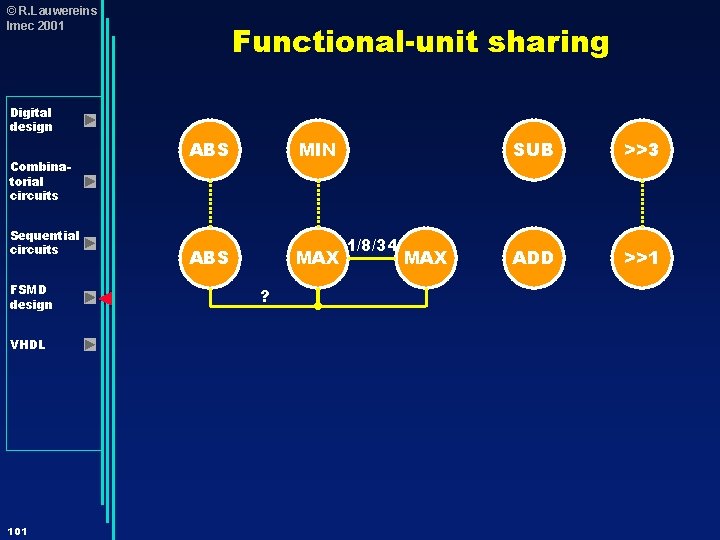
© R. Lauwereins Imec 2001 Functional-unit sharing Digital design Combinatorial circuits Sequential circuits FSMD design VHDL 101 ABS MIN ABS MAX ? 1/8/34 MAX SUB >>3 ADD >>1
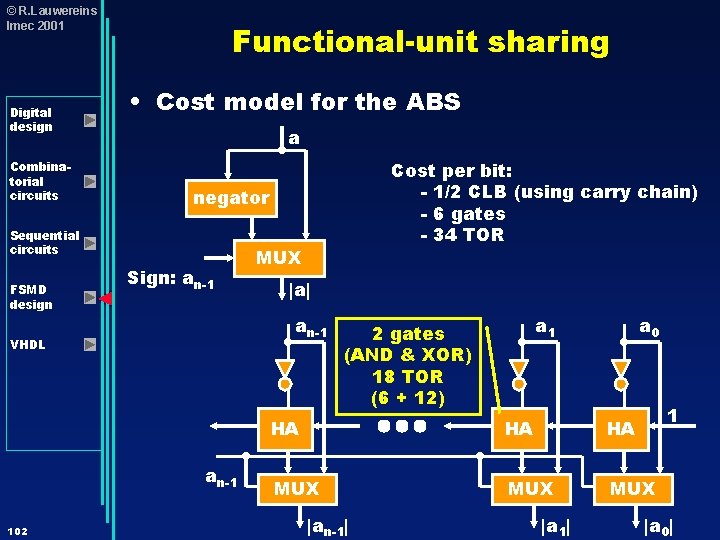
© R. Lauwereins Imec 2001 Digital design Combinatorial circuits Functional-unit sharing • Cost model for the ABS a negator Sequential circuits FSMD design Sign: an-1 MUX |a| an-1 VHDL an-1 102 Cost per bit: - 1/2 CLB (using carry chain) - 6 gates - 34 TOR a 1 2 gates (AND & XOR) 18 TOR (6 + 12) a 0 1 HA HA HA MUX MUX |an-1| |a 0|
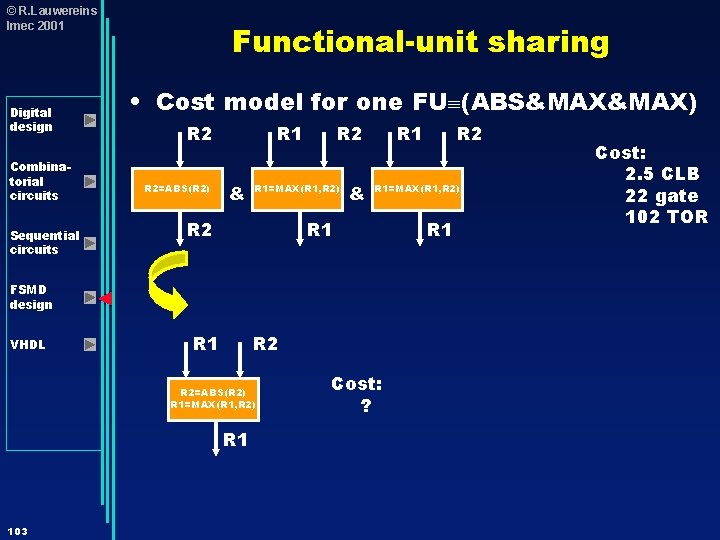
© R. Lauwereins Imec 2001 Digital design Combinatorial circuits Sequential circuits Functional-unit sharing • Cost model for one FU (ABS&MAX) R 2=ABS(R 2) R 1 & R 2 R 1=MAX(R 1, R 2) R 2 & R 1=MAX(R 1, R 2) R 1 FSMD design VHDL R 1 R 2=ABS(R 2) R 1=MAX(R 1, R 2) R 1 103 R 2 Cost: ? R 1 Cost: 2. 5 CLB 22 gate 102 TOR
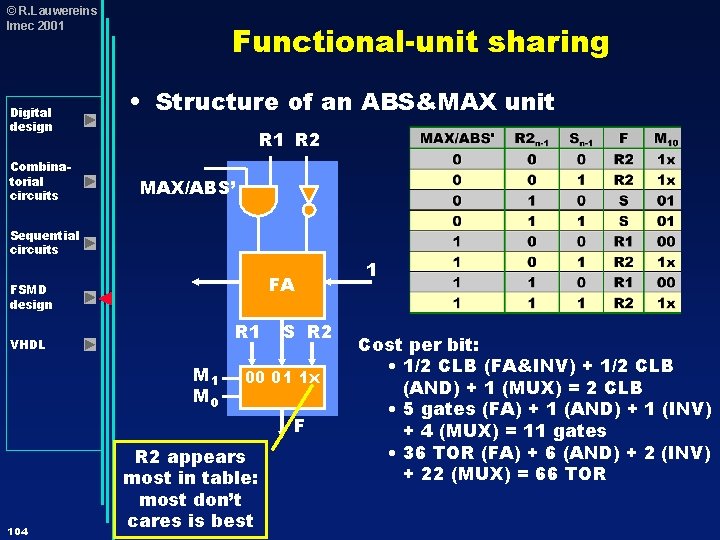
© R. Lauwereins Imec 2001 Digital design Combinatorial circuits Functional-unit sharing • Structure of an ABS&MAX unit R 1 R 2 MAX/ABS’ Sequential circuits FA FSMD design R 1 VHDL M 1 M 0 S R 2 00 01 1 x F 104 R 2 appears most in table: most don’t cares is best 1 Cost per bit: • 1/2 CLB (FA&INV) + 1/2 CLB (AND) + 1 (MUX) = 2 CLB • 5 gates (FA) + 1 (AND) + 1 (INV) + 4 (MUX) = 11 gates • 36 TOR (FA) + 6 (AND) + 2 (INV) + 22 (MUX) = 66 TOR
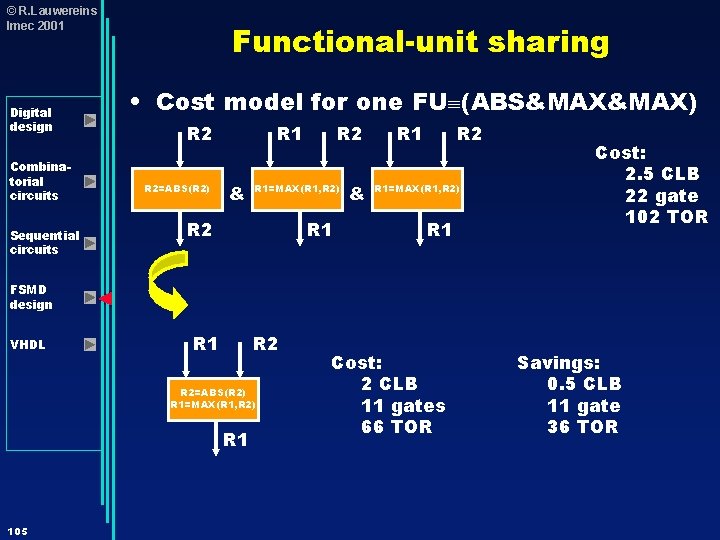
© R. Lauwereins Imec 2001 Digital design Combinatorial circuits Sequential circuits Functional-unit sharing • Cost model for one FU (ABS&MAX) R 2=ABS(R 2) R 1 & R 2 R 1=MAX(R 1, R 2) R 2 R 1 & R 1 R 2 R 1=MAX(R 1, R 2) R 1 Cost: 2. 5 CLB 22 gate 102 TOR FSMD design VHDL R 1 R 2=ABS(R 2) R 1=MAX(R 1, R 2) R 1 105 Cost: 2 CLB 11 gates 66 TOR Savings: 0. 5 CLB 11 gate 36 TOR
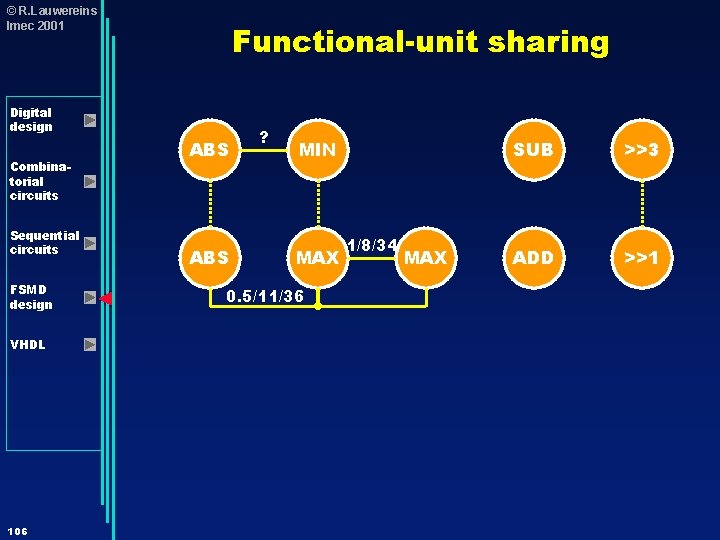
© R. Lauwereins Imec 2001 Functional-unit sharing Digital design Combinatorial circuits Sequential circuits FSMD design VHDL 106 ABS ? MIN MAX 0. 5/11/36 1/8/34 MAX SUB >>3 ADD >>1
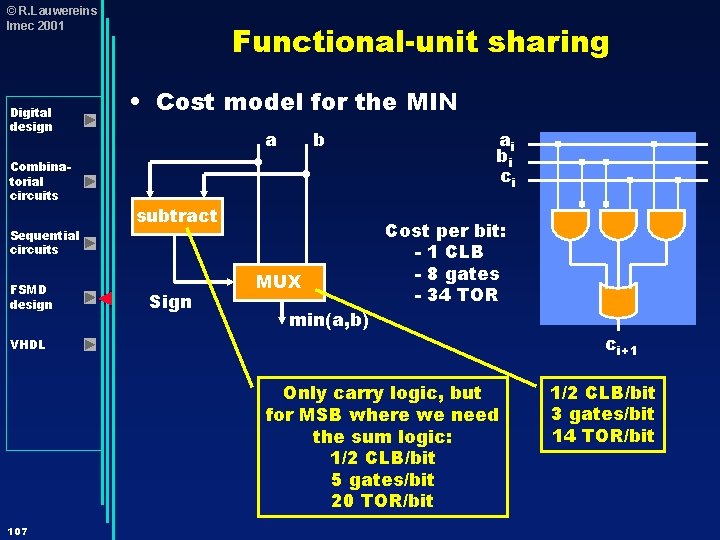
© R. Lauwereins Imec 2001 Digital design Combinatorial circuits Sequential circuits FSMD design Functional-unit sharing • Cost model for the MIN a b subtract Sign MUX min(a, b) ai bi ci Cost per bit: - 1 CLB - 8 gates - 34 TOR VHDL Only carry logic, but for MSB where we need the sum logic: 1/2 CLB/bit 5 gates/bit 20 TOR/bit 107 ci+1 1/2 CLB/bit 3 gates/bit 14 TOR/bit
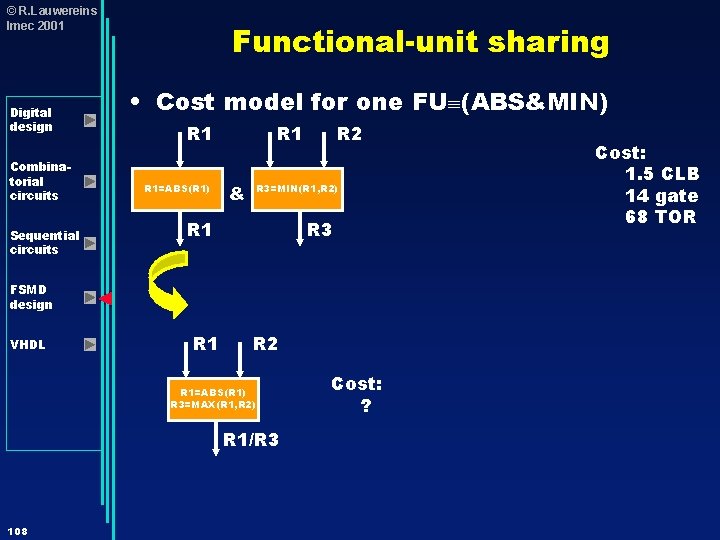
© R. Lauwereins Imec 2001 Digital design Combinatorial circuits Sequential circuits Functional-unit sharing • Cost model for one FU (ABS&MIN) R 1=ABS(R 1) R 1 & R 2 R 3=MIN(R 1, R 2) R 1 R 3 FSMD design VHDL R 1 R 2 R 1=ABS(R 1) R 3=MAX(R 1, R 2) R 1/R 3 108 Cost: ? Cost: 1. 5 CLB 14 gate 68 TOR
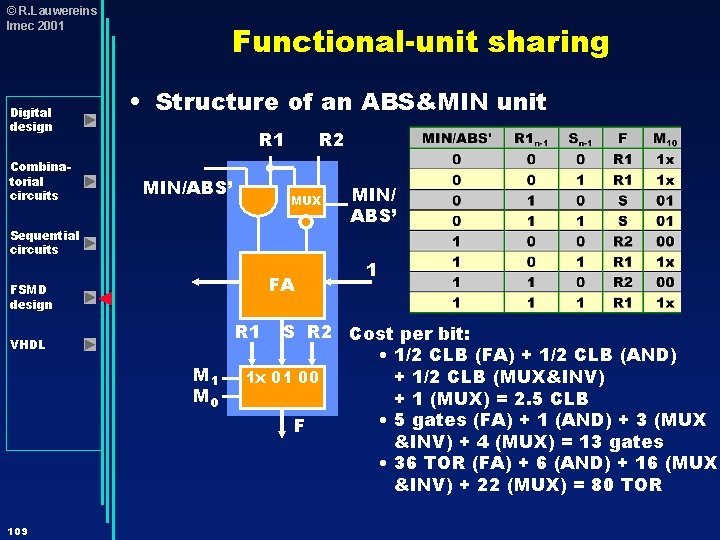
© R. Lauwereins Imec 2001 Digital design Combinatorial circuits Functional-unit sharing • Structure of an ABS&MIN unit R 1 MIN/ABS’ R 2 MUX Sequential circuits FA FSMD design R 1 VHDL M 1 M 0 109 MIN/ ABS’ 1 S R 2 Cost per bit: • 1/2 CLB (FA) + 1/2 CLB (AND) + 1/2 CLB (MUX&INV) 1 x 01 00 + 1 (MUX) = 2. 5 CLB • 5 gates (FA) + 1 (AND) + 3 (MUX F &INV) + 4 (MUX) = 13 gates • 36 TOR (FA) + 6 (AND) + 16 (MUX &INV) + 22 (MUX) = 80 TOR
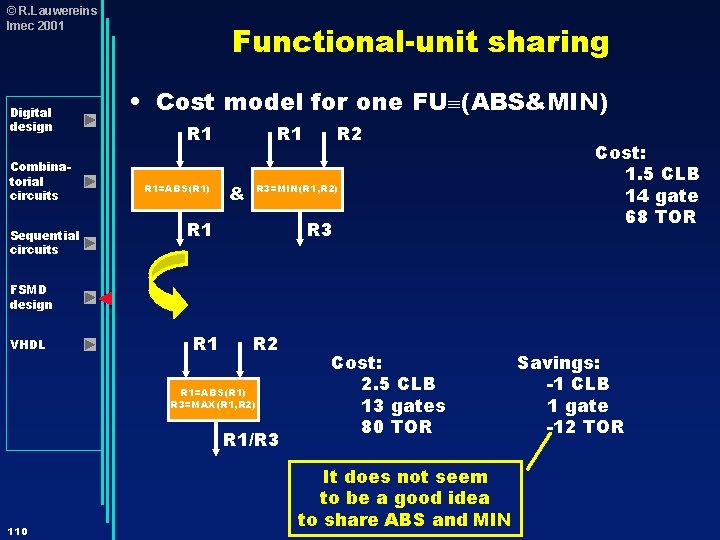
© R. Lauwereins Imec 2001 Digital design Combinatorial circuits Sequential circuits Functional-unit sharing • Cost model for one FU (ABS&MIN) R 1=ABS(R 1) R 1 & R 2 R 3=MIN(R 1, R 2) R 1 R 3 Cost: 1. 5 CLB 14 gate 68 TOR FSMD design VHDL R 1 R 2 R 1=ABS(R 1) R 3=MAX(R 1, R 2) R 1/R 3 110 Cost: 2. 5 CLB 13 gates 80 TOR It does not seem to be a good idea to share ABS and MIN Savings: -1 CLB 1 gate -12 TOR
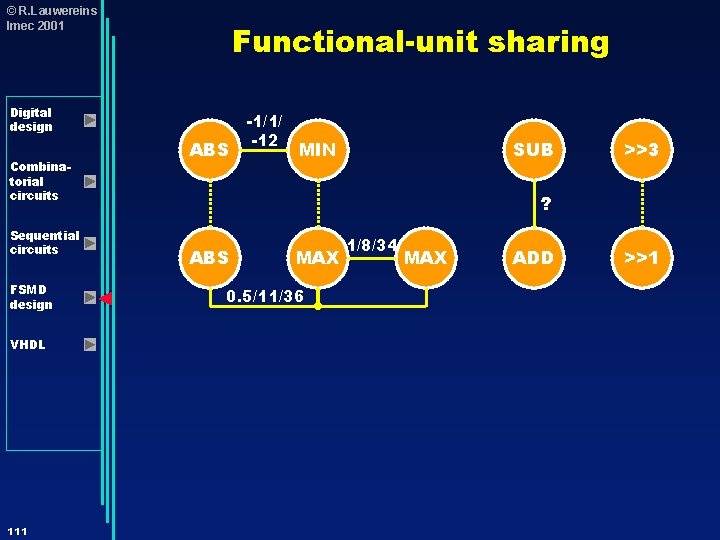
© R. Lauwereins Imec 2001 Functional-unit sharing Digital design Combinatorial circuits Sequential circuits FSMD design VHDL 111 ABS -1/1/ -12 MIN SUB >>3 ? ABS MAX 0. 5/11/36 1/8/34 MAX ADD >>1
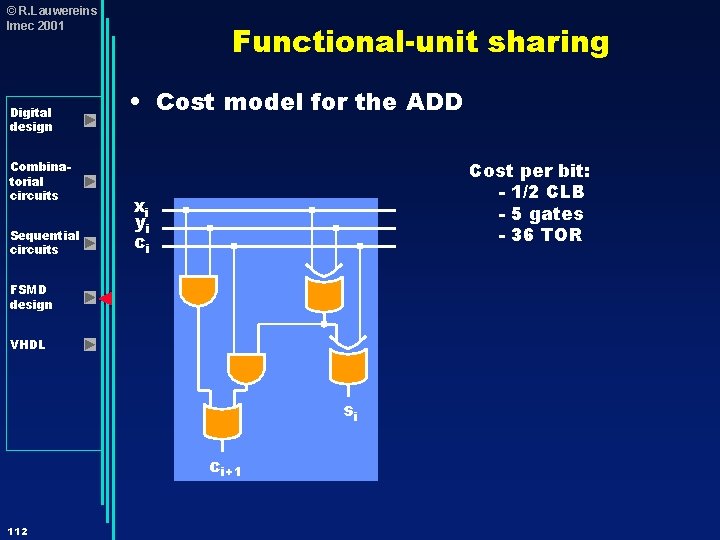
© R. Lauwereins Imec 2001 Digital design Combinatorial circuits Sequential circuits Functional-unit sharing • Cost model for the ADD Cost per bit: - 1/2 CLB - 5 gates - 36 TOR xi yi ci FSMD design VHDL si ci+1 112
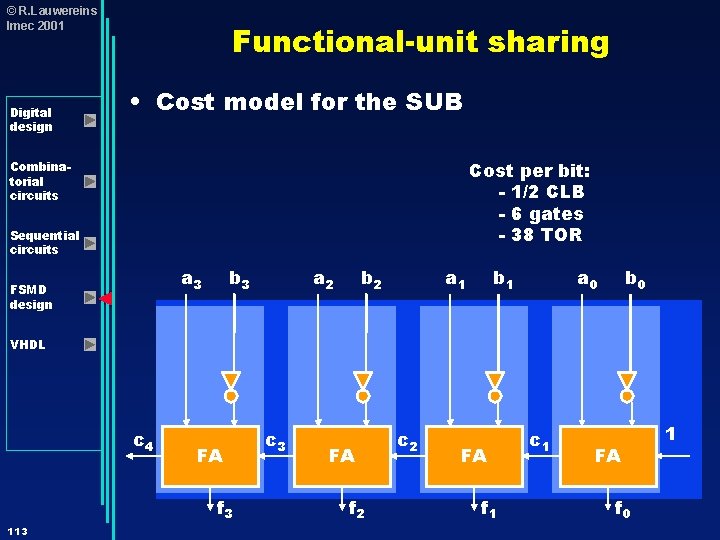
© R. Lauwereins Imec 2001 Digital design Functional-unit sharing • Cost model for the SUB Cost per bit: - 1/2 CLB - 6 gates - 38 TOR Combinatorial circuits Sequential circuits a 3 FSMD design b 3 a 2 b 2 a 1 b 1 a 0 b 0 VHDL c 4 FA f 3 113 c 3 FA f 2 c 2 FA f 1 c 1 FA f 0 1
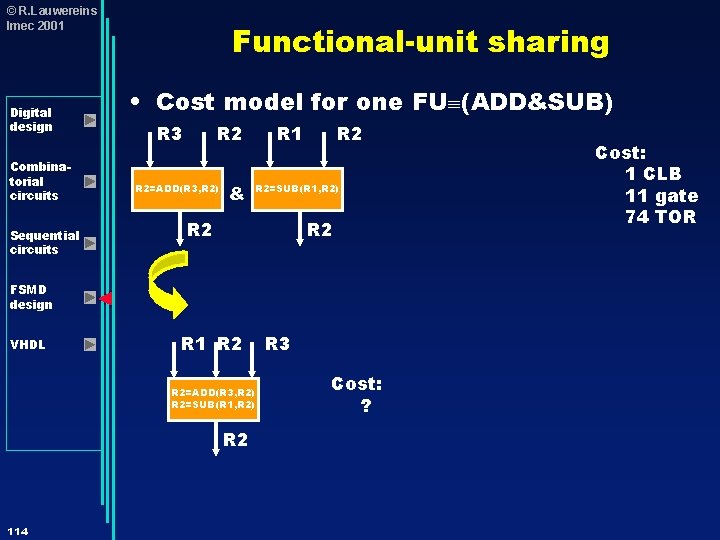
© R. Lauwereins Imec 2001 Digital design Combinatorial circuits Sequential circuits Functional-unit sharing • Cost model for one FU (ADD&SUB) R 3 R 2=ADD(R 3, R 2) & R 1 R 2=SUB(R 1, R 2) R 2 FSMD design VHDL R 1 R 2=ADD(R 3, R 2) R 2=SUB(R 1, R 2) R 2 114 R 3 Cost: ? Cost: 1 CLB 11 gate 74 TOR
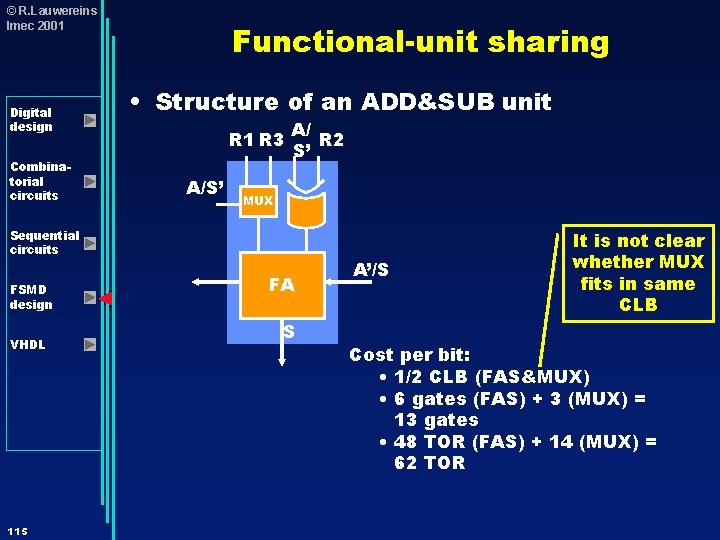
© R. Lauwereins Imec 2001 Digital design Combinatorial circuits Functional-unit sharing • Structure of an ADD&SUB unit R 1 R 3 A/S’ A/ R 2 S’ MUX Sequential circuits FSMD design VHDL 115 FA S A’/S It is not clear whether MUX fits in same CLB Cost per bit: • 1/2 CLB (FAS&MUX) • 6 gates (FAS) + 3 (MUX) = 13 gates • 48 TOR (FAS) + 14 (MUX) = 62 TOR
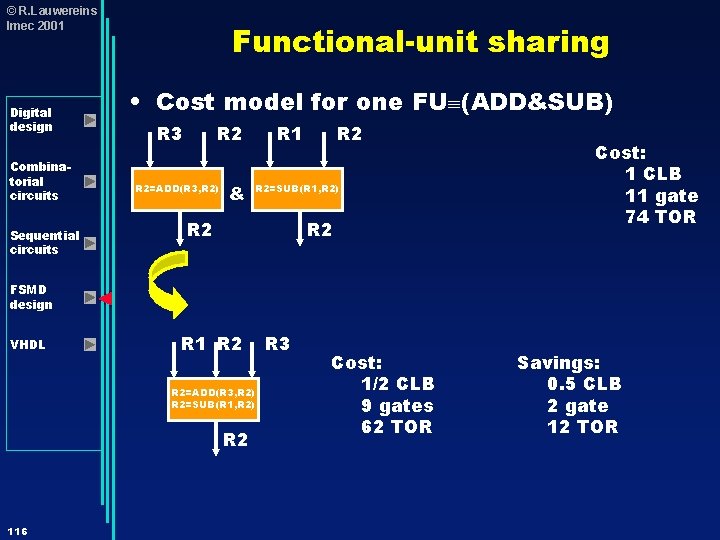
© R. Lauwereins Imec 2001 Digital design Combinatorial circuits Sequential circuits Functional-unit sharing • Cost model for one FU (ADD&SUB) R 3 R 2=ADD(R 3, R 2) & R 1 R 2=SUB(R 1, R 2) R 2 Cost: 1 CLB 11 gate 74 TOR FSMD design VHDL R 1 R 2=ADD(R 3, R 2) R 2=SUB(R 1, R 2) R 2 116 R 3 Cost: 1/2 CLB 9 gates 62 TOR Savings: 0. 5 CLB 2 gate 12 TOR
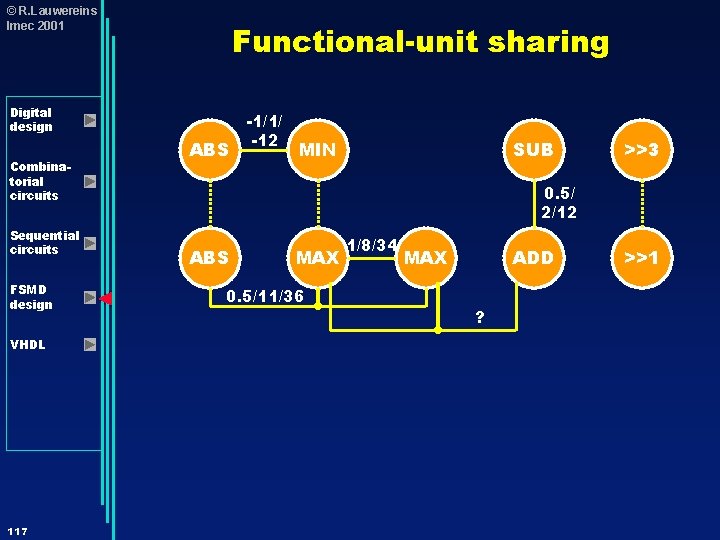
© R. Lauwereins Imec 2001 Functional-unit sharing Digital design Combinatorial circuits Sequential circuits FSMD design VHDL 117 ABS -1/1/ -12 MIN SUB >>3 0. 5/ 2/12 ABS MAX 0. 5/11/36 1/8/34 MAX ADD ? >>1
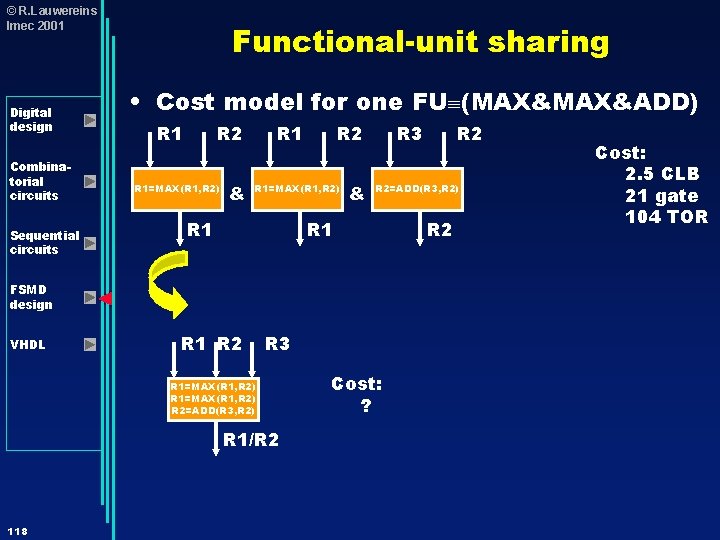
© R. Lauwereins Imec 2001 Digital design Combinatorial circuits Sequential circuits Functional-unit sharing • Cost model for one FU (MAX&ADD) R 1 R 2 R 1=MAX(R 1, R 2) & R 1 R 2 R 1=MAX(R 1, R 2) R 1 & R 3 R 2=ADD(R 3, R 2) R 1 FSMD design VHDL R 1 R 2 R 3 R 1=MAX(R 1, R 2) R 2=ADD(R 3, R 2) R 1/R 2 118 R 2 Cost: ? R 2 Cost: 2. 5 CLB 21 gate 104 TOR
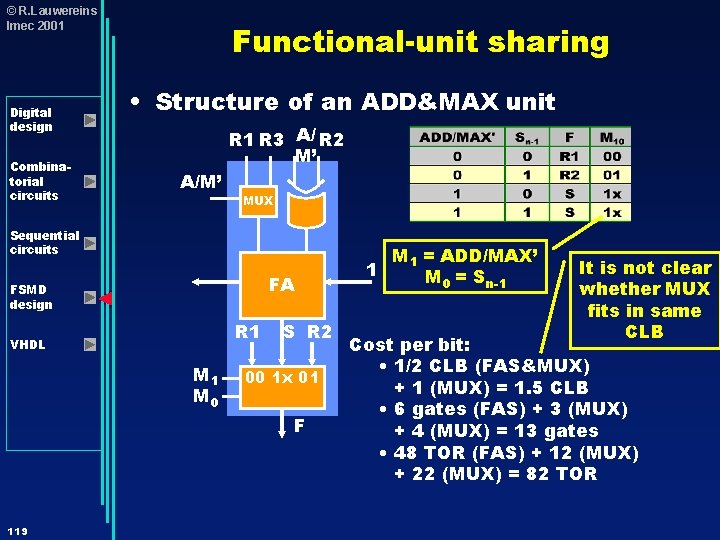
© R. Lauwereins Imec 2001 Digital design Combinatorial circuits Functional-unit sharing • Structure of an ADD&MAX unit R 1 R 3 A/ R 2 M’ A/M’ MUX Sequential circuits FA FSMD design R 1 VHDL M 1 M 0 S R 2 00 1 x 01 F 119 M 1 = ADD/MAX’ 1 M 0 = Sn-1 It is not clear whether MUX fits in same CLB Cost per bit: • 1/2 CLB (FAS&MUX) + 1 (MUX) = 1. 5 CLB • 6 gates (FAS) + 3 (MUX) + 4 (MUX) = 13 gates • 48 TOR (FAS) + 12 (MUX) + 22 (MUX) = 82 TOR
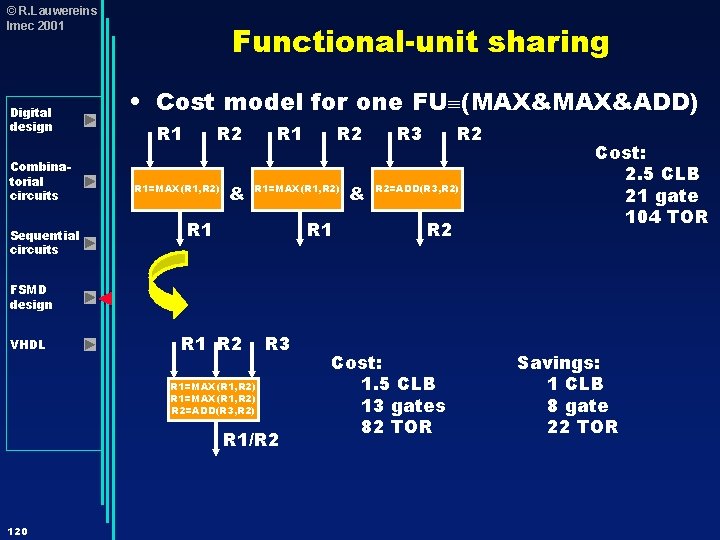
© R. Lauwereins Imec 2001 Digital design Combinatorial circuits Sequential circuits Functional-unit sharing • Cost model for one FU (MAX&ADD) R 1 R 2 R 1=MAX(R 1, R 2) & R 1 R 2 R 1=MAX(R 1, R 2) R 1 & R 3 R 2=ADD(R 3, R 2) R 2 Cost: 2. 5 CLB 21 gate 104 TOR FSMD design VHDL R 1 R 2 R 3 R 1=MAX(R 1, R 2) R 2=ADD(R 3, R 2) R 1/R 2 120 Cost: 1. 5 CLB 13 gates 82 TOR Savings: 1 CLB 8 gate 22 TOR
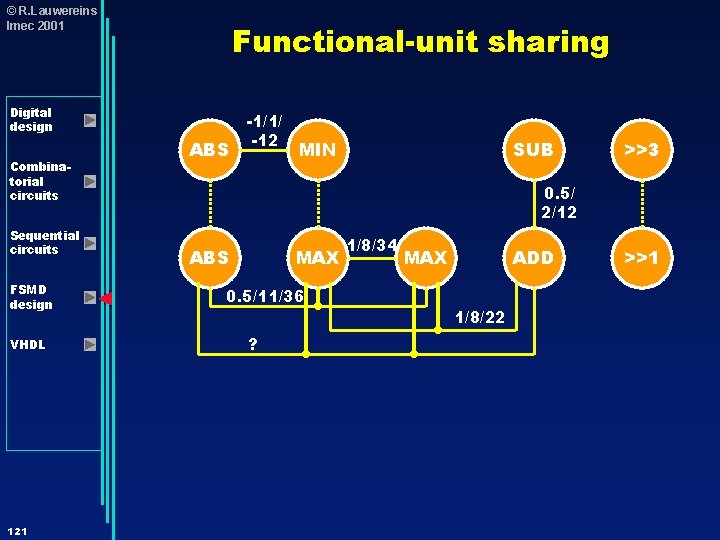
© R. Lauwereins Imec 2001 Functional-unit sharing Digital design Combinatorial circuits Sequential circuits FSMD design VHDL 121 ABS -1/1/ -12 MIN SUB >>3 0. 5/ 2/12 ABS MAX 0. 5/11/36 ? 1/8/34 MAX ADD 1/8/22 >>1
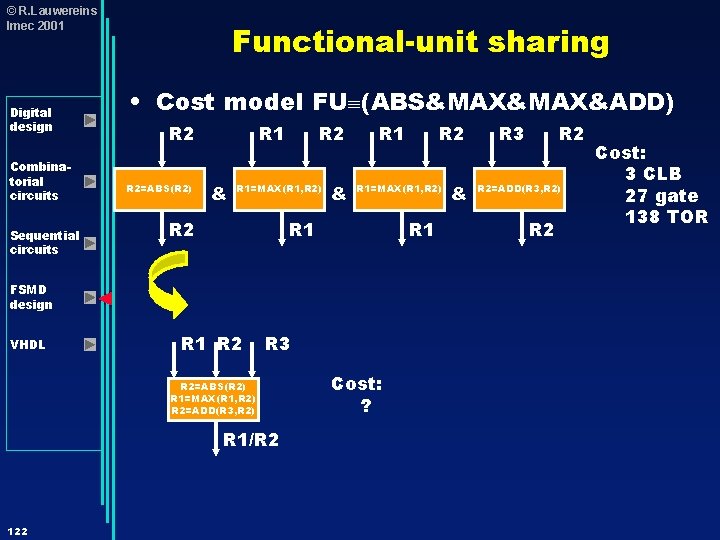
© R. Lauwereins Imec 2001 Digital design Combinatorial circuits Sequential circuits Functional-unit sharing • Cost model FU (ABS&MAX&ADD) R 2=ABS(R 2) R 1 & R 2 R 1=MAX(R 1, R 2) R 2 & R 1=MAX(R 1, R 2) R 1 FSMD design VHDL R 1 R 2 R 3 R 2=ABS(R 2) R 1=MAX(R 1, R 2) R 2=ADD(R 3, R 2) R 1/R 2 122 R 2 Cost: ? & R 3 R 2=ADD(R 3, R 2) R 2 Cost: 3 CLB 27 gate 138 TOR
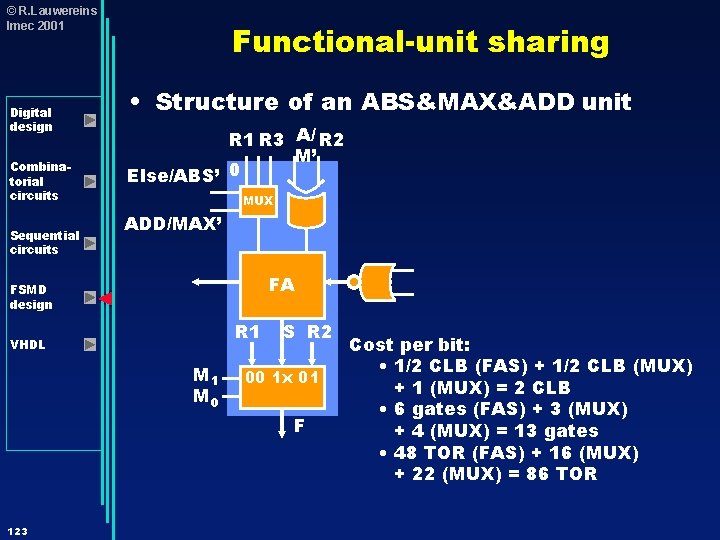
© R. Lauwereins Imec 2001 Digital design Combinatorial circuits Sequential circuits Functional-unit sharing • Structure of an ABS&MAX&ADD unit R 1 R 3 A/ R 2 M’ Else/ABS’ 0 MUX ADD/MAX’ FA FSMD design R 1 VHDL M 1 M 0 S R 2 00 1 x 01 F 123 Cost per bit: • 1/2 CLB (FAS) + 1/2 CLB (MUX) + 1 (MUX) = 2 CLB • 6 gates (FAS) + 3 (MUX) + 4 (MUX) = 13 gates • 48 TOR (FAS) + 16 (MUX) + 22 (MUX) = 86 TOR
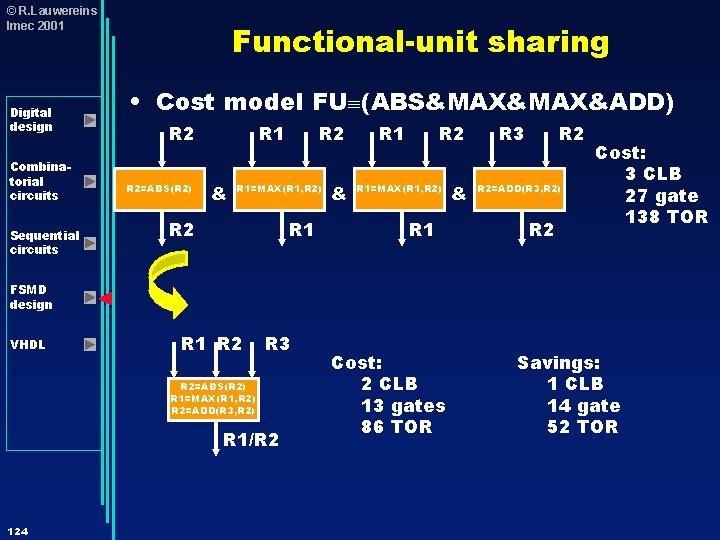
© R. Lauwereins Imec 2001 Digital design Combinatorial circuits Sequential circuits Functional-unit sharing • Cost model FU (ABS&MAX&ADD) R 2=ABS(R 2) R 1 & R 2 R 1=MAX(R 1, R 2) R 2 R 1 & R 1 R 2 R 1=MAX(R 1, R 2) R 1 & R 3 R 2=ADD(R 3, R 2) R 2 Cost: 3 CLB 27 gate 138 TOR FSMD design VHDL R 1 R 2 R 3 R 2=ABS(R 2) R 1=MAX(R 1, R 2) R 2=ADD(R 3, R 2) R 1/R 2 124 Cost: 2 CLB 13 gates 86 TOR Savings: 1 CLB 14 gate 52 TOR
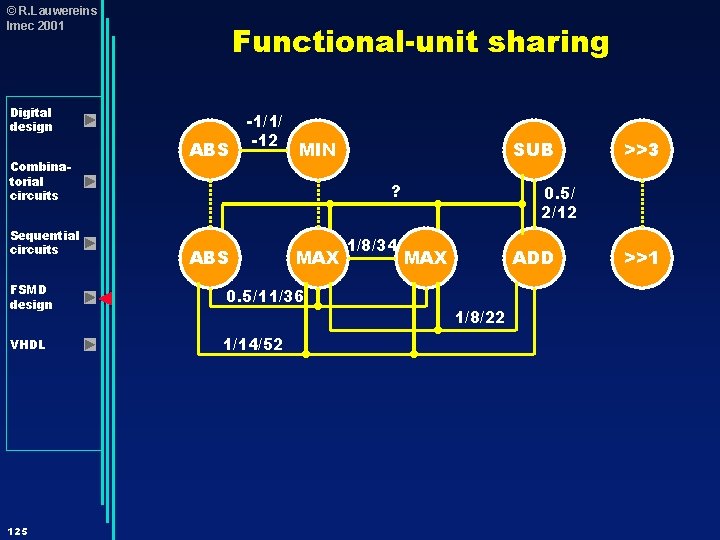
© R. Lauwereins Imec 2001 Functional-unit sharing Digital design Combinatorial circuits Sequential circuits FSMD design VHDL 125 ABS -1/1/ -12 MIN SUB ? ABS MAX 0. 5/11/36 1/14/52 1/8/34 >>3 0. 5/ 2/12 MAX ADD 1/8/22 >>1
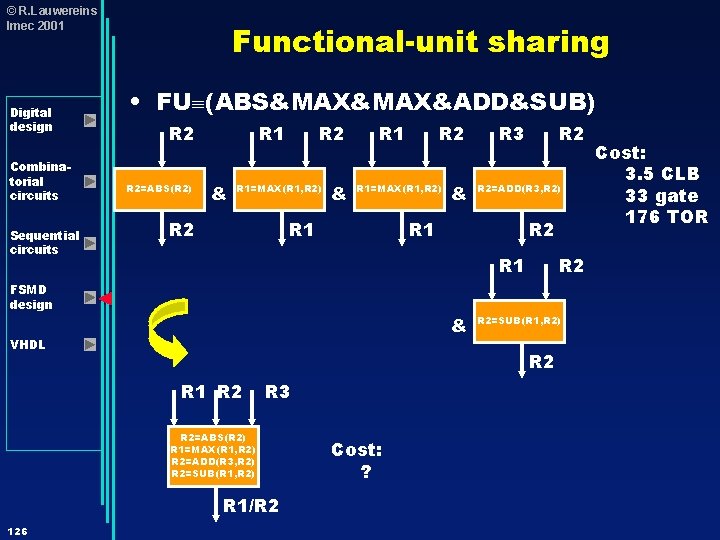
© R. Lauwereins Imec 2001 Digital design Combinatorial circuits Sequential circuits Functional-unit sharing • FU (ABS&MAX&ADD&SUB) R 2=ABS(R 2) R 1 & R 2 R 1=MAX(R 1, R 2) R 2 & R 1 R 2 R 1=MAX(R 1, R 2) R 1 & R 3 R 2=ADD(R 3, R 2) R 1 R 2 FSMD design & VHDL R 2 R 1 R 2 R 3 R 2=ABS(R 2) R 1=MAX(R 1, R 2) R 2=ADD(R 3, R 2) R 2=SUB(R 1, R 2) R 1/R 2 126 R 2=SUB(R 1, R 2) Cost: ? Cost: 3. 5 CLB 33 gate 176 TOR
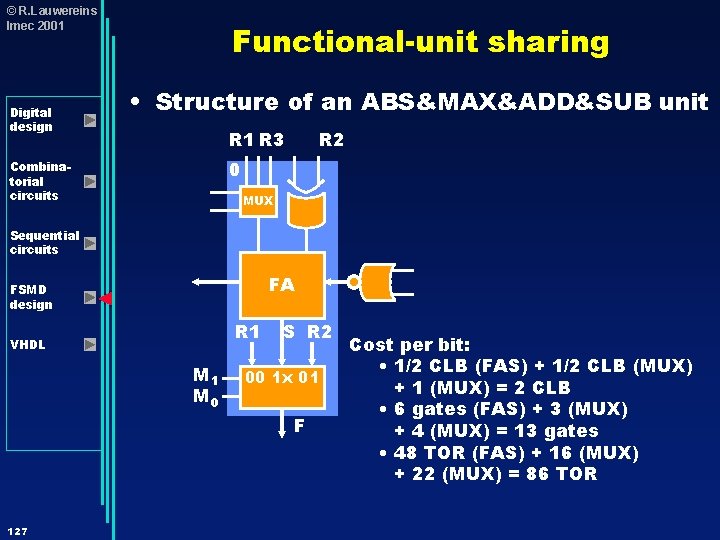
© R. Lauwereins Imec 2001 Digital design Functional-unit sharing • Structure of an ABS&MAX&ADD&SUB unit R 1 R 3 R 2 0 Combinatorial circuits MUX Sequential circuits FA FSMD design R 1 VHDL M 1 M 0 S R 2 00 1 x 01 F 127 Cost per bit: • 1/2 CLB (FAS) + 1/2 CLB (MUX) + 1 (MUX) = 2 CLB • 6 gates (FAS) + 3 (MUX) + 4 (MUX) = 13 gates • 48 TOR (FAS) + 16 (MUX) + 22 (MUX) = 86 TOR
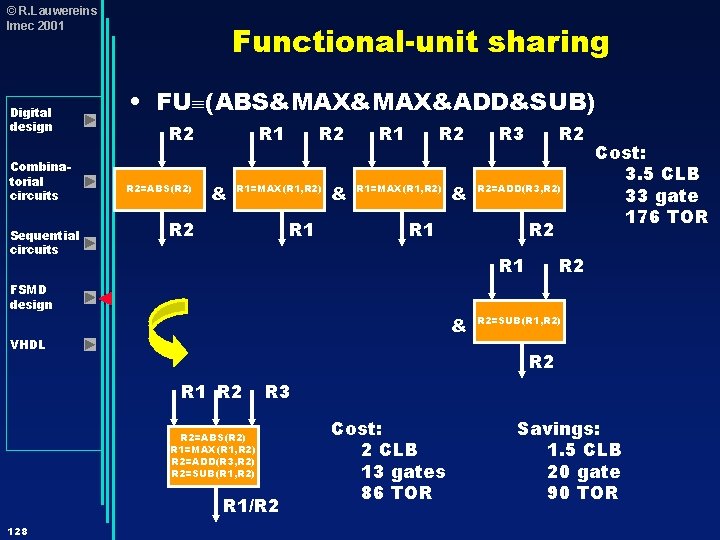
© R. Lauwereins Imec 2001 Digital design Combinatorial circuits Sequential circuits Functional-unit sharing • FU (ABS&MAX&ADD&SUB) R 2=ABS(R 2) R 1 & R 2 R 1=MAX(R 1, R 2) R 2 R 1 & R 1 R 2 R 1=MAX(R 1, R 2) & R 3 R 2=ADD(R 3, R 2) R 1 R 2 R 1 Cost: 3. 5 CLB 33 gate 176 TOR R 2 FSMD design & VHDL R 2 R 1 R 2 R 3 R 2=ABS(R 2) R 1=MAX(R 1, R 2) R 2=ADD(R 3, R 2) R 2=SUB(R 1, R 2) R 1/R 2 128 R 2=SUB(R 1, R 2) Cost: 2 CLB 13 gates 86 TOR Savings: 1. 5 CLB 20 gate 90 TOR
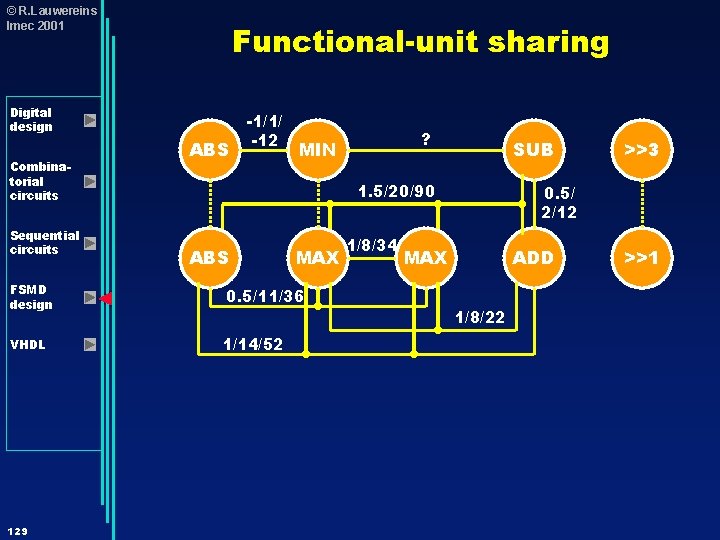
© R. Lauwereins Imec 2001 Functional-unit sharing Digital design Combinatorial circuits Sequential circuits FSMD design VHDL 129 ABS -1/1/ -12 ? MIN SUB 1. 5/20/90 ABS MAX 0. 5/11/36 1/14/52 1/8/34 >>3 0. 5/ 2/12 MAX ADD 1/8/22 >>1
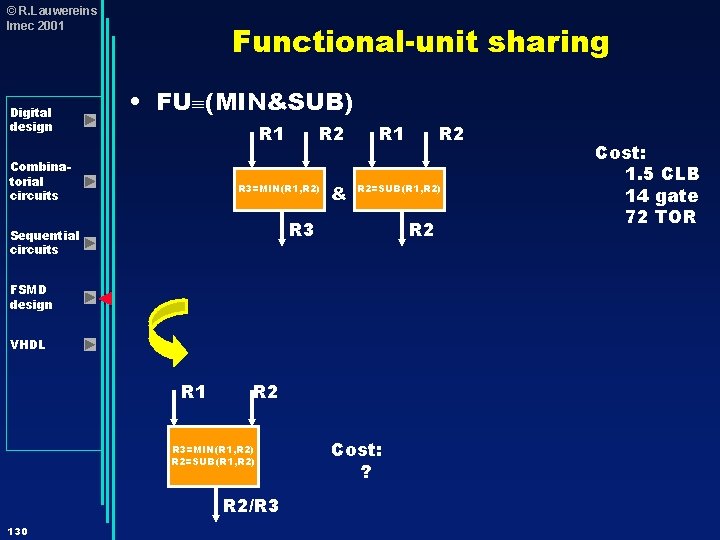
© R. Lauwereins Imec 2001 Digital design Functional-unit sharing • FU (MIN&SUB) R 1 Combinatorial circuits R 2 R 3=MIN(R 1, R 2) & R 1 R 2=SUB(R 1, R 2) R 3 Sequential circuits R 2 FSMD design VHDL R 1 R 2 R 3=MIN(R 1, R 2) R 2=SUB(R 1, R 2) R 2/R 3 130 R 2 Cost: ? Cost: 1. 5 CLB 14 gate 72 TOR
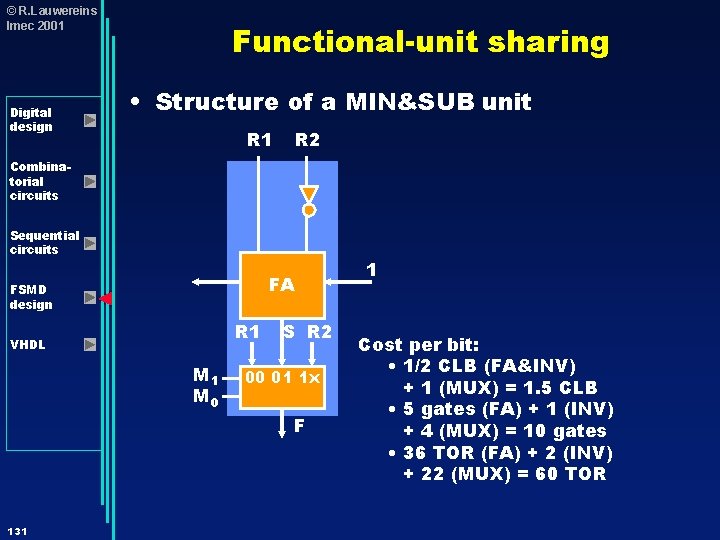
© R. Lauwereins Imec 2001 Digital design Functional-unit sharing • Structure of a MIN&SUB unit R 1 R 2 Combinatorial circuits Sequential circuits FA FSMD design R 1 VHDL M 1 M 0 S R 2 00 01 1 x F 131 1 Cost per bit: • 1/2 CLB (FA&INV) + 1 (MUX) = 1. 5 CLB • 5 gates (FA) + 1 (INV) + 4 (MUX) = 10 gates • 36 TOR (FA) + 2 (INV) + 22 (MUX) = 60 TOR
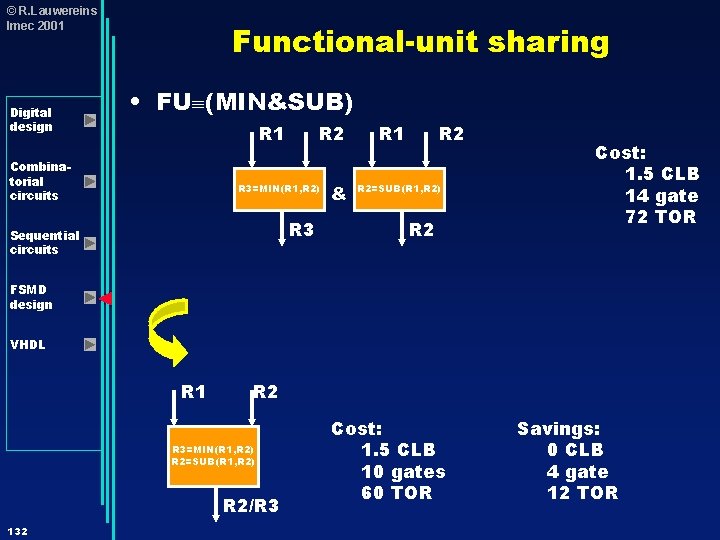
© R. Lauwereins Imec 2001 Digital design Functional-unit sharing • FU (MIN&SUB) R 1 Combinatorial circuits R 2 R 3=MIN(R 1, R 2) R 3 Sequential circuits & R 1 R 2=SUB(R 1, R 2) R 2 Cost: 1. 5 CLB 14 gate 72 TOR FSMD design VHDL R 1 R 2 R 3=MIN(R 1, R 2) R 2=SUB(R 1, R 2) R 2/R 3 132 Cost: 1. 5 CLB 10 gates 60 TOR Savings: 0 CLB 4 gate 12 TOR
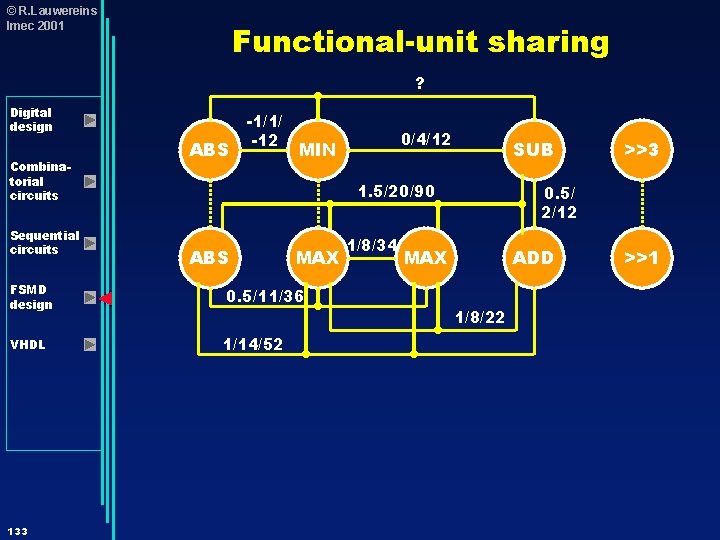
© R. Lauwereins Imec 2001 Functional-unit sharing ? Digital design Combinatorial circuits Sequential circuits FSMD design VHDL 133 ABS -1/1/ -12 0/4/12 MIN SUB 1. 5/20/90 ABS MAX 0. 5/11/36 1/14/52 1/8/34 >>3 0. 5/ 2/12 MAX ADD 1/8/22 >>1
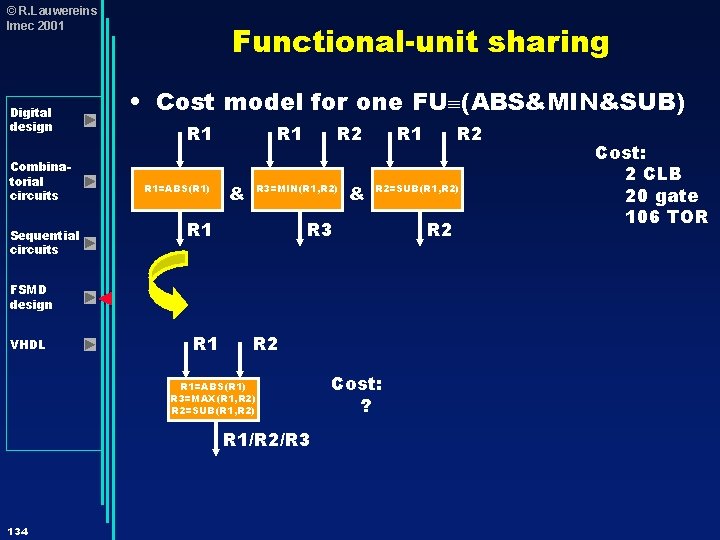
© R. Lauwereins Imec 2001 Digital design Combinatorial circuits Sequential circuits Functional-unit sharing • Cost model for one FU (ABS&MIN&SUB) R 1=ABS(R 1) R 1 & R 2 R 3=MIN(R 1, R 2) R 1 & R 1 R 2=SUB(R 1, R 2) R 3 FSMD design VHDL R 1 R 2 R 1=ABS(R 1) R 3=MAX(R 1, R 2) R 2=SUB(R 1, R 2) R 1/R 2/R 3 134 R 2 Cost: ? R 2 Cost: 2 CLB 20 gate 106 TOR
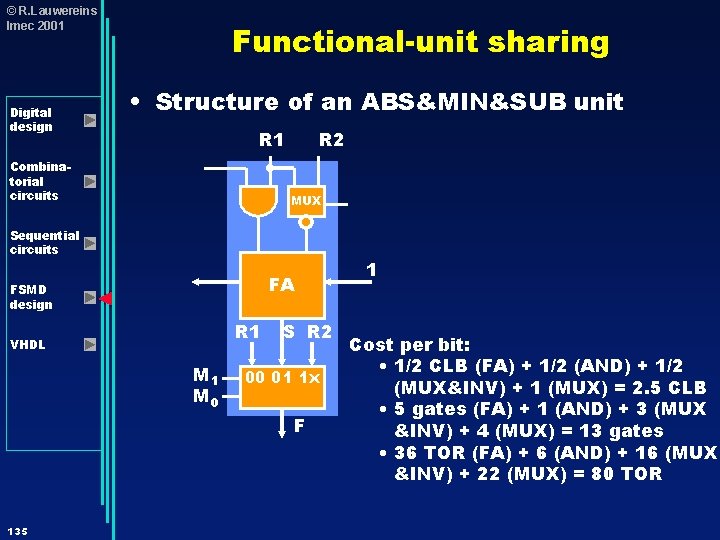
© R. Lauwereins Imec 2001 Digital design Functional-unit sharing • Structure of an ABS&MIN&SUB unit R 1 Combinatorial circuits R 2 MUX Sequential circuits FA FSMD design R 1 VHDL M 1 M 0 S R 2 00 01 1 x F 135 1 Cost per bit: • 1/2 CLB (FA) + 1/2 (AND) + 1/2 (MUX&INV) + 1 (MUX) = 2. 5 CLB • 5 gates (FA) + 1 (AND) + 3 (MUX &INV) + 4 (MUX) = 13 gates • 36 TOR (FA) + 6 (AND) + 16 (MUX &INV) + 22 (MUX) = 80 TOR
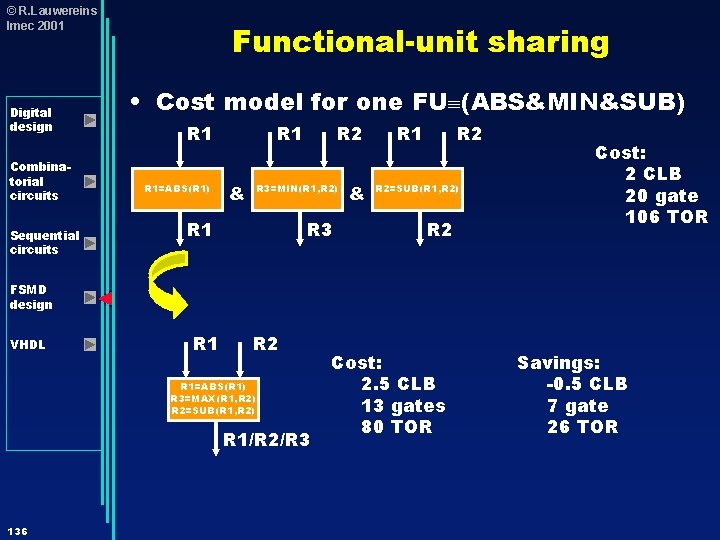
© R. Lauwereins Imec 2001 Digital design Combinatorial circuits Sequential circuits Functional-unit sharing • Cost model for one FU (ABS&MIN&SUB) R 1=ABS(R 1) R 1 & R 2 R 3=MIN(R 1, R 2) R 1 R 3 & R 1 R 2=SUB(R 1, R 2) R 2 Cost: 2 CLB 20 gate 106 TOR FSMD design VHDL R 1 R 2 R 1=ABS(R 1) R 3=MAX(R 1, R 2) R 2=SUB(R 1, R 2) R 1/R 2/R 3 136 Cost: 2. 5 CLB 13 gates 80 TOR Savings: -0. 5 CLB 7 gate 26 TOR
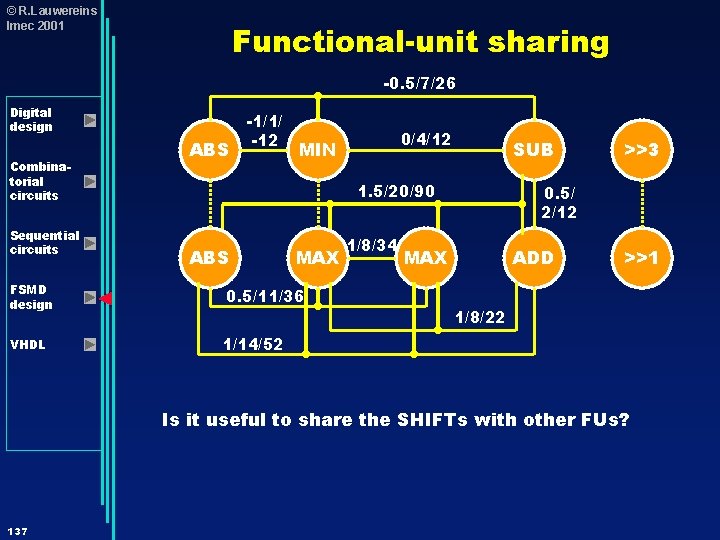
© R. Lauwereins Imec 2001 Functional-unit sharing -0. 5/7/26 Digital design Combinatorial circuits Sequential circuits FSMD design VHDL ABS -1/1/ -12 0/4/12 MIN SUB 1. 5/20/90 ABS MAX 0. 5/11/36 1/8/34 >>3 0. 5/ 2/12 MAX ADD >>1 1/8/22 1/14/52 Is it useful to share the SHIFTs with other FUs? 137
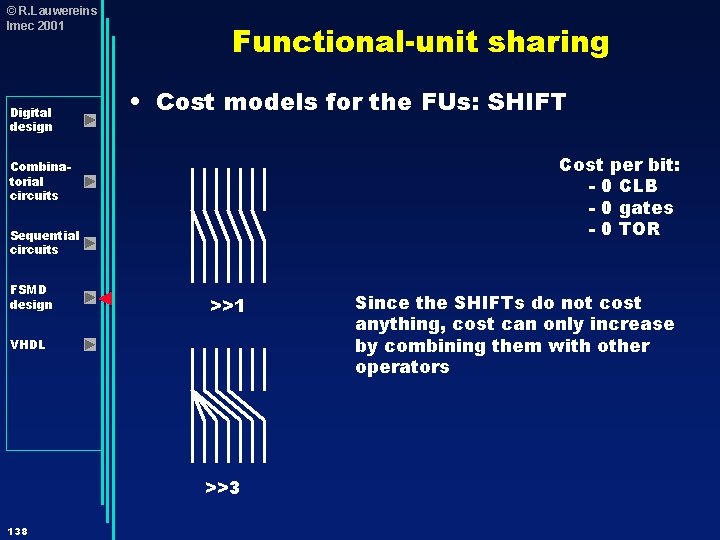
© R. Lauwereins Imec 2001 Digital design Functional-unit sharing • Cost models for the FUs: SHIFT Cost per bit: - 0 CLB - 0 gates - 0 TOR Combinatorial circuits Sequential circuits FSMD design >>1 VHDL >>3 138 Since the SHIFTs do not cost anything, cost can only increase by combining them with other operators
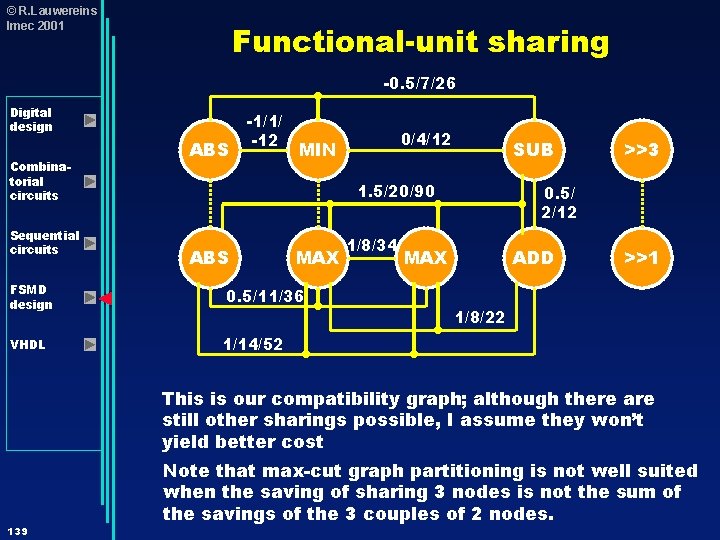
© R. Lauwereins Imec 2001 Functional-unit sharing -0. 5/7/26 Digital design Combinatorial circuits Sequential circuits FSMD design VHDL ABS -1/1/ -12 0/4/12 MIN SUB 1. 5/20/90 ABS MAX 0. 5/11/36 1/8/34 >>3 0. 5/ 2/12 MAX ADD >>1 1/8/22 1/14/52 This is our compatibility graph; although there are still other sharings possible, I assume they won’t yield better cost 139 Note that max-cut graph partitioning is not well suited when the saving of sharing 3 nodes is not the sum of the savings of the 3 couples of 2 nodes.
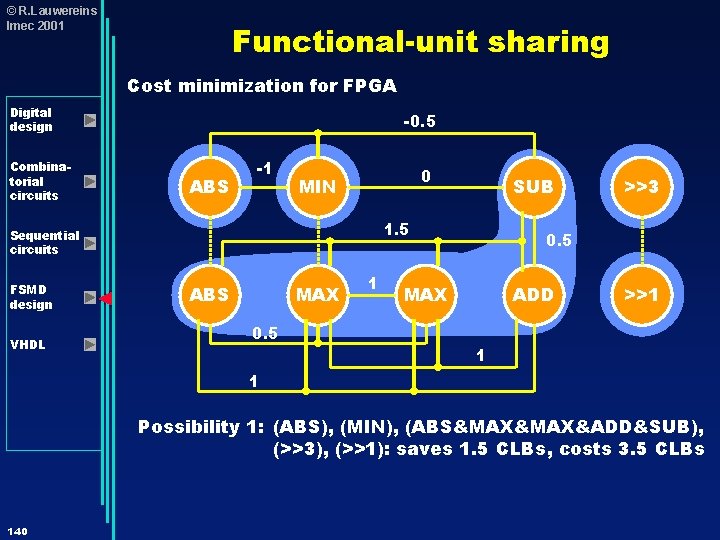
© R. Lauwereins Imec 2001 Functional-unit sharing Cost minimization for FPGA Digital design Combinatorial circuits -0. 5 ABS -1 0 MIN 1. 5 Sequential circuits FSMD design VHDL SUB ABS MAX 0. 5 1 >>3 0. 5 MAX ADD >>1 1 1 Possibility 1: (ABS), (MIN), (ABS&MAX&ADD&SUB), (>>3), (>>1): saves 1. 5 CLBs, costs 3. 5 CLBs 140
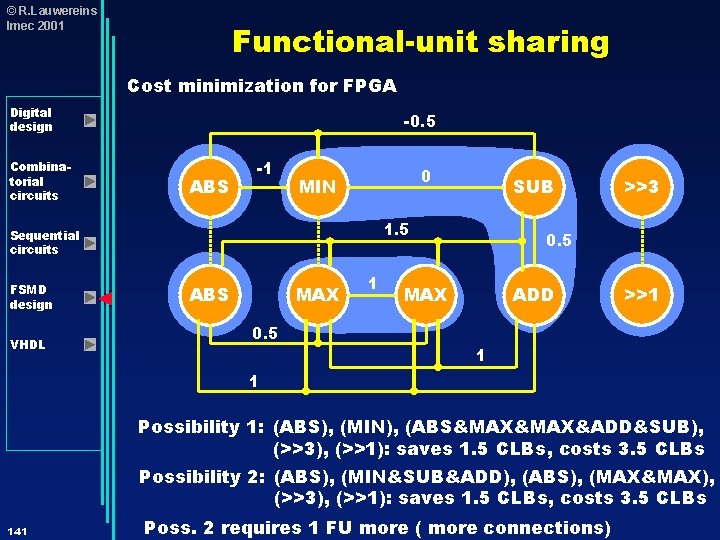
© R. Lauwereins Imec 2001 Functional-unit sharing Cost minimization for FPGA Digital design Combinatorial circuits -0. 5 ABS -1 0 MIN 1. 5 Sequential circuits FSMD design VHDL SUB ABS MAX 0. 5 1 >>3 0. 5 MAX ADD >>1 1 1 Possibility 1: (ABS), (MIN), (ABS&MAX&ADD&SUB), (>>3), (>>1): saves 1. 5 CLBs, costs 3. 5 CLBs Possibility 2: (ABS), (MIN&SUB&ADD), (ABS), (MAX&MAX), (>>3), (>>1): saves 1. 5 CLBs, costs 3. 5 CLBs 141 Poss. 2 requires 1 FU more ( more connections)
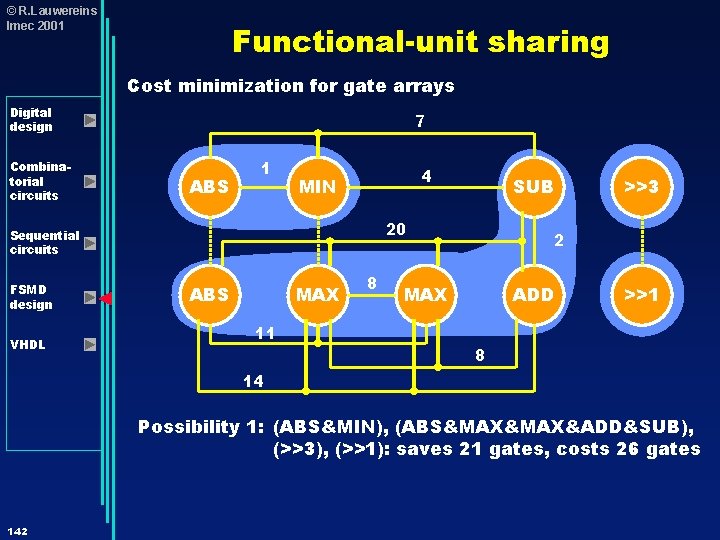
© R. Lauwereins Imec 2001 Functional-unit sharing Cost minimization for gate arrays Digital design Combinatorial circuits 7 ABS 1 4 MIN 20 Sequential circuits FSMD design VHDL SUB ABS MAX 11 8 >>3 2 MAX ADD >>1 8 14 Possibility 1: (ABS&MIN), (ABS&MAX&ADD&SUB), (>>3), (>>1): saves 21 gates, costs 26 gates 142
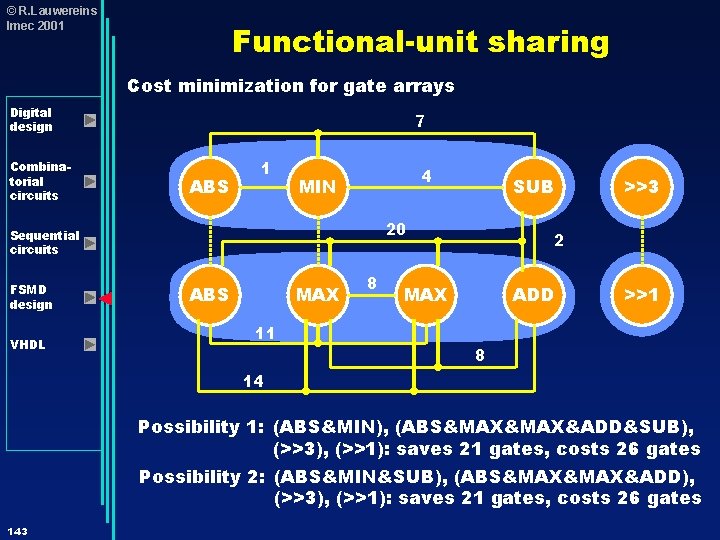
© R. Lauwereins Imec 2001 Functional-unit sharing Cost minimization for gate arrays Digital design Combinatorial circuits 7 ABS 1 4 MIN 20 Sequential circuits FSMD design VHDL SUB ABS MAX 11 8 >>3 2 MAX ADD >>1 8 14 Possibility 1: (ABS&MIN), (ABS&MAX&ADD&SUB), (>>3), (>>1): saves 21 gates, costs 26 gates Possibility 2: (ABS&MIN&SUB), (ABS&MAX&ADD), (>>3), (>>1): saves 21 gates, costs 26 gates 143
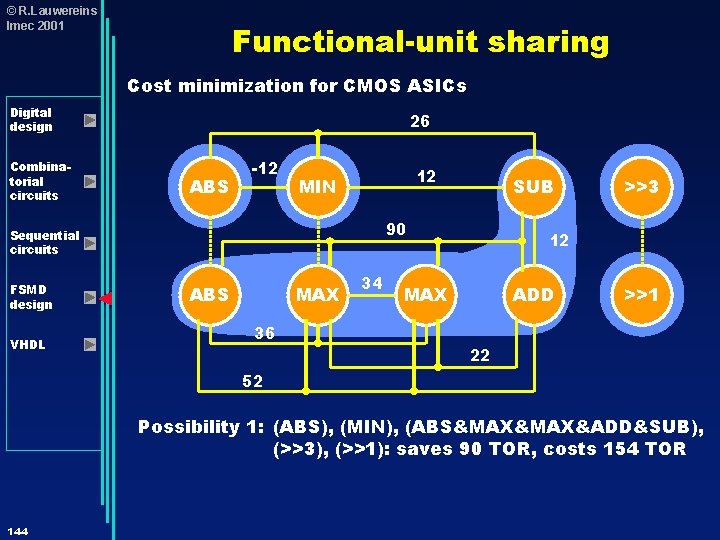
© R. Lauwereins Imec 2001 Functional-unit sharing Cost minimization for CMOS ASICs Digital design Combinatorial circuits 26 ABS -12 12 MIN 90 Sequential circuits FSMD design VHDL SUB ABS MAX 36 34 >>3 12 MAX ADD >>1 22 52 Possibility 1: (ABS), (MIN), (ABS&MAX&ADD&SUB), (>>3), (>>1): saves 90 TOR, costs 154 TOR 144
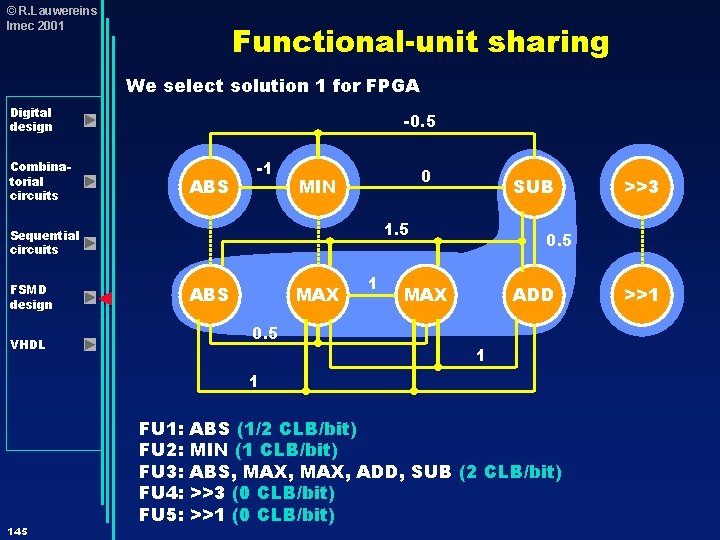
© R. Lauwereins Imec 2001 Functional-unit sharing We select solution 1 for FPGA Digital design -0. 5 Combinatorial circuits ABS -1 0 MIN SUB 1. 5 Sequential circuits FSMD design ABS MAX 0. 5 VHDL 1 0. 5 MAX ADD 1 1 145 FU 1: FU 2: FU 3: FU 4: FU 5: >>3 ABS (1/2 CLB/bit) MIN (1 CLB/bit) ABS, MAX, ADD, SUB (2 CLB/bit) >>3 (0 CLB/bit) >>1
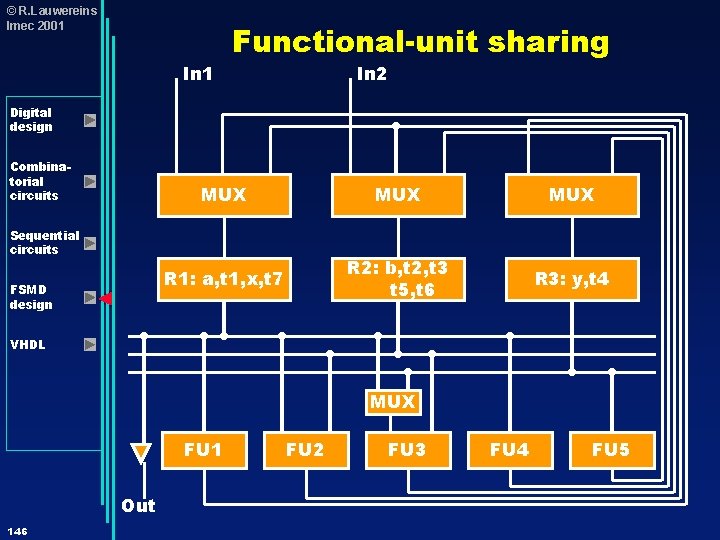
© R. Lauwereins Imec 2001 In 1 Functional-unit sharing In 2 Digital design Combinatorial circuits MUX MUX R 1: a, t 1, x, t 7 R 2: b, t 2, t 3 t 5, t 6 R 3: y, t 4 Sequential circuits FSMD design VHDL MUX FU 1 Out 146 FU 2 FU 3 FU 4 FU 5
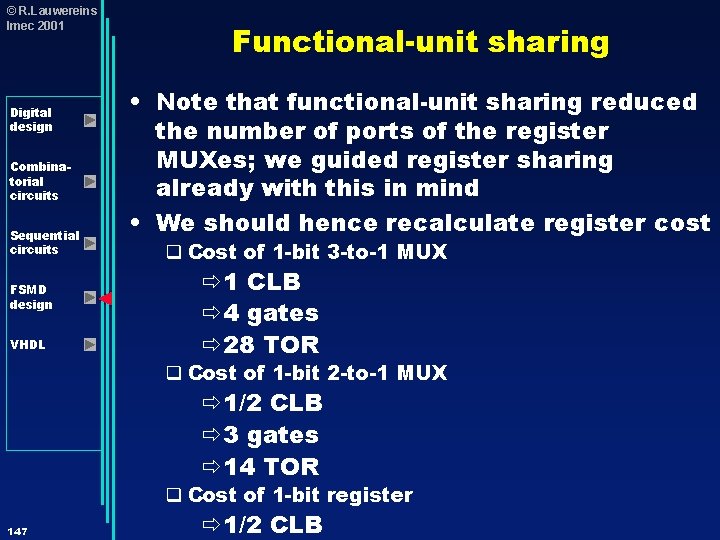
© R. Lauwereins Imec 2001 Digital design Combinatorial circuits Sequential circuits FSMD design VHDL Functional-unit sharing • Note that functional-unit sharing reduced the number of ports of the register MUXes; we guided register sharing already with this in mind • We should hence recalculate register cost q Cost of 1 -bit 3 -to-1 MUX ð 1 CLB ð 4 gates ð 28 TOR q Cost of 1 -bit 2 -to-1 MUX ð 1/2 CLB ð 3 gates ð 14 TOR q Cost of 1 -bit register 147 ð 1/2 CLB
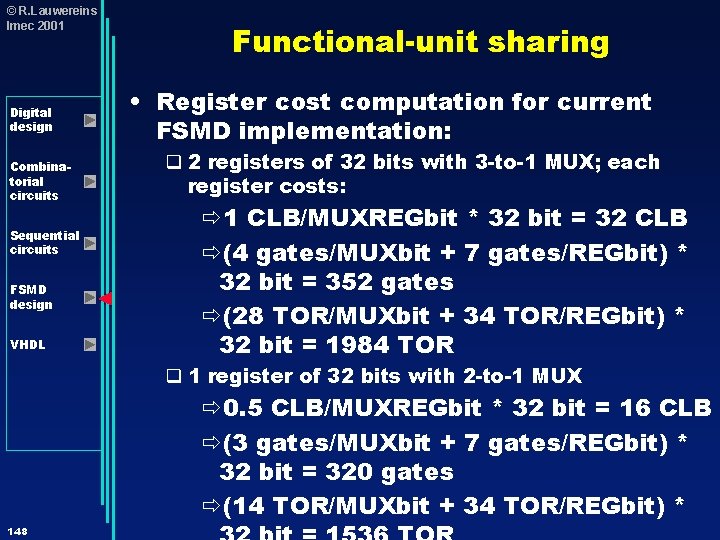
© R. Lauwereins Imec 2001 Digital design Combinatorial circuits Sequential circuits FSMD design VHDL Functional-unit sharing • Register cost computation for current FSMD implementation: q 2 registers of 32 bits with 3 -to-1 MUX; each register costs: ð 1 CLB/MUXREGbit * 32 bit = 32 CLB ð(4 gates/MUXbit + 7 gates/REGbit) * 32 bit = 352 gates ð(28 TOR/MUXbit + 34 TOR/REGbit) * 32 bit = 1984 TOR q 1 register of 32 bits with 2 -to-1 MUX ð 0. 5 CLB/MUXREGbit * 32 bit = 16 CLB ð(3 gates/MUXbit + 7 gates/REGbit) * 32 bit = 320 gates ð(14 TOR/MUXbit + 34 TOR/REGbit) * 148
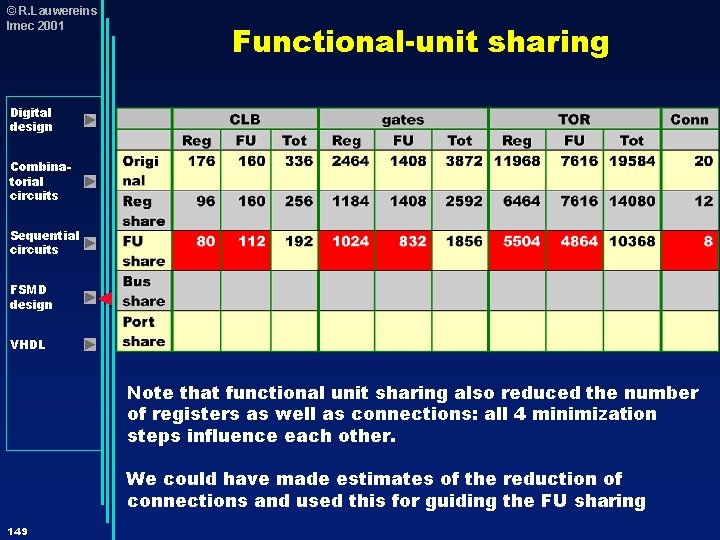
© R. Lauwereins Imec 2001 Functional-unit sharing Digital design Combinatorial circuits Sequential circuits FSMD design VHDL Note that functional unit sharing also reduced the number of registers as well as connections: all 4 minimization steps influence each other. We could have made estimates of the reduction of connections and used this for guiding the FU sharing 149
© R. Lauwereins Imec 2001 Digital design Combinatorial circuits Sequential circuits FSMD design VHDL 150 FSMD design • FSMDs • Models • Synthesis techniques q Basic principles q Merging ðRegister sharing (variable merging) ðFunctional-unit sharing (operator merging) èBus sharing (connection merging) ðRegister port sharing (register merging)
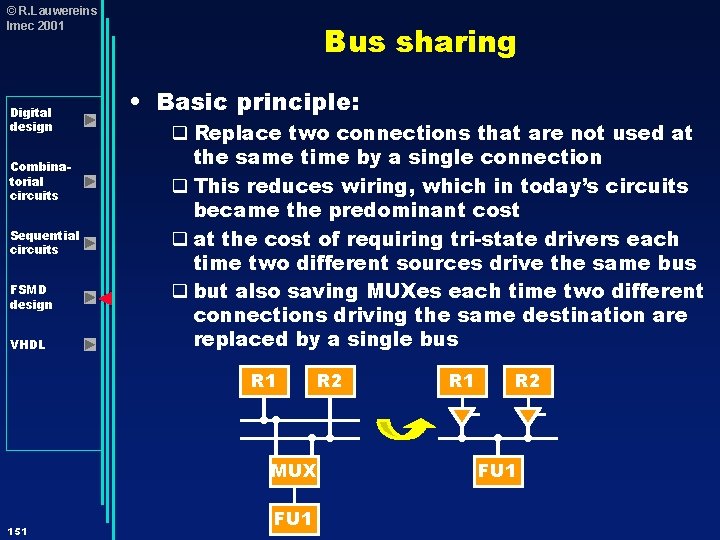
© R. Lauwereins Imec 2001 Digital design Combinatorial circuits Sequential circuits FSMD design VHDL Bus sharing • Basic principle: q Replace two connections that are not used at the same time by a single connection q This reduces wiring, which in today’s circuits became the predominant cost q at the cost of requiring tri-state drivers each time two different sources drive the same bus q but also saving MUXes each time two different connections driving the same destination are replaced by a single bus R 1 MUX 151 FU 1 R 2 R 1 R 2 FU 1

© R. Lauwereins Imec 2001 Digital design Combinatorial circuits Sequential circuits FSMD design VHDL 152 Bus sharing • Since wiring cost is so high for buses, we search for the absolute minimum number of buses, without looking at the increased cost for drivers • When several solutions lead to the same number of buses, we choose that combination that has the minimum number of tri-state drivers at the sources and MUXes at the destinations
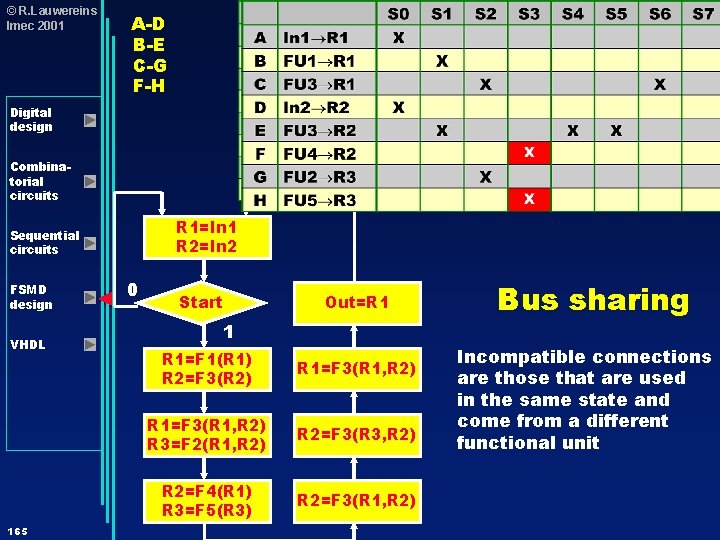
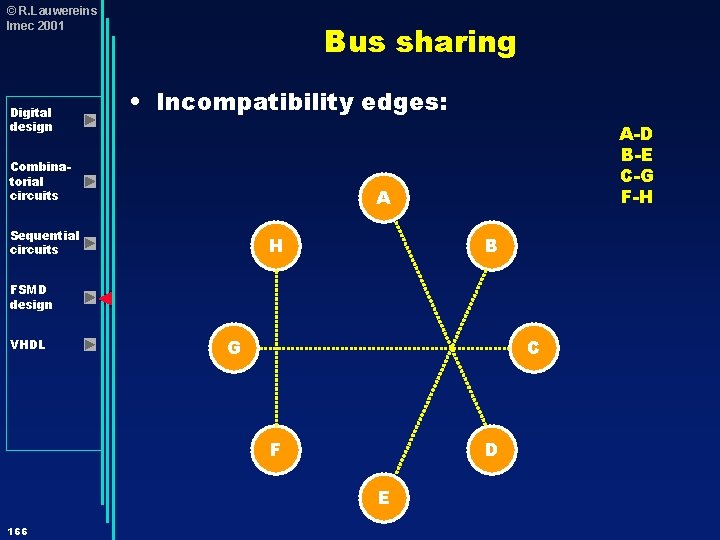
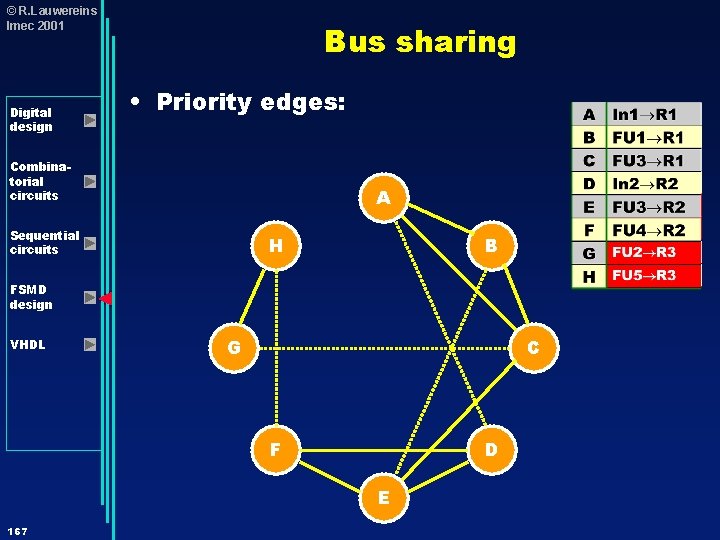
© R. Lauwereins Imec 2001 Digital design Combinatorial circuits Sequential circuits FSMD design VHDL 153 Bus sharing • Build a compatibility graph for the connections from registers to functional units and a second compatibility graph for the connections from functional units to registers q Nodes are connections q Incompatibility edges are drawn between two connections that are used in the same state and have different sources q Priority edges are drawn between two connections that have the same source (saves on tri-state drivers) or the same destination (saves on input MUXes)
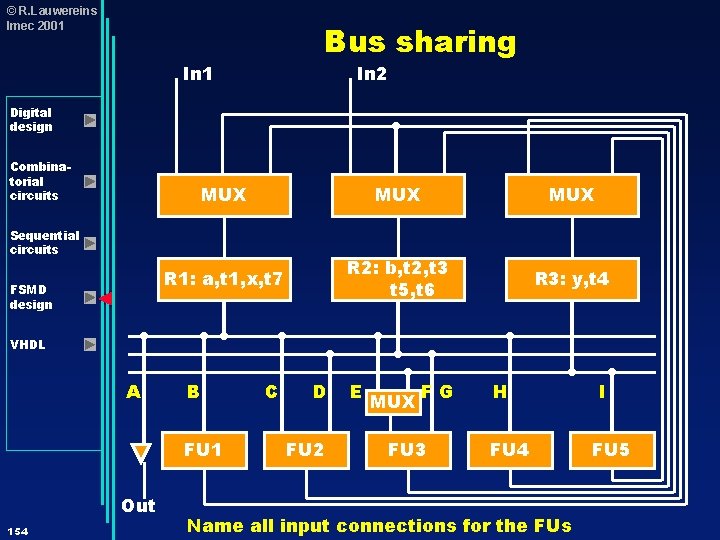
© R. Lauwereins Imec 2001 Bus sharing In 1 In 2 Digital design Combinatorial circuits MUX MUX R 1: a, t 1, x, t 7 R 2: b, t 2, t 3 t 5, t 6 R 3: y, t 4 Sequential circuits FSMD design VHDL A B FU 1 Out 154 C D FU 2 E MUX FG FU 3 H FU 4 Name all input connections for the FUs I FU 5
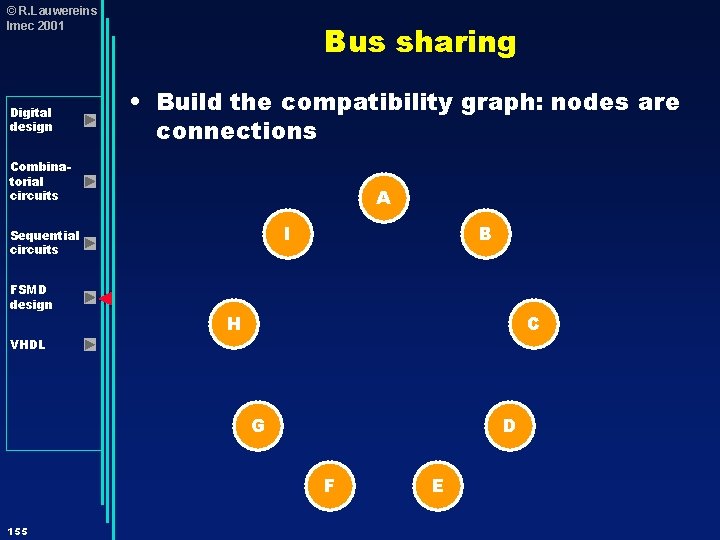
© R. Lauwereins Imec 2001 Digital design Bus sharing • Build the compatibility graph: nodes are connections Combinatorial circuits A I Sequential circuits FSMD design VHDL B H C G D F 155 E
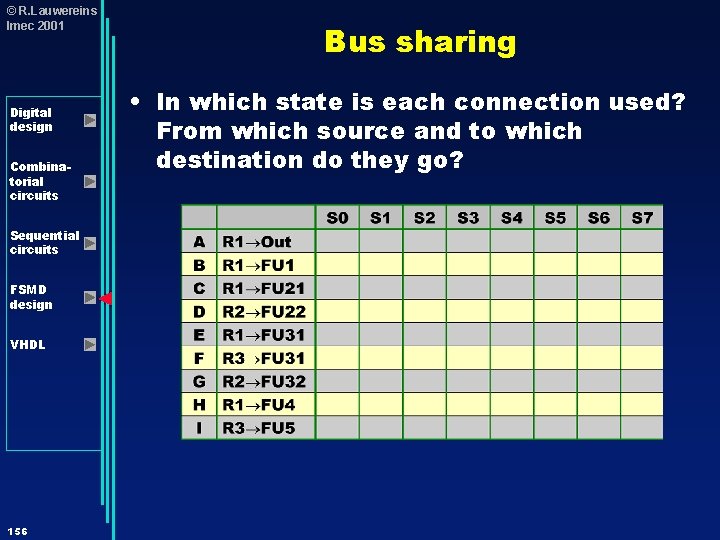
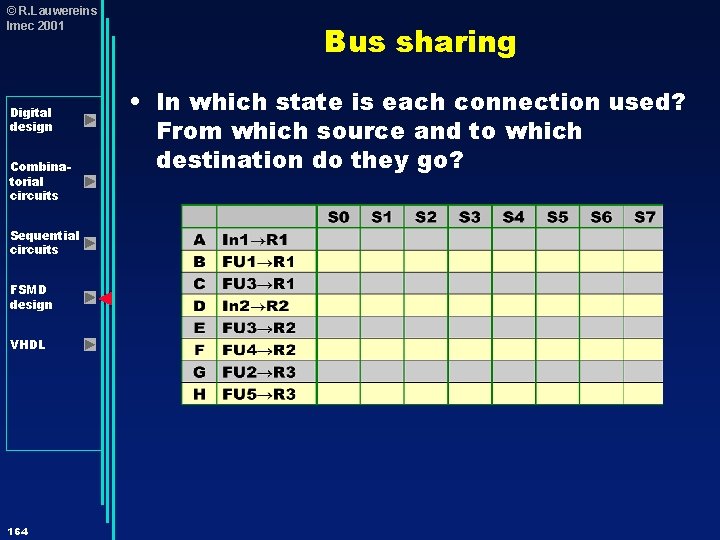
© R. Lauwereins Imec 2001 Digital design Combinatorial circuits Sequential circuits FSMD design VHDL 156 Bus sharing • In which state is each connection used? From which source and to which destination do they go?
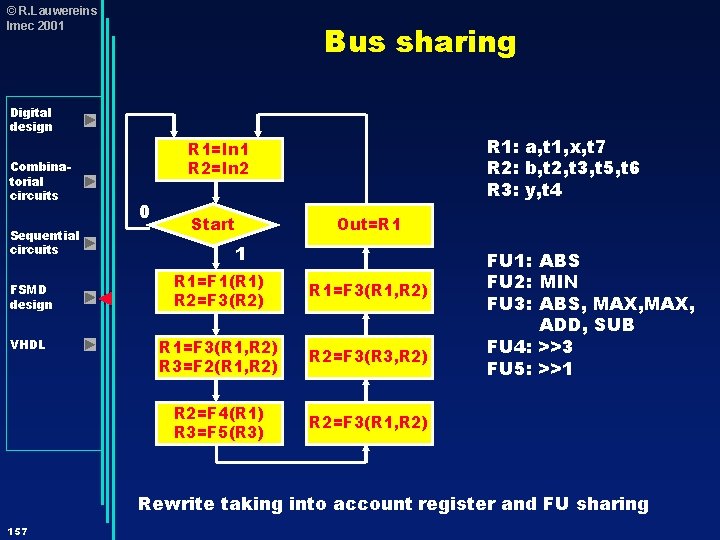
© R. Lauwereins Imec 2001 Bus sharing Digital design Combinatorial circuits Sequential circuits FSMD design VHDL R 1: a, t 1, x, t 7 R 2: b, t 2, t 3, t 5, t 6 R 3: y, t 4 R 1=In 1 a=In 1 R 2=In 2 b=In 2 0 Start Out=R 1 Out=t 7 1 R 1=F 1(R 1) t 1=|a| R 2=F 3(R 2) t 2=|b| R 1=F 3(R 1, R 2) t 7=max(t 6, x) R 1=F 3(R 1, R 2) x=max(t 1, t 2) R 3=F 2(R 1, R 2) y=min(t 1, t 2) R 2=F 3(R 3, R 2) t 6=t 4+t 5 R 2=F 4(R 1) t 3=x>>3 R 3=F 5(R 3) t 4=y>>1 R 2=F 3(R 1, R 2) t 5=x-t 3 FU 1: ABS FU 2: MIN FU 3: ABS, MAX, ADD, SUB FU 4: >>3 FU 5: >>1 Rewrite taking into account register and FU sharing 157
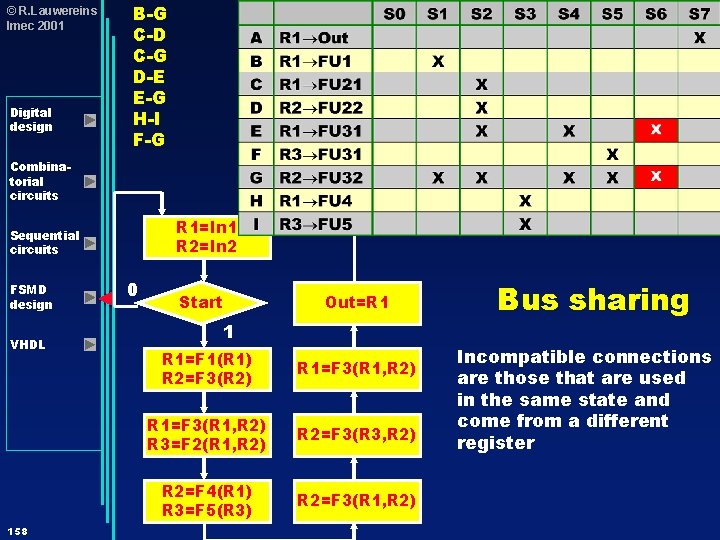
© R. Lauwereins Imec 2001 Digital design B-G C-D C-G D-E E-G H-I F-G Combinatorial circuits R 1=In 1 R 2=In 2 Sequential circuits FSMD design VHDL 158 0 Start Out=R 1 1 R 1=F 1(R 1) R 2=F 3(R 2) R 1=F 3(R 1, R 2) R 3=F 2(R 1, R 2) R 2=F 3(R 3, R 2) R 2=F 4(R 1) R 3=F 5(R 3) R 2=F 3(R 1, R 2) Bus sharing Incompatible connections are those that are used in the same state and come from a different register
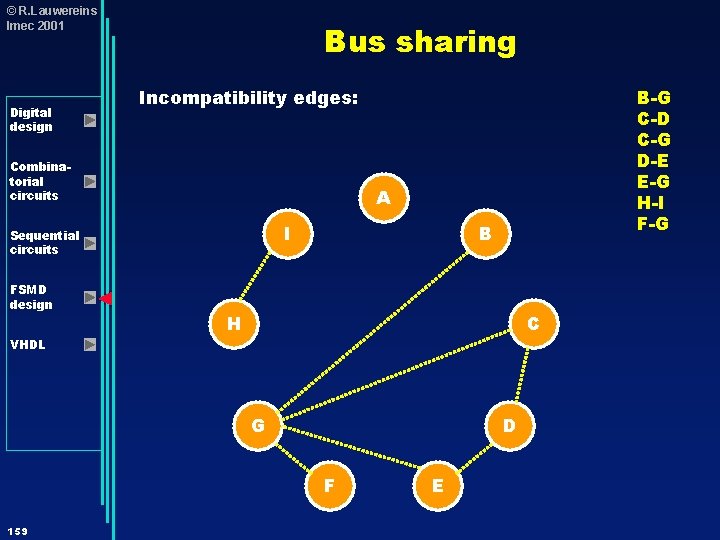
© R. Lauwereins Imec 2001 Digital design Bus sharing Incompatibility edges: Combinatorial circuits A I Sequential circuits FSMD design VHDL B H C G D F 159 B-G C-D C-G D-E E-G H-I F-G E
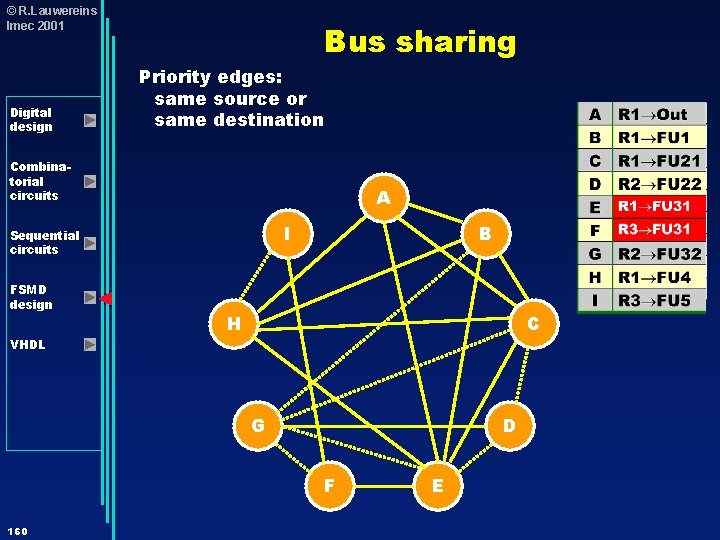
© R. Lauwereins Imec 2001 Digital design Bus sharing Priority edges: same source or same destination Combinatorial circuits A I Sequential circuits FSMD design VHDL B H C G D F 160 E
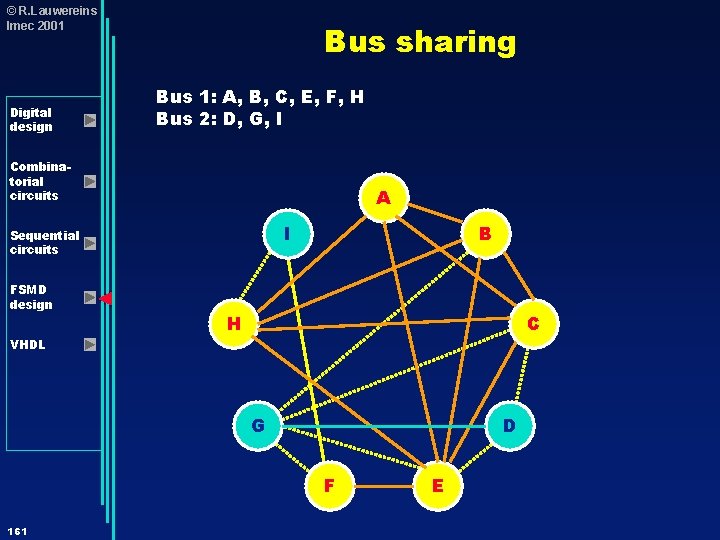
© R. Lauwereins Imec 2001 Digital design Bus sharing Bus 1: A, B, C, E, F, H Bus 2: D, G, I Combinatorial circuits A I Sequential circuits FSMD design VHDL B H C G D F 161 E
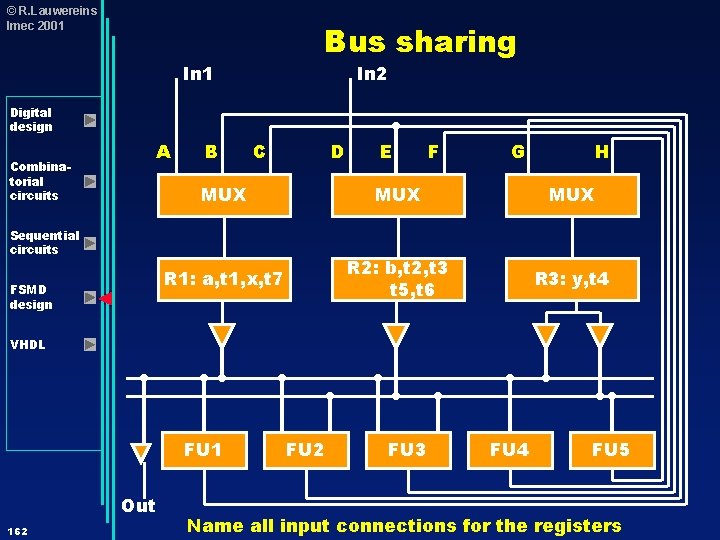
© R. Lauwereins Imec 2001 Bus sharing In 1 In 2 Digital design A Combinatorial circuits B C D F G H MUX MUX R 1: a, t 1, x, t 7 R 2: b, t 2, t 3 t 5, t 6 R 3: y, t 4 Sequential circuits FSMD design E VHDL FU 1 Out 162 FU 3 FU 4 FU 5 Name all input connections for the registers
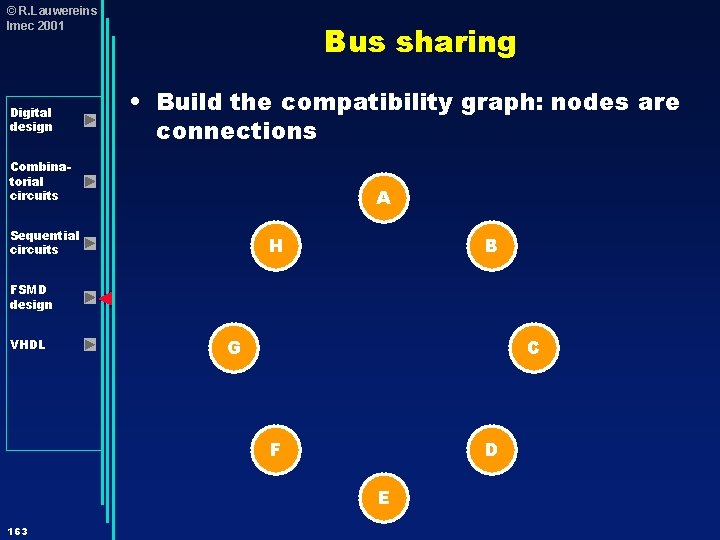
© R. Lauwereins Imec 2001 Digital design Bus sharing • Build the compatibility graph: nodes are connections Combinatorial circuits A Sequential circuits H B FSMD design VHDL G C F D E 163
© R. Lauwereins Imec 2001 Digital design Combinatorial circuits Sequential circuits FSMD design VHDL 164 Bus sharing • In which state is each connection used? From which source and to which destination do they go?
© R. Lauwereins Imec 2001 A-D B-E C-G F-H Digital design Combinatorial circuits R 1=In 1 R 2=In 2 Sequential circuits FSMD design VHDL 165 0 Start Out=R 1 1 R 1=F 1(R 1) R 2=F 3(R 2) R 1=F 3(R 1, R 2) R 3=F 2(R 1, R 2) R 2=F 3(R 3, R 2) R 2=F 4(R 1) R 3=F 5(R 3) R 2=F 3(R 1, R 2) Bus sharing Incompatible connections are those that are used in the same state and come from a different functional unit
© R. Lauwereins Imec 2001 Digital design Bus sharing • Incompatibility edges: Combinatorial circuits A-D B-E C-G F-H A Sequential circuits H B FSMD design VHDL G C F D E 166
© R. Lauwereins Imec 2001 Digital design Bus sharing • Priority edges: Combinatorial circuits A Sequential circuits H B FSMD design VHDL G C F D E 167
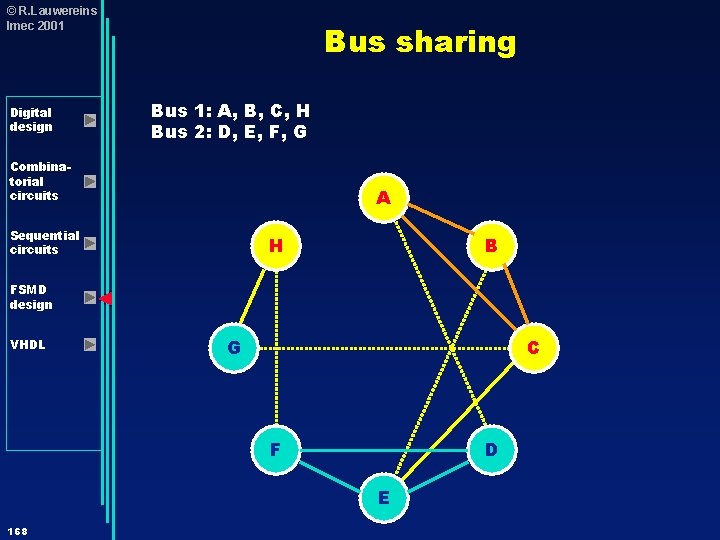
© R. Lauwereins Imec 2001 Digital design Bus sharing Bus 1: A, B, C, H Bus 2: D, E, F, G Combinatorial circuits A Sequential circuits H B FSMD design VHDL G C F D E 168
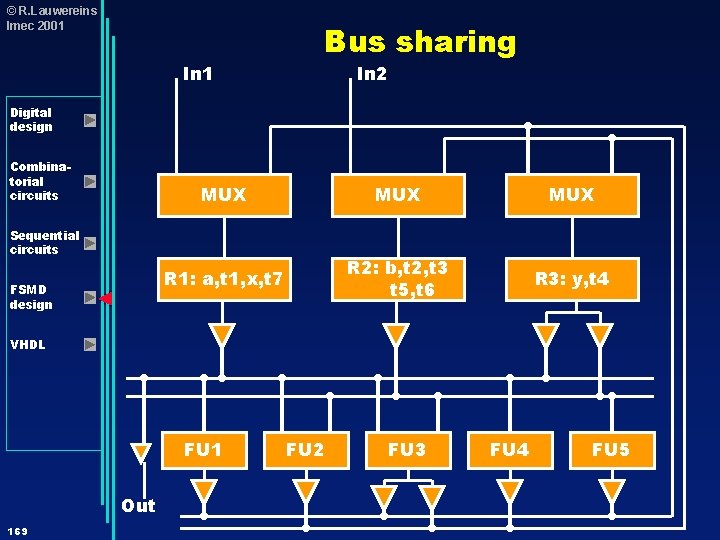
© R. Lauwereins Imec 2001 In 1 Bus sharing In 2 Digital design Combinatorial circuits MUX MUX R 1: a, t 1, x, t 7 R 2: b, t 2, t 3 t 5, t 6 R 3: y, t 4 Sequential circuits FSMD design VHDL FU 1 Out 169 FU 2 FU 3 FU 4 FU 5
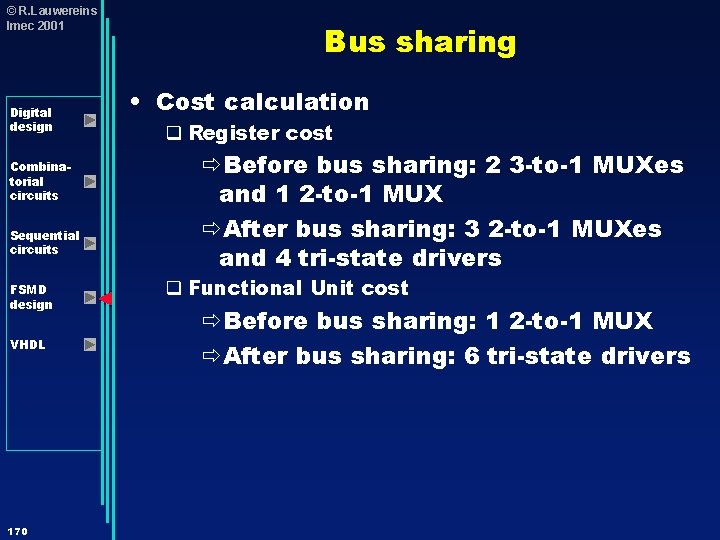
© R. Lauwereins Imec 2001 Digital design Combinatorial circuits Sequential circuits FSMD design VHDL 170 Bus sharing • Cost calculation q Register cost ðBefore bus sharing: 2 3 -to-1 MUXes and 1 2 -to-1 MUX ðAfter bus sharing: 3 2 -to-1 MUXes and 4 tri-state drivers q Functional Unit cost ðBefore bus sharing: 1 2 -to-1 MUX ðAfter bus sharing: 6 tri-state drivers
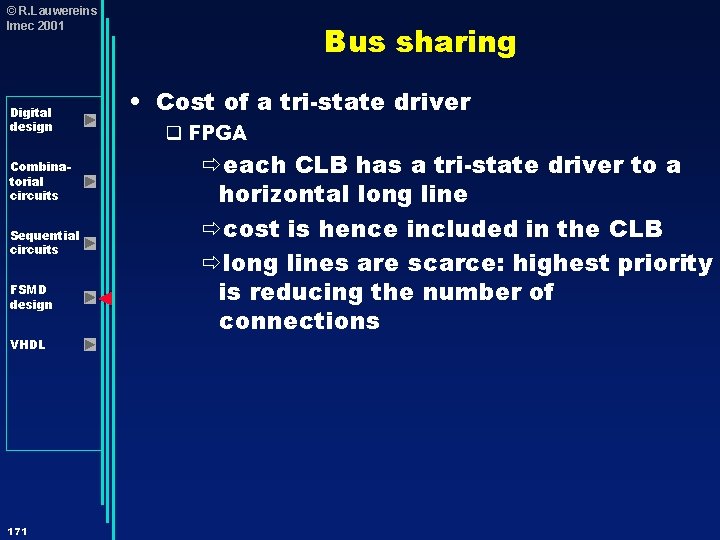
© R. Lauwereins Imec 2001 Digital design Combinatorial circuits Sequential circuits FSMD design VHDL 171 Bus sharing • Cost of a tri-state driver q FPGA ðeach CLB has a tri-state driver to a horizontal long line ðcost is hence included in the CLB ðlong lines are scarce: highest priority is reducing the number of connections
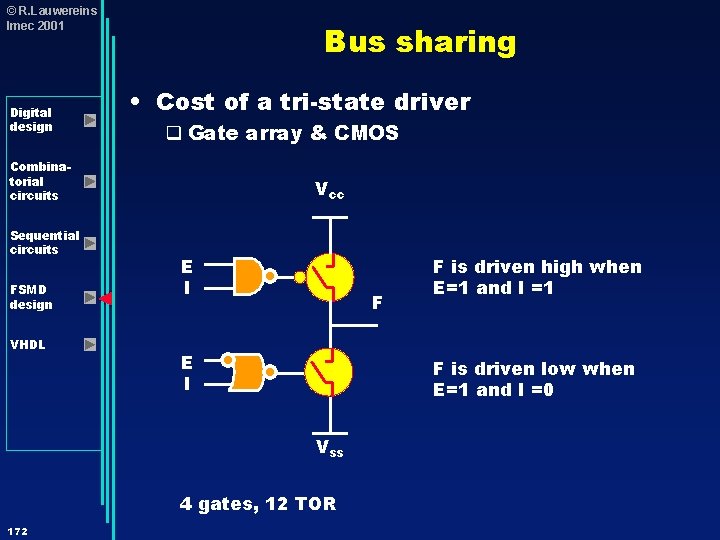
© R. Lauwereins Imec 2001 Digital design Bus sharing • Cost of a tri-state driver q Gate array & CMOS Combinatorial circuits Sequential circuits FSMD design VHDL Vcc E I F is driven low when E=1 and I =0 Vss 4 gates, 12 TOR 172 F is driven high when E=1 and I =1
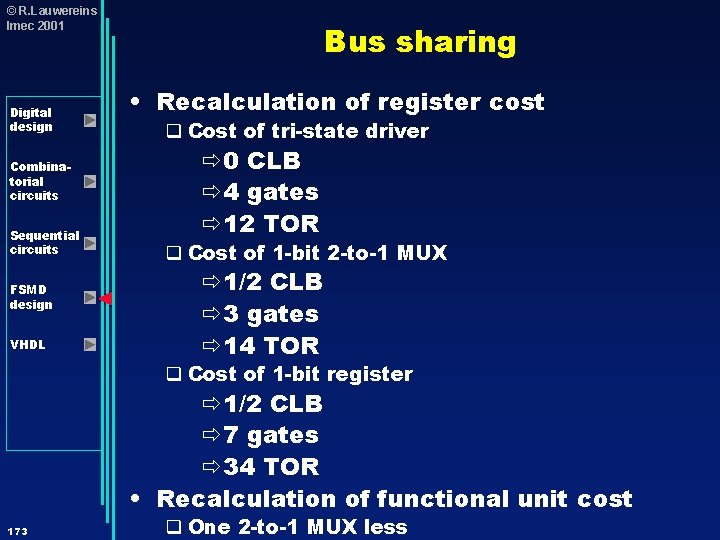
© R. Lauwereins Imec 2001 Digital design Combinatorial circuits Sequential circuits FSMD design VHDL Bus sharing • Recalculation of register cost q Cost of tri-state driver ð 0 CLB ð 4 gates ð 12 TOR q Cost of 1 -bit 2 -to-1 MUX ð 1/2 CLB ð 3 gates ð 14 TOR q Cost of 1 -bit register ð 1/2 CLB ð 7 gates ð 34 TOR • Recalculation of functional unit cost 173 q One 2 -to-1 MUX less
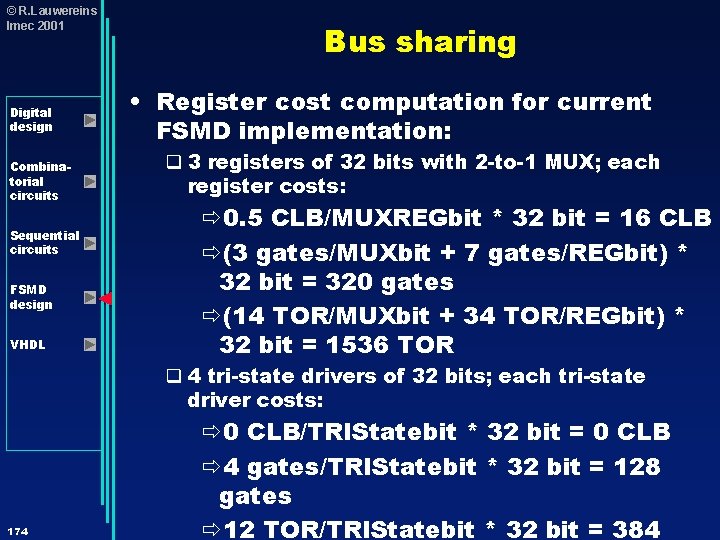
© R. Lauwereins Imec 2001 Digital design Combinatorial circuits Sequential circuits FSMD design VHDL Bus sharing • Register cost computation for current FSMD implementation: q 3 registers of 32 bits with 2 -to-1 MUX; each register costs: ð 0. 5 CLB/MUXREGbit * 32 bit = 16 CLB ð(3 gates/MUXbit + 7 gates/REGbit) * 32 bit = 320 gates ð(14 TOR/MUXbit + 34 TOR/REGbit) * 32 bit = 1536 TOR q 4 tri-state drivers of 32 bits; each tri-state driver costs: 174 ð 0 CLB/TRIStatebit * 32 bit = 0 CLB ð 4 gates/TRIStatebit * 32 bit = 128 gates ð 12 TOR/TRIStatebit * 32 bit = 384
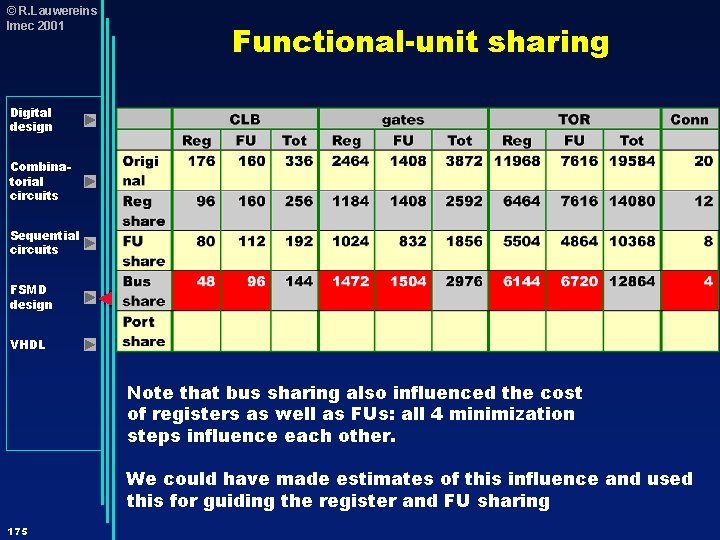
© R. Lauwereins Imec 2001 Functional-unit sharing Digital design Combinatorial circuits Sequential circuits FSMD design VHDL Note that bus sharing also influenced the cost of registers as well as FUs: all 4 minimization steps influence each other. We could have made estimates of this influence and used this for guiding the register and FU sharing 175
© R. Lauwereins Imec 2001 Digital design Combinatorial circuits Sequential circuits FSMD design VHDL 176 FSMD design • FSMDs • Models • Synthesis techniques q Basic principles q Merging ðRegister sharing (variable merging) ðFunctional-unit sharing (operator merging) ðBus sharing (connection merging) èRegister port sharing (register merging)
© R. Lauwereins Imec 2001 Digital design Combinatorial circuits Sequential circuits FSMD design VHDL 177 Register port sharing • Basic principle: q Combine several registers into one register file to reduce the number of read ports (less input MUXes) and the number of write ports (less tristate drivers • Methodology: build the Register Access Table, indicating reads and writes to registers in each state
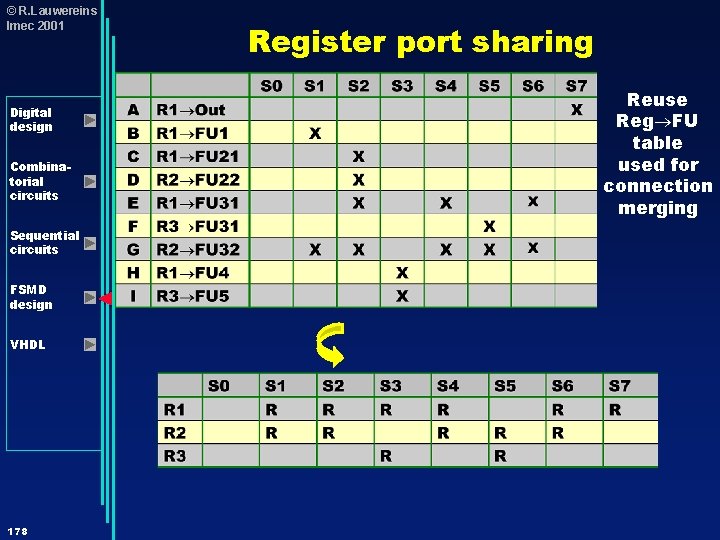
© R. Lauwereins Imec 2001 Digital design Combinatorial circuits Sequential circuits FSMD design VHDL 178 Register port sharing Reuse Reg FU table used for connection merging
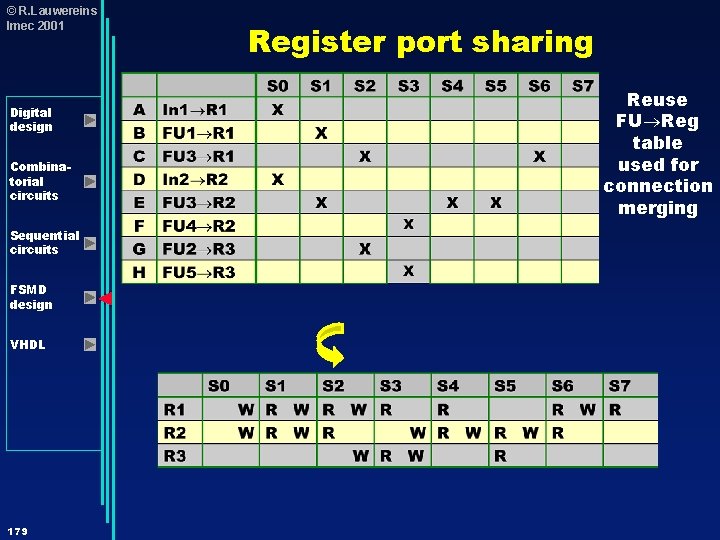
© R. Lauwereins Imec 2001 Digital design Combinatorial circuits Sequential circuits FSMD design VHDL 179 Register port sharing Reuse FU Reg table used for connection merging
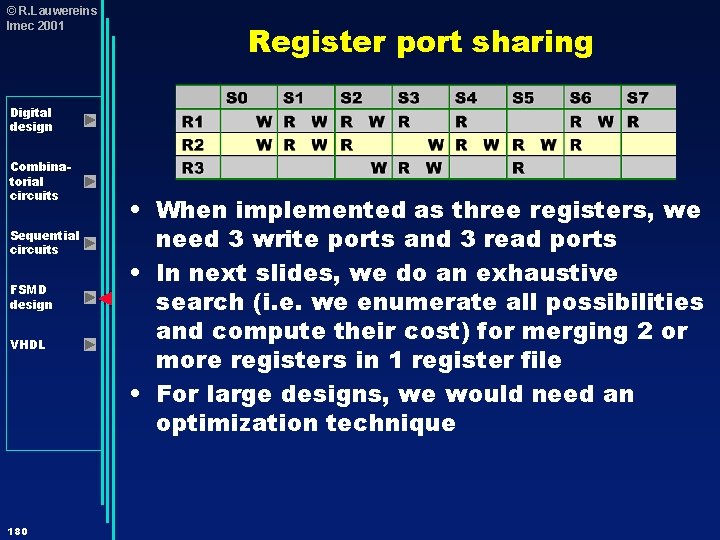
© R. Lauwereins Imec 2001 Register port sharing Digital design Combinatorial circuits Sequential circuits FSMD design VHDL 180 • When implemented as three registers, we need 3 write ports and 3 read ports • In next slides, we do an exhaustive search (i. e. we enumerate all possibilities and compute their cost) for merging 2 or more registers in 1 register file • For large designs, we would need an optimization technique
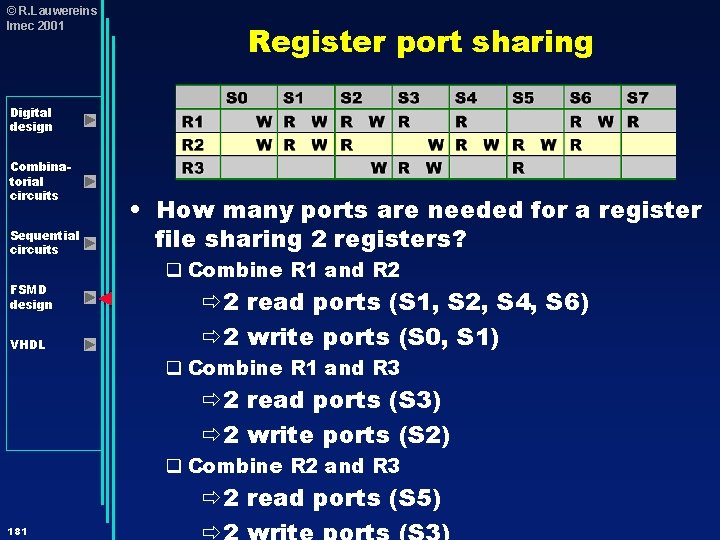
© R. Lauwereins Imec 2001 Register port sharing Digital design Combinatorial circuits Sequential circuits FSMD design VHDL • How many ports are needed for a register file sharing 2 registers? q Combine R 1 and R 2 ð 2 read ports (S 1, S 2, S 4, S 6) ð 2 write ports (S 0, S 1) q Combine R 1 and R 3 ð 2 read ports (S 3) ð 2 write ports (S 2) q Combine R 2 and R 3 ð 2 read ports (S 5) 181
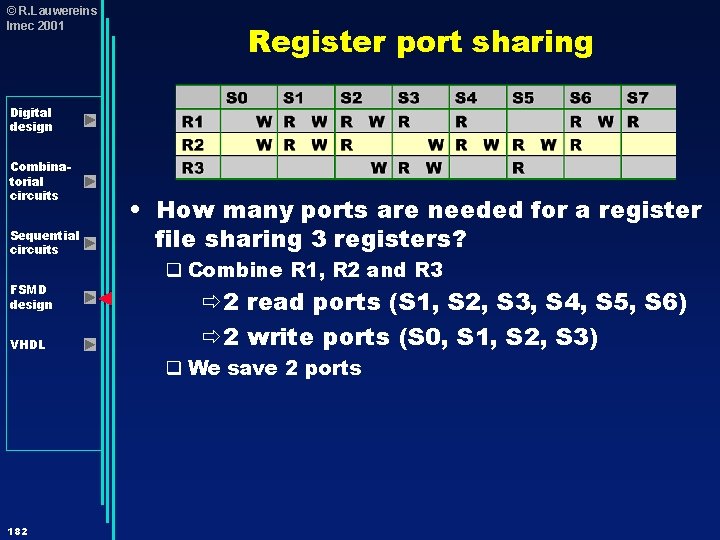
© R. Lauwereins Imec 2001 Register port sharing Digital design Combinatorial circuits Sequential circuits FSMD design VHDL • How many ports are needed for a register file sharing 3 registers? q Combine R 1, R 2 and R 3 ð 2 read ports (S 1, S 2, S 3, S 4, S 5, S 6) ð 2 write ports (S 0, S 1, S 2, S 3) q We save 2 ports 182
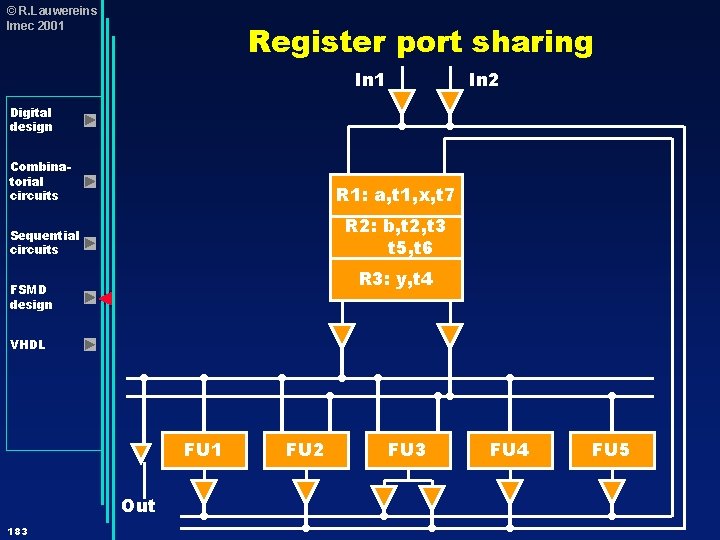
© R. Lauwereins Imec 2001 Register port sharing In 1 In 2 Digital design Combinatorial circuits R 1: a, t 1, x, t 7 R 2: b, t 2, t 3 t 5, t 6 Sequential circuits R 3: y, t 4 FSMD design VHDL FU 1 Out 183 FU 2 FU 3 FU 4 FU 5
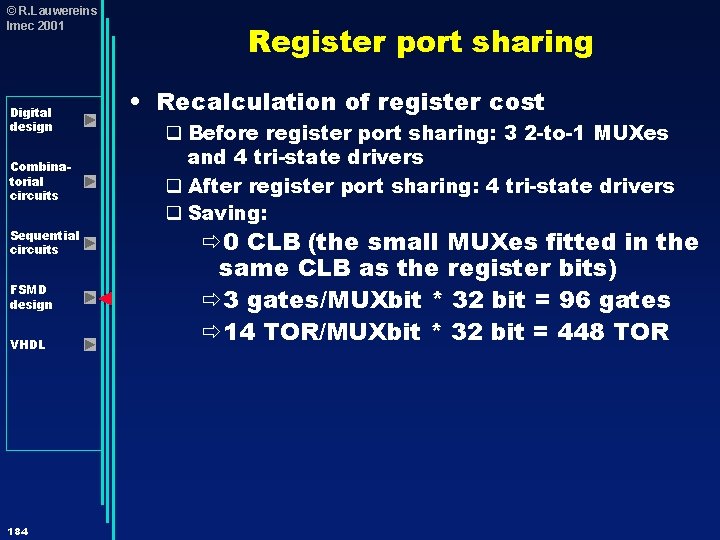
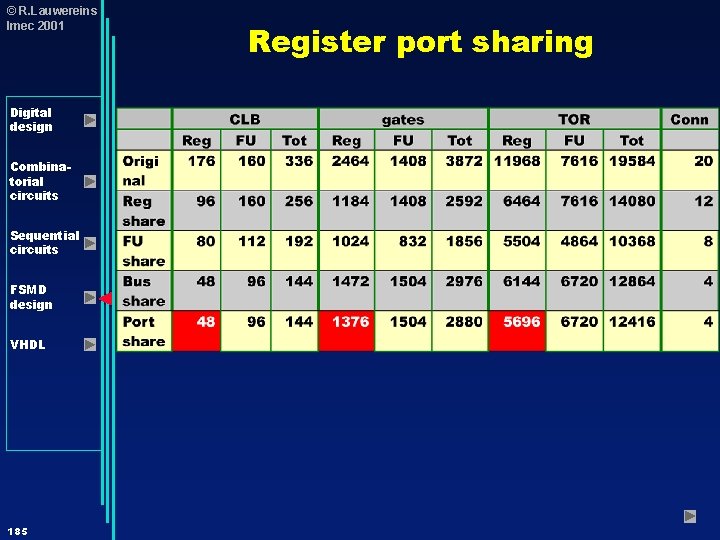
© R. Lauwereins Imec 2001 Digital design Combinatorial circuits Sequential circuits FSMD design VHDL 184 Register port sharing • Recalculation of register cost q Before register port sharing: 3 2 -to-1 MUXes and 4 tri-state drivers q After register port sharing: 4 tri-state drivers q Saving: ð 0 CLB (the small MUXes fitted in the same CLB as the register bits) ð 3 gates/MUXbit * 32 bit = 96 gates ð 14 TOR/MUXbit * 32 bit = 448 TOR
© R. Lauwereins Imec 2001 Digital design Combinatorial circuits Sequential circuits FSMD design VHDL 185 Register port sharing
- Slides: 185