
R 4 d Can prove or disprove simple
- Slides: 14
R 4 d. Can prove or disprove simple statements about a character by finding evidence in a text Commissioned by The Pi. XL Club Ltd. October 2017 This resource is strictly for the use of member schools for as long as they remain members of The Pi. XL Club. It may not be copied, sold nor transferred to a third party or used by the school after membership ceases. Until such time it may be freely used within the member school. All opinions and contributions are those of the authors. The contents of this resource are not connected with nor endorsed by any other company, organisation or institution. © Copyright The Pi. XL Club Limited, 2017
Teachers’ Notes q. This therapy begins by identifying how we find out about characters in narratives by: what we are told by the narrator, what they do, what they say and how they say it. q. Proving statements true or false is exemplified – initially, with straight forward descriptions of a character. q. This is developed to using text references and quotes to explain their theories. q. To develop these skills, pupils could make up some true/false statements for a partner based on an additional shared text.
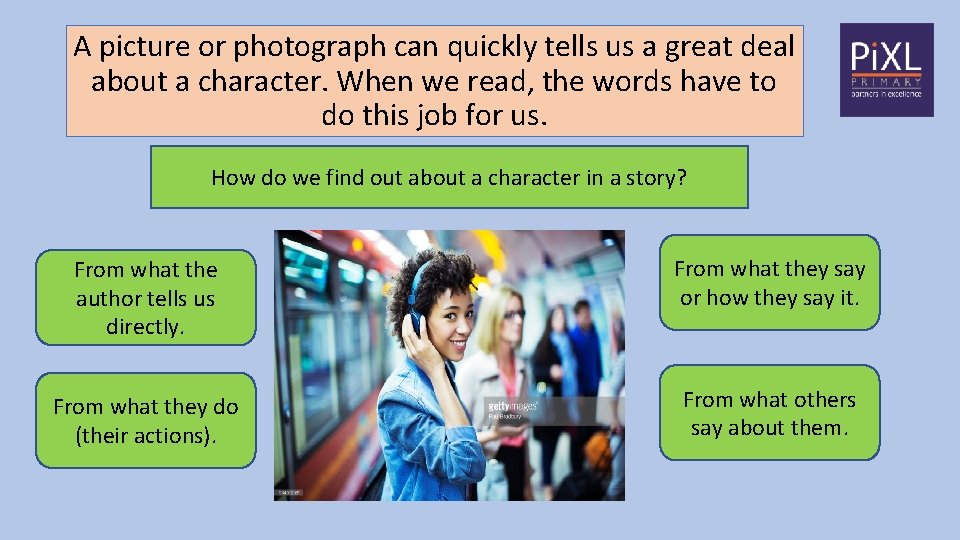
A picture or photograph can quickly tells us a great deal about a character. When we read, the words have to do this job for us. How do we find out about a character in a story? From what the author tells us directly. From what they say or how they say it. From what they do (their actions). From what others say about them.
To be able to prove or disprove a statement about a character, we need to find evidence in the text. For example: The woman in this description has black hair. True or false? To decide, I will underline the key words in the statement then scan the text for them. Then I will read the sentence/s around it to make sure. The woman in this description has black hair. True or false? I have scanned the information and found the words black hair. I have re-read the sentence, to check the meaning, and decided that the statement is true. As I arrived on the train, I noticed a striking woman in front of me. She had a dazzling smile and her eyes sparkled. On her wavy, black hair, sat a pair of headphones. Perhaps what she was listening to was making her smile? Interestingly, her blue headphones matched the jacket she was wearing.
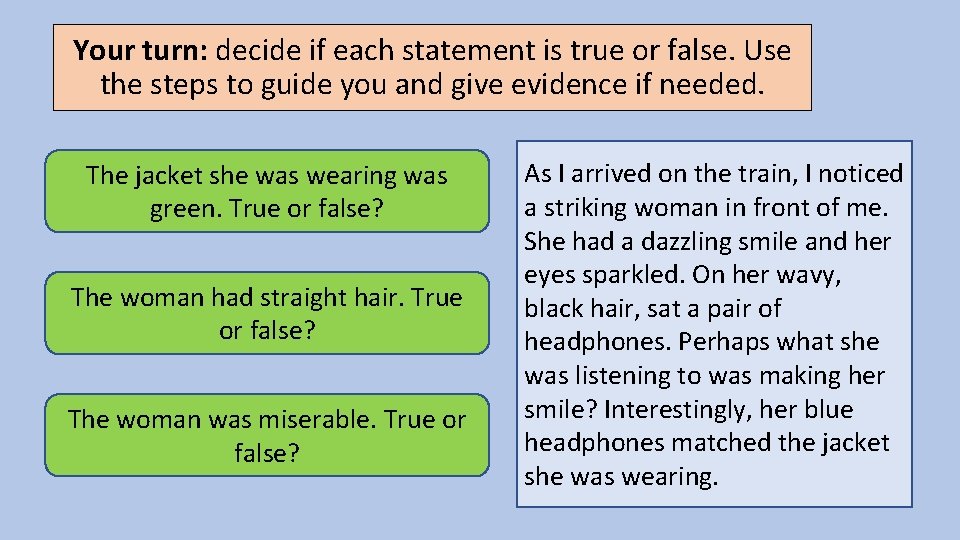
Your turn: decide if each statement is true or false. Use the steps to guide you and give evidence if needed. The jacket she was wearing was green. True or false? The woman had straight hair. True or false? The woman was miserable. True or false? As I arrived on the train, I noticed a striking woman in front of me. She had a dazzling smile and her eyes sparkled. On her wavy, black hair, sat a pair of headphones. Perhaps what she was listening to was making her smile? Interestingly, her blue headphones matched the jacket she was wearing.
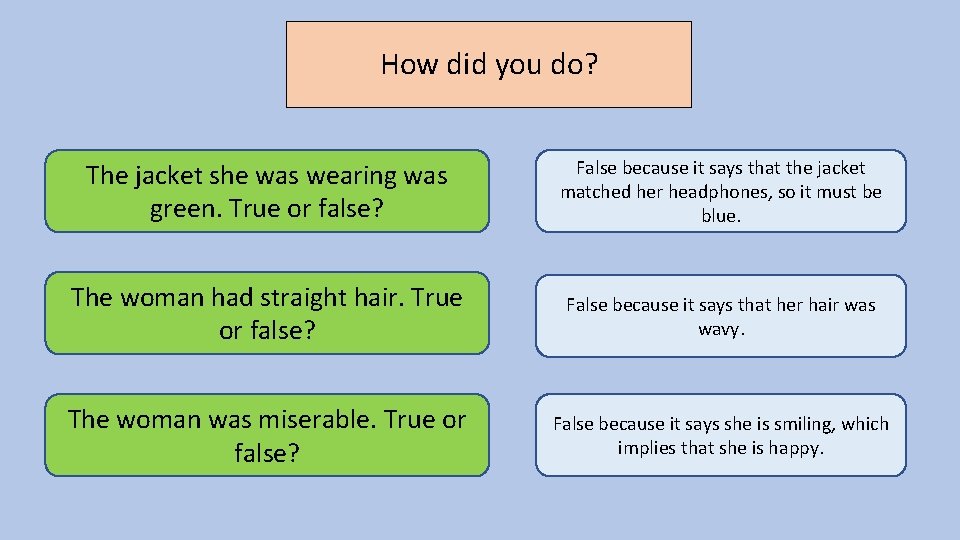
How did you do? The jacket she was wearing was green. True or false? False because it says that the jacket matched her headphones, so it must be blue. The woman had straight hair. True or false? False because it says that her hair was wavy. The woman was miserable. True or false? False because it says she is smiling, which implies that she is happy.
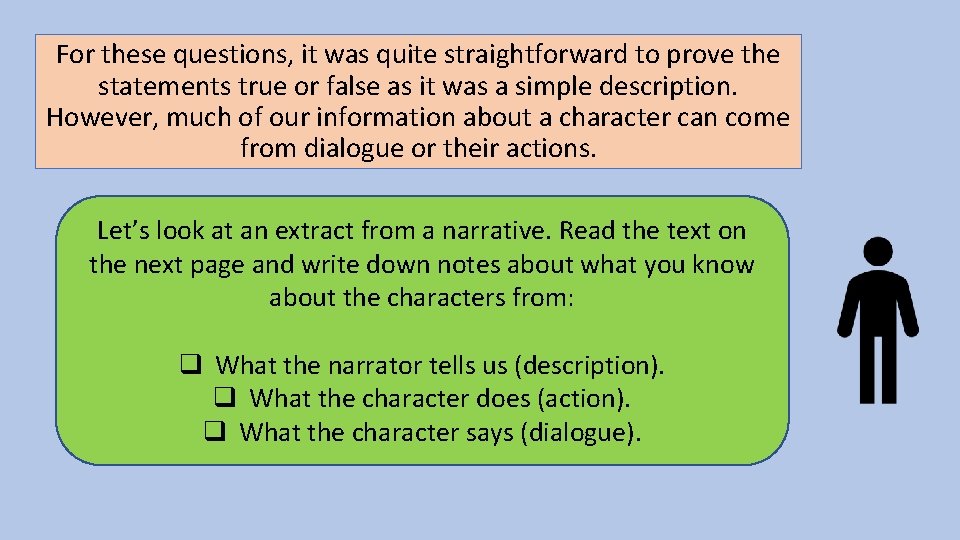
For these questions, it was quite straightforward to prove the statements true or false as it was a simple description. However, much of our information about a character can come from dialogue or their actions. Let’s look at an extract from a narrative. Read the text on the next page and write down notes about what you know about the characters from: q What the narrator tells us (description). q What the character does (action). q What the character says (dialogue).
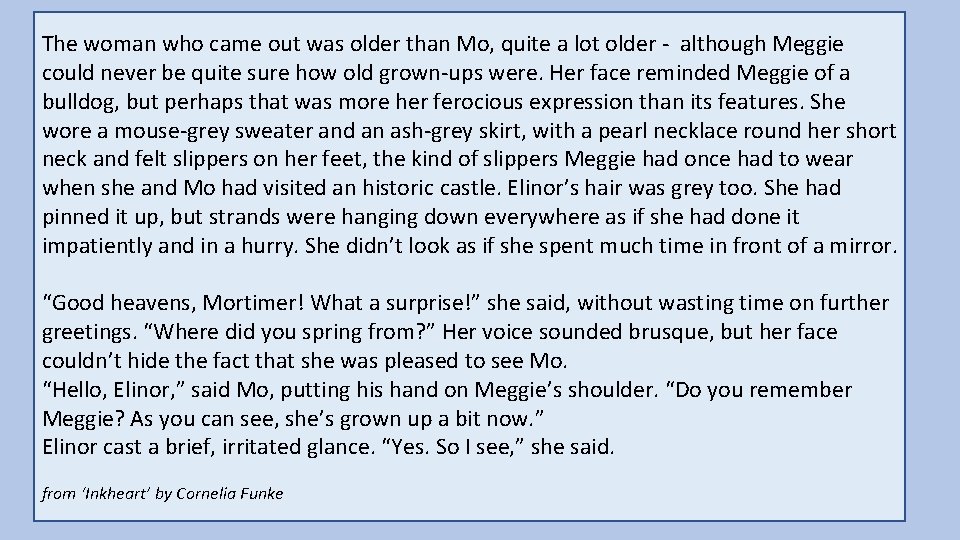
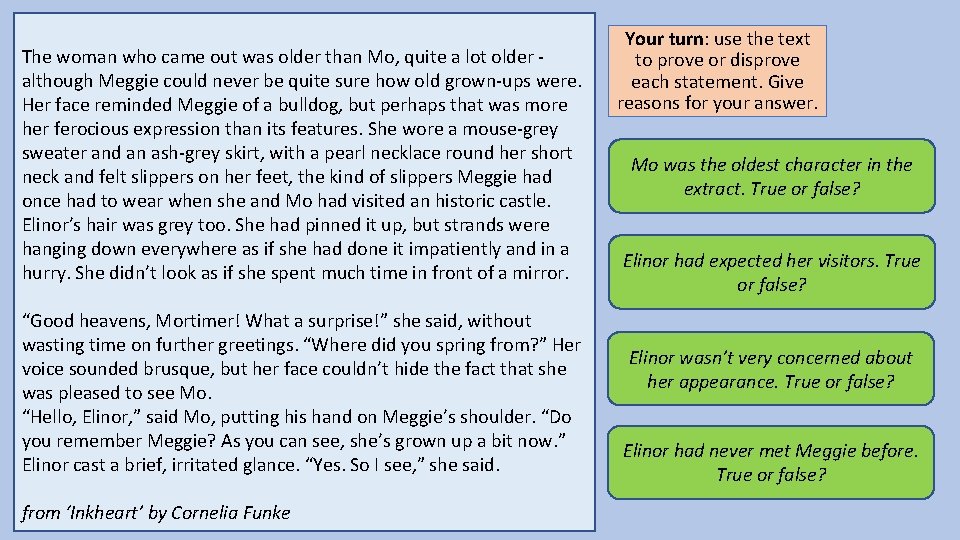
The woman who came out was older than Mo, quite a lot older - although Meggie could never be quite sure how old grown-ups were. Her face reminded Meggie of a bulldog, but perhaps that was more her ferocious expression than its features. She wore a mouse-grey sweater and an ash-grey skirt, with a pearl necklace round her short neck and felt slippers on her feet, the kind of slippers Meggie had once had to wear when she and Mo had visited an historic castle. Elinor’s hair was grey too. She had pinned it up, but strands were hanging down everywhere as if she had done it impatiently and in a hurry. She didn’t look as if she spent much time in front of a mirror. “Good heavens, Mortimer! What a surprise!” she said, without wasting time on further greetings. “Where did you spring from? ” Her voice sounded brusque, but her face couldn’t hide the fact that she was pleased to see Mo. “Hello, Elinor, ” said Mo, putting his hand on Meggie’s shoulder. “Do you remember Meggie? As you can see, she’s grown up a bit now. ” Elinor cast a brief, irritated glance. “Yes. So I see, ” she said. from ‘Inkheart’ by Cornelia Funke
The woman who came out was older than Mo, quite a lot older although Meggie could never be quite sure how old grown-ups were. Her face reminded Meggie of a bulldog, but perhaps that was more her ferocious expression than its features. She wore a mouse-grey sweater and an ash-grey skirt, with a pearl necklace round her short neck and felt slippers on her feet, the kind of slippers Meggie had once had to wear when she and Mo had visited an historic castle. Elinor’s hair was grey too. She had pinned it up, but strands were hanging down everywhere as if she had done it impatiently and in a hurry. She didn’t look as if she spent much time in front of a mirror. “Good heavens, Mortimer! What a surprise!” she said, without wasting time on further greetings. “Where did you spring from? ” Her voice sounded brusque, but her face couldn’t hide the fact that she was pleased to see Mo. “Hello, Elinor, ” said Mo, putting his hand on Meggie’s shoulder. “Do you remember Meggie? As you can see, she’s grown up a bit now. ” Elinor cast a brief, irritated glance. “Yes. So I see, ” she said. from ‘Inkheart’ by Cornelia Funke Your turn: use the text to prove or disprove each statement. Give reasons for your answer. Mo was the oldest character in the extract. True or false? Elinor had expected her visitors. True or false? Elinor wasn’t very concerned about her appearance. True or false? Elinor had never met Meggie before. True or false?
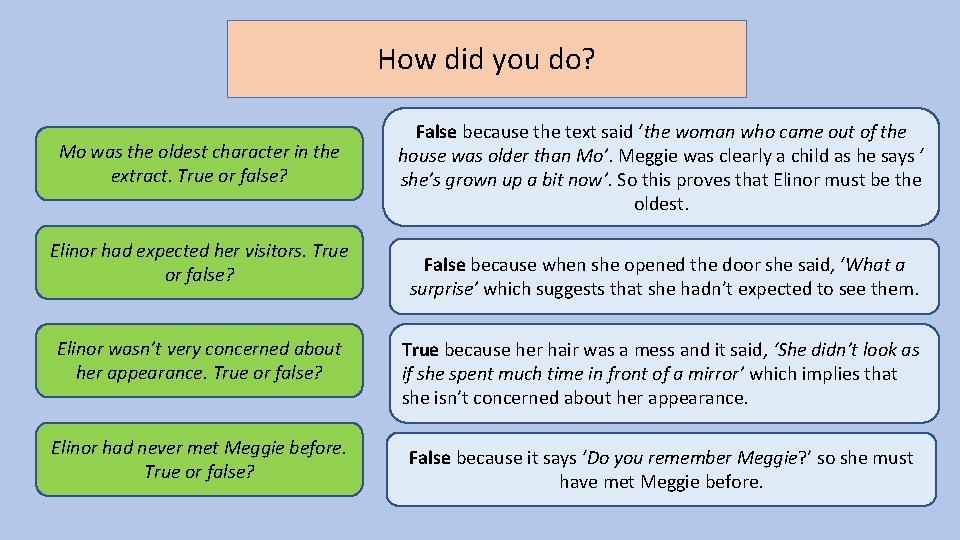
How did you do? Mo was the oldest character in the extract. True or false? Elinor had expected her visitors. True or false? False because the text said ‘the woman who came out of the house was older than Mo’. Meggie was clearly a child as he says ‘ she’s grown up a bit now’. So this proves that Elinor must be the oldest. False because when she opened the door she said, ‘What a surprise’ which suggests that she hadn’t expected to see them. Elinor wasn’t very concerned about her appearance. True or false? True because her hair was a mess and it said, ‘She didn’t look as if she spent much time in front of a mirror’ which implies that she isn’t concerned about her appearance. Elinor had never met Meggie before. True or false? False because it says ‘Do you remember Meggie? ’ so she must have met Meggie before.
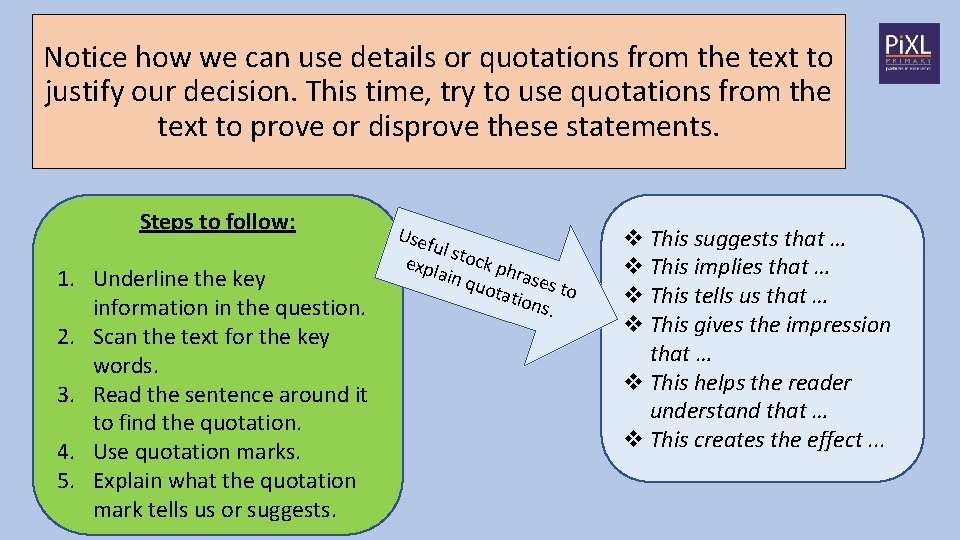
Notice how we can use details or quotations from the text to justify our decision. This time, try to use quotations from the text to prove or disprove these statements. Steps to follow: 1. Underline the key information in the question. 2. Scan the text for the key words. 3. Read the sentence around it to find the quotation. 4. Use quotation marks. 5. Explain what the quotation mark tells us or suggests. Usef ul st expl ock ph ain q r uota ases to tion s. v This suggests that … v This implies that … v This tells us that … v This gives the impression that … v This helps the reader understand that … v This creates the effect. . .
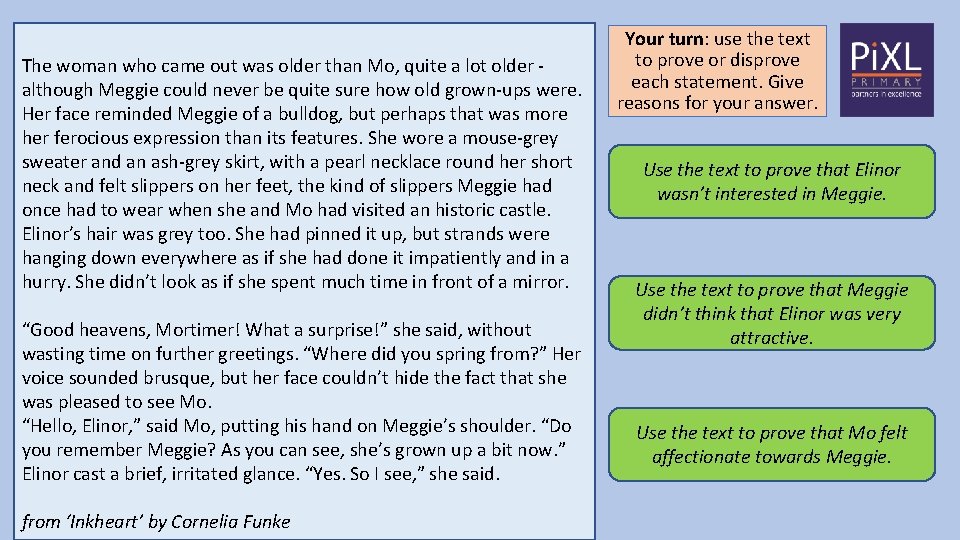
The woman who came out was older than Mo, quite a lot older although Meggie could never be quite sure how old grown-ups were. Her face reminded Meggie of a bulldog, but perhaps that was more her ferocious expression than its features. She wore a mouse-grey sweater and an ash-grey skirt, with a pearl necklace round her short neck and felt slippers on her feet, the kind of slippers Meggie had once had to wear when she and Mo had visited an historic castle. Elinor’s hair was grey too. She had pinned it up, but strands were hanging down everywhere as if she had done it impatiently and in a hurry. She didn’t look as if she spent much time in front of a mirror. “Good heavens, Mortimer! What a surprise!” she said, without wasting time on further greetings. “Where did you spring from? ” Her voice sounded brusque, but her face couldn’t hide the fact that she was pleased to see Mo. “Hello, Elinor, ” said Mo, putting his hand on Meggie’s shoulder. “Do you remember Meggie? As you can see, she’s grown up a bit now. ” Elinor cast a brief, irritated glance. “Yes. So I see, ” she said. from ‘Inkheart’ by Cornelia Funke Your turn: use the text to prove or disprove each statement. Give reasons for your answer. Use the text to prove that Elinor wasn’t interested in Meggie. Use the text to prove that Meggie didn’t think that Elinor was very attractive. Use the text to prove that Mo felt affectionate towards Meggie.
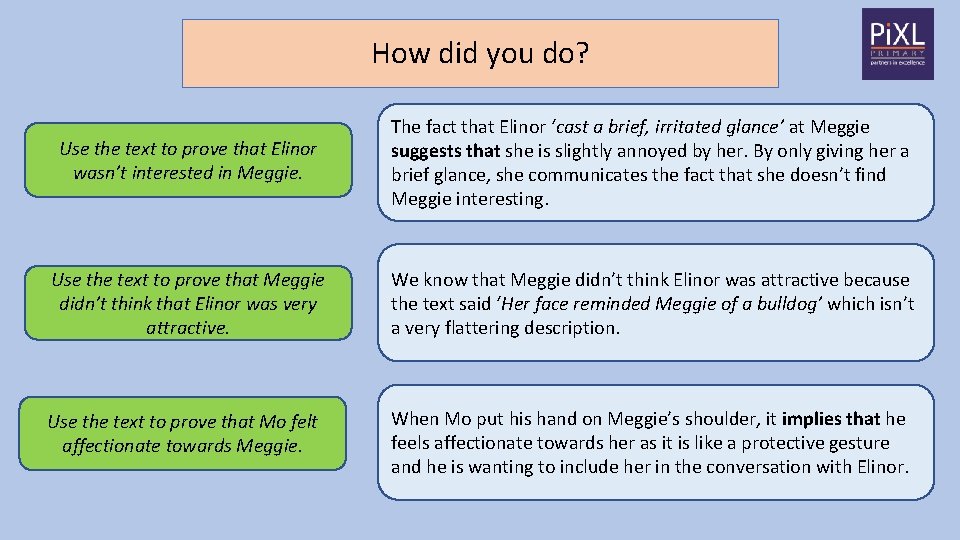
How did you do? Use the text to prove that Elinor wasn’t interested in Meggie. The fact that Elinor ‘cast a brief, irritated glance’ at Meggie suggests that she is slightly annoyed by her. By only giving her a brief glance, she communicates the fact that she doesn’t find Meggie interesting. Use the text to prove that Meggie didn’t think that Elinor was very attractive. We know that Meggie didn’t think Elinor was attractive because the text said ‘Her face reminded Meggie of a bulldog’ which isn’t a very flattering description. Use the text to prove that Mo felt affectionate towards Meggie. When Mo put his hand on Meggie’s shoulder, it implies that he feels affectionate towards her as it is like a protective gesture and he is wanting to include her in the conversation with Elinor.
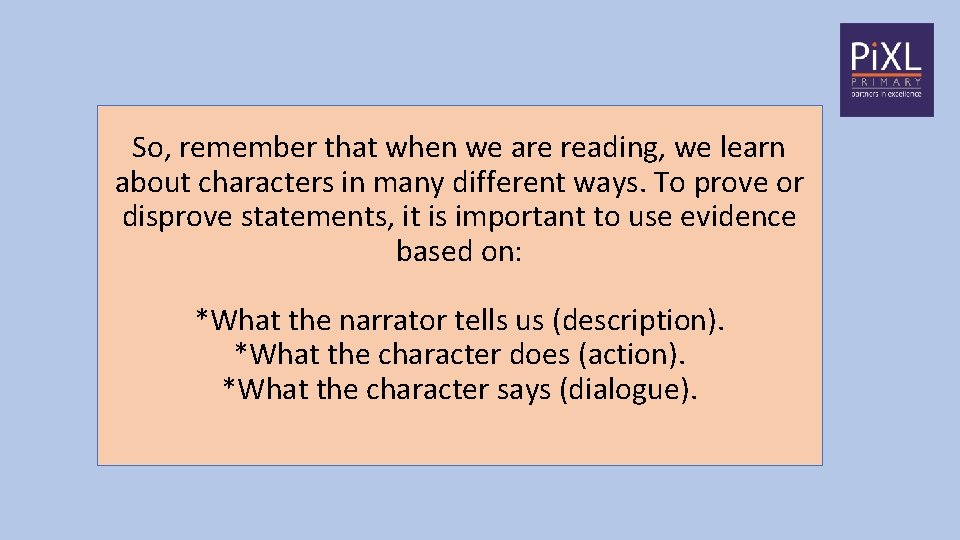
So, remember that when we are reading, we learn about characters in many different ways. To prove or disprove statements, it is important to use evidence based on: *What the narrator tells us (description). *What the character does (action). *What the character says (dialogue).