
R 2 Polyisocyanurate Insulation Product Line and Installation
- Slides: 73
R 2+ Polyisocyanurate Insulation Product Line and Installation Basics
Objectives • Introduce R 2+ polyiso insulation board and accessory products. • Understand the advantages of the different R 2+ polyiso insulation boards. • Describe 4 types of R 2+ installation. • Explain R 2+ application specifics by reviewing critical details for each type of installation. 2
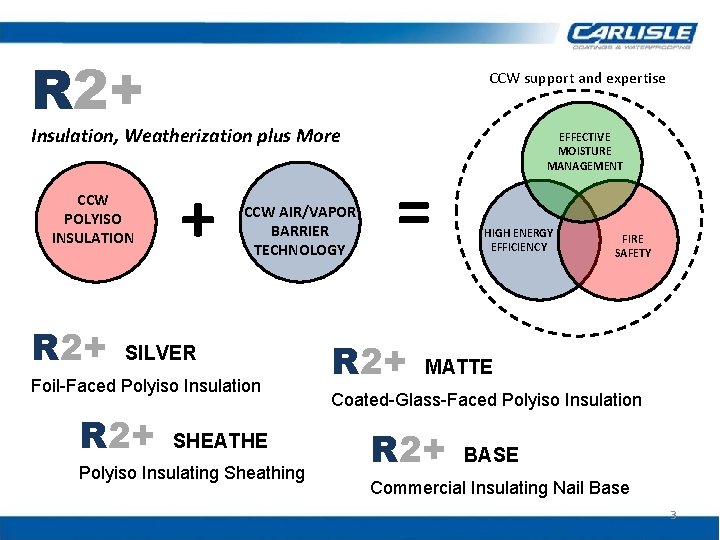
R 2+ CCW support and expertise Insulation, Weatherization plus More CCW POLYISO INSULATION R 2+ + CCW AIR/VAPOR BARRIER TECHNOLOGY SILVER Foil-Faced Polyiso Insulation R 2+ SHEATHE Polyiso Insulating Sheathing = R 2+ EFFECTIVE MOISTURE MANAGEMENT HIGH ENERGY EFFICIENCY FIRE SAFETY MATTE Coated-Glass-Faced Polyiso Insulation R 2+ BASE Commercial Insulating Nail Base 3
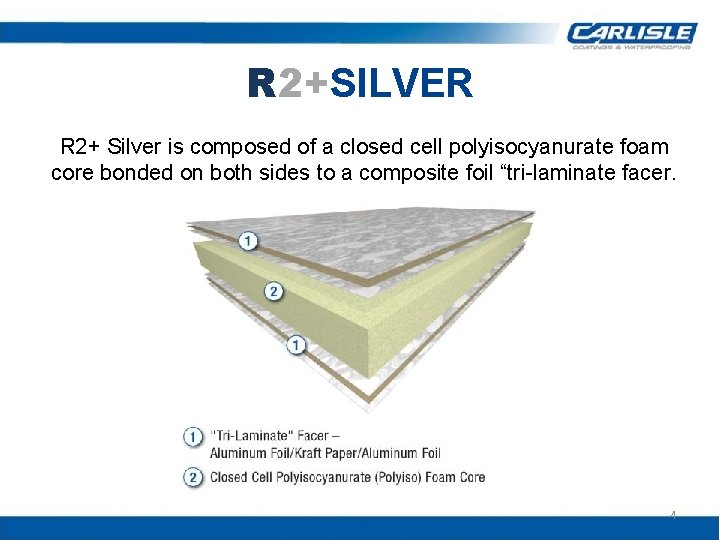
R 2+SILVER R 2+ Silver is composed of a closed cell polyisocyanurate foam core bonded on both sides to a composite foil “tri-laminate facer. 4
R 2+SILVER • R 2+ Silver has been fire-tested to NFPA 285 and passes this test in many wall assemblies. • High R-Value per inch – 6. 7 • Reflective facer can act as a radiant barrier adding an additional R-value of 2. 3 when facing a 1 -3/4” dead air space. • Part of a full weatherization system by CCW. Takes guesswork out of installation and procedures and product compatibility. 5
R 2+SILVER • R 2+ Silver is the most popular option which offers the best value in terms of cost per R(value) per sq. ft. • R 2+ Silver is used most commonly when a noncombustible closed grout cladding like brick, stone, concrete and terra cotta is installed. • Sell R 2+ Silver whenever possible. 6
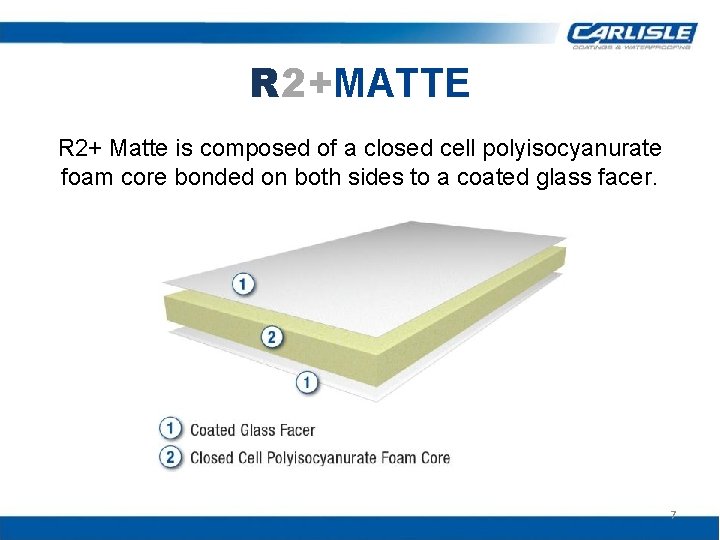
R 2+MATTE R 2+ Matte is composed of a closed cell polyisocyanurate foam core bonded on both sides to a coated glass facer. 7
R 2+MATTE • R 2+ Matte has been fire-tested to NFPA 285 and passes this test in many wall assemblies. • High R-Value per inch – 6. 0 • Meets wall assembly continuous insulation (ci) requirements prescribed by the Building Code. • No glare during exposure • Part of a full weatherization system by CCW. Takes guesswork out of installation and procedures and product compatibility. 8
R 2+MATTE • R 2+ Matte is the second most popular option and offers similar value in terms of cost per R(value) per sq. ft. • R 2+ Matte is used when a non-combustible closed grout cladding like brick, stone, concrete and terra cotta is installed. • With its high service temperature properties R 2+ Matte is ideal for use under metal composite panels, sheet metal and siding. • Coated glass facer provides effective burn resistant properties. 9
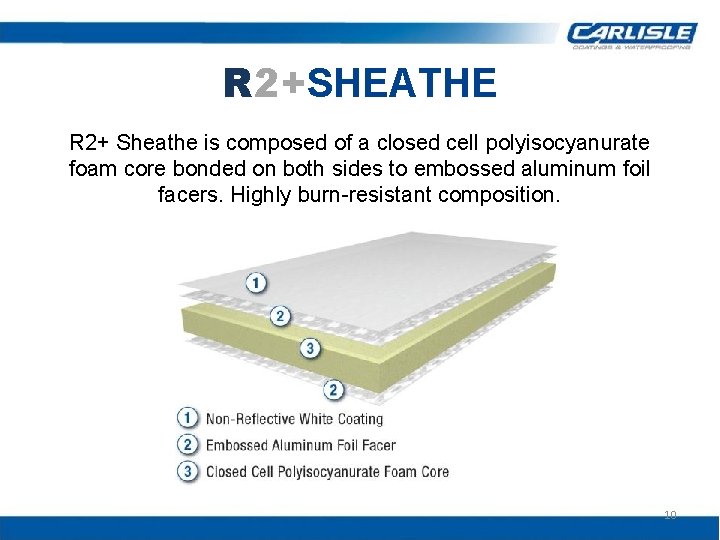
R 2+SHEATHE R 2+ Sheathe is composed of a closed cell polyisocyanurate foam core bonded on both sides to embossed aluminum foil facers. Highly burn-resistant composition. 10
R 2+SHEATHE • R 2+ Sheathe facers and foam core are of highly burn-resistant composition, allowing the direct installation over steel studs. • R 2+ Sheathe has been fire-tested to NFPA 285 and passes this test in many wall assemblies. • High R-Value per inch – 6. 3 • With silver side installed to the exterior it provides a radiant barrier adding an additional R-value of 3. 62 when facing a 1 -3/4” dead air space. • Part of a full weatherization system by CCW. Takes guesswork out of installation and procedures and product compatibility. 11
R 2+SHEATHE • R 2+ Sheathe is used to replace the sheathing and acts as an air barrier, vapor barrier, water resistive barrier and thermal barrier in one installation. • Non-combustible closed grout cladding like brick, stone, concrete and terra cotta may be installed over R 2+ Sheathe. • Thin veneer claddings such as metal composite panels, sheet metal and siding may also be installed over R 2+ Sheathe. • Competitive option when used as a sheathing and air barrier in terms of cost per R(value) per sq. ft. 12
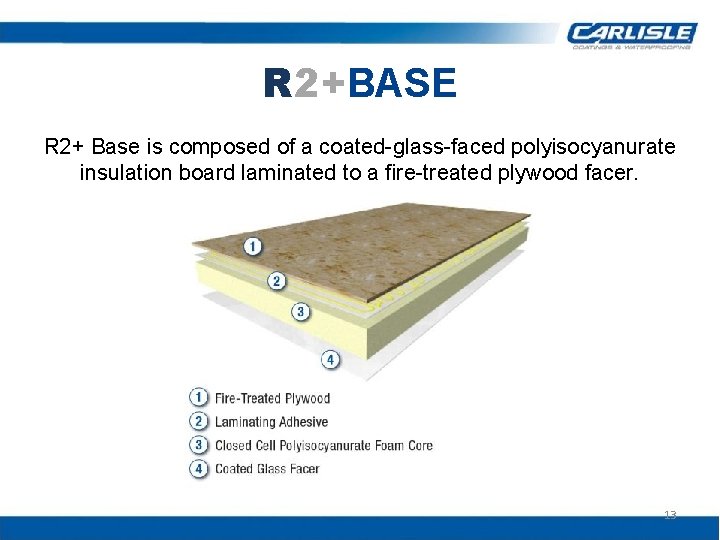
R 2+BASE R 2+ Base is composed of a coated-glass-faced polyisocyanurate insulation board laminated to a fire-treated plywood facer. 13
R 2+BASE • R 2+ Base provides continuous insulation and a nail base in one installation. • R 2+ has been fire-tested to NFPA 285 and passes this test in many wall assemblies. • High R-Value per inch – 6. 0 • Simple solution to providing continuous insulation under thin veneer cladding systems like stucco, corrugated metal and fiber cement siding. • Part of a full weatherization system by CCW. Takes guesswork out of installation and procedures and product compatibility. 14
R 2+BASE • R 2+ Base is used when continuous insulation (ci) and nail base is required over open studs. • R 2+ Base is ideal for use with thin veneer claddings like stucco, metal composite panels, fiber cement siding and sheet metal. • Excellent value in terms of cost per R(value) per sq. ft. • Ideal for mixed cladding installations, i. e. brick veneer wainscoting with stucco. 15
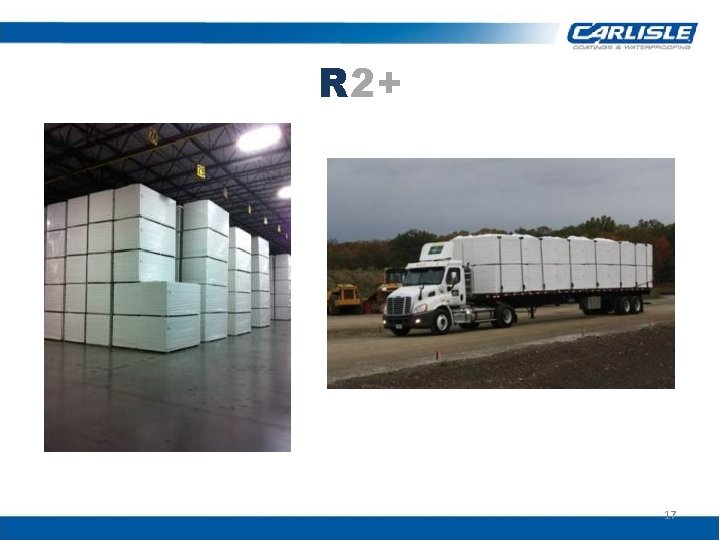
R 2+ Sizes • R 2+ Silver, Sheathe, and Matte: • 4’ x 8’ – 24” x 8’ – 16” x 8’ • 1” thick – 3. 5” thick • R 2+ Base • 4’ x 8’ • 1” thick – 3” thick polyiso with 5/8” fire treated plywood. R 2+ Base is also available with ¾” plywood on special order. 16
R 2+ 17
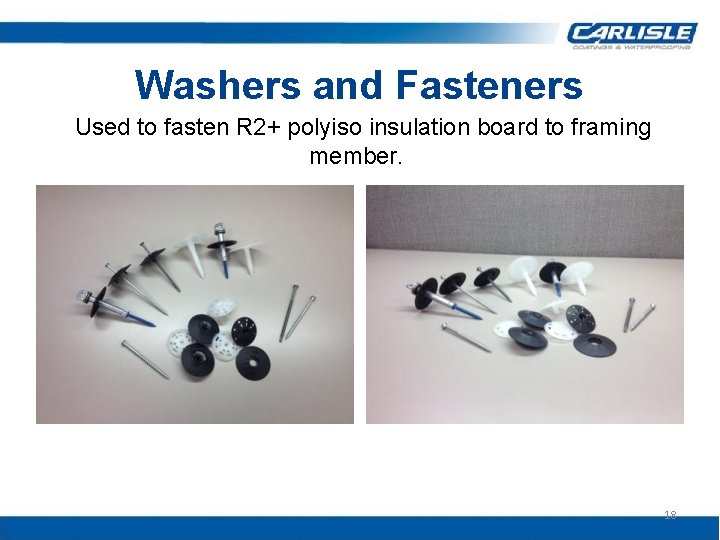
Washers and Fasteners Used to fasten R 2+ polyiso insulation board to framing member. 18
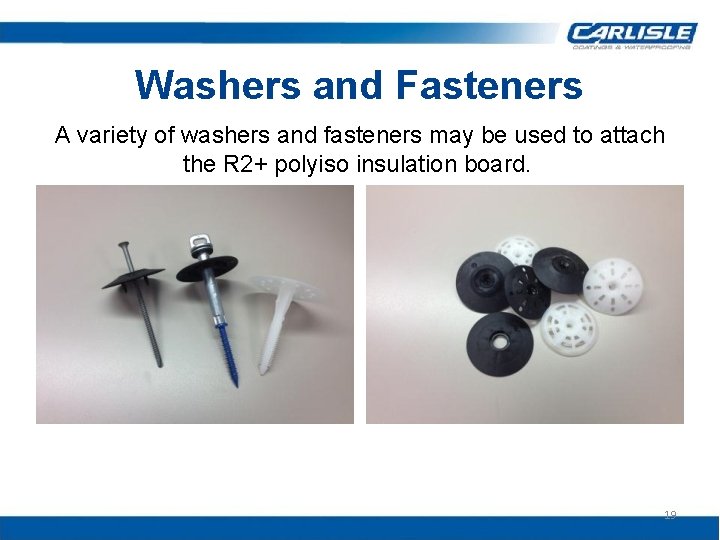
Washers and Fasteners A variety of washers and fasteners may be used to attach the R 2+ polyiso insulation board. 19
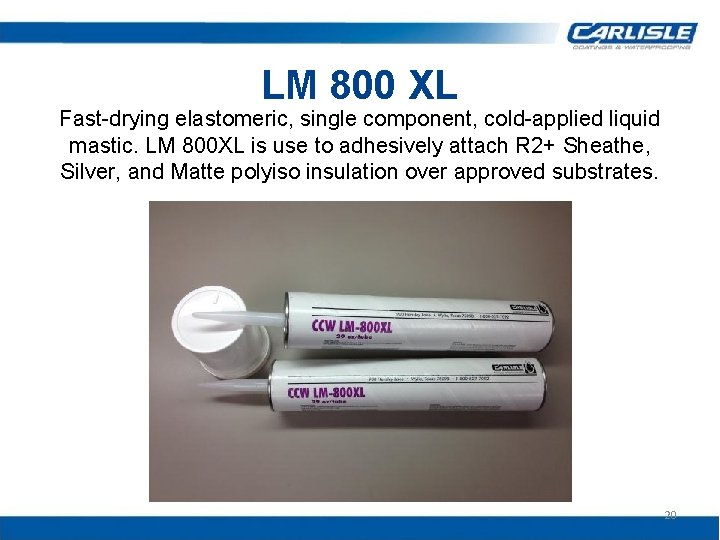
LM 800 XL Fast-drying elastomeric, single component, cold-applied liquid mastic. LM 800 XL is use to adhesively attach R 2+ Sheathe, Silver, and Matte polyiso insulation over approved substrates. 20
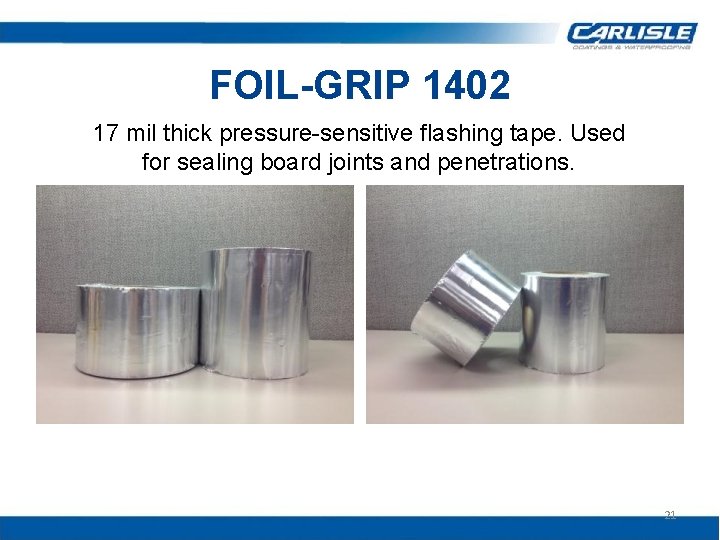
FOIL-GRIP 1402 17 mil thick pressure-sensitive flashing tape. Used for sealing board joints and penetrations. 21
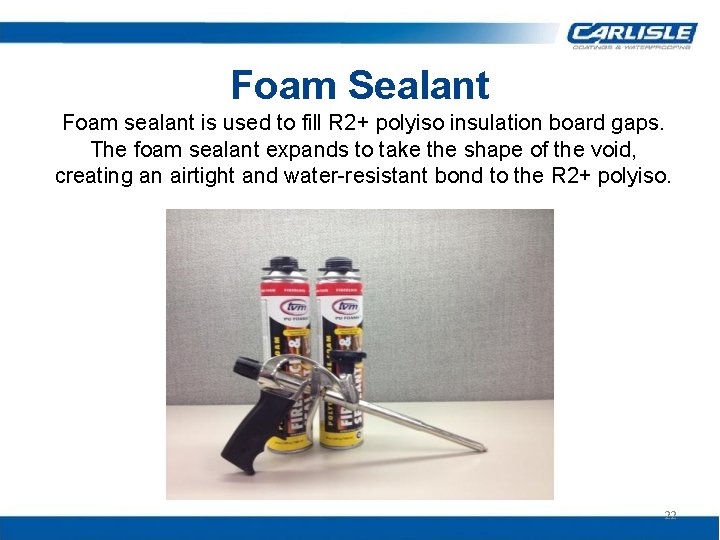
Foam Sealant Foam sealant is used to fill R 2+ polyiso insulation board gaps. The foam sealant expands to take the shape of the void, creating an airtight and water-resistant bond to the R 2+ polyiso. 22
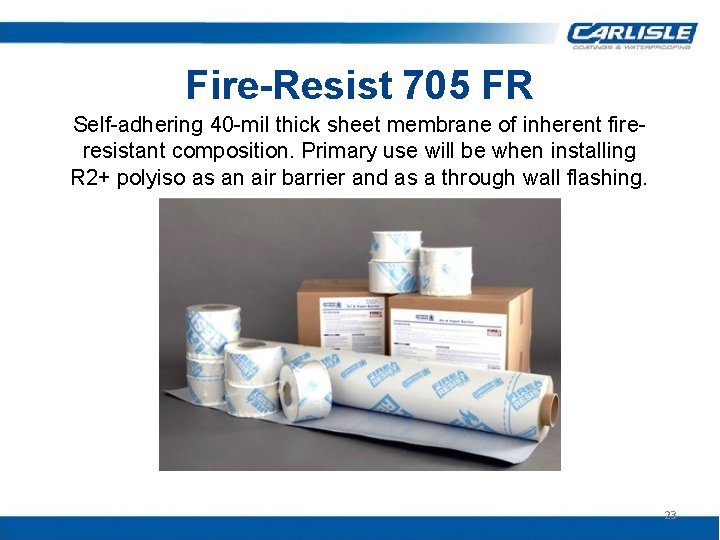
Fire-Resist 705 FR Self-adhering 40 -mil thick sheet membrane of inherent fireresistant composition. Primary use will be when installing R 2+ polyiso as an air barrier and as a through wall flashing. 23
Installation Basics • 4 types of application: • Application over an installed air/vapor barrier. • Application over approved substrates with R 2+ to perform as an air barrier. • Application over framing with R 2+ to perform as the substrate and air barrier. • Application as an insulated nail base. 24
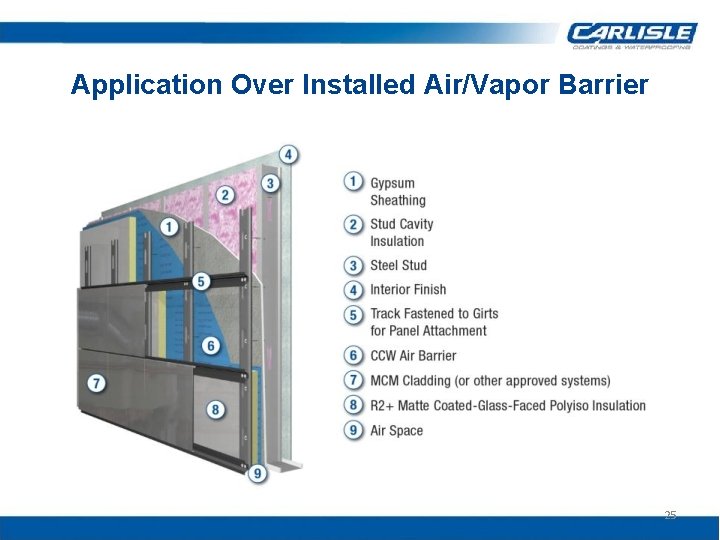
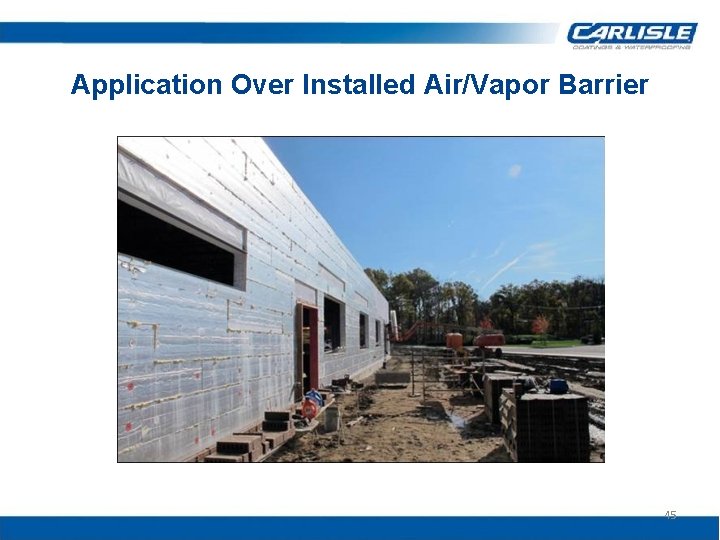
Application Over Installed Air/Vapor Barrier 25
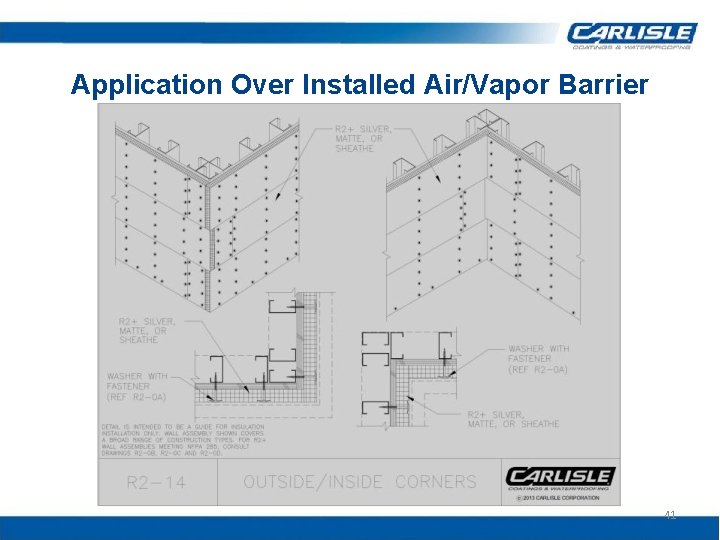
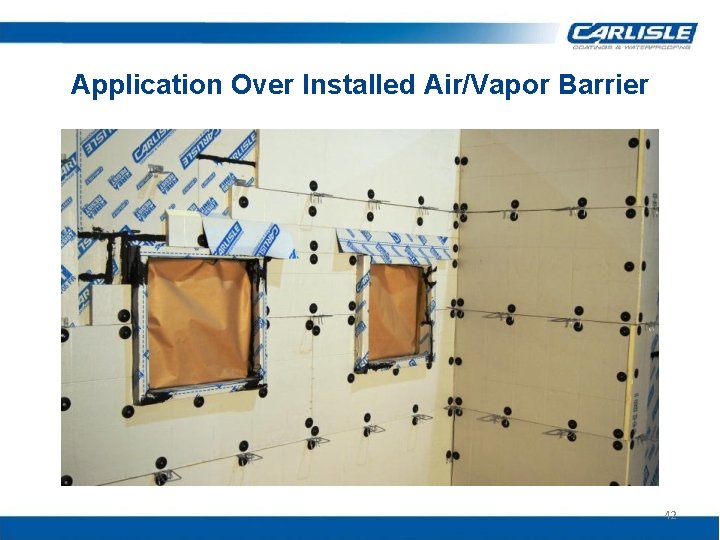
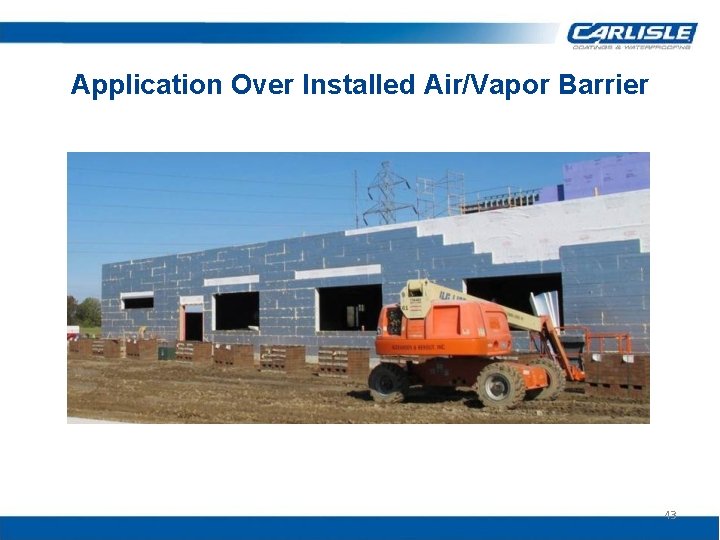
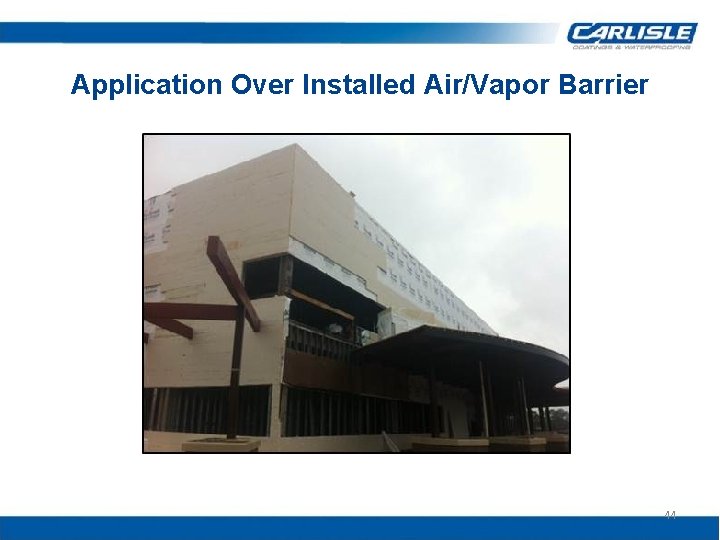
Application Over Installed Air/Vapor Barrier • Verify air/vapor has been properly installed. • Do not block flashing, weeps or other drainage paths. • Install R 2+ Silver, Sheathe or Matte continuously to deliver its maximum impact. • Do not apply over walls that are vulnerable to water intrusion. 26
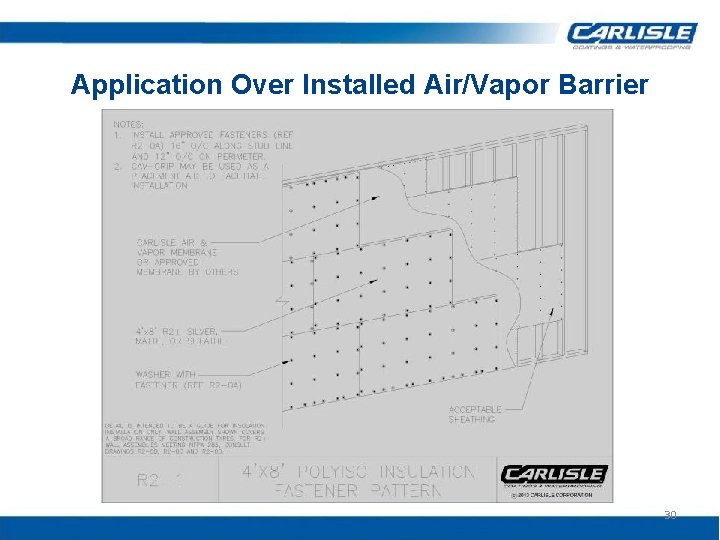
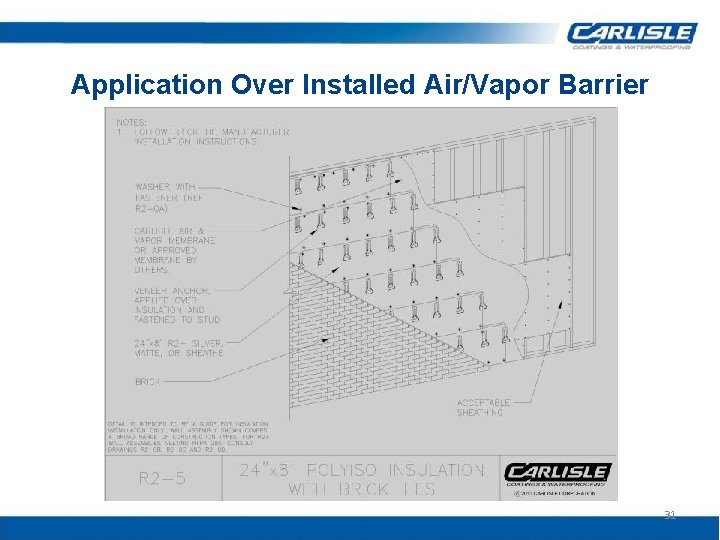
Application Over Installed Air/Vapor Barrier Mechanical Attachment • Space fasteners 12 -inches o. c. at perimeter and 16 inches o. c. in the field. Set back perimeter fasteners 3/8 inch from board edges and end. One washer may be used to bridge adjoining boards. • Where R 2+ is installed by the same trade as the cladding, or in close cooperation with that trade: cladding attachment hardware can supplement or replace the insulation fasteners. Cladding fasteners fulfilling insulation attachment function shall be designed for this function. If the cladding attachment is 16" o. c. or closer, and it tightly secures the insulation, no additional fastening is required. 27
Application Over Installed Air/Vapor Barrier Mechanical Attachment • If cladding attachment hardware is used to secure the R 2+ polyiso insulation board ensure that a tight application of both the hardware and R 2+ is achieved. • Z-girts and rails may not be installed tightly at all locations. 28
Application Over Installed Air/Vapor Barrier • • • Mechanical Attachment Begin at base of wall from firm, permanent, or temporary support. Apply R 2+ polyiso horizontally in a running bond pattern using maximum board lengths to minimize number of joints. Offset R 2+ polyiso board joints minimum 6 -inches. Pre-cut R 2+ polyiso to fit openings and projections. Stagger insulation and sheathing board joints minimum 6 inches. R 2+ polyiso insulation boards are cut with knife using a square to guide the cut or table saw. Abut all joints tightly and ensure overall flush level surface. Fasten R 2+ polyiso insulation board to steel framing member with appropriate length fastener min. 4 -threads of the fastener into steel framing, min. 1” into wood framing, and min. ½” into plywood. 29
Application Over Installed Air/Vapor Barrier 30
Application Over Installed Air/Vapor Barrier 31
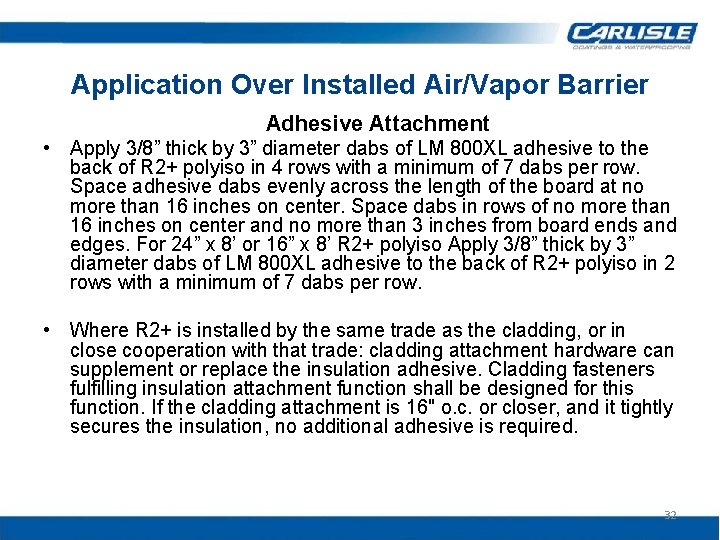
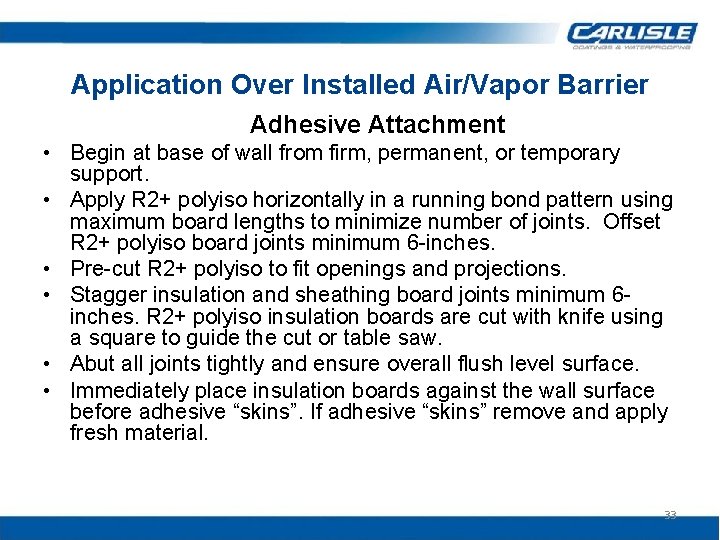
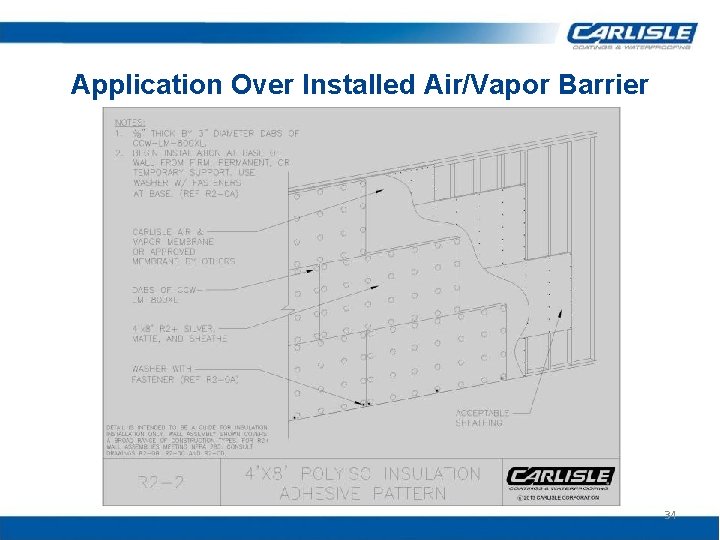
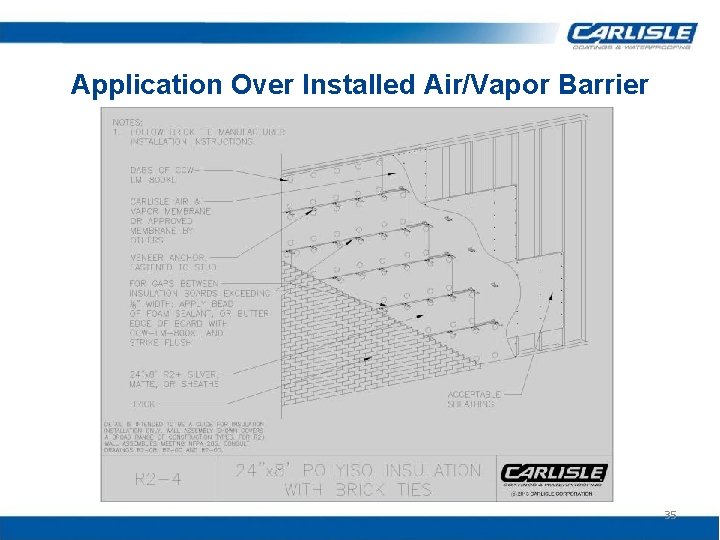
Application Over Installed Air/Vapor Barrier Adhesive Attachment • Apply 3/8” thick by 3” diameter dabs of LM 800 XL adhesive to the back of R 2+ polyiso in 4 rows with a minimum of 7 dabs per row. Space adhesive dabs evenly across the length of the board at no more than 16 inches on center. Space dabs in rows of no more than 16 inches on center and no more than 3 inches from board ends and edges. For 24” x 8’ or 16” x 8’ R 2+ polyiso Apply 3/8” thick by 3” diameter dabs of LM 800 XL adhesive to the back of R 2+ polyiso in 2 rows with a minimum of 7 dabs per row. • Where R 2+ is installed by the same trade as the cladding, or in close cooperation with that trade: cladding attachment hardware can supplement or replace the insulation adhesive. Cladding fasteners fulfilling insulation attachment function shall be designed for this function. If the cladding attachment is 16" o. c. or closer, and it tightly secures the insulation, no additional adhesive is required. 32
Application Over Installed Air/Vapor Barrier Adhesive Attachment • Begin at base of wall from firm, permanent, or temporary support. • Apply R 2+ polyiso horizontally in a running bond pattern using maximum board lengths to minimize number of joints. Offset R 2+ polyiso board joints minimum 6 -inches. • Pre-cut R 2+ polyiso to fit openings and projections. • Stagger insulation and sheathing board joints minimum 6 inches. R 2+ polyiso insulation boards are cut with knife using a square to guide the cut or table saw. • Abut all joints tightly and ensure overall flush level surface. • Immediately place insulation boards against the wall surface before adhesive “skins”. If adhesive “skins” remove and apply fresh material. 33
Application Over Installed Air/Vapor Barrier 34
Application Over Installed Air/Vapor Barrier 35
Application Over Installed Air/Vapor Barrier 36
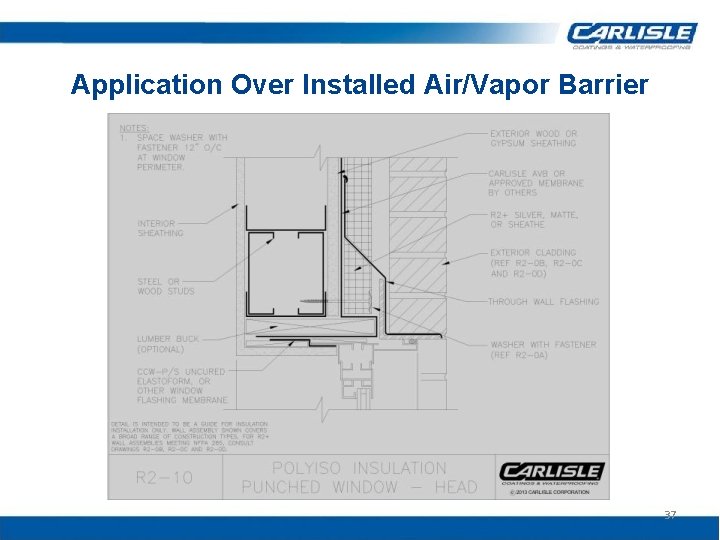
Application Over Installed Air/Vapor Barrier 37
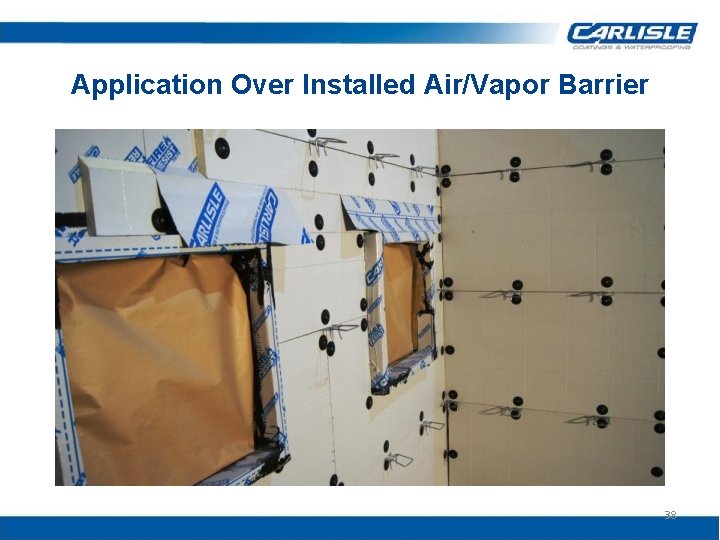
Application Over Installed Air/Vapor Barrier 38
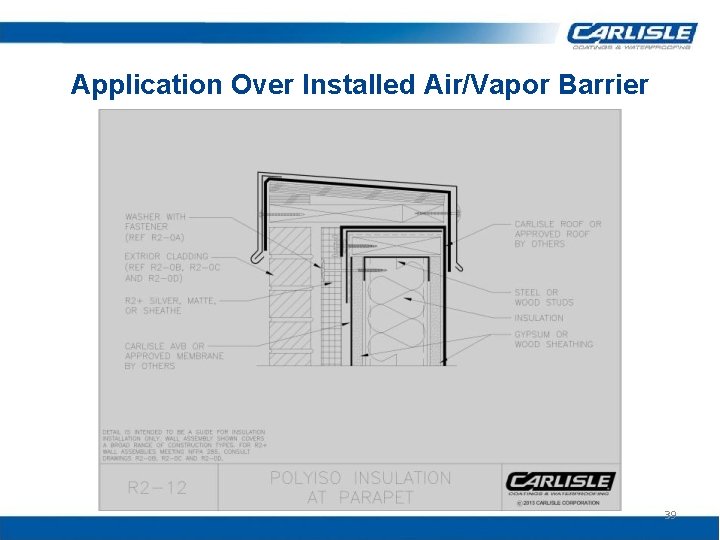
Application Over Installed Air/Vapor Barrier 39
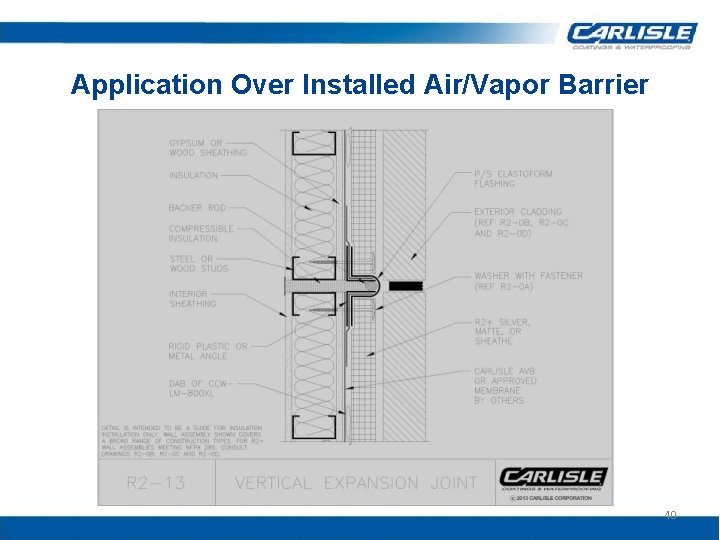
Application Over Installed Air/Vapor Barrier 40
Application Over Installed Air/Vapor Barrier 41
Application Over Installed Air/Vapor Barrier 42
Application Over Installed Air/Vapor Barrier 43
Application Over Installed Air/Vapor Barrier 44
Application Over Installed Air/Vapor Barrier 45
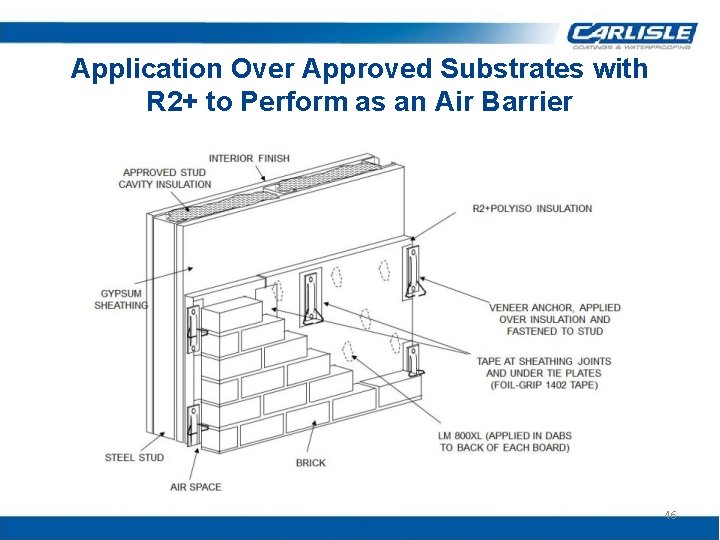
Application Over Approved Substrates with R 2+ to Perform as an Air Barrier 46
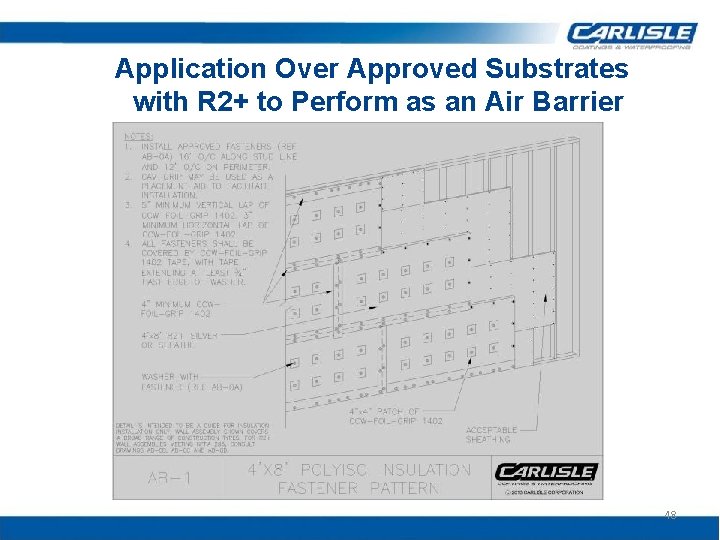
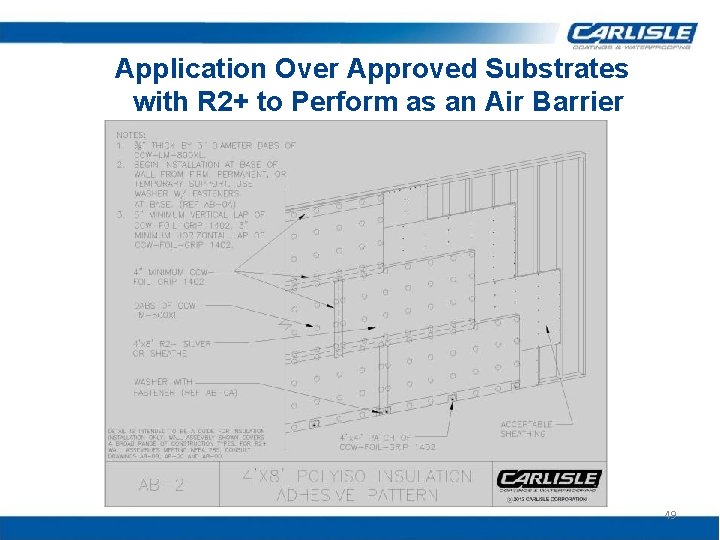
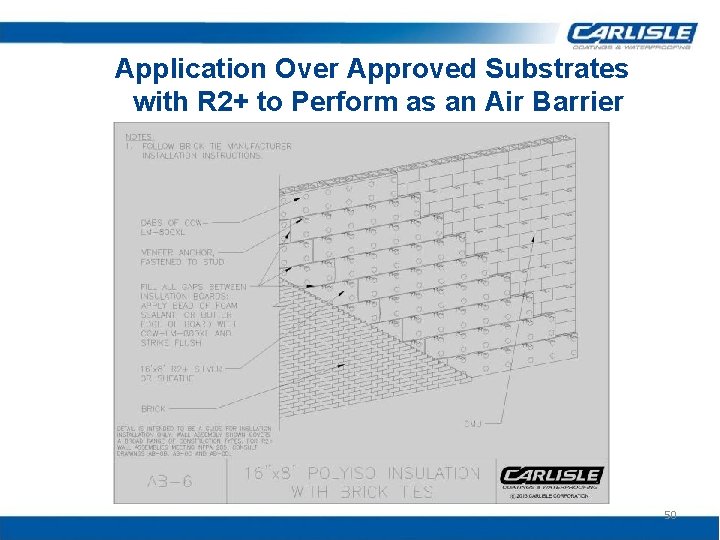
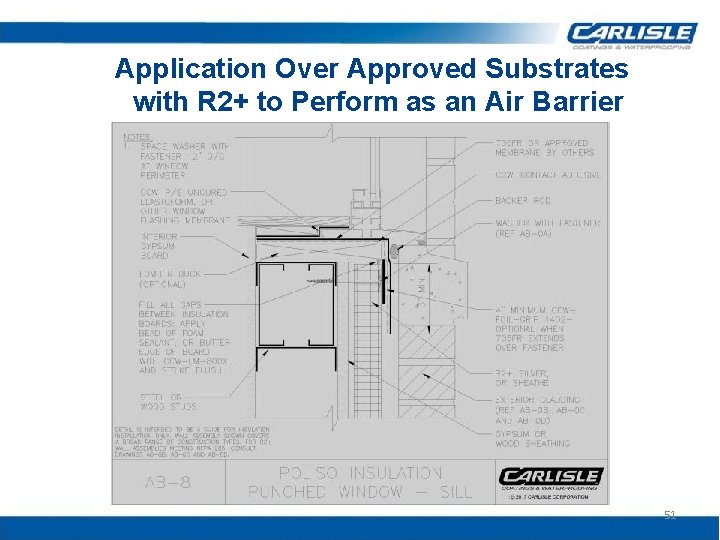
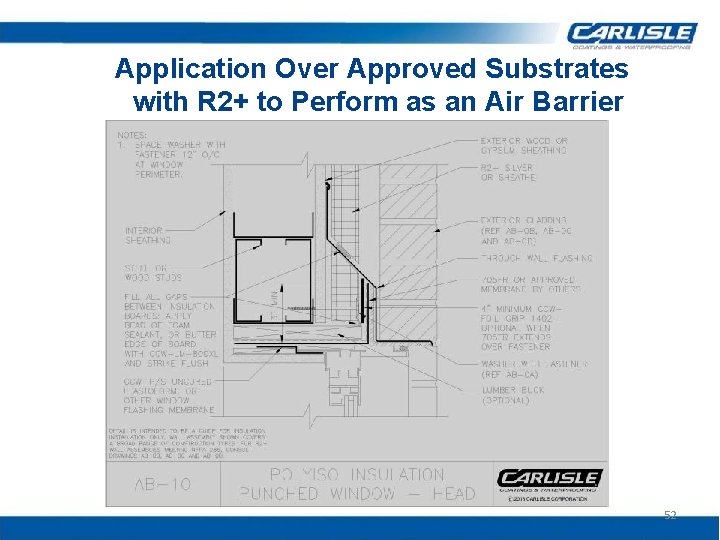
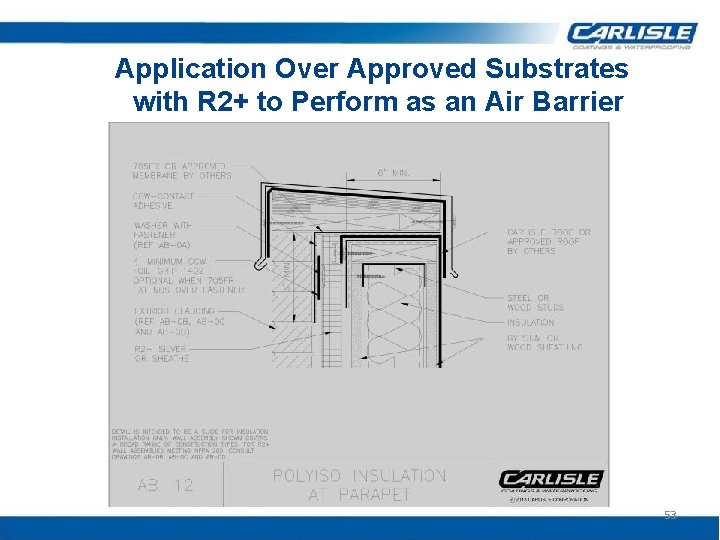
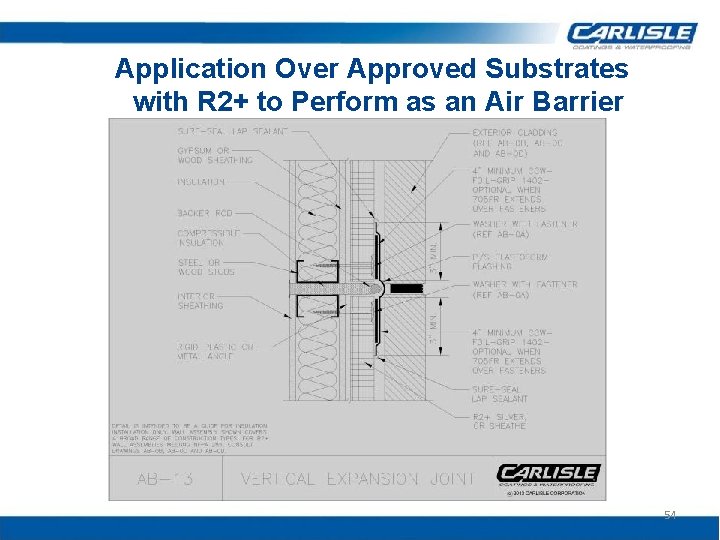
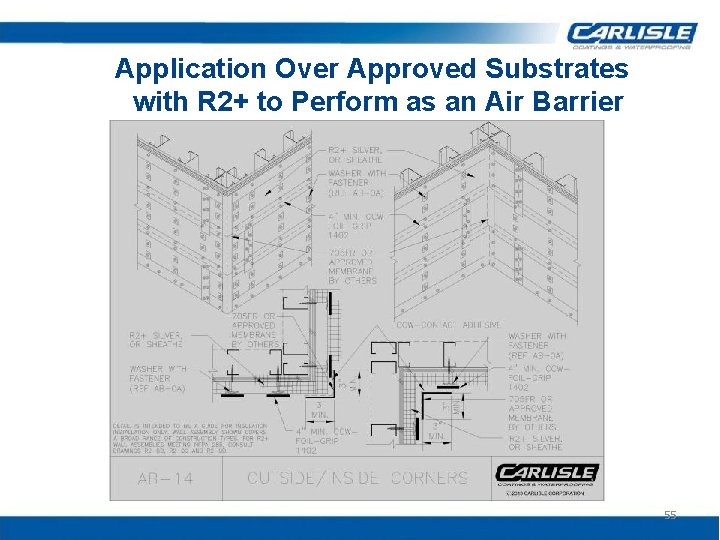
• • • Application Over Approved Substrates with R 2+ to Perform as an Air Barrier Verify sheathing has been properly installed. Install R 2+ Silver or Sheathe continuously to deliver its maximum impact. R 2+ Matte is not used in this application. Foam sealant is used to fill R 2+ polyiso insulation board gaps. Do not apply over walls that are vulnerable to water intrusion. R 2+ mechanical and adhesive installation patterns are identical. FOIL-GRIP 1402 is used to treat R 2+ board joints and penetrations. 47
Application Over Approved Substrates with R 2+ to Perform as an Air Barrier 48
Application Over Approved Substrates with R 2+ to Perform as an Air Barrier 49
Application Over Approved Substrates with R 2+ to Perform as an Air Barrier 50
Application Over Approved Substrates with R 2+ to Perform as an Air Barrier 51
Application Over Approved Substrates with R 2+ to Perform as an Air Barrier 52
Application Over Approved Substrates with R 2+ to Perform as an Air Barrier 53
Application Over Approved Substrates with R 2+ to Perform as an Air Barrier 54
Application Over Approved Substrates with R 2+ to Perform as an Air Barrier 55
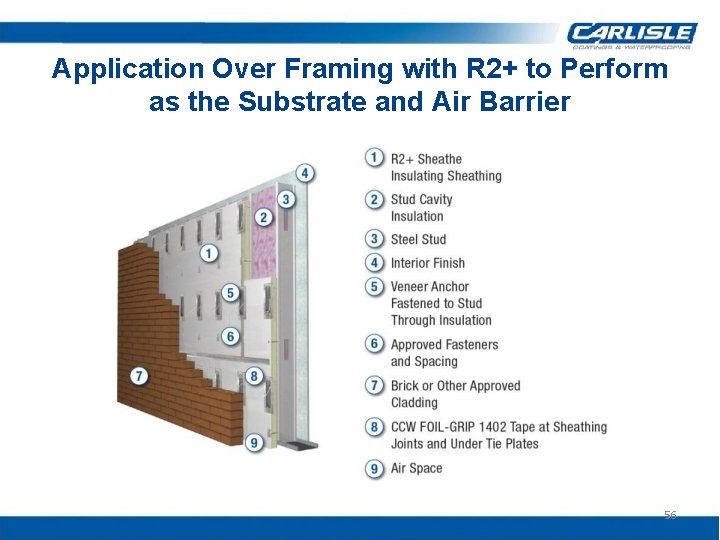
Application Over Framing with R 2+ to Perform as the Substrate and Air Barrier 56
Application Over Framing with R 2+ to Perform as the Substrate and Air Barrier 57
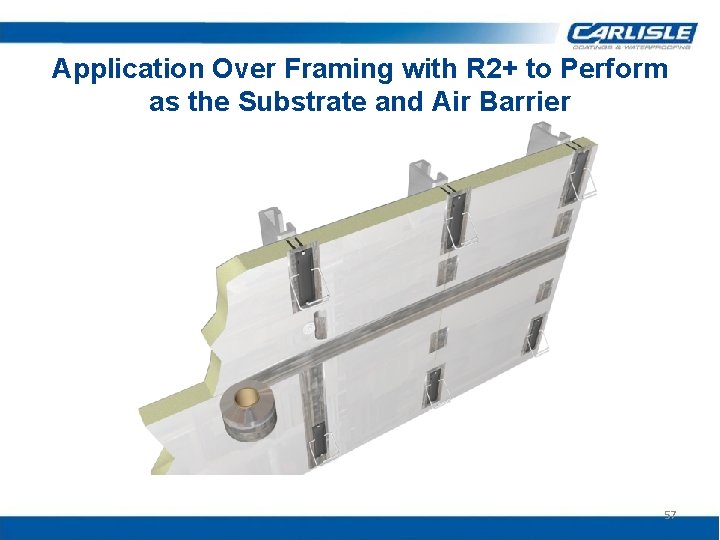
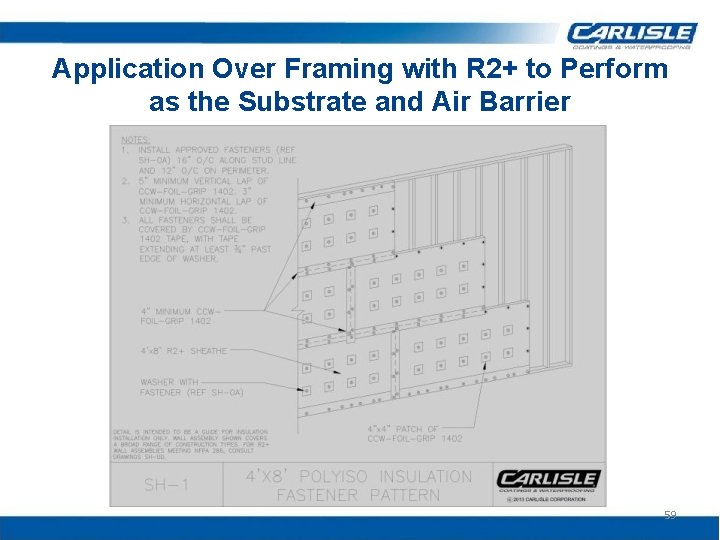
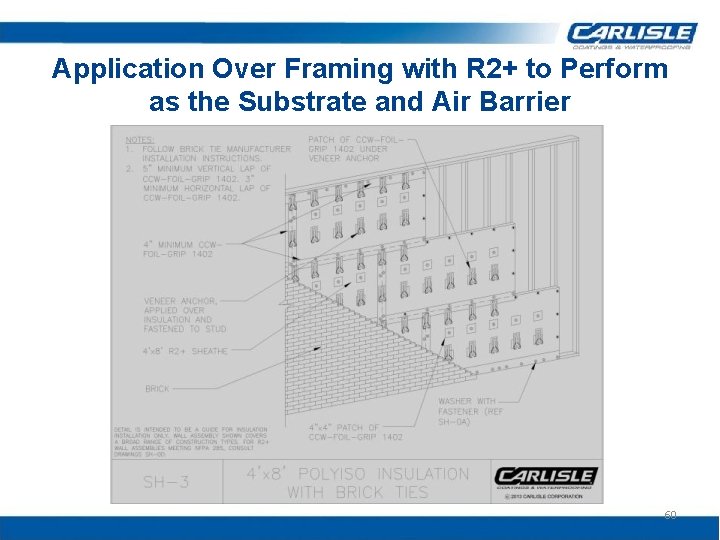
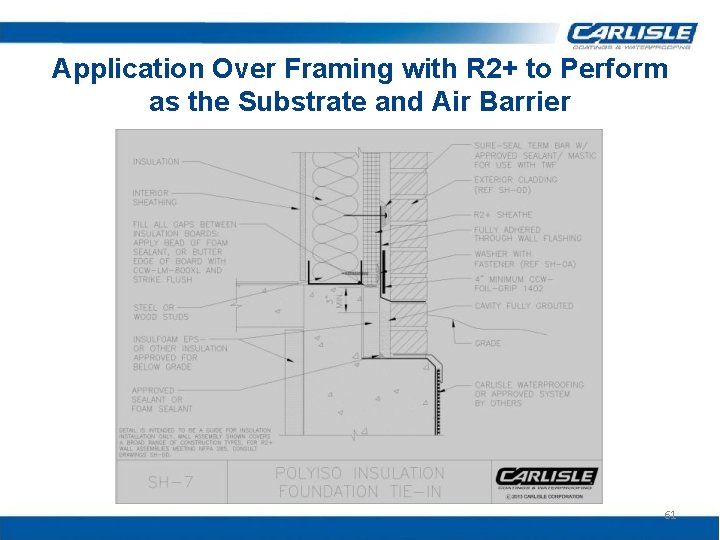
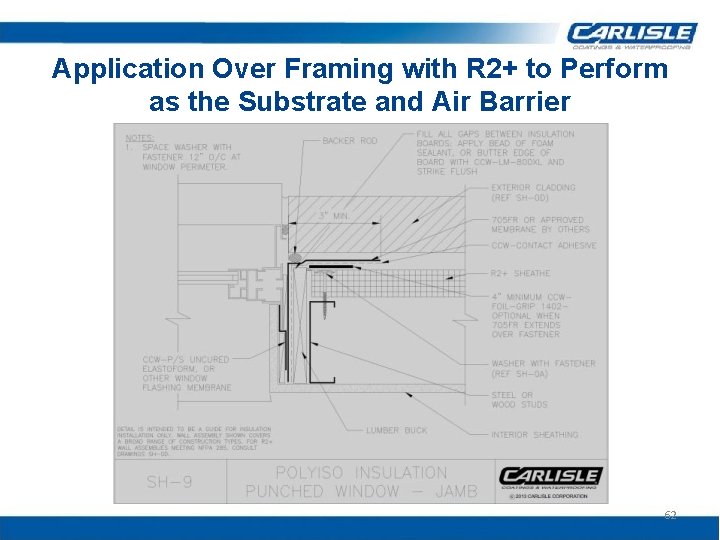
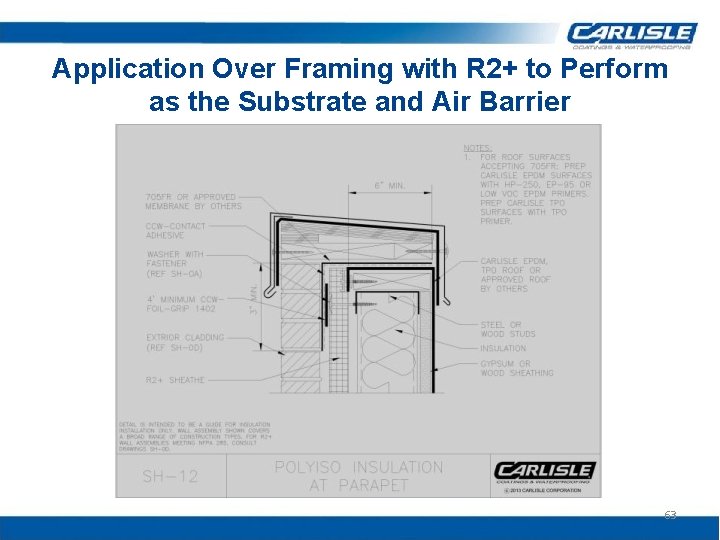
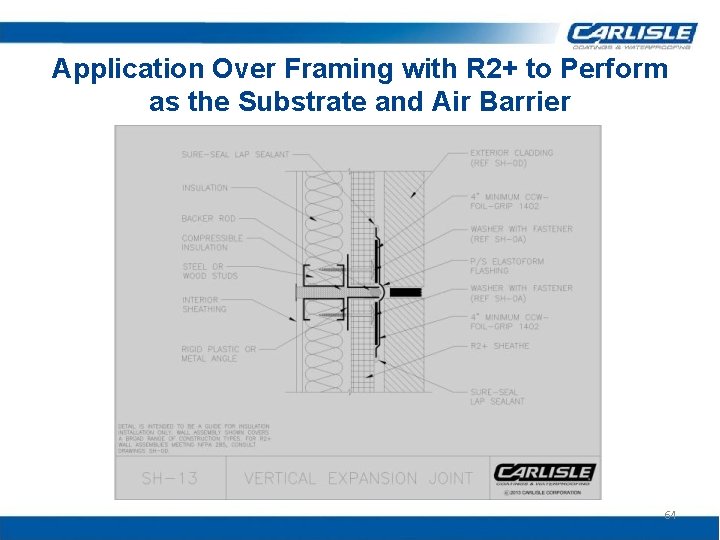
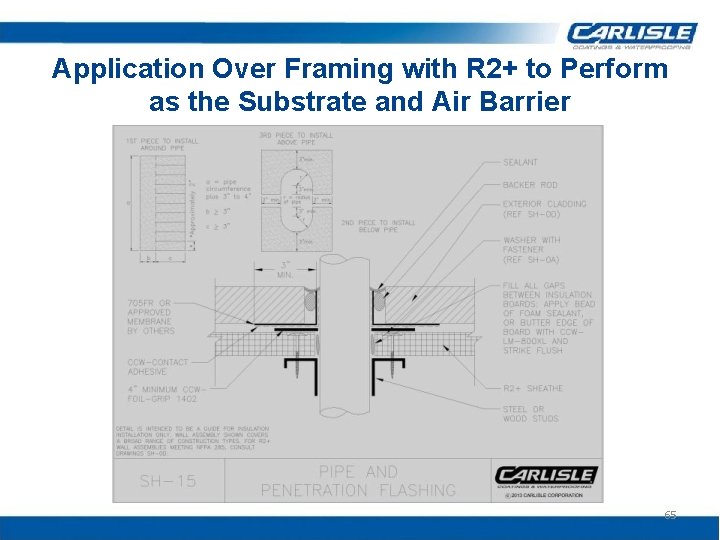
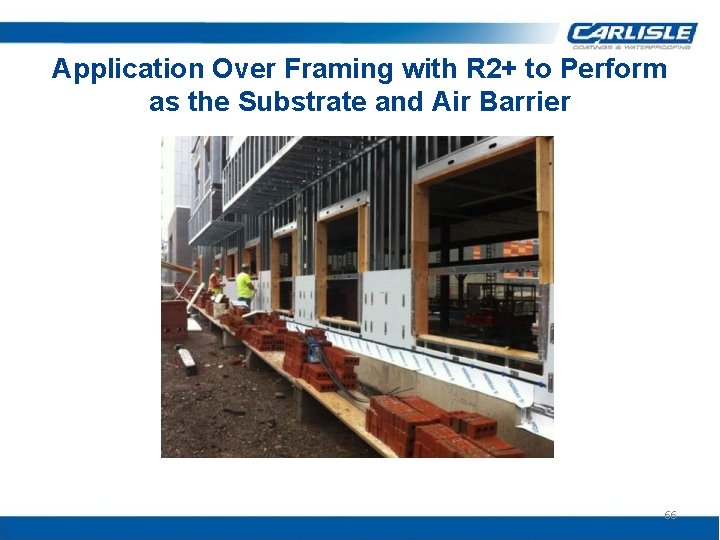
Application Over Framing with R 2+ to Perform as the Substrate and Air Barrier • R 2+ Sheathe must be installed continuously to deliver its maximum impact on building energy efficiency. • Fasteners are spaced 12” o. c. at the perimeter and 16” o. c. in the field with fasteners set back 3/8” from board edges and ends. • Foam sealant is used to fill R 2+ polyiso insulation board gaps. • CCW FOIL-GRIP 1402 and 705 FR is applied in like manner as the application of R 2+ over sheathing. 58
Application Over Framing with R 2+ to Perform as the Substrate and Air Barrier 59
Application Over Framing with R 2+ to Perform as the Substrate and Air Barrier 60
Application Over Framing with R 2+ to Perform as the Substrate and Air Barrier 61
Application Over Framing with R 2+ to Perform as the Substrate and Air Barrier 62
Application Over Framing with R 2+ to Perform as the Substrate and Air Barrier 63
Application Over Framing with R 2+ to Perform as the Substrate and Air Barrier 64
Application Over Framing with R 2+ to Perform as the Substrate and Air Barrier 65
Application Over Framing with R 2+ to Perform as the Substrate and Air Barrier 66
Application as an Insulated Nail Base 67
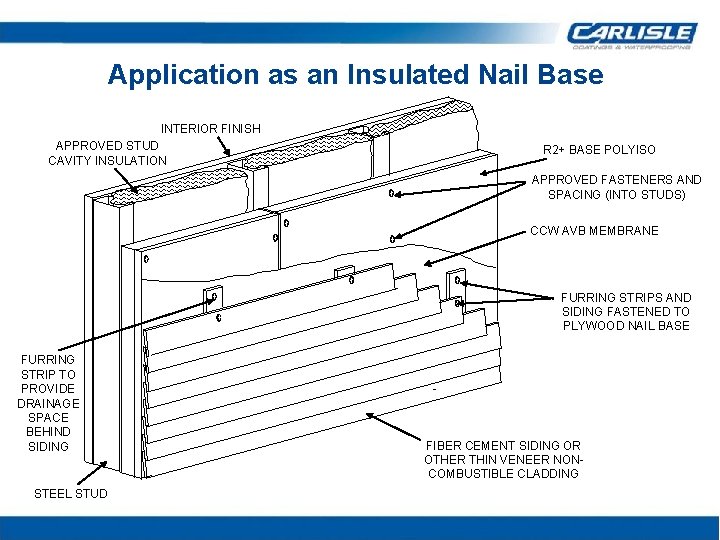
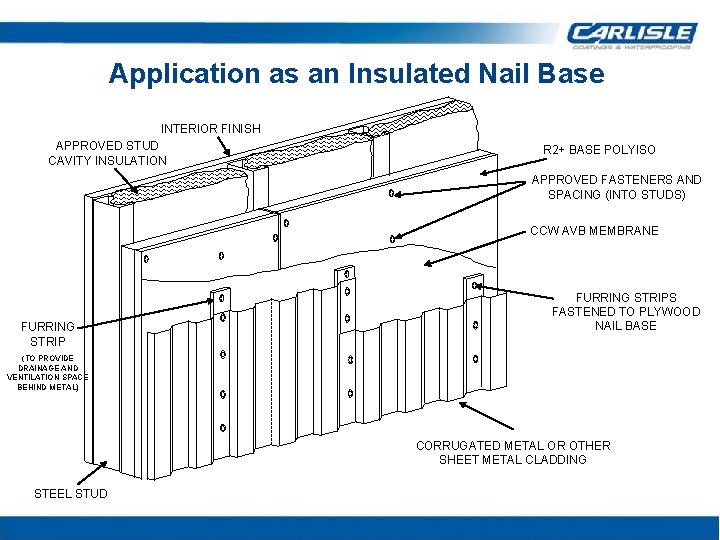
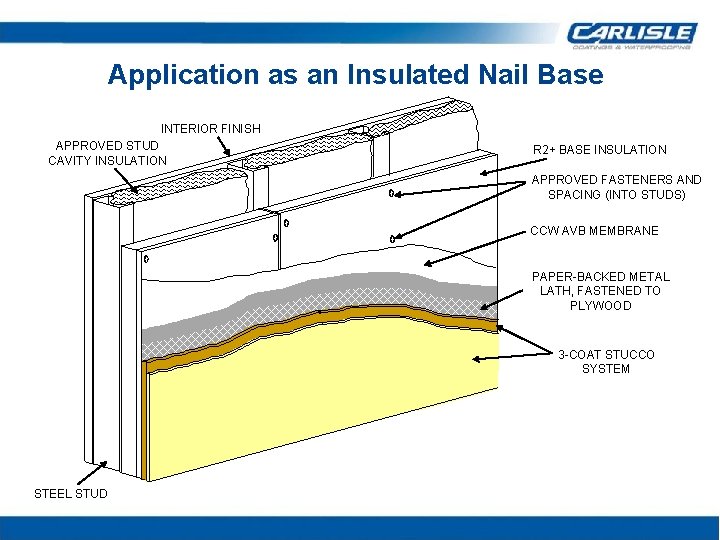
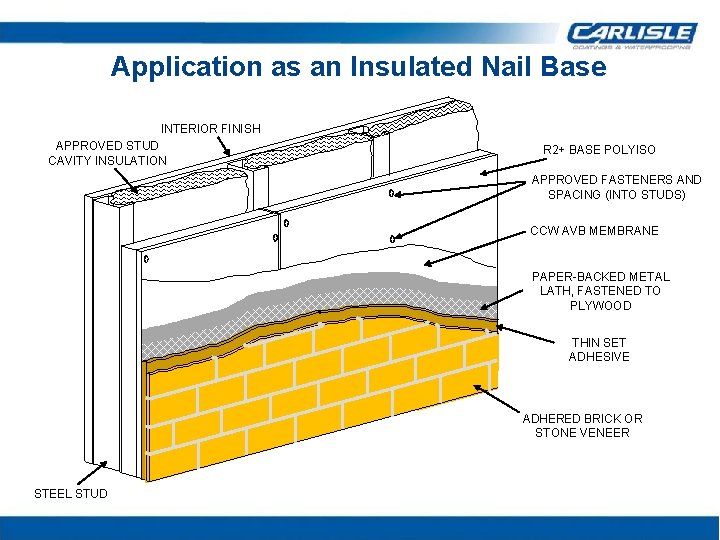
Application as an Insulated Nail Base • R 2+ Base designed for use in commercial construction. • Provides sheathing, nail base and thermal barrier in one installation. • R 2+ Base is ideal for use under common thinveneer cladding systems such as stucco, corrugated metal and fiber cement siding. • Installed similar to plywood sheathing. Fastening pattern is per the design professional and must support the weight of the cladding and R 2+ Base polyiso. 68
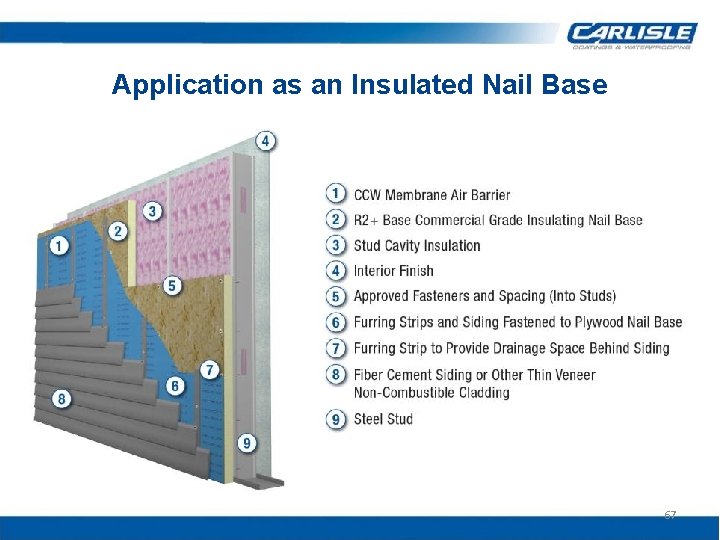
Application as an Insulated Nail Base INTERIOR FINISH APPROVED STUD CAVITY INSULATION R 2+ BASE POLYISO APPROVED FASTENERS AND SPACING (INTO STUDS) CCW AVB MEMBRANE FURRING STRIPS AND SIDING FASTENED TO PLYWOOD NAIL BASE FURRING STRIP TO PROVIDE DRAINAGE SPACE BEHIND SIDING STEEL STUD FIBER CEMENT SIDING OR OTHER THIN VENEER NONCOMBUSTIBLE CLADDING
Application as an Insulated Nail Base INTERIOR FINISH APPROVED STUD CAVITY INSULATION R 2+ BASE POLYISO APPROVED FASTENERS AND SPACING (INTO STUDS) CCW AVB MEMBRANE FURRING STRIPS FASTENED TO PLYWOOD NAIL BASE (TO PROVIDE DRAINAGE AND VENTILATION SPACE BEHIND METAL) CORRUGATED METAL OR OTHER SHEET METAL CLADDING STEEL STUD
Application as an Insulated Nail Base INTERIOR FINISH APPROVED STUD CAVITY INSULATION R 2+ BASE INSULATION APPROVED FASTENERS AND SPACING (INTO STUDS) CCW AVB MEMBRANE PAPER-BACKED METAL LATH, FASTENED TO PLYWOOD 3 -COAT STUCCO SYSTEM STEEL STUD
Application as an Insulated Nail Base INTERIOR FINISH APPROVED STUD CAVITY INSULATION R 2+ BASE POLYISO APPROVED FASTENERS AND SPACING (INTO STUDS) CCW AVB MEMBRANE PAPER-BACKED METAL LATH, FASTENED TO PLYWOOD THIN SET ADHESIVE ADHERED BRICK OR STONE VENEER STEEL STUD
Key Takeaways • Understand the differences of R 2+ Silver, Matte, Sheathe and Base. • Identify what R 2+ product to use and when to use it. • Understand proper R 2+ mechanical and adhesive attachment techniques. • Know what accessory products can be used and how they help achieve the design objective. • Recognize critical details so that the R 2+ polyiso installation meets specification criteria. 73