
R 12300 ME Lab Hardware Development LINDSAY WILKENS
R 12300: ME Lab Hardware Development LINDSAY WILKENS CHRISTOPHER MOREHOUSE ERIC WILCOX MATT FIGLIOTTI JOHN KNIGHT
Overview Background Benchmarking Stakeholders Affinity Diagram Mission Statement Objective Tree Constraints Voice of the Customer
Background RIT changing from quarters to semesters in Fall 2013 First year students currently take Physics, Problem Solving with Computers and Measurement Instrumentation and Controls ME 102 will replace these courses Lab hardware needs to be developed for five labs Three labs to be integrated into ME 102 Two in class demonstrations Statics Thermodynamics
Benchmarking Empathy Exercise Examined current lab facilities in the RIT ME Department Researched existing lab experiments used by other universities Did not find any labs that addressed the needs of ME 102 Did not find any universities that had a course comparable to ME 102 Researched existing lab kits and demonstrations Pasco ENGAGE
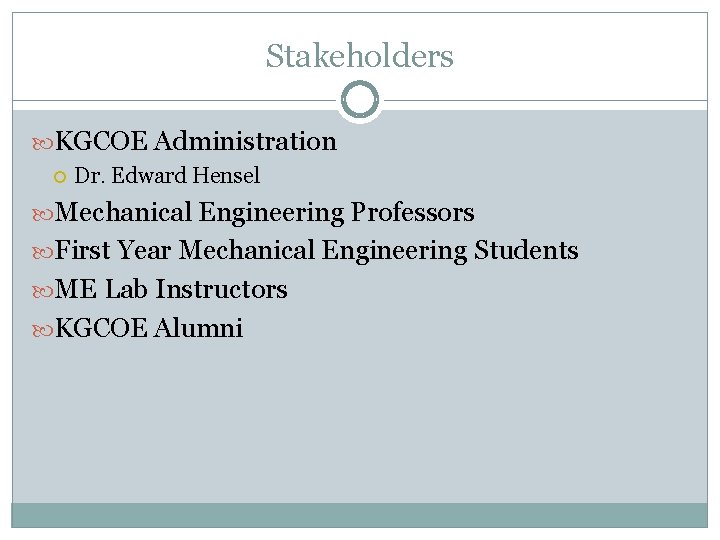
Stakeholders KGCOE Administration Dr. Edward Hensel Mechanical Engineering Professors First Year Mechanical Engineering Students ME Lab Instructors KGCOE Alumni
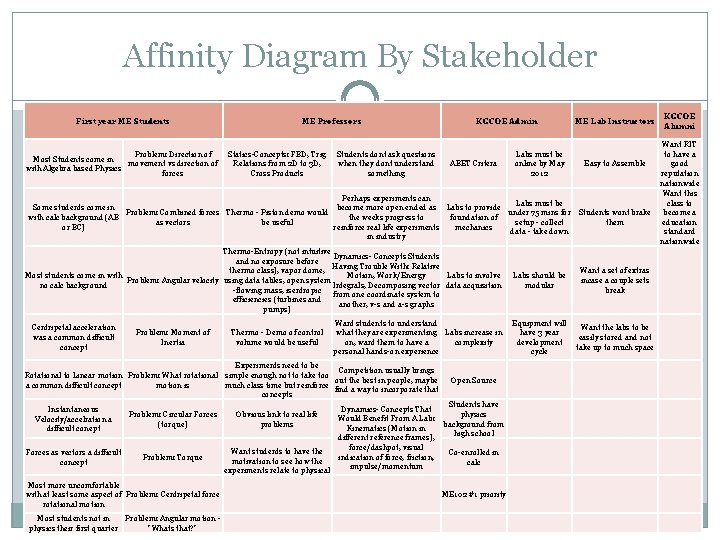
Affinity Diagram By Stakeholder First year ME Students ME Professors KGCOE Admin ME Lab Instructors KGCOE Alumni Want RIT to have a ABET Critera Easy to Assemble good reputation nationwide Want this Perhaps experiments can Labs must be class to Some students come in become more open ended as Labs to provide Problem: Combined forces Thermo - Piston demo would under 75 mins for Students wont brake become a with calc background (AB foundation of the weeks progress to as vectors be useful setup - collect them education or BC) mechanics reinforce real life experiments data - take down standard in industry nationwide Thermo-Entropy (not intuitive Dynamics- Concepts Students and no exposure before Having Trouble With: Relative Want a set of extras thermo class), vapor dome, Most students come in with Labs to involve Labs should be Motion, Work/Energy incase a couple sets Problem: Angular velocity using data tables, open system no calc background modular Integrals, Decomposing vector data acquisition break -flowing mass, isentropic from one coordinate system to efficiencies (turbines and another, v-s and a-s graphs pumps) Problem: Direction of Most Students come in movement vs direction of with Algebra based Physics forces Centripetal acceleration was a common difficult concept Problem: Moment of Inertia Statics-Concepts: FBD, Trig Relations from 2 D to 3 D, Cross Products Thermo - Demo of control volume would be useful Students dont ask questions when they dont understand something Want students to understand what they are experimenting Labs increase in on, want them to have a complexity personal hands-on experience Experiments need to be Competition usually brings Rotational to Linear motion Problem: What rotational simple enough not to take too out the best in people, maybe a common difficult concept motion is much class time but reinforce find a way to incorporate that concepts Instantaneous Velocity/accelration a difficult conept Problem: Circular Forces (torque) Forces as vectors a difficult concept Problem: Torque Most more uncomfortable with at least some aspect of Problem: Centripetal force rotational motion Most students not in Problem: Angular motion - physics their first quarter "Whats that? " Obvious link to real life problems Want students to have the motivation to see how the experiments relate to physical Labs must be online by May 2012 Open Source Students have Dynamics- Concepts That physics Would Benefit From A Lab: background from Kinematics (Motion in high school different reference frames), force/dashpot, visual Co-enrolled in indication of force, friction, calc impulse/momentum ME 102 #1 priority Equipment will Want the labs to be have 3 year easily stored and not development take up to much space cycle
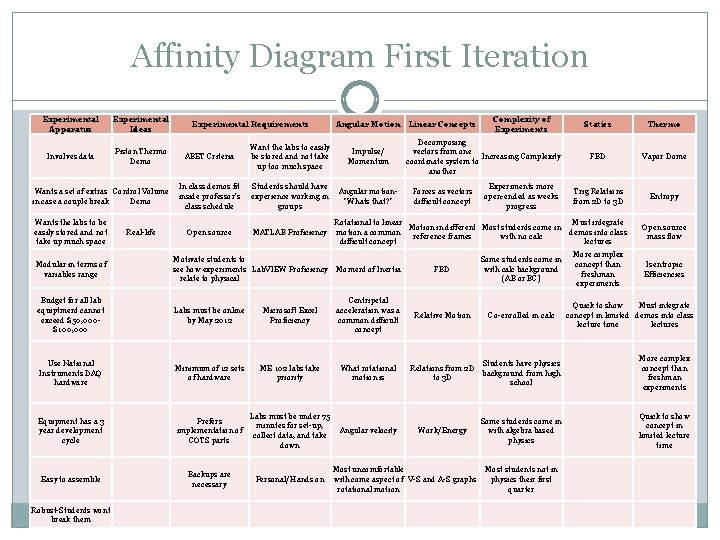
Affinity Diagram First Iteration Experimental Apparatus Experimental Ideas Involves data Piston Thermo Demo Experimental Requirements Angular Motion Linear Concepts Complexity of Experiments Decomposing vectors from one Increasing Complexity coordinate system to another Want the labs to easily be stored and not take up too much space Impulse/ Momentum In class demos fit Wants a set of extras Control Volume inside professor's in case a couple break Demo class schedule Students should have experience working in groups Angular motion- "Whats that? " Wants the labs to be easily stored and not take up much space Real-life MATLAB Proficiency Modular in terms of variables range Motivate students to see how experiments Lab. VIEW Proficiency Moment of Inertia relate to physical Budget for all lab equiptment cannot exceed $50, 000$100, 000 Labs must be online by May 2012 Microsoft Excel Proficiency Centripetal acceleration was a common difficult concept Use National Instruments DAQ hardware Minimum of 12 sets of hardware ME 102 labs take priority What rotational motion is Students have physics Relations from 2 D background from high to 3 D school Equipment has a 3 year development cycle Prefers implementation of COTS parts Labs must be under 75 minutes for set-up, Angular velocity collect data, and take down Easy to assemble Backups are necessary Robust-Students wont break them ABET Criteria Open source Personal/Hands on Forces as vectors difficult concept Experiments more open-ended as weeks progress Statics Thermo FBD Vapor Dome Trig Relations from 2 D to 3 D Entropy Rotational to linear Must integrate Motion in different Most students come in motion a common demos into class reference frames with no calc difficult concept lectures FBD Some students come in with calc background (AB or BC) Relative Motion Co-enrolled in calc Work/Energy Most uncomfortable with come aspect of V-S and A-S graphs rotational motion More complex concept than freshman experiments Open source mass flow Isentropic Efficiencies Quick to show Must integrate concept in limited demos into class lecture time lectures More complex concept than freshman experiments Some students come in with algebra based physics Quick to show concept in limited lecture time Most students not in physics their first quarter
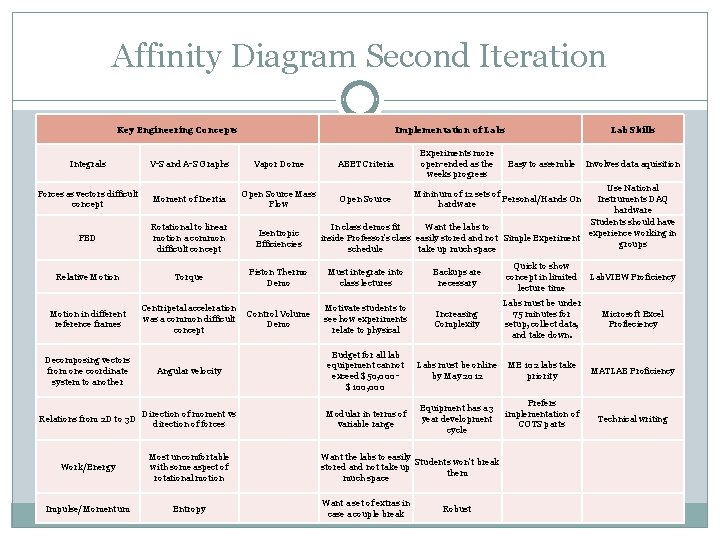
Affinity Diagram Second Iteration Key Engineering Concepts Implementation of Labs Integrals V-S and A-S Graphs Vapor Dome Forces as vectors difficult concept Moment of Inertia Open Source Mass Flow FBD Rotational to linear motion a common difficult concept Isentropic Efficiencies Relative Motion Torque Piston Thermo Demo Motion in different reference frames Decomposing vectors from one coordinate system to another Centripetal acceleration Control Volume was a common difficult Demo concept Angular velocity Direction of moment vs Relations from 2 D to 3 D direction of forces ABET Criteria Impulse/Momentum Most uncomfortable with some aspect of rotational motion Entropy Involves data aquisition Mininum of 12 sets of Personal/Hands On hardware Must integrate into class lectures Backups are necessary Quick to show concept in limited lecture time Lab. VIEW Proficiency Motivate students to see how experiments relate to physical Increasing Complexity Labs must be under 75 minutes for setup, collect data, and take down. Microsoft Excel Profieciency Budget for all lab equipement cannot exceed $50, 000$100, 000 Modular in terms of variable range Easy to assemble Use National Instruments DAQ hardware Students should have In class demos fit Want the labs to experience working in inside Professor's class easily stored and not Simple Experiment groups schedule take up much space Open Source Work/Energy Experiments more open-ended as the weeks progress Lab Skills Labs must be online ME 102 labs take by May 2012 priority Prefers Equipment has a 3 implementation of year development COTS parts cycle Want the labs to easily Students won't break stored and not take up them much space Want a set of extras in case a couple break MATLAB Proficiency Robust Technical writing
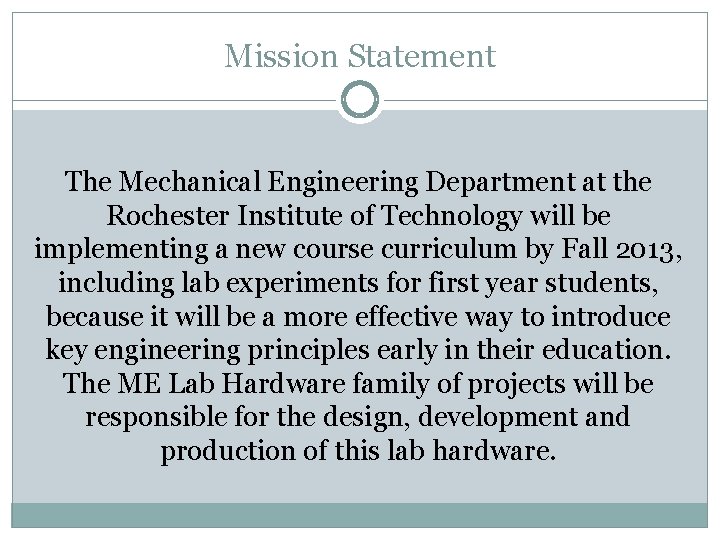
Mission Statement The Mechanical Engineering Department at the Rochester Institute of Technology will be implementing a new course curriculum by Fall 2013, including lab experiments for first year students, because it will be a more effective way to introduce key engineering principles early in their education. The ME Lab Hardware family of projects will be responsible for the design, development and production of this lab hardware.
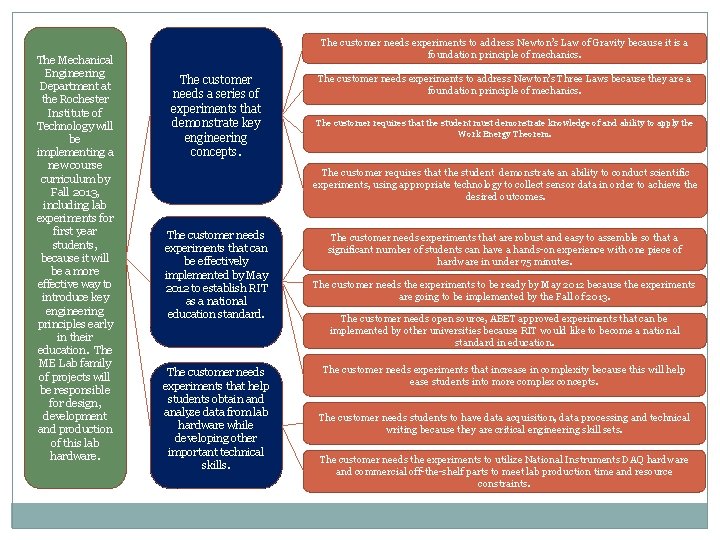
The Mechanical Engineering Department at the Rochester Institute of Technology will be implementing a new course curriculum by Fall 2013, including lab experiments for first year students, because it will be a more effective way to introduce key engineering principles early in their education. The ME Lab family of projects will be responsible for design, development and production of this lab hardware. The customer needs experiments to address Newton’s Law of Gravity because it is a foundation principle of mechanics. The customer needs a series of experiments that demonstrate key engineering concepts. The customer needs experiments to address Newton’s Three Laws because they are a foundation principle of mechanics. The customer requires that the student must demonstrate knowledge of and ability to apply the Work Energy Theorem. The customer requires that the student demonstrate an ability to conduct scientific experiments, using appropriate technology to collect sensor data in order to achieve the desired outcomes. The customer needs experiments that can be effectively implemented by May 2012 to establish RIT as a national education standard. The customer needs experiments that help students obtain and analyze data from lab hardware while developing other important technical skills. The customer needs experiments that are robust and easy to assemble so that a significant number of students can have a hands-on experience with one piece of hardware in under 75 minutes. The customer needs the experiments to be ready by May 2012 because the experiments are going to be implemented by the Fall of 2013. The customer needs open source, ABET approved experiments that can be implemented by other universities because RIT would like to become a national standard in education. The customer needs experiments that increase in complexity because this will help ease students into more complex concepts. The customer needs students to have data acquisition, data processing and technical writing because they are critical engineering skill sets. The customer needs the experiments to utilize National Instruments DAQ hardware and commercial off-the-shelf parts to meet lab production time and resource constraints.
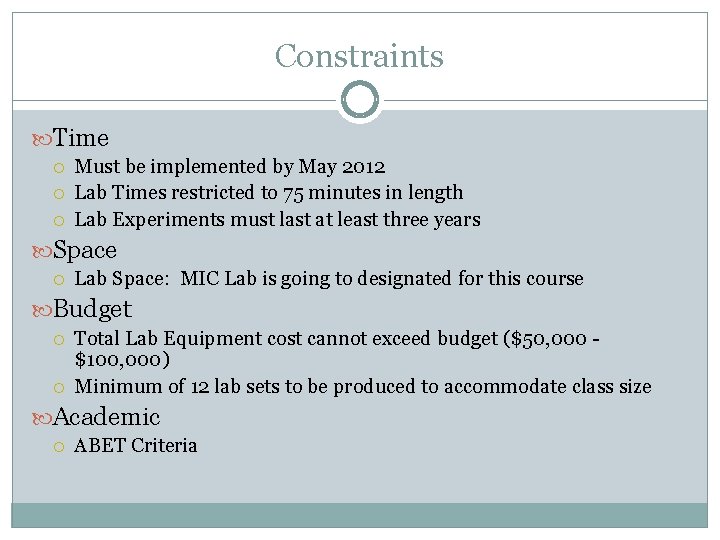
Constraints Time Must be implemented by May 2012 Lab Times restricted to 75 minutes in length Lab Experiments must last at least three years Space Lab Space: MIC Lab is going to designated for this course Budget Total Lab Equipment cost cannot exceed budget ($50, 000 - $100, 000) Minimum of 12 lab sets to be produced to accommodate class size Academic ABET Criteria
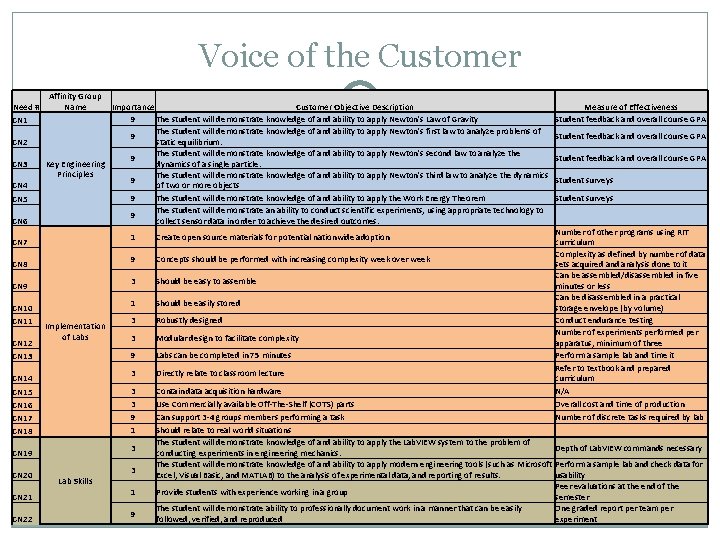
Voice of the Customer Need # CN 1 CN 2 CN 3 CN 4 CN 5 CN 6 Affinity Group Name Importance Customer Objective Description 9 The student will demonstrate knowledge of and ability to apply Newton's Law of Gravity The student will demonstrate knowledge of and ability to apply Newton's first law to analyze problems of 9 static equilibrium. The student will demonstrate knowledge of and ability to apply Newton's second law to analyze the 9 dynamics of a single particle. Key Engineering Principles The student will demonstrate knowledge of and ability to apply Newton's third law to analyze the dynamics 9 of two or more objects 9 The student will demonstrate knowledge of and ability to apply the Work Energy Theorem The student will demonstrate an ability to conduct scientific experiments, using appropriate technology to 9 collect sensor data in order to achieve the desired outcomes. CN 7 CN 8 CN 9 CN 10 CN 11 CN 12 CN 13 Implementation of Labs CN 14 CN 15 CN 16 CN 17 CN 18 CN 20 CN 21 CN 22 Lab Skills Student feedback and overall course GPA Student surveys Number of other programs using RIT curriculum Complexity as defined by number of data sets acquired analysis done to it Can be assembled/disassembled in five minutes or less Can be disassembled in a practical storage envelope (by volume) Conduct endurance testing Number of experiments performed per apparatus, minimum of three Perform a sample lab and time it Refer to textbook and prepared curriculum N/A Overall cost and time of production Number of discrete tasks required by lab 1 Create open source materials for potential nationwide adoption 9 Concepts should be performed with increasing complexity week over week 3 Should be easy to assemble 1 Should be easily stored 3 Robustly designed 3 Modular design to facilitate complexity 9 Labs can be completed in 75 minutes 3 Directly relate to classroom lecture 3 3 9 1 Contain data acquisition hardware Use Commercially available Off-The-Shelf (COTS) parts Can support 3 -4 groups members performing a task Should relate to real world situations The student will demonstrate knowledge of and ability to apply the Lab. VIEW system to the problem of Depth of Lab. VIEW commands necessary conducting experiments in engineering mechanics. The student will demonstrate knowledge of and ability to apply modern engineering tools (such as Microsoft Perform a sample lab and check data for Excel, Visual Basic, and MATLAB) to the analysis of experimental data, and reporting of results. usability Peer evaluations at the end of the Provide students with experience working in a group semester The student will demonstrate ability to professionally document work in a manner that can be easily One graded report per team per followed, verified, and reproduced experiment 3 CN 19 Measure of Effectiveness Student feedback and overall course GPA 3 1 9
Summary Background Benchmarking Stakeholders Affinity Diagram Mission Statement Objective Tree Constraints Voice of the Customer
QUESTIONS?
- Slides: 14