
Quotes and attribution I said Rules for newswriting
“Quotes and attribution, ” I said Rules for newswriting and copyediting By Jeff South VCU School of Mass Communications 1
3 sources of news info ! What people say ! What reporters observe ! What is contained in documents 2
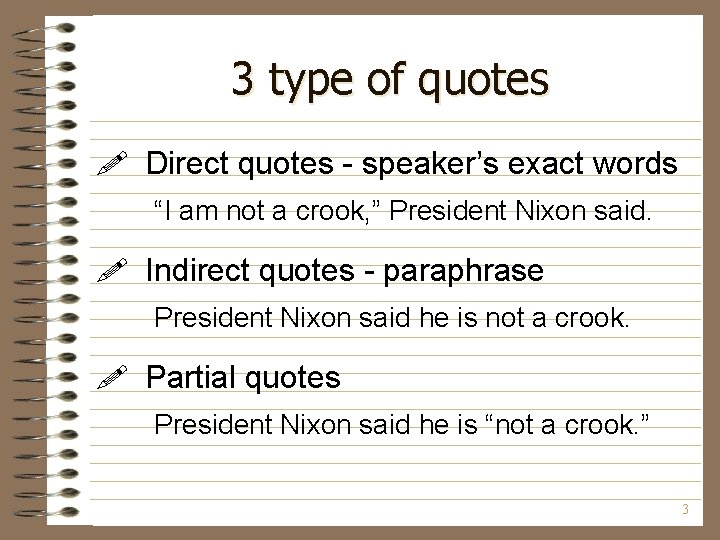
3 type of quotes ! Direct quotes - speaker’s exact words “I am not a crook, ” President Nixon said. ! Indirect quotes - paraphrase President Nixon said he is not a crook. ! Partial quotes President Nixon said he is “not a crook. ” 3
It’s OK to say ‘said’ a lot. ! It’s simple and neutral. ! Substitutes like ‘claimed, ’ ‘noted, ’ ‘pointed out, ’ and ‘maintained’ imply value judgments. ! Substitutes like ‘stated, ’ ‘asserted, ’ and ‘elucidated’ sound stilted. 4
It’s OK to say ‘said’ a lot. ! ‘Added’ is OK if true. ! Sometimes you can use ‘explained’ or ‘noted’: The Constitution guarantees freedom of speech, she noted. He explained that he was late because of a dentist appointment. ! Use ‘according to’ for documents only. ‘Said’ is fine for documents, too. 5
Why synonyms don’t work ! O. J. Simpson claimed he was happy. ! Gov. Jesse Ventura pointed out that religion is a crutch. ! Mayor Tim Kaine noted that most Richmonders support the Million Mom March. ! Hillary Clinton denied she had broken any laws. 6
When to use direct quotes ! Speaker’s words must be special. ! Words that reflect personality or other characteristic ! Memorable sentences or phrases ! Phrased better than you could 7
When to use direct quotes ! Beware of slang and dialect. Don’t needlessly embarrass people you quote. ! Be picky. Don’t overuse direct quotes. You’re not a court reporter! ! Direct quotes should not repeat info from a previous quote. Don’t write: Clinton said he plans to go to Moscow next week. “I plan to go to Moscow next week, ” he said. 8
How to write direct quotes ! Don’t add words to direct quotes. Avoid parentheses. ! If you must explain a direct quote: Ë Set it up with the background. Instead of: “As soon as I get home, ” Wilson said, “I’m going to bury it [his dog Rover’s body] next to the doghouse. ” Write: Wilson said he knows exactly where to bury his dog Rover’s body. “As soon as I get home, I’m going to bury it next to the doghouse. ” 9
How to write direct quotes ! A colon can be an elegant punctuation mark between a paraphrased setup and a direct quote: She said she won’t give up: “I’ll go to my grave fighting this battle. ” 10

How to write direct quotes ! If you must explain a direct quote: Ë Use a partial quote. Instead of: Jones said, “SADD (Students Against Drunk Driving) is out of control on this issue (to outlaw happy hour). ” Write: Jones said the group Students Against Drunk Driving is “out of control” on its push to outlaw happy hour. 11
How to write direct quotes ! Generally, don’t use ellipses. ! Never use ‘ … ’ at the start of a quote. ! Rarely, you might use ellipses at the end of a quote for literary effect. “I wonder …” His voice trailed off as Sherman pondered how life would have been different in Mississippi. 12
How to write direct quotes ! If necessary, use an ellipsis in the middle of a direct quote. ! Don’t use more than one ellipsis in a direct quote. ! When in doubt, paraphrase and use partial quotes. 13
How to write direct quotes ! Original quote: “I demand, and I’ve said this before on many occasions, that Elian be returned to Cuba, ” Castro said. ! OK: “I demand … that Elian be returned to Cuba, ” Castro said. ! Or: Castro repeated his demand that Elian be returned to Cuba. 14
Partial quotes ! Use if speaker’s words are strongly emotional or highly opinionated. ! Partial quotes sometimes imply the writer doubts the quoted words are true. She said she was “annoyed” by the article. ! Try removing the quotation marks. She said she was annoyed by the article. 15
How to use quotes ! Mix direct and indirect quotes. ! Use paraphrasing and partial quotes to set up direct quotes. She said the case is now in the jury’s hands. “We’ll have to wait and see what they do. ” 16
Attribution ! Whenever in doubt, attribute. ! Always attribute information that could be disputed (especially about crimes). ! Always attribute opinions. ! Attribute feelings and beliefs. He said he felt sorry. She said she believes in God. 17
Attribution ! If you attribute a paraphrase, you don’t have to put attribution in the direct quote that follows. Clinton said he believes human cloning is immoral. “So I call on Congress to ban the cloning of humans. ” ! Generally, for short direct quotes, put the attribution at the end. “That’s the dumbest thing I’ve ever heard, ” she said. 18
Attribution ! Generally, for long direct quotes, put the attribution in the middle. “That’s the dumbest thing I’ve ever heard, ” she said. “I, for one, am going to ignore the rule. ” ! Usually, start the paragraph with the quote, not the attribution. This grabs the reader’s attention. 19
Attribution ! Don’t quote two people in the same paragraph. ! Put them in separate paragraphs. ! Let the reader know you’re switching speakers. 20
Attribution ! Instead of: “This disaster could have been avoided, ” Wilcox said. “It was entirely the governor’s fault, ” Ruiz said. ! Write: “This disaster could have been avoided, ” Wilcox said. Ruiz agreed. “It was entirely the governor’s fault. ” 21
‘South said’ or ‘said South’? ! Most editors prefer ‘South said, ’ as in: “This course will be difficult, ” South said. ! Reverse that if you have a clause or phrase (like a long title) after the name: “The situation is hopeless, ” said Ralph Goode, the field coordinator for the Red Cross. 22
Abbreviated titles in quotes ! Spell out all formal titles when used in quotations, with one exception: Dr. “Governor Gilmore considers the bill a waste of money, ” said his spokesman, Mark Miner. “I have asked General Colin Powell to be my running mate, ” Texas Gov. George W. Bush said. Mayor Tim Kaine said, “Dr. Chargois has given us all an example to follow. ” 23
- Slides: 23