
QuizQuestion of the Day Define Position Speed Acceleration


- Slides: 32
Quiz/Question of the Day • Define: • Position • Speed • Acceleration
Physics Chapter 1
Question/Quiz of the Day • A _____ is a possible explanation for why things are the way they are. • What are the SI (metric) units for: – Length – Mass – Time • Express 6, 000 in scientific notation.
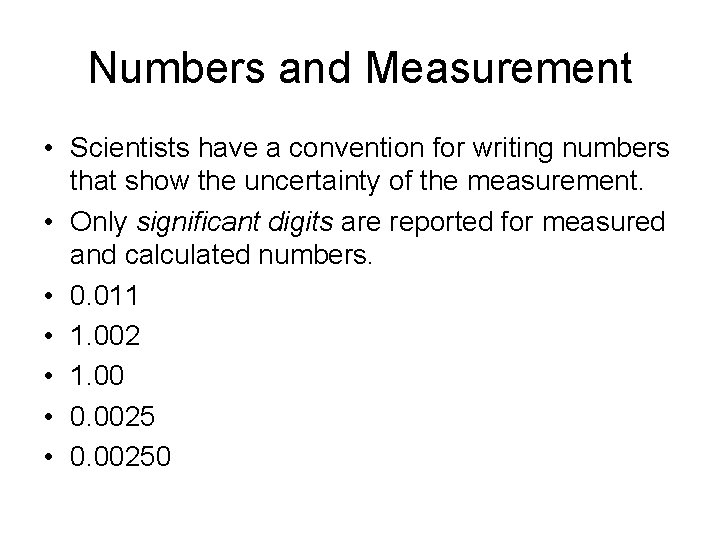
Numbers and Measurement • Scientists have a convention for writing numbers that show the uncertainty of the measurement. • Only significant digits are reported for measured and calculated numbers. • 0. 011 • 1. 002 • 1. 00 • 0. 00250
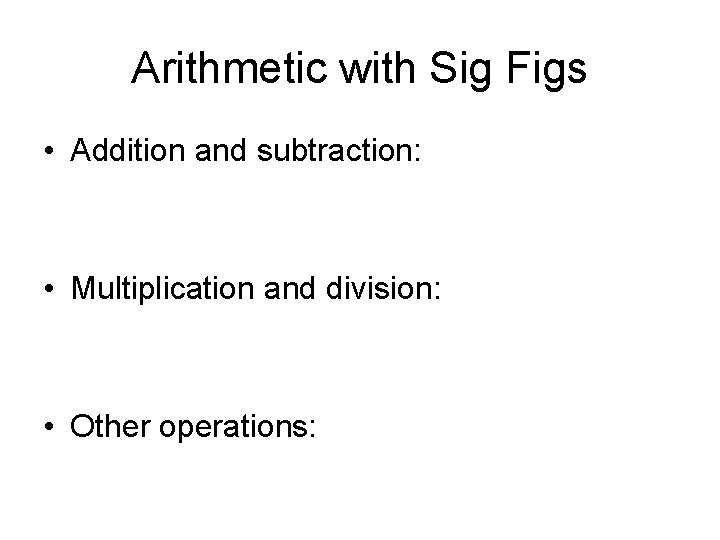
Arithmetic with Sig Figs • Addition and subtraction: • Multiplication and division: • Other operations:
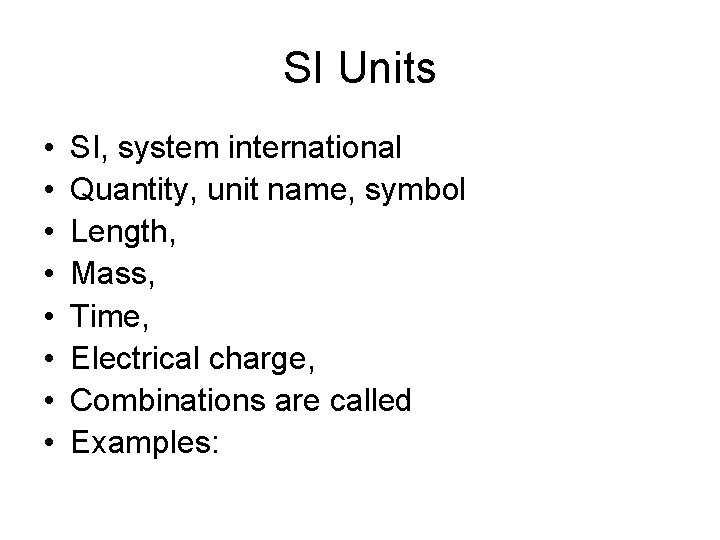
SI Units • • SI, system international Quantity, unit name, symbol Length, Mass, Time, Electrical charge, Combinations are called Examples:
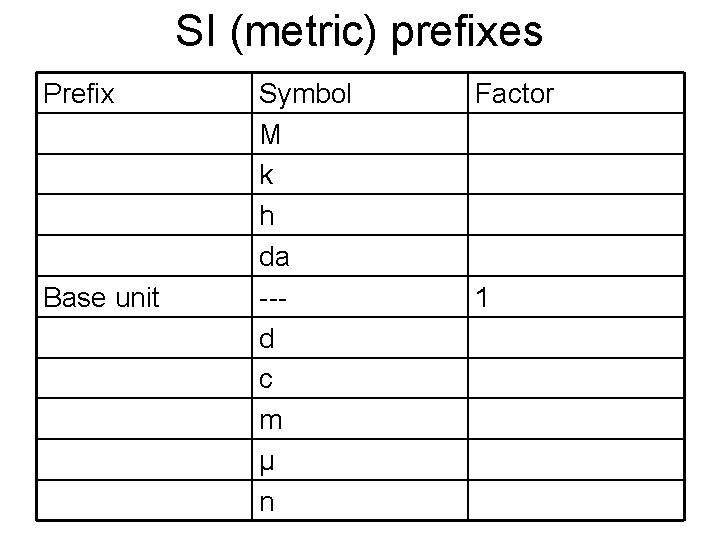
SI (metric) prefixes Prefix Base unit Symbol M k h da --d c m μ n Factor 1
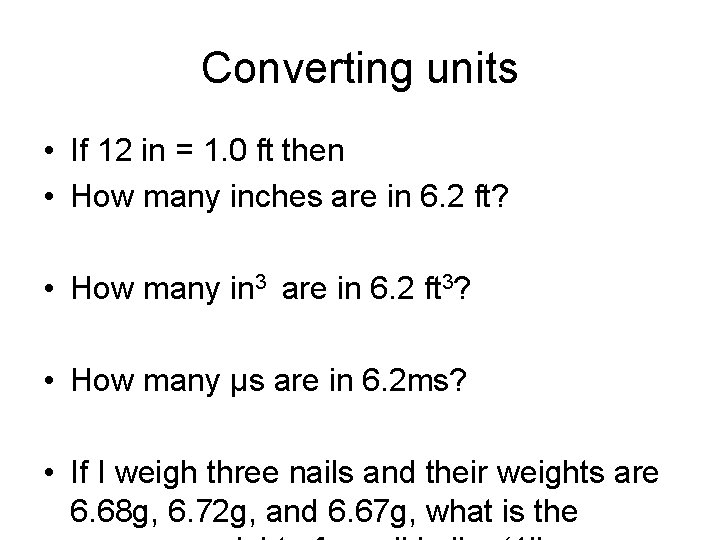
Converting units • If 12 in = 1. 0 ft then • How many inches are in 6. 2 ft? • How many in 3 are in 6. 2 ft 3? • How many μs are in 6. 2 ms? • If I weigh three nails and their weights are 6. 68 g, 6. 72 g, and 6. 67 g, what is the
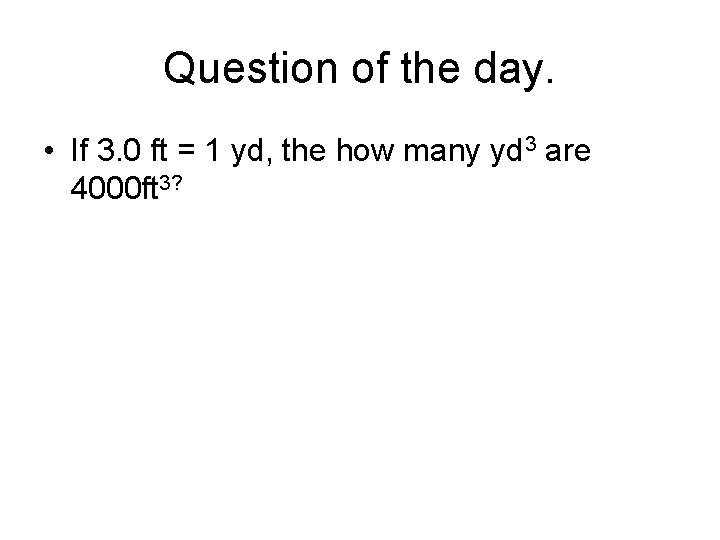
Question of the day. • If 3. 0 ft = 1 yd, the how many yd 3 are 4000 ft 3?
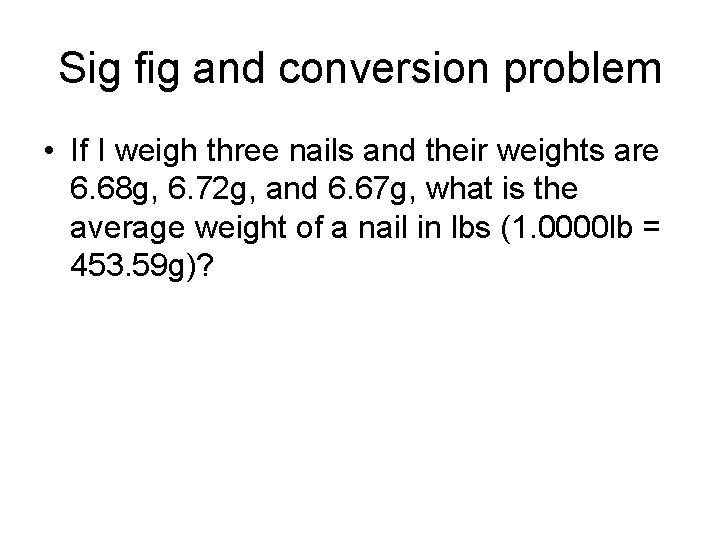
Sig fig and conversion problem • If I weigh three nails and their weights are 6. 68 g, 6. 72 g, and 6. 67 g, what is the average weight of a nail in lbs (1. 0000 lb = 453. 59 g)?
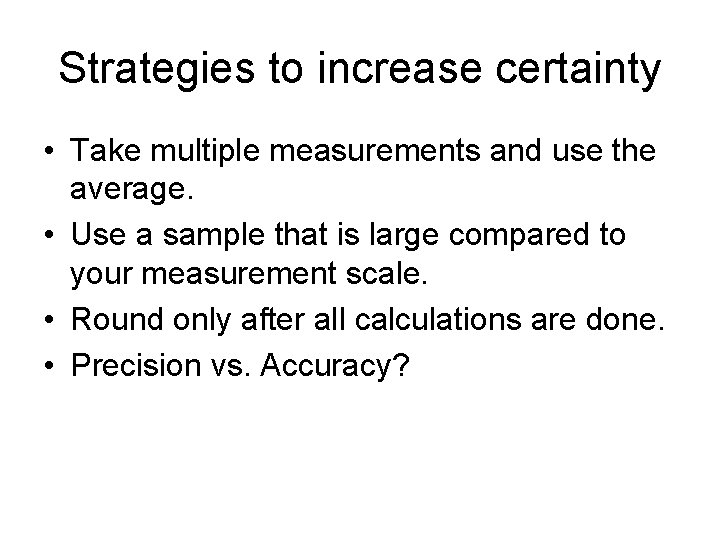
Strategies to increase certainty • Take multiple measurements and use the average. • Use a sample that is large compared to your measurement scale. • Round only after all calculations are done. • Precision vs. Accuracy?
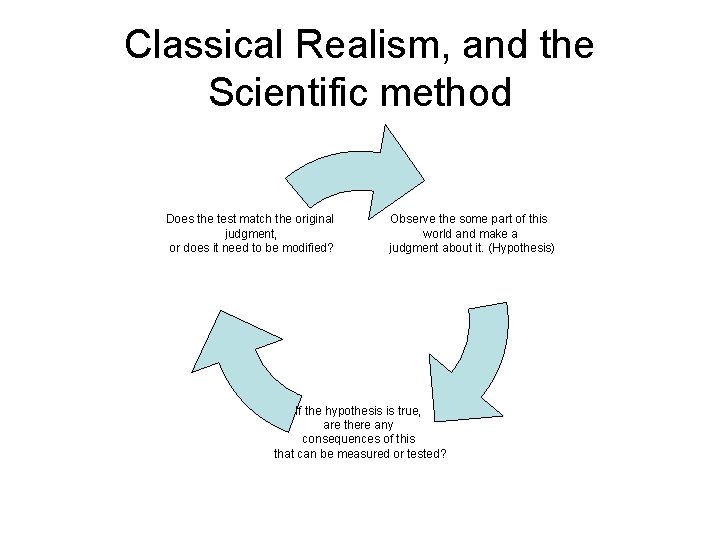
Classical Realism, and the Scientific method Does the test match the original judgment, or does it need to be modified? Observe the some part of this world and make a judgment about it. (Hypothesis) If the hypothesis is true, are there any consequences of this that can be measured or tested?
Chapter 1 Review problems • Page 27… • #’s 2, 5, 10, 11, 13, 16, 20, 27, 45
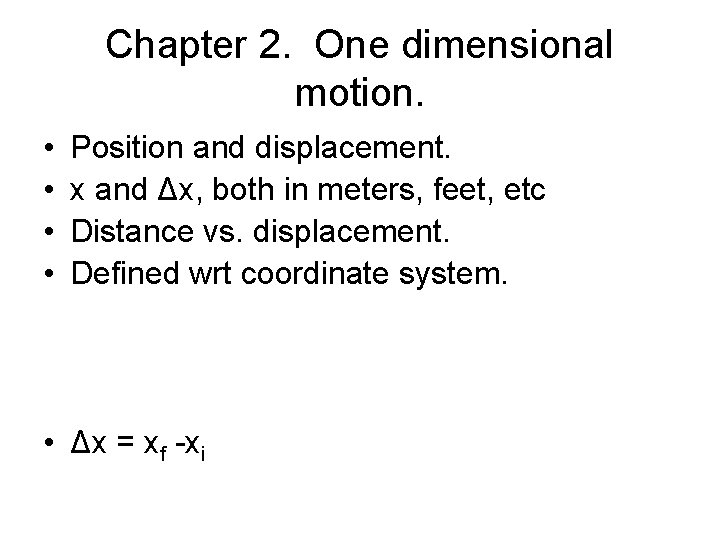
Chapter 2. One dimensional motion. • • Position and displacement. x and Δx, both in meters, feet, etc Distance vs. displacement. Defined wrt coordinate system. • Δx = xf -xi
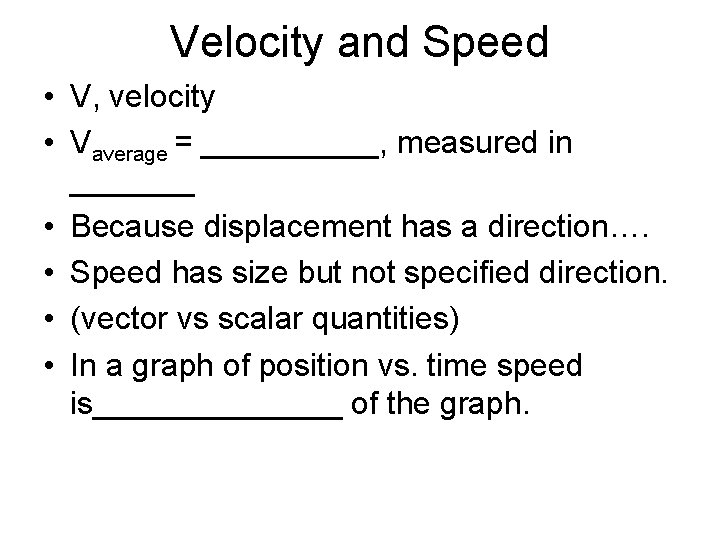
Velocity and Speed • V, velocity • Vaverage = _____, measured in _______ • Because displacement has a direction…. • Speed has size but not specified direction. • (vector vs scalar quantities) • In a graph of position vs. time speed is_______ of the graph.
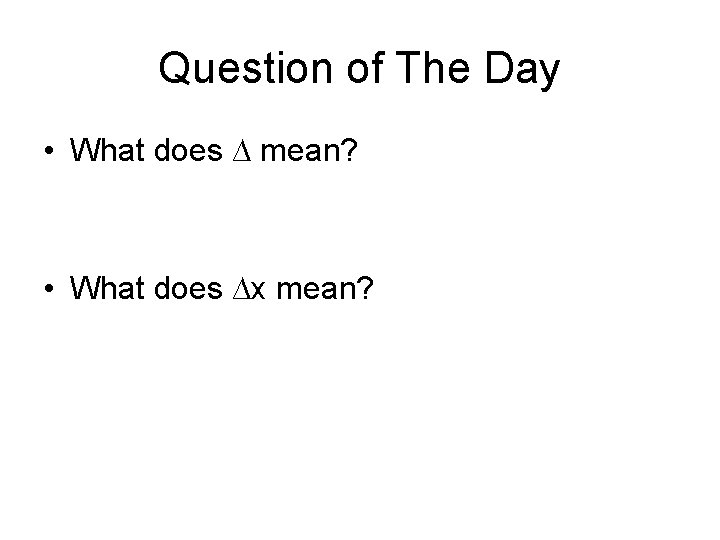
Question of The Day • What does ∆ mean? • What does ∆x mean?
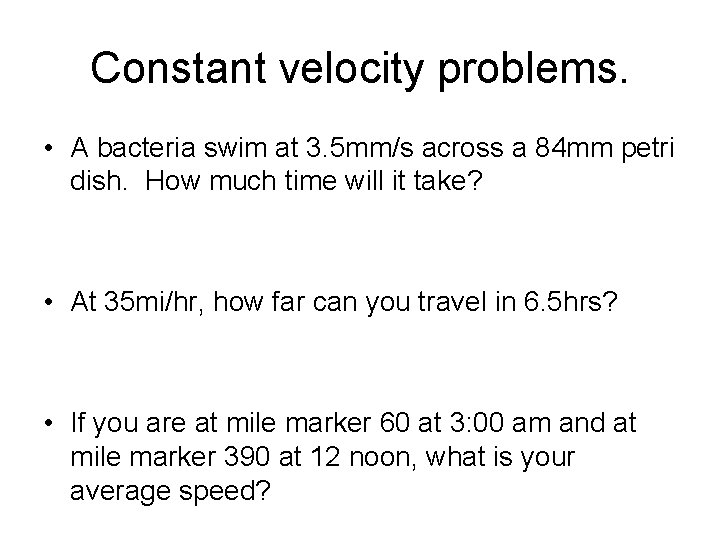
Constant velocity problems. • A bacteria swim at 3. 5 mm/s across a 84 mm petri dish. How much time will it take? • At 35 mi/hr, how far can you travel in 6. 5 hrs? • If you are at mile marker 60 at 3: 00 am and at mile marker 390 at 12 noon, what is your average speed?
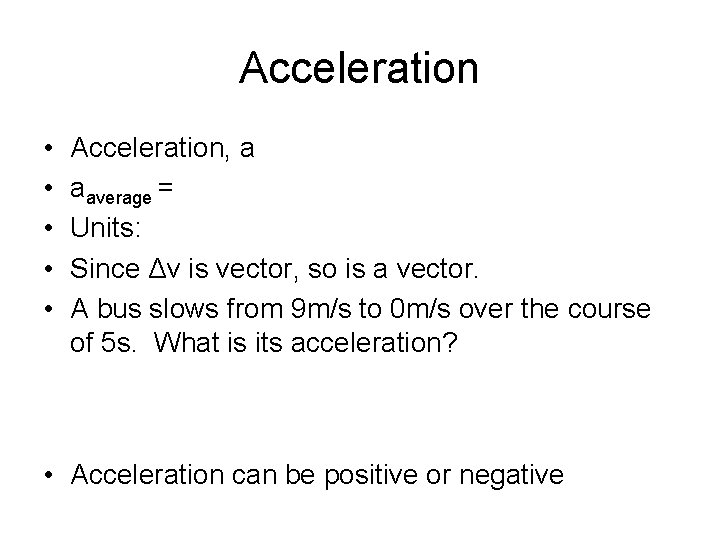
Acceleration • • • Acceleration, a aaverage = Units: Since Δv is vector, so is a vector. A bus slows from 9 m/s to 0 m/s over the course of 5 s. What is its acceleration? • Acceleration can be positive or negative
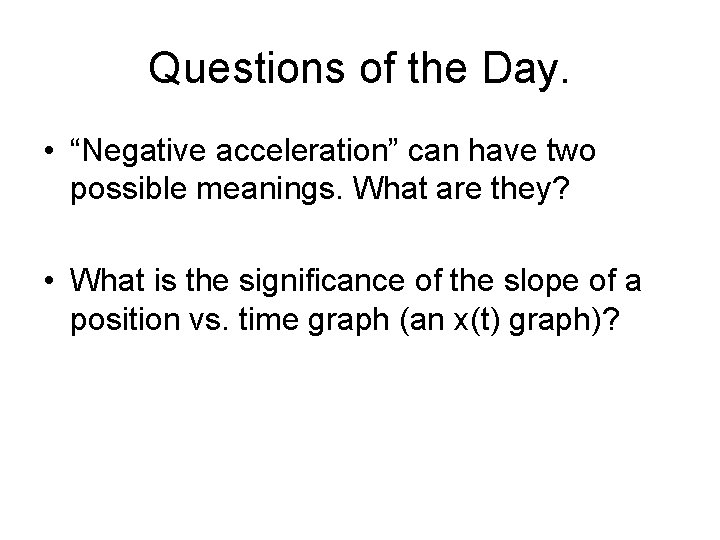
Questions of the Day. • “Negative acceleration” can have two possible meanings. What are they? • What is the significance of the slope of a position vs. time graph (an x(t) graph)?
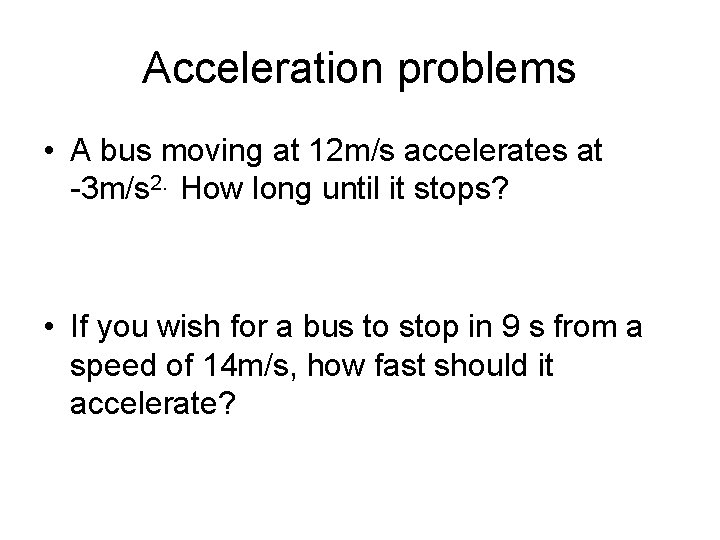
Acceleration problems • A bus moving at 12 m/s accelerates at -3 m/s 2. How long until it stops? • If you wish for a bus to stop in 9 s from a speed of 14 m/s, how fast should it accelerate?
Chapter 2 Review Problems • Page 69… 1 -6, 9, 10, 16, 19, 22, 25, 28, 29, 32, 50, 55, 60, 65
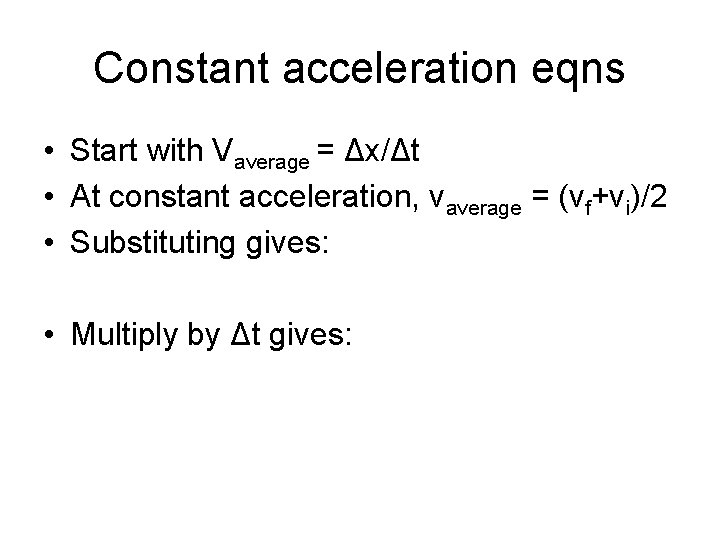
Constant acceleration eqns • Start with Vaverage = Δx/Δt • At constant acceleration, vaverage = (vf+vi)/2 • Substituting gives: • Multiply by Δt gives:
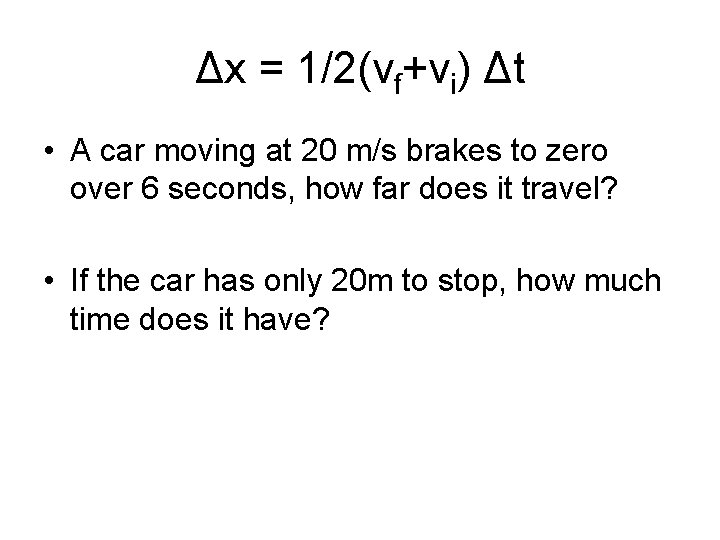
Δx = 1/2(vf+vi) Δt • A car moving at 20 m/s brakes to zero over 6 seconds, how far does it travel? • If the car has only 20 m to stop, how much time does it have?
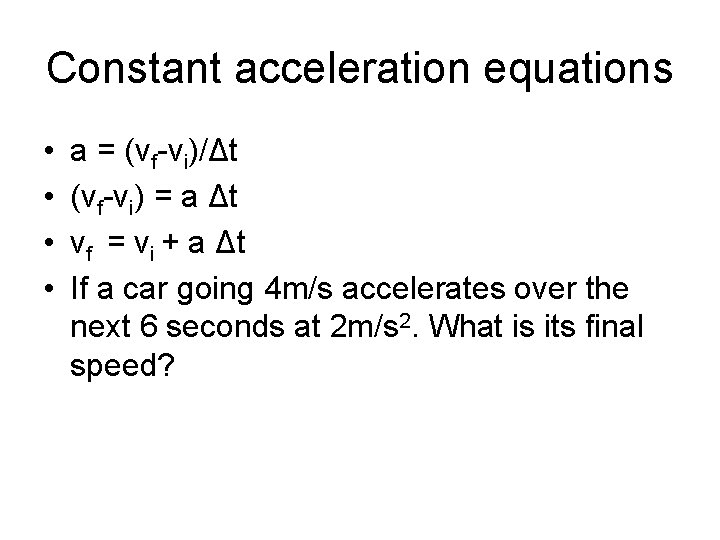
Constant acceleration equations • • a = (vf-vi)/Δt (vf-vi) = a Δt vf = vi + a Δt If a car going 4 m/s accelerates over the next 6 seconds at 2 m/s 2. What is its final speed?
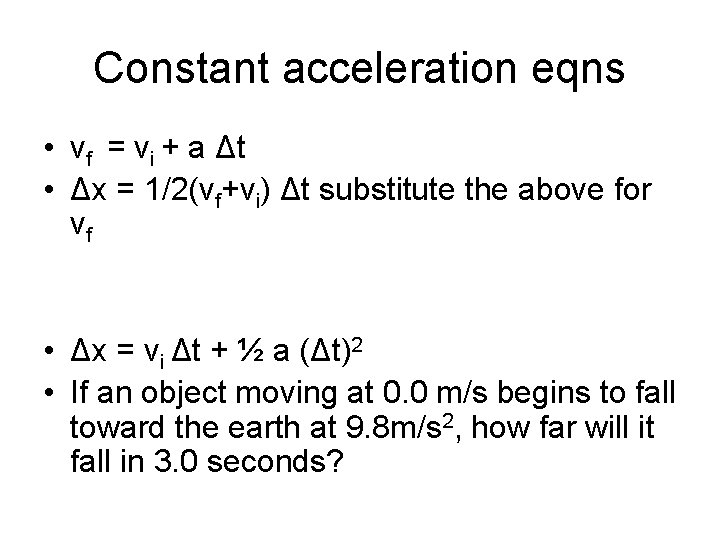
Constant acceleration eqns • vf = vi + a Δt • Δx = 1/2(vf+vi) Δt substitute the above for vf • Δx = vi Δt + ½ a (Δt)2 • If an object moving at 0. 0 m/s begins to fall toward the earth at 9. 8 m/s 2, how far will it fall in 3. 0 seconds?
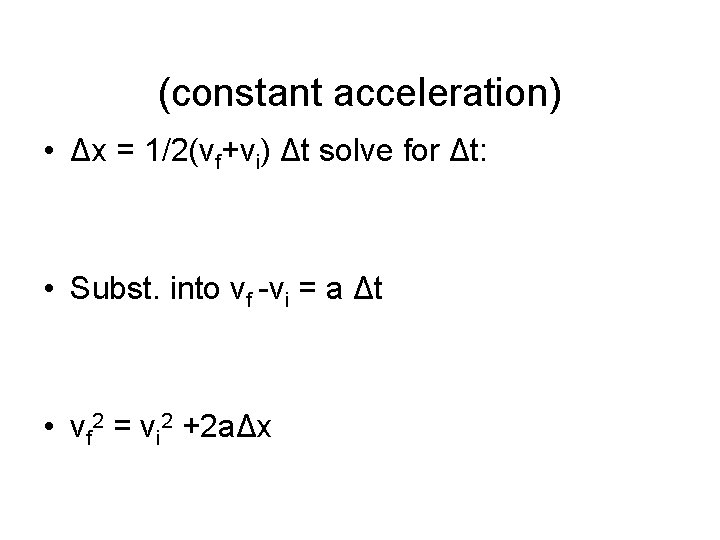
(constant acceleration) • Δx = 1/2(vf+vi) Δt solve for Δt: • Subst. into vf -vi = a Δt • vf 2 = vi 2 +2 aΔx
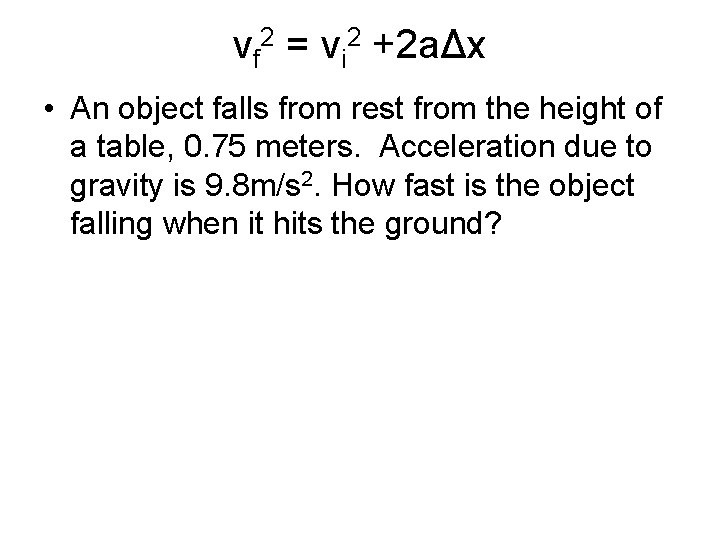
vf 2 = vi 2 +2 aΔx • An object falls from rest from the height of a table, 0. 75 meters. Acceleration due to gravity is 9. 8 m/s 2. How fast is the object falling when it hits the ground?
Question(s) of the day • What is the significance of the slope of a “velocity as a function of time” or v(t) plot?
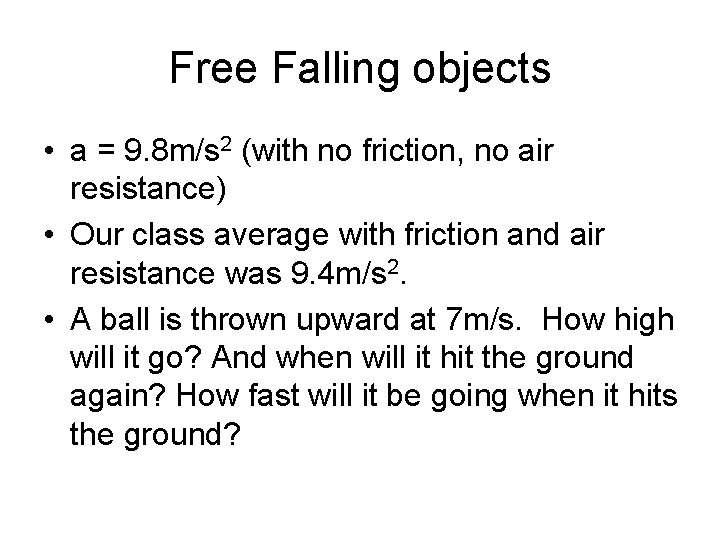
Free Falling objects • a = 9. 8 m/s 2 (with no friction, no air resistance) • Our class average with friction and air resistance was 9. 4 m/s 2. • A ball is thrown upward at 7 m/s. How high will it go? And when will it hit the ground again? How fast will it be going when it hits the ground?
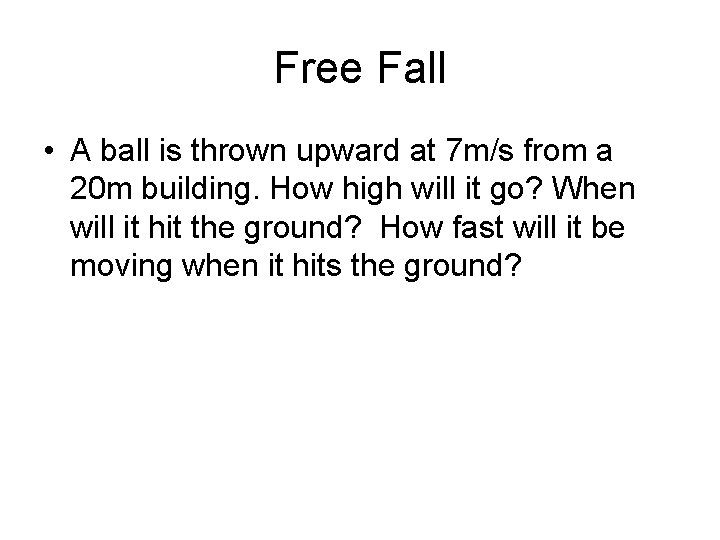
Free Fall • A ball is thrown upward at 7 m/s from a 20 m building. How high will it go? When will it hit the ground? How fast will it be moving when it hits the ground?