
Quiz Unit 1 5 Have 3 signed conversations
- Slides: 6
Quiz Unit 1 -5 Have 3 signed conversations before we start so you are thinking in ASL and not English! Question over Vocabulary from Unit 1 -5 Quiz will be 1 -15
Unit 6 Review Go over Unit 6 Vocabulary Small group I give you Favorite 3 Sport, less Favorite Sport Activities you enjoy outside of school What something you do year around, or monthly or weekly or every Monday? ? ?
Contrastive structure: Grammar Constructive structure is a grammatical aspect often used in ASL. It compares or contrasts two persons, things, or ideas. It also often functions as 'AND' as well as 'OR' in ASL sentences. When talking about these two things, the signer establishes these referents in specific spatial locations, one on the left side and one on the right of the signer which are the two points of reference. In contrastive structure, the right-handed signers usually first refers to the left and then to the right, while the left-handed signers starts in the right space, using body-shifting. When talking about two sets of siblings, it doesn't matter which brothers or sisters you start with in the left space. It can be either "# brothers and # sisters" or "# sisters and # brothers". But, once you establish the referents in their locations, you should retain the same points of reference for these referents when you point to them.
Conjunctions beyond FINISH and WRONG in American Sign Language Conjunction is a word that connect words, phrases, or clauses. An example of the conjunctions in English are: and, but, because, as, etc. ASL students may have learned a few common conjunctions "FINISH" and "WRONG" in ASL level one. Now you will learn some more conjunctions of the following closest-equivalent glosses below. WRONG - suddenly, without warning; unknowingly. conj-FINISH - then; when done; completed. conj-DO-DO - what is planned next or expected. conj-FIND - only to find out that; realize that. conj-HAPPEN/ - in a coincidence that; happened that. conj-HIT - unexpectedly; conj-ONE - something extraordinary out of "same old". (eye brows up with one) conj-SLAM-CHIN(FRUSTRATE) - to be prevented from; unfortunately turned out that. These ASL conjunctions are usually accompanied with raised eyebrows.
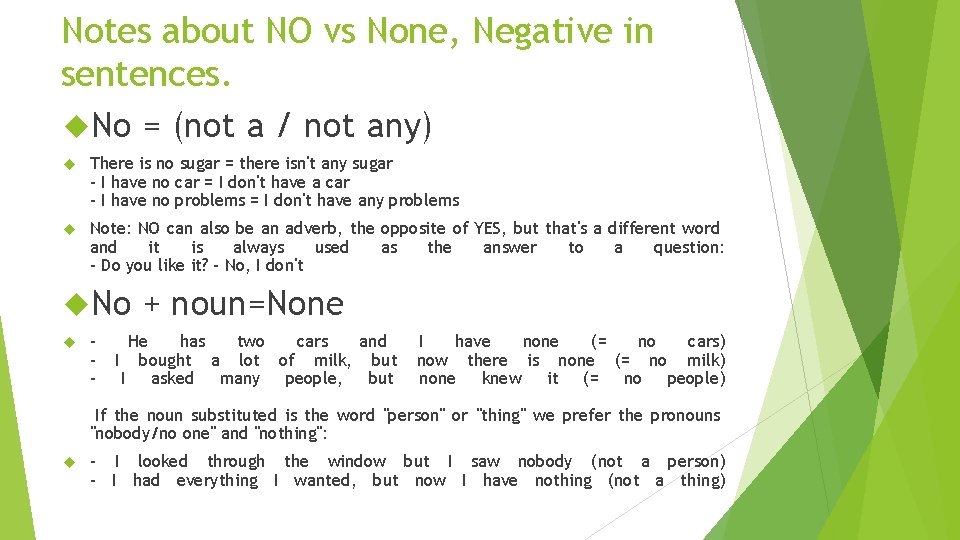
Notes about NO vs None, Negative in sentences. No = (not a / not any) There is no sugar = there isn't any sugar - I have no car = I don't have a car - I have no problems = I don't have any problems Note: NO can also be an adverb, the opposite of YES, but that's a different word and it is always used as the answer to a question: - Do you like it? - No, I don't No - + noun=None He has two cars and I bought a lot of milk, but I asked many people, but I have none (= no cars) now there is none (= no milk) none knew it (= no people) If the noun substituted is the word "person" or "thing" we prefer the pronouns "nobody/no one" and "nothing": - I looked through the window but I saw nobody (not a person) - I had everything I wanted, but now I have nothing (not a thing)
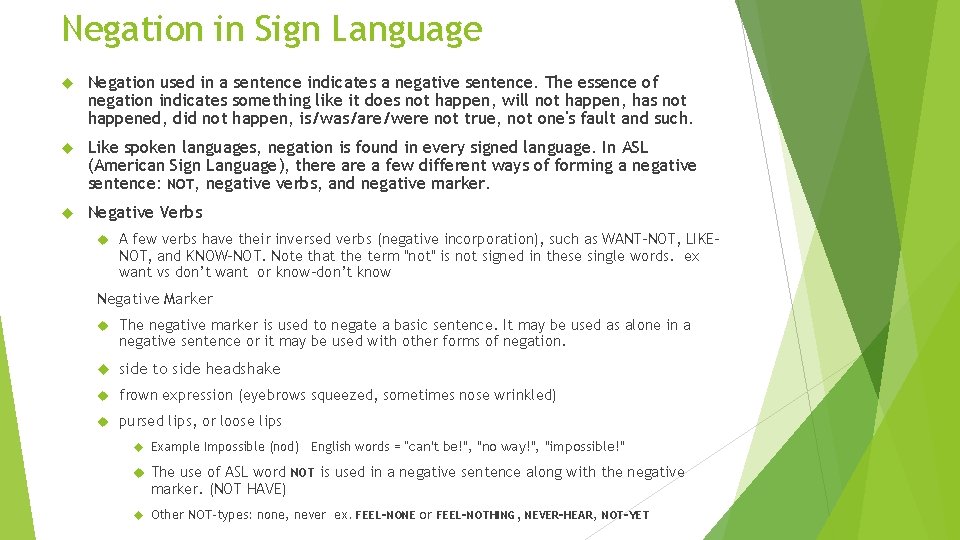
Negation in Sign Language Negation used in a sentence indicates a negative sentence. The essence of negation indicates something like it does not happen, will not happen, has not happened, did not happen, is/was/are/were not true, not one's fault and such. Like spoken languages, negation is found in every signed language. In ASL (American Sign Language), there a few different ways of forming a negative sentence: NOT, negative verbs, and negative marker. Negative Verbs A few verbs have their inversed verbs (negative incorporation), such as WANT-NOT, LIKENOT, and KNOW-NOT. Note that the term "not" is not signed in these single words. ex want vs don’t want or know-don’t know Negative Marker The negative marker is used to negate a basic sentence. It may be used as alone in a negative sentence or it may be used with other forms of negation. side to side headshake frown expression (eyebrows squeezed, sometimes nose wrinkled) pursed lips, or loose lips Example Impossible (nod) English words = "can't be!", "no way!", "impossible!" The use of ASL word NOT is used in a negative sentence along with the negative marker. (NOT HAVE) Other NOT-types: none, never ex. FEEL-NONE or FEEL-NOTHING, NEVER-HEAR , NOT-YET